行政院國家科學委員會專題研究計畫 成果報告
台灣漢語失語症聲調之研究
研究成果報告(精簡版)
計 畫 類 別 : 個別型
計 畫 編 號 : NSC 95-2411-H-004-028-
執 行 期 間 : 95 年 08 月 01 日至 96 年 07 月 31 日
執 行 單 位 : 國立政治大學語言學研究所
計 畫 主 持 人 : 萬依萍
計畫參與人員: 碩士班研究生-兼任助理:陳慧盈、廖儷雲
工讀生:張恆毅、巫春惠
報 告 附 件 : 國外研究心得報告
處 理 方 式 : 本計畫涉及專利或其他智慧財產權,2 年後可公開查詢
中 華 民 國 96 年 11 月 13 日
Taiwan Journal of Linguistics
Vol. 4.2, 85-112, 2006
85 TONE ERRORS IN NORMAL AND APHASIC SPEECH
IN MANDARIN ∗
I-Ping Wan
ABSTACT
This paper studies the distribution of tone production deficits in aphasic speech in comparison to tone errors in normal production in Mandarin and their implications. 876 aphasic tone errors and 2515 normal tone errors are analyzed and results support the following findings: First, the percentage of tone errors is similar to that of consonant errors, suggesting that the extent of tone impairment is comparable to that of consonant impairment in Mandarin aphasics. Second, contextual tone errors within clause boundaries (e.g., those involving anticipatory or perseveratory effects) reflect the aphasics’ less efficient monitoring mechanism in speech production planning and execution. Finally, the high tone is the least resistant to aphasic disturbance, suggesting that aphasic patients select the high tone as the replacing tone to some extent based on its strength of being easier to be produced and earlier to be acquired in Mandarin.
1. INTRODUCTION
The study of speech errors has long served as a window through which investigators have attempted to detect the processes and structures underlying linguistic performance. Researchers in the past decade have
∗
I am grateful to the anonymous reviewers of the TJL for their insightful comments, which lead to great improvements in the organization and argumentation of this paper. My sincere appreciation also goes to Prof. Jeri Jaeger and Prof. One-Soon Her for discussions on some of the issues. I would also like to thank my two research assistants, Li-yun Liao and Huei-ying Chen, for running the statistical program and collecting the data with me. Errors and infelicities which remain are of course my own. Research reported in this paper has been funded by NSC Grants NSC95-2411-H-004-028 and NSC94-2411-H-004-001 in Taiwan.
I-Ping Wan
86
used the patterns and constraints observed in extensive collections of errors to argue both for the validity of phonological units as processing units, and for particular phonological theories or cognitive processing models (e.g., Fromkin 1973a, Stemberger 1983, Dell 1984, Shattuck-Hufnagel 1979, Levelt 1989, Bock & Levelt 1994). There has also been much work which has attempted to determine the psychological validity of various linguistic claims ranging from the existence of certain units to the existence of particular rules. Research based on speech errors has become an area of the major interest in the study of speech production processes (e.g., Fromkin 1973a, 1980, Cutler 1982, Stemberger 1983, Berg 1987, Jaeger 2004, among others). Recently there has been an increasing interest in the study of speech production processes. A number of researchers have started to look at evidence from aphasic speech. Aphasic speakers produce a wide range of errors, which are of interest to linguistic or psycholinguistic theories, since they provide a source of evidence as to the content of information processing and serve as certain constraints in relation to normal production system. Therefore, it is generally accepted that aphasic speech constitutes an important source of data for testing the processes and structures underlying linguistic performances, and it allows us to understand the planning units and structures involved in mechanisms of language production better (e.g., Blumstein 1973, Schwartz, Saffran, Bloch & Dell 1994, Schwartz, Gagnon, Martin, Dell & Saffran 1996). Recent interest in speech errors has focused largely on the evidence such errors provide about levels of linguistic analysis and psycholinguistic models of speech production processes (e.g., Fromkin 1973a, 1980, Cutler 1982, Stemberger 1983, Berg 1987, Jaeger 2004, among others). Especially, Schwartz et. al (1994) found that aphasic errors share many characteristics with normal performance errors.
In the past decades, the majority of aphasic research has been done on English (e.g., Blumstein & Milberg 1981, Linebarger, Schwartz & Saffran 1983, Blumstein, Dworetzky & Milberg 1987, Hagoort 1993, Katz 1988, Kohn 1989, Kohn & Smith 1990, 1994, Ostrin & Tyler 1993, Prather 1994, Prather, Zurif & Love 1992, Schwartz, Saffran, Bloch & Dell 1994, Schwartz, Gagnon, Martin, Dell & Saffran 1996, Baum 1998, Caramazza, Papagno & Ruml 2000, among many others). Such studies have provided evidence for the cognitive reality of linguistic units such as phonological structures, productive phonological and morphological processes, and semantic constructs. Fewer reports in the literature, on the
Tone Deficits
87
other hand, bear on the issue of the phenomenon involving phonological production deficits in Mandarin (e.g., Naeser & Chan 1980, Packard 1986, Lin 1988, Xu 1989, Su 1991, Wu 1992, Sah 1995, C. Chen 2005).
The purpose of the present paper is to expand the discussion by including a psycholinguistic perspective and to provide more evidence with regard to the phonological organization status of Mandarin tone in speech production by examining two corpora involving naturally-occurring speech errors and aphasic speech to see if these two error corpora yield any similarity or discrepancy. Therefore, the main focus of this paper is to examine some general patterns and distribution of tone production deficits in aphasic patients in comparison to tone errors in normal speakers in Mandarin spoken in Taiwan. Questions to be explored in regard to tone in aphasic speech and speech errors will be interpreted as follows:
(1) Regarding the relationship between tone and segments, what is the ratio of errors involving tones in relation to segments in aphasic speech and speech errors in Mandarin?
(2) Looking at the type of tone errors, what is the proportion of substitution vs. addition vs. deletion errors in aphasic speech in Mandarin? Will aphasic speech data yield a similar ratio to that found in speech errors in Mandarin?
(3) Regarding contextuality in tone, what is the ratio of errors involving contextual vs. non-contextual errors in relation to tone in aphasic speech and speech-error corpora in Mandarin?
(4) Regarding the distance in contextual tone errors, how is the distance measured in syllables between target and source tones in aphasic speech in comparison to normal speech errors in Mandarin? How large is the contextual window examined in the two error corpora? (5) How symmetrical is the position of target and source tones in the
forward (anticipatory) and backward (perseverative) direction in aphasic speech in Mandarin? Will disordered speakers in Mandarin produce fewer anticipations and more perseverations or vice versa? (6) In regard to the distribution of tone, are lexical tone errors
distributed evenly or do they occur randomly in aphasic speech in Mandarin? Will aphasic patients be more likely to replace the particular tones with a certain tone?
The organization of this paper is as follows: In the following section a number of relevant studies with regard to tone production deficits in aphasic speech will be reviewed. In Section three there will be a
I-Ping Wan
88
presentation of the methodology for the data collection and analysis of aphasic errors in detail. A substantial number of examples from the errors observed in aphasic speech are provided to help validate the findings. In Section four, there will be a report of data showing the occurrence and distribution of error types in the aphasic error corpus produced by left brain-damaged patients in Mandarin produced as part of work leading to this present study. In Section five, there will be a presentation of the results and a summary of the study with reference to mechanisms in language processing.
2. LITERATURE REVIEW
In the past, given the fact that right hemisphere lateralization has demonstrated for musical, tonal, and intonational stimuli, a tonal production deficit was reported to be less severe than a segmental production deficit (e.g., Gandour, Buckingham, Dardarananda, Stawathumrong & Petty 1982, Gandour, Dardarananda, Vibulsreth & Buckingham 1982, Gandour, Dardarnanda & Vejjajiva 1985). A number of studies in relation to aphasic tone production deficits in Mandarin and Thai have found the following. With regard to the types of errors, Naeser & Chan (1980) and Packard (1986) both found the third tone, the low-falling tone, accounts for over half of tone confusions in responses to tones produced by aphasic speakers when speaking Mandarin. Gandour et al. (1988, 1992) also found some patterns involving tone deficits in Thai. Although Gandour et al. (1988) found that tone production is relatively intact in aphasic patients with unilateral left hemisphere lesions, Gandour et al. (1992) further found that correct identification of the five Thai tones produced by left hemisphere nonfluent vs. fluent aphasic speakers shows a general property in which high and rising tones are the least resistant to aphasic disturbance since these two tones are most likely to replace any other tones; in addition, confusions of low and mid tones in both fluent and nonfluent speakers were relatively high, suggesting that the low and mid tones are more likely to be replaced. Lu (1990) investigated the tone errors involved in aphasic speech for Taiwanese speakers by conducting reading, picture naming, repetition, identification of words/pictures, and discrimination tasks and suggested that contour tones are more likely to be replaced with level tones. Such an order of tonal breakdown is in agreement with
Tone Deficits
89
Hsu’s (1989) acquisition data for Taiwanese in which a hierarchical order of tone acquisition is described whereby the high and rising tones are acquired much more easily and earlier than the falling tone, followed by the low and mid tones.
Turning to the relationship between tone and segments, in Mandarin, there are around 26 consonant phones as well as 12 vowel phones in the surface representation (e.g., Wan & Jaeger 2003), but there are only four tones, plus one neutral tone. Mandarin aphasic patients may therefore be more likely to produce more segment errors due to the fact that the chance of retrieving segments is greater than that of retrieving tones. With reference to types of tone errors, it is found that naturally-occurring speech errors show a general hierarchy of error types in which substitutions outnumber additions, which in turn outnumber deletions, and this property has been found in every language for which data are available (e.g., Berg 1987, Nooteboom 1973, Wells-Jensen 1999, Wan, in press). However, Stemberger (1990) further found that additions occur more frequently than deletions in contextual speech errors, whereas deletions occur more frequently than additions in non-contextual speech errors in English. Therefore, it is important to see whether contextual influences will affect the proportion of addition and deletion errors in aphasic speech in Mandarin.
Regarding contextuality in tone errors, cross-linguistic studies of naturally-occurring speech errors have shown that the source unit influencing the production of the target unit usually occurs within the context of the utterance (Nooteboom 1973 for English, Wan to appear for Mandarin). However, evidence from the work of Buckingham and Kertesz (1976) and Buckingham (1985) has shown that contextual influences in jargon aphasic speech may cross one or more clauses. Schwartz et al. (1994) have also examined contextual influences over a large window, spanning the clause before and after the error, and each occurrence of the substituted segment in that context window was counted as a potential source for the error in the data, and this implies that contextual influences examined in naturally-occurring speech errors may not have the same contextual window as found in aphasic speech. Therefore, it would be interesting to see how large a contextual window is examined in aphasic speech in Mandarin, especially for tones and segments.
Turning to the issue of the distance measured in syllable spans in tone errors, Wan (in press) has found that in speech errors produced by
I-Ping Wan
90
normal speakers of Mandarin, segments and tones both have a bias towards an occurrence of frequency distribution of target-source pairings within one-syllable span (consonants: 66.8%; vowels: 67.4%; tones: 60%). This property suggests that most linguistic units prefer to occur in contiguous errors. However, if aphasic patients are regarded as having a less efficient monitoring mechanism in speech production planning and execution, they might yield different proportion in error types compared with the window size that normal speakers produce. Regarding directionality in tone errors, evidence from naturally-occurring tone errors in both Thai and Mandarin supports a perseverative bias, in which source units occur before the error unit in the utterance of the context (Gandour 1977, Wan, in press). Hyman & Schuh (1974) found that the universals of tone rules show a left-to-right bias, Maddieson (1978) further found a predominance of left-to-right processes in tone rules among Chinese languages, except for Wu languages. Similarly, M. Chen (2000) and Yip (2002) also found the same direction in tone sandhi rules in many Chinese languages. Therefore, there might be a built-in device for the perseverative bias in speech production mechanisms. However, Schwartz et al. (1994) and Dell et al. (1997) further found that less practiced and disordered speakers produce fewer anticipations and more perseverations in English than more fluent speakers. Therefore, if tones act as an important device in terms of the production planning unit, it would be interesting to see how aphasic patients will rely on such a device in their speech and how the balance of its use lies in relation to the source and error units.
Finally, turning to the issue of the distribution of tone errors, aphasic patients may or may not be more likely to replace particular tones with a certain tone given the fact that Mandarin has four lexical tones plus one neutral tone. However, there is agreement in the studies on naturally-occurring tone errors found in Gandour (1977) and Wan (in press) in that the preponderance of tone substitution errors involves the falling tone in Thai and in Mandarin. A number of studies from tone inventories, acoustic measurements, acquisition data, production and perception studies have referred to the important status of the falling tone in tone languages (e.g., Ohala 1972, Ohala & Ewan 1973, Sundberg 1973, Hombert 1975, Li & Thompson 1976, Zhang 2000, 2001).
Tone Deficits
91
3. METHODOLOGY AND SUBJECTS
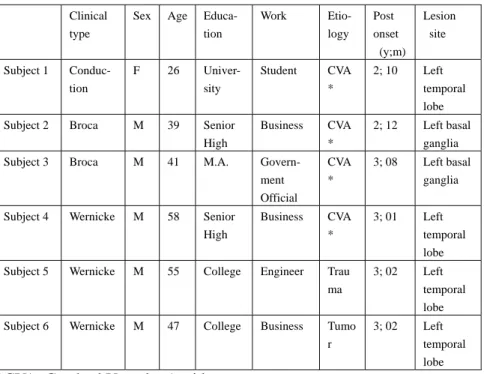
The current study is based on excerpts of aphasic errors produced by six aphasic patients pooled for the purposes of statistical analysis from the following three diagnostic aphasic groups, Broca’s, Wernicke’s, and conduction aphasics. Each group is distinguished by clinical characteristics and accompanying pathology. The diagnosis and classification of the aphasic groups was based on the evaluation of the Chinese version of the Boston Diagnostic Aphasia Examination (BDAE). Each diagnosis had been substantiated by a CT scan for all six aphasics as part of their standard clinical care, and arrangements with regard to the grouping were made by the therapists of the Department of Physical Medicine and Rehabilitation, National Taiwan University Hospital. It can be suggested that the subcategories of such groups are necessary to check the performance of all six aphasic patients individually since any production deficits among left brain-damaged patients could be attributed to a certain type of aphasic syndrome. However, few single-case or patient-group studies have been reported with regard to the specific findings on tone production in aphasia (e.g., Gandour et al. 1988), and the main purpose of this paper is to look at general error distributions involving tones among all six aphasic patients. Issues as to whether different aphasic syndromes will produce different types of tone errors will not be the main focus under this study.
The data contains 876 aphasic errors collected by the author’s research team from aphasic speakers of Mandarin between 2002 and 2005. The aphasic error data are drawn from interview questions with aphasic patients. The questions were produced during the course of open-ended conversations regarding the patients’ illness, work, weather, hobbies, family, friends, etc. These patients made occasional segmental and suprasegmental errors during their conversational speech with the therapists.
Each patient was given the interview individually in a moderately quiet room, and the spontaneous speech of each patient for about 30 minutes. The raw data used in this study was selected from the tape-recorded interviews. For each potential error, a guess was made at the intended target independently by two assistants and the author. We then compared our notes, and inconsistencies were resolved by negotiation. If the potential error in the patient’s utterance was identified as an error whose target words could clearly be determined by the
I-Ping Wan
92
surrounding context, the error was considered to have been identified. Otherwise, no target was assumed. This procedure follows the aphasic study in Schwartz et al. (1994). The error utterances were transcribed using the International Phonetic Alphabet for more precise identification.
According to Blumstein (1973), articulatory failure has nothing to do with the damage to the articulatory apparatus per se, and is the result of difficulties in producing speech sounds precisely. Therefore, dysarthric speech has been omitted from this study as the characteristic of speech produced under a condition of the dysarthria is related to damage to the articulatory apparatus, which converts the string of phonetic specifications into motor programs to be sent to the articulators for speaking, and speech output from such patients would cause the phenomena of phonetic disintegration.
There was special emphasis on phonological errors in the recordings of the utterances. In the study, some problems arose in making decisions as to which errors were contextual and non-contextual. This indecision may have contributed to have the low rate of contextual errors observed. Since the conversations between the aphasic patients and therapists lasted for 30 minutes, the total length of each transcription is less than ten pages. If an error is made, it was not difficult for the assistants to check the whole transcription to see whether or not the source unit(s) occurs before or after the error unit within an utterance or across the utterance. Therefore, such an error was classified as ‘non-contextual’ when no source identical to the error unit(s) occurred in the utterance. One might argue that such a strict restriction should not be applied to aphasic speech when coding patients’ errors since there may not be any reason to predict an anticipatory or perseverative effect within utterance in their speech. However, since evidence from speech errors in normal production clearly limits the contextual influences within clauses in a strictly restricted narrow window, nearly within seven-syllable spans, it is more symmetrical to make an evaluation based on the same criteria and see how large a size of window aphasic patients can reach, spanning the source-error pairing before and after clauses. If the source and error unit(s) occurs across clauses, there might be a possibility to classify the utterance as a potential contextual error.
The spontaneous speech collected from the six aphasic patients was transcribed using IPA fonts. The frequencies tabulated were based on the actual pronunciations produced by the patients and not the target tones. In this study, aphasic errors were collected from six patients whose brain
Tone Deficits
93
damage resulted from the presence of trauma, vascular disease, or tumors. Table 1 shows a summary of the significant features of each patient’s case.
Table 1: Patient summary Clinical
type
Sex Age Educa- tion Work Etio- logy Post onset (y;m) Lesion site Subject 1 Conduc- tion F 26 Univer-sity Student CVA * 2; 10 Left temporal lobe Subject 2 Broca M 39 Senior
High
Business CVA *
2; 12 Left basal ganglia Subject 3 Broca M 41 M.A. Govern-
ment Official CVA * 3; 08 Left basal ganglia
Subject 4 Wernicke M 58 Senior High Business CVA * 3; 01 Left temporal lobe Subject 5 Wernicke M 55 College Engineer Trau
ma
3; 02 Left temporal lobe Subject 6 Wernicke M 47 College Business Tumo
r
3; 02 Left temporal lobe *CVA: Cerebral Vascular Accident
The phonological errors which occurred in aphasic speech in Mandarin are classified as follows: First, the error was classified as ‘non-contextual’ when there was no source identical to the error unit(s) occurring in the utterance. In each case, the unit(s) which the speaker intended to produce is classified as the target unit(s), the unit(s) which was the interfering factor in the error is classified as the source unit(s), and the unit(s) in the utterance production which violated the speaker’s intentions is classified as the error. Second, the errors were classified as certain types of errors based on the phonological units involved in the utterance such as substitution, addition, and deletion. Third, the errors were classified by the directionality based on the linear relationship between the source and error. These classifications are provided in the following table, and one example of each sub-category will be provided.
I-Ping Wan
94
Table 2: Phonological errors in aphasic speech
Aphasic errors: Contextual and non-contextual errors (N=876)
Substitutions
1. C: tjw55-to55 ko55-ty51Æ tjw55-ko55 ko55-ty51 ‘join-communicate work-tool’ ‘meaningless’ ‘transportation’
2. V: tsaj35-n35 Æ tsaj35-na35 ‘talent’ ‘talent- ability’ ‘meaningless’
3. T: jow51 ow21 Æ jow51 ow51 ‘right hand’ ‘right hand’ ‘meaningless’
4. C: kw35-to55 Æ pw35-to55 ‘junior high’ ‘nation-center’ ‘meaningless’
5. V: su51-tjw55 Æ s51-tjw55 ‘plastics’ ‘plastics’ ‘meaningless’
6. T: jow51 ow21 Æ jow51 ow55 ‘right hand’ ‘right hand’ ‘meaningless’
Additions
7. C: tjw21-ta 51-t55 Æ tjw21 tw51 t55 ‘bicycle’ ‘foot-peddle-car’ ‘meaningless’
8. V: kow21-u 51 Æ kow21 w51 ‘speech errors’ ‘lips-errors’ ‘meaningless’
9. T: twej55 t Æ twej55 t55 ‘push forward’ ‘push particle’ ‘meaningless’
10. C. fa 21-u51 pu51 Æ f21-u51 pu51 ‘Ministry of Justice’
‘law-affairs department’ ‘meaningless’
11. V. i 55-fu Æ ja55-fu ‘clothes’ ‘clothes-clothes’ ‘meaningless’
12. T. tsw51 kw51 l Æ tsw51 kw51 l35 ‘had missed (it)’ ‘miss PAST COMP’ ‘meaningless’
Deletions
13. C: i51-li51 Æ i51 i51 ‘willpower’ ‘firm-power’ ‘meaningless’
14. V: tjow55 tjn55 Æ tjow55 t in55 ‘autumn’ ‘autumn day’ ‘meaningless’
15. T: kw35-min35 Æ kw35 min ‘citizen’ ‘nation-citizen’ ‘meaningless’
Tone Deficits
95
16. C: tjow51-xu51 t55 Æ jow51-xu51 t55 ‘ambulance’ ‘rescue-protect vehicle’ ‘meaningless’
17. V: mej35 t 51 Æ m i35 t 51 ‘nonsense’ ‘no LINK matter’ ‘meaningless’
18. T: tja55-ti35 Æ tja55 ti ‘family’ ‘home-courtyard’ ‘meaningless’
Directionalities
Anticipation
19. C: taj51-t Æ taj51-t ‘to wear’ ‘wear-particle’ ‘meaningless’
20. V: t55-ta21 Æ t55-ta21 ‘lighthouse’ ‘light-tower’ ‘meaningless’
21. T: 35-xwa51 Æ 51-xwa51 ‘truth’ ‘true-words’ ‘meaningless’
Perseveration
22. C: fa55 tu55 Æ fa55 fu55 ‘to send out’ ‘send out’ ‘meaningless’
23. V: mej35- k35 laj35-n55Æ mej35 k35 lej35 n55 ‘Meg Ryan’ ‘Meg Ryan’ ‘meaningless’
24. T: ta55 tow35 Æ ta55 tow55 ‘his head’ ‘he head’ ‘meaningless’
Anticipation/perseveration
25. C: taj35 pej21 taj35 nan35Æ taj35 tej21 taj35 nan35 ‘Taipei, Tainan’ ‘Tai north Tai south’ ‘meaningless’
26. V: tsaj35 nn35 kan51Ætsaj35 nan35 kan51 ‘only can be seen’ ‘only able see’ ‘meaningless’
27. T: mej35 t35 55-lj35 Æ mej35 t35 35-lj35 ‘not negotiable’ ‘no able consult-measure’ ‘meaningless’
Exchange
28. C: ti55-i21 Æ i55 ti21 ‘regain consciousness’
‘clear awake’ ‘meaningless’
29. V: ti55 to51 Æ to55 ti51 ‘understand’ ‘hear understand’ ‘meaningless’
30. T: xn21 nan35 Æ xn35 nan21 ‘very difficult’
I-Ping Wan
96
Examples (1-6) are of substitution errors involving consonants, vowels, and tones. Example (1) shows a contextual error in which the source consonant [k] from the syllable [ko] is substituted for the target consonant [t]. Example (2) shows a contextual error in which the source vowel [a] from the syllable [tsaj] is substituted for the target vowel []. Example (3) shows a contextual error in which the source tone [51] is substituted for the target tone [21]. Example (4) shows a non-contextual error in which the error consonant [p] is substituted for the target consonant [k], and there is no potential source consonant [p] in the utterance context. Example (5) shows a non-contextual error in which the error vowel [] is substituted for the target vowel [u], and there is no potential source vowel [] in the utterance context. Example (6) shows a non-contextual error in which the error tone [51] is substituted for the target tone [21].
Examples (7-12) are of addition errors involving consonants, vowels, and tones. Example (7) shows a contextual error in which the source consonant [w] in the final coda position is added after the vowel [a], and the vowel [a] is then phonetically realized as its correct phonetic variant []. Example (8) shows a contextual error in which the source vowel [o] is added after the target vowel [u], and since Mandarin does not allow two vowels in sequences in a syllable, the high vocalic vowel [u] changes to the glide [w], and the mid vowel [o] is then phonetically realized as its correct phonetic variant []1. Example (9) shows a contextual error in which the source tone [55] is added into the tone-less syllable [t]. Example (10) shows a non-contextual error in which the error consonant [] in the final coda position is added after the vowel [a], and the vowel [a] changes to its correct phonetic variant []. Note that there is no potential consonant [] in the utterance context. Example (11) shows a non-contextual error in which the error vowel [a] is added after the target vowel [i], and since there is no allowance for two vowels in sequences in Mandarin, the high vocalic vowel [i] changes to its correct phonetic variant [j]. Note that there is no potential source vowel [a] in the utterance context. Example (12) shows a non-contextual error in which the error tone [35] is added into the syllable [l], and there is no potential source tone [35] in the utterance context.
1
Additional discussion on vowel alternations on Mandarin vowels is provided in Wan & Jaeger (2003).
Tone Deficits
97
Examples (13-18) are of deletion errors containing consonants, vowels, and tones. Example (13) is a contextual error in which the consonant [l] is deleted before the vowel [i] causing the resulting form to be more similar to the preceding syllable. Example (14) is a contextual error in which the vowel [] is deleted from the syllable [tjn]. According to Wan & Jaeger (2003), since the vowels [o] and [] belong to the same phoneme, this error may thus be categorized as a contextual error and due to dissmilatory effect, the resulting form drops the same vowel unit. Example (15) is a contextual error in which the tone [35] is deleted from the syllable [min] due to dissimilatory effect. Example (16) is a non-contextual error in which the target consonant [t] is deleted from the syllable [tjow], noting that there is no potential consonant [t] in the utterance context. Example (17) is a non-contextual error in which the target vowel [e] is deleted from the syllable [mej], and since there is no vocalic vowel when the vowel [e] is dropped, the glide [j] is then phonetically realized as its correct phonetic variant [i]. Note that there is no vowel [e] in the utterance context. Example (18) is a non-contextual error in which the target [35] is deleted from the syllable [ti], noting that there is no tone [35] in the utterance context.
Examples (19-30) are of contextual errors in which there is a potential source in the context of the utterance. Examples (19-21) are of anticipation errors involving consonants, vowels, and tones. In example (19), the initial source consonant [t] is anticipated and substituted for the target consonant [t]. In Example (20), the source vowel [a] is anticipated and substituted for the target vowel []. In Example (21), the source tone is [51] is anticipated and substituted for the target tone [35]. Examples (22-24) are of perseveration errors involving consonants, vowels, and tones. In Example (22), the source consonant [f] is perseverated and substituted for the target consonant [t]. In Example (23), the source vowel [e] is perseverated and substituted for the target vowel [a]. In Example (24), the source tone unit [55] is perseverated and substituted for the target tone unit [35]. Examples (25-27) are of anticipation and perseveration errors since there are both anticipation and perseveration sources at an equal distance from the target. If there is more than one potential source for an error, the case will be resolved in favor of the closest source. In Example (25), the source consonant [t] is either from the preceding or the following syllables [taj] and substituted for the target consonant [p]. In Example (26), the source vowel [a] can be from either the preceding syllable [tsaj] or the following syllable
I-Ping Wan
98
[kan] and is substituted for the target vowel []. In Example (27), all three but one syllables carry the tone [35], and the source tone [35] from either the preceding or the following syllable is substituted for the target tone [55]. Examples (28-30) are of exchange errors involving consonants, vowels and tones. In Example (28), the two consonants [t] and [] exchange their positions. In Example (29), the two vowels [i] and [o] exchange their position. In Example (30), the two tone units [21] and [35] exchange their positions.
4. FINDINGS
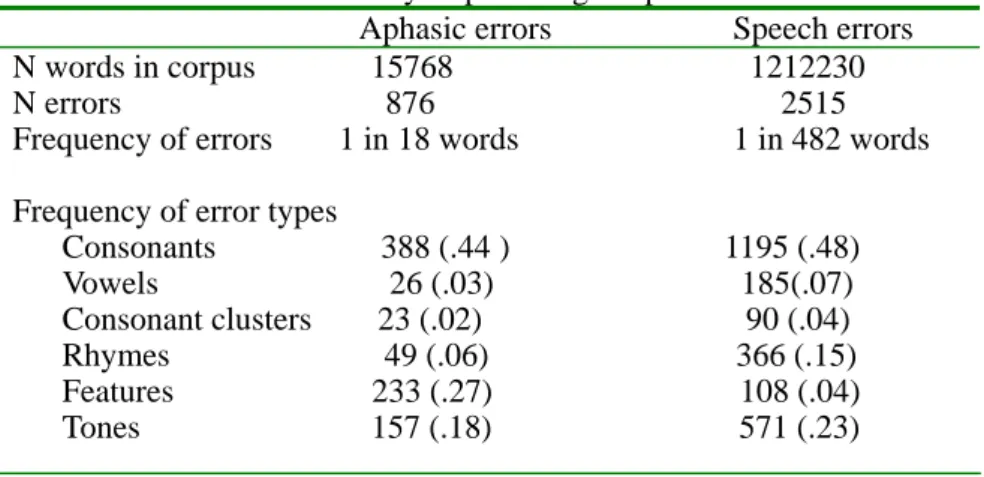
The first finding is with regard to a comparison of the frequency distribution of tones and segments observed in the aphasic speech. The distribution of tone and segmental errors involving consonants and vowels in aphasic speech is based on total row scores of 876errors. The rate and distribution of the phonological units occurring in the aphasic errors as compared to normal production errors is provided in Table 3.
Table 3: Error summary of phonological production errors Aphasic errors Speech errors N words in corpus 15768 1212230 N errors 876 2515 Frequency of errors 1 in 18 words 1 in 482 words Frequency of error types Consonants 388 (.44 ) 1195 (.48) Vowels 26 (.03) 185(.07) Consonant clusters 23 (.02) 90 (.04) Rhymes 49 (.06) 366 (.15) Features 233 (.27) 108 (.04) Tones 157 (.18) 571 (.23)
Tone Deficits
99
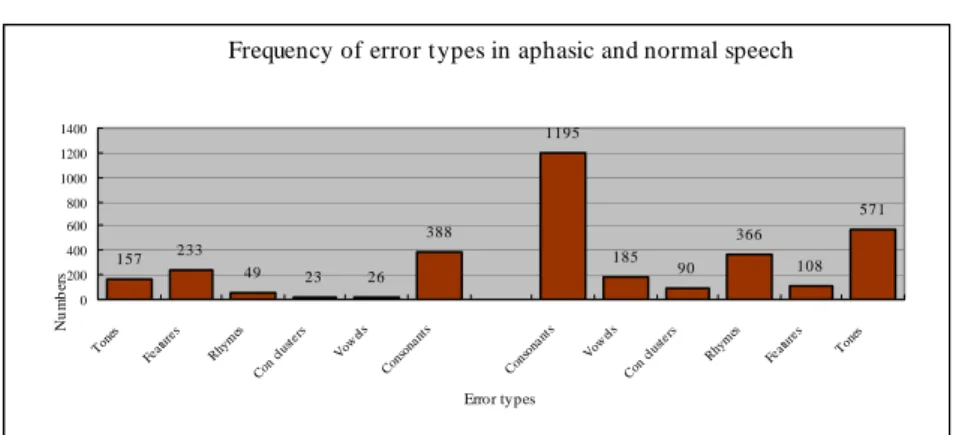
Frequency of error types in aphasic and normal speech
157 233 49 23 26 388 1195 185 90 366 108 571 0 200 400 600 800 1000 1200 1400 Tone s Feat ures Rhym es Con clus ters Vowe ls Con sona nts Cons onan ts Vowe ls Con clust ers Rhy mes Feat ures Tone s Error types Nu m b er s
Figure 1: Frequency of error types in aphasic and normal speech
In Table 3 and Figure 1, it can be seen that the rate of error reaches to 18%, suggesting that aphasic patients tend to produce an error per 18 words in Mandarin. This is a close correspondence to the error rates found by Schwartz et al. (1994). Schwartz et al. (1994) in their study of aphasic speech in English found that aphasic patients in English tend to produce an error per 15 words. In Table 3, consonantal errors comprise the significantly highest proportion of the major error types. Feature errors also constitute a remarkably high proportion in the corpus, and the replacement of the positive or negative value on the feature [aspiration] from a segment in aphasic speech predominates. Tone errors in aphasic speech occur quite frequently. The distribution of tone errors will be the central focus of this study in a comparison with segmental (consonant and vowel) errors.
Chi-square tests were then performed to compare the error distribution of tones and segments containing consonants and vowels in aphasic speech. The results yielded a highly significant difference among consonantal, vowel, and tone errors in aphasic speech (χ2 (5) = 394.252,
p < .01). The aphasic patients show a proportion of consonantal errors
which is significantly more common than tone errors, which again significantly outnumber vowel errors. This finding in Mandarin may confirm the study of Gandour et al. (1988) in which tones and vowels are more resistant to disruption in aphasia than consonants.
I-Ping Wan
100
The next finding is with regard to the distribution of tone errors sub-categorized by substitution, addition, and omission. Data to be discussed involve contextual and non-contextual errors.
Table 4: Error types for tone errors
Units Tones Total Error types Substitution Addition Omission Aphasia 150 (.96) 5 (.03) 2 (.01) 157 Speech errors 556 (.97) 11 (.02) 4 (.01) 571
It can be clearly seen that in tone errors, substitutions are much more common than any other type of error. The result of Chi-square tests showed that aphasic patients and normal speakers show no difference in the production of substitution over addition errors (χ2 (1) = 0.907, p = .341). This may be related to the internal structure of tonal construct. Since speech errors nearly always result in a possible unit in a language, not all sequences of tone would allow replacement such that a real Mandarin tone would result. So far there has yet to have been enough evidence reporting that aphasic speakers would produce illegal phonetic forms in Mandarin so it is reasonable to believe that Mandarin aphasic patients produce tone substitution errors.
The next finding is with regard to the distribution of segmental vs. tone errors sub-categorized as contextual and non-contextual errors in aphasic speech. In speech errors occurring in spontaneous speech cross-linguistically, it is more likely to find the source and target units occurring in the immediate vicinity (Nooteboom 1973). The distinction between contextual and non-contextual errors is based on the presence or absence of identical segments in the target unit, and a source unit occurring in close proximity to the target is suspected to be the source of the error. Wan (in press) has found that in normal production, a greater proportion of errors occur in the one-syllable distance between the source and target in speech error and such unit involves segmental-size units and larger units including consonant clusters, rhymes and whole syllables as well as suprasegmental units containing tone. The distribution of contextual and non-contextual aphasic errors based on total scores of 388, 26, and 157 errors for consonants, vowels, and tones respectively is seen in Table 5.
Tone Deficits
101
Table 5: Contextual influences
Aphasic speech (N=571) Speech errors (N=1951) Contextual Consonant 51 (.09) Vowel 5 (.01) Tone 33 (.06) Total 89 (.16) Non-contextual 337 (.59) 21 (.03) 124 (.22) 482 (.84) Contextual 1135 (.58) 176 (.09) 542 (.28) 1853 (.95) Non-contextual 60 (.03) 9 (.01) 29 (.01) 98 (.05) To determine whether the performance of the left brain-damaged aphasic patients differed significantly from each other with regard to contextual influences on tones, Chi-square tests were done to compare the frequency distribution of contextual vs. non-contextual errors within tones. Results of the Chi-square tests showed a highly significant difference between contextual and non-contextual tone errors in aphasic speech, indicating that the source and target tones are less likely to occur in proximity in aphasic speech (χ2 (1) = 1656.484, p < .01). In general, aphasic patients are less likely to produce contextual errors or with an obvious source in the immediate vicinity. In speech errors, the target and source tones are more likely to occur within clauses in that 1853 (95%) cases show target-source pairings occurring in a fairly narrow window, and there are only 98 (5%) cases which do not involve a potential source in the context of utterance. On the contrary, it can be seen clearly that only 89 (16%) cases involve a potential source unit in the context of the utterance whereas with a total of 482 (84%) errors in which the phonological unit spoken in the error does not otherwise occur in the utterance (i.e., there is no source element), suggesting that the majority of aphasic errors are not caused by potential sources within clauses.
When contextual influences have been explored, the finding is then influenced by how large a window one applies to be used to count as contextual tone errors in aphasic speech. Regarding the distance in contextual tone errors, cross-linguistic studies have found that in speech errors produced by normal speakers, segments and suprasegmentals both have a bias towards an occurrence of frequency distribution of source-target pairings within a one-syllable span and the distance in a window size between source and target does not generally exceed seven syllables (Noteboom 1973, Cohen 1973, Wan to appear).
I-Ping Wan
102
Table 6: Distribution of contextual errors as a distance of syllable span between source and target/error
Units Tones Total Syllable spans 1 2 3 4 5 6 7 Aphasia 26 (.79) 6 (.18) 1 (.03) 0 0 0 0 33
Speech errors 324 (.60) 153 (.28) 42 (.07) 21(.04) 2 (.01) 0 0 542
In Table 6, it is shown that in the two error corpora, tone errors are not distributed evenly in terms of a function of the distance between source and target. More errors occur in one-syllable spans than in other syllable spans (aphasic speech: 79%; normal speech: 60%). The overall distributions of tone errors as a function of the distance between source and target in one/two/three syllable span(s) do not show any significant difference in the two error corpora (χ2 (2) = 3.705, p = .157), suggesting that aphasic patients may have a short memory span in the generation of utterances. However, tone errors in normal production with a span of one to five syllables show target-source pairs occurring in a fairly larger window size, suggesting that the processing of language material including tone has a longer memory trace in the normal production system.
In addition to the issue involving target-source tones occurring in different window sizes, it is also important to look at the contextual influences in relation to the target-source direction. Evidence from speakers’ tone errors in normal production in both Thai and Mandarin supports a left-to-right direction (perseveration), in which source units occur before target unit in the utterance of the context (Gandour 1977, Wan in press). The rate and distribution of tonal error in terms of directionality in the two error corpora are provided in the following table.
Table 7: Directionality of tone errors
Units Tones
Directionality Anticipation Perseveration Anticipation/Perseveration Exchange Aphasia (N=33) 15 (.45) 17 (.52) 0 1 (.03) Speech errors (N=542) 156 (.29) 281 (.52) 75 (.14) 30 (.05)
There is a markedly significant difference with regard to anticipations, perseverations, anticipations/perseverations, and exchanges involving tone errors in the two error data (χ2 (3) = 7.836, p
Tone Deficits
103
< .01). It can be seen that anticipations and perseverations involving tone far outnumber any other type of tone errors.Although the aphasic error data are still too small to yield any significant effect, it can be seen clearly that aphasic patients produce nearly an equal amount of anticipatory (N=15, 45%) and perseverative (N=17, 52%) tone errors. However, normal speakers prefer to produce more perseverative tone errors (N=281, 52%). The tone unit in the immediate memory may be assumed to be subject to decay so the longer the memory trace of such an element has been in existence, the greater the chance that it will be forgotten.
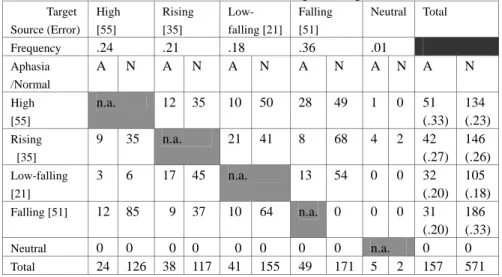
A number of researchers found that linguistic elements are involved in speech errors in numbers which are proportional to the frequency of occurrence of the linguistic elements in the language. Therefore, the distribution of tone errors may not occur randomly in aphasic speech. The following table shows 157 errors in aphasic speech and 571 errors in normal speech in the two error corpora involving contextual substitution of tones.
Table 8: Tonal substitution: aphasic speech Target Source (Error) High [55] Rising [35] Low- falling [21] Falling [51] Neutral Total Frequency .24 .21 .18 .36 .01 Aphasia /Normal A N A N A N A N A N A N High [55] n.a. 12 35 10 50 28 49 1 0 51 (.33) 134 (.23) Rising [35] 9 35 n.a. 21 41 8 68 4 2 42 (.27) 146 (.26) Low-falling [21] 3 6 17 45 n.a. 13 54 0 0 32 (.20) 105 (.18) Falling [51] 12 85 9 37 10 64 n.a. 0 0 0 31 (.20) 186 (.33) Neutral 0 0 0 0 0 0 0 0 n.a. 0 0 Total 24 126 38 117 41 155 49 171 5 2 157 571
Frequency: source from
http://www.edu.tw/EDU_WEB/EDU_MGT/MANDR/EDU
I-Ping Wan
104
Table 8 shows the total distribution of tone errors occurring in aphasic speech and normal speech in Mandarin. In this table, of 157 tone errors, 51 (33%) cases show the high tone is the most common tone in aphasic speech whereas of 571 tone errors, 186 (33%) cases show the falling tone is the most common tone in normal speech. In normal speech production, this finding is not surprising because the falling tone is the most frequent tone in Mandarin and it is thus predicted to be involved in tone errors more often than the other three tones (for a more detailed discussion of the special status of the falling tone, see Wan (in press)). However, in aphasic speech, results from the distribution of tone errors do not yield a similar pattern. In fact 33% of the errors involve the high tone as the source tone compared to the rising tone: 27%, low-falling tone: 20%, and falling tone: 20%. This property suggests that the high tone as source tone is the least resistant to disruption for aphasic patients in Mandarin since aphasic patients are more prone to use high tone in Mandarin.
5. DISCUSSION AND CONCLUSION
The major result of the present study based on the analysis of 876 errors observed in aphasic speech in Mandarin shows that the rate of production deficits reaches to 18%, suggesting that aphasic patients tend to produce an error per 18 words in Mandarin, the finding of which confirms Schwartz et al’s (1994) findings for English aphasic speech in which English patients seem to produce an error per 15 words. Among all the phonological categories, consonant errors comprise the significantly highest proportion of error types. Tone errors also constitute a higher proportion of error type. This property suggests that aphasic patients produce tone errors in a greater amount relative to consonant errors so tones are as impaired as consonants in Mandarin aphasic speech. Since there are around 26 consonant phones and 12 vowel phones but 4 tones plus one neutral tone in Mandarin, Mandarin aphasic patients were supposed to produce higher error rates of segments if error rates could be expected to reflect the frequency of the occurrence of segments in Mandarin; however, this was not the case as found in this study. Therefore, a frequency effect of tones is not apparent and plays no role in participating in errors.
Tone Deficits
105
When the types of tone error are compared between the aphasic speech and naturally-occurring speech errors in Mandarin, it is not surprising to find that substitutions account for the preponderance of tone errors in both of the two corpora. This may be related to the internal structure of tone construct. Since speech errors nearly always result in a possible unit in a language, not all sequences of tone would allow replacement such that a real Mandarin tone would result. Once a tone unit is deleted or added into a syllable, the resulting form may cause an illegal syllable output. So far there has not been enough evidence reporting that aphasic speakers would produce illegal phonetic forms in Mandarin and the preponderance of tone substitution errors will further suggest that the tonal root in the phonological framework is the more independently controlled unit in speech production planning because the majority of tone errors are whole-tone units and there is no case of split-tone errors.
In terms of the ratio involving contextual vs. non-contextual errors observed in tones and segments in Mandarin aphasic speech, the contextual window found in aphasic speakers is not of the same size as that for normal speakers. There is a fewer proportion of errors involving contextual influences within a single utterance in aphasic speech (consonants: 9%; vowels: 1%; tones: 6%), and this finding confirms similar findings by Buckingham & Kertesz (1976) and Buckingham (1985) whereby the target-source pairing units can cross one or more clauses in aphasic speech. This property is found in segments and tones, reflecting that aphasic speakers have a less efficient monitoring mechanism in speech production planning and thus they are unlikely to plan ahead in terms of accessing the phonological representations of the words that have been accessed.
The overall distributions of tone errors as a function of the distance measured in syllable spans between source and target show that aphasic patients have a shorter memory span in the generation of utterances. However, tone errors in normal production with a span of one to five syllables show target-source pairs occurring in a fairly larger window size, suggesting that the processing of language material including tone has a longer memory trace in the normal production system.
In terms of the directionality of source and target tones, anticipations and perseverations far outnumber any other type of errors. It has been found that a built-in device for tones occurring in a
I-Ping Wan
106
left-to-right fashion may be settled in speech production planning in tone languages such as Mandarin or Thai. However, the present study shows that aphasic patients nearly produce an equal amount of anticipatory and persevertory tone errors, suggesting that the tone unit in the immediate memory may be assumed to be subject to decay and so the longer the memory trace of such an element has been in existence, the greater the chance that it will be forgotten. Due to the lack of monitoring mechanisms in aphasic patients, the planning for any unit which is planned ahead and has not yet been produced cannot be planned too far ahead of the time of production. The source unit, which is supposed to be the new information occurring after the target one, will thus cause the target-source pairing unit restrained in consecutive syllables. Therefore, it is more likely for aphasic patients to produce errors in which the target-source units occur in a right-to-left fashion. However, the perseverative influence operates under such a condition that the source unit that has been spoken moves over to the following target unit, drawing the already produced information over to the following syllables, causing the source-target pairing unit occurring in consecutive syllables. Similarly, it is easier for aphasic patients to produce errors where the target-source units restricted in a left-to-right direction. This fact confirms Kohn and Smith’s (1994) finding where phonemic planning is linear, proceeding in a left-to-right fashion in English aphasics. Schwartz et al. (1994) and Dell et al. (1997) also found that less practiced and disordered speakers produce fewer anticipations and more perseverations in English than more fluent speakers.
Finally, the present study shows that the high and rising tones are the least resistant to aphasic disturbance since they are likely to replace any other tones. This confirms Gandour et al’s (1988) finding for Thai-speaking aphasics but is contradicatory to Su’s (1991) finding for both Mandarin and Taiwanese aphasic speakers. The present study shows that the falling tone is more likely to be replaced than any other tone is. Since Gandour (1977) and Wan (in press) both found that a larger proportion of tone substitution errors involve the falling tone in naturally-occurring speech errors in tone languages, one might predict that there would be a preference for the falling tone as is the case for the majority of the tone substitution errors of the Mandarin-speaking aphasics. Contrary to such an expectation, the present finding shows the opposite order in that the falling tone is the easiest to be replaced, and the high and rising tones account for the preponderance of errors.
Tone Deficits
107
Based on Blumstein’s (1973) study of English aphasics, if the frequency of a phone is higher, the chance of the phone being involved in errors will be lower. The frequency effect may partially account for the distribution of the different types of tone errors in aphasic speech. The frequency count by percentage shows that the falling tone is .36, the high tone, .24, the rising tone, .21, and the low-falling tone, .18. The distribution of the source (replacing) or error tone by percentage is that the high tone is .33, the rising tone, .27, the falling tone, .20, and the low-falling tone, .202. Since the falling tone is regarded as the most common tone unit in Mandarin based on the frequency count provided in Table 8, proportionately fewer errors will be produced in relation to the production than is the case for the less common tones in the inventory, and therefore the frequency of an error made on another tone would be inversely correlated with its frequency of occurrence. However, the relationship between the replacing and replaced tones is not simply a function of the frequency count since the high tone is also regarded as a frequent tone in Mandarin and it can replace any other tones. A more explanatory proposal comes from the development of Mandarin tones. Language acquisition studies have shown that the rising and low-falling tones are the most difficult ones for children to produce and perceive (Li & Thompson 1976) and the level tone (i.e., high tone) is acquired earlier than the contour tones in Mandarin. The finding herein indicates that aphasic patients select the high tone as the replacing tone to some extent based on its strength of being easier to be produced and earlier to be acquired in Mandarin. This may be the reason to account for the preponderance of replacing errors involved in the production of the high tone. At the same time, there is no doubt that the low-falling tone is the least likely one to replace other tones in Mandarin aphasics, and this finding can be found in every Mandarin aphasic studies in relation to tones for which data are available.
This paper has tried to examine some general patterns and distribution of tone production deficits observed in Mandarin aphasic speech. In general, the present study has shown some agreement in findings between Mandarin and Thai aphasics, suggesting that the same parameters are built into the universals of tones in speech production mechanisms. In a future study it is hoped to evaluate to some extent the
2
Note that the distribution of neutral tone errors is too small to yield any specific effects on error counts.
I-Ping Wan
108
issue as to whether any tone production deficits among left brain-damaged patients can be attributed to a specific type of aphasic syndrome.
REFERENCES
Baum, Shari. 1998. Anticipatory coarticulation in aphasia: effects of utterance complexity. Brain and language 63:357-380.
Berg, Thomas. 1987. A Cross-linguistic Comparison of Slips of the Tongue. Indiana University Linguistics Club.
Blumstein, Sheila E. 1973. A Phonological Investigation of Aphasic Speech. The Hague: Mouton.
Blumstein, Sheila, and William Milberg. 1981. Lexical decision and aphasia: Evidence for semantic processing. Brain and Language 14:371–385.
Blumstein, Sheila, B Dworetzky., and William Milberg. 1987. Processing of lexical ambiguities in aphasia. Brain and Language 31:138–150.
Bock, K., and Willem Levelt. 1994. Language production: grammatical encoding. Handbook of Psycholinguistics, ed. by M. Gernsbacher, 945-984. San Diego: Academic Press.
Buckingham, W., and A. Kertesz. 1976. Neologistic Jargon Aphasia. Amsterdam: Swets & Zeitlinger.
Buckingham, H. W. 1985. Perseveration in aphasia. Current Perspectives in Dysphasia, ed. by S Newman, Epstein, R. Edinburgh. Churchill Livingstone.
Caramazza, Alfonso, Costanza Papagno, and Wheeler Ruml. 2000. The selective impairment of phonological processing in speech production. Brain and Language 75:428-450.
Chen, Matthew. 2000. Tone sandhi. Cambridge, Cambridge University Press
Chen, Chien-Shien. 2005. A psycholinguistic study on aphasic tone errors in Mandarin. M.A. Thesis. National Cheng-chi University, Taiwan.
Cohen, A. 1973. Errors of speech and their implication for understanding the strategy of language users. Speech errors as linguistic evidence, ed. by Victoria Fromkin, 88-92. The Hague: Mouton.
Cutler, Anne. (Ed.), 1982. Slips of the Tongue and Language Production. New York: Mouton.
Dell, Gary. S. 1984. The representation of serial order in speech: Evidence from the repeated phoneme effect in speech errors. Journal of Experimental Psychology: Learning, Memory & Cognition 10:222-233.
Dell, Gary S., L. K. Burger, and W. R. Svec. 1997. Language production and serial order: a functional analysis and a model. Psychological Review 1:123-147.
Fromkin, Victoria. (Ed.) 1973a. Speech errors as linguistic evidence, The Hague: Mouton.
Tone Deficits
109 Fromkin, Victoria. 1973b. The non-anomalous nature of anomalous utterances. Speech
errors as linguistic evidence, ed. by Victoria Fromkin. The Hague: Mouton. Fromkin, Victoria. (Ed.), 1980. Errors in Linguistic Performance: Slips of the tongue, ear,
pen, and hand. New York: Academic Press.
Gandour, Jack. 1977. Counterfeit tones in the speech of Southern Thai bidialectals. Lingua 41:125-143.
Gandour, Jack, Hugh Buckingham, Rochana Dardarananda, Preecha Stawathumrong, and Soranee Holasuit Petty. 1982. Case study of a Thai conduction aphasic. Brain and Language 17:327-358.
Gandour, Jack, Rochana Dardarananda, S. Vibulsreth, and Hugh Buckingham. 1982. Case study of a Thai transcortical motor aphasic. Language and Speech 25:127-150.
Gandour, Jack, and Rochana Dardarannda. 1983. Identification of tonal contrasts in Thai aphasic patients. Brain and Language 18:98-114.
Gandour, Jack, Soranee Holasuit Petty, and Rochana Dardarananda. 1988. Perception and production of tone in aphasia. Brain and Language 35:206-224.
Gandour, Jack, Suvit Ponglorpisit, Fuangfa Khunadorn, Sumalee Dechongkit, Prasert Boongird, Rachanee Boonklam, and Siripong Potisuk. 1992. Lexical tones in Thai after unilateral brain damage. Brain and Language 43:275-307.
Hagoort, P., 1993. Impairments of lexical–semantic processing in aphasia: Evidence from the processing of lexical ambiguities. Brain and Language 45:198–232. Hombert, J. M. 1975. The perception of contour tones. Proceeding of the First Annual
Meeting of the Berkeley Linguistics Society. 221-232.
Hsu, Hui-Chuan. 1989. Phonological acquisition of Taiwanese: A longitudinal case study. M.A. Thesis. National Tsing Hua University, Taiwan.
Hyman, L. and R. Schuh. 1974. Universals of tone rules: evidence from West Africa. Linguistic Inquiry 5:81-115.
Jaeger, Jeri. 2004. Kids’ slips: What young children’s slips of the tongue reveal about language development. New Jersey: Lawrence Erlbaum.
Katz, W., 1988. An investigation of lexical ambiguity in Broca’s aphasics using an auditory lexical priming technique. Neuropsychologia 26(5):747–752.
Kohn, Susan E. 1989. The nature of phonemic string deficit in conduction aphasia. Aphasiology 3:209-239.
Kohn, Susan E., and Katherine L. Smith. 1990. Between –word speech errors in conduction aphasia. Cognitive Neuropsychology 7:133-156.
Kohn, Susan E., and Katherine L. Smith. 1994. Distinctions between two phonological output deficits. Psycholinguistics 15:75-95.
Li, Charles N. and Sandra. A. Thompson. 1976. The acquisition of tone in Mandarin-speaking children. Child Language 4:185-199.
Lin, Cai-Juan. 1988. The study on performance of the verb and preposition in Mandarin aphasics. M.A.Thesis. National Taiwan Normal University.
Linebarger, M., Myrna Schwartz, and Eleanor Saffran. 1983. Sensitivity to grammatical structure in so-called agrammatic aphasics. Cognition 13:361–393.
I-Ping Wan
110
Levelt, Willem. 1989. Speaking: From intention to Articulation. Cambridge, MA: MIT Press.
Lu, Ching-Ching. 1990. On the tonal production and comprehension of Taiwanese aphasics. M.A. Thesis. National Tsing Hua University, Taiwan.
Maddieson, Ian. 1978. Universals of tone. Universals of human language 2. ed. by J. Greenberg, 335-365. Stanford University Press.
Naesear, M. A., and S Chan. 1980. Case study of a Chinese aphasic with the Boston Diagnostic Aphasia Exam. Neuropsychology 18:389-410.
Nooteboom, Sieb G., 1973. The tongue slips into patterns. Speech Errors as Linguistic Evidence, ed. by Victoria Fromkin, 144-156. Mouton, Paris.
Ohala, John J. 1972. The physiology of tone. Consonant types and tone. ed. by L. M. Hyman, 1-14. Southern California Occasional Papers in Linguistics 1.
Ohala, John J., and W. Ewan. 1973. Speed of pitch change. Journal of the Acoustical Society of America 53:345.
Ostrin, R., and L Tyler. 1993. Automatic access to lexical semantics in aphasia: Evidence from semantic and associative priming. Brain and Language 45: 147–159. Packard, Jerome. L., 1986. Tone production deficits in nonfluent aphasic Chinese speech.
Brain and Language 29:212-223.
Prather, P. A., 1994. The time course of lexical activation in fluent and nonfluent aphasia. Linguistics and Cognitive Neuroscience 6:128–144.
Prather, P., E. Zurif, and T Love. 1992. Time course of lexical access in fluent and nonfluent aphasia. Academy of Aphasia.
Sah, Wen-Hui. 1995. Speech Prosody in Chinese Broca's and Wernicke's Aphasics: An acoustic Investigation of Duration and Fundamental Frequency Contour. M.A. Thesis. National Cheng-Chi University, Taiwan.
Schwartz, Myrna F., Eleanor M. Saffran, Diane E. Bloch, and Gary S. Dell. 1994. Disordered speech production in aphasic and normal speakers. Brain and Language 47:52-88.
Schwartz, Myrna F., Deborah A. Gagnon, Nadine Martin, Gary S. Dell, and Eleanor M. Saffran. 1996. Phonological facilitation of semantic errors in normal and aphasic speakers. Language and Cognitive Process 11:257-282.
Shattuck-Hufnagel, Stefanie, and D. Klatt. 1979. The limited use of distinctive features and markedness in speech production. Journal of Verbal Learning and Verbal Behavior 13:41-55.
Stemberger, Joseph P. 1983. Speech Errors and Theoretical Phonology: a Review. Indiana, University Linguistics Club.
Stemberger, Joseph P. 1990. Wordshape errors in language production. Cognition 35 (2):123-157.
Su, I-Jing. 1991. An acoustic investigation on Chinese aphasia. M.A. Thesis. National Tsing-Hua University, Taiwan.
Sundberg, J. 1973. Data on maximum speech of pitch changes. Royal Institute of Technology, Stockholm, Speech Transmission Laboratory. Quarterly Progress Status Report. 4:39-47.
Tone Deficits
111 Wan, I-Ping. To appear. Mandarin speech errors into phonological patterns. Journal of
Chinese Linguistics.
Wan, I-Ping. In press. On the phonological organization of Mandarin tone. Lingua. Wan, I-Ping. and Jeri Jaeger. 2003. The phonological representation of Taiwan Mandarin
vowels: a psycholinguistic study. Journal of East Asian Linguistics 12:205-257. Wells-Jensen, S., 1999. Cognitive correlates of linguistic complexity: A cross-linguistic
comparison of errors in speech. Ph. D. dissertation: University at Buffalo, State University of New York.
Wu, Jin-Wei. 1992. An Investigation on the Classifier from the Evidence of the Chinese Aphasics. M.A .Thesis. National Tsing-Hua University, Taiwan.
Xu, W., 1989. Exploring of the Structure of Mental Lexicon from Impaired Speech. M.A .Thesis. National Taiwan Normal University.
Yip, Moira. 2002. Tone. Cambridge, Cambridge University Press.
Zhang, Jie. 2000. Non-contrastive features and categorical patterning in Chinese diminutive suffixation: Max[F]or Ident[F]? Phonology 17(3):427-478.
Zhang, Jie. 2001. The Effects of Duration and Sonority on Contour Tone Distribution: Typological Survey and Formal Analysis. Ph.D. dissertation. UCLA.
I-Ping Wan
Graduate Institute of Linguistics National Chengchi University Taipei, Taiwan 116, ROC
漢語口語與失語症調誤 萬依萍 國立政治大學 本文旨在研究漢語失語症聲調調誤與一般口語調誤之比較以及其他理論應 用。由 876 筆失語症聲調調誤及 2515 筆一般口語調誤希望證明以下特點: 第一、聲調調誤出現比率與子音語誤出現比例相當,在失語症的語料亦有 類似現象。第二、失語症調誤較不易找出來源調,與一般口語調誤中有大 量的來源調有很大的差別,由此可見失語症患者在發音上缺乏有效率的發 音執行及計畫。最後,失語症患者大量的利用高平調來取代其他聲調,此 點強化了高平調在發音學上的簡易度以及在習得歷程中先被學會的容易 度。