行政院國家科學委員會補助專題研究計畫成果報告
※※※※※※※※※※※※※※※※※※※※※※※※※※
※
※
※
利用高壓合成新材料及其特性分析(1/3)
※
※ (中波國合計畫)
※
※
※
※※※※※※※※※※※※※※※※※※※※※※※※※※
計畫類別:
þ
個別型計畫
□整合型計畫
計畫編號:NSC 91-2113-M-002-023
執行期間:91 年 2 月 1 日至 92 年 1 月 31 日
計畫主持人:劉如熹 台灣大學化學系
共同主持人:楊弘敦 中山大學物理系
波方主持人:Prof. S. M. Filipek 波蘭科學院物理化學研究所
計畫參與人員:王健源、張嵩駿、詹丁山 台灣大學化學系
黃家莞
中山大學物理系
本成果報告包括以下應繳交之附件:
þ
赴國外出差或研習心得報告一份
□赴大陸地區出差或研習心得報告一份
□出席國際學術會議心得報告及發表之論文各一份
□國際合作研究計畫國外研究報告書一份
執行單位:台灣大學化學系
中
華
民
國
91
年 11 月 30 日
行政院國家科學委員會專題研究計畫成果報告
利用高壓合成新材料及其特性分析(1/3)
Synthesis and Study of New Mater ials Using High Pr essur e
計畫編號:NSC 91-2113-M-002-023
執行期限:91 年 2 月 1 日至 92 年 1 月 31 日
主持人: 劉如熹 台灣大學化學系
共同主持人: 楊弘敦 中山大學物理系
波方主持人:Prof. S. M. Filipek 波蘭科學院物理化學研究所
計畫參與人員:王健源、張嵩駿、詹丁山 台灣大學化學系
黃家莞 中山大學物理系
一、中文摘要 最近波蘭科學院物理化學研究所 S.M. Filipek 教 授 利 用 高 壓 設 備 成 功 地 合 成 YMn2Hx (x > 4.5)金屬間氫化物。本計畫與其 合作利用 X 光粉末繞射、X 光吸收近邊緣結 構與 SQUID 磁性量測等方法進行合成產物 之分析。 關鍵詞:氫化物、Laves 相、釔錳化合物、高 壓合成 Abstr actRecently, Prof. S.M. Filipek at the Institute of Physical Chemistry of the Polish Academy of Sciences has successfully synthesized the intermetallic hydride YMn2Hx
with x > 4.5 using the high pressure apparatus.
This project has been cooperated with Prof. Filipek to characterize the crystal structure and magnetic properties of the synthesized products by powder X-ray diffraction (XRD), Mn X-ray absorption near edge structure (XANES) and SQUID magnetometer.
Keywor ds: hydride, Laves phase, YMn2, high
pressure synthesis
二、緣由與目的
The intermetallic compound YMn2 is
characterized by a cubic crystal structure (C15) of Laves phase under ambient conditions.1 YMn2 also has been found as an itinerant
electron antiferromagnet with the Mn moments
(ìMn) of 2.7 ìB2 and the Néel temperature (TN)
of ~100 K.3,4 The results of heat capacity and thermal expansion measurements as a function of temperature indicate that this compound exhibits a first order phase transition at TN
accompanied with a giant volume change of about 5%, which is ascribed to the spontaneous volume magnetostriction due to the collapse of the Mn moment at TN.4,5 Another anomalous
behavior of YMn2 is a large thermal expansion
coefficient above TN. Such behavior can be
interpreted by a rapid recovery of the amplitude of spin fluctuations with increasing temperature above TN.6 Oomi et al.7 found that the
magnetism of YMn2 is very sensitive to
external pressure: the onset of magnetic order is not observable at 3.7 kbar. Ballou et al.8 elucidated the helimagnetic structure with a period of about 400 Å of YMn2, which is
consistent with an angle modulation of the antiferromagnetic structure, based on the results of neutron diffraction experiments and NMR spectra arising from a perturbation of the helix by the magnetocrystalline anisotropy. Further efforts were done by Nakamura et al.,3,9,10they determined the direction of the spin axis, i.e. the direction of magnetization, is parallel to the [111] direction by analyzing both the intensity of magnetic peaks and the 55Mn spin-echo NMR spectrum at 4.2 K. The electronic structures of Laves phase compounds AB2 (A =
Y, Zr and Nb; B = Cr, Mn, Fe, Co and Ni) were investigated systematically by means of several theoretical calculation methods, and the predictions are in good agreement with the
experimental results.2,11,12
It is also found that a change of high-symmetry C15 structure (Fd-3m space
group) of YMn2 intermetallic compound is
induced by absorption of hydrogen or decreasing in temperature. Fuji et al.13 have shown that YMn2Hx hydrides have a solid
solution of hydrogen in the C15 structure up to
x = 3.5 H/f.u. with a continuous increase of the
cell parameter at room temperature. For 3.5 < x
< 4, a two-phase range with a mixture of cubic and rhombohedral phases occurs. For 4 < x <
4.3, a single phase hydride with a rhombohedral structure (R-3m space group) is obtained.14
Latroche et al.15,16 performed the neutron powder diffraction experiments of YMn2Dx (1
≤ x≤ 4.5) at temperatures above the magnetic transition. They found that the C15 structure is conserved on deuteration and the cell parameter
a increases linearly with increasing of x. In
addition, the atomic position and site occupation of deuterium were determined; only the A2B2 sites are occupied in this range of
concentration. It is worth to note that some lower-temperature physical properties of these hydrides and deuterides are rather different as compared with the parent compound YMn2.
For example, the YMn2 intermetallic
compound undergoes a first order magnetic transition to an antiferromagnetic state at about 100 K, while the magnetic ordering temperatures (TN) of YMn2Hx compounds (x =
0.5, 2 and 3) increase with increasing of x.17
Figiel et al.18 believe that this deviating behavior is attributed to an increase in Mn-Mn distances due to the hydrogenation causes the increasing localization of more stable Mn moments resulting in the suppression of the spin fluctuations. Consequently, the volume anomalies of YMn2Hx compounds at TN
decrease with increasing of x. Some works on
hydrogen induced phase transitions of YMn2Hx
(0 < x < 1.2) were also done by Figiel et al. In
their studies, the phase transitions were interpreted in terms of Mn-Mn magnetic interactions in dependence of the lattice expansion caused by hydrogen. Fujii et al.19 and Goncharenko et al.20 also proved that YMn2Hx
compounds exhibit a weak ferromagnetic property in the range of 1 < x < 3.5 while for
the rhombohedral phase with x = 4.3, an
antiferromagnetic state is observed. In the respect of deuterides, the YMn2Dx (x = 1.15
and 4.5) compounds have been studied by means of temperature dependent neutron diffraction reported by Latroche et al.16,21 They concluded that under ambient pressure, both deuterium ordering and magnetic interactions are intimately related and involve each other, however, which is the first effect to take place is still a question. From their study on YMn2D1,
it was expected that the magnetic effect is the driving force involving an electronic and geometrical modification of the lattice and that deuterium ordering is a consequence of this rearrangement.22 From these previous works, it is important to note that magnetic properties of these compounds are very sensitive to Mn-Mn distances. Absorption of hydrogen or deuterium will not only change the cell parameter but also influence the magnetic structure by a progressive filling of the Mn d-band. Moreover, if some hydrogen or deuterium ordering occurs, i.e. an ordered sublattice of hydrogen or deuterium in the metal host is formed; it will cause a change to a certain extent in the magnetic interaction between two Mn atoms. Therefore, it could influence the magnetic order not only by varying the lattice constant but also by changing the local environment of the Mn atoms and by inducing distortions in the metal lattice.20 Based on evolution of previous works, a phase diagram can be fully schemed for both of the YMn2Hx and YMn2Dx systems (0 ≤ x ≤
4.2).18,23 However, the structural and magnetic properties of YMn2Hx with higher
concentration of hydrogen, for instances x > 4.5,
remained still not fully understand.
The aim of the present investigation is to research the possibility of existence of the single-phase YMn2Hx compounds with higher
concentration of hydrogen and determine their crystal structures. In order to identify the structure and characterize the magnetic properties of the synthesized product, the powder X-ray diffraction (XRD), Mn X-ray absorption near edge structure (XANES) and magnetization measurement were carried out.
The processes for preparing the YMn2
compound are the same with those described in refs.16,24 The YMn2 sample was prepared by
induction melting of the pure components (yttrium, 99.9%; manganese, 99.99%) in a water-cooled copper crucible under vacuum then under argon atmosphere to avoid sublimation of manganese. In order to prevent from the precipitation of the Y6Mn23 compound,
a 3-5% yttrium excess was added for obtaining a single-phase YMn2 compound. To ensure
good homogeneity, the sample was melted five times and annealed for 11 days at 800°C. The homogeneity of the sample was checked by metallographic examination and the composition was analyzed by electron microprobe analysis (EMPA). The powder X-ray diffraction was performed on a PW1710 Philips diffractometer with Cu Ká radiation.
After the XRD pattern was successfully indexed as a cubic Fd-3m space group with cell
parameter a = 7.681(1) Å . About 8 g of the
alloy ingot were ground mechanically under argon atmosphere and then sieved for the grain size less than 36 ìm.
Samples were located in a high-pressure apparatus described elsewhere25 and treated at 100°C in vacuum before the hydrogen charging. Without this treatment, the presence of water adsorbed on the surface of the alloy affects the penetration of hydrogen into the bulk.26 The hydrogenation was performed at pressures of 1.7 kbar and temperatures of 200°C for 12 hours. After the apparatus was cooled down to room temperature, the hydride powder was discharged and immediately stored in liquid nitrogen for further investigations. The hydride was obtained by exposing the powdered sample to hydrogen pressure at room temperature up to ~5 H/f.u. The hydrogen content was measured by elemental analyzer.
The XRD measurements were carried out with synchrotron radiation (ë = 1.3125 Å ). The Wiggler-A beamline of the Synchrotron Radiation Research Center (SRRC) in Taiwan, has been designed for such experiments, where the concern is more with photon flux than resolution. Data for the Rietveld refinement were collected in the 2è range 10–120° with a step size of 0.02° and a count time of 10 s per
step. The magnetization measurements were done by (SQUID) magnetometer (Quantum Design) form 5 K up to 300 K in the magnetic field of 5 Tesla. Measurement at temperature higher than 300 K could not be performed due to desorption of hydrogen from the sample.
The valence of Mn in the synthesized intermetallic hydride was determined by the X-ray absorption technique. The spectra were obtained using synchrotron radiation with the electron beam energy of 1.5 GeV at SRRC. The spectra were recorded by measuring the ratio I/I0 ratio, where I0 is the intensity of the
incident beam. According to the attenuation law I = I0 exp(–ìx), ln(I/I0) is proportional to
the absorption function ì. Based on the transmission mode, the thickness x of the
sample has to be adjusted such as ì.x = 1,
where ì is the absorption cross-section of the element of interest. The incident photon flux (I0)
was monitored simultaneously by an ion-chamber which was positioned after the exit slit of the monochromator. The intensity of the transmitted X-ray monitored in the same way was considered as I0 of the standard metal
foil for calibrating the energy of the beam. All the measurements were performed at room temperature. The photon energies were calibrated to an accuracy of 0.1 eV via the theoretical values of the Mn metal K-edge
absorption energies. The reproducibility of the absorption spectra of the same sample in different experimental runs was found to be extremely good.
四、實驗結果與討論
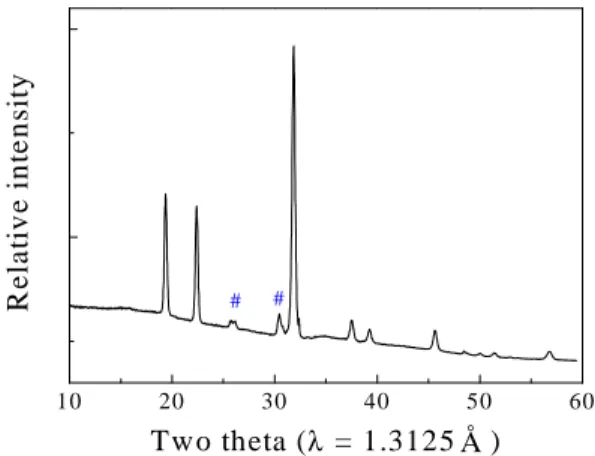
The powder XRD pattern (Fig. 1) of the synthesized hydride sample and the structural parameters calculated with Rietveld refinement is carried out. The pattern could be indexed on the basis of a cubic cell [a = b = c = 6.7203(4)
Å , á = â = ã = 90°] and the space group of its
crystal structure is F-43m. The values of
reliability factors, Rp, Rwp and ÷2 calculated
from the XRD patent with some excluded peaks, which was assumed as a cubic phase (Fd-3m) of YMn2Hx (x < 4)14, are all acceptable.
According to the result of elemental analysis, the concentration of hydrogen in YMn2Hx was
the YMn2H4.71 compound and the geometric
structure of the A2B2-type sites occupied by
hydrogen plotted with ATOMS software are shown in Fig. 2(a) and 2(b), respectively. In the C15 type of structure, three kinds of tetrahedral interstitial site are available for hydrogen occupation: AB3, A2B2 and B4. Experimentally,
it has been found that A2B2 site are the most
favorable for hydrogen bonding, thus they should be filled first. The possibility of filling other two sites, however, could not be excluded27,28, especially when the hydrogen content is higher. Moreover, it has been proposed that filling into AB3 sites might
induce a rhombohedral distortion of the host structure.16 In this case, however, the crystal symmetry of the YMn2H4.71 compound remains
cubic structure. There is no conclusive proof that the hydride was charged at higher temperature (200°C) and high pressure (1.7 kbar) resulting in an exception to the rule. This is a good illustration of the fact that the thermodynamic as well as kinetic dynamic condition of the reaction influenced on formation of the product. We consider that further experiments and theoretical calculations should be performed to prove the hypothesis.
10 20 30 40 50 60 # # R e la ti v e i n te n si ty Two theta (λ = 1.3125 )
Fig. 1. XRD pattern of the YMn2H4.71phase with a small
amount of the YMn2Hx (x < 4.3, marked by a “#” symbol) phase. This pattern was taken by synchrotron radiation with wavelength ë = 1.3271 Å .
(a)
(b)
(b)
Fig. 2. (a) Crystal structure of the YMn2H4.71 with cubic
unit cell (space group: F-43m). (b) The A2B2-type
tetragonal site occupied by hydrogen.
X-ray energies are sufficiently high to eject, via the photoelectric effect, one or more core electrons from an atom. Each core electron has a well-defined binding energy, and when the energy of the incident X-ray is varied across one of these energies, there is an abrupt increase in the absorption coefficient. This is the so-called “absorption edge” of the element. Absorption edges are named according to the electron of which shell is excited, for example, K = 1s; L1 = 2s, L2, 3 =2p, etc. The Mn K-edge
XANES spectra of the YMn2 and YMn2H4.71
compounds are shown in Fig. 3 and the Mn foil is used as a reference. Knowing reference spectrum at the absorption edge, it is possible to use it as a fingerprint of the valence and site symmetry, so as to characterize the unknown sample. In other words, although the differences between the energy values (E0)
corresponding to ìx = 0.5 can usually be used
to determine the valences of the metals in the different compounds, the comparison should be applied based on the same or at least fairly similar structural coordination environment. It is very important to keep this point in mind as Å
H
Y
we examine these spectra. Therefore, as shown in Fig. 3, we would like to propose that the E0
at such little different energy values is attributed to the different chemical environment of Mn. And it is more plausible to determine the valence of Mn based on the energy value of the onset of XANES spectrum (as the arrow in fig. 3 shows). Viewed in this light, the valence of Mn in the intermetallic alloy as well as the hydride can be regarded as the same metallic state with that of Mn foil. In the case of K-edge
XANES spectrum, the X-ray absorption of a 3d transition metal is mainly due to the excitation process of its 1s core electron to higher 4p manifold electronic states. While for L-edge
XANES spectrum, the absorption corresponds to the 2p to 3d transition. In addition, the d electrons are more shielded from the chemical environment than p electrons and therefore have retained their atomic character relatively. As a consequence, it is suggested that the
L-edge XANES spectrum has less interference
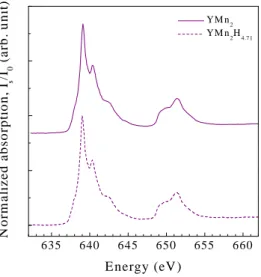
from the site symmetry. The manganese L edge XANES spectra of the YMn2, YMn2H4.71 and
Mn foil are shown in Fig. 4. The spectra show two separated broad multiple structures arising from the spin-orbital splitting of Mn 2p electronic energy levels, the former and later peaks corresponding to 2p3/2 3d and 2p1/2
3d transitions are named LIII and LII-edge,
respectively. The phenomena that alloying decreases the electron occupancy of the metal d-band is observed and widely accepted now. By use of the integrated area under the LIII- and
LII-edge XANES spectra, these groups even
could quantify this change in d-band occupancy. The results of our experiments, however, shake this general belief. When we consider the role of hydrogen in the host, the state of Mn influenced by complicate electronic interactions becomes more open to question. After careful comparison, it seems no difference among the
L-edge spectra of these three samples. As a
result, it can be concluded that the manganese is metallic, and alloyed with yttrium.
The magnetization curves of the YMn2
and YMn2H4.71 compounds as a function of
temperature were shown in Fig. 5. We observed that absorption of hydrogen results in the
6530 6540 6550 6560 6570 6580 6590 0.0 0.2 0.4 0.6 0.8 1.0 1.2 Y M n2 Y M n2H4.71 M n N or m al ize d A b sor pt io n Energy (eV )
Fig. 3. Normalized Mn K-edge XANES spectra of the YMn2 and YMn2H4.71 compounds and that of the
standard sample (Mn foil).
635 640 645 650 655 660 YM n2 YM n2H4.71 N o rm al ized ab so rp ti o n , Is /I0 ( a rb . u n it ) Energy (eV )
Fig. 4. Normalized Mn L-edge XANES spectra of the YMn2 and YMn2H4.71 compounds.
two-orders enhanced magnetic moment of Mn and there is a rapid increasing of magnetization exhibited by the YMn2H4.71 compound from
120 down to 5 K. As shown in Fig. 6, we also have measured the magnetization loops for the YMn2 and YMn2H4.71 compounds. It is found
that the hydride exhibited higher magnetic moment as compared with its parent alloy (YMn2), in addition, the magnetization of these
two samples is not saturated at magnetic field up to 5 T. The magnetization curves measured at 5 K, show no appreciable magnetic hysteresis for both samples. It is too involved a subject to be treated here in detail. And we think that it needs further investigation and discussion.
0 50 100 150 200 250 300 0.14 0.16 0.18 0.20 1.5 2.0 2.5 3.0 3.5 Y M n2 Y M n 2H4 .71 H = 1 T M a g n e ti z a ti o n ( e m u /g ) T em perature (K )
Fig. 5. Temperature dependence of magnetization at a magnetic field of 1 T for the YMn2 and YMn2H4.71
compounds. -5 -4 -3 -2 -1 0 1 2 3 4 5 -4 -3 -2 -1 0 1 2 3 4 T = 5K Y M n 2H4.71 Y M n2 M ag n et izati o n ( em u /g ) M agnetic Field (T)
Fig. 6. The magnetization loops of the YMn2 and
YMn2H4.71 compounds measured at 5 K (H = -5 ~ 5 T).
五、結論
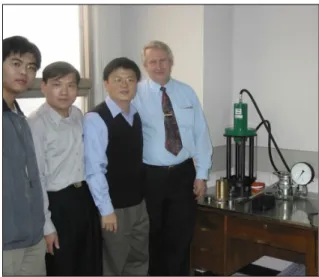
We have cooperated with Prof. Filipek to chacterize the crystal structure, the chemical state of Mn and the magnetic property of new intermetallic hydrides YMn2H4.71. The high
pressure apparatus for investigation of gas-solids reactions under pressures up to 1.5 GPa has already set up at National Taiwan University. The photograph illustrates the main body of this apparatus is shown in Fig. 7.
六、計畫成果自評
We have designed and set-up high pressure piston cylinder apparatus for pressures up to 1.5 GPa (for chemically inert media as argon, nitrogen, hydrocarbons etc.) and performed measurements of the materials from Poland. We have reached the goals of the project.
Fig. 7. High pressure apparatus for investigation of gas-solids reactions under pressures up to 1.5 GPa set up by this project.
七、參考文獻
[1] A. E. Dwight, Trans. Am. Soc. Met.53, 479 (1961).
[2] H. Yamada and M. Shimizu, Phys. Lett. A117, 313
(1986).
[3] Y. Nakamura, M. Shiga and S. Kawano, Physica B
120, 212 (1983).
[4] H. Wada, H. Nakamura, K. Yoshimura, M. Shiga and Y. Nakamura,J. Magn. Magn. Mater.70, 134
(1987).
[5] T. Okamoto, H. Nagata, H. Fujii and Y. Makihara, J.
Magn. Magn. Mater.70, 139 (1987).
[6] M. Shiga, H. Wada, H. Nakamura, K. Yoshimura and Y. Nakamura, J. Phys. F17, 1781 (1987).
[7] G. Oomi, T. Terada, M. Shiga and Y Nakamura, J.
Magn. Magn. Mater.70, 137 (1987).
[8] R. Ballou, J. Deportes, R. Lemaire, Y. Nakamura and B. Ouladdiaf, J. Magn. Magn. Mater.70, 129 (1987).
[9] K. Yoshimura and Y. Nakamura, J. Magn. Magn.
Mater.40, 55 (1983).
[10] H. Nakamura, N. Metoki, S. Suzuki, F. Takayanagi and M. Shiga, J. Phys.: Condens. Matter13, 475
(2001).
[11] S. Asano and S. Ishida, J. Magn. Magn. Mater.70,
39 (1987).
[12] H. Yamada and M. Shimizu, J. Magn. Magn. Mater.
70, 47 (1987).
[13] H. Fuji, M. Saga and T. Okamoto, J. Less-Common
Met.130, 25 (1987).
[14] J. Przewoznik, V. Paul-Boncour, M. Latroche and A. Percheron-Guegan,J. Alloys Compds.225, 436
(1995).
[15] M. Latroche, V. Paul-Boncour, J. Przewoznik, A. Percheron-Guegan and F. Bouree-Vigneron, J.
Alloys Compds.231, 99 (1995).
[16] M. Latroche, V. Paul-Boncour, A.
Percheron-Guegan and F. Bouree-Vigneron, J.
Alloys Compds.274, 59 (1998).
[17] H. Figiel, A. Lindbaum, Cs. Kapusta and E. Gratz, J.
[18] H. Figiel, J. Przewoznik, V. Paul-Boncour, A. Lindbaum, E. Gratz, M. Latroche, M. Escorne, A. Percheron-Guégan and P. Mietniowski, J. Alloys
Compds.274, 29 (1998).
[19] H. Fujii, M. Saga and T. Okamoto J. Less-Common
Metals130, 25 (1987).
[20] I. N. Goncharenko, I. Mirebeau, A. V. Irodova and E. Suard, Phys. Rev. B56, 2580 (1997).
[21] M. Latroche, V. Paul-Boncour, A.
Percheron-Guégan, F. Bourée-Vigneron and G. André, Physica B276, 666 (2000).
[22] M. Latroche, V. Paul-Boncour, A.
Percheron-Guégan, F. Bourée-Vigneron and G. Andre, Physica B234, 599 (1997).
[23] J. Przewoznik, J. Zukrowski and K. Krop, J. Magn.
Magn. Mater.140, 807 (1995).
[24] M. Latroche, V. Paul-Boncour, A.
Percheron-Guégan, F. Bourée-Vigneron and G. André, J. Solid State Chem.154, 398 (2000).
[25] B. Baranowski and S. M. Filipek, High Pressure
Chemical Synthesis Ed. J. Jurczak and B.
Baranowski (Amsterdam: Elsevier) pp. 55–100. [26] S. M. Filipek, V. Paul-Boncour, A. P. Guégan, I.
Jacob, I. Marchuk, M. Dorogova, T. Hirata and Z. Kaszkur,J. Phys.: Condens. Matter13, 475 (2001).
[27] D. Fruchart, A. Rouault, C. B. Shoemaker and D. P. Shoemaker, J. Less-Common Metals73, 363
(1980).
[28] A. V. Irodova, O. A. Lavrova, G. V. Laskova and L. N. Padurets, Sov. Phys. Solid State, 24, 22 (1982).
(附件)
行政院國家科學委員會補助專題研究計畫
利用高壓合成新材料及其特性分析(中波國合計畫)
出國研究心得報告
計畫編號:NSC 91-2113-M-002-023 出國期間:91 年 7 月 24 日至 92 年 9 月 8 日出國人員:劉如熹 台灣大學化學系(計畫主持人)
王健源 台灣大學化學系(博士班學生)
黃家莞
中山大學物理系(碩士班學生)
中 華 民 國 九 十 一 年 十 一 月
一、 緣起 波蘭科學院係該國於各學術領域之研發重鎮,其中利用高壓系統合成儲氫合金材料之研 究上已累積相當豐富之經驗。2001 年波蘭科學院物理化學研究所副所長 S. M. Filipek 教授與 行政院國科會自然處處長楊弘敦教授首度於一項國際會議中討論未來中波二國進行學術交流 與研究合作之可能性。楊教授回國後旋即積極地將此一發展之契機與國內學術界廣泛交換意 見,而台灣大學化學系劉如熹教授與楊處長均對此研究領域抱持著頗高的興趣。劉教授並於 是年底提出一項名稱為「利用高壓合成新材料及其特性分析」之三年期國際合作研究計畫, 同時擔任該計畫之主持人。經由國科會化學研究計畫審議小組的審核與評估,認為本項計畫 之執行有下列具體目標可望達成,並對國內學術發展做出一定程度之貢獻:一、高壓合成系 統之建立有助於擴展研發材料時之新領域,二、藉由本研究所獲致之經驗與知識,有助於國 內工業之發展,三、透過研究論文之發表,可提昇我國國際學術研究之地位,四、訓練與培 養國內於高壓系統研究領域之人員,包括博士後研究與博(碩)士研究人員。本計畫既為一國際 合作研究計畫,故於計畫中提出以雙方互訪並參與研究之方式達成技術交流之目的。2002 年 三月底,本計畫之波方主持人 S. M. Filipek 教授來台進行為期一週之訪問,其間參觀行政院 同步輻射研究中心、台灣大學化學所與中山大學物理所,為雙方之合作進行第一次訪問。其 間 Filipek 教授對我方之研究環境無論軟硬體設施之齊備均留下深刻的印象。2002 年中依計畫 之安排,計畫主持人劉教授率我方研究人員至波蘭科學院物理化學研究所進行訪問並參與研 究為期二個月,主要目的在於學習並實地操作高壓系統與利用其合成樣品,同時探討所合成 樣品之特性。 二、 訪問經過與心得 此 次 我 方 赴 波 蘭 之 研 究 人 員 共 有 三 名 , 停 留 期 間 分 別 為 計 畫 主 持 人 劉 如 熹 教 授 (91.7.24~91.8.5)、台灣大學化學所博士班學生王健源(91.7.24~91.9.8)與中山大學物理所碩士班 學生黃家莞(91.7.24~91.8.25)。以下依序為該三名研究人員之訪問經過與心得報告: 劉如熹教授部分:
91.7.31 於波蘭的克拉科(Department of Solid State Physics, Facility of Physics and Nuclear Techniques, University of Mining and Metallurgy)訪問 Prof. H. Figiel、Prof. Cz. Kapusta 與 Prof. J. Korecki 等三人。Figiel 利用核磁共振(NMR)技術與磁特性量測針對 RMn2 (R = Y, Tb, Gd)等化
合物及其氫(氘)化物之研究具有相當豐富之經驗。Kapusta 教授對於目前熱門之具優良磁阻特 性 Sr2FeMoO6化合物之 NMR 研究亦有其獨到且精闢之立論。Korecki 教授則對於利用分子束
磊晶(MBE)之技術製作 Cr/Fe/Cr 薄膜有深入之研究,相信未來將有機會與其進行學術上之合 作與交流。91.8.1 於 Institute of Low Temperature and Structure Research, Polish Academy of Sciences (Wroclaw, Poland)與 Prof. O. J. Zogal 進行討論,該教授素以 NMR 研究氫化物之特性 於相關領域享富盛名。91.8.2 則與 Prof. J. Lipkowski [Director of Institute of Physical Chemistry,
Polish Academy of Sciences (PAS)]、Prof. M. Tkacz (Researcher of PAS)及 Prof. T. Hirata (Visiting scholar of PAS) 作研究上意見之交換與心得的分享。後二位學者分別在應用高壓技 術於使用氫氣之鑽石鉆槽,以及氫氣於高溫超導體中之研究上發表過許多值得參考的文獻。 藉由此次之面談,對於氫氣與固體材料間之反應特性取得更深入的瞭解。王健源部分:
本次所訪問之波蘭科學院物理化學研究所由副所長 Filipek 副教授親自接待。首先拜會該 所所長 Lipkowski 教授,由他介紹波蘭科學院物理化學所之現況:該所目前共有 Physical Chemistry of Solids、Physico-Chemistry of Supramolecular Complexes、Soft Condensed Matter and Fluids、Calorimetry、Catalysis on Metals、Electrochemistry and Corrosion、Applied Surface Science、Applied Thermodynamics、Photochemistry and Spectroscopy、Quantum Theory of Solids、Molten Salts、Electrode Processes、Chemical Dynamics 與 Process Kinetics 等 14 個系。 職員約有 280 人,約一半職員投入研究工作,博士生約有 30 人。在材料化學領域中,該所擁 有許多非常先進的儀器設備,譬如:低溫 CCD 單晶繞射儀;表面化學的 STM、AFM Kelvin probe 及 AES-XPS;光化學動力學的 pico 及 femto-second laser 等貴重儀器。本計畫之波方主持人 Filipek 教授之高壓實驗室,具特色為許多裝置皆為他們自己組裝的,包括各式各樣的高溫高 壓系統,此亦突顯出其於該研究領域確實具有獨立運作與開創性研發的實力。其研究主題包 括金屬於高壓氫氣的環境下,其表面和塊材內所含氫的濃度之差異性以及氫化過程中材料表 面所引起的形態改變等具前瞻性的研究。於此其間之主要目的在於學習並實地操作高壓系統 與利用其合成樣品,Filipek 教授之學生 I. Marchuk 與 M. Dorogova 非常詳實地為我們三人解 說他們所設計的適用於各種壓力範圍與量測不同材料性質的高壓合成裝置。所合成之樣品均 以 X 光粉末繞射法鑑定其樣品純度與結晶特性。經過數次的當面討論之後確實可加強雙方之 溝通與互動,亦能有效地規劃與提出較具體之合作研究計畫。 黃家莞部分: 此次至波蘭,展開為期一個月之參觀與學習。主要目的為學習高壓合成樣品之技術及此 些樣品的分析研究。由於目前國內對於所謂〝高壓〞之實驗技術以及設備都尚未有進一步的 發展,故此行即成為將此技術帶回國內的前驅。於此期間,我們參與波方 YMn2H6等樣品的 製作,並學習此套高壓設備的使用方法,且因為是高壓之故,十分在意著實驗時的安全。然 而此些製備的過程並不是一次就可以成功做出很好的樣品,從 XRD 的量測下就可以清楚得知 樣品之純度,因此須要不斷的致力改善樣品的製程。此外,整套儀器是十分煩瑣的,且彼此 之間又有著連鎖關係,所以使用上必須清楚了解每個步驟,也因為所使用的氣體是〝氘氣〞 及高達 200 大氣壓的壓力,除熟練之外,仍得處處小心。大致上,我們實際操作的地方並不 多,所以只能用心仔細觀察,學習對方的數據分析方法並討論樣品的製作。等到今年年底此 套儀器在臺灣裝設完成之後,我們就能隨著波蘭的博士後研究員進行實驗。最後我們會將此 行的經驗傳承給明年度計畫前往波蘭之學生,希望有助於學習的態度與激起不同的想法,而 發揮此套高壓設備的最佳效益。 此次參與波蘭之行的人員均感收穫甚豐,除與波蘭人之交流外,與該國其他領域之工作 者亦有更進一步地了解,特別是與許多於物理、化學及材料界均有突出研究成果之研究者當 面討論,相信將有助於彼此之合作與瞭解。波方於利用高壓合成含氫之固態材料有極優異之 研究表現,而我方於材料之合成技術與分析設備(如同步輻射研究中心),較引起波方之興 趣。除研究成果之交換外,對波方人員安排整個活動之細心實感欽佩亦值得作為學習之榜樣。
此外王健源同學於本次訪問期間恰逢本研究計畫所涉及之金屬氫化物研究領域相當重要 之年度會議,即 International Symposium on Metal Hydrogen Systems - Fundamental and Applications (MH2002) ,因此順道參加此會議。今年此會乃於法國安錫舉行,席間許多該領 域之著名研究學者均參與此項盛會,並發表多場其重要研究成果之演說。如 L. Schlapbach 以 材料科學的觀點介紹氫能科技之發展、M. Latroche 對於 RM3型化合物之結構與熱力學特性有 精闢的解說,以及 V. Paul-Boncour 則提出其對氫與氘之吸收造成 ErFe2化合物於結構上與磁 特性之影響的完整論點。藉由參與此會,我方人員除對於此領域之最新發展有所瞭解外,亦 把握機會積極接觸此些重要研究學者,經與其作面對面之討論讓未來雙方之合作創造機會。 三、建議事項 本次國合計畫之訪問活動內容雖由波方主導主要行程,然因行前雙方有效之溝通與彼此對 活動內容所欲達成目標之共識相當清楚,使整體發揮極高之效率,此可作為我方未來主辦類 似活動時之寶貴經驗。 四、攜回資料
1. International Symposium on Metal Hydrogen Systems - Fundamental and Applications (MH2002) 會議議程與摘要一本。
2. 波蘭科學研究院物理、化學研究所介紹一本。