國
立
交
通
大
學
資訊學院
資訊科學與工程研究所
博 士 論 文
用於多媒體安全的影像驗證與秘密傳輸的
新技術之研究
A Study on New Techniques for Image
Authentication and Covert Communication
for Multimedia Security Applications
研 究 生: 李 哲 瑋
指 導 教 授: 蔡 文 祥 博士
用於多媒體安全的影像驗證與秘密傳輸的
新技術之研究
A Study on New Techniques for Image
Authentication and Covert Communication for
Multimedia Security Applications
研 究 生 : 李 哲 瑋
Student: Che-Wei Lee
指 導 教 授 : 蔡 文 祥 博士
Advisor: Dr. Wen-Hsiang Tsai
國 立 交 通 大 學 資 訊 學 院
資 訊 科 學 與 工 程 研 究 所
博 士 論 文
A Dissertation Submitted to
Institute of Computer Science and Engineering
College of Computer Science
National Chiao Tung University
In Partial Fulfillment of the Requirements for
the Degree of Doctor of Philosophy
in Computer and Information Science
May 2012
Hsinchu, Taiwan, 300
Republic of China
用於多媒體安全的影像驗證與秘密傳輸的新技術之研究
研究生: 李哲瑋
指導教授: 蔡文祥博士
國立交通大學資訊學院
資訊科學與工程研究所
摘要
影像驗證是保護數位影像內容一種有效率的方法,此技術的目的在檢驗數位 影像的完整性與真確性。當一張數位影像遭受竄改或破壞時,影像驗證技術可以 偵測竄改並將影像遭竄改的部分定位出來。本論文中,我們針對灰階公文影像、 黑白影像與灰階影像分別提出了可修復式之影像驗證方法。所提出的方法不只可 以偵測並定位竄改,還能進一步地修復影像遭到竄改的部分。對於灰階公文影像 與黑白影像,我們首先將輸入的影像轉換成含有透明層的PNG格式影像,接著利 用Shamir的秘密分享技術將驗證訊號與修復訊號轉換成許多的秘密碎片,並以特 定的方式將秘密碎片散佈在透明層中,以產生受保護的影像。如此一來,在一張 遭受竄改的影像,只要能從透明層中蒐集回足夠數量並存活的秘密碎片,再經由 Shamir秘密分享的反程序,便可進行影像修復。此外,本論文亦提出一個彩色影 像驗證方法,該法是立基於我們所提出的一個利用影像透明層來隱蔽資料的新型 資訊隱藏方法。而在灰階影像驗證方面,我們設計了一種盒子碼,它的概念是將 像素中較重要的幾個位元壓縮成較短的位元。此盒子碼兼具驗證訊號與修復訊號 的功能,因此我們利用此盒子碼來發展可修復式灰階影像驗證。 在多媒體安全方面,我們提出一個具自我驗證能力,並以常見的試算表作為 機密訊息載體的新型機密傳輸方法。我們將機密訊息透過Shamir秘密分享技術轉 換成特定數量的數字碎片,將這些數字碎片依據所設計的原則去替換掉試算表中 某些數字; 在擷取機密訊息時,只要藉由檢查多份數字碎片運算後之結果是否一 致,便可達到自我驗證的功能。如此一來,使機密訊息接收者在不需任何輔助資 訊的情況下,便可確認機密訊息的真確性與完整性。在可逆式資訊隱藏領域,我 們提出一個兩階段式直方圖位移之可逆式資訊隱藏技術。藉由兩種直方圖位移方 式的搭配,所提出的方法可以重複性地操作以達到更大的資訊隱藏量,並且在擷取所藏入的資訊時,本法不需任何額外的輔助資訊即可進行。
以上所提出的方法之效能皆已經由理論分析與實驗做過評估,結果顯示了它 們在實際應用上的可行性。
A Study on New Techniques for Image
Authentication and Covert Communication
for Multimedia Security Applications
Student: Che-Wei Lee
Advisor: Dr. Wen-Hsiang Tsai
Institute of Computer Science and Engineering
College of Computer Science
National Chiao Tung University
Abstract
Image authentication is an effective technique to protect digital image content and the goal of such techniques is to check the integrity and fidelity of a digital image. It means that image authentication techniques are capable of providing the function of tempering detection and tampering localization when an image has been tampered with. In this dissertation, repairable image authentication methods for grayscale document images, binary images and grayscale images are proposed, respectively. The proposed methods can not only detect and localize the tampered region but further repair the tampered region for an attacked image. For authentication of grayscale document images and binary images, an input cover image is first transformed into a stego-image in the PNG format with an alpha channel plane. Subsequently, the information used for authentication and image repairing are transformed into partial shares by the Shamir’s secret sharing method, which are then distributed in a well-designed manner into an alpha channel plane to create a stego-image in the PNG format. In this way, data repairing can be applied to tampered region by a reverse Shamir scheme after collecting enough shares from the alpha channel plane. In addition, a color image authentication method which is based on a new data hiding method proposed is developed in this dissertation. The data hiding method conceals data by utilizing the character of the transparency of the alpha
channel plane. For authentication of grayscale images, a method which is based on the concept of compressing a number of the most significant bits of a pixel’s gray value into a shorter “bin code” is proposed. The bin code is for use both as an authentication signal for the pixel and as an index for generating the data for repairing the pixel when it is authenticated to have been tampered with.
In the aspect of multimedia security, a new covert communication method which takes Spreadsheets as the cover medium and applies Secret Sharing method to yield a self-authentication capability is proposed. Through checking the consistency of the copies in value computed from secret shares, the proposed covert communication has the capability of self-authentication. In the field of reversible data hiding, a blind two-phase reversible data hiding method based on histogram shifting is proposed. Two types of histogram-shifting techniques are executed in two phases such that the proposed method can be performed iteratively during the data embedding process and blindly during the data extraction process.
The feasibility and effectiveness of all the above proposed method have been demonstrated by theoretical analyses and experiments.
Acknowledgement
I would like to express my sincere appreciation to my advisor, Professor Wen-Hsiang Tsai, for his guidance and invaluable training in every stage of the dissertation study. His knowledge, patience, and energy have urged me to become a mature researcher.
I am also grateful to the colleagues in the Computer Vision Laboratory at National Chiao Tung University for their valuable help and comments during this study. They certainly enriched my doctoral study life.
I would like to convey my gratitude to Miss Tzu-Ling Chen, my girlfriend, for her love, trust and encouragement. I would also like to thank my parents, sister, brother-in-law, and two lovely nephews for their love, support, and endurance. This dissertation is dedicated to them.
誌謝
整本論文我最想寫的就是這個部分。 首先我要感謝我的指導教授 蔡文祥教授,老師在研究上展現的創新精神與 堅持到底的毅力,為我樹立了良好的榜樣。此外,老師在星巴克親自指導我改出 一篇又一篇的論文,是我研究歷程中受益最深,也最難忘的一段時光。我要向老 師致上我真摯的感謝,謝謝老師所給予的指導、磨練、與耐心。 我也要向實驗室全體成員致上謝意,特別是神恩、雅琳給予的協助,學弟致 瑋、新翔的熱心幫忙,以及助理瑋馨、學弟為帥、彥成、張揚與冠霖的支援。我 也要特別提及學弟楊國鋒,他在數學上的專業學識令人敬佩,而他健談的性格也 豐富了我的研究生活。已畢業的學弟黃政揆與學長吳至仁,認識你們是一件很棒 的事。 我的幾位老友,志光、哲毅、煒翰、周節與阿名,謝謝你們的陪伴與鼓勵, 你們存在的價值無法衡量。 接著是我重要的家人。 我的父母,感謝你們的付出與關懷,使我可以選擇自己的道路,謝謝你們的 信任與激勵。我的姊姊,還好這個世界上有妳,還好我的人生有妳,我才得以跨 越一些難關,完成許多重要的事。我的姊夫,謝謝你把姊姊照顧得很好,我間接 蒙受其利,這是一個食物鏈的問題,謝謝你。我的外甥子昕與子夫,你們的純真、 擁抱與熱情,總是帶給我很多力量,我愛你們。 最後是我的女友,姿伶小姐,我要對她獻上我最深的感謝,她是這段歷程中 最重要的人物,因為有她的陪伴、支持、信任與理解,這一切才會實現。我的感 謝也包括她的家人,感謝他們的照顧與關心。 感謝主,榮耀歸給神。Table of Contents
摘要 ... iii Abstract ...v Acknowledgement ...vii 誌謝 ... viii Table of Contents...ix List of Figures...xiii List of Tables...xix List of Tables...xix Chapter 1 Introduction ...1 1.1 Motivation of Study ... 11.2 Overview of Data Hiding and its Applications related to multimedia security... 2
1.3 Survey of Related Works... 3
1.4 Main Ideas and Contributions of This Study... 7
1.5 Thesis Organization ...11
Chapter 2 Overview of Proposed Techniques and Ideas...12
2.1 Repairable Authentication Method for Grayscale Document Images ... 12
2.2 Recoverable Authentication Method for Binary Images... 13
2.3 Color Image Authentication Based on an Information-sharing-based Data Hiding Method... 14
2.5 Covert Communication Method via Spreadsheets with an Authentication
Capability ... 15
2.6 Reversible Data Hiding Method ... 16
Chapter 3 ...17
3.1 Introduction ... 17
3.2 Review of Shamir’s Method for Secret Sharing... 20
3.3 Merits of Proposed Method... 21
3.4 Proposed Method for generation of a stego-image... 23
3.5 Proposed Image Authentication and Repairing Process ... 27
3.6 Security Enhancement... 30
3.7 Experimental Results ... 31
3.8 Summary ... 42
Chapter 4 ...43
4.1 Introduction ... 43
4.2 Merits of Proposed Method... 43
4.3 Proposed Method for generation of a stego-image... 44
4.4 Proposed Image Authentication and Recovery Process... 48
4.5 Security Consideration... 50
4.6 Experimental Results ... 53
4.7 Summary ... 65
Chapter 5 ...67
5.1 Introduction ... 67
5.2 Merits of Proposed Method... 68
5.3 Proposed Data Embedding Method ... 69
5.4 Proposed Data Extraction Method... 73
5.5 Application of Proposed Method to Image Authentication... 74
5.6 Security Consideration... 77
5.7 Experimental Results ... 77
Chapter 6 An Optimal Pixel-level Self-repairing Authentication Method for
Grayscale Images under a Minimax Criterion of Distortion Reduction ...87
6.1 Introduction ... 87
6.2 Merits of Proposed Method... 87
6.3 Proposed Method for generation of a stego-image... 88
6.4 Proposed Image Authentication and Recovery Process... 91
6.5 Proof of Optimality of Proposed Method for Image Distortion Reduction ... 94
6.6 Experimental Results ... 98
6.7 Summary ... 108
Chapter 7 A Steganographic Method Based on Information Sharing for Hiding Secret Data in Spreadsheets with a Self-Authentication Capability ... 109
7.1 Introduction ... 109
7.2 Merits of Proposed Method...110
7.3 Review of Shamir’s Method for Secret Sharing...111
7.4 Proposed Method for generation of a stego-image...113
7.5 Proposed Image Authentication and Recovery Process...115
7.6 Security Consideration...116
7.7 Experimental Results ...117
7.8 Summary ... 127
Chapter 8 A Blind Reversible Data Hiding Method Based on a New Iterative Histogram-Shifting Technique ... 129
8.1 Introduction ... 129
8.2 Merits of Proposed Method... 129
8.3 Proposed Data Embedding Method ... 130
8.4 Proposed Data Extraction Method... 133
8.5 Experimental Results ... 135
8.6 Summary ... 138
References... 144 Vitae ... 152 List of Publications... 153
List of Figures
Fig. 1.1 Scope of data hiding applications...2
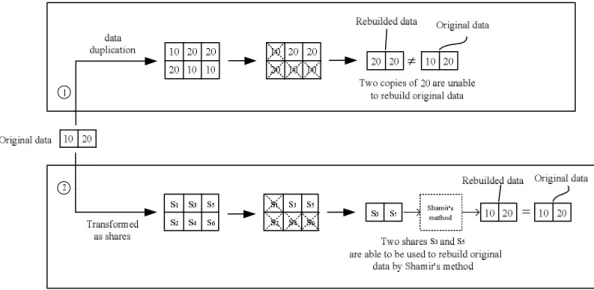
Fig. 1.2 Illustration of the better capability in fault tolerance of using secret sharing than using data duplication...9
Fig. 2.1 Illustration of scaling sample depth of a binary image from 1 to 8 by a PNG encoder. ...13
Fig. 3.1 A binary-like grayscale document image with two major gray values...18
Fig. 3.2 Framework of proposed document image authentication method. ...22
Fig. 3.3 Framework of a conventional image authentication method. ...23
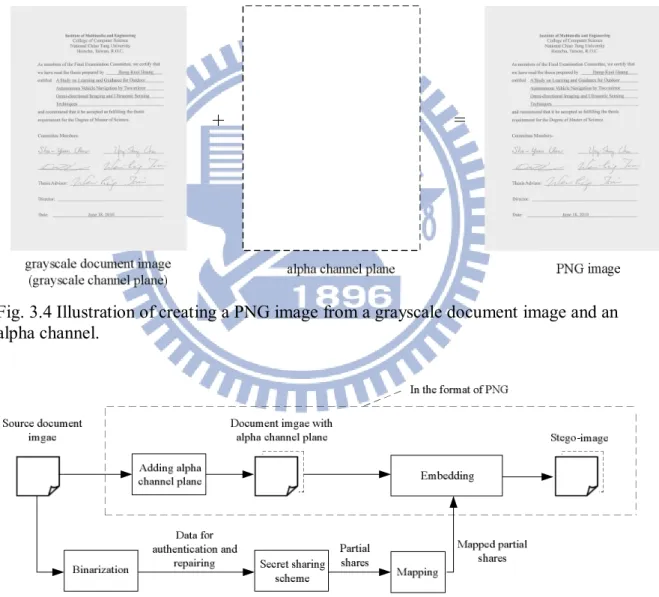
Fig. 3.4 Illustration of creating a PNG image from a grayscale document image and an alpha channel. ...24
Fig. 3.5 Generation process of a stego-image in PNG format from a grayscale document image...24
Fig. 3.6 Authentication process including verification and self-repairing of a stego-image in PNG format...25
Fig. 3.7 Illustration of embedding six shares created for a block two shares embedded at the current block and the other four in four randomly-selected pixels outside the block, with each selected pixel not being the first two ones in any block. ...28
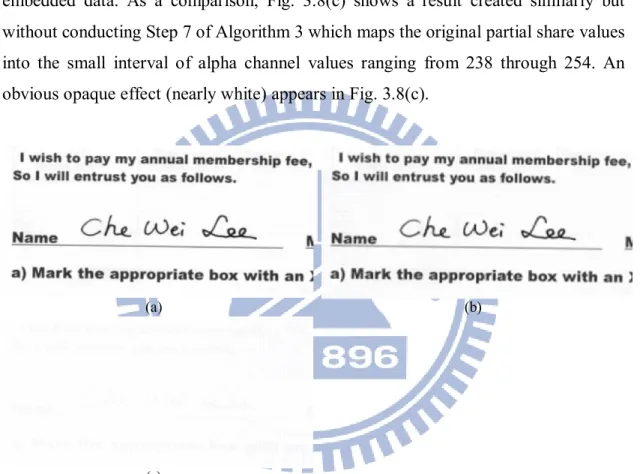
Fig. 3.8 Experimental result of a document image of a signed paper. (a) Original cover image. (b) A stego-image with embedded data. (c) Another stego-image created without conducting partial share value mapping...31
Fig. 3.9 Authentication result of a PNG document image of a signed paper attacked by superimposing a white rectangular shape on the signature in Fig. 3.8(b). (a) Tampered image yielded by the superimposing operation. (b) Result with tampered blocks detected and marked as gray. (c) Data repair result. (d) Data repair result with red dots indicating unrepaired tampered blocks. (e) Erroneous data repair result obtained with a wrong key. ...33
Fig. 3.10 Authentication result of the document image of a signed paper attacked by superimposing a white rectangular shape on a piece of text in Fig. 3.8(b). (a) Tampered image yielded by the superimposing operation. (b) Result with tampered blocks detected and marked as gray. (c) Data repair result. (d) Data repair result with red dots indicating unrepaired tampered blocks...34
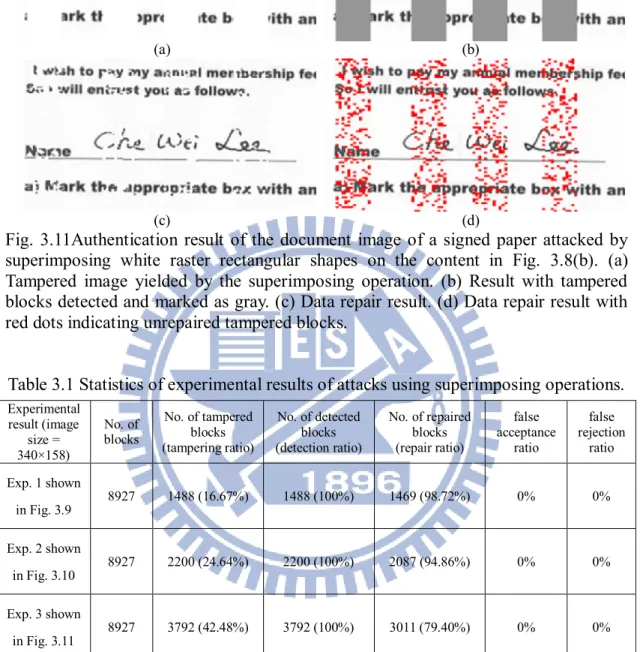
Fig. 3.11Authentication result of the document image of a signed paper attacked by superimposing white raster rectangular shapes on the content in Fig. 3.8(b). (a) Tampered image yielded by the superimposing operation. (b) Result with tampered blocks detected and marked as gray. (c) Data repair result. (d) Data
repair result with red dots indicating unrepaired tampered blocks...35 Fig. 3.12 Authentication result of document image of a signed paper attacked by
painting white color on the original signature and texts, and replacing the signature by a fake one in Fig. 3.8(b). (a) Tampered image yielded by the painting operation. (b) Result with tampered blocks detected and marked as gray. (c) Data repair result (d) Data repair result with red dots indicating
unrepaired blocks...36 Fig. 3.13 Authentication result of document image of a signed paper attacked by
painting white color on signature in Fig. 3.8(b). (a) Tampered image yielded by the painting operation. (b) Result with tampered blocks detected and marked as gray. (c) Data repair result. (d) Data repair result with red dots
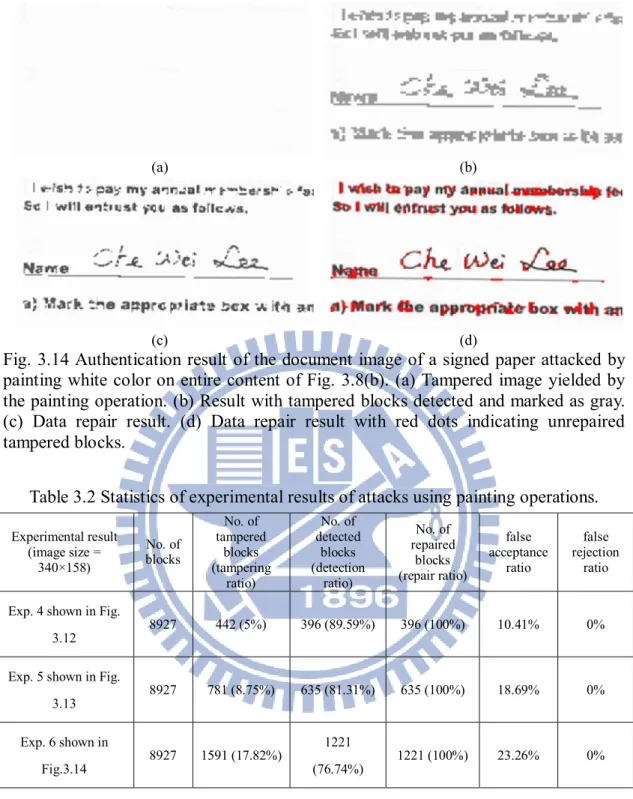
indicating unrepaired tampered blocks. ...37 Fig. 3.14 Authentication result of the document image of a signed paper attacked by
painting white color on entire content of Fig. 3.8(b). (a) Tampered image yielded by the painting operation. (b) Result with tampered blocks detected and marked as gray. (c) Data repair result. (d) Data repair result with red dots
indicating unrepaired tampered blocks. ...38 Fig. 3.15 Authentication result of an image of a check in PNG format attacked by
superimposing counterfeit number “750” located at right side and text “Seven hundred fifty” located at left side. (a) Original cover image. (b) A stego-image with embedded data. (c) Tampered image by the superimposing operation. (d) Result with tampered blocks detected and marked as gray. (e) Result of data repair. (f) Data repair result with red dots indicating unrepaired tampered
blocks. ...39 Fig. 3.16 Authentication result of a PNG document image of a check attacked by
added noises. (a) Original cover image. (b) A stego-image with embedded data. (c) Tampered image with added noises. (d) Result with tampered blocks
detected and marked as gray. (e) Data repair result. (f) Data repair result with
red dots indicating unrepaired tampered blocks. ...40 Fig. 4.1 Illustration of embedding six shares created for a block two shares
embedded within the current block and the other four in four
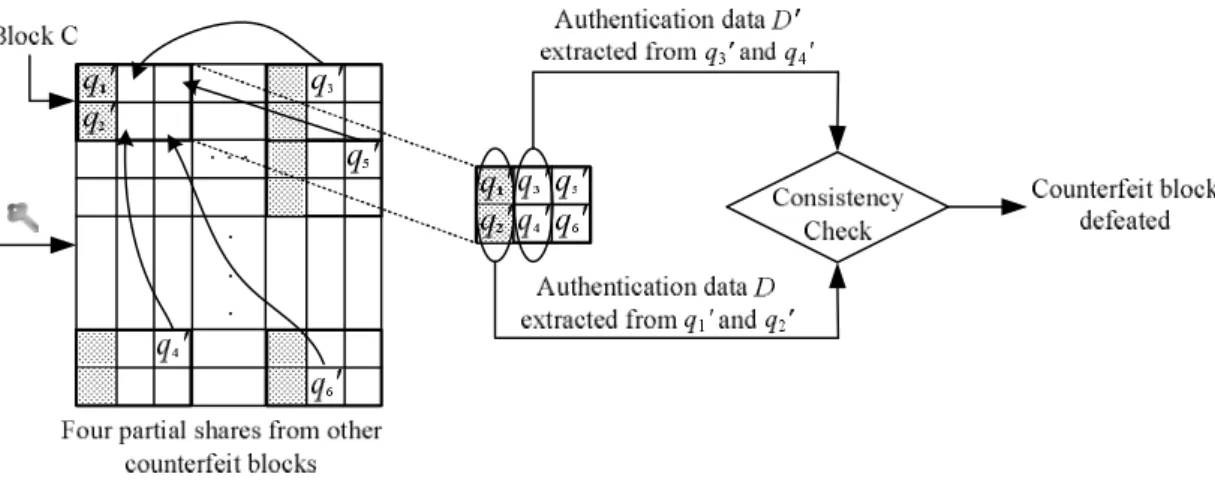
randomly-selected pixels outside the block, with each selected pixel not being
either of the first two in any block...48 Fig. 4.2 Illustration of immunity of proposed method against cut-and-paste counterfeit
attack. ...52 Fig. 4.3 Result of a binary comic image processed by proposed method. (a) PNG
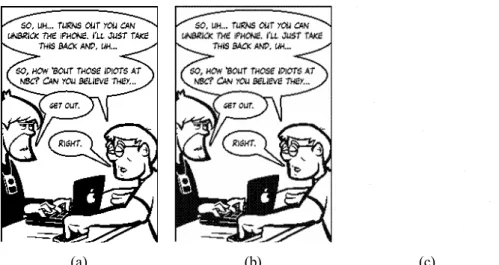
cover binary image of 216×324. (b) A stego-image with embedded data. (c)
Another stego-image created without conducting partial share value mapping. ...54 Fig. 4.4 Another authentication result of a stego-image of comic attacked by the
superimposing operation. (a) A stego-image. (b) Tampered image yielded by superimposing a fake face on the person at the right side in Fig. 4.4(a). (c) Result with tampered blocks detected and marked as gray. (d) Result of image recovery. (e) Result of image recovery with red dots indicating unrecovered tampered blocks. (f) Erroneous image recovery result obtained with a wrong
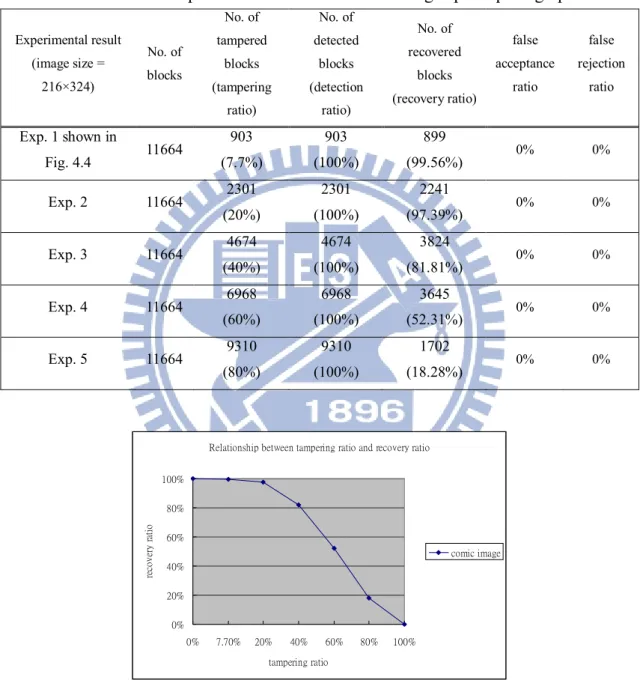
key. ...56 Fig. 4.5 Relationship between tampering ratios and recovery ratios of Table 4.2 for the
comic image. ...57 Fig. 4.6 Authentication result of a stego-image of comic attacked by painting. (a) A
tampered image. (b) Result of authentication with tampered blocks detected
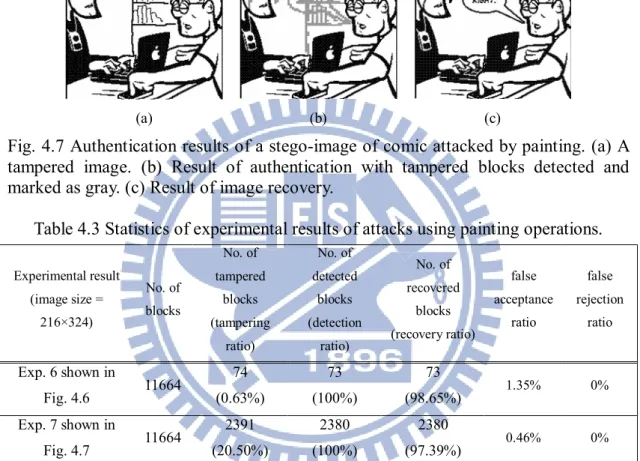
and marked as gray. (c) Result of image recovery...58 Fig. 4.7 Authentication results of a stego-image of comic attacked by painting. (a) A
tampered image. (b) Result of authentication with tampered blocks detected
and marked as gray. (c) Result of image recovery...59 Fig. 4.8 Result of a binary document image processed by proposed method. (a) PNG
cover image of 195×196. (b) A stego-image with embedded data. ...60 Fig. 4.9 Authentication result of a stego-image of document attacked by
superimposing operations. (a) A stego-image. (b) Tampered image yielded by superimposing counterfeit text parts on Fig. 4.9(a). (c) Result with tampered blocks detected and marked as gray. (d) Result of image recovery. (e)
Unrecovered blocks shown in red (none for this example)...61 Fig. 4.10 Relationship between tampering ratio and recovery ratio for the document
image...62 Fig. 4.11 Authentication result of a stego-image of document attacked by painting
color on entire content of Fig. 4.11(a). (c) Result with tampered blocks
detected and marked as gray. (d) Result of image recovery...63
Fig. 5.1 Illustration of proposed data hiding method via PNG images. ...68
Fig. 5.2 Block diagram of proposed data hiding processes. ...70
Fig. 5.3 Block diagram of proposed data extraction processes...73
Fig. 5.4 Block diagram of generating a stego-image with authentication signals. ...74
Fig. 5.5 Block diagram of verifying a stego-image...75
Fig. 5.6 Results of applying Algorithm 1 to embed a long sequence of binary message data into three images. (a) Cover image Lena. (b) Stego-image of Lena. (c) Cover image Jet. (d) Stego-image of Jet. (e) Cover image Tiffany. (f) Stego-image of Tiffany...78
Fig. 5.7 An example of experimental results showing compromise between data hiding capacity and stego-image quality. (a) Stego-image of Lena yielded by choosing t = 7 with more data hidden but showing more white noise coming from the alpha channel. (b) Stego-image of Lena yielded by choosing t = 3 with less data hidden but with almost no noise due to nearly total transparency in the alpha channel. ...79
Fig. 5.8 Stego-images yielded by Algorithm 1 for t = 1 through 7. (a) through (g) correspond to t = 1, 2, …, 7, respectively. ...80
Fig. 5.9 Authentication result of an attacked stego-image of Tiffany with a pasted fake mouth. (a) Cover image. (b) Stego-image with authentication signals. (c) Modified stego-image. (d) Result with altered pixels detected and marked in black. ...81
Fig. 5.10 Authentication result of an attacked stego-image of Tiffany with an added rose. (a) Stego-image with authentication signals. (b) Modified stego-image. (c) Result with altered pixels detected and marked in black. ...82
Fig. 5.11 Authentication result of an attacked stego-image of jet with the smeared logo and words. (a) Stego-image with authentication signals. (b) Modified stego-image. (c) Result with altered pixels detected and marked in black. ...83
Fig. 5.12 Authentication result of an attacked stego-image in which the jet has been smeared. (a) Stego-image with authentication signals. (b) Modified stego-image. (c) Result with altered pixels detected and marked in black. ...84 Fig. 6.1 Illustration of bin code (authentication signal) generation and embedding. (a)
randomly selected by a secret key K. ...90 Fig. 6.2 Diagram of authentication signal matching and tampered pixel marking
(detail to be described in Algorithm 2). ...92 Fig. 6.3 Diagram of tampered pixel repairing (detail to be described in Algorithm 2)...92 Fig. 6.4 Generation of stego-image from an input surveillance image. (a) Input image
taken by a monitor. (b) Stego-image with PSNR value 37.51. ...99 Fig. 6.5 Authentication result of a surveillance image taken by a monitor with
tampered area. (a) Image with modification of two car plate numbers. (b) Authentication image with noise. (c) Final authentication image. (d) Final
repairing result with PSNR 45.60 with respect to stego-image. ...100 Fig. 6.6 Authentication result of a surveillance image taken by a monitor with
tampered area. (a) Image with modification of entire car plate. (b)
Authentication image with noise. (c) Final authentication image. (d) Final
repairing result with PSNR 36.38 with respect to stego-image. ...103 Fig. 6.7 Relations of performances among tampering ratios, false tampering detection,
and tampering repairing using surveillance image of Fig. 6.4(a)...103 Fig. 6.8 Generation of stego-image from another image. (a) Input image Lena. (b)
Stego-image with PSNR 39.34...104 Fig. 6.9 Authentication result of a grayscale image with an added flower shape
composed of 2084 pixels. (a) Image with modification of a hair portion. (b) Authentication image with noise. (c) Final authentication image. (d) Final
repairing result with PSNR 47.00 with respect to stego-image of Fig. 6.9(b). ...105 Fig. 6.10 Relations of performances among tampering ratios, tampering detection, and
tampering repairing using image Lena of Fig. 6.8(a). ...106 Fig. 7.1 Illustration of proposed covert communication method via spreadsheets by
secret sharing. (a) Generation of a stego-spreadsheet. (b) Self-authentication of
the extracted message. ... 110 Fig. 7.2 Examples of spreadsheets. (a) Microsoft Excel. (b) Google Docs... 111 Fig. 7.3 A cover spreadsheet with 300 numeric items of students’ test scores. (a) List
of the first 36 items in the spreadsheet. (b) List of the last 34 items in the
spreadsheet. ...118 Fig. 7.4 A dialogue for entering input secret message. ... 119 Fig. 7.5 Comparison of a cover spreadsheet and the stego-spreadsheet generated from
Fig. 7.6 A tampered spreadsheet with fake items 16 through 26. ...121 Fig. 7.7 An extracted secret message with a message segment retrieved from tampered
items in the stego-spreadsheet marked by symbols “*.”...121 Fig. 7.8 A cover spreadsheet of financial statement with 32 numeric items. ...124 Fig. 7.9 A dialogue with the input secret message. ...124 Fig. 7.10 A stego-spreadsheet in which the decimal fractions of the numeric items
have been modified by embedded shares...124 Fig. 7.11 A stego-spreadsheet with 3 numeric items (highlighted) being modified...125 Fig. 7.12 The recovered secret message. (a) Message extracted from the intact
stego-spreadsheet shown in Fig. 7.10. (b) Message extracted from the
modified stego-spreadsheet shown in Fig. 7.11. ...125 Fig. 8.1 Test images used in experiments. (a) Lena. (b) Airplane. (c) Baboon. (d) Boat...137 Fig. 8.2 Illustration of comparison of embedding capacity versus image distortion
between the proposed method and Kim et al.’s method using (a) image Lena,
List of Tables
Table 1.1 Proper applications of proposed methods...11
Table 3.1 Statistics of experimental results of attacks using superimposing operations...35
Table 3.2 Statistics of experimental results of attacks using painting operations...38
Table 3.3 Statistics of experimental results of using an image of check. ...40
Table 3.4 Comparison of document image authentication methods. ...41
Table 4.1 List of symbols used in Algorithms 3 and 4...46
Table 4.2 Statistics of experimental results of attacks using superimposing operations...57
Table 4.3 Statistics of experimental results of attacks using painting operations...59
Table 4.4 Statistics of experimental results of attacks using superimposing operations...61
Table 4.5 Statistics of experimental results of attacks using painting operations...63
Table 4.6 Size comparison between cover images and resulting stego-images...64
Table 4.7 Comparison of binary image authentication methods...65
Table 5.1 Data hiding capacities and stego-image qualities for t = 1 through 7 (DHC = data hiding capacity; PSNR = peak of signal to noise ratio)...79
Table 5.2 Statistics of experimental results. ...82
Table 5.3 Statistics of experimental results. ...84
Table 5.4 Comparison of existing color image authentication methods. ...85
Table 6.1 Bins, bin numbers, bin codes, and representative values of bins used in this study. ...89
Table 6.2 Statistics of experiments using a surveillance image of Fig. 6.4(a)...102
Table 6.3 Statistics of experiments using image Lena of Fig. 6.8(a). ...106
Table 6.4 Comparison of performance of proposed method with those of [8] and [9]...107
Table 6.5 Comparison of performance of proposed method with those of [71]. ...107
Table 7.1 Experimental results of using strategy 1 with a cover spreadsheet with high scatter level of numeric data...122
Table 7.2 Experimental results of using strategy 1 with a cover spreadsheet with medium scatter level of numeric data. ...122
Table 7.3 Experimental results of using strategy 1 with a cover spreadsheet with low scatter level of numeric data...123
Table 7.4 Experimental results of using strategy 2 for a cover spreadsheet of a financial statement. ...125
Table 8.1 Statistics of experimental results of proposed method using block size 33. ...137 Table 8.2 Statistics of experimental results of Kim et al’s method using the sampling
Chapter 1
Introduction
1.1 Motivation of Study
With the era of cloud computing coming, data stored originally in personal computers mostly will eventually be moved to and processed in powerful servers at far ends. However, how can one be sure that personal data accessed from cloud servers are intact? Undoubtedly, this problem of data security has become a significant issue in the age of cloud computing. This study tries to explore this issue of keeping digital image data secure. Furthermore, with the fast advance of digital technologies, it is easy to make visually imperceptible modifications to the contents of digital images. To ensure the integrity and authenticity of a digital image is thus a challenge. In addition, it is hoped that if a critical image part is authenticated to have been altered illicitly, its original content can be recovered. The use of an image authentication technique provides a solution to this issue and this thesis study is also devoted to this second security issue of keeping digital image data.
On the other hand, covert communication is the art of concealing secret information into a cover medium in an undetectable way and only a sender and an intended receiver know the existence of the hidden data in the resulting stego-medium. However, if an adversary subtly makes modifications to the passing-by stego-medium for the purpose of misleading a receiver, or if the stego-medium undergoes some unintentional destruction during the transmission, a receiver might extract an incorrect secret message from the stego-medium. Therefore, how to provide a self-authentication capability for verifying the correctness of an extracted secret message is a challenge. This thesis study is devoted to this issue of multimedia security as well.
Also very important for the purpose of maintaining multimedia security is the development of reversible data hiding techniques. Such techniques embed message data into host images and are capable of restoring the resulting stego-images to their original states after the hidden data are extracted. In particular, histogram shifting is an efficient technique used in many reversible data hiding methods. However, before extracting the hidden data, certain information, called overhead information, needs to
be known in advance. Therefore, a fourth goal of this research is to solve this common problem of how to share such overhead information between the sender and the recipient.
In summary, the goals of this thesis study include: 1) secure keeping of image data; 2) image authentication; 3) self-authentication of embedded messages; and 4) overhead sharing for reversible data hiding. Fulfillments of these goals together enhance the state-of-art studies on image authentication and covert communication for multimedia security applications.
1.2 Overview of Data Hiding and its Applications related to
multimedia security
Data hiding is a process of embedding information imperceptibly into a certain digital file that acts as a host. Via the use of data hiding techniques, many applications related to multimedia security can be accomplished as shown in Fig. 1.1.
Fig. 1.1 Scope of data hiding applications.
Through data hiding techniques, multimedia authentication can be accomplished. Specifically, information such as authentication signals can be embedded by a data hiding technique into a cover image to be protected to create a stego-image, and illicit modifications made to the stego-image may then be localized such that the integrity and fidelity of the original image content can be checked. It is noted that the major concern in the application of image authentication is the fragility of the embedded signals. In practical uses, it is desirable that an image authentication method is capable of further recovering the localized tampered region.
Applications of Data Hiding Multimedia Authentication Copyright Protection Covert Communication Data Association Digital rights management …
On the other hand, in the application of copyright protection, an owner of a digital file can use data hiding techniques to embed a visible or invisible digital watermark into the file content to claim the ownership of the content. The major concern in such an application is the robustness of the embedded signals, which means that a surviving and recognizable watermark such as a logo has to be extracted from the stego-image even after attacks
A third application of data hiding is covert communication, by which people can hide a secret message into a cover file, resulting in a stego-file; and a receiver of the latter can extract the hidden message from it to complete the communication. In more detail, the major concern in the application of covert communication is the undetectability of the embedded information. By concealing secret information into a cover medium in an undetectable way, only a sender and an intended receiver know the existence of the hidden data in the resulting stego-medium.
In the following sections, a survey of related works is given in Section 1.3, followed by the contributions of this study in Section 1.4. Finally, the organization of this thesis is described in Section 1.5.
1.3 Survey of Related Works
In this study, the concerned topics include Image authentication, covert communication, and data hiding. With the era of cloud computing coming, data stored originally in personal computers mostly will eventually be moved to and processed in powerful servers at far ends. A problem involved here is how to make sure that personal data accessed from cloud servers are intact. This problem of data security is a very significant issue. This study explores this issue of keeping digital image data secure, and proposes the use of an image authentication technique as a solution.
In the literature, several authentication methods for binary images have been proposed. Wu et al. [1] explored flippable image pixels in which data can be embedded without causing noticeable artifacts for the purpose of authentication and annotation of binary images. Yang et al. [2] proposed a pattern-based data hiding method for binary image authentication, which uses the flippability of pixels effectively by a connectivity-preserving criterion [3]. Kim et al. [4] chose a set of pseudo-random pixels which were later cleared for embedding authentication code in a binary or halftone image. Tzeng and Tsai [5] embedded authentication codes into
blocks of a cover binary image for the later use of tampering detection in the verification process. In addition, to reduce the image distortion caused by the authentication codes embedding, a technique of using a code holder allowing multiple locations of pixels for embedding the codes was proposed. Lee et al. [6] embedded watermark data into one pixel in each binary image block by a Hamming-code-based data embedding method with small distortions and low false negative rates. Method proposed in [7] utilized an edge-line similarity measure to choose flippable pixels, yielding smaller distortion compared with that of method in [6].
As to the image authentication for grayscale images, several fragile watermarking techniques for image authentication have been proposed in the past and they may be categorized into two approaches: block-wise [8-14] and pixel-wise [15-18]. Methods of the former approach embed fragile watermarks as authentication signals into non-overlapping blocks of the cover image and identify possible tampered image parts in the unit of block. One weakness of such block-level authentication methods is that the detail of the tampered image part cannot be located precisely [16]. On the other hand, methods of the second approach [15-18] authenticate images at the pixel level such that tampered image parts can be identified pixel by pixel, yielding a detailed tampering localization result. Liu et al. [15] generated a binary image that is mapped from the difference image computed from the cover image and its so-called chaotic pattern. And the least-significant-bit (LSB) plane was used to accommodate the binary image as the fragile watermark for the use in later image authentication. Because of the binary nature of the embedded fragile watermark, the LSB of a tampered pixel value may coincide with the watermark bit, yielding a high erroneous pixel authentication rate up to 50%. To deal with this phenomenon, a statistical fragile watermarking method which utilizes probability distributions computed from the original pixels and the tampered ones to locate the tampered pixels was proposed in Zhang and Wang [16]. However, the method only works in the case that the tampering ratio is smaller than 1.1% [17]. As an improvement, Zhang and Wang [17] proposed later a fragile watermarking method for authenticating grayscale images using a hierarchical mechanism, which embeds watermark data derived from the pixels and blocks of the cover image into the LSBs of all the pixels. In the authentication process, tampered blocks are identified first, and tampered pixels within the identified blocks are located subsequently.
Covert communication is a technique of concealing secret information into a cover medium in an imperceptible way or with a camouflage effect such that only a sender and an intended receiver know the existence of the hidden data in the resulting stego-medium. In the literature, emphases were put on the use of multimedia like images, videos, and audios [19-22] because these media in general provide larger embeddable spaces and cause less suspicion due to their wide distributions. And weaknesses existing in human beings’ visual capabilities are often exploited to design effective covert communication methods. For example, the methods proposed in [23-25] replace the least-significant bits of pixels in cover images to embed information, and that of [26] uses the parities of palette colors, composed by similar colors, to represent hidden message bits.
In addition to methods developed for multimedia, several others [27-30] used cover media of text, PDF, or Word documents for covert communication. In Brassil and Maxemchuk [27], data are embedded by slightly adjusting the lines, tabs, or characters in text files. Lee and Tsai [28] used special ASCII codes in PDF files to embed data between characters. Liu and Tsai [30] made use of the change tracking function in Microsoft Word to embed data imperceptibly by a document degeneration technique.
As to the topic of data hiding, many data hiding methods for use in the spatial domain of image files [31-35] have been proposed. Bender et al. [31] proposed the technique of least-significant-bit (LSB) replacement, in which a secret message is embedded in the least significant bits of image pixel values. The method yields high data hiding capacities and low computational complexities. Following Bender et al. [31], Wang et al. [32] proposed an optimal LSB-replacement-based method which is integrated with a genetic algorithm to reduce the computation time for finding the optimal hiding result. Mielikainen [33] proposed a modified LSB replacement method which embeds as many bits as the conventional method, but changes less pixel values. Wu and Tsai [34] proposed a steganographic method for images by pixel-value differencing, in which the difference values between pixel value pairs are classified into a number of ranges to decide the number of bits which can be embedded into the pixel pairs. Yang et al. [35] proposed an adaptive k-LSB substitution method in which larger values of k are adopted in the edge areas of the cover image and smaller ones are used for the smooth areas. Also, the range of value differences of consecutive pixel pairs is divided into different levels, and the value of k is adaptively decided
according to the level into which the pixel difference value falls. In this way, larger data hiding capacities with higher stego-image qualities can be obtained.
Another data hiding approach is to utilize the frequency domain. Wang et al. [36] transformed image block contents into coefficients in the frequency domain by the discrete cosine transform (DCT), recomputed the AC values of the central block of every nine 8×8 image blocks, and embedded secret bits by modifying the magnitude relations between the new AC values and the original ones. Wu and Hsieh [37] embedded data in the frequency domain by using the so-called zerotree in the rearranged DCT coefficients of the cover image. Besides data embedding techniques using the DCT, the discrete wavelet transform (DWT) [38-40] and the discrete Fourier transform (DFT) [41-42] have also been used.
From another viewpoint, different types of image may be used as cover media such as JPEG [43-45] and palette-based images [46-49]. Fridrich and Du [46] explored the optimal parity of a color palette, and embedded message bits into the parities of palette colors. Tzeng, Yang, and Tsai [47] hid secret data into data-embeddable image pixels by using a color-mapping function, and the color of a data-embeddable pixel is replaced by an optimal one selected from the color palette. Zhang et al. [48] utilized the concept of gregarious color, meaning a color with some other colors similar to it, in the palette to hide at least one secret bit for any pixel with a gregarious color. In [49], Lee and Wu proposed a reversible data hiding method for palette-based images, which adjusts palette colors and image data to embed secret data and side information for reconstruction of the original image content.
Reversible data hiding methods embed message data into host images and are capable of restoring resulting stego-images to their original states after the hidden data are extracted. Histogram shifting is an efficient technique used in many reversible data hiding methods. Ni, et al. [50] shifted slightly part of a histogram between its peak point and the zero point by one pixel value to create an empty bin besides the peak point for accommodating message data. The knowledge of the locations of the peak point and the zero point of the histogram need be memorized in order to retrieve the hidden data and restore the original image losslessly, making the resulting method non-blind. Kuo et al. [51], Lee and Tsai [52], and Fallahpour et al. [53] proposed a similar idea of decomposing an entire cover image into blocks and using the peak point of the histogram of each block to hide data. The technique of block division successfully improves the data hiding capacity but the side information composed of
peak points and zero points still should be kept. Tsai et al. [54] explored the similarity of neighboring pixels in the host image and employed a linear prediction technique to generate a residual histogram of the image for data embedding. The data hiding capacity of Tsai et al.’s method [54] is superior to the aforementioned histogram-based hiding methods and maintains simultaneously the high quality of the resulting stego-image; however, the side information of peak points and zero points is still needed. Later, Kim et al. [55] utilized the high spatial correlation between sub-sampled images of the cover image to obtain a high data embedding capacity while keeping the distortion in the stego-image at a low level.
1.4 Main Ideas and Contributions of This Study
In this study, the secret sharing proposed by Shamir in 1979 is utilized to develop a series of image authentication methods with data recovery capabilities. The original aim of the secret sharing method is to deal with the issue of key management in cryptographic systems. This technique transforms the value of a key into many data pieces, called secret shares, which are then distributed to some participants. At a later time, the value of the key can be reconstructed using a sufficient number, but not necessarily all, of the shares. This results in a property of loss-tolerant capability, which inspires us to apply such a secret sharing technique to develop a data recovery capability for the image authentication method. Accordingly, the content of the image to be authenticated may be transformed into many secret shares; and can be recovered, even if tampered with, when a sufficient number of shares are collected.
However, a problem one may encounter here is how to find enough space in an image to accommodate the secret shares. The embedding spaces in the spatial or frequency domain provided by conventional methods seem insufficient to satisfy the requirement of large-volume spaces for embedding the shares. To deal with this issue, the PNG image with an alpha channel plane is explored in this study to solve the problem. Meanwhile, the transparency of the alpha channel is also utilized to provide a camouflage effect to the embedded secret shares, resulting in a nearly transparent image.
In addition to the previously-mentioned inspiration of using the secret sharing technique, in the following we state further more benefits of using the secret sharing method for data recovery in the image authentication methods to be proposed later in
this thesis. Moreover, some additional new ideas behind other methods proposed in this study are also described in this section. Finally, the main contributions made in this study are listed.
A. Why secret sharing
An intuitive strategy for image recovery in an image authentication method is data duplication, which means that multiple copies of image data are created and stored somewhere in the image itself. Accordingly, if the image is damaged to some extent, it may be recovered by utilizing the surviving copies. This strategy is reasonable but has two drawbacks. The first is that the data sequence in the stored image copies must be known, and the second is that if a part of the stored image data is destroyed, the image content will possibly not be recoverable even when other parts of the image data are retained.
In this study, we propose the use of the Shamir secret sharing method, also called the (k, n)-thresholding method, to overcome the two drawbacks mentioned above. By the method, the original data are transformed into n shares, and when k of the n shares are collected, the original data can be reconstructed without the prior knowledge of the data sequence. As a result, a higher capability of fault tolerance is yielded. This merit is not found in the approach of data duplication. An example for revealing this merit is shown in Fig. 1.2.
Specifically, in the upper rectangle shown in Fig. 1.2, the original data consisting of two parts, “10” and “20,” are duplicated into three copies to become six digits as shown in the figure. Then, if two digits, both “20,” survive attacks, the original data unfortunately cannot be reconstructed because both are the same value “20.” On the other hand, the rectangle shown below in the figure illustrates the case of (2, 6)-thresholding. The original data 10 and 20 are transformed into 6 shares, and even if only two shares survive, the original data can still be reconstructed without errors. This reveals that in the same condition of collecting two surviving digits, the capability of fault tolerance provided by the (k, n)-thresholding method is better than that provided by the data duplication scheme.
Fig. 1.2 Illustration of the better capability in fault tolerance of using secret sharing than using data duplication.
B. Other new ideas proposed in this study for enhancing multimedia security
In the field of steganography, the existing methods are mostly only concerned with statistical undetectability and none of them can promise the receiver that the message that he/she extracts from a stego-file is trusty and intact. To deal with this weakness, we propose in this study a new steganographic method with a self-authentication capability for secret data hiding in spreadsheets using the secret sharing technique. In the method, a scheme of (k, k+1)-threshold secret sharing is developed for the first time to provide a self-authentication capability by checking the value-consistency of k + 1 results coming from all k + 1 combinations to determine whether an extracted secret is intact or not.
Finally, in the field of reversible data hiding, histogram shifting is an efficient technique used in many related methods. However, an issue of how to share the information of the used peak points between the sender and the receiver remains to be solved. In this study, a new histogram-shifting-based blind reversible data hiding method composed of two-phase iterations for more effective data hiding is proposed. With the cooperation of the two data hiding phases based on histogram shifting, the proposed method skillfully stores the value of the peak point yielded in phase 1 via the use of phase 2, solving the common problem of sharing the peak information between the two parties.
C. Main contributions of this study
The main contributions of this thesis study are summarized in the following. 1. A new blind image authentication method with a data repair capability for
binary-like grayscale document images based on secret sharing is proposed. The proposed method has higher possibility to survive image content attacks and provides pixel-level repairs of tampered image parts.
2. A new approach to binary image authentication based on the uses of PNG images and the secret sharing technique with a self-recovery capability for repairing tampered image data is proposed. The proposed method has the capabilities of tampering detection, tampering localization, and tampering recovery, and also has the capability of reversing the tampered image to its original content.
3. A new data hiding method via PNG images based on Shamir’s (k, n)-threshold secret sharing scheme is proposed and can be applied to color image authentication. The proposed image authentication method possesses the merits of losslessness during image authentication, high sensitivity to image alterations, good tampering localization capability, and very low false acceptance and rejection ratios.
4. A new blind pixel-level self-repairing grayscale image authentication method, which is optimal under a minimax criterion of image distortion reduction, is proposed. The proposed method develops the “bin code” for use both as an authentication signal for the image pixel and as an index for generating the data for repairing the image pixel when it is authenticated to have been tampered with.
5. A new covert communication method with a self-authentication capability for secret data hiding in spreadsheets using the information sharing technique is proposed. In the proposed method, the presence of the steganographic content is statistically undetectable and a receiver can confirm the correctness of the extracted secret message.
6. A blind two-phase reversible data hiding method based on histogram shifting is proposed. The proposed method has the advantageous property of blindness and significantly improves the data hiding capacity while keeping low degradations of the image quality when compared with other methods.
In addition, a summarized table listing applications for which the aforementioned proposed methods are developed is given in the following.
Table 1.1 Proper applications of proposed methods. Image authentication Covert Communication Copyright protection Data Association 1st method ▲ 2nd method ▲ 3rd method ▲ ▲ 4th method ▲ 5th method ▲ 6th method ▲ ▲
1.5 Thesis Organization
The remainder of this thesis is organized as follows, In Chapter 2, an overview of the proposed techniques and the ideas associated with image authentication, covert communication, and reversible data hiding is given. In Chapter 3, the proposed method for authentication of grayscale document images with a data repairing capability is described. In Chapter 4, the proposed new approach to binary Image authentication is described. The proposed color image authentication method based on a new data hiding technique is presented in Chapter 5. In Chapter 6, the proposed pixel-level self-repairing authentication method for grayscale images is described. In Chapter 7, the proposed covert communication method based on information sharing is described. In Chapter 8, the proposed blind reversible data hiding method is described. Finally, in the last chapter, conclusions of this study and some suggestions for future research are included.
Chapter 2
Overview of Proposed Techniques and Ideas
In this chapter, we describe the main ideas and techniques of the proposed methods for image authentication, steganography and reversible data hiding.
2.1 Repairable Authentication Method for Grayscale
Document Images
A method for authentication of document images with an additional self-repair capability for fixing tampered image data is proposed. The input cover image is assumed to be a binary-like grayscale image with two major gray values. After the proposed method is applied, the cover image is transformed into a stego-image in the PNG format with an additional alpha channel for transmission on networks or archiving in databases. The stego-image, when received or retrieved, may be verified by the proposed method for its authenticity. Integrity modifications of the stego-image can be detected by the method at the block level and repaired at the pixel level. In case that the alpha channel is totally removed from the stego-image, the entire resulting image is regarded as inauthentic, meaning that the fidelity check of the image fails. The proposed method is based on the so-called (k, n)-threshold secret sharing scheme proposed by Shamir [56] in which a secret message is transformed into n shares for keeping by n participants; and when k of the n shares, not necessarily all of them, are collected, the secret message can be recovered losslessly. Such a secret sharing scheme is useful for reducing the risk of incidental partial data loss.
To the best of our knowledge, this is the first secret-sharing-based authentication method for binary-like grayscale document images. It is also the first authentication method for such document images through the use of the PNG image. Note that this method is not a secret-sharing technique, but a document image authentication method.
2.2 Recoverable Authentication Method for Binary Images
A new method for binary image authentication with an additional self-recovery capability for repairing tampered image data is proposed. The method is based on the (k, n)-threshold scheme proposed by Shamir [56] for secret sharing and is developed via the use of PNG images with alpha channels. The secret sharing scheme is used in the proposed method to enhance the capability of self-recovery of lost data as well as to generate share data which carry information for image authentication and data recovery.
More specifically, the alpha channel in a cover PNG image is used in this study as a carrier for embedding secret shares, though it is defined originally for creating desired image transparencies. Since all channels in a PNG image should have the same sample depth according to the PNG standard [57], a PNG encoder will scale all the channels’ samples up to the same depth. Therefore, a binary image used in this study whose sample depth is 1 will automatically be scaled up to have a depth of 8 but with only two pixel values 0 and 255, when an alpha channel with sample depth 8 is appended to the original binary image. Fig. 2.1 shows how samples of depth 1 are mapped to depth 8 in the scaling process.
Fig. 2.1 Illustration of scaling sample depth of a binary image from 1 to 8 by a PNG encoder.
However, it is found that embedding data into the alpha channel will yield random transparency in the resulting stego-image, producing an undesired opaque effect with a lot of white noise. A solution to this phenomenon, as proposed in this study, is to map the resulting alpha channel values into a small range near their extreme value of 255, yielding instead uniformly distributed and nearly imperceptible noise in the alpha channel. This idea of creating the effect of imperceptibility by
alpha-channel value mapping is proved feasible by the experiments conducted in this study.
Finally, to recover losslessly the original content of a tampered block, the technique adopted in the proposed method is to distribute the generated multiple shares randomly into the alpha channel. The resulting location randomness of the shares together with their multiplicity allows the share data to have more chances to survive attacks without being totally destroyed, thus promoting the capability of image recovery of the proposed method.
2.3 Color Image Authentication Based on an
Information-sharing-based Data Hiding Method
In the information-sharing-based data hiding method proposed in this study, a PNG image is used as the cover image in which the alpha-channel value of each pixel is set to be 255 initially. That is, the cover image is a totally transparent color one at the beginning of the proposed data hiding process. A data string to be hidden is transformed into shares by the Shamir’s secret sharing method, which is then embedded into the alpha-channel plane of the cover PNG image. Coefficient parameters involved in the Shamir method are used as carriers of the data to be hidden in the proposed method. A prime number used in the method, which is found to dominate the resulting visual quality and data hiding capacity of the stego-image, is properly selected. Also, a mapping function is designed for adjusting the alpha-channel values to create uniform transparency in the alpha-channel plane, resulting in an imperceptible effect in the stego-image. The original R, G, and B channels are untouched so that the original image appearance revealed by the color information of these three channels is kept.
The proposed data hiding method is suitable for applications of image authentication and metadata hiding. In particular, the application of the proposed method to color image authentication is investigated and relevant algorithms are proposed in the subsequent chapter.
2.4 Self-repairing Authentication Method for Grayscale
Images
A method for pixel-level grayscale image authentication using fragile authentication signals with an additional capability for repairing attacked image parts automatically is proposed. The method is based on the concept of compressing a number of the most significant bits (MSBs) of a pixel’s gray value into a shorter “bin code” for use both as an authentication signal for the pixel and as an index for generating the data for repairing the pixel when it is authenticated to have been tampered with. The bin code is generated from a bin-mapping scheme which transforms each pixel’s gray value into one of eight “bins,” coded by three bits. It is proved that the choice of using three bits out of eight ones in a pixel as the bin code is optimal under a minimax criterion of reducing the total maximum pixel-level gray-value distortion resulting both from authentication signal embedding and from tampered pixel repairing.
2.5 Covert Communication Method via Spreadsheets with
an Authentication Capability
We propose a new covert communication method which applies Shamir’s (k, n)-threshold secret sharing scheme with n = k + 1 to a given secret item to yield k+1 shares, and the generated k + 1 shares are embedded into the number items in a spreadsheet as if they are part of the spreadsheet content. The purpose of transforming the secret data into secret shares by the (k, k+1)-threshold secret sharing scheme is not to enforce robustness, but to yield a blind self-authentication capability for the embedded secret. Conventionally, the concept of (k, n)-threshold secret sharing is applied to provide destruction-tolerant capabilities. That is, any k shares collected
from n ones may be processed to reveal the shared secret even though up to (n k) shares are destroyed. But in the proposed method, the scheme of (k, k + 1)-threshold secret sharing is developed for the first time to provide instead a self-authentication capability by checking the value-consistency of k + 1 results coming from all k + 1 combinations to determine whether the extracted secret is intact or not. That is, only when the results computed from any k shares collected from k + 1 shares are all identical in value can the extracted secret be decided to be intact. Moreover, to
conceal the presence of hidden data, secret shares are spread throughout the cover spreadsheet in a sparsely fashion. And a spreadsheet containing numeral items with a high scatter level is more suitable to be used as a cover spreadsheet for better concealment.
2.6 Reversible Data Hiding Method
An iterative reversible data hiding method which is composed of two phases and yields high data embedding rates is proposed. The method utilizes the spatial similarity of neighboring pixels to create a difference histogram. In the first phase of histogram shifting, the peak point of the difference histogram is used to accommodate some message data, and in the second phase the value of the peak point, combined with the remaining message data, is embedded into the difference histogram again using another histogram-shifting scheme.
Chapter 3
A Secret-Sharing-Based Method for
Authentication of Grayscale Document Images
via the Use of the PNG Image with a Data
Repairing Capability
3.1 Introduction
Document images, which include texts, tables, line arts, etc. as main contents, are often digitized into grayscale images with two major gray values. One of the two values represents the background (including mainly blank spaces) and the other represents the foreground (including mainly texts). It is noted that such images, though gray-valued in nature, look like binary. For example, the two major gray values in the document image shown in Fig. 3.1 are 174 and 236, respectively. It seems that such binary-like grayscale document images may be thresholded into binary ones for later processing, but such a thresholding operation often destructs the smoothness of the boundaries of text characters, resulting in visually unpleasant stroke appearances with zigzag contours. Therefore, in practical applications text documents are often digitized and kept as grayscale images for later visual inspection.
In general, the image authentication problem is difficult for a binary document image because of its simple binary nature. This nature leads to creation of perceptible changes after authentication signals are embedded in the image pixels. Such changes will arouse possible suspicions from attackers. A good solution to such binary image authentication thus should take into account not only the security issue of preventing image tampering, but also the necessity of keeping the visual quality of the resulting image. In this study, we propose an authentication method which deals with binary-like grayscale document images instead of pure binary ones, and solves simultaneously the problems of image tampering detection and visual quality keeping.
Fig. 3.1 A binary-like grayscale document image with two major gray values.
In this study, a method for authentication of document images with an additional self-repair capability for fixing tampered image data is proposed. The input cover image is assumed to be a binary-like grayscale image with two major gray values like the one shown in Fig. 3.1. After the proposed method is applied, the cover image is transformed into a stego-image in the PNG format with an additional alpha channel for transmission on networks or archiving in databases. The stego-image, when received or retrieved, may be verified by the proposed method for its authenticity. Integrity modifications of the stego-image can be detected by the method at the block level and repaired at the pixel level. In case that the alpha channel is totally removed from the stego-image, the entire resulting image is regarded as inauthentic, meaning that the fidelity check of the image fails. The proposed method is based on the so-called (k, n)-threshold secret sharing scheme proposed by Shamir [56] in which a secret message is transformed into n shares for keeping by n participants; and when k of the n shares, not necessarily all of them, are collected, the secret message can be recovered losslessly. Such a secret sharing scheme is useful for reducing the risk of incidental partial data loss.
Conventionally, the concepts of “secret sharing” and “data hiding for image authentication” are two irrelevant issues in the domain of information security. But in the proposed method, we combine them together to develop a new image authentication technique. The secret sharing scheme is used in the developed
technique not only to carry authentication signals and image content data, but also to help repair tampered data through the use of shares.
An issue in self-repairing of tampered data at attacked image parts is that after the original data of the cover image are embedded into the image itself for use in later data repairing, the cover image is destructed in the first place and the original data are no longer available for data repairing, resulting in a contradiction. A solution to this problem is to embed the original image data somewhere else without altering the cover image itself. The way proposed in this study to implement this solution is to utilize the extra alpha channel in a PNG image to embed the original image data. However, the alpha channel of the PNG image is used originally for creating a desired degree of transparency for the image. Embedding of data into the alpha channel will so create random transparency in the resulting PNG image and produce an undesirable opaque effect. One way out, as proposed in this study, is to map the resulting alpha channel values into a small range near their extreme value of 255, yielding a nearly imperceptible transparency effect on the alpha channel plane.
Another problem encountered in self-repairing of the original image data is that the data to be embedded in the carrier are often large-sized. For our case here with the alpha channel as the carrier, this is not a problem because we may just transform the binary-like cover image into a binary version and embed the small-sized result into the carrier. Furthermore, through a careful design of authentication signals, a proper choice of the basic authentication unit (i.e., the unit of 2×3 image block), and a good adjustment of the parameters in Shamir’s scheme, we can reduce the data volume of the generated shares effectively so that more shares can be embedded into the alpha channel plane. It is noted that by the proposed method, the larger the number of shares is, the higher the resulting data repair capability becomes, as can be seen in the subsequent sections. Finally, we distribute the multiple shares randomly into the alpha channel to allow the share data to have large chances to survive attacks and so to promote the data repair capability. To the best of our knowledge, this is the first secret-sharing-based authentication method for binary-like grayscale document images. It is also the first authentication method for such document images through the use of the PNG image. Note that this method is not a secret-sharing technique, but a document image authentication method.