IEEE COMMUNICATIONS LETTERS, VOL. 3, NO. 3, MARCH 1999 63
Modeling the Sleep Mode for
Cellular Digital Packet Data
Yi-Bing Lin,
Senior Member, IEEE,and Yu-Min Chuang
Abstract— Cellular digital packet data (CDPD) utilizes sleep mode mechanism to conserve the power of mobile end systems (M-ES’s). A timer called T203 determines how quick an M-ES enters the sleep mode, and another timer called T204 determines how often the M-ES wakes up. A large T204 value and a small T203 value can effectively reduce the power consumption at the cost of degrading the frame transmission performance, i.e., more lost frames, longer frame waiting times, and larger waiting variance. When the power consumption budget is determined in a CDPD system design, our study provides guidelines to determine the timer values as well as the buffer size to optimize the frame transmission performance.
Index Terms—Cellular digital packet data, sleep mode, wireless data.
I. INTRODUCTION
C
ELLULAR digital packet data (CDPD) [1]–[5] offers mobile users access to a low-cost, ubiquitous, wireless data network. CDPD can be overlaid on existing analog cellular systems and share their infrastructure equipment on a noninterfering basis. CDPD may serve as the wireless extension to other data networks such as Internet.Fig. 1 illustrates the CDPD network reference model [3]. A CDPD user communicates with the CDPD network by using the mobile end system (ES). The physical location of M-ES’s may change from time to time, but continuous network access is maintained. The mobile data base station (MDBS) is responsible for detailed control of the radio interface, such as radio channel allocation, interoperation with cellular voice channel usage and radio media access control. In order to share radio resources with the cellular system, an MDBS is expected to be colocated with the voice equipment that provides cellular telephone service. Furthermore, MDBS’s may share cellular equipment, such as antennas for transmitters and receivers, to communicate with the M-ES’s. The mobile data intermediate system (MD-IS) connects to several MDBS’s via wired links or micro waves. An MD-IS receives data from one network entity and forwards it to another network entity.
An M-ES communicates with the corresponding MDBS by a 19.2 kb/s raw duplex wireless link referred to as a CDPD channel stream. A CDPD channel stream can be accessed by several M-ES’s. The link from the MDBS to the M-ES is called
Manuscript received November 4, 1997. The associate editor coordinating the review of this letter and approving it for publication was Prof. A. K. Elhakeem.
The authors are with the Department of Computer Science and Information Engineering, National Chiao Tung University, Hsinchu 300, Taiwan, R.O.C. (e-mail: [email protected]).
Publisher Item Identifier S 1089-7798(99)02646-0.
Fig. 1. CDPD network reference model.
the forward link, and the link from the M-ES to the MDBS is called the reverse link. The MD-IS queues all frames, and sends them to the corresponding MDBS for transmission on the forward link. The MDBS broadcasts frames in its radio coverage area. Only M-ES’s that have valid identifiers can decode the received data. It is clear that the transmission on the forward link is contentionless.
CDPD follows the traditional slotted, nonpersistent digital sense multiple access (DSMA) protocol for the reverse link access. The protocol works as follows. The MDBS broadcasts (on the forward link) the availability of the reverse link by the idle/busy control flags. If no transmissions are on the reverse channel, the MDBS sets the control flag “idle.” Upon detecting the idle status, an M-ES may transmit the data on the reverse link. If the M-ES detects the “busy” status, it waits for a random time period, and rechecks the status of the control flag. It is possible that two M-ES’s detect the “idle” status, and try to access the reverse link at the same time. In this case, a collision occurs and the M-ES’s follow an exponential backoff procedure for retransmission.
A sleep mode is provided in CDPD to allow an idle M-ES to shut off power for a predefined period. To “wake up” the M-ES,the MD-IS periodically broadcasts a notification mes-sage to provide the list of M-ES’s that are recipients of the frames queued in the MD-IS. The M-ES periodically activates its receiver to listen to the broadcast notification message. If its name is found in the list, the M-ES leaves the sleep mode by sending a message to the MD-IS. With this mechanism, the battery life of the M-ES can last longer (12-h battery life with CDPD power-saving mode has been reported in the commercial products). Details of the sleep mode mechanism is described in the next section.
II. THE SLEEP MODEOPERATION
The sleep mode operation is requested during the TEI (tem-porary equipment identifier) assignment procedure. Within the serving area of an MD-IS, each M-ES requests a TEI to be a legal client. The TEI will be contained in every frame transmitted on the channel stream. During the TEI assignment phase, the value of the element inactivity timer (T203) is negotiated by the ID Request messages. A zero value of T203
64 IEEE COMMUNICATIONS LETTERS, VOL. 3, NO. 3, MARCH 1999
implies no sleep mode operation. The default T203 value is 30 s [5]. Both the MD-IS and the M-ES maintain the T203 timers. The M-ES triggers T203 on the completion of a frame transmission on the reverse link, and the MD-IS starts the corresponding T203 timer after the reception of the reverse frame from the M-ES. If no frame is transmitted before T203 timers expire, the sleep management procedures are executed at both the M-ES and the MD-IS.
The MD-IS maintains a TEI notification timer (T204) for each channel stream. A recommended T204 value is 60 s [5]. The MD-IS broadcasts TEI notification frame when T204 expires. This frame contains the TEI values of the M-ES’s that have pending frames in the MD-IS. Even if no sleeping M-ES is using the channel stream, the TEI notification frame is still sent to allow all M-ES’s to synchronize with the T204 timer. Each sleeping M-ES should wake up during the TEI no-tification message broadcast time to receive the message. If the TEI value of an M-ES is not in the notification message, the M-ES simply enters the sleep mode again. Otherwise, the M-ES exits the sleep mode and sends an RR (receiver ready) frame to notify the MD-IS that it is ready to receive the pending frames. If the MD-IS does not receive an RR frame from the sleeping M-ES, the MD-IS triggers T204 again.
III. SIMULATION EXPERIMENTS AND CONCLUSIONS
We conduct simulation experiments to study the CDPD sleep mode performance. In the simulation model, the data frames from the network side arrive at the MD-IS with a Poisson process at rate . The length of a frame is uniformly distributed between 1 unit and 10 units. For every connecting M-ES, the MD-IS maintains a buffer area to hold the pending frames that cannot be delivered to the M-ES immediately. The buffer size is measured in terms of frame units. We assume that the frame transmission is error-free, and the transmission time is 0.1 s per frame unit. The transmission times of the RR frames and the TEI notification messages are ignored. Following the description in the previous section, an M-ES enters the sleep mode if no frame arrives before T203 expires. For the illustration purpose, we assume that every forward frame results in a reverse frame that always triggers T203. The sleeping M-ES wakes up every time the T204 expires. If the buffer is empty, then the M-ES enters the sleep mode again. Otherwise, it becomes active. From the experiments, we study how the frame arrival rate , the buffer size , the T203 timer, and the T204 timer affect the output measures such as the frame lost probability , the expected frame waiting time
, and the variance of the frame waiting time.
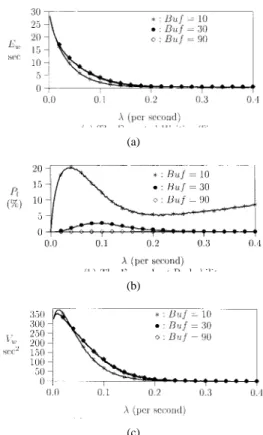
Effect of the Frame Arrival Rate : Fig. 2(a) indicates that the expected frame waiting time decreases as increases. For per second, is dominated by the sleep mode operation. For example, if , the M-ES is always in the sleep mode, and the frame is expected to wait for
s [in Fig. 2(a), we observe that
s when ]. For per second, the M-ES is active in most of the time, and the frames are processed within short waiting periods. Note that as , will increase and
(a)
(b)
(c)
Fig. 2. Sleep mode performance with various buffer sizes (T203 = 30 s; T204= 60 s). (a) The expected waiting time. (b) The frame lost probability. (c) The variance of the waiting time.
approach to s (where 0.1 s are the time to transmit one frame unit).
Fig. 2(b) plots the frame lost probability . For
per second, increases then decreases. For a very small , most frames arrive when the M-ES is in the sleep mode. As increases, it is more likely that the buffer is full when a frame arrives (while the M-ES is still in the sleep mode), and the frame is lost. Thus, in this range of ( for ), increases as increases. When is sufficiently
large ( for ), the M-ES becomes
more active as increases (i.e., T203 seldom expires), and most frames are processed within a short waiting period. Thus, decreases as increases. When is large ( for ), the frame arrival rate is larger than the active frame transmission rate of 10 frame units per second, and more frames will be lost. Thus, increases as increases.
Fig. 2(c) indicates that the variance of the waiting time decreases as increases (with the exception when is very small). For , the M-ES is likely to be in the active mode, and most frames are processed in short periods. Thus, the variance of the waiting time is small. For
per second, the M-ES is likely to be in the sleep mode when the frames arrive, and the extra waiting times of the frames result in a larger variance .
Effect of the MD-IS Buffer Size: Fig. 2(b) indicates that when , the buffer capacity is not large enough for the frame transmission mechanism to catch up with the frame arrival rate, whether the M-ES is in the active mode or the sleep mode. The figure also indicates that increasing
LIN AND CHUANG: THE SLEEP MODE FOR CDPD 65
(a)
(b)
Fig. 3. The sleep mode performance with various T204 values (T203= 30 s). (a)Buf = 10. (b) Buf = 30.
the buffer size significantly reduces for (when the M-ES is likely to be in the sleep mode). Fig. 2(a) indicates that the expected frame waiting time increases as the buffer size increases. However, this phenomenon becomes insignificant for . Similar observations are found in Fig. 2(c) for . Specifically, Fig. 2(a) and (c) indicate that when , and are not affected by the buffer size. On the other hand, Fig. 2(b) indicates that increasing the buffer size significantly reduces when per second. Thus, our discussion suggests that when the M-ES is likely to be in the sleep mode, increasing the buffer size improves performance without increasing and .
Effect of the T204 Value: Fig. 3 indicates that by increas-ing the sleep length (i.e., the T204 value), increases. This effect becomes more significant for a larger buffer size. For example, when per second, if T204 is increased by 25% from 60 to 75 s, then is increased by 17.81% for [see Fig. 3(a)], and 49.38% for [see Fig. 3(b)].
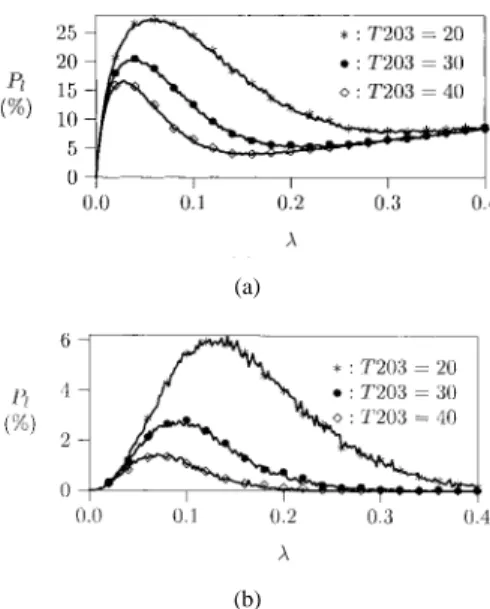
Effect of the T203 Value: Fig. 4 indicates that by increas-ing the T203 value, decreases. This effect becomes more significant for a larger buffer size. For example, when
per second, if T203 is decreased by 25% from 40 to 30 s, then is increased by 93.99% for [see Fig. 4(a)], and 162.5% for [see Fig. 4(b)].
Based on the above discussion, we have the following conclusions:
• Large buffer size can effectively reduce the frame lost probability due to the sleep mode operation. Also, if the buffer is sufficiently large, increasing the buffer size only slightly increases the expected frame waiting time and its variance. If the buffer size is sufficiently large, then most frame units arriving in the M-ES sleeping period
(a)
(b)
Fig. 4. The sleep mode performance with various T203 values (T204= 60 s). (a)Buf = 10. (b) Buf = 30.
are queued in the buffer and few frames are lost. These buffered frames are processed when the M-ES wakes up. Consider an extreme case where no frames are lost. Then for fixed T203 and T204 values, increasing the buffer size will not change the waiting time of a queued frame. Instead, the waiting time is determined by the T203 and T204 values.
• Changing the T203 and T204 values has more effect on the frame lost probability when the MD-IS buffer size is large than when the buffer size is small.
• If T203 and T204 are engineered at the values rec-ommended by the specification [5] (i.e., 30 and 60 s, respectively), then changing T203 has more impact on the frame lost probability than T204.
It is clear that by selecting a large T204 value and a small T203 value, the sleep mode operation can effectively reduce the power consumption at the cost of degrading the frame transmission performance (i.e., more lost frames, longer frame waiting times, and larger waiting variance). When the power consumption budget is determined in a CDPD system design, our study can provide guidelines to determine the timer values as well as the buffer size to optimize the frame transmission performance.
REFERENCES
[1] Y.-M. Chuang, T.-Y. Lee, and Y.-B. Lin, “Trading CDPD availability and voice blocking probability in cellular networks,” IEEE Network, vol. 2, no. 12, pp. 48–54, 1998.
[2] R. F. Quick, Jr., “An overview of the cellular digital packet data (CDPD) system,” in Proc. IEEE Personal Indoor And Mobile Radio Conf., 1993, pp. 338–343.
[3] CDPD Forum, “Cellular digital packet data system specification: Release 1.1,” CDPD Forum, Inc., Tech. Rep., Jan. 1995.
[4] C. Pawlowski and P. McConnell, “CDPD air interface basics,”
Tele-phony, Dec. 1994.
[5] M. Sreetharan and R. Kumar, Cellular Digital Packet Data. Reading, MA: Artech House, 1996.