
在MPEG/Audio上資料隱藏方法之研究與使用ADSP-2181數位訊號處理器實現資料隱藏解碼器
99
0
0
全文
(2) 在 MPEG/Audio 上資料隱藏方法之研究與使用 ADSP-2181 數位訊號處理器實現資料隱藏解碼器 研. 究. 生 :黃榮煌. Student : Ruang-Huang Huang. 指 導 教 授 :鄧清政 教授. Advisor : Prof. Ching-Cheng Teng. 共同指導教授 :吳炳飛 教授 Co-Advisor : Prof. Bing-Fei Wu. 國 立 交 通 大 學 電機與控制工程學系 碩 士 論 文. A Thesis Submitted to Department of Electrical and Control Engineering College of Electrical Engineering and Computer Science National Chiao Tung University in Partial Fulfillment of the Requirements for the Degree of Master in Electrical and Control Engineering July 2004 Hsinchu, Taiwan, Republic of China. 中 華 民 國 九 十 三 年 七 月.
(3) 在 MPEG/Audio 上資料隱藏方法之研究與使用 ADSP-2181 數位訊號處理器實現資料隱藏解碼器 學生:黃榮煌. 指 導 教 授 :. 鄧清政 教授. 共同指導教授:. 吳炳飛 教授. 國立交通大學電機與控制工程學系碩士班. 摘 要 本論文提出把資料嵌入 MPEG/Audio 裡的方法與實作。資料嵌入 MP3 的目的 是為了增加 MP3 的用途與功能性,也可以提供音樂公司對消費者的額外服務,如 在 MP3 中加入歌詞同步顯示、歌手照片或是消費者的基本資訊等等。本論文中的 資料嵌入方法可分為資料嵌入編碼器和解碼器:資料嵌入編碼器是在電腦上實 現,主要是把資料嵌入到 MP3 音框的三個比較不重要的區塊裡,對音樂本身的音 質較無影響。而這三個區塊分別是 big-value 區塊中 10KHz 以上的符號位元、count1 區 塊 中 的 符 號 位 元 和 bit reservoir 中 用 不 到 的 位 元 。 資 料 嵌 入 解 碼 器 是 在 ADSP-2181 數位訊號處理器上實現,主要是做資料的擷取並做分析,並做歌詞和 圖片的同步顯示。此包含資料嵌入解碼器的 MP3 解碼器在 ADSP-2181 上使用了 20.7Kbytes 的程式記憶體和 23.6Kbytes 的資料記憶體,並且在 18MIPS 就可達到即 時播放的速度,約佔此晶片 55%的運算能力。此資料嵌入的方法亦可應用到 MPEG-2/Audio AAC 或是 MEPG-4/Audio AAC 裡,並不只侷限於使用在 MP3 演算 法上。. i.
(4) A Study of Data Embedded Method on MPEG/Audio and Implementation of Data Embedded Decoder on the ADSP-2181 DSP Processor Student:Ruang-Huang Huang. Advisor :Prof. Ching-Cheng Teng Co-Advisor :Prof. Bing-Fei Wu. Department of Electrical and Control Engineering National Chiao Tung University Abstract In this thesis the method and implementation of embedding data into MPEG/Audio will be discussed. The purpose of embedding data into MP3 is to add applications and functions of MP3, as well as to facilitate the music company to provide additional service to customers, for example, adding pictures of singers, background information or lyrics into MP3 for synchronous display. Data embedded encoder and decoder will be introduced in this thesis. The data embedded encoder, implemented on PC, is to embed data into three less important music regions in MP3, causing less influence to the quality of music. These three music regions are: sign bites which exceed 10 KHz in big-value region, sign bites in count1 region, and unused bites in bit reservoir region. Data embedded decoder, ported on ADSP-2181 DSP processor, is to catch data for analyzing and executing synchronous display of lyrics and pictures. The MP3 data decoder in ADSP-2181 uses 20.7Kbytes of program memories and 23.6Kbytes of data memories, and will accomplish real-time playing in 18MIPS, occupying about 55% processing power of the DSP. This approach can be applied in MPEG.-2/Audio ACC or MPEG-4/Audio ACC as well, not only in MP3 algorithm.. ii.
(5) 誌. 謝. 首先感謝鄭清政教授和吳炳飛教授的指導,從他們身上我學到了做研究的嚴 謹態度,和解決問題的能力。老師也提供很豐富的研究資源,有良好的環境和最 新的設備。也就是有條件才能完成這本論文。. 在實驗室中也有很多要感謝的伙伴。一同參加比賽的煜翔同學、俊傑同學、 映伶學妹,雖然沒得獎,但是重點是比賽時一起努力的過程,這是難以忘記的回 憶。志旭學長和煜翔同學在我做研究遇到困難時也時常給我許多建議,告訴我許 多經驗,讓我研究可以順利的完成。研究做累時常和我聊天的重甫學長、馬哥、 坤卿學長,假日常來實驗室找我吃飯的明達學長、紹麒學長,晚上常和我運動的 光輝學長,幫我搬家無數次的琪文同學,國防役要和我一起到凌陽上班的律嘉同 學,還有其它實驗室的伙伴。還要感謝其它我在交大認識幫過我的許多朋友們。. 最重要的要感謝我的父母炳和先生、玉蒼女士,有你們辛苦的工作拉拔,我 才有今天,弟妹榮仁、秀穗、還有家族裡的其它家人,陪我從小一路走來,我也 希望你們陪我分享論文完成的喜悅。. 最後還要感謝很多在求學過程中陪我走過許多歡笑與不如意的朋友,現在大 家各分東西為自己的前程努力,也希望大家一起加油。. iii.
(6) Award 第七屆「生創新獎」 第一名 得獎作品. 向下相容的 mp3 音樂安全機制 黃榮煌、林煜翔、林映伶、顏志旭. 得 獎 者 交通大學/電機與控制工程學系 指導老師. 吳炳飛. iv.
(7) v.
(8) Contents 摘 要 ................................................................................................................................................ I ABSTRACT ..................................................................................................................................... II 誌 謝 ............................................................................................................................................. III AWARD ...........................................................................................................................................IV CONTENTS ....................................................................................................................................VI LIST OF TABLES ........................................................................................................................... X LIST OF FIGURES ........................................................................................................................XI CHAPTER 1 INTRODUCTION..................................................................................................... 1 1.1. RESEARCH BACKGROUND ................................................................................................ 1. 1.2. RESEARCH MOTIVATION ................................................................................................... 1. 1.3. INNOVATION ..................................................................................................................... 2. 1.3.1. MP3 Encoder .............................................................................................................. 2. 1.3.2. MP3 Decoder .............................................................................................................. 2. 1.4. CHARACTERISTIC ............................................................................................................. 2. 1.5. CONTENT ORGANIZATION ................................................................................................ 4. CHAPTER 2 DATA EMBEDDED ALGORITHM IN THE MPEG/AUDIO .............................. 5 2.1. INTRODUCTION TO MPEG AUDIO..................................................................................... 5. 2.1.1. Introduction of the MP3 Encoder Algorithm .............................................................. 7. 2.1.2. Introduction of the MP3 Decoder Algorithm .............................................................. 8. 2.2. INTRODUCTION OF DATA EMBEDDED METHODS ............................................................... 9. 2.2.1. The Principle of Watermarking Algorithm.................................................................. 9. 2.2.2. Main Characteristics for Watermarking Algorithm................................................... 10. 2.2.3. Applications of Watermarking Algorithm................................................................. 11. vi.
(9) 2.2.4 2.3. Classification on Watermarking Techniques ............................................................. 12 DATA EMBEDDED CODEC ALGORITHM FOR MPEG/AUDIO ............................................ 12. 2.3.1. The Properties of Data Embedded Codec ................................................................. 13. 2.3.2. The Structure of Data Embedded Codec................................................................... 16. 2.3.3. The Methods of Data Embedded Codec ................................................................... 18. 2.3.3.1. Embedded Data into the Count1 Region ............................................................................18. 2.3.3.2. Embedded Data into the Big-Value Region........................................................................20. 2.3.3.3. Embedded Data into Bit Reservoir.....................................................................................24. CHAPTER 3 ENVIRONMENT OF HARDWARE AND SOFTWARE .................................... 27 3.1. HARDWARE ENVIRONMENT ............................................................................................ 27. 3.1.1. ADSP-2181 EZ-KIT Lite Board ............................................................................... 27. 3.1.2. ADSP-2181 Microprocessor..................................................................................... 28. 3.2. SOFTWARE ENVIRONMENT ............................................................................................. 31. CHAPTER 4 IMPLEMENTATION OF DATA EMBEDDED CODEC .................................... 35 4.1. DATA EMBEDDED ENCODER ........................................................................................... 35. 4.1.1. Package Embedded Data........................................................................................... 35. 4.1.2. Embed Data into the MP3 File.................................................................................. 38. 4.2. DATA EMBEDDED DECODER ........................................................................................... 40. 4.2.1. Extract Data from the MP3 File................................................................................ 41. 4.2.2. Porting MP3 Decoder with Data Embedded Decoder on the ADSP-2181 ............... 41. 4.2.3. Data Stream Analyzer ............................................................................................... 43. 4.2.4. Lyric Analyzer .......................................................................................................... 46. 4.3. EXPERIMENTAL PROCESS ................................................................................................ 48. 4.3.1. Encoding ................................................................................................................... 48. 4.3.2. Decoding................................................................................................................... 49. 4.4. EXPERIMENTAL RESULTS ................................................................................................ 54. vii.
(10) 4.4.1. The Embedded Bits Counts of the Different Methods .............................................. 54. 4.4.2. The Encoding Speed of the Different Methods......................................................... 56. 4.4.3. The Music Quality of the Different Methods............................................................ 58. 4.4.4. The File Size of the Different Methods..................................................................... 60. 4.4.5. Comparison with other methods ............................................................................... 61. CHAPTER 5 CONCLUSIONS AND FUTURE WORKS........................................................... 63 5.1. CONCLUSIONS ................................................................................................................ 63. 5.2. FUTURE WORKS ............................................................................................................. 64. REFERENCES ............................................................................................................................... 65 APPENDIX A MP3 ENCODER/DECODER ALGORITHM..................................................... 67 A.1. THE STRUCTURE OF MP3 ENCODER ALGORITHM ........................................................... 67. A.1.1. Analysis Polyphase Filter Bank ................................................................................ 68. A.1.2. MDCT and Alias Reduction...................................................................................... 71. A.1.3. Psychoacoustic Model .............................................................................................. 73. A.1.4. Nonuniform Quantization ......................................................................................... 76. A.1.5. Huffman Encoding.................................................................................................... 77. A.1.6. Bitstream Formatting ................................................................................................ 78. A.2. THE STRUCTURE OF MP3 DECODER ALGORITHM........................................................... 78. A.2.1. Decoding of Bitstream .............................................................................................. 79. A.2.2. Inverse Quantization ................................................................................................. 81. A.2.3. Frequency to Time Mapping..................................................................................... 81. APPENDIX B INTRODUCTION TO THE TESTING STANDARD OF THE MUSIC QUALITY : ODG..................................................................................................................................... 84 B.1. INTRODUCTION ............................................................................................................... 84. B.2. DESCRIPTION OF PEAQ.................................................................................................. 84. viii.
(11) ix.
(12) List of Tables TABLE 1 CLASSIFICATION OF WATERMARKING ACCORDING TO SEVERAL VIEWPOINTS [10] .......................................................................................................................................................... 12 TABLE 2 CLASSIFICATION OF THE WATERMARKING TECHNIQUE IN THIS THESIS............... 14 TABLE 3 THE PARAMETERS OF THE HEADER IN THE PACKAGE FILE ...................................... 36 TABLE 4 THE SPEC. OF THE MP3 DECODER WITH DATA EMBEDDED DECODER ON THE ADSP-2181....................................................................................................................................... 43 TABLE 5 THE INFORMATION OF “01-CAN”....................................................................................... 49 TABLE 6 THE EMBEDDED BITS COUNT OF THE DIFFERENT METHODS ................................... 55 TABLE 7 THE EMBEDDED BITS COUNT PER FRAME BY THE DIFFERENT METHODS............ 56 TABLE 8 THE SPEC. OF THE TEST PLATFORM ................................................................................. 56 TABLE 9 THE ENCODING SPEED OF THE DIFFERENT METHODS BY FLOATING POINT ENCODER ....................................................................................................................................... 57 TABLE 10 THE ENCODING SPEED OF THE DIFFERENT METHODS BY FIXED POINT ENCODER ....................................................................................................................................... 58 TABLE 11 THE TESTING ENVIRONMENT OF THE MUSIC QUALITY ........................................... 59 TABLE 12 THE MUSIC QUALITY OF THE DIFFERENT METHODS ................................................ 60 TABLE 13 THE FILE SIZE OF THE DIFFERENT METHODS.............................................................. 61. x.
(13) List of Figures FIG. 1 THE HIERARCHY OF THE ISO MPEG STANDARD................................................................... 6 FIG. 2 THE COMPARISON OF THE ISO MPEG AUDIO STANDARD COMPRESSION RATIO ......... 7 FIG. 3 MPEG-1/AUDIO LAYER 3 ENCODER BLOCK DIAGRAM [5].................................................. 8 FIG. 4 MPEG-1/AUDIO LAYER III DECODER BLOCK DIAGRAM...................................................... 9 FIG. 5 COMBINATION OF THE WATERMARKING PROCESS ON MPEG/AUDIO .......................... 10 FIG. 6 THE STRUCTURE OF DATA EMBEDDED ENCODER ............................................................. 17 FIG. 7 THE STRUCTURE OF DATA EMBEDDED DECODER ............................................................. 18 FIG. 8 THE ABSOLUTE THRESHOLD OF HEARING .......................................................................... 19 FIG. 9 THE FREQUENCY LINE MAPPING TO FREQUENCY............................................................. 22 FIG. 10 THE DISTRIBUTION OF MUSIC QUALITY AND BITS IN THE BIG-VALUE REGION ..... 23 FIG. 11 THE DISTRIBUTION OF MUSIC QUALITY AND BITS IN THE BIG-VALUE REGION ..... 24 FIG. 12 THE BITSTREAM AND BIT RESERVOIR OF MP3 ................................................................. 25 FIG. 13 THE RESERVOIR OVER 512 BYTES AND STUFF “1” ........................................................... 25 FIG. 14 EZ-KIT LITE’S FUNCTIONAL BLOCK DIAGRAM [15]......................................................... 28 FIG. 15 ADSP-2181 FUNCTIONAL BLOCK DIAGRAM [17] ............................................................... 29 FIG. 16 HARVARD ARCHITECTURE..................................................................................................... 30 FIG. 17 VISUALDSP USER INTERFACE ............................................................................................... 32 FIG. 18 THE FORMAT OF THE PACKAGED FILE................................................................................ 37 FIG. 19 THE FLOWCHART OF THE PACKAGED FILE ....................................................................... 38 FIG. 20 THE BLOCK DIAGRAM OF THE MP3 ENCODER WITH DATA EMBEDDED ENCODER 39 FIG. 21 THE DISTRIBUTION OF THE UNNECESSARY BITS OF THE BIT RESERVOIR IN MP3 SONG [19]........................................................................................................................................ 40 FIG. 22 THE BLOCK DIAGRAM OF THE MP3 DECODER WITH DATA EMBEDDED DECODER 41 FIG. 23 THE FLOWCHART OF THE DATA EMBEDDED ANALYZER ............................................... 45 FIG. 24 THE FLOWCHART OF THE LYRIC ANALYZER..................................................................... 47 FIG. 25 THE EXTRACTED LYRICS OF THE MP3 SONG..................................................................... 50. xi.
(14) FIG. 26 PHOTO1.JPG................................................................................................................................ 51 FIG. 27 PHOTO2.JPG................................................................................................................................ 51 FIG. 28 PHOTO3.JPG................................................................................................................................ 52 FIG. 29 PHOTO4.JPG................................................................................................................................ 52 FIG. 30 PHOTO5.JPG................................................................................................................................ 53 FIG. 31 PHOTO6.JPG................................................................................................................................ 53 FIG. 32 MPEG-1/AUDIO LAYER 3 ENCODER BLOCK DIAGRAM [5].............................................. 68 FIG. 33 ANALYSIS SUBBAND FILTER AND MDCT............................................................................ 68 FIG. 34 COEFFICIENT OF C[N] AND H[N] (N = 0~511)....................................................................... 70 FIG. 35 FREQUENCY RESPONSE OF SUBBAND ................................................................................ 71 FIG. 36 ILLUSTRATION OF THE FOUR APPLICABLE WINDOW TYPES AND USING CONDITION .................................................................................................................................... 72 FIG. 37 ILLUSTRATION OF ALIAS REDUCTION BUTTERFLIES ..................................................... 73 FIG. 38 THE ABSOLUTE THRESHOLD OF HEARING ........................................................................ 74 FIG. 39 FREQUENCY MASKING THRESHOLD AND THRESHOLD IN QUIET [8] ......................... 75 FIG. 40 TEMPORAL MASKING THRESHOLD [8]................................................................................ 76 FIG. 41 MAIN DATA ORGANIZATION OF A FRAME .......................................................................... 78 FIG. 42 MPEG-1/AUDIO LAYER III DECODER BLOCK DIAGRAM.................................................. 79 FIG. 43 DECODING OF BITSTREAM BLOCK DIAGRAM .................................................................. 79 FIG. 44 MPEG-1/AUDIO LAYER III HEADER FORMAT ..................................................................... 80 FIG. 45 FREQUENCY TO TIME MAPPING ........................................................................................... 82 FIG. 46 BLOCK DIAGRAM OF MEASUREMENT SCHEME ............................................................... 85. xii.
(15) CHAPTER 1 Introduction 1.1. Research Background In recent ten years, the popularization of Internet and the rapid development of. computer industries make our life more convenient and comfortable. People can communicate by sending messages to each other via electronic(E-) texts, E-mail, E-news, digital image, audio, video etc. under the connection of Internet. Meanwhile, digital music also replaces the traditional music which can be diffused quickly on the net, causing multi-media industry a great loss. The popularity of MP3 has a great impact on the music industry indeed. Some network companies which provide P2P service share the market of the traditional music company using the network connectivity convenience, such as Kuro, ezpeer, etc.. 1.2. Research Motivation The technology of MPEG Audio [2] provides low bit rate and low computation. requirement for high quality audio compression. Therefore, it is widely used for storing nearly all kinds of music.. The invention of digital music has changed the consumption model of the traditional music market. Selling music on the net becomes a new model, and also a main trend. Competitors for music content providers increase since they can sell music on the internet, too. The music content providers must offer additional services to compete with the competitors and attract more customers. Data embedded technique can be one of the weapons in the market. Nevertheless, techniques of data embedded which. 1.
(16) differs from the Cryptography System [1] are to embed extra information into multimedia work, such as MP3 (MPEG -1 Audio Layer III).. 1.3 Innovation 1.3.1 MP3 Encoder In this thesis, the data embedded methods are developed to embed data into MP3 file without depending on the absolute threshold of hearing of the psychoacoustic model, because the psychoacoustic model of the MP3 algorithm is removed in our MP3 encoder.. General watermarking techniques or data hiding techniques reference the psychoacoustic model [14] in the music compressing technique. But the computation of the psychoacoustic model is a great quantity of ratio in the MP3 encoder, and it accounts about 20% computation of the MP3 encoder. Our MP3 encoder not only can embed data without making influence to the music quality but improves the encoding speed.. 1.3.2 MP3 Decoder In general, the MP3 decoder playing the MP3 file with lyric must have an additional lyric file and install a plug-in software to play the lyric. Some users even don’t know where to find the lyric file. The data embedded method will solve the problem. The lyric of a MP3 song can be embedded into the MP3 and the MP3 decoder with data embedded decoder can play the song and show the lyric concurrently.. 1.4 Characteristic. 2.
(17) In this thesis, we try to find ways to embed digital data into MP3 and combine the embedded data codec with an MP3 codec. This technique for data embedding can include a great amount of information, such as lyrics, pictures of the singer or other information. There are several characteristics: y. Won’t changing the file size, and won’t be noticed by users Data embedding techniques won’t cause negative influences on quality of audio work and will not be noticed by users or attackers.. y. Using for network streaming broadcast The data is embedded everywhere not in the beginning of the music file. If the music receives from the half of the music file on the internet, the music player also can extract the embedded data. So the music file with embedded data can be used on the network streaming broadcast.. y. Providing additional service by music content provider The MP3 encoder with data embedded encoder can be used for the music content provider to embed some information about singer in the MP3 songs. The content provider can provide this new service in their music product. In other way, content provider will have more advantages to fight the pirates.. y. Portable MP3 decoder with data embedded decoder The MP3 decoder with data embedded decoder has been ported on the ADSP-2181 processor. It can combine with the USB storage device and LCD display to become a portable device.. The data embedded technique improves the encoder and the decoder respectively. Its dedication to encoder is the technique that data embeds into the MP3 without referencing the psychoacoustic model. In decoder the data embedded technique is ported on DSP platform, ADSP-2181, to realize the data embedded decoding. It could further be developed as a portable product. To sum up, the purpose of this method is to. 3.
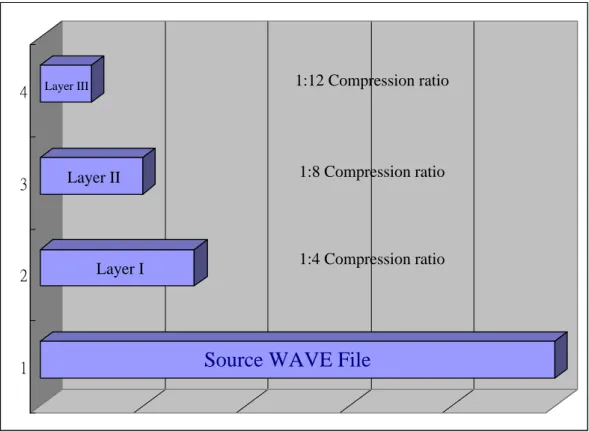
(18) increase the applications of MP3 music media.. 1.5. Content Organization This thesis contains six chapters. Chapter 1 is in the premise. Chapter 2 introduces. three methods which are used to embed data into the MP3 file in this thesis. In Chapter 3, the hardware and software environment where the MP3 decoder with data embedded decoder ported is developed are introduced. Chapter 4 presents the implementation and performance verification of these methods. This thesis finishes with conclusion and future works in Chapter 5. Appendix A introduces the MPEG-1 Layer III codec algorithm, which is including the brief principles and functionality. Appendix B introduces the ODG standard which is used for testing the music quality.. 4.
(19) CHAPTER 2 Data Embedded Algorithm in the MPEG/Audio In this chapter, we will describe the MPEG-1/Audio compression algorithm briefly and the MPEG-1/Audio format. This serves as the necessary background of understanding our MPEG-1/Audio data embedded schemes. The data embedded technique will be introduced in Section 2.2. It includes the principle, the application, and the classification of the data embedded algorithm. The data embedded algorithm that used to implement the data embedded codec about the MPEG/Audio in this thesis is introduced in Section 2.3. Section 2.3 introduces the data embedded encoder which includes the principles, the application, the advantages, and other methods to embed data into the MPEG/Audio. It introduces the data embedded decoder which extracts the embedded data.. 2.1 Introduction to MPEG Audio The ISO MPEG standard [3][4] contains four parts for compression standards shown in Fig. 1. The MPEG-1 is divided into five parts, namely system, video, audio, compliance testing, and software simulation. The MPEG-1 audio algorithm is an international standard for digital audio compression and does not make any assumptions about the nature of the audio source. It is suitable for audio-only applications as well as combined with video data (MPEG Systems Coding).. 5.
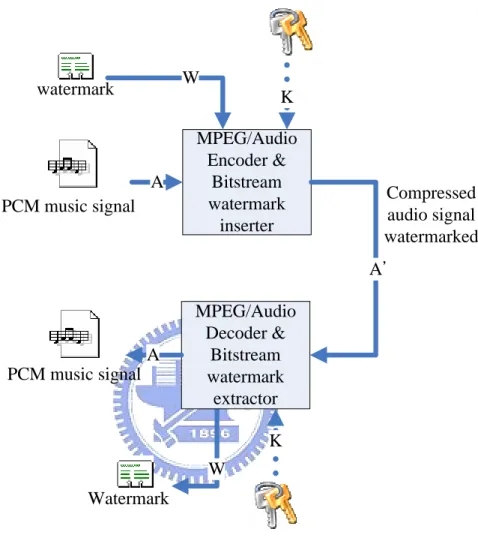
(20) ISO MPEG Standard. MPEG-1. System. MPEG-2. Video. Audio. Layer 1. Layer 2. MPEG-7. MPEG-21. Compliance Testing. Software Sumulation. Layer 3. Fig. 1 The hierarchy of the ISO MPEG Standard. Depending on the applications, MPEG audio coding system can also be divided into three layers with increasing encoder complexity: y. Layer I Layer I contains the basic mapping of the audio samples into 32 subbands, fixed segmentation to format the data into blocks, a psychoacoustic model for the bit allocation, and quantization. It best suits the bit rate above 128Kbps per channel.. y. Layer II Layer II provides additional coding of bit allocation, scale-factors and samples. It targets the bit rate around 128 Kbps per channel.. y. Layer III Layer III introduces increased frequency resolution based on a hybrid filterbank. It uses non-uniform quantizer and entropy coding (Huffman Coding). It offers the best audio quality at the bit rate around 64 Kbps per channel.. 6.
(21) The MPEG audio compression is a lossy algorithm and uses the special nature of the human auditory system (HAS). It removes the perceptually irrelevant parts of the audio and makes the audio signal distortions inaudible to the human ear, so it can provide compression ratios ranging form 2.7 to 24, see the Fig. 2. The compression ratios depend on different predefined fixed bit rates ranging from 32 kbps to 224 kbps.. 4. 3. 2. 1. 1:12 Compression ratio. Layer III. Layer II. Layer I. 1:8 Compression ratio. 1:4 Compression ratio. Source WAVE File. Fig. 2 The comparison of the ISO MPEG Audio standard compression ratio. 2.1.1 Introduction of the MP3 Encoder Algorithm The description of the encoding process is based on the block diagram in Fig. 3. The input audio signal which comes from a single channel PCM signal is passed through a polyphase filter bank. This filter bank divides the input signal into 32 equally-space frequency subbands. After this process, the samples in each subband are still in the time domain. A Modified Discrete Cosine Transform (MDCT) is then used to. 7.
(22) map the samples in each subband to frequency domain. In the meantime, input signal after FFT transformation passes through a psychoacoustic model that determines the ratio of the signal energy to the masking threshold for each subband. The distortion control block uses the signal-to-mask ratios (SMR) from the psychoacoustic model to decide how to assign the total number of code bits available for the quantization of the subband signals to minimize the audibility of the quantization noise. The quantized subband samples are coded with the lossless Huffman coding to decrease the entropy of samples. Finally, the end block takes the Huffman coded subband samples and side information into a packed bitstream according to the MPEG/Audio standard.. Distortion control loop. Digital Audio signal (PCM) Filterbank 32 subbands. MDCT. Non-uniform quantization rate control loop. Huffman encoding Coded audio signal. Window switching FFT 1024 points. Psychoacoustic model. Bitstream formatting Coding of side-information. mnr. Fig. 3 MPEG-1/Audio Layer 3 encoder block diagram [5]. 2.1.2 Introduction of the MP3 Decoder Algorithm In this section the MPEG-1/Audio Layer III decoder will be described with its functionality. The decoding process is based on the block diagram in Fig. 4. The decoder has three main parts: “Decoding of Bitstream”, “Inverse Quantization”, and “Frequency to Time mapping”.. The input coded bitstream is passed through the first parts to synchronize and extract the quantized frequency line and other information of each frame. The inverse. 8.
(23) quantization part dequantized the frequency line according to the output of previous part. Finally, the last part is a set of reverse operations of the MDCT and analysis polyphase filter bank in the encoder. Its output is the audio signal in PCM format.. Coded audio signal. Decoding of Bitstream. Inverse Quantization. Frequency to Time mapping. Digital Audio signal (PCM). Fig. 4 MPEG-1/Audio Layer III decoder block diagram. 2.2 Introduction of Data Embedded methods There are many watermark techniques [8] in terms of their application areas and purposes. The technology of data embedded is a kind of watermarking. It is also related to the science of steganography. The word steganography is derived from the Greek words stegano (hidden) and pgrphein (to write) and therefore means “covered writing”. Data embedded of MPEG/Audio is a technique for the transmission of additional data along with audio signals existing distribution channels.. The principle, the characteristics, the applications, and the classifications are introduced in the following:. 2.2.1 The Principle of Watermarking Algorithm Mathematically, data embedded can be expressed like EQ 1. If an original audio signal A and a watermark W are given, the watermarked audio signal A′ is represented as the following Eq. 1.. A′ = A + f ( A, W ). Eq. 1. 9.
(24) Fig. 5 shows the combination of the watermarking process which includes inserting and extracting watermark.. W. watermark. K. A PCM music signal. MPEG/Audio Encoder & Bitstream watermark inserter. Compressed audio signal watermarked A'. A PCM music signal. MPEG/Audio Decoder & Bitstream watermark extractor K W. Watermark. Fig. 5 Combination of the watermarking process on MPEG/Audio. 2.2.2 Main Characteristics for Watermarking Algorithm There are many watermark characteristics, which may be required for an effective watermark, but the following main characteristics are important ones. y. Invisibility It is not able for human sense system to find the difference between the host media and watermark media. This is the essential requirement of all the. 10.
(25) data hiding system including watermarking system. This is why the watermark hidden in the audio must be music inaudible. y. Robustness Robustness, also an essential requirement is the ability to resist some of the signal processing operations, such as filtering, compression and the identifiable degree of the retrieved watermarks. The embedded algorithm must make chance to fight against the different kinds of signal processing operations. In general, the more robust the watermarking techniques have, the fewer capacities we can embed.. y. Security After the watermark embedding, if someone wants to take out the embedded watermark, he must own some of the secret information related to the original signal. In general, to keep secret of the embedding algorithm is not easy, so the safety of the embedding system relies on the secret key which represents the location that watermark embedded. Using the secret key as the seed of the random number generator, we can get a serial random number and cooperate with an algorithm to embed the watermark. Therefore, the secret key is necessary to extract the watermark from the embedded media.. 2.2.3 Applications of Watermarking Algorithm y. Compatible Transmission of Data (Watermarks) Basically watermarking algorithms provide a data transmission channel that can be used in existing distribution channels. The data hiding (watermark) transmission is backward compatible in the sense that every existing channel that is able to carry watermarked music. Hence watermarking can be utilized in a wide field of applications.. y. Digital Rights Management (DRM). 11.
(26) Digital Rights Management is often considered as the main application of watermark. Watermark can provide means to fulfill the demands of DRM, such as proof of ownership, access control for digital media, tracing illegal copies and so on. y. Broadcasting A variety of applications for audio watermark are in the field of broadcasting. These include program type identification, advertising research, broadcast coverage research and etc.. 2.2.4 Classification on Watermarking Techniques The data embedded technique has different insertion and extraction methods, and may be classify and analyze these methods from the various points of view like in Table 1. Table 1 Classification of watermarking according to several viewpoints [9]. Classification. Contents. Inserted media category. text, image, audio, video. Perceptivity of watermark. visible, invisible. Robustness of watermark. robust, semi-fragile, fragile. Inserting watermark type. noise, image, format. Processing method. Spatial domain. LSB, patchwork, random function. Transform domain. Look-up table, spread spectrum. Necessary data for extraction. Private, semi-private, public watermarking. File size. Vary or not. 2.3 Data Embedded Codec Algorithm for MPEG/Audio 12.
(27) In this section, the properties and the data embedded codec algorithm which includes several methods to embed data into the MPEG/Audio will be introduced.. 2.3.1 The Properties of Data Embedded Codec In this thesis, the MPEG/Audio signal is the inserted media because the technique of the data embedded bases on the specification of the MPEG/Audio. The embedded data is private information which is invisible and fragile. And the file type of embedded data can be any format or just be a series of bitstream. In other words, any data can be embedded into the MPEG/Audio media no matter what data type it is as long as the size of the embedded data is not bigger than the upper limit of the embedded data of the media.. There are three methods for data embedding, embedded data into count1 region, embedded data into bit reservoir, and modify the MP3 encoder from floating point to fixed point.. Recent research has produced a number of algorithms for embedding and retrieval of watermarks in audio signals [10] [11][12][13]. While most known systems operate in the uncompressed domain (PCM Watermarking), few are capable of embedding watermarks into compressed domain (Bitstream Watermarking) such as this thesis. The classification of the watermarking algorithm proposed in this thesis as mentioned above in Table 1 can be summarized and shown in Table 2:. 13.
(28) Table 2 Classification of the watermarking technique in this thesis. Classification. Contents. Inserted media category. MPEG/Audio. Perceptivity of watermark. invisible. Robustness of watermark. fragile. Inserting watermark type. Any format. Processing method: Frequency domain. spread spectrum of high frequency. Necessary data for extraction. Public watermarking. File size of inserted media. No change. y. Inserted media category : MPEG/Audio The data embedded method designed flow is based on the property of MPEG/Audio Specification. The MPEG-1 Layer-3 (MP3) is used for embedding data in this thesis. After MP3 encoder doses MDCT transformation which transforms signal from time domain to frequency domain, the frequency lines of the main data are distributed from low frequency to high frequency in a frame as shown in Fig. 41. Data is embedded into frequency domain by MP3 encoders, and extracted by MP3 decoders.. y. Perceptivity of watermark : Invisible The embedded data as watermarks must be invisible because the inserted media file is the audio file. The embedded data can not either affect the quality of the original music or at least the affection can not be heard. The MP3 decoder with data embedded decoder can be used to extract the embedded data stream and reconstruct the embedded data stream to the original file.. y. Robustness of watermark : fragile Embedding data into MP3 music is additional service by the content. 14.
(29) providers. But the purpose of embedding data is not to provide additional protection for MP3 music, on the contrary, the embedded data becomes fragile and easily distorted when the music is compressed. More robust the watermark is, less space for data embedding. Therefore the fragile method is preferred because more fragile the watermark is, more space for data embedding. y. Inserting watermark type : any format The data type that is embedded into the audio file can be any file format, because the embedded data stream has a header which records the synchronization, the embedded file size, the embedded file length, and the file data stream. The embedded data stream just is a series signal of “0” and ”1” whatever any files types are. The extractor in the MP3 decoder can extract the embedded data and an analyzer of embedded data can reconstruct the embedded files.. y. Processing method : Frequency domain The embedded data is embedded into frequency lines of the frequency domain after the MDCT transformation which transforms from time domain to frequency domain.. y. Necessary data for extraction : public watermark The embedded data belongs to public watermark. The embedded data only can be extracted by a special decoder.. y. File size : no change After the data embeds into the MP3 file, the MP3 file size that is embedded data is the same to the MP3 file that is encoded by other MP3 encoder. One file is encoded by MP3 encoder with data embedded encoder, and the other one is encoded by any other MP3 encoders in the same bitrate and sampling rate. The size of the two MP3 files is the same, if they compare. 15.
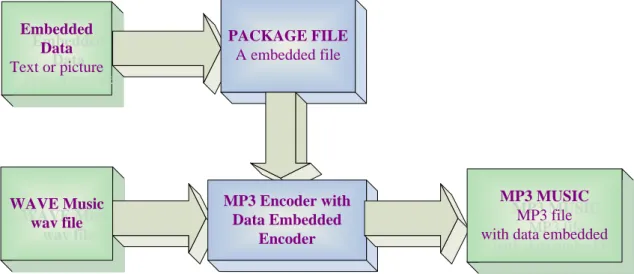
(30) to each other. They just can be differentiated by the MP3 decoder with embedded data analyzer. The one which embedded data can extract embedded information but the other one can’t.. 2.3.2 The Structure of Data Embedded Codec The data embedded codec are divided into two parts: one part is the data embedded encoder, and the other part is data embedded decoder. The data embedded encoder usually is used for content provider to provide additional service which embed lyrics, the basic information of singer, the photos of the singer, and even the information of customer into the MP3 audio. Almost all information can be embedded into the MP3 file under the upper bond of the size of the embedded data. The data embedded decoder is used for users and combines with the MP3decoder. It can extract all the information that is embedded in the MP3 files and display the information on the monitor. The MP3 decoder with data embedded decoder has also ported on the ADSP-2181 to become a portable device.. Fig. 6 indicates the structure of data embedded encoder. There are two source data for encoding: one is the audio raw data, and one is the embedded data. If there are too many embedded files input into the encoder at the same time, the encoder will confuse the files. And it causes the decoder could not extract the embedded data. The embedded data does not just include only one file. It may include two files or more, so a package program is designed in order to pack all the files to become a file with special format for encoding. The packaged file and the audio raw data input to the MP3 encoder with data embedded encoder together, and the encoder will output a MP3 file with embedded data. The file size after embedding data is the same to the file size which is encoded by other MP3 encoder. The MP3 file which embeds data can also be played by any general MP3. 16.
(31) player, and the embedded data won’t affect the quality of the music.. Embedded Embedded Data Text orData picture Text or picture. PACKAGE FILE A embedded file. WAVE Music WAVE Music wav file wav file. MP3 Encoder with Data Embedded Encoder. MP3 MUSIC MP3 MP3 MUSIC file MP3 file with data embedded with data embedded. Fig. 6 The structure of data embedded encoder. Fig. 7 indicates the structure of data embedded decoder. The decoder structure is the inverse flow of the encoder. The MP3 file with embedded data as the input data inputs to the MP3 decoder with data embedded decoder. The decoder has two output ends: one is the music raw data, and the other one is the embedded data stream. The music raw data is the same music of CD quality which decodes by other general MP3 decoder. The embedded data stream has to input the data stream analyzer to analyze, and the data stream analyzer reconstructs the original embedded files. And the files would be shown on the displayer or save as files in the disk.. 17.
(32) MP3 MUSIC MP3 MP3 MUSIC file MP3 file with data embedded with data embedded. MP3 Decoder with Data Embedded Decoder. WAVE Music WAVE Music wave file wave file. Data Embedded Data Embedded Stream Stream Text or picture stream Text or picture stream. DATA STREAM WRITE TO FILE. FILES FILES Text or picture Textfile or picture file. Fig. 7 The structure of data embedded decoder. 2.3.3 The Methods of Data Embedded Codec In this section, there are some methods for data embedding. They are introduced in the following subsection:. 2.3.3.1 Embedded Data into the Count1 Region The count1 region saves the frequency lines which distribute on the relative high frequency in a frame. And the energy of the count1 region is small than the energy of big-value region. So the method of embedded data into count1 region can affect the quality of the music small.. General watermarking techniques reference the absolute threshold of hearing of the psychoacoustic model [14] in the music compressing technique, as shown in Fig. 8. The signal energy can’t be heard by people under the absolute threshold of hearing, and the watermark usually hides under the absolute threshold of hearing, too. The signal of the embedded data can’t be heard by people, so it would not affect the quality of the music.. 18.
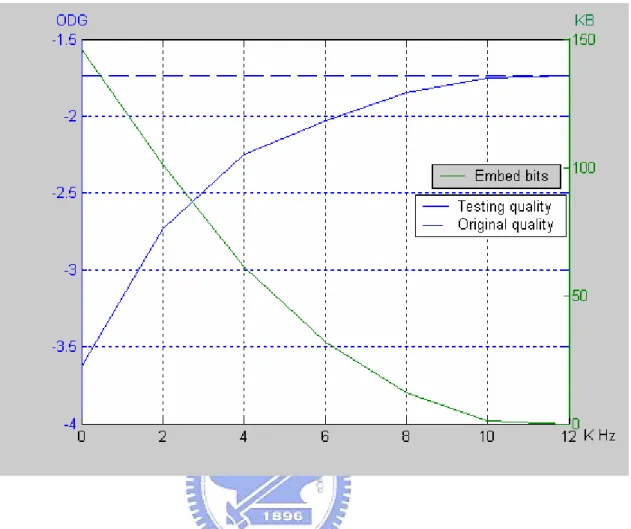
(33) Fig. 8 The Absolute Threshold of Hearing. The computation of the psychoacoustic model is a great quantity of ratio in the MP3 encoder, and it accounts about 20% computation of the MP3 encoder. The quality of the MP3 music after the MP3 encoder encodes without psychoacoustic model and the bit rate sets 128kbps. The general bitrate of MP3 is almost 128kbps now, but a few songs even uses 128kbps for more high quality music. There are few songs encoded by 96kbps or less, because the quality is a little ugly. In order to speed up the encoding time of the MP3 encoder, the psychoacoustic model of the MP3 encoder would be removed for embedded system.. The MP3 encoding speed is speed up after the psychoacoustic model of the MP3 encoder is removed. On the other side, it is not good for data embedded techniques. The data embedded techniques would easily destroy the quality of the music without the reference of the psychoacoustic model. So should embed information in a situation without psychoacoustic model, must look for other places that can embed information in the music. The main condition of the place would not affect the original quality of the music or the affect to the quality should be the lowest.. 19.
(34) In this thesis, the method of data embedded bases on a principle that the sensitive degree of different frequency bands for ears of people is different. The sound of low frequency for common people’s ears, no matter how the loud voice of the sound is or where the source of the sound is more relatively sensitivity to distinguish coming out. But people’s ears are relatively insensitive to high frequency sound. The property is used during MP3 encoding. The property is that people’s ears can’t distinguish the phase of the high frequency.. The MP3 media data embedded technique is designed to utilize the different degree of sensitiveness of human ears to different sound band. Normally human ears, despite the volume or source of the sounds, are more sensitive to those with the phase of lower frequency but are less sensitive to those with the phase of higher frequency. Using this characteristic we develop modified MP3 coding technique, embedding the data in high frequency sound band when compressing MP3 data files to decrease the negative influence of the quality of the sounds. Then a MP3 media data decoder is being developed. The embedded data will be shown on the screen at the same time during decoding.. 2.3.3.2 Embedded Data into the Big-Value Region The method of embedding data into the bit value region is the extended method of Section 2.3.3.1, which embeds data into the count1 region. This method uses the sign bits of the big-value region for embedding data, and it is the same as Section 2.3.3.1, which the sign bits of the count1 region, is used for embedding data.. The property that people is less sensitive to the phase of the high frequency is used in the last section. According to this property, the embedded data is used to replace the. 20.
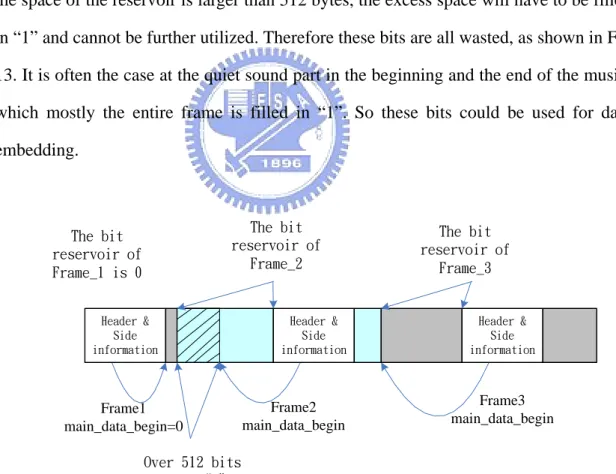
(35) sign bits which represent the phase of the high frequency in the count1 region. For the same reason, the sign bits that represent the phase of the relative high frequency can be used for embedding data. People are sensitive to the sound of low frequency, so the embedded data can not replace all the sign bits in the big-value region. It will cause lots of distortion. The relation between changing the sign bit in the big-value region and the quality of the music is pretty close especially the quality of the low frequency music. For this reason, the lower limit of the frequency must be searched to make sure that the embedded data won’t result in distortion.. There are 6,930 frames in a song which plays three minutes and four granules in a frame. Therefore, there are 27,720 granules in a song. Changing the sign bits of the count1 region doesn't influence the music quality obviously because the count1 region represents the part of the relatively high frequency signal in every granule. The average starting boundary of the count1 region is the 310th frequency line in the granule through the frequency lines statistic. And it maps to the real frequency is 11.84 KHz, as shown in Fig. 9. That is to say, without considering where the starting point of the count1 region is, the 310th frequency line lies in the big-value region. When the data embeds in the sign bits of the frequency lines after the 310th one is replaced, the influence upon the music quality is small.. 21.
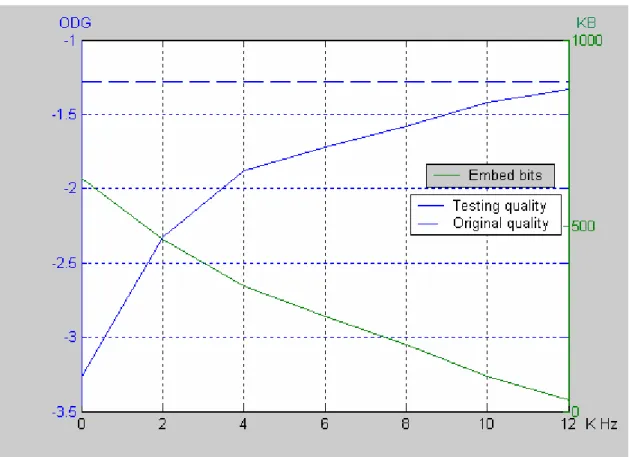
(36) Frequency lines (576) Huffman Code. scalefactor. Region 0 Region 1 Region 2. 1 or 0. 00000000. Big_value. Count 1. Zero_region. Part2_length. Part3_length. Part2_3_length Frequency line. 0. 310. 575. Frequency. 0KHz. 11.84 KHz. 22 KHz. Fig. 9 The frequency line mapping to frequency. The data space for embedding data into the big-value region is bigger than embedding data into the count1 region. But the energy of the signals in the big-value region is bigger than those in the count1 region. On the other hand, data embedded into the big-value region has greater influence upon the music quality than the data embedded into the count1 region. If the quality of the music is highly considered, the latter one is preferred.. Fig. 10 and Fig. 11 are shown two distribution of music quality and bit numbers in big-value region. The meanings of the two figures are the different variations of music quality and bit numbers which embeds data from different frequency in the big-value region. In Fig. 10, if user embeds data from 0K Hz, he can get a quantity of space about 620Kbytes for embedding data. But the music quality will be too worse to hear, the ODG [20] is about -3.2. If user dose not need a big space for embedding data and needs a better music quality, he can embed data from higher frequency, for example, 10K Hz. The selected frequency for embedding data is a trade off between the music quality and. 22.
(37) the bit numbers. Or user can embed data into the other two regions that provides in this thesis. Embedded data into the big-value region affects the music quality easily, so the big-value region is the last region that we suggest for embedding data in the three methods.. Fig. 10 The distribution of music quality and bits in the big-value region (Sample name: 01-can). 23.
(38) Fig. 11 The distribution of music quality and bits in the big-value region (Sample name: speech). 2.3.3.3 Embedded Data into Bit Reservoir In the MP3 encoder algorithm, an enhancement method called “bit reservoir” is used to fit encoder’s time-varying demand on code bits. The encoder can donate bits to a reservoir when it needs less than the average number of bits to code a frame. Next, when the encoder needs more than the average number of bits to code a frame, it can borrow bits from the reservoir mechanism, as shown in Fig. 12.. 24.
(39) The bit reservoir of Frame_2. The bit reservoir of Frame_1 is 0 Header & 檔頭和附 Side 屬資料 information. The bit reservoir of Frame_3. Header & Side information. Frame2 main_data_begin. Frame1 main_data_begin=0. Header & Side information. Frame3 main_data_begin. Fig. 12 The bitstream and bit reservoir of MP3. In bit reservoir, there is a 9-bit flag to record the beginning point of the reservoir. If the space of the reservoir is larger than 512 bytes, the excess space will have to be filled in “1” and cannot be further utilized. Therefore these bits are all wasted, as shown in Fig. 13. It is often the case at the quiet sound part in the beginning and the end of the music, which mostly the entire frame is filled in “1”. So these bits could be used for data embedding.. The bit reservoir of Frame_2. The bit reservoir of Frame_1 is 0 Header & 檔頭和附 Side 屬資料 information. Frame1 main_data_begin=0. The bit reservoir of Frame_3. Header & Side information. Frame2 main_data_begin. Header & Side information. Frame3 main_data_begin. Over 512 bits stuff “1". Fig. 13 The reservoir over 512 bytes and stuff “1”. Embedding data into unutilized bit reservoir space has a huge advantage: It will. 25.
(40) not influence the quality of the music at all. Because in MP3 decoding process, when encountering redundant bit reservoir, the decoder will just read “1” from the bitstream but not decode it. Therefore using these space filled in “1” to embed data will not influence the quality of the music.. 26.
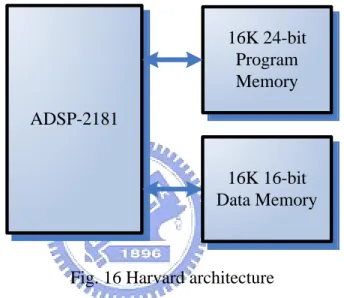
(41) CHAPTER 3 Environment of Hardware and Software In this chapter, the hardware and software environment are described briefly. The data embedded algorithm is ported on the ADSP hardware, and the data embedded algorithm is developed by the VisualDSP which is the software environment. The hardware is concerned with the development of programs while the software influences the development speed and performance.. 3.1 Hardware Environment 3.1.1 ADSP-2181 EZ-KIT Lite Board The hardware used in this thesis is AnalogDevice ADSP-2181 EZ-Kit Lite board. The EZ-KIT Lite consists of a small ADSP-2181 based development/demonstration board with full 16-bit stereo audio I/O capabilities. The board’s features which shown in Fig. 14 include: y. ADSP-2181 16-bit 33 MIPS DSP. y. AD1847 Stereo SoundPort. y. RS-232 Interface. y. Socketed EPROM. y. User Pushbuttons. y. Power Supply Regulation. y. Expansion Connectors. y. User Configurable Jumpers. 27.
(42) Fig. 14 EZ-KIT Lite’s functional block diagram [14]. The board can run standalone or can simply connect to the RS-232 port of the PC. A monitor program running on the DSP in conjunction with a host program running on the PC interactively download programs as well as interrogate the ADSP-2181. The board comes with a socketed EPROM so that we can download the MP3 codec with data hiding algorithm into the EPROM.. 3.1.2 ADSP-2181 Microprocessor The ADSP-2181 is a programmable single-chip microprocessor that uses a common base architecture optimized for digital signal processing (DSP) and other high-speed numeric processing applications. Fig. 15 shows the main functional units of the ADSP-2181 architecture which functions are included in the processor.. 28.
(43) Fig. 15 ADSP-2181 functional block diagram [16] y. Computational Units The ADSP-2181 processor contains three independent, full-function computational units: an arithmetic/logic unit (ALU), a multiplier/accumulator (MAC) and a barrel shifter. The computational units process 16-bit data directly and also provide hardware support for multiprecision computations.. y. Data Address Generators & Program Sequencer Two dedicated address generators and a program sequencer supply addresses for on-chip or external memory access. The sequencer supports single-cycle conditional branching and executes program loops with zero overhead. Dual data address generators allow the processor to generate simultaneous addresses for dual operand fetches. Together the sequencer and data address generators keep the computational units continuously working, maximizing throughput.. y. Memory. 29.
(44) The ADSP-2181 uses a modified Harvard architecture in which data memory stores data, and program memory stores both instructions and data, as shown in Fig. 16. The ADSP-2181 contains on-chip RAM that comprises a portion of the program memory space and data memory space. The speed of the on-chip memory allows the processor to fetch two operands (one from data memory and one from program memory) and in instruction (from program memory) in a single cycle.. 16K 24-bit Program Memory ADSP-2181 16K 16-bit Data Memory. Fig. 16 Harvard architecture y. Serial Ports The serial ports (SPORTs) provide a complete serial interface with hardware companding for data compression and expansion. Both µ -law and A-low companding are supported. The SPORTs interface easily and directly to a wide variety of popular serial devices. Each SPORT can generate a programmable internal clock or accept an external clock. SPROT0 includes a multichannel option.. y. Timer A programmable timer/counter with 8-bit prescaler provides periodic interrupt generation.. y. DMA Ports. 30.
(45) The ADSP-2181’s Internal DMA Port (IDMA) and Byte DMA Port (BDMA) provide efficient data transfers to and form internal memory. The IDMA port has a 16-bit multiplexed address and data bus and supports 24-bit program memory. The IDMA port is completely asynchronous and can be written to while the ADSP-2181 is operating at full speed. The byte memory DMA port allows boot loading and storing of program instructions and data.. 3.2 Software Environment The ADSP software offers a PC based debugger environment, called VisualDSP++ [17] which user can develop quickly and debug easily in programming stage. Fig. 17 shows the VisualDSP++ user interface. This software development support enables user to develop DSP applications.. 31.
(46) Fig. 17 VisualDSP user interface. VisualDSP++ provides the following features:. Extensive editing capabilities Create and modify source files by using multiple language syntax highlighting, drag-and-drop, bookmarks, and other standard editing operations. View files generated by the code development tools.. Flexible project management Specify a project definition that identifies the files, dependencies, and tools that is used to build projects. Create this project definition once or modify it to meet changing development needs.. 32.
(47) Easy access to code development tools Analog Devices provides the following code development tools: C/C++ compiler, VIDL compiler, assembler, linker, splitter, and loader. Specify options for these tools by using dialog boxes instead of complicated command line scripts. Options that control how the tools process inputs and generate outputs have a one-to-one correspondence to command line switches. Define options for a single file or for an entire project. Define these options once or modify them as necessary.. Flexible project build options Control builds at the file or project level. VisualDSP++ enables to build files or projects selectively, update project dependencies, or incrementally build only the files that have changed since the previous build. View the status of the project build in progress. If the build reports an error, double-click on the file name in the error message to open that source file. Then correct the error, rebuild the file or project, and start a debug session.. VisualDSP++ Kernel (VDK) Support Add VDK support to a project to structure and scale application development. The Kernel tab page of the Project window enables to manipulate kernel objects such as events, event bits, priorities, semaphores, and thread types.. Flexible workspace management Create multiple workspaces and quickly switch between them. Assigning a different project to each workspace enables to build and debug multiple projects in a single session.. 33.
(48) Easy movement between debug and build activities Start the debug session and move freely between editing, build, and debug activities.. 34.
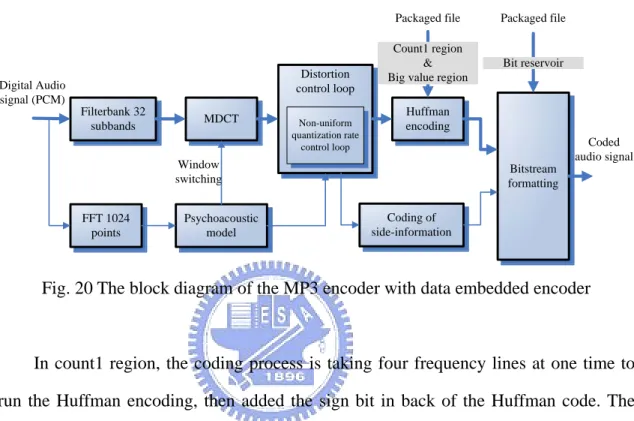
(49) CHAPTER 4 Implementation of Data Embedded Codec In this section, the design of data embedded codec will be introduced. In Section 4.1, the flow of design will be discussed, which includes packaging embedded data and designing MP3 encoder with embedded data. Section 4.2 will introduce the design flow of data embedded decoder, which includes the MP3 decoder with data extracting decoder and the data embedded analyzer.. 4.1 Data Embedded Encoder The data embedded encoder contains two parts: packaging program and the main data embedding program.. It is very important that embedded data cannot affect the quality of the music. Yet another requirement is that the embedded data after being extracted by decoder must be exactly the same as it was encoded by encoder. The bit stream of the embedded data embeds audio file in series type, and the embedding data format must be pre-defined otherwise the extracted bit stream would not be recognized by data analyzer. Thus, a program package the files which will be embedded into the MP3 is needed, and the package format also needs to be defined.. 4.1.1 Package Embedded Data The embedded data usually has several files, not just one. These files are embedded in series but not parallel, and cannot overlap with one another. If the files mix. 35.
(50) up with one another, the embedded data cannot be extracted by the MP3 decoder. Therefore the embedded files must first be packaged.. Here is another problem that should be taken into consideration: the start point and the end point of the files embedded, as well as the data embedded in series type, are not known by the decoder. Therefore a header is defined for the embedded files and is packaged in front of the embedded files. The header contains three parameters: “synchronization bits”, “file length bits”, and “file type bits”, as shown in Table 3. The first parameter, “synchronization bits” is defined to synchronize the start point of the embedded file. It is accounted 4 bytes and has a value of 02040608. The second parameter, “file length bits” is defined to record the size of the embedded file. It is accounted 2 bytes and its value is the same as the size of the embedded file. The last parameter, “file type bits” is defined to record the file type embedded into the MP3 file. The maximum file size it can define is 64K bytes. The “file type bits” is accounted 1 byte. The value 00 represents the txt file, 01 represents the jpg file, and 02 represents the gif file, etc.. The “file type bits” can define as much as 256 types of files. Table 3 The parameters of the header in the package file. Parameters. Size. value. maximum. Synchronization bits. 4 bytes. 02040608. File length bits. 2 bytes. The size of the file. 64K Bytes. File type bits. 1 bytes. 00:txt 01:jpg 02:gif. 256 types. The packaged file contains all the files that will be embedded into the MP3 file. The embedded files connect one another and every embedded file has an individual header in front of the file, as shown in Fig. 18. The packaged files can be added on before the total size exceeds the maximum embedded capacity of the MP3 file.. 36.
(51) Synchonization Header1. File length File type File data. Synchonization Header2. File length File type. File data. Synchonization Header3. File length File type ……. Fig. 18 The format of the packaged file. The following Fig. 19 is a flowchart shows how the packaging program is designed. The parameters of the embedded file are read and saved into a register first. The lyrics must start at the beginning of the music, so the text file is sorted at the first. Therefore lyrics have first priority, and pictures shown on the display screen during which the music is playing come in second. Next, the program identifies the file length and file type for adding header at the next stage in the flowchart. Then the embedded file is copied into the packaged file behind the header. If there are other files to be embedded into the MP3, the program jumps back to the third stage of the flowchart for getting the new synchronization, file length and file type. The loop will run continuously until there is no files need embedding further.. 37.
(52) start. Read the parameters of the embedded files. To sort files : .txt > .jpg > .gif. Find out the file length and the file type. Add header. Package into the file. Any other files?. Yes. No. End Fig. 19 The flowchart of the packaged file. 4.1.2 Embed Data into the MP3 File From the structure of the data embedded encoder, as shown in Fig. 20, the packaged file that embedded data has been packaged will be sent to MP3 encoder along. 38.
(53) with the raw PCM data to be encoded. There are two ways to embed the package file. One is embedding the data in count1 region and big-value region while processing the Huffman encoding. The other is embedding the data in the block of the bitstream formatting bit reservoir, if there is redundant bites.. Distortion control loop. Digital Audio signal (PCM) Filterbank 32 subbands. MDCT. Non-uniform quantization rate control loop. Packaged file. Packaged file. Count1 region & Big value region. Bit reservoir. Huffman encoding Coded audio signal. Window switching FFT 1024 points. Bitstream formatting Coding of side-information. Psychoacoustic model. Fig. 20 The block diagram of the MP3 encoder with data embedded encoder. In count1 region, the coding process is taking four frequency lines at one time to run the Huffman encoding, then added the sign bit in back of the Huffman code. The four frequency lines are represented by v, w, x, and y. If the value of the frequency lines do not equal zero, then it will have to save the sign bit of the frequency lines. The data embedded method, using the storage space of sign bit to embed data, means to replace sign bit by the embedded data. Because in every song, after quantization the size of count1 region differs in every frame, thus the storage space for the embedded data differs. If the song has less energy in high frequency band, then the space of count1 region after quantization will be larger, that is, more space for embedded data.. Another embedded region is bit reservoir, which has a 9-bit pointer to record how much bits are redundant in the former frame. Embedding data in the redundant bits in bit reservoir would not cause any negative influence to the music. If the bit reservoir. 39.
(54) exceed 512 bytes, it would be neglected the redundant bits then wasted. Usually in the beginning of the music, the frame is quite sound without any signals so could be used for encoding, thus bit reservoir would has redundant space for embedded data. So does the ending of the music. But in frames with sound, there are not much redundant bits for embedded data in bit reservoir. Most redundant space for embedded data in bit reservoir is provided by the non-signal frames in the beginning or the ending of the music, as shown in Fig. 21.. Fig. 21 The distribution of the unnecessary bits of the bit reservoir in MP3 song [18]. 4.2 Data Embedded Decoder The data embedded decoder includes four parts: extracting data from the MP3 file, porting the MP3 decoder with data embedded decoder on the ADSP-2181, the data. 40.
(55) stream analyzer, and the lyric analyzer.. 4.2.1 Extract Data from the MP3 File The data is embedded into the “bitstream coding” block at the end of the encoder. The data stream extractor is located in the “decoding of bitstream” block of the decoder, as shown in Fig. 22. When inputting MP3 data stream in for decoder bitstream decoding, there will be two outputs: 576 lines of frequency lines that decoded from Huffman decoding are prepared for inverse quantization, and extracted data from data stream extractor.. Coded audio signal. Decoding of Bitstream. Inverse Quantization. Frequency to Time mapping. Digital Audio signal (PCM). Data stream extractor Embedded data stream. Fig. 22 The block diagram of the MP3 decoder with data embedded decoder. The data stream extractor extracts data from the count1 region and big-value region of the Huffman coding and the bit reservoir. And the data stream is collected and saved in the buffer. It will be analyzed by the data stream analyzer.. 4.2.2 Porting MP3 Decoder with Data Embedded Decoder on the ADSP-2181 The structure of the MP3 decoder with the data embedded decoder ported on the. 41.
(56) ADSP-2181 is the same as the structure on the PC. The MP3 decoder and the data embedded decoder are implemented in ADSP assembly language directly in order to have the better executing performance.. The ADSP-2181 is designed for digital signal processing. It has circular buffer function, which is used for DSP porting. This function is for write-in or when reading process is performed to the end of the buffer address, the address pointer will automatically point back to the beginning of the circular buffer, like circuit. The bit stream is decoded from the PC-based data embedded decoder and put into the data analyzer to analyze every frame. The data analyzer will analyze the extracted data and store the result in the buffer. Because ADSP-2181 belongs to the device end of the entire embedded system, it is controlled by StrongARM CPU which is as a host of the system. In ADSP-2181, could not perform data reading and analyzing every frame in the host, which would be a waste of time for the host and device to do hand-shaking constantly. At the device, the extracted data is written into a shared buffer by the extractor on the ADSP-2181 and the writing address is recorded. When the host read the data stored in the shared buffer, it will just have to identify if the data write pointer is changed, and then the reading process could be performed. As a result, the host won’t have to read the buffer in every frame and cause an influence to the CPU performance.. The MP3 decoder with data embedded decoder is realized real-time decoder which the decoding speed is 18 MIPS, 20.7K bytes of program memory, and 23.6K bytes of data memory, as shown in Table 4. It could further be developed as a portable product.. 42.
(57) Table 4 The spec. of the MP3 decoder with data embedded decoder on the ADSP-2181. Program memory. Data memory. The peak computing power. MP3 decoder with data. 20.7K bytes. 23.6K bytes. 18 MIPS. embedded decoder. 4.2.3 Data Stream Analyzer The data stream analyzer is used to analyze the data stream which is extracted by the data embedded decoder. The data stream is a series of signal of “0” and “1”, it must be analyzed and reconstructed to the original files by the data stream analyzer.. The flowchart of the data stream analyzer is shown as Fig. 23, which is based in the state machine structure. The purpose of stream analyzer is for data stream analyzing, identifying synchronization, file length, file type, and processing every different files type. The start point of the embedded must be found to perform data stream analyzing, thus synchronization bits should be identified.. “Synchronization bits” is composed of 4 bytes. So at first 4 bytes should be read to judge if its synchronization bits. If not, left-shifting one byte and replenish a byte for judging, until the synchronization bits is found to jump to the next state. On the other hand, the file length parameter shows the analyzer how many bytes in the file to read. Last, the file type parameter shows the analyzer what file type is, which would be beneficial for the analyzer to handle it properly in next state. If the file type is lyric, the file will be saved to a lyric buffer, preparing to be shown synchronously on the screen during the song is playing. Other file types will be saved as file, then finishing the file analyzing. State machine will jump to the first state and proceeds to the synchronization 43.
(58) bits of the next file for analyzing.. 44.
(59) start 0. Read 4 bytes from buffer 1. Read 1 bytes from buffer. No. Sync?. 2. Yes. File length 3. File type 4. File type. =0. File type. File data : Lyric buffer. != 0. File data: Put to file. Fig. 23 The flowchart of the data embedded analyzer. 45.
(60) 4.2.4 Lyric Analyzer The lyric analyzer is also designed in the structure of state machine. It’s for computing show time of the lyrics, which should be synchronous to the playing time of the song, the same as lyrics showing in KTV. In data stream analyzer, if the data type is lyrical after analyzing, it will be saved temporarily to lyric buffer for analyzing by lyric analyzer.. The lyric format is defined as ”[mm:ss] the lyrics of a line”, shown by line as its unit. “[” represents the beginning of the lyrics in every line, ”mm” records the showing minutes of the lyrics, ”:” is for partition, and “ss” is to records the showing seconds of the lyrics. From ”]” to the changing line character ”0D 0A”, they all are the contents of a line of the lyrics.. At first the state machine will read one byte to identify if it’s the beginning of one line ”[”. After finding that, it will jump to the next state to store the address of the line. Then next four states record the showing time of the lyrics. After finish reading the showing time of the lyrics would be the contents of the lyrics. The result will be saved to print buffer and then the state machine will jump to the first state for the next line of the lyric analyzing.. 46.
(61) start. Read 1 byte from lyric buffer. No. Get “[". Yes. Record next stream pointer. Read 2 bytes from lyric buffer & save minute. Read 1 byte “:"from the lyric buffer & don't care. Read 2 bytes from lyric buffer & save second. Read 1 byte “]"from the lyric buffer. Compute frame count Save now stream pointer. Read a line of lyric from lyric buffer & save to the print buffer. Fig. 24 The flowchart of the lyric analyzer. 47.
(62) 4.3 Experimental process This section presents the overall experimental process from embedding data in the encoder to extract data in the decoder. The process has been introduced in the former section.. 4.3.1 Encoding In the encoder process, several samples are chosen for embedding data. And the files which are embedded into MP3 are embedded into the count1 region and the big-value region that the embedded region are brought out in the previously chapter. We select one from the samples to demo in the following.. There are six MP3 samples which are chosen for embedding data in this experiment. Their MP3 names are “01-can”, “Aero Smith - Miss a Thing”, “Bon Jovi always”, “Dido thank you”, “Natalie-Torn” and “Speech”. The “01-can” is selected to demo and the information about “01-can” is shown in Table 5. The “01-can” is embedded a lyric file and six photo files. The total size of the embedded files is about 100K bytes and the files are embedded into the MP3 file that the size of the sample is 3.3 MB. To be mentioned that the embedded photos can be any resolution as long as the file size of the photo is not bigger than the maximum embedded size of the MP3 file.. 48.
數據
+7
![Fig. 14 EZ-KIT Lite’s functional block diagram [14]](https://thumb-ap.123doks.com/thumbv2/9libinfo/8377857.178035/42.892.175.809.105.714/fig-ez-kit-lite-s-functional-block-diagram.webp)
![Fig. 15 ADSP-2181 functional block diagram [16] y Computational Units](https://thumb-ap.123doks.com/thumbv2/9libinfo/8377857.178035/43.892.179.804.127.768/fig-adsp-functional-block-diagram-y-computational-units.webp)
相關文件
The remaining positions contain //the rest of the original array elements //the rest of the original array elements.
Our main goal is to give a much simpler and completely self-contained proof of the decidability of satisfiability of the two-variable logic over data words.. We do it for the case
Experiment a little with the Hello program. It will say that it has no clue what you mean by ouch. The exact wording of the error message is dependent on the compiler, but it might
– Each time a file is opened, the content of the directory entry of the file is moved into the table.. • File Handle (file descriptor, file control block): an index into the table
(A) 重複次數編碼(RLE, run length encoding)使用記録符號出現的次數方式進行壓縮 (B) JPEG、MP3 或 MPEG 相關壓縮法採用無失真壓縮(lossless compression)方式
This paper presents (i) a review of item selection algorithms from Robbins–Monro to Fred Lord; (ii) the establishment of a large sample foundation for Fred Lord’s maximum
The temperature angular power spectrum of the primary CMB from Planck, showing a precise measurement of seven acoustic peaks, that are well fit by a simple six-parameter
無庸置疑,共產主義及蘇維埃超級大國瓦解,是促成全球巨變的首要因素。自 1945
