Fault Hamiltonicity and Fault Hamiltonian Connectivity of
the (n, k)-Star Graphs
Hong-Chun Hsu, Yi-Lin Hsieh, Jimmy J. M. Tan, Lih-Hsing Hsu
Department of Computer and Information Science, National Chiao Tung University, Hsinchu, Taiwan 300, Republic of China
In this paper, we consider the fault Hamiltonicity, and the fault Hamiltonian connectivity of the (n, k)-star graph
Sn,k. Assume that F僒 V(Sn,k)僔 E(Sn,k). For nⴚ k ≥ 2, we prove that Sn,kⴚ F is Hamiltonian if 円F円 ≤ n ⴚ 3 and Sn,k ⴚ F is Hamiltonian connected if 円F円 ≤ n ⴚ 4. For n ⴚ k ⴝ 1,
Sn,nⴚ1 is isomorphic to the n-star graph Sn which is known to be Hamiltonian if and only if n> 2 and Hamil-tonian connected if and only if nⴝ 2. Moreover, all the bounds are tight.© 2003 Wiley Periodicals, Inc.
Keywords: Hamiltonian cycle; Hamiltonian connected; (n, k)-star graph
1. INTRODUCTION
The architecture of an interconnection network is usually represented by a graph. There are many mutually conflicting requirements in designing the topology of interconnection networks. It is almost impossible to design a network which is optimum from all aspects. One has to design a suitable network depending on the requirements of its properties. The Hamiltonian property is one of the major requirements in designing the topology of a network. Fault tolerance is also desirable in massive parallel systems.
In this paper, a network is represented as a loopless undirected graph. For graph definitions and notations, we follow [2]. G⫽ (V, E) is a graph if V is a finite set and E is a subset of {(u, v)兩(u, v) is an unordered pair of V}. We say that V is the vertex set and E is the edge set. Two vertices u and v are adjacent if (u, v) 僆 E. A path is represented by具v0, v1, v2, . . . , vk典. The length of a path P is the number of edges in P. We also write the path具v0, v1,
v2, . . . , vk典 as 具v0, P1, vi, vi⫹1, . . . , vj, P2, vt, . . . , vk典, where P1is the path具v0, v1, . . . , vi典 and P2is the path具vj,
vj⫹1, . . . , vt典. Hence, it is possible to write a path as 具v0,
v1, P, v1, v2, . . . , vk典 if the length of P is 0. We use d(u,
v) to denote the distance between u and v, that is, the length
of the shortest path joining u and v. A path is a Hamiltonian
path if its vertices are distinct and span V. A cycle is a path
with at least three vertices such that the first vertex is the same as the last vertex. A cycle is a Hamiltonian cycle if it traverses every vertex of G exactly once. A graph is
Ham-iltonian if it has a HamHam-iltonian cycle.
In [4], the performance of the Hamiltonian property in faulty networks is discussed. A Hamiltonian graph G is
k-vertex-fault Hamiltonian if G ⫺ F remains Hamiltonian
for every F傺 V(G) with 兩F兩 ⱕ k. The vertex fault-tolerant
HamiltonicityᏴv(G) is defined to be the maximum integer
k such that G is k-vertex-fault Hamiltonian if G is
Hamil-tonian and is undefined otherwise. Obviously, Ᏼv(G)
ⱕ ␦(G) ⫺ 2, where ␦(G) ⫽ min{deg(v)兩v 僆 V(G)} if
Ᏼv(G) is defined. Similarly, a Hamiltonian graph G is
k-edge-fault Hamiltonian if G ⫺ F remains Hamiltonian
for every F傺 E(G), with 兩F兩 ⱕ k. The edge fault-tolerant
HamiltonicityᏴe(G) is defined to be the maximum integer
k such that G is k-edge-fault Hamiltonian if G is
Hamilto-nian and is undefined otherwise. Again, Ᏼe(G) ⱕ ␦(G) ⫺ 2 if Ᏼe(G) is defined. Huang et al. [5] defined a more general parameter: fault-tolerant Hamiltonicity. A Hamilto-nian graph G is k-fault HamiltoHamilto-nian if G ⫺ F remains Hamiltonian for every F 傺 V(G) 艛 E(G) with 兩F兩 ⱕ k. The fault-tolerant HamiltonicityᏴf(G) is defined to be the maximum integer k such that G is k-fault Hamiltonian if G is Hamiltonian and is undefined otehrwise. Clearly,Ᏼf(G) ⱕ ␦(G) ⫺ 2 if Ᏼf(G) is defined. Huang et al. [5] also introduced the term fault-tolerant Hamiltonian connected. A graph G is Hamiltonian connected if there exists a Hamil-tonian path joining any two vertices of G. All HamilHamil-tonian connected graphs except the complete graphs K1and K2are Hamiltonian. A graph G is k-fault Hamiltonian connected if
G⫺ F remains Hamiltonian connected for every F 傺 V(G)
艛 E(G) with 兩F兩 ⱕ k. The fault-tolerant Hamiltonian
connectivityᏴf(G) is defined to be the maximum integer k such that G is k-fault Hamiltonian connected if G is Ham-iltonian connected and is undefined otherwise. It can be checked thatᏴf(G)ⱕ␦(G) ⫺ 3 only if Ᏼf(G) is defined and兩V(G)兩 ⱖ 4.
In this paper, we consider the fault-tolerant Hamiltonic-Received February 2002; accepted July 2003
Correspondence to: L. H. Hsu; e-mail: [email protected]
ity of the (n, k)-star graph. The (n, k)-star graph is an attractive alternative to the n-star graph [1]. However, the growth of vertices is n! for an n-star graph. To remedy this drawback, the (n, k)-star graph was proposed by [3]. The (n, k)-star graph is a generalization of the n-star graph. It has two parameters n and k. When k ⫽ n ⫺ 1, an (n, n ⫺ 1)-star graph is isomorphic to an n-star graph, and when
k ⫽ 1, an (n, 1)-star graph is isomorphic to a complete
graph Kn. Then, all the parallel algorithms of the n-star graphs and the complete graphs Kncan be applied to the (n,
k)-star graphs.
Throughout this paper, we assume that n and k are positive integers with n⬎ k. We use 具n典 to denote the set {1, 2, . . . , n}. The (n, k)-star graph, denoted by Sn,k, is a graph with the vertex set V(Sn,k)⫽ {u1u2. . . uk兩ui僆 具n典 and ui⫽ ujfor i⫽ j}. Adjacency is defined as follows: A vertex u1u2. . . ui. . . uk is adjacent to (1) the vertex
uiu2u3. . . u1. . . uk, where 2 ⱕ i ⱕ k (i.e., we swap ui with u1), and (2) the vertex xu2u3. . . uk, where x僆 具n典 ⫺ {ui兩1 ⱕ i ⱕ k}. The (4, 2)-star graph is shown in Figure 1. The edges of type (1) are referred to as i-edges, and the edges of type (2) are referred to as 1-edges. By definition,
S(n, k) is an (n ⫺ 1)-regular graph with n!/(n ⫺ k)!
vertices. Moreover, it is vertex-transitive.
In the following section, we discuss some properties of complete graphs Kn. In Section 3, we discuss some prop-erties of the (n, k)-star graphs. In the final section, we prove that (1)Ᏼf(Sn,k)⫽ n ⫺ 3 and Ᏼf(Sn,k)⫽ n ⫺ 4 if n ⫺ k ⱖ 2; (2) Ᏼf(S2,1) is undefined andᏴf(S2,1) ⫽ 0; and (3) Ᏼf(Sn,n⫺1) ⫽ 0 and Ᏼf(Sn,n⫺1) is undefined if n ⬎ 2. 2. SOME PROPERTIES OF COMPLETE GRAPHS
Let G⫽ (V, E) be a graph. We use E to denote the edge set of the complement of G. The following theorem was proved by Ore [7]:
Theorem 1 [7]. Assume that G⫽ (V, E) is a graph with nⱖ 4 vertices. Then, G is Hamiltonian if 兩E兩 ⱕ n ⫺ 3 and is Hamiltonian connected if兩E兩 ⱕ n ⫺ 4.
Let G⫽ (V, E) be a graph with n vertices where n ⱖ 4 and兩E兩 ⱕ n ⫺ 4. By Theorem 1, there is a Hamiltonian path joining any two different vertices. Actually, there are two Hamiltonian paths of different types joining any two different vertices. Therefore, we have a more profound result.
Theorem 2. Assume that G ⫽ (V, E) is a graph with V
⫽ 具n典, n ⱖ 4, and 兩E兩 ⱕ n ⫺ 4. Then, there are two
Hamiltonian paths of G joining any two different vertices i and j in V, say P1⫽ 具i ⫽ i1, i2, . . . , in⫺1, in⫽ j典 and P2⫽ 具i ⫽ i⬘1, i⬘2, . . . , i⬘n⫺1, in⬘⫽ j典, such that i2⫽ i⬘2and in⫺1⫽ i⬘n⫺1. Proof. We prove this theorem by induction on n. The theorem is true for n⫽ 4 because G is the complete graph
K4. Assume that the theorem holds for every integer m with
n⬎ m ⱖ 4. Let i and j be any two vertices of G. We want
to find two Hamiltonian paths of G joining i and j, say P1 ⫽ 具i ⫽ i1, i2, . . . , in⫺1, in ⫽ j典 and P2 ⫽ 具i ⫽ i⬘1,
i⬘2, . . . , i⬘n⫺1, i⬘n⫽ j典, such that i2⫽ i⬘2and in⫺1⫽ i⬘n⫺1. Let X be a subset of具n典. We use GXto denote the subgraph of G induced by X and EX to denote the set {(i, j)兩(i, j) 僆 E, i, j 僆 X}.
CASE1. 兩{ x 僆 具n ⫺ 1典兩(n, x) 僆 E}兩 ⫽ 0. Hence, 兩E具n⫺1典兩
ⱕ n ⫺ 4 and (n, l ) 僆 E for any l 僆 具n ⫺ 1典.
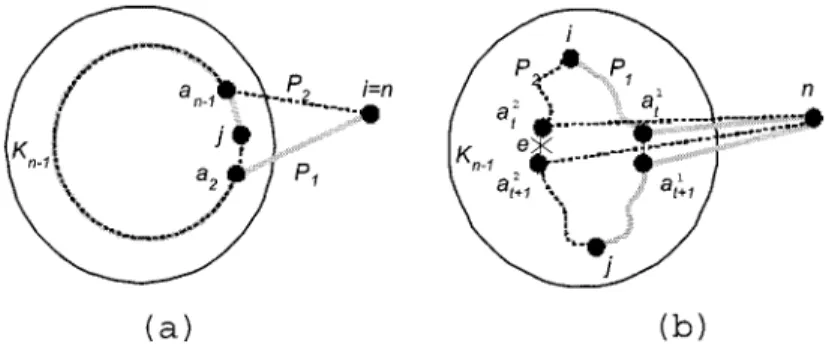
Suppose that i⫽ n or j ⫽ n. Without loss of generality, we assume that i⫽ n. Since 兩E具n⫺1典兩 ⫽ n ⫺ 4 ⫽ (n ⫺ 1) ⫺ 3, by Theorem 1, there is a Hamiltonian cycle of G具n⫺1典, say 具j ⫽ a1, a2, a3, . . . an⫺1, a1 ⫽ j典. Then, P1 ⫽ 具i ⫽ n, a2, a3, . . . , an⫺1, a1⫽ j典 and P2⫽ 具i ⫽ n, an⫺1,
an⫺2, . . . , a2, a1⫽ j典 form two Hamiltonian paths of G, satisfying our requirements. See Figure 2(a) for an example. For illustrative purpose, we draw P1 and P2 as internal disjoint paths. Similar situations hold for the remaining figures.
Now, we consider that i ⫽ n and j ⫽ n. Suppose that
E具n⫺1典 ⫽ A. Then, G is the complete graph Kn and the theorem is obviously true. Suppose that E具n⫺1典 ⫽ A. We can choose any edge e in E具n⫺1典. Obviously, G具n⫺1典⫹ e is a graph with n⫺ 1 vertices. Moreover, the complement of
G具n⫺1典 ⫹ e contains at most (n ⫺ 1) ⫺ 4 edges. By
induction, there are two Hamiltonian paths of G具n⫺1典 ⫹ e joining i and j, say P⬘1⫽ 具i ⫽ a1
1 , a2 1 , . . . , an1⫺2, an1⫺1⫽ j典 and P⬘2⫽ 具i ⫽ a1 2 , a2 2 , . . . , an2⫺2, an2⫺1⫽ j典, such that a2 1⫽ a22
and an1⫺2⫽ an2⫺2. For l 僆 {1, 2}, we set Pl as 具i ⫽ a1l , a2 l , . . . , at l , n, atl⫹1, . . . , anl⫺2, anl⫺1⫽ j典, where t⫽ 2 if (ap l
, apl⫹1)⫽ e for all 1 ⱕ p ⱕ n ⫺ 1, or t is the index p such that (ap
l
, apl⫹1) ⫽ e. Obviously, P1 and P2 form two Hamiltonian paths of G, satisfying our require-ments. See Figure 2(b) for an illustration.
CASE2. 兩{ x 僆 具n ⫺ 1典兩(n, x) 僆 E}兩 ⱖ 1. Hence, 兩E具n⫺1典兩
ⱕ n ⫺ 5. Suppose that i ⫽ n or j ⫽ n. Without loss of generality, we assume that i⫽ n. Since 兩E兩 ⱕ n ⫺ 4, there are at least three different vertices r, s, and t, such that {(r, FIG. 1. (4, 2)-star graph.
n), (s, n), (t, n)}傺 E. Without loss of generality, we may
assume that r⫽ j and s ⫽ j. By induction, there exist two Hamiltonian paths P1and P2of G具n⫺1典joining r and j, say
P1 ⫽ 具a1 ⫽ r, a2, . . . , an⫺1 ⫽ j典 and P2 ⫽ 具b1 ⫽ r,
b2, . . . , bn⫺1⫽ j典, such that a2⫽ b2and an⫺2⫽ bn⫺2. Similarly, there exist two Hamiltonian paths P3and P4of
G具n⫺1典 joining s and j, say P3⫽ 具c1 ⫽ s, c2, . . . , cn⫺1 ⫽ j典 and P4⫽ 具d1⫽ s, d2, . . . , dn⫺1⫽ j典, such that c2 ⫽ d2and cn⫺2⫽ dn⫺2. Without loss of generality, we may assume that an⫺2⫽ cn⫺2. Obviously,具i, a1⫽ r, a2, . . . ,
an⫺1 ⫽ j典 and 具i, c1 ⫽ s, c2, . . . , cn⫺1 ⫽ j典 form the desired Hamiltonian paths of G.
Now, we consider that i⫽ n and j ⫽ n. Since 兩E具n⫺1典兩 ⱕ n ⫺ 5, by induction, there are two Hamiltonian paths of
G具n⫺1典 joining i and j, say P1 ⫽ 具a1⫽ i, a2, . . . , an⫺1
⫽ j典 and P2⫽ 具b1⫽ i, b2, . . . , bn⫺1⫽ j典, such that a2 ⫽ b2 and an⫺2⫽ bn⫺2.
Suppose that {(i, n), ( j, n)} 傺 E. Without loss of generality, we assume that (i, n)僆 E. Since 兩E兩 ⱕ n ⫺ 4, there exists a smallest index p such that (n, ap) 僆 E. Obviously, 2ⱕ p ⱕ n ⫺ 3. Set J ⫽ {a1, a2, . . . , ap⫺1}. Thus, 兩E具n典⫺J兩 ⱕ 兩E兩 ⫺ 兩J兩 ⫽ n ⫺ 4 ⫺ ( p ⫺ 1) and
G具n典⫺Jis a graph with兩具n典 ⫺ J兩 ⫽ n ⫺ p ⫹ 1 ⱖ n ⫺ (n ⫺ 3) ⫹ 1 ⫽ 4 vertices. By induction, there are two Hamiltonian paths P3and P4of G具n典⫺Jjoining apto j, say
P3 ⫽ 具cp ⫽ ap, cp⫹1, . . . , cn ⫽ j典 and P4⫽ 具dp ⫽ ap,
dp⫹1, . . . , dn ⫽ j典, such that cp⫹1 ⫽ dp⫹1 and cn⫺1 ⫽ dn⫺1. See Figure 3(a) for an illustration. Similarly, let q be the smallest index such that (n, bq)僆 E. Set J⬘ ⫽ {b1,
b2, . . . , bq⫺1}. Again, 2 ⱕ q ⱕ n ⫺ 3, 兩E具n典⫺J⬘兩 ⱕ 兩E兩 ⫺ 兩J⬘兩 ⫽ n ⫺ 4 ⫺ (q ⫺ 1), and G具n典⫺J⬘is a graph with FIG. 2. Illustrations for Case 1.
n ⫺ q ⫹ 1 ⱖ 4 vertices. By induction, there are two
Hamiltonian paths P5and P6of G具n典⫺J⬘joining bqto j, say
P5 ⫽ 具eq⫽ bq, eq⫹1, . . . , en⫽ j典 and P6 ⫽ 具fq ⫽ bq,
fq⫹1, . . . , fn ⫽ j典, such that eq⫹1 ⫽ fq⫹1 and en⫺1 ⫽ fn⫺1. Without loss of generality, we may assume that
cn⫺1 ⫽ en⫺1. Then, we set P7 ⫽ 具a1 ⫽ i, a2, . . . , ap ⫽ cp, cp⫹1, . . . , cn⫺1, cn ⫽ j典 and P8 ⫽ 具b1 ⫽ i,
b2, . . . , bq⫽ eq, eq⫹1, . . . , en⫺1, en⫽ j典. Obviously, P7 and P8form the desired Hamiltonian paths of G. See Figure 3(b) for an illustration.
Suppose that {(i, n), ( j, n)}傺 E. We assume that 兩{ x 僆 具n典兩(n, x) 僆 E}兩 ⱕ 1. By Theorem 1, there exists a Hamiltonian cycle of G具n⫺1典⫺{i}, say C⫽ 具j, k, Q1, l, j典. Since the cycle C can be traversed forward and backward, we may assume that (k, n)僆 E. Then, P1⫽ 具i, n, k, Q1,
l, j典 forms a Hamiltonian path of G. Similarly, there also
exists a Hamiltonian cycle of G具n⫺1典⫺{ j}, say具i, k⬘, Q2, l⬘,
i典 with (k⬘, n) 僆 E. Then, P2⫽ 具i, l⬘, Q2, k⬘, n, j典 forms another Hamiltonian path of G. Thus, P1and P2form the desired Hamiltonian paths of G. See Figure 3(c) for an illustration.
Assume that兩{ x 僆 具n典兩(n, x) 僆 E}兩 ⱖ 2. Since 兩E兩 ⱕ
n⫺ 4, n ⱖ 6 and there exists a vertex k in 具n典 ⫺ {i, j}
such that (k, n)僆 E. Obviously, 兩E具n⫺1典⫺{i}兩 ⱕ n ⫺ 6 and
G具n⫺1典⫺{i} is a graph with (n ⫺ 2) vertices. By Theorem 1, there exists a Hamiltonian path具g1⫽ k, g2, . . . , gn⫺2 ⫽ j典 of G具n⫺1典⫺{i} joining k to j. Similarly, there exists a Hamiltonian path 具h1 ⫽ i, h2, . . . , hn⫺2 ⫽ k典 of
G具n⫺1典⫺{ j}joining i to k. Obviously,具i, n, k ⫽ g1, g2, . . . , gn⫺2⫽ j典 and 具h1⫽ i, h2, . . . , hn⫺2⫽ k, n, j典 form the desired Hamiltonian paths of G. See Figure 3(d) for an
illustration. ■
Lemma 1. Assume that nⱖ 4. Then, Knis (n⫺ 3)-fault
Hamiltonian and (n⫺ 4)-fault Hamiltonian connected.
Proof. Let F be any subset of V(Kn)艛 E(Kn). We use
FV to denote F 艚 V(Kn). Then, Kn⫺ F is isomorphic to
Kn⫺f ⫺ F⬘, where f ⫽ 兩FV兩 and F⬘ is a subset of edges in the subgraph of Kninduced by具n典 ⫺ FV. Obviously,兩F⬘兩 ⱕ 兩F兩 ⫺ f. Thus, if 兩F兩 ⱕ n ⫺ i, then E(Kn⫺f ⫺ F⬘) ⫽ 兩F⬘兩 ⱕ 兩F兩 ⫺ f ⱕ (n ⫺ f ) ⫺ i. Since n ⫺ f is the number of vertices of Kn⫺f⫺ F⬘, the lemma follows from
Theorem 1. ■
The following theorem was proved by Hung et al. [6]: Theorem 3 [6]. Let Kn⫽ (V, E) be the complete graph
with n vertices. Let F傺 (V 艛 E) be a faulty set with 兩F兩 ⱕ n⫺ 2. Then, there exists a vertex set V⬘ 債 V(Kn)⫺ F with 兩V⬘兩 ⫽ n ⫺ 兩F兩 such that there exists a Hamiltonian path of
Kn⫺ F joining every pair of vertices in V⬘.
3. BASIC PROPERTIES OF THE (N, K)-STAR GRAPHS
Let u ⫽ u1u2. . . uk be any vertex of the (n, k)-star graph. We say uiis the ith coordinate of u, denoted as (u)i,
for 1ⱕ i ⱕ k. Let v be a neighbor of u. We say that v is an
i-neighbor of u if ui ⫽ vi. By the definition of Sn,k, there is exactly one i-neighbor of u for 2ⱕ i ⱕ k and there are (n ⫺ k) 1-neighbors of u. We use i(u) to denote the unique i-neighbor of u if i⫽ 1. Hence, (k(u))k⫽ (u)1. For 1ⱕ i ⱕ n, let Sni⫺1,k⫺1 be the subgraph of Sn,kinduced by those vertices u with (u)k ⫽ i. In [3], Chiang and Chen proved that Sn,kcan be decom-posed into n subgraphs Sni⫺1,k⫺1, 1ⱕ i ⱕ n, such that each subgraph Sni⫺1,k⫺1 is isomorphic to Sn⫺1,k⫺1. Thus, the (n,
k)-star graph can be constructed recursively.
Lemma 2. Let n ⬎ k ⬎ 1 and u and v be two distinct vertices in Snl⫺1,k⫺1with d(u, v)ⱕ 2 for some 1 ⱕ l ⱕ n.
Then, (u)1⫽ (v)1.
Proof. Let u⫽ u1u2. . . uk. Suppose that d(u, v)⫽ 1. Since every edge in Snl⫺1,k⫺1is an i-edge with 1 ⱕ i ⬍ k, v is either i(u) for some 2ⱕ i ⬍ k or xu2. . . ukfor some
x僆 具n典 ⫺ {uj兩1 ⱕ j ⱕ k}. Obviously, (v)1is either uiwith 2ⱕ i ⬍ k or x. Hence, (u)1⫽ (v)1.
Suppose that d(u, v)⫽ 2. Let w ⫽ w1w2. . . wkbe the common neighbor of u and v in Snl⫺1,k⫺1. Then, u is either
i(w) or x1w2w3. . . wk for some x1 僆 具n典 ⫺ {wr兩1 ⱕ r ⱕ k}.
Assume that u is i(w). Then, v is either j(w) for some 2 ⱕ j ⫽ i ⬍ k or xw2. . . wkfor some x僆 具n典 ⫺ {wr兩1 ⱕ r ⱕ k}. Thus, (u)1⫽ wi. Moreover, (v)1⫽ wjor (v)1⫽ x with 2ⱕ i ⫽ j ⬍ k. Hence, (u)1⫽ (v)1.
Assume that u is x1w2. . . wk for some x1 僆 具n典 ⫺ {wr兩1 ⱕ r ⱕ k}. Then, v is x2w2. . . wkfor some x2僆 具n典 ⫺ {wr兩1 ⱕ r ⱕ k}, with x1⫽ x2. Thus, (u)1⫽ x1and (v)1 ⫽ x2. Hence, (u)1⫽ (v)1.
Thus, the lemma is proved. ■
For 1ⱕ i ⫽ j ⱕ n, we use Ei, jto denote the set of edges between Sni⫺1,k⫺1and Snj⫺1,k⫺1. Let (u, v) be any edge in Ei, j. We assume that u僆 Sni⫺1,k⫺1and v僆 Snj⫺1,k⫺1. Thus, (u, v) 僆 Ei, j
implies that (v, u)僆 Ej,i. However, (u, v)ⰻ Ej,iif (u, v) 僆 Ei, j
. In [3], it was proved that兩Ei, j兩 ⫽ [(n ⫺ 2)!]/[(n ⫺ k)!]. Thus,兩Ei, j兩 ⫽ 1 if k ⫽ 2. The following lemma can be easily obtained from the definition of Sn,k.
Lemma 3. Let (u, v) and (uⴕ, vⴕ) be any two distinct edges in Ei,j. Then, {u, v} 艚 {uⴕ, vⴕ} ⫽ A.
Let F be a faulty set of Sn,k. An edge (u, v) is F-fault if (u, v)僆 F, u 僆 F, or v 僆 F, and (u, v) is F-fault free if (u, v) is not F-fault. Let H ⫽ (V⬘, E⬘) be a subgraph of
Sn,k. We use F(H) to denote the set (V⬘ 艛 E⬘) 艚 F. We associate Sn,kwith the complete graph Knwith vertex set 具n典 such that vertex l of Knis associated with Snl⫺1,k⫺1for every 1ⱕ l ⱕ n. We define a faulty edge set R(F) of Kn as (i, j)僆 R(F) if some edge of Ei, j is F-fault. Obviously, 兩R(F)兩 ⱕ 兩F兩. Assume that I is any subset of 具n典. We use
SnI⫺1,k⫺1 to denote the subgraph of Sn,k induced by 艛i僆IV(Sni⫺1,k⫺1). Similarly, we use Kn
I
to denote the sub-graph of Kninduced by I.
Lemma 4. Suppose that kⱖ 2 and (n ⫺ k) ⱖ 2. Let I 債
具n典 with 兩I兩 ⫽ m ⱖ 2 and let F 傺 V(Sn,k) 艛 E(Sn,k) with
Sni⫺1,k⫺1⫺ F being Hamiltonian connected for all i 僆 I. Let u and v be any two vertices of SnI⫺1,k⫺1such that (1) (u)k ⫽ (v)k, (2) there exists a Hamiltonian path P⫽ 具(u)k⫽ i1,
i2, . . . , im⫽ (v)k典 of Kn
I ⫺ R(F), and (3) (u)1⫽ i2
and (v)1 ⫽ im⫺1 if k⫽ 2. Then, there exists a Hamiltonian path of
SnI⫺1,k⫺1⫺ F joining u to v.
Proof. Let u1⫽ u and vm ⫽ v. Suppose that we can choose two different vertices uland vlin S
n⫺1,k⫺1
il for every
il僆 I such that (vl, ul⫹1)僆 Eii
,il⫹1. Since (i
l, il⫹1)ⰻ R(F), (vl, ul⫹1) is F-fault free. Since S
n⫺1,k⫺1
il ⫺ F is
Hamilto-nian connected, there exists a HamiltoHamilto-nian path Pl of
Snil⫺1,k⫺1⫺ F joining ul and vl for all 1ⱕ l ⱕ m. Using the second condition, then具u ⫽ u1, P
1, v1, u2, P2, v2, . . . , um, P
m, vm⫽ v典 forms a Hamiltonian path of SnI⫺1,k⫺1⫺
F joining u to v. Thus, the lemma is proved as long as such
a choice is achievable.
Suppose that kⱖ 3. Since 兩Ei, j兩 ⱖ (n ⫺ 2) ⱖ 3 for any
i and j in I, such a choice is easily achievable. Suppose that k⫽ 2. We can choose uland vlin S
n⫺1,k⫺1
il for every i
l僆 I as the only edge (vl, ul⫹1)僆 Eil,il⫹1. Since (ul)
1⫽ (vl⫺1)k ⫽ (vl)
1 ⫽ (ul⫹1)k, ul ⫽ vl for every 1 ⬍ l ⬍ m. The conditions (u)1⫽ i2 and (v)1 ⫽ im⫺1 imply that u ⫽ u1 ⫽ v1and v⫽ vm ⫽ um. Hence, the lemma is proved.
■
4. HAMILTONIAN PROPERTIES OF THE (N, K)-STAR GRAPHS
Lemma 5. S4,2 is 1-fault Hamiltonian and Hamiltonian
connected.
Proof. Let F ⫽ { f} 傺 V(S4,2) 艛 E(S4,2). Assume that f 僆 V(S4,2). Since S4,2 is vertex-transitive, we may assume that f is the vertex 12. Obviously,
具32, 42, 24, 34, 14, 41, 21, 31, 13, 43, 23, 32典 forms a Hamiltonian cycle of S4,2⫺ F. Suppose that f is an edge. By the symmetric property of S4,2, we may assume that f is either the edge (42, 32) or the edge (12, 21). Obviously,
具32, 12, 42, 24, 34, 14, 41, 21, 31, 13, 43, 23, 32典 forms a Hamiltonian cycle of S4,2 ⫺ F. Hence, S4,2 is 1-fault Hamiltonian.
Let x and y be any two vertices of S4,2. By the symmetric property of S4,2, we may assume that x is the vertex 12 and y僆 {32, 21, 41, 14, 34}. Thus, 具12, 42, 24, 34, 14, 41, 21, 31, 13, 43, 23, 32典, 具12, 42, 32, 23, 13, 43, 34, 24, 14, 41, 31, 21典, 具12, 32, 42, 24, 14, 34, 43, 23, 13, 31, 21, 41典, 具12, 21, 41, 31, 13, 43, 23, 32, 42, 24, 34, 14典, and 具12, 21, 41, 31, 13, 43, 23, 32, 42, 24, 14, 34典
are the corresponding Hamiltonian paths of S4,2. Hence,
S4,2 is Hamiltonian connected. ■
Lemma 6. Suppose that Sn⫺1,k⫺1is (n⫺ 4)-fault
Hamil-tonian and (n⫺ 5)-fault Hamiltonian connected, for some k
ⱖ 2, n ⱖ 5, and n ⫺ k ⱖ 2. Then, Sn,k is (n ⫺ 3)-fault
Hamiltonian.
Proof. Assume that F is any faulty set of Sn,kwith兩F兩 ⱕ n ⫺ 3. Without loss of generality, we assume that 兩F(Sn1⫺1,k⫺1)兩 ⱖ 兩F(Sn2⫺1,k⫺1)兩 ⱖ . . . ⱖ 兩F(Snn⫺1,k⫺1)兩. Let F⬘ ⫽ F ⫺ F(Sn1⫺1,k⫺1).
CASE1. 兩F(Sn1⫺1,k⫺1)兩 ⱕ n ⫺ 5. By the assumption of this
lemma, Sn⫺1,k⫺1
i ⫺ F is Hamiltonian connected for every
i 僆 具n典. Since 兩R(F)兩 ⱕ 兩F兩 ⱕ n ⫺ 3, by Lemma 1, Kn ⫺ R(F) is Hamiltonian. Let C ⫽ 具t1, t2, . . . , tn, t1典 be a Hamiltonian cycle of Kn⫺ R(F). Thus, all edges in E
t1,tn
are F-fault free. We choose any edge (u, v) in Et1,tn.
Obvi-ously,具t1, t2, . . . , tn典 is a Hamiltonian path of Kn⫺ R(F), (u)1 ⫽ (v)k ⫽ tn, and (v)1 ⫽ (u)k ⫽ t1. By Lemma 4, there exists a Hamiltonian path P1of Sn,k⫺ F joining u to v. Thus, 具u, P1, v, u典 forms a Hamiltonian cycle of Sn,k ⫺ F.
CASE 2. 兩F(Sn1⫺1,k⫺1)兩 ⫽ n ⫺ 4. Thus, 兩F⬘兩 ⱕ 1 and
兩R(F⬘)兩 ⱕ 1. By the assumption of this lemma, Sn⫺1,k⫺1
1 ⫺
F is Hamiltonian.
Suppose that Sni⫺1,k⫺1 ⫺ F is Hamiltonian connected for every i⫽ 1. Let C be a Hamiltonian cycle of Sn1⫺1,k⫺1 ⫺ F. Since the length of C is at least 3, there exists an edge (u, v) in C such that both (u, k(u)) and (v, k(v)) are F-fault free. We can write C as具u, P1, v, u典. Since 兩R(F⬘)兩 ⱕ 1,
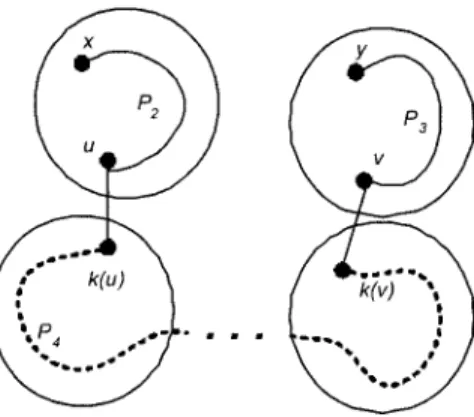
Kn具n典⫺{1} ⫺ R(F⬘) is Hamiltonian connected. Obviously, (k(k(u)))k ⫽ (u)k ⫽ (v)k ⫽ 1. By Lemma 4, there is a Hamiltonian path P2of Sn具n典⫺{1}⫺1,k⫺1⫺ F⬘ joining k(u) to k(v). Hence,具u, k(u), P2, k(v), v, P1, u典 forms a Hamiltonian cycle of Sn,k⫺ F.
Suppose that Sni⫺1,k⫺1 ⫺ F is not Hamiltonian
con-nected for every i ⫽ 1. We claim that n ⫽ 5 and
兩F(Sn2⫺1,k⫺1)兩 ⫽ 1. Suppose that n ⱖ 6 or (n ⫽ 5 and 兩F(Sn2⫺1,k⫺1)兩 ⫽ 0). Since 兩F⬘兩 ⱕ 1, Sni⫺1,k⫺1 ⫺ F is Hamiltonian connected by the assumption of this lemma. We get a contradiction.
Hence, we consider n ⫽ 5. Obviously, k 僆 {2, 3}. Moreover,兩F兩 ⫽ 2, 兩F(S4,k1 ⫺1)兩 ⫽ 兩F(S4,k2 ⫺1)兩 ⫽ 1, and 兩F(S4,k{3,4,5}⫺1 )兩 ⫽ 0. Suppose that k ⫽ 2. We use brute force to construct such Hamiltonian cycles for S5,2 ⫺ F. (See Appendix)
Suppose that k ⫽ 3. Since 兩Ei, j兩 ⫽ 3 for any 1 ⱕ i, j ⱕ 5 in S5,3, there is an F-fault-free edge (u, v) in E1,2. Since S4,2 is 1-fault Hamiltonian, there is a Hamiltonian cycle C1 ⫽ 具u, P1, w, u典 in S4,2
1 ⫺ F and there is a
Hamiltonian cycle C2⫽ 具v, x, P2, xⴕ, v典 in S4,2
2 ⫺ F. By
Lemma 2, (x)1 ⫽ (xⴕ)1. Since cycle C2 can be traversed backward and forward, we may assume that (w)1⫽ (x)1. Since Kn
{3,4,5}
is Hamiltonian connected, by Lemma 4, there exists a Hamiltonian path P3 of S4,2
{3,4,5}
joining k(w) and
k(x). Then,具u, P1, w, k(w), P3, k(x), x, P2, xⴕ, v, u典 forms a Hamiltonian cycle of S5,3 ⫺ F. See Figure 4(a) for an illustration.
CASE3. 兩F(Sn1⫺1,k⫺1)兩 ⫽ n ⫺ 3. Thus, 兩F ⫺ F(Sn1⫺1,k⫺1)兩
⫽ 0. Choose any element f in F(Sn1⫺1,k⫺1). By the assump-tion of this lemma, there exists a Hamiltonian cycle of
Sn1⫺1,k⫺1⫺ F ⫹ { f}. By deleting f from Sn1⫺1,k⫺1 ⫺ F, we can find a Hamiltonian path of Sn1⫺1,k⫺1⫺ F joining u and v such that d(u, v)ⱕ 2, no matter whether f is a vertex or an edge. By Lemma 2, (u)1 ⫽ (v)1. Since Kn具n典⫺{1} is Hamiltonian connected and (u)k⫽ (v)k⫽ 1, by Lemma 4, there exists a Hamiltonian path P2of Sn具n典⫺{1}⫺1,k⫺1joining k(u) to k(v). Thus, 具u, k(u), P2, k(v), v, P1, u典 forms a Hamiltonian cycle of Sn,k ⫺ F. See Figure 4(b) for an illustration.
Hence, the lemma follows: ■
Lemma 7. Sn,2is (n⫺ 4)-fault Hamiltonian connected for
nⱖ 5.
Proof. By definition, Sni⫺1,1is isomorphic to Kn⫺1for every i僆 具n典. Moreover, 兩Ei, j兩 ⫽ 1 for any two i, j 僆 具n典. Assume that F is any faulty set of Sn,2with兩F兩 ⱕ n ⫺ 4. Without loss of generality, we assume that兩F(Sn1⫺1,1)兩 ⱖ 兩F(Sn2⫺1,1)兩 ⱖ . . . ⱖ 兩F(Snn⫺1,1)兩. Let x and y be any two arbitrary vertices of Sn,2 ⫺ F. We need to construct a Hamiltonian path of Sn,2⫺ F joining x and y.
CASE 1. 兩F(Sn1⫺1,1)兩 ⱕ n ⫺ 5. By Lemma 1, Snt⫺1,1 ⫺ F(Snt⫺1,1) is Hamiltonian connected for any t 僆 具n典. SUBCASE1.1. (x)k⫽ (y)k. Let F⬘ ⫽ F 艛 {(y, k(y))}. Then,
兩R(F⬘)兩 ⱕ n ⫺ 3. By Lemma 1, there exists a Hamiltonian cycle C in Kn⫺ R(F⬘), say C ⫽ 具(x)k⫽ a1, a2, . . . , an,
a1典. Thus, the only edge (u, k(u)) in Ea1,a2 and the only
edge (v, k(v)) in Ea1,an are F-fault free.
Suppose that兩F(Sna⫺1,11 )兩 ⫽ 0. Since (y, k(y)) 僆 F⬘, v ⫽ y. Obviously, 具a1, a3, . . . , an典 is a Hamiltonian path of
Kn具n典⫺{a1} ⫺ R(F⬘) and (u)k ⫽ (v)k ⫽ a1. By Lemma 4, there exists a Hamiltonian path P1of Sn具n典⫺{a⫺1,1 1} joining k(u) to k(v). Since Sna⫺1,11 is kn⫺1, there exist two paths P2and
P3covering all vertices in Sna⫺1,11 such that P2joins x to u and P3joins v to y. Then,具x, P2, u, k(u), P1, k(v), v, P3, y典 forms a Hamiltonian path of Sn,2⫺ F joining x to y. See Figure 5(a) for an illustration.
Suppose that兩F(Sna⫺1,11 )兩 ⱖ 1. We create a new graph H by setting V(H) ⫽ V(Sna⫺1,11 ) 艛 {n} and E(H) ⫽ E(Sna⫺1,11 )艛 {(w, n)兩w 僆 V(Sna⫺1,11 )}. Hence, H is Kn. Then, we set F⬙ ⫽ F(Sna⫺1,11 )艛 {(w, n)兩 the only edge in
Ea1,(w)1is F-fault}. Hence,兩F⬙兩 ⱕ n ⫺ 4. By Lemma 1, H
⫺ F⬙ is Hamiltonian connected. Thus, there exists a Ham-iltonian path P1 of H ⫺ F⬙ joining x to y. Since n is an internal vertex of P1, we can write P1as具x ⫽ u
1 , Q1, u s , n ⫽ us⫹1, us⫹2, Q2, u n ⫽ y典. Since 兩F(S n⫺1,1 a1 )兩 ⱖ 1, 兩R(F(Sn具n典⫺{a⫺1,1 1}))兩 ⱕ 兩F ⫺ F(Sna⫺1,11 )兩 ⱕ n ⫺ 5. By Lemma 1, Kn具n典⫺{a1} ⫺ R(F(Sn具n典⫺{a⫺1,1 1})) is Hamiltonian connected. Obviously, (us)k⫽ (u
s⫹2)
k⫽ a1. By Lemma 4, there exists a Hamiltonian path P2of Sn具n典⫺{a⫺1,1 1}⫺ F joining
k(us) to k(us⫹2). Then, 具x ⫽ u1, Q1, u s
, k(us), P2,
k(us⫹2), us⫹2, Q2, u
n⫽ y典 forms a Hamiltonian path of
Sn,2⫺ F joining x to y. See Figure 5(b) for an illustration. SUBCASE1.2. (x)k⫽ (y)k. Since兩F兩 ⱕ n ⫺ 4, 兩R(F)兩 ⱕ n
⫺ 4. By Theorem 2, there are two Hamiltonian paths of Kn ⫺ R(F) joining (x)kto (y)k, say P1⫽ 具(x)k⫽ l1, l2, . . . , FIG. 4. Illustrations for Lemma 6.
ln⫽ (y)k典 and P2⫽ 具(x)k⫽ l⬘1, l⬘2, . . . , l⬘n⫽ (y)k典, such that l2⫽ l⬘2and ln⫺1⫽ l⬘n⫺1. Suppose that ((x)1⫽ l2and (y)1⫽ ln⫺1) or ((x)1 ⫽ l⬘2and (y)1⫽ l⬘n⫺1). By Lemma 4, there is a Hamiltonian path of Sn,2 ⫺ F joining x to y. Thus, we consider that ((x)1⫽ l2or (y)1⫽ ln⫺1) and ((x)1 ⫽ l⬘2 or (y)1 ⫽ l⬘n⫺1). Since l2 ⫽ l⬘2 and ln⫺1 ⫽ l⬘n⫺1, without loss of generality, we assume that (x)1 ⫽ l2 and (y)1 ⫽ l⬘n⫺1.
Suppose that 兩F(Snl1⫺1,1)兩 ⱖ 1 or some edges in 艛j僆具n典⫺{l1}E
l1, j are F-fault. Since 兩F兩 ⱕ n ⫺ 4 and
艛j僆具n典⫺{l1}E
l1, j⫽ n ⫺ 1, there exists an index i 傾 具n典 ⫺
{l1, l2, ln} such that the only edge (u, k(u)) 僆 E l1,i is
F-fault free. Since (x)1⫽ l2⫽ i, u ⫽ x. By Lemma 1, there exists a Hamiltonian path P6of Snl1⫺1,1⫺ F joining x to u. Let F⬘ ⫽ F(Sn具n典⫺{l⫺1,11}). Then, 兩R(F⬘)兩 ⱕ n ⫺ 5. By Theorem 2, there exist two Hamiltonian paths of Kn具n典⫺{l1} ⫺ R(F⬘) joining i to ln, say P3⫽ 具i ⫽ a1, a2, . . . , an⫺1 ⫽ ln典 and P4 ⫽ 具i ⫽ b1, b2, . . . , bn⫺1 ⫽ ln典, such that
a2⫽ b2and an⫺2⫽ bn⫺2. Without loss of generality, we may assume that (y)1⫽ an⫺2. Obviously, (u)k ⫽ l1. By Lemma 4, there exists a Hamiltonian path P5of Sn具n典⫺{l⫺1,11}⫺
F⬘ joining k(u) to y. Then, 具x, P6, u, k(u), P5, y典 forms a Hamiltonian path of Sn,2⫺ F joining x to y. See Figure 6(a) for an illustration.
Suppose that 兩F(Snl1⫺1,1)兩 ⫽ 0 and all edges in 艛j僆具n典⫺{l1}E
l1, jare F-fault free. Let u be the only vertex of
Snl1⫺1,1 such that (u, k(u)) 僆 El1,ln. Since (y)1 ⫽ ln⫺1 ⫽ (u)k⫽ l1and (x)1⫽ l2⫽ (u)1⫽ ln, k(u)⫽ y and u ⫽ x. By Lemma 1, there exists a Hamiltonian path P7 of
Snln⫺1,1 ⫺ F joining k(u) to y. Let F⬘ ⫽ F(Sn具n典⫺{l⫺1,11,ln}). Since兩F兩 ⱕ n ⫺ 4, 兩R(F⬘)兩 ⱕ n ⫺ 4. Thus, Kn具n典⫺{l1,ln} ⫺ R(F⬘) has a Hamiltonian path, say 具c1, c2, . . . , cn⫺2典. Since all edges in艛j僆具n典⫺{l1}E
l1, jare F-fault free, the only
edge (v, k(v)) in El1,c1 and the only edge (w, k(w)) in
El1,cn⫺2are F-fault free. Obviously, (k(k(v)))
k⫽ (v)k⫽ l1 and (k(k(w)))k⫽ (w)k ⫽ l1. By Lemma 4, there exists a Hamiltonian path P8 of Sn具n典⫺{l⫺1,11,ln} ⫺ F⬘ joining k(v) to
k(w). Since k(v) and k(w) are the endpoints of the path P8, at least one of v and w is not x. Without loss of generality, we assume that v⫽ x. Since Snl1⫺1,1is Kn⫺1, there exist two disjoint paths P9 and P10 covering all vertices of Snl1⫺1,1 such that P9joins x to w and P10joins u to v. Note that it is possible that x is w. Hence,具x, P9, w, k(w), P8, k(v), v,
P10, u, k(u), P7, y典 forms a Hamiltonian path of Sn,2⫺ F joining x to y. See Figure 6(b) for an illustration.
CASE 2. 兩F(Sn1⫺1,1)兩 ⫽ n ⫺ 4. Thus, Sn1⫺1,1 ⫺ F is
Hamiltonian and兩F ⫺ F(Sn1⫺1,1)兩 ⫽ 0.
SUBCASE 2.1. (x)k ⫽ (y)k ⫽ 1. Choose any element f in F(Sn1⫺1,1). By Lemma 1, there exists a Hamiltonian path P of Sn1⫺1,1 ⫺ F(Sn1⫺1,1) ⫹ f joining x and y. By deleting f, we can find two paths P1 and P2 covering all vertices of FIG. 5. Illustrations for Subcase 1.1.
Sn1⫺1,1⫺ F such that P1joins x to u, and P2joins v to y. Since Sn1⫺1,1 is Kn⫺1, d(u, v) ⫽ 1. By Lemma 2, (u)1 ⫽ (v)1. Obviously, Kn具n典⫺{1} is Hamiltonian connected and (u)k ⫽ (v)k ⫽ 1. From Lemma 4, there is a Hamiltonian path P3 of Sn具n典⫺{1}⫺1,1 joining k(u) to k(v). Thus, 具x, P1, u,
k(u), P3, k(v), v, P2, y典 forms a Hamiltonian path of Sn,2 ⫺ F joining x to y. See Figure 7(a) for an illustration. SUBCASE2.2. (x)k ⫽ 1 and (y)k⫽ 1. Let C be a Hamilto-nian cycle of Sn1⫺1,1⫺ F. Write C as 具x, u, P1, v, x典. By Lemma 2, (u)1⫽ (v)1. Since the cycle C can be traversed forward and backward, we may assume that (u)1 ⫽ i ⫽ (y)k. Since兩F ⫺ F(Sn1⫺1,1)兩 ⫽ 0 and n ⱖ 5, there exists an l 僆 具n典 ⫺ {(x)k, i, (y)k} such that the only edge (w,
k(w)) in E( y)k,lsatisfies w⫽ y. Obviously, K
n
具n典⫺{(x)k,(y)
k} is Hamiltonian connected, (u)k ⫽ (x)k, and (w)k ⫽ (y)k. From Lemma 4, there exists a Hamiltonian path P2 of
Sn具n典⫺{(x)⫺1,1 k,(y)k} joining k(u) to k(w). By Lemma 1, there exists a Hamiltonian path P3of Sn(y)⫺1,1k joining w to y. Thus, 具x, v, P1, u, k(u), P2, k(w), w, P3, y典 forms a Hamiltonian path of Sn,2 ⫺ F joining x to y. See Figure 7(b) for an illustration.
SUBCASE2.3. (x)k⫽ (y)k⫽ 1. By Lemma 1, there exists a Hamiltonian cycle C of Sn1⫺1,1 ⫺ F.
Assume that the only edge (u, k(u)) in E(x)k,1is F-fault
free. Write C as具k(u), v, P2, vⴕ, k(u)典. By Lemma 2, (v)1 ⫽ (vⴕ)1. Since nⱖ 5, we can choose a vertex w in Sn(x)⫺1,1k such that (v)1⫽ (w)1, w⫽ u, and w ⫽ y. Since Sn(x)⫺1,1k is
Kn⫺1, a Hamiltonian path of Sn(x)⫺1,1k can be written as具x, w,
P4, y典 if x ⫽ u and 具x, u, w, P4, y典 if x ⫽ u. Thus, such a Hamiltonian path can be expressed as具x, P3, u, w, P4, y典. Obviously, Kn具n典⫺{1,(x)k} is Hamiltonian connected, (v)k ⫽ 1, and (w)k⫽ (x)k. By Lemma 4, there exists a Ham-iltonian path P5of Sn具n典⫺{1,(x)⫺1,1 k} joining k(v) to k(w). Thus, 具x, P3, u, k(u), vⴕ, P2, v, k(v), P5, k(w), w, P4, y典 forms a Hamiltonian path of Sn,2 ⫺ F joining x to y. See Figure 8(a) for an illustration.
Assume that the only edge (u, k(u)) in E(x)k,1is F-fault.
Since兩艛j僆具n典⫺{1}E1, j兩 ⫽ n ⫺ 1 and 兩F兩 ⱕ n ⫺ 4, there are at least three F-fault free edges in 艛j僆具n典⫺{1}E1, j. Thus, there exists an index r僆 具n典 ⫺ {(x)k, 1} such that the only edge (v, k(v)) in E(x)k,rand the only edge (w, k(w))
in E1,r are F-fault free. Thus, k(w)⫽ k(v). By Lemma 1, there exists a Hamiltonian path P1of Snr⫺1,1joining k(v) to
k(w) and there exists a Hamiltonian path P2 of Sn(x)⫺1,1k joining x to y. We write P2as具x, v, z, P4, y典 and write C as具w, t, P2, tⴕ, w典. Since Sn1⫺1,1 is Kn⫺1, d(t, tⴕ) ⫽ 1. By Lemma 2, (t)1⫽ (tⴕ)1. Since the cycle C can be traversed forward and backward, we may assume that (t)1 ⫽ (z)1. FIG. 7. Illustrations for Subcases 2.1 and 2.2.
Obviously, Kn具n典⫺{(x)k,1,r} is Hamiltonian connected, (t)k ⫽ 1, and (z)k ⫽ (x)k. By Lemma 4, there exists a Hamil-tonian path P5 of S具n典⫺{(x)k
,1,r}
joining k(t) to k(z). Then, 具x, v, k(v), P1, k(w), w, tⴕ, P2, t, k(t), P5, k(z), z, P4, y典 forms a Hamiltonian path of Sn,2 ⫺ F joining x to y. See Figure 8(b) for an illustration.
SUBCASE2.4. (x)k, (y)k, and 1 are distinct. By Theorem 3,
there exists a vertex set V⬘ of Sn1⫺1,1with兩V⬘兩 ⱖ 3 such that there exists a Hamiltonian path of Sn1⫺1,1⫺ F joining every pair of vertices in V⬘. We define F* ⫽ {(1, l )兩(u, v) 僆 E1,l
and u ⰻ V⬘}. Since 兩V⬘兩 ⱖ 3, 兩F*兩 ⱕ n ⫺ 4. By Theorem 2, there are two Hamiltonian paths of Kn⫺ F* joining (x)k to (y)k, say P1 ⫽ 具(x)k ⫽ l1, l2, . . . , ln ⫽ (y)k典 and P2 ⫽ 具(x)k ⫽ l⬘1, l⬘2, . . . , l⬘n ⫽ (y)k典, such that l2 ⫽ l⬘2 and ln⫺1 ⫽ l⬘n⫺1.
Suppose that ((x)1⫽ l2and (y)1⫽ ln⫺1) or ((x)1⫽ l⬘2 and (y)1 ⫽ l⬘n⫺1). Without loss of generality, we assume that (x)1⫽ l2and (y)1⫽ ln⫺1. Obviously, we can choose the only F-fault-free edge (vlt, ult⫹1) in Elt,lt⫹1for any 1ⱕ t
ⱕ n ⫺ 1. Since 1 is an internal vertex of P1, we assume that 1⫽ li. Since k(u
li)⫽ vli⫺1and k(vli)⫽ uli⫹1, uli⫽ vli.
Since uli and vli are in V⬘ and uli ⫽ vli, there exists a
Hamiltonian path Pliof Sn⫺1,1
li ⫺ F joining ulito vli. Since
k(ulr) ⫽ vlr⫺1 and k(vlr)⫽ ulr⫹1, ulr⫽ vlr. Since S
n⫺1,1 lr is
Kn⫺1for any lr 僆 具n典 ⫺ {1} and u
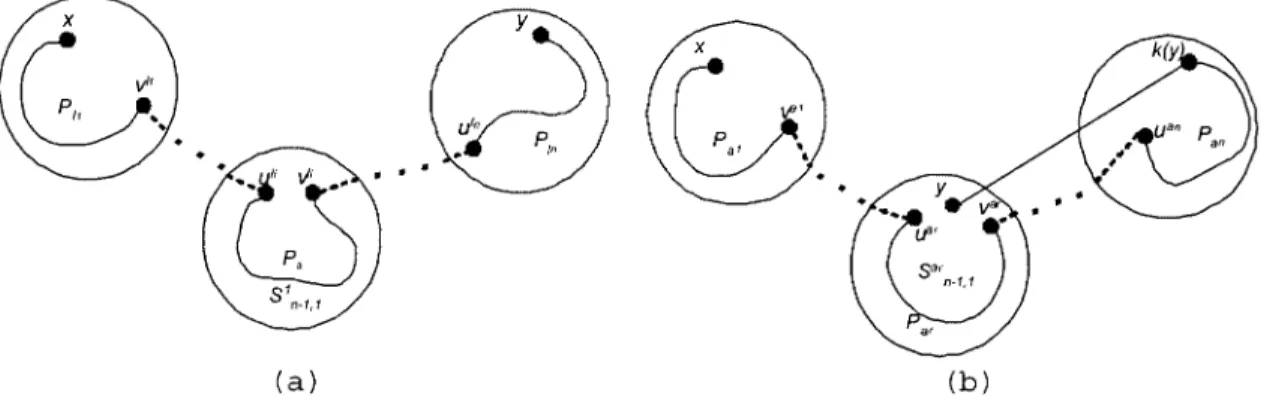
lr⫽ vlr, there exists a Hamiltonian path Plrof Sn⫺1,1 lr joining ulrto vlr. Then,具x ⫽ ul1, P l1, v l1, ul2, P l2, v l2, . . . , uln, P ln, v ln ⫽ y典 forms a
Hamiltonian path of Sn,2⫺ F joining x to y. See Figure 9(a) for an illustration.
Thus, we consider that ((x)1⫽ l2or (y)1 ⫽ ln⫺1) and ((x)1⫽ l⬘2or (y)1⫽ l⬘n⫺1). Since l2⫽ l⬘2and ln⫺1⫽ l⬘n⫺1, without loss of generality, we assume that (x)1 ⫽ l⬘2 and (y)1 ⫽ ln⫺1.
Suppose that there exists an index t such that 1ⱕ t ⬍ n ⫺ 2, 1 ⫽ lt, and 1 ⫽ lt⫹1. Since兩F ⫺ F(Sn1⫺1,1)兩 ⫽ 0, the only edge (p, k(p)) in Eln,ltand the only edge (q, k(q))
in Eln,lt⫹1are F-fault free. Obviously, P
3⫽ 具l1, . . . , lt, ln,
lt⫹1, . . . , ln⫺1典 is also a Hamiltonian path of Kn⫺ R(F*). We rewrite P3 as 具a1, a2, . . . , an典. We set x ⫽ u
a1 and
k(y) ⫽ van. Then, we choose the only edge in Ear,ar⫹1 as
(var, uar⫹1) for any 1 ⱕ r ⱕ n. Since k(var) ⫽ uar⫹1 and
k(uar) ⫽ var⫺1, var ⫽ uar. Let i be the index such that a
i ⫽ 1. Obviously, uai and vai are in V⬘ and there exists a
Hamiltonian path Paiof Sn⫺1,1
1 ⫺ F joining uaito vai. Since
Snr⫺1,1is Kn⫺1for any r僆 具n典, there exists a Hamiltonian path Parof Sn⫺1,1
ar ⫺ {y} joining uarto varfor any a
r僆 具n典 ⫺ {1}. Then, P4⫽ 具x ⫽ ua1, P a1, v a1, ua2, P a2, v a2, . . . , uan, P an, v
an⫽ k(y)典 forms a Hamiltonian path of S
n,2⫺ F ⫺ {y} joining x to k(y). Then, 具x, P4, k(y), y典 forms a Hamiltonian path of Sn,2⫺ F joining x to y. See Figure 9(b) for an illustration.
Suppose that there is no index t such that 1 ⱕ t ⬍ n ⫺ 2, 1 ⫽ lt, and 1 ⫽ lt⫹1. We claim that n ⫽ 5 and l2 ⫽ 1. Let p be the index such that lp⫽ 1. Suppose that n ⱖ 6. We can choose t to be 1 if p ⱖ 3 and choose t to be 3 otherwise. Suppose that n⫽ 5 and l2⫽ 1. We can choose
t to be 1. Obviously, 1 ⫽ lt and 1 ⫽ lt⫹1. We get a contradiction.
Thus, we only consider the case that n⫽ 5 and l2⫽ 1. Since (x)1⫽ l⬘2 ⫽ l⬘5 ⫽ l5and (y)1 ⫽ l4 ⫽ l1, the only edge (u, k(u)) 僆 El1,l5 satisfies u ⫽ x and k(u) ⫽ y. By
Lemma 1, there exists a Hamiltonian path P7 of Snl5⫺1,1 joining k(u) to y. Since兩F ⫺ F(Sn1⫺1,1)兩 ⫽ 0, the only edge (w, k(w)) in El1,l4is F-fault free. Since (l
1, l2) 僆 P1, the only edge (v, vl2) in El1,l2 is F-fault free. Since S
n⫺1,1 l1 is
Kn⫺1, there exist two paths P5and P6covering all vertices in Snl1⫺1,1such that P5joins x to w and P6joins v to u. Since 具l2, l3, l4典 is a subpath of P1, the only edge (u
l2, vl3) in El2,l3
and the only edge (ul3, vl4) in El3,l4are F-fault free. Since vl2
and ul2are in V⬘, by Lemma 3, there exists a Hamiltonian
path P2of Snl2⫺1,1⫺ F joining ul2to vl2. By Lemma 1, there exists a Hamiltonian path Pl3of Sn⫺1,1
l3 joining ul3to vl3and a Hamiltonian path Pl4of Sn⫺1,1 l2 joining k(w) to vl4. Then, 具x, P5, w, k(w), Pl4, v l4, ul3, P l3, v l3, ul2, P l2, v l2, v, P 6, u, k(u), P7, y典 forms a Hamiltonian path of S5,2 ⫺ F joining x to y.
Thus, the lemma is proved. ■
Lemma 8. Suppose that Sn⫺1,k⫺1is (n⫺ 4)-fault
Hamil-tonian and (n⫺ 5)-fault Hamiltonian connected, for some k
ⱖ 3 and n ⫺ k ⱖ 2. Then, Sn,kis (n⫺ 4)-fault Hamiltonian
connected.
Proof. Since k ⱖ 3, n ⱖ 5, and (n ⫺ k) ⱖ 2, 兩Er,s兩 ⫽ [(n ⫺ 2)!]/[(n ⫺ k)!] ⱖ (n ⫺ 2) for all 1 ⱕ r ⫽ s ⱕ n. By Lemma 3, all edges in Er,s
are independent. Assume that F is any faulty set of Sn,kwith兩F兩 ⱕ n ⫺ 4. Without loss of generality, we assume that兩F(Sn1⫺1,k⫺1)兩 ⱖ 兩F(Sn2⫺1,k⫺1)兩 ⱖ . . . ⱖ 兩F(Snn⫺1,k⫺1)兩. Let x and y be any two arbitrary vertices of Sn,k⫺ F. We want to construct a Hamiltonian path of Sn,k⫺ F joining x and y.
CASE1. 兩F(Sn1⫺1,k⫺1)兩 ⱕ n ⫺ 5. By the assumption of this
lemma, Snt⫺1,k⫺1⫺ F(Snt⫺1,k⫺1) is Hamiltonian connected for any t 僆 具n典.
SUBCASE 1.1. (x)k ⫽ (y)k. Since 兩R(F)兩 ⱕ n ⫺ 4, by
Lemma 1, Kn ⫺ R(F) is Hamiltonian connected. By
Lemma 4, there exists a Hamiltonian path of Sn,k ⫺ F joining x and y.
SUBCASE1.2. (x)k⫽ (y)k. By the assumption of this lemma,
there exists a Hamiltonian path P1 of Sn(x)⫺1,k⫺1k ⫺
F(Sn(x)⫺1,k⫺1k ) joining x to y. We claim that there exists an edge (u, v) of P1 such that (u, k(u)) in E
(x)k,(u)1 and (v,
k(v)) in E(x)k,(v)1are F-fault free. Let F⬘ denote the set of
F-fault edges in艛j僆具n典⫺{(x)k}E
(x)k, j. Suppose that no such
edge exists. Then, 兩F⬘兩 ⱖ 兩P1兩/ 2. Thus, 兩F⬘ 艛
F(Sn(x)⫺1,k⫺1k )兩 ⱖ [(n⫺1)!]/[2(n ⫺ k)!] ⬎ 兩F兩 when n ⱖ 5 and kⱖ 3. We get a contradiction.
Thus, we can write P1as具x, P2, u, v, P3, y典. Since d(u, v)⫽ 1, (u)1⫽ (v)1. Let具(u)1⫽ l1, l2, . . . , ln⫺1⫽ (v)1典 be any Hamiltonian path of Kn具n典⫺{(x)k}. We set k(u)⫽ v
l1
and k(v)⫽ uln⫺1. Since兩Er,s兩 ⫺ 兩F兩 ⱖ 2 for any r, s 僆 具n典,
we can choose any F-fault-free edges (uli, vli⫹1) in Eli,li⫹1for
all 1ⱕ i ⱕ n ⫺ 1. By the assumption of this lemma, there exists a Hamiltonian path Pliof Sn⫺1,k⫺1
li ⫺ F joining vlito uli. Then, P 4⫽ 具v l1, P l1, u l1, vl2, . . . , P ln⫺1, u ln⫺1典 forms a
Hamiltonian path of Sn具n典⫺{(x)⫺1,k⫺1k} ⫺ F joining k(u) to k(v). Thus,具x, P2, u, k(u), P4, k(v), v, P3, y典 forms a Hamil-tonian path of Sn,k⫺ F joining x to y. See Figure 10 for an illustration.
CASE2. 兩F(Sn1⫺1,k⫺1)兩 ⫽ n ⫺ 4. In this case, all faults are in Sn1⫺1,k⫺1.
SUBCASE 2.1. (x)k ⫽ (y)k ⫽ 1. Choose any element f in F(Sn⫺1,k⫺1
1
). By the assumption of this lemma, we can find a Hamiltonian path P of Sn⫺1,k⫺1
1 ⫺ F(S
n⫺1,k⫺1 1
) ⫹ f joining x to y. By deleting f, we can find two vertices u and v with d(u, v)ⱕ 2 such that (1) there are two paths P1and
P2covering all the vertices of Sn⫺1,k⫺1
1 ⫺ F, (2) P1
joins x to u, and (3) P2joins v to y. By Lemma 2, (u)1⫽ (v)1. Then, there exists a Hamiltonian path of Kn具n典⫺{1} joining (u)1to (v)1. By Lemma 4, there is a Hamiltonian path P3 joining k(u) and k(v) in Sn具n典⫺{1}⫺1,k⫺1. Thus, 具x, P1, u, k(u),
P3, k(v), v, P2, y典 forms a Hamiltonian path of Sn,k⫺ F joining x to y. See Figure 11(a) for an illustration. SUBCASE2.2. (x)k ⫽ 1 and (y)k⫽ 1. Let C be a
Hamilto-nian cycle of Sn1⫺1,k⫺1⫺ F(Sn1⫺1,k⫺1). Write C as具x, u,
P1, v, x典. Thus, d(u, v) ⱕ 2. By Lemma 2, (u)1⫽ (v)1. Since the cycle C can be traversed forward and backward, we may assume that (u)1⫽ (y)k. Since兩F ⫺ F(Sn1⫺1,k⫺1)兩 ⫽ 0 and 兩Er,s兩 ⱖ (n ⫺ 2) for any 1 ⱕ r ⬍ s ⱕ n, there exists an F-fault-free edge (w, k(w)) in E(y)k,lfor some l
僆 具n典 ⫺ {(x)k, (u)1, (y)k} such that w ⫽ y. Obviously, there exists a Hamiltonian path of Kn具n典⫺{(x)k,(y)k} joining (u)1to (w)1, (k(k(u)))k ⫽ (u)k ⫽ (x)k, and (w)k ⫽ (y)k. By Lemma 4, there exists a Hamiltonian path P2 of
Sn具n典⫺{(x)⫺1,k⫺1k,(y)k} joining k(u) to k(w). By the assumption of this lemma, there exists a Hamiltonian path P3of Sn(y)⫺1,k⫺1k FIG. 10. Illustration for Subcase 1.2.
joining w to y. Then,具x, v, P1, u, k(u), P2, k(w), w, P3, y典 forms a Hamiltonian path of Sn,k⫺ F joining x to y. See Figure 11(b) for an illustration.
SUBCASE2.3. (x)k ⫽ (y)k ⫽ 1. By the assumption of this
lemma, there exists a Hamiltonian path P1 of Sn⫺1,k⫺1 (x)k
joining x to y and there exists a Hamiltonian cycle C of
Sn⫺1,k⫺1
1 ⫺ F(S
n⫺1,k⫺1 1
). Since 兩E(x)k,1兩 ⫺ 兩F兩 ⱖ 2, there
exists an F-fault-free edge (u, k(u))僆 E(x)k,1with x⫽ u.
Thus, we can write C as具k(u), v, P2, vⴕ, k(u)典 and write
P1as具x, P3, u, w, P4, y典. Since d(v, vⴕ) ⱕ 2, (v)1⫽ (vⴕ)1. Without loss of generality, we assume that (v)1 ⫽ (w)1. Obviously, there exists a Hamiltonian path of Kn具n典⫺{1,(x)k} joining (u)1to (w)1. By Lemma 4, there exists a Hamilto-nian path P5of Sn具n典⫺{1,(x)⫺1,k⫺1 k} joining k(v) to k(w). Thus,具x,
P3, u, k(u), vⴕ, P2, v, k(v), P5, k(w), w, P4, y典 forms a Hamiltonian path of Sn,k ⫺ F joining x to y. See Figure 12(a) for an illustration.
SUBCASE2.4. (x)k, (y)k, and 1 are distinct. Since兩E(x)k,1兩 ⱖ
(n⫺ 2), there exists an F-fault-free edge (u, k(u)) in E(x)k,1
and u⫽ x. By the assumption of this lemma, there exists a Hamiltonian path P3of Sn⫺1,k⫺1
(x)k joining x to u and there is
a Hamiltonian cycle C in Sn⫺1,k⫺1
1 ⫺ F. We can write C as
具k(u), v, P1, w, k(u)典. Since d(v, w) ⱕ 2, (v)1 ⫽ (w)1. Without loss of generality, we assume that (v)1 ⫽ (y)k. Then, there exists a Hamiltonian path of Kn具n典⫺{(x)k,1} join-ing (v)1to (y)k. By Lemma 4, there exists a Hamiltonian path P2of S具n典⫺{(x)k
,1}
joining k(v) to y. Then,具x, P3, u,
k(u), w, P1, v, k(v), P2, y典 forms a Hamiltonian path of
Sn,k⫺ F joining x to y. See Figure 12(b) for an illustration.
Thus, the lemma is proved. ■
Theorem 4. Let n and k be two positive integers with n
⬎ k ⱖ 1. Then,
(1) Ᏼf(Sn,k)⫽ n ⫺ 3 and Ᏼf(Sn,k)⫽ n ⫺ 4 if n ⫺ k ⱖ 2; (2) Ᏼf(S2,1) is undefined andᏴf(S2,1)⫽ 0; and
(3) Ᏼf(Sn,n⫺1)⫽ 0 and Ᏼf(Sn,n⫺1) is undefined if n⬎ 2.
Proof. We first consider the case k ⫽ n ⫺ 1. It is proved in [3] that Sn,n⫺1is isomorphic to the n-star graph
Sn. In [1], it is proved that Snis bipartite for every n and Sn is Hamiltonian if and only if n ⬎ 2. The graph S2 is K2 which is Hamiltonian connected. It is known that the num-ber of vertices in both partite sets of any bipartite Hamilto-nian graph are the same. For these reasons, any bipartite Hamiltonian graph is not Hamiltonian connected. Thus, Ᏼf(Sn,n⫺1) ⫽ 0 and Ᏼf(Sn,n⫺1) is undefined if n ⬎ 2. Moreover,Ᏼf(S2,1) is undefined and Ᏼf(S2,1) ⫽ 0.
Now, we consider the case n⬎ k ⱖ 1. By Lemma 1, the theorem is true for Sn,1. According to Lemma 5, the theo-rem is true for S4,2. Based on the Lemmas 6 and 7, the theorem is true for Sn,2 with n ⱖ 5. By Lemmas 6 and 8, the theorem is true for all Sn,kwith n ⱖ 5, k ⱖ 3, and (n
⫺ k) ⱖ 2. Hence, the theorem is proved. ■
Acknowledgments
The authors would like to thank the referees for their comments and suggestions. These comments and suggestions were very helpful for improving the quality of this paper. APPENDIX
Fact 1. S5,2 ⫺ F is Hamiltonian for any F 債 V(S5,2) 艛
E(S5,2) with兩F兩 ⫽ 2 and 兩F(S4,1 1
)兩 ⫽ 兩F(S4,12 )兩 ⫽ 1 (see Fig. A.1).
FIG. A.1. S5,2. FIG. 12. Illustrations for Subcases 2.3 and 2.4.
Proof. Assume that F consists of two vertices. Then, we have the following 16 cases, namely: (1) {21, 12}, (2) {21, 32}, (3) {21, 42}, (4) {21, 52}, (5) {31, 12}, (6) {31, 32}, (7) {31, 42}, (8) {31, 52}, (9) {41, 12}, (10) {41, 32}, (11) {41, 42}, (12) {41, 52}, (13) {51, 12}, (14) {51, 32}, (15) {51, 42}, and (16) {51, 52}. The corresponding Hamiltonian cycles of S5,2 ⫺ F are listed below:
(1) 具31, 13, 23, 32, 42, 52, 25, 15, 45, 35, 53, 43, 34, 24, 54, 14, 41, 51, 31典 (2) 具31, 13, 23, 43, 53, 35, 15, 45, 25, 52, 12, 42, 24, 34, 54, 14, 41, 51, 31典 (3) 具31, 13, 23, 32, 12, 52, 25, 15, 45, 35, 53, 43, 34, 24, 54, 14, 41, 51, 31典 (4) 具31, 13, 23, 32, 12, 42, 24, 14, 54, 34, 43, 53, 35, 25, 45, 15, 51, 41, 31典 (5) 具21, 41, 14, 24, 42, 32, 52, 25, 35, 53, 13, 23, 43, 34, 54, 45, 15, 51, 21典 (6) 具21, 12, 42, 52, 25, 15, 45, 35, 53, 13, 23, 43, 34, 24, 54, 14, 41, 51, 21典 (7) 具21, 12, 32, 52, 25, 15, 45, 35, 53, 13, 23, 43, 34, 24, 54, 14, 41, 51, 21典 (8) 具21, 12, 32, 42, 24, 14, 54, 34, 43, 13, 23, 53, 35, 25, 45, 15, 51, 41, 21典 (9) 具21, 31, 13, 23, 32, 42, 52, 25, 35, 53, 43, 34, 14, 24, 54, 45, 15, 51, 21典 (10) 具21, 12, 42, 52, 25, 15, 35, 45, 54, 14, 24, 34, 43, 23, 53, 13, 31, 51, 21典 (11) 具21, 12, 32, 52, 25, 15, 35, 45, 54, 14, 24, 34, 43, 23, 53, 13, 31, 51, 21典 (12) 具21, 12, 32, 42, 24, 14, 34, 54, 45, 15, 25, 35, 53, 23, 43, 13, 31, 51, 21典 (13) 具21, 31, 13, 23, 32, 42, 52, 25, 15, 45, 35, 53, 43, 34, 24, 54, 14, 41, 21典 (14) 具21, 12, 42, 52, 25, 15, 35, 45, 54, 14, 24, 34, 43, 23, 53, 13, 31, 41, 21典 (15) 具21, 12, 32, 52, 25, 15, 35, 45, 54, 14, 24, 34, 43, 23, 53, 13, 31, 41, 21典 (16) 具21, 12, 32, 42, 24, 14, 34, 54, 45, 15, 25, 35, 53, 23, 43, 13, 31, 41, 21典
Assume that F consists of two edges, Then, we have 36 cases. We divide these 36 cases into four classes, namely: (1) {(21, 31), (12, 32)}, {(21, 31), (42, 52)}, {(21, 41), (12, 32)}, {(21, 41), (42, 52)}, {(31, 51), (12, 32)}, {(31, 51), (42, 52)}, {(41, 51), (12, 32)}, {(41, 51), (42, 52)}. (2) {(21, 31), (12, 42)}, {(21, 31), (12, 52)}, {(21, 31), (32, 42)}, {(21, 31), (32, 52)}, {(21, 41), (12, 42)}, {(21, 41), (12, 52)}, {(21, 41), (32, 42)}, {(21, 41), (32, 52)}, {(31, 51), (12, 42)}, {(31, 51), (12, 52)}, {(31, 51), (32, 42)}, {(31, 51), (32, 52)}, {(41, 51), (12, 42)}, {(41, 51), (12, 52)}, {(41, 51), (32, 42)}, {(41, 51), (32, 52)}. (3) {(21, 51), (12, 32)}, {(21, 51), (42, 52)}, {(31, 41), (12, 32)}, {(31, 41), (42, 52)}. (4) {(21, 51), (12, 42)}, {(21, 51), (12, 52)}, {(21, 51), (32, 42)}, {(21, 51), (32, 52)}, {(31, 41), (12, 42)}, {(31, 41), (12, 52)}, {(31, 41), (32, 42)}, {(31, 41), (32, 52)}. The corresponding Hamiltonian cycles of S5,2⫺ F are listed below:
(1) 具21, 12, 42, 24, 14, 41, 31, 13, 23, 32, 52, 25, 35, 53, 43, 34, 54, 45, 15, 51, 21典 (2) 具21, 12, 32, 23, 13, 31, 41, 14, 24, 42, 52, 25, 35, 53, 43, 34, 54, 45, 15, 51, 21典 (3) 具21, 12, 42, 24, 14, 41, 51, 15, 25, 52, 32, 23, 43, 34, 54, 45, 35, 53, 13, 31, 21典 (4) 具21, 12, 32, 23, 13, 31, 51, 15, 25, 52, 42, 24, 34, 43, 53, 35, 45, 54, 14, 41, 21典
Assume that F consists of one vertex and one edge. Then, we have 48 cases. We divide these 48 cases into 18 classes, namely: (1) {21, (12, 32)}, {21, (42, 52)}. (2) {21, (12, 42)}. (3) {21, (12, 52)}, {21, (32, 42)}, {21, (32, 52)}. (4) {31, (12, 32)}, {31, (42, 52)}. (5) {31, (12, 42)}, {31, (12, 52)}, {31, (32, 42)}, {31, (32, 52)}. (6) {41, (12, 32)}, {41, (42, 52)}. (7) {41, (12, 42)}, {41, (12, 52)}, {41, (32, 42)}, {41, (32, 52)}. (8) {51, (12, 32)}, {51, (42, 52)}. (9) {51, (12, 42)}, {51, (12, 52)}, {51, (32, 42)}, {51, (32, 52)}. (10) {12, (21, 31)}, {12, (41, 51)}. (11) {12, (21, 41)}, {12, (31, 41)}, {12, (31, 51)}. (12) {12, (21, 51)}. (13) {32, (21, 31)}, {32, (21, 51)}, {32, (31, 41)}, {32, (41, 51)}. (14) {32, (21, 41)}, {32, (31, 51)}. (15) {42, (21, 31)}, {42, (21, 51)}, {42, (31, 41)}, {42, (41, 51)}. (16) {42, (21, 41)}, {42, (31, 51)}. (17) {52, (21, 31)}, {52, (21, 41)}, {52, (31, 51)}, {52, (41, 51)}. (18) {52, (21, 51)}, {52, (31, 41)}.
The corresponding Hamiltonian cycles of S5,2⫺ F are listed below: (1) 具31, 13, 23, 32, 42, 12, 52, 25, 15, 45, 35, 53, 43, 34, 24, 54, 14, 41, 51, 31典 (2) 具31, 13, 23, 32, 12, 52, 42, 24, 14, 54, 34, 43, 53, 35, 25, 45, 15, 51, 41, 31典 (3) 具31, 13, 23, 32, 12, 42, 52, 25, 15, 45, 35, 53, 43, 34, 24, 54, 14, 41, 51, 31典 (4) 具21, 12, 42, 24, 14, 34, 54, 45, 25, 52, 32, 23, 13, 43, 53, 35, 15, 51, 41, 21典 (5) 具21, 12, 32, 23, 13, 43, 53, 35, 15, 45, 25, 52, 42, 24, 34, 54, 14, 41, 51, 21典 (6) 具21, 12, 42, 24, 14, 34, 54, 45, 15, 35, 25, 52, 32, 23, 43, 53, 13, 31, 51, 21典 (7) 具21, 12, 32, 23, 13, 43, 53, 35, 25, 52, 42, 24, 14, 34, 54, 45, 15, 51, 31, 21典 (8) 具21, 12, 42, 24, 14, 34, 54, 45, 15, 35, 25, 52, 32, 23, 43, 53, 13, 31, 41, 21典 (9) 具21, 12, 32, 23, 13, 43, 53, 35, 15, 45, 25, 52, 42, 24, 34, 54, 14, 41, 31, 21典 (10) 具21, 41, 14, 24, 42, 32, 52, 25, 15, 35, 45, 54, 34, 43, 23, 53, 13, 31, 51, 21典 (11) 具21, 31, 13, 23, 32, 42, 52, 25, 15, 45, 35, 53, 43, 34, 24, 54, 14, 41, 51, 21典 (12) 具21, 31, 13, 23, 32, 42, 52, 25, 35, 53, 43, 34, 14, 24, 54, 45, 15, 51, 41, 21典 (13) 具21, 12, 42, 52, 25, 15, 51, 31, 13, 23, 43, 53, 35, 45, 54, 24, 34, 14, 41, 21典 (14) 具21, 12, 42, 52, 25, 15, 51, 41, 14, 24, 34, 54, 45, 35, 53, 23, 43, 13, 31, 21典 (15) 具21, 12, 32, 52, 25, 15, 51, 31, 13, 23, 43, 53, 35, 45, 54, 24, 34, 14, 41, 21典 (16) 具21, 12, 32, 52, 25, 15, 51, 41, 14, 24, 34, 54, 45, 35, 53, 23, 43, 13, 31, 21典 (17) 具21, 12, 32, 42, 24, 14, 41, 31, 13, 23, 53, 43, 34, 54, 45, 25, 35, 15, 51, 21典 (18) 具21, 12, 32, 42, 24, 14, 41, 51, 15, 25, 35, 45, 54, 34, 43, 23, 53, 13, 31, 21典
Hence, S5,2 ⫺ F is Hamiltonian when 兩F兩 ⫽ 2 and 兩F(S4,11 )兩 ⫽ 兩F(S4,12 )兩 ⫽ 1. ■
REFERENCES
[1] S.B. Akers, D. Harel, and B. Krishnamurthy, The star graph: An attractive alternative to the n-cube, Proc Int Conf on Parallel Processing, 1987, pp. 393– 400.
[2] J.A. Bondy and U.S.R. Murty, Graph theory with applica-tions, North-Holland, New York, 1980.
[3] W.K. Chiang and R.J. Chen, The (n, k)-star graph: A gen-eralized star graph, Info Process Lett 56 (1995), 259 –264. [4] S.Y. Hsieh, G.H. Chen, and C.W. Ho, Fault-free Hamiltonian
cycles in faulty arrangement graphs, IEEE Trans Paral Dis-trib Syst 10 (1999), 223–237.
[5] W.T. Huang, J.M. Tan, C.N. Hung, and L.H. Hsu, Fault-tolerant Hamiltonicity of twisted cubes, J Paral Distrib Com-put 62 (2002), 591– 604.
[6] C.N. Hung, L.H. Hsu, and T.Y. Sung, On the construction of combined k-fault-tolerant Hamiltonian graphs, Networks 37 (2001), 165–170.
[7] O. Ore, Hamilton connected graphs, J Math Pure Appl 42 (1963), 21–27.