Arch Pharm Res Vol 26, No 7, 511-515, 2003
~[rtOibes of
harmata[ ge~eartO
http://apr.psk.or.kr
Effect of Active Synthetic 2-Substituted Quinazolinones on
Anti-Platelet Aggregation and the Inhibition of Superoxide
Anion Generation by Neutrophils
Fang-Rong Chang, Chin-Chung Wu, Tsong-Long Hwang 1, Ramesh Patnam, Reen-Yen Kuo, Wei-Ya Wang,
Yu-Hsuan Lan, and Yang-Chang Wu
Graduate Institute of Natural Products, Kaohsiung Medical University, Kaohsiung 807, Taiwan and 1Graduate Insti- tute of Natural Products, Chang Gung University, Taoyuan 333, Taiwan
(Received April 23, 2003)
Quinazolinones, 2-substituted and 3-substituted, mainly synthesized by microwave irradiation, were subjected to anti-platelet aggregation and inhibition of superoxide anion generation assays. Interestingly, 2-phenyl-4-quinazolinone (4) exhibited significant inhibitory activities toward platelet aggregation and neutrophil activation, and it might therefore serve as a proto- type lead compound.
Key words: Hydrangea chinensis,
Quinazolinones, Anti-platelet aggregation, Superoxide anion generation, MicrowaveINTRODUCTION
The roots of Hydrangea chinensis were used for the treatment of malaria and cardiovascular diseases (Chiang- Su, 1978). In a previous investigation on this species, the quinazolinones, febrifugine and isofebrifugine, exhibited significant anticancer activity against mouse mammalian tumor FM3A cell line (Kobayashi et aL, 1999). Moreover, quinazolinones are one of the frequently encountered heterocycles in medical chemistry literature with such applications as anticonvulsant (Mannschreck et aL, 1984), antibacterial agent (Ravikanth et aL, 2000), anti-malarial agent (Murata et aL, 1999), inhibitor of DNA repair enzyme poly(ADP-ribose) polymerase (PARP) (Griffin et aL, 1998), and antagonist of angiotensin (De Laszlo et aL, 1993).
Currently, there has been increasing interest in the use of microwave irradiation techniques in organic syntheses (Seijas et al., 1999). A number of synthetically useful organic reactions have been carried out in the microwave oven in open vessels (Seger et aL, 1998; Sharma et al.,
1989; Malamas et al., 1991). In each case, the reactions proceeded in a highly accelerated manner, with final
Correspondence to: Yang-Chang Wu, Professor and Director, Graduate Institute of Natural Products, Kaohsiung Medical Univer- sity, Kaohsiung 807, Taiwan
E-mail: [email protected]
product yields and purity comparable to those obtained with traditional protocols. Due to the excellent biological functions of quinazolinones, a series of 2-substituted and 3-substituted derivatives were synthesized in the current investigation by using a domestic microwave machine, and all products were subjected to anti-platelet aggregation and inhibition of superoxide anion generation assays.
MATERIALS AND METHODS
Instruments and reagents
Melting points were determined on a Laboratory Devices MeI-Temp II and were uncorrected. The UV spectra were obtained on a Hitachi 200-20 spectrophotometer, IR spectra on a Hitachi 260-30 spectrophotometer, and 1H- NMR (400 and 200 MHz, using CDCI3 as solvent) spectra on a Varian NMR spectrometer (Unity Plus). Low-resolution ElMS were collected on a JEOL JMS-SX/SX 102 A mass spectrometer or Quattro GC/MS spectrometer featuring a direct inlet system. The reactant mixtures in a test tube were irradiated in a domestic microwave (530 W, Sunhow) oven for 10 minutes. Silica gel 60 (Merck, 230400 mesh) was used for column chromatography. The spots were detected by spraying with 50% H2SO4 and then heating on a hot plate.
General experimental procedure for the synthe-
sis of 2-substituted quinazolinones
A mixture of 2-amino benzoic acid (1 mmol) and an amide (1.5 mmol) in a test tube was irradiated in a micro- wave oven for 10 minutes. After cooling, the crude reaction product was purified by column over silica (or alumina) gel to afford the 2-substituted quinazoline (Seger et aL,
1998).
4-Quinazolinone (1)
White powder; mp 215-217 ~ IR (Neat) Vm~x: 1697, 1657, 1607 cm-~; UV (MeOH) ~ax : 223, 263, 270(sh), 300, 312 nm; 1H-NMR (CD3OD): (~ 8.23 (1H, dd, J = 8.8, 0.8 Hz), 8.10 (11-1, s), 7.84 (11-1, td, J = 8.8, 0.8 Hz), 7.70 (11-1, dd, J = 8.8, 0.8 Hz), 7.60 (11-1, td, J = 8.8, 0.8 Hz); ElMS re~z: 146 [M]+; yield 60%.
2-Methyl-4-quinazolinone (2)
White powder; mp 240-242 ~ IR (Neat) Vm,x: 2956, 2928, 2868, 1726, 1273, 1120, 1069 cm-~; UV (MeOH) ~-max: 223, 263, 270(sh), 303, 312 nm; 1H-NMR (CD3OD): 8.18 (1H, dd, J = 8.0, 1.6 Hz), 7.80 (1H, td, J = 8.0, 1.6 Hz), 7.61 (1H, dd, J = 8.0, 1.6 Hz), 7.49 (1H, td, J = 8.0, 1.6 Hz), 2.46 (3H, s); ElMS m/z: 160 [M]§ yield 57%.
2-Ethyl-4-quinazolinone (3)
White powder; mp 232-234 ~ IR (Neat) Vmax: 3037, 2974, 2847, 1680, 1605, 1120, 1462, 893, 768 cm 1; UV (MeOH) ;Lrnax: 280, 263, 305 nm; ~H-NMR (CDCI3): ~ 8.28 (1H, dd, J = 8.0, 0.6 Hz), 7.75 (2H, m), 7.48 (1H, td, J = 7.2, 1.2 Hz), 2.83 (2H, q, J = 6.6 Hz), 1.45 (3H, t, J = 6.6 Hz); ElMS m/z: 173 [M-l]+; yield 58%.
2-Phenyl-4-quinazolinone (4)
White powder; mp 220-222 oC; IR (Neat) Vm,x: 1666, 1599, 1477, 765, 691 cm-~; UV (CHCI3) ;Lr~x : 225, 243, 290, 321(sh) nm; 1H-NMR (CDCI3): 8 8.31 (1H, dd, J=8.0, 0.6 Hz), 8.07 (2H, m), 7.82 (2H, m), 7.57 (4H, m); ElMS
m/z: 222 [M]§ yield 55%.
2-(4-Methoxylphenyl)-4-quinazolinone (5)
White powder; mp 178-180 ~ IR (Neat) Vm~x: 1669, 1581, 764 cm-1; UV (CHCI3) ~ax: 222, 243, 297 nm; ~H- NMR (CDCI3): 8 8.31 (1H, dd, J = 8.0, 0.6 Hz), 7.80 (2H, m), 7.70-7.28 (41-1, m), 7.12 (11-1, dd, J = 7.8, 2.4 I-Iz), 3.95 (31-1, s); ElMS m/z: 251 [M-l]; yield 55%.
8-Methoxy-2-methyl-4-quinazolinone (6)
White oil; IR (Neat) Vmax: 2965, 1672, 1618, 1572, 1269, 754 cm-1; UV (MeOH) ;Lrna• 225(sh), 243, 280, 318, 325(sh) nm; 1H-NMR (CD3OD): 5 7.73 (1H, dd, J = 7.8, 1.6 Hz), 7.45-7.25 (2H, m), 3.99 (3H, s), 2.46 (3H, s); ElMS m/z: 189 [M-l]+; yield 28%.
2-Ethyl-8-methoxy-4-quinazolinone (7)
White powder; mp 261-263 ~ IR (Neat) Vmax: 1679, 1618, 1568, 1264, 753, 721 cm-1; UV (CHCI3) X~x: 243, 280, 322 nm; 1H-NMR (CD3OD): 5 7.68 (1H, dd, J = 7.8, 1.0 Hz), 7.41 (1H, dd, J = 7.8 Hz), 7.25 (1H, dd, J = 7.8, 1.0 Hz), 4.02 (3H, s), 3.09 (2H, q, J = 7.2 Hz), 1.43 (3H, t, J = 7.2 Hz); ElMS m/z: 203 [M-l]+; yield 26%.
8-Methoxy-2-phenyl-4-quinazolinone (8)
White oil; IR (Neat) Vmax: 1664, 1597, 1559, 1266, 751, 689 cm-1; UV (MeOH) X~ax: 240, 300, 325(sh) nm; tH- NMR (CD3OD): 8 8.03 (2H, m), 7.80 (1H, dd, J = 7.8, 1.6 Hz), 7.60-7.30 (5H, m), 4.03 (3H, s); ElMS m/z: 251 [M- 1]+; yield 25%.
Synthesis of 3-(2-hydroxy-2-phenylethyl)-3,4-dihy-
droquinazolin-4-one (9)
4-Quinazolinone (1) (110 mg, 0.75 mmol) was suspended in 10 mL isopropanol containing 0.05 mL pyridine. While the mixture was heated slowly to 120 ~ (oil bath) 0.1 mL (8.8 mmol) of styrene oxide was added. After dissolution of the components the reaction mixture turned to brown from yellow. After 5 h at reflux, the reaction mixture was allowed to cool slowly in the oil bath. Column chromato- graphy of the reaction mixture gave 86 mg (43 %) of 9. White powder; mp 160-162~ IR (Neat)Vmax: 3404, 2922, 1671, 1608, 1472, 1373, 772, 753, 696 cm-1; UV (MeOH) X~x: 243, 270, 303 nm; 1H-NMR (CDCI3): 5 8.20 (1H, s), 8.25 (1H, dd, J = 7.8, 1.2 Hz), 7.80 (1H, m), 7.67 (1H, br. d, J = 8.0 Hz), 7.50-7.60 (3H, m), 7.40-7.30 (3H, m), 5.12 (1H, dd, J = 9.2, 3.2 Hz), 4.45 (1H, dd, J = 13.2, 3.2 Hz), 3.93 (1H, dd, J = 13.2, 9.2 Hz); ElMS m/z: 265 [M-l] § 247, 160 (base peak).
Synthesis of 3-(2-chloro-2-phenylethyl)-3,4-dihyd-
roquinazolin-4-one (10)
Hydroxyl compound 9 (60 mg, 0.23 mmol) was added in droplets to 0.2 mL (2.7 mmol) of thionyl chloride in 5 mL of absolute benzene (rapid HCI and SO2 evolution). After 1 h of reflux, the product was precipitated by addition of 5 mL ether. Column chromatography of the reaction mixture gave 61 mg (93 %) of 10. White powder; mp 160-162 ~ IR (Neat) Vmax: 3404, 2922, 1671, 1608, 1472, 1373, 772, 753, 696 cm-1; UV (MeOl-I) 7.max: 243, 270, 303 nm; 11-1- NMR (CDCI3): 8 8.20 (1H, s), 8.25 (1H, dd, J = 7.8, 1.2 Hz), 7.82 (1 I-I, m), 7.65 (11-1, br. d, J = 8.0 Hz), 7.50-7.60 (31-1, m), 7.40-7.45 (31-1, m), 5.56 (1H, dd, J = 8.6, 5.8 Hz), 4.57 (1H, dd, J= 14.0, 5.8 Hz), 4.54 (11-1, dd, J= 14.0, 8.6
Hz); ElMS
m/z: 284 [M] + , 160 (base peak).Anti-platelet activity assay
Blood anticoagulated with ethylenediaminetetraacetic acid (EDTA) was collected from New Zealand rabbits.
Anti-Platelet Aggregation and the Inhibition of Superoxide Anion 513
Rabbit piatelet suspension was prepared according to the procedure previously described (Wu et aL, 2000). The platelets, after washing, were finally suspended in Tyrode's solution containing Ca 2+ (1 mM), glucose (11.1 mM) and bovine serum albumin (3.5 mg/mL) at a concentration of 3• platelets/mL. Platelet aggregation was measured turbidimetrically with a light-transmission aggregometer (Chrono-Log Co., U.S.A.). The platelet suspension (400 pL) was incubated with dimethyl sulfoxide (DMSO, vehicle) or tested compounds at 37 ~ for 3 min under a stirring condition (1200 rpm), then arachidonic acid (AA, 100 ~M), collagen (10 pg/mL), platelet-activating factor (PAF, 1 ng/ mL) or thrombin (0.1 U/mL) was added to trigger platelet aggregation. The extent of platelet aggregation was measured as the maximal increase of light transmission within 5 min after the addition of inducers. To avoid the effect of the solvent on platelet aggregation, the final concentration of DMSO in the platelet suspensions was fixed at 0.5%.
Neutrophil s u p e r o x i d e anion f o r m a t i o n
Human neutrophils from venous blood of healthy, adult volunteers (18-32 years old) were isolated with a standard method of dextran sedimentation prior to centrifugation in Ficoll Hypaque gradient and hypotonic lysis of erythrocytes (Boyum et aL, 1968). Neutrophil superoxide anion genera- tion was determined using superoxide dismutase (SOD)- inhibitable cytochrome c reduction (Cross et al., 1984). In brief, after supplementing with ferricytochrome c (0.5 mg/ mL), neutrophils (106/mL) were equilibrated at 37 ~ for 2 min and incubated with either control or different concen- trations of the tested compounds for 5 min. Cells were activated by formyI-L-methionyI-L-leucyI-L-phenylalanine (fMLP, 0.1 ~M) or phorbol myristate acetate (PMA, 0.05 I~M) for 10 min. When fMLP was used as stimulant, cytochalasin B (1 pg/mL) (CB) was incubated for 3 min before peptide activation.
R E S U L T S A N D D I S C U S S I O N
In view of the importance of bioactive quinazolinones and their structure-activity relationship, 2-substitued quinazolinones were prepared by using microwave irradiation with 2- aminobenzoic acids and different amides in dry conditions (Scheme 1). In a typical experiment, 2-aminobenzoic acid and different amides were mixed in a test tube and subjected to microwave irradiation yielding the correspon- ding 2-substituted quinazolinones (1-5). When we repeated the same reaction with 3-methoxy-2-aminobenzoic acid and different amides, the corresponding 2-substituted 8- methoxy-quinazolinones (6-8) were produced at poor yields compared with traditional methods. The methoxy group at 8-position is probably responsible for the low yields in the
O 0
2 + R2 ~ R2
RI RI
Substrate I Substrate 2 Product
Entry R1 R2 Product No.
1 H H 1 2 H CH3 2 3 H CH2CH3 3 4 H phenyl 4 5 H 4-methoxylphenyl 5 6 OCH3 CH3 6 7 OCH3 CH2CH~ 7 8 OCH3 phenyl 8
Scheme 1. Synthesis of 2-substituted quinazolinones using microwave irradiation
domestic microwave system.
In addition to 2-substituted quinazolinones, we prepared 3-substituted versions using known procedures (Seger et al., 1998) (Scheme 2) to elucidate the structure-activity relationships. In the literature, quinazolinone I was prepared at 130 ~ for 2.5 h. As described above, entry 1 achieved 60% yield by microwave irradiation for 10 min. The phenethyl moiety was introduced to 1 by addition of styrene oxide to give 9. Subsequent halogenation by the addition of thionyl chloride gave 10. The structures of derivatives 1-10 and a natural product (+)-febrifugine were determined by physical and spectral methods and compared with data from literature data.
Based on the literature (Kobayashi et aL, 1999), products 1-10 were subjected to cytotoxicity assay. None of them exhibit any inhibition at the concentration of 20 I~g/ mL toward HONE-1 (human nasopharyngeal carcinoma) and NUGC (human gastric cancer) cell lines, which are two of the important lethal cancers in Taiwan.
However, an interesting paper has mentioned that quinazolinones exhibited anti-malarial and NO production activities in activated macrophages (Murata et aL, 1998).
o isopropanol, reflux, 43% yield
SOC2
benzene, reflux, 93% yieldThe action of NO production is also an important target for anti-platelet aggregation (Wu et a/., 2000). Therefore, products 1-10 and (+)-febrifugine were tested for their anti-platelet aggregation. As shown in Table I, products 4, 8, and 10 inhibited platelet aggregation caused by arachidonic acid (AA) and collagen with ICso values of 20- 47 pg/mL and 19-27 I~g/mL, respectively. Furthermore, at the highest concentration used (100 I.tg/mL), product 4 also partially inhibited thrombin- and PAF-induced platelet aggregation, 34% and 37%, respectively. In view of the structure-activity relationship, derivatives with 2-phenyl substitution (4, 5, and 8) greatly increased the anti-platelet activity in comparison to quinazolinone 1 and the 2-alkyl quinazolinones, 2, 3, 6 and 7. Furthermore, the para- methoxy substitution at the 2-phenyl group, 5, slightly decreases the anti-platelet activity in comparison with non-substituted phenyl derivatives, 4 and 8. The natural product, (+)-febrifugine, didnt show any significant activity. In summary, the active quinazolinone derivatives markedly inhibited the platelet aggregation caused by AA and collagen, but demonstrated only little or partial inhibition on thrombin and PAF stimulation. These results are similar to those of aspirin, a cyclooxygenase inhibitor.
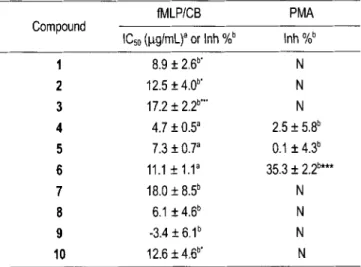
The in vitro inhibition by quinazolinones on superoxide anion generation from human neutrophiles was studied (Table II). fMLP/CB and PMA induced superoxide anion generation from human neutrophils. Products 4, 5, and 6 inhibited superoxide anion generation from human neutrophils stimulated with fMLP/CB in a concentration- dependent manner with IC~o values of 4.7+0.5, 7.3+0.7, and 11.1+1.1 #g/mL, respectively. Furthermore, at the con-
Table I. Inhibitory effects of products (1-10) on the aggregation of washed rabbit platelets
IC5o ~ in pg/mL (Percentage of inhibition at 100 pg/mL? Compound AA (100 pM) Collagen (10 pg/mL) 1 >100 (8.2) >100 (14.2) 2 >100 (16.9) >100 (26.0) 3 >100 (8.0) >100 (30.7) 4 20.8 + 5.7 19.1 + 3.3 5 >100 (24.9) 74.0 __ 19.6 6 >100 (38.7) 84.7 _+ 12.6 7 >100 (8.4) >100 (43.1) 8 20.2 + 6.1 21.6 4- 2.1 9 >100 (1.0) >100 (9.7) 10 47.0 + 11.6 27.2 + 3.5 (+)-Febrifugine >100 (3.2) >100 (21.5) Aspirin 6.2 +_ 0.2 4.0 + 0.7 Concentration necessary for 50% inhibition (IC50).
0 Percentage of inhibition (Inh %) in parentheses at 100 pg/mL concentration. For all data, results are presented as mean 4- S.E.M. (n = 3~4).
Table I1. The in vitro inhibition by the synthesized quinazolinones on neutrophil superoxide anion generation
Compound fMLP/CB PMA
ICso (pglmL) ~ or Inh %o Inh %o
1 8.9 + 2.6 ~ N 2 12.5 + 4.0 v N 3 17.2 + 2.2 ~ N 4 4.7 + 0.5 a 2.5 + 5.8 ~ 5 7.3 + 0.7 a 0.1 + 4.3 ~ 6 11.1 _+ 1.1 a 35.3 + 2.2 ~ 7 18.0 + 8.5 ~ N 8 6.1 + 4.6 ~ N 9 -3.4 + 6.1 ~ N 10 12.6 + 4.6 ~ N
a Concentration necessary for 50% inhibition (IC~0).
~ of inhibition (Inh %) at 10 l~g/mL concentration. *P < 0.05; ***P < 0.001 as compared with control value (0.1% DMSO). For all data, results are presented as average + S.E.M. (n = 3 - 4). N = not tested.
centration of 10 pg/mL, product 6 also partially inhibited PMA-induced superoxide anion generation by human neutrophils.
In conclusion, we synthesized a series of 2-substituted quinazolinones under microwave irradiation in dry conditions at acceptable yields. The advantages of this methodology are the need of only a domestic microwave oven, the absence of a solvent, shorter reaction time, simpler reaction conditions, and an improvement over previous synthesis methods by using conventional heating. Among the pro- duced compounds, the product 4, 2-phenyl quinazolinone, possessed the best anti-platelet activities and the greatest inhibition of superoxide anion generation activities. It is therefore concluded that product 4 is a promising lead compound for further investigation.
ACKNOWLEDGEMENTS
This work was supported by a grant from the National Science Council of the Republic of China and the National Science and Technology Program for Biotechnology and Pharmaceuticals.
REFERENCES
Boyum, A., Isolation of mononuclear cells and granulocytes from human blood. Scand. J. Clin. Lab. Invest., 97, 77-89 (1968).
Chiang-Su New Medical College, The Dictionary of Chinese Medicine (I). Shanghai Scientific Technology, Shanghai, pp.45, (1978).
Anti-Platelet Aggregation and the Inhibition of Superoxide Anion 515
Cross, A. R., Parkinson, J. F., and Jones, O. T. G., The superoxide-generating oxidase of leucocytes. NADPH- dependent reduction of flavin and cytochrome b in solubilized preparations, Biochem. J., 223, 337-344 (1984).
De Laszlo, S. E., Quagliato, C. S., Greenlee, W. J., Patchett, A. A., Chang, R. S. L., Lotti, V. J., Chen, T. B., Scheck, S. A., Faust, K. A., Kivlighn, S. S., Schorn, T. S., Zingaro, G. J., and Siegl, P. K. S., A potent, orally active, balanced affinity angiotensin II AT1 antagonist and AT2 binding inhibitor. J.
Med. Chem., 36, 3207-3210 (1993).
Griffin, R. J., Srinivasan, S., Bowman, K., Calvert, A. H., Curtin, N. J., Newell, D. R., Pemberton, L. C., and Golding, B. T., Resistance-modifying agents. 5. Synthesis and biological properties of quinazolinone inhibitors of the DNA repair enzyme poly(ADP-ribose) polymerase (PARP). J. Med.
Chem., 41,5247-5256 (1998).
Kobayashi, S., Ueno, M., Suzuki, R., Ishitani, H., Kim, H. S., and Wataya, Y., Catalytic asymmetric synthesis of antimalarial alkaloids febrifugine and isofebrifugine and their biological activity. J. Org. Chem., 64, 6833-6841 (1999).
Malamas, M. S. and Millen, J., Quinazolineacetic acids and related analogs as aldose reductase inhibitors. J. Med.
Chem., 34, 1492-1503 (1991).
Mannschreck, A., Koller, H., Stuhler, G,, Davies, M. A., and Traber, J., The enantiomers of methaqualone and their unequal anticonvulsive activity. Eur. J. Med. Chem., 19, 381 (1984).
Murata, K., Takano, F., Fushiya, S., and Oshima, Y., Enhance- ment of NO production in activated macrophages in vivo by an antimalarial crude drug, Dichroa febrifuga. J. Nat. Prod., 61,729-733 (1998).
Ravikanth, V., Ramesh, P., Diwan, P. V., and Venkateswarlu, Y., Microwave irradiation of embelin and evaluation of anti- bacterial activity. Heterocycl. Commun., 6, 315-318 (2000). Seger, C., Vajrodaya, S., Greger, H., and Hofer, O., Structure
elucidation and synthesis of a new bioactive quinazolone derivative obtained from Glycosmis cf. chlorosperma. Chem.
Pharm. Bull., 46, 1926-1928 (1998).
Seijas, J. A., Vazquez-Tato, M. P., and Montserrat, M. M., Microwave enhanced synthesis of 4-aminoquinazolines.
Tetrahedron Lett., 41,2215-2217 (2000).
Sharma, S. D. and Kaur, V., Synthesis of 3-oxa- and 3-aza-1- dethiacepham analogs. Synthesis, 9, 677-680 (1989). Wu, C. C., Huang, S. W., Hwang, T. L., Kuo, S. C., Lee, F. Y.,
and Teng, C. M., YD-3, a novel inhibitor of protease-induced platelet activation. Br. J. PharmacoL, 130, 1289-1296 (2000).