Crystal-Engineering Studies of Coordination Polymers and a
Molecular-Looped Complex Containing Dipyridyl-Amide Ligands
Biing-Chiau Tzeng,*,†Yung-Chi Huang,† Bo-So Chen,†Wan-Min Wu,†Shih-Yang Lee,† Gene-Hsiang Lee,‡ and Shie-Ming Peng‡
Department of Chemistry and Biochemistry, National Chung Cheng UniVersity,
168 UniVersity Road, Min-Hsiung, Chia-Yi, Taiwan 621, and Department of Chemistry, National Taiwan UniVersity, 1, Sec. 4, RooseVelt Road, Taipei, Taiwan 106
Received August 12, 2006
We report herein crystal-engineering studies of coordination polymers and a molecular-looped complex containing two dipyridyl-amide ligands, 1,3-bis-pyridin-4-ylmethyl urea (L1) andN,N′-bis-4-methylpyridyl oxalamide (L2). The reaction of Cd(OAc)2with L1 gives rise to [Cd(OAc)2(L1)]n(1), a 1-D chain through coordination to two L1 and two acetate ligands, and then the axial coordination to one urea’s carbonyl group through the third L1 ligand leads 1 to form “a dimer of 1-D chains”. With a slight change in the structural backbone from L1 to L2, the reaction of L2 with Cd(OAc)2 gives [Cd(OAc)2(L2)(H2O)]n (2), a 1-D chain structure. The reaction of Cd(NO3)2, instead of Cd-(OAc)2, with L2 gives [Cd(NO3)2(L2)3/2]n(3), where the coordinated-anion effect on the assembly process has been observed for 2 and 3. The former forms a 1-D chain structure, and the latter, a 2-D sheet structure, depending on the coordinated anions used. [HgCl2(L1)]n(4) and [CuCl2(L2)]n(5), which are 1-D chain structures, show tetrahedral [Hg(II)] and square-planar [Cu(II)] centers, respectively. Surprisingly, 4 shows a typical amide−amide hydrogen bonding and 5 shows none. Instead, a hydrogen-bonding interaction between Cl and the amide group is observed in 5. Finally, the different structural conformation of L2 (asyn or antiform) leads to the formation of different structural motifs, coordination polymers (2, 3, and 5 with anantiform), and a macrocycle ([Pd(PPy)(L2)]2(ClO4)2(6) with asynform, PPy)2-phenylpyridine). Each side of the boat form of 6 (pseudo-cyclohexane) ranges from 6.12 to 6.39 Å, and the molecular loop is further hydrogen-bonded to stack into a 1-D hydrogen-bonded framework with a ladder pattern through amide−amide hydrogen bonding. Interestingly, one ClO4-anion is encapsulated inside the cavity through multiple CH‚‚‚O interactions.
Introduction
The coordinative-bond approach has been widely used in the construction of coordination polymers with a wide range of 1-, 2-, and 3-D infinite solid-state networks1 as well as
discrete supramolecular entities.2 Moreover, it is also
pos-sible, in parallel, to use highly directional hydrogen bonds
as a means of controlling self assembly in supramolecular systems. In this context, the combination of the coordinative-bond approach, hydrogen coordinative-bonding, and/or other weak interactions (that is, π···π interactions) has recently been recognized as a very powerful and versatile strategy in material synthesis.3A paradigm example of a supramolecular
system, [(en)Pd(4,4′-bpy)]4(NO3)8 (en ) ethylenediamine;
4,4′-bpy ) 4,4′-bipyridyl), was first reported by Fujita et * To whom correspondence should be addressed. E-mail:
†National Chung Cheng University. ‡National Taiwan University.
(1) (a) Janiak, C. Dalton Trans. 2003, 2781. (b) Yaghi, O. M.; Li, H.; Davis, C.; Richardson, D.; Groy, T. L. Acc. Chem. Res. 1998, 31, 474. (c) Swiegers, G. F.; Malefetse, T. J. Chem. ReV. 2000, 100, 3483. (d) Zaworotko, M. J. Angew. Chem., Int. Ed. 2000, 39, 3052. (e) Batten, S. R.; Robson, R. Angew. Chem., Int. Ed. 1998, 37, 1461. (f) Hagrman, P. J.; Hagrman, D.; Zubieta, J. Angew. Chem., Int. Ed. 1999, 38, 2639. (g) James, S. L. Chem. Soc. ReV. 2003, 32, 276. (h) Kitagawa, S.; Kitaura, R.; Noro, S.-I. Angew. Chem., Int. Ed. 2004, 43, 2334.
(2) (a) Fujita, M. Chem. Soc. ReV. 1998, 27, 417. (b) Leininger, S.; Olenyuk, B.; Stang, P. J. Chem. ReV. 2000, 100, 853. (c) Holliday, B. J.; Mirkin, C. A. Angew. Chem., Int. Ed. 2001, 40, 2022. (d) Dinolfom, P. H.; Hupp, J. T. Chem. Mater. 2001, 13, 3113. (e) Seidel, S. R.; Stang, P. J. Acc. Chem. Res. 2002, 35, 972. (f) Fujita, M.; Tominaga, M.; Hori, A.; Therrien, B. Acc. Chem. Res. 2005, 38, 371. (g) Thanasekaran, P.; Liao, R.-T.; Liu, Y.-H.; Rajendran, T.; Rajagopal, S.; Lu, K.-L. Coord. Chem. ReV. 2005, 249, 1085. (h) Atwood, J. L.; Barbour, L. J. Cryst. Growth Des. 2003, 3, 3. (i) Cotton, F. A.; Lin, C.; Murillo, C. A. Acc. Chem. Res. 2001, 34, 759. (j) Steel, P. J. Acc. Chem. Res. 2005, 38, 243.
Inorg. Chem. 2007, 46, 186
−
195
al.,4aand its molecular structure was further determined by
an X-ray diffraction study confirming a molecular-square structure.4bLater, [Re(CO)
3X(diimine)]4(X ) Cl, Br; diimine ) pyrazine, 4,4-bipyridine, or other linear spacers), also
reported by the Hupp group, was shown to represent another interesting family of neutral molecular squares with tunable cavity sizes, depending on the linear spacers used.5 The
related studies have so far extended to molecular triangles, rectangles, pentagons, hexagons, cages, and so forth.2
Ap-plications, including chemical sieving, sensing, and catalysis, based on these supramolecular systems have recently been found, and some have shown exciting results.6
Organic amides have long proved to be very useful in self assembly through hydrogen bonding, and the assembled products have relevance to biological systems. With reference to the delicate work reported by Ghadiri et al.,7 cyclic
oligoamides can be used as building units to give interesting nanotubes or zeolite-like frameworks through inter-ring and/ or inter-tube NH‚‚‚OdC hydrogen bonding, potentially representing a new family of functional materials. However, the related study based on metal-containing cyclic amides is still in its infancy. Puddephatt et al. reported an intriguing work based on this novel idea toward the construction of a metal-containing [Pt(II) ions] supramolecular structure with dipyridyl-amide (N-pyridin-4-yl-isonicotinamide) as a bridg-ing ligand and of Pt(II) ions as connectors in the assembly process.8 The complex cation appears to be an interesting
example of a triangular structure that forms a dimeric architecture through the NH‚‚‚OdC hydrogen bonding and
Pt‚‚‚OdC interactions similar to that formed by cyclic peptides, and it suggests that the biomimetic approach to the organization of the coordination networks holds consider-able promise.
We9and other groups3h-lhave previously constructed some
interesting molecular rectangles, triangles, and coordination polymers and successfully demonstrated the important role of hydrogen-bonding interactions in the crystal-engineering study for the metal-containing pyridyl-amide system. In-deed, the previous work also confirms that the amide-amide hydrogen bonding did increase the supramolecular complex-ity in the solid state. We report herein the crystal-engineering study of coordination polymers and a molecular-looped complex containing two dipyridyl-amide ligands, 1,3-bis-pyridin-4-ylmethyl urea (L1) and N,N′-bis-4-methylpyridyl oxalamide (L2).
Experimental Section
General Information. The reaction for [Pd(PPy)(L2)]2(ClO4)2
(PPy ) 2-phenylpyridine) was performed under a nitrogen atmo-sphere, and the solvents for syntheses (analytical grade) were purified by literature methods. Caution: Perchlorate salts are
potentially explosiVe and should be handled with care and in small amounts. NMR: Bruker DPX 400 MHz NMR; deuterated solvents
with the usual standards. 1,3-Bis-pyridin-4-ylmethyl urea (L1) and
N,N′-bis-4-methylpyridyl oxalamide (L2) were prepared by litera-ture methods,10 and [Pd(PPy)(OAc)]
2 was also prepared in a
modified method.11
Syntheses of [Cd(OAc)2L1]n(1), [Cd(OAc)2(L2)(H2O)]n(2),
[Cd(NO3)2(L2)3/2]n(3), [HgCl2(L1)]n(4), and [CuCl2(L2)]n(5).
1: Cd(OAc)2‚2H2O (26 mg, 0.1 mmol) dissolved in 7 mL of C2H5
-OH was carefully layered onto a dimethylforamide (DMF) solution of L1 (24 mg (0.1 mmol), dissolved in 7 mL of DMF). The colorless crystals were obtained within 5 days in an ∼74% yield. FTIR (KBr): νNH) 3267 cm-1andνCdO) 1651 cm-1. Anal. Calcd for
C17H20CdN4O5: C, 43.19; H, 4.26; N, 11.85. Found: C, 42.80; H,
4.26; N, 11.63. 2: Cd(OAc)2‚2H2O (26 mg, 0.1 mmol) dissolved
in 7 mL of CH3OH was carefully layered onto a tetrahydrofuran
(THF) solution of L2 (27 mg (0.1 mmol), dissolved in 7 mL of THF). The colorless crystals were obtained within 2 weeks in an
∼56% yield. FTIR (KBr): νNH) 3280 cm-1and νCdO) 1686
cm-1. Anal. Calcd for C36H40Cd2N8O14: C, 41.83; H, 3.90; N,
10.84. Found: C, 41.67; H, 4.27; N, 10.80. 3: Cd(NO3)2‚4H2O
(26 mg, 0.1 mmol) dissolved in 7 mL of CH3OH was carefully
layered onto a THF solution of L2 (27 mg (0.1 mmol), dissolved in 7 mL of THF). The colorless crystals were obtained within 6
(3) (a) Burrows, A. D.; Chan, C.-W.; Chowdhry, M. W.; McGrady, J. E.; Mingos, D. M. P. Chem. Soc. ReV. 1995, 24, 329. (b) Gianneschi, N. C.; Tiekink, E. R. T.; Rendina, L. M. J. Am. Chem. Soc. 2000, 122, 8474. (c) Burrows, A. D.; Mingos, D. M. P.; White, A. J. P.; Williams, D. J. Chem. Commun. 1996, 97. (d) Chen, Z.-N.; Zhang, H.-X.; Yu, K.-B.; Zheng, K.-C.; Cai, H.; Kang, B.-S. J. Chem. Soc., Dalton Trans.
1998, 1133. (e) Aakero¨y, C. B.; Beatty, A. M.; Helfrich, B. A. J. Chem.
Soc., Dalton Trans. 1998, 1943. (f) Cameron, B. R.; Corrent, S. S.; Loeb, S. J. Angew. Chem., Int. Ed. 1995, 34, 2689. (g) Copp, S. B.; Subramanian, S.; Zaworotko, M. J. J. Am. Chem. Soc. 1992, 114, 8719. (h) Qin, Z.; Jennings, M. C.; Puddephatt, R. J. Chem. Commun. 2002, 354. (i) Muthu, S.; Yip, J. H. K.; Vittal, J. J. J. Chem. Soc., Dalton Trans. 2002, 4561. (j) Muthu, S.; Yip, J. H. K.; Vittal, J. J. J. Chem. Soc., Dalton Trans. 2001, 3577. (k) Burchell, T. J.; Eisler, D. J.; Puddephatt, R. J. Inorg. Chem. 2004, 43, 5550. (l) Schauer, C. L.; Matwey, E.; Fowler, F. W.; Lauher, J. W. Cryst. Eng. 1998, 1, 213. (4) (a) Fujita, M.; Yazaki, J.; Ogura, K. J. Am. Chem. Soc. 1990, 112, 5645. (b) Fujita, M.; Sasaki, O.; Mitsuhashi, T.; Fujita, T.; Yazaki, J.; Yamaguchi, K.; Ogura, K. Chem. Commun. 1996, 1535.
(5) (a) Slone, R. V.; Hupp, J. T.; Stern, C. L.; Albrecht-Schmitt, T. E. Inorg. Chem. 1996, 35, 4096. (b) Slone, R. V.; Hupp, J. T. Inorg. Chem. 1997, 36, 5422.
(6) (a) Be´langer, S.; Hupp, J. T.; Stern, C. L.; Slone, R. V.; Watson, D. F.; Carrell, T. M. J. Am. Chem. Soc. 1999, 121, 557. (b) Be´langer, S.; Hupp, J. T. Angew. Chem., Int. Ed. 1999, 38, 2222. (c) Mines, G. A.; Tzeng, B.-C.; Stevenson, K. J.; Li, J.; Hupp, J. T. Angew. Chem., Int. Ed. 2002, 41, 154. (d) Keefe, M. H.; Slone, R. V.; Hupp, J. T.; Czaplewski, K. F.; Snurr, R. Q.; Stern, C. L. Langmuir 2000, 16, 3964. (e) Merlau, M. L.; Mejia, M. D. P.; Nguyen, S. T.; Hupp, J. T. Angew. Chem., Int. Ed. 2001, 40, 4239. (f) Tashiro, S.; Tominaga, M.; Kawano, M.; Therrien, B.; Ozeki, T.; Fujita, M. J. Am. Chem. Soc. 2005, 127, 4546. (g) Yoshizawa, M.; Takeyama, Y.; Okano, T.; Fujita, M. J. Am. Chem. Soc. 2003, 125, 3243.
(7) (a) Hartgerink, J. D.; Clark, T. D.; Ghadiri, M. R. Chem.sEur. J.
1998, 4, 1367. (b) Ghadiri, M. R.; Kobayashi, K.; Granja, J. R.;
Chadha, R. K.; McRee, D. E. Angew. Chem., Int. Ed. 1995, 34, 93. (8) (a) Qin, Z.; Jennings, M. C.; Puddephatt, R. J. Chem. Commun. 2001, 2676. (b) Qin, Z.; Jennings, M. C.; Puddephatt, R. J. Inorg. Chem.
2003, 42, 1956.
(9) (a) Tzeng, B.-C.; Chen, B.-S.; Lee, S.-Y.; Liu, W.-H.; Lee, G.-H.; Peng, S.-M. New J. Chem. 2005, 29, 1254-1257. (b) Tzeng, B.-C.; Yeh, H.-T.; Wu, Y.-L.; Kuo, J.-H.; Lee, G.-H.; Peng, S.-M. Inorg. Chem. 2006, 45, 591. (c) Tzeng, B.-C.; Lu, Y.-M.; Lee, G.-H.; Peng, S.-M. Eur. J. Inorg. Chem. 2006, 1698. (d) Tzeng, C.; Chen, B.-S.; Yeh, H.-T.; Lee, G.-H.; Peng, S.-M. New J. Chem. 2006, 30, 1087. (10) Fraser, C. S. A.; Eisler, D. J.; Jennings, M. C.; Puddephatt, R. J. Chem.
Commun. 2002, 1224.
(11) Constable, E. C.; Cargill Thompson, A. M. W.; Leese, T. A.; Reese, D. G. F.; Tocher, D. A. Inorg. Chim. Acta. 1991, 182, 93.
weeks in an∼62% yield. FTIR (KBr): νNH) 3290 cm
-1andν CdO ) 1660 cm-1. Anal. Calcd for C
21H21CdN8O9: C, 39.30; H, 3.30;
N, 17.46. Found: C, 38.97; H, 3.17; N, 17.80. 4: HgCl2(27 mg,
0.1 mmol) dissolved in 7 mL of C2H5OH was carefully layered
onto a DMF solution of L2 (24 mg (0.1 mmol), dissolved in 7 mL of DMF). The colorless crystals were obtained within 10 days in an∼71% yield. FTIR (KBr): νNH) 3326 cm-1andνCdO) 1635
cm-1. Anal. Calcd for C6.5H7ClHg0.5N2O0.5: C, 30.39; H, 2.75; N,
10.90. Found: C, 29.92; H, 2.84; N, 10.92. 5: CuCl2‚2H2O (17
mg, 0.1 mmol) dissolved in 7 mL of CH3OH was carefully layered
onto a dimethyl sulfoxide (DMSO) solution of L2 (27 mg (0.1 mmol), dissolved in 7 mL of DMSO). The pale-blue crystals were obtained within 3 weeks in an∼64% yield. FTIR (KBr): νNH)
3238 cm-1 and νCdO ) 1667 cm-1. Anal. Calcd for C14H14Cl2
-CuN4O2: C, 41.55; H, 3.49; N, 13.84. Found: C, 41.92; H, 3.84;
N, 13.92.
Synthesis of [Pd(PPy)(L2)](ClO4)2(6). The reaction of L2 (27
mg (0.1 mmol), dissolved in CH2Cl2/MeOH (1:1, 25 mL)) with
[Pd(PPy)(OAc)]2(85 mg, 0.1 mmol) at room temperature for 24 h
gave a colorless solution. The solution was filtered off, and the filtrate was concentrated to∼5 mL. Addition of excess LiClO4
yielded a pale-yellow solid. Recrystallization of the crude product by diffusion of diethyl ether into a DMF solution afforded colorless crystals with a 75% yield.1H NMR (400 MHz, CD
3C(O)CD3, 25 °C): δ (ppm) 9.15 (t, 4H,3J HH) 5.7 Hz), 8.15 (d, 2H,3JHH) 4.0 Hz), 7.78 (d, 1H,3J HH) 7.4 Hz), 7.66 (d, 5H, 3JHH) 5.7 Hz), 7.29 (dd, 1H,3J HH) 4.6 Hz), 7.19 (t, 1H,3JHH) 7.7 Hz), 6.97 (t, 1H,3J HH) 7.4 Hz), 6.09 (d, 1H,3JHH) 7.8 Hz), 4.71 (dd, 4H, 3J HH ) 5.5 Hz). FTIR: νNH ) 3292 cm-1, νCdO) 1660 cm-1,
νCl-O) 1095 cm-1. ESI-MS: [M - 2× ClO4+ H2O], m/e )
538, 20%. Anal. Calcd for C50H44Cl2N10O12Pd2: C, 49.59; H, 3.66;
N, 11.57. Found: C, 49.87; H, 3.49; N, 11.28.
X-ray Crystallography. Suitable crystals were mounted on glass
capillaries. Data collection was carried out on a Bruker SMART
CCD or Nonius KappaCCD diffractometer with Mo radiation (0.71073 Å) at 273(2) K for 1-4 and at 150(1) K for 5‚2MeOH and 6‚3/2DMF‚Et2O, respectively. A preliminary orientation matrix
and unit cell parameters were determined from three runs of 15 frames each, with each frame corresponding to a 0.3°scan in 20 s, followed by spot integration and least-square refinement. Data were measured using anω scan of 0.3°per frame for 20 s until a complete hemisphere had been collected. Cell parameters were retrieved using SMART12asoftware and refined using SAINT12b software on all
observed reflections. Data reduction was performed with the SAINT software and corrected for Lorentz and polarization effects. Absorption corrections were applied with the program SADABS.12c
The structure was solved by direct methods with the SHELXS-9712dprogram and refined by full-matrix least-squares methods on F2with SHELXL-97.12eAll non-hydrogen atomic positions were
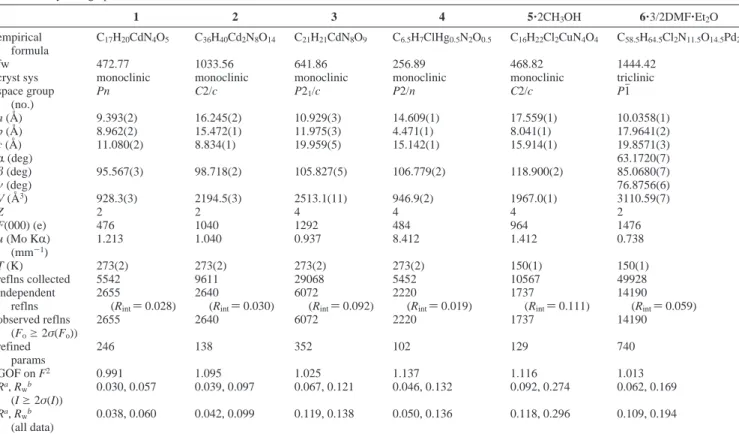
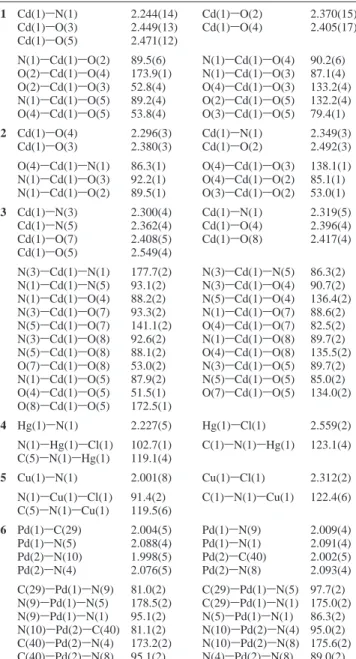
located in difference Fourier maps and refined anisotropically. Hydrogen atoms of 1-3 and 5-6 were constrained to the ideal geometry using an appropriate riding model, and those of 4 were refined with the position. Detailed data collection and refinement of 1-4, 5‚2MeOH, and 6‚3/2DMF‚Et2O are summarized in Table
1, and their selected bond distances and angles are summarized in Table 2. Hydrogen bonds in the structures are given in Table 3.
Results and Discussion
Two dipyridyl-amide ligands, 1,3-bis-pyridin-4-ylmethyl urea (L1) and N,N′-bis-4-methylpyridyl oxalamide (L2), have been chosen and synthesized here for use in crystal-(12) (a) SMART V5.625: Software for the CCD Detector System; Bruker-axs Instruments Division: Madison, WI, 2000. (b) SAINT V6.22: Software for the CCD Detector System; Bruker-axs Instruments Division: Madison, WI, 2000. (c) Sheldrick, G. M. SADABS, V 2.03; University of Go¨ttingen: Germany, 2002. (d) Sheldrick, G. M. SHELXS-97. Acta Crystallogr. 1990, A46, 467. (e) Sheldrick, G. M. SHELXL-97; University of Go¨ttingen: Germany, 1997.
Table 1. Crystallographic Data of 1-6
1 2 3 4 5‚2CH3OH 6‚3/2DMF‚Et2O
empirical formula
C17H20CdN4O5 C36H40Cd2N8O14 C21H21CdN8O9 C6.5H7ClHg0.5N2O0.5 C16H22Cl2CuN4O4 C58.5H64.5Cl2N11.5O14.5Pd2
fw 472.77 1033.56 641.86 256.89 468.82 1444.42
cryst sys monoclinic monoclinic monoclinic monoclinic monoclinic triclinic
space group (no.) Pn C2/c P21/c P2/n C2/c P1h a (Å) 9.393(2) 16.245(2) 10.929(3) 14.609(1) 17.559(1) 10.0358(1) b (Å) 8.962(2) 15.472(1) 11.975(3) 4.471(1) 8.041(1) 17.9641(2) c (Å) 11.080(2) 8.834(1) 19.959(5) 15.142(1) 15.914(1) 19.8571(3) R (deg) 63.1720(7) β (deg) 95.567(3) 98.718(2) 105.827(5) 106.779(2) 118.900(2) 85.0680(7) γ (deg) 76.8756(6) V (Å3) 928.3(3) 2194.5(3) 2513.1(11) 946.9(2) 1967.0(1) 3110.59(7) Z 2 2 4 4 4 2 F(000) (e) 476 1040 1292 484 964 1476 µ (Mo KR) (mm-1) 1.213 1.040 0.937 8.412 1.412 0.738 T (K) 273(2) 273(2) 273(2) 273(2) 150(1) 150(1) reflns collected 5542 9611 29068 5452 10567 49928 independent reflns 2655 (Rint) 0.028) 2640 (Rint) 0.030) 6072 (Rint) 0.092) 2220 (Rint) 0.019) 1737 (Rint) 0.111) 14190 (Rint) 0.059) observed reflns (Fog 2σ(Fo)) 2655 2640 6072 2220 1737 14190 refined params 246 138 352 102 129 740 GOF on F2 0.991 1.095 1.025 1.137 1.116 1.013 Ra, Rwb (I g 2σ(I)) 0.030, 0.057 0.039, 0.097 0.067, 0.121 0.046, 0.132 0.092, 0.274 0.062, 0.169 Ra, Rwb (all data) 0.038, 0.060 0.042, 0.099 0.119, 0.138 0.050, 0.136 0.118, 0.296 0.109, 0.194 aR )∑||F o| - |Fc||/∑|Fo|.bwR2 ){[∑w(Fo2- Fc2)2]/∑[w(Fo2)2]}1/2. Tzeng et al.
engineering studies, and indeed their applications based on the combination of the coordinative-bond approach and hydrogen bonding have recently been demonstrated. In this regard, the amide-amide hydrogen bonding has been suc-cessfully used to increase the supramolecular complexity of the dinuclear Pt(IV)10complex and the Zn(II)9arectangle with
N,N′-bis-4-methylpyridyl oxalamide. In the dinuclear Pt(IV) complex, two 4-methyl-benzoic acid ligands trans to each other both coordinate to two different Pt(IV) centers, and the N,N′-bis-4-methylpyridyl oxalamide ligand acts as a bridge between two octahedral Pt(IV) centers, leading to a 1-D chain through hydrogen bonding between two 4-methyl-benzoic acid ligands and further a double-helical structure through amide-amide hydrogen bonding. For the dinuclear Zn(II) complex, two tetrahedral Zn(II) centers coordinate to two bridging N,N′-bis-4-methylpyridyl oxalamide ligands and two iodo atoms to form a rectangle, and further an interesting nanotube framework was built from π···π interactions in combination with amide-amide hydrogen bonding. In this
work, the crystal-engineering study was carried out by taking advantage of the different structural flexibilities of dipyridyl-amides (i.e., L1 or L2), metal salts with different anions (i.e., OAc- or NO3-), metal ions with different coordination
geometries (i.e., tetrahedron or square-plane), and the geometric isomerism (i.e., cis or trans coordination) to examine the effect on the assembly process and rationalize the formation of different structural frameworks.
1-6 have been isolated as air-stable solids, and their molecular structures were determined by the single-crystal X-ray diffraction study, which confirmed the coordination polymers for 1-5 and a macrocyclic structure for 6. All of the complexes form extended hydrogen-bonded frameworks that are 1-D, 2-D, or 3-D in the solid state (Scheme 1). Among them, 1-5 are obtained by a layer method and 6 is obtained by a typical solution method with medium yields of 56-74%. Three hydrogen-bonding synthons between the coordinated anions and amide groups of 1-3 are shown in Figure 1.
1 crystallizes in the Pn space group. In the structure of 1, as shown in Figure 2a, each Cd(II) center achieves a
seven-Table 2. Selected Bond Distances (Å) and Angles (deg) of 1-6
1 Cd(1)sN(1) 2.244(14) Cd(1)sO(2) 2.370(15) Cd(1)sO(3) 2.449(13) Cd(1)sO(4) 2.405(17) Cd(1)sO(5) 2.471(12) N(1)sCd(1)sO(2) 89.5(6) N(1)sCd(1)sO(4) 90.2(6) O(2)sCd(1)sO(4) 173.9(1) N(1)sCd(1)sO(3) 87.1(4) O(2)sCd(1)sO(3) 52.8(4) O(4)sCd(1)sO(3) 133.2(4) N(1)sCd(1)sO(5) 89.2(4) O(2)sCd(1)sO(5) 132.2(4) O(4)sCd(1)sO(5) 53.8(4) O(3)sCd(1)sO(5) 79.4(1) 2 Cd(1)sO(4) 2.296(3) Cd(1)sN(1) 2.349(3) Cd(1)sO(3) 2.380(3) Cd(1)sO(2) 2.492(3) O(4)sCd(1)sN(1) 86.3(1) O(4)sCd(1)sO(3) 138.1(1) N(1)sCd(1)sO(3) 92.2(1) O(4)sCd(1)sO(2) 85.1(1) N(1)sCd(1)sO(2) 89.5(1) O(3)sCd(1)sO(2) 53.0(1) 3 Cd(1)sN(3) 2.300(4) Cd(1)sN(1) 2.319(5) Cd(1)sN(5) 2.362(4) Cd(1)sO(4) 2.396(4) Cd(1)sO(7) 2.408(5) Cd(1)sO(8) 2.417(4) Cd(1)sO(5) 2.549(4) N(3)sCd(1)sN(1) 177.7(2) N(3)sCd(1)sN(5) 86.3(2) N(1)sCd(1)sN(5) 93.1(2) N(3)sCd(1)sO(4) 90.7(2) N(1)sCd(1)sO(4) 88.2(2) N(5)sCd(1)sO(4) 136.4(2) N(3)sCd(1)sO(7) 93.3(2) N(1)sCd(1)sO(7) 88.6(2) N(5)sCd(1)sO(7) 141.1(2) O(4)sCd(1)sO(7) 82.5(2) N(3)sCd(1)sO(8) 92.6(2) N(1)sCd(1)sO(8) 89.7(2) N(5)sCd(1)sO(8) 88.1(2) O(4)sCd(1)sO(8) 135.5(2) O(7)sCd(1)sO(8) 53.0(2) N(3)sCd(1)sO(5) 89.7(2) N(1)sCd(1)sO(5) 87.9(2) N(5)sCd(1)sO(5) 85.0(2) O(4)sCd(1)sO(5) 51.5(1) O(7)sCd(1)sO(5) 134.0(2) O(8)sCd(1)sO(5) 172.5(1) 4 Hg(1)sN(1) 2.227(5) Hg(1)sCl(1) 2.559(2) N(1)sHg(1)sCl(1) 102.7(1) C(1)sN(1)sHg(1) 123.1(4) C(5)sN(1)sHg(1) 119.1(4) 5 Cu(1)sN(1) 2.001(8) Cu(1)sCl(1) 2.312(2) N(1)sCu(1)sCl(1) 91.4(2) C(1)sN(1)sCu(1) 122.4(6) C(5)sN(1)sCu(1) 119.5(6) 6 Pd(1)sC(29) 2.004(5) Pd(1)sN(9) 2.009(4) Pd(1)sN(5) 2.088(4) Pd(1)sN(1) 2.091(4) Pd(2)sN(10) 1.998(5) Pd(2)sC(40) 2.002(5) Pd(2)sN(4) 2.076(5) Pd(2)sN(8) 2.093(4) C(29)sPd(1)sN(9) 81.0(2) C(29)sPd(1)sN(5) 97.7(2) N(9)sPd(1)sN(5) 178.5(2) C(29)sPd(1)sN(1) 175.0(2) N(9)sPd(1)sN(1) 95.1(2) N(5)sPd(1)sN(1) 86.3(2) N(10)sPd(2)sC(40) 81.1(2) N(10)sPd(2)sN(4) 95.0(2) C(40)sPd(2)sN(4) 173.2(2) N(10)sPd(2)sN(8) 175.6(2) C(40)sPd(2)sN(8) 95.1(2) N(4)sPd(2)sN(8) 89.0(2)
Table 3. Hydrogen Bonds in the Structures of 1-6 complex DsH···A DsH (Å)l H···A (Å) D···A (Å) DsH···A (deg) 1 N(2)sH(2A)···O(3)a 0.86 2.058 2.889(18) 162.4 N(3)sH(3A)···O(5) 0.86 2.027 2.874(17) 167.9 2 N(2)sH(2A)···O(5)b 0.86 2.255 2.993(14) 143.9 N(3)sH(3A)···O(3)c 0.86 2.098 2.887(13) 152.3 3 N(2)sH(2B)···O(3)d 0.86 2.355 3.007(6) 132.9 N(4)sH(4A)···O(5)e 0.86 2.541 3.289(6) 146.0 4 N(2)sH(1A)···O(1)f 0.78 2.050 2.782(7) 157.0 5 N(2)sH(2A)···Cl(1)g 0.88 2.411 3.261(9) 162.8 C(9)sH(9A)···N(2) 0.99 2.354 3.270(20) 153.3 6 N(7)sH(7)···O(3)h 0.88 2.031 2.766(5) 140.2 N(6)sH(6)···O(4)i 0.8 2.089 2.871(5) 147.5 N(2)sH(2A)···O(4)j 0.88 2.144 2.992(6) 161.7 N(3)sH(3A)···O(6)k 0.88 2.175 2.962(8) 148.8 C(5)sH(5A)···O(5) 0.95 2.478 3.152(9) 127.9 C(24)sH(24A)···O(8) 0.95 2.352 3.199(8) 148.2 a-kSymmetry positions of atoms A: (a)1/2+ x, -y, -1/2+ z; (b)1/2+ x,3/2- y,1/2+ z; (c)1/2+ x, -1/2+ y, z; (d) -1 + x,1/2- y, -1/2+ z; (e) x,3/2- y,1/2+ z; (f) x, 1 + y, z; (g) x, -1 - y, -1/2+ z; (h) x, 1 -y, 1 - z; (i) 1 - x, 1 - -y, 1 - z; (j) -x, 1 - -y, 1 - z; (k) -1 + x, -y, z. lThe hydrogen atoms of 1-3 and 5-6 were constrained to the ideal geometry using an appropriate riding model, and those of 4 were refined with the position. Data collection was carried out at 273(2) K for 1-4 and at 150(1) K for 5 and 6, respectively.
coordinate geometry by three independent L1 ligands and two unsymmetricalη2-acetate ligands (Cd‚‚‚O (Å):
2.370-(15), 2.449(13), 2.405(17), 2.471(12)), where two pyridyl groups from two different L1 ligands and a carbonyl group from a urea form the third one-coordinate to the Cd(II) center. The structure can be first regarded as a 1-D chain through
coordination to two different L1 ligands and two acetate ligands, and then the axial coordination to one urea’s carbonyl group of the third L1 ligand leads 1 to give “a dimer of 1-D chains” (Figure 2b), which features a 1-D assembly of Cd2(L1)2rectangles or a 1-D ladder chain. The distance
separating the two Cd(II) centers located at the vertexes of Figure 1. Three hydrogen-bonding synthons between the coordinated anions and the amide groups of 1-3.
Figure 2. (a) Molecular structure (the ORTEP diagram shows 50% probability ellipsoids), (b) 1-D ladder structure, and (c) 2-D hydrogen-bonded framework of 1.
each metallamacrocycle is ∼8.27 Å, while the distances between each Cd(II) center and the carbon atoms of the two urea groups located at the two other vertexes of the rectangles are ∼3.54 and 7.62 Å for the long and short sides, respectively. Another notable feature of this assembly is that the 1-D chains of the rectangles interact with each other via hydrogen bonds (Figure 2c). The urea groups act as hydrogen bond donors, establishing bridges with oxygen atoms of coordinated acetate groups (N2‚‚‚O3, 2.889(18) Å; N3‚‚‚ O5, 2.874(17) Å) instead of amide-amide hydrogen bonding and generating a 2-D hydrogen-bonded structure. Signifi-cantly, this structural pattern seems to receive the benefit from theπ···π interaction between the pyridyl rings of each neighboring L1 pair (the edge-to-edge distance is∼3.4 Å), and thus it may facilitate coordination to the Cd(II) center from the urea’s carbonyl group of the third L1 ligand. Although the structural motif has been observed in [Cu-(OAc)2(L1)]n13a with the weak Cu‚‚‚O interaction
[2.316-(15) Å] between the square-planar Cu(II) center and the third L1 ligand, where a 1-D assembly of Cu2(L1)2rectangles is
also constructed, the seven-coordinate Cd(II) center with the real Cd-O bond (2.372(13) Å) giving rise to a similar structural motif seems more convincing in the formation of “a dimer of 1-D chains”.
The reaction of Cd(OAc)2with L2 instead of L1 gives 2,
which crystallizes in the C2/c space group. In the structure of 2, as shown in Figure 3a, each Cd(II) center achieves a seven-coordinate geometry by two independent L2 ligands, two unsymmetricalη2-acetate ligands (Cd‚‚‚O (Å):
2.492-(3), 2.380(3)), and one water molecule, leading to the formation of a 1-D chain structure. It is noted that, compared with the structure of 1, the coordinated water molecule in 2 is absent in 1; the reaction conditions are similar for both, but only L1 and L2 were used for the synthesis of 1 and 2, respectively. The hydrogen bonding between the coordinated acetate and the amide group (N2‚‚‚O5, 2.993(14) Å; N3‚‚‚ O3, 2.887(13) Å), instead of amide-amide hydrogen bond-ing, increases the supramolecular complexity, and hence 1-D coordination polymers are further stacked into a 3-D hydrogen-bonded framework in Figure 3b. Interestingly, with a slight change in the structural flexibility from L1 to L2, different metal-organic frameworks can be generated upon reaction with the same metal salts in similar reaction conditions for 1 and 2, respectively. This result is remarkable and may be rationalized by the fact that the less structurally flexible oxalamide group, compared with the urea group, prevents the occurrence of theπ···π interaction between the pyridyl rings of neighboring L2 ligands in 2 (as opposed to the case for 1), and hence the Cd(II) center coordinates to water instead of the urea group to achieve the seven-coordinate geometry.
The reaction of L2 with Cd(NO3)2instead of Cd(OAc)2
gives 3, which crystallizes in the P21/c space group. In the
structure of 3, as shown in Figure 4a, each Cd(II) center still achieves a seven-coordinate geometry by three inde-(13) (a) Dı´az, P.; Benet-Buchholz, J.; Vilar, R.; White, A. J. P. Inorg. Chem.
2006, 45, 1617. (b) Zhang, X.; Zhou, X.; Li, D. Cryst. Growth. Des. 2006, 6, 1440. (c) Springsteen, C H.; Sweeder, R. D.; LaDuca, R. L.
Cryst. Growth. Des. 2006, 6, 2308. (d) Wang, R.; Yuan, D.; Jiang, F.; Han, L.; Gong, Y.; Hong, M. Cryst. Growth. Des. 2006, 6, 1351. (e) Kong, L.-Y.; Zhu, H.-F.; Huang, Y.-Q.; Okamura, T.-a.; Lu, X.-H.; Song, Y.; Liu, G.-X.; Sun, W.-Y.; Ueyama, N. Inorg. Chem. 2006, 45, 8098.
pendent L2 ligands and two η2-nitrate ligands (One is
symmetrical, Cd‚‚‚O (Å): 2.408(5), 2.417(4). The other is unsymmetrical, Cd‚‚‚O (Å): 2.396(4), 2.549(4)). Although the reaction conditions are similar for the reaction of Cd-(NO3)2or Cd(OAc)2with L2, the coordinated water molecule
in 3 is absent and instead the third L2 ligand through pyridyl coordination to the Cd(II) center is observed, with a 2-D coordination polymer formed. Significantly, the interesting 90-membered rings constructed from six seven-coordinate Cd(II) centers as connectors and the six L2 ligands propagate into a 2-D sheet structure in Figure 4b, and every neighboring two sheets are hydrogen-bonded and interpenetrated together between the coordinated nitrate and the amide group (N4‚
‚‚O5, 3.289(6) Å), leading to a sheet pair. In addition, every
sheet pair is further hydrogen-bonded to stack into a 3-D framework through amide-amide hydrogen bonding (N2‚‚
‚O3, 3.007(6) Å). It is noted that, with a change in Cd(II)
salt anions used (OAc-or NO3-), two dramatic and different
metal-organic frameworks of 2 and 3 can be obtained upon the reaction with L2 in similar reaction conditions. However, the bond angles of O(2)-Cd(1)-O(2A) (170.3°) in 2 (OAc-)
and of O(5)-Cd(1)-O(8) (172.5°) in 3 (NO3-) are
compa-rable, and the reason why the coordination environments for 2 (two L2 ligands, two OAc-anions, and one water) and 3 (three L2 ligands and two NO3
-anions) are different is still unclear. In fact, the anion-directed assembly is an interesting phenomenon in crystal-engineering studies and has been reported by several groups.13
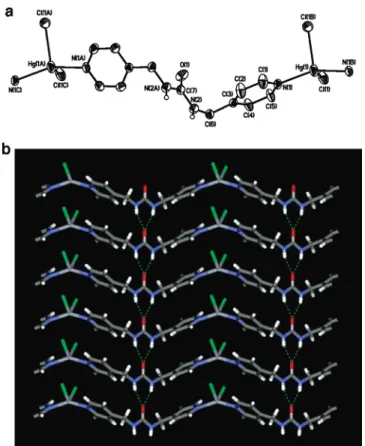
While 1-3 contain seven-coordinate Cd(II) centers, 4 and 5, with their respective space groups being P2/n and C2/c, contain four-coordinate tetrahedral and square-planar metal centers, respectively. In the structure of 4, as shown in Figure 5a, each Hg(II) center is coordinated by two independent L1 ligands and two Cl ligands, leading to a 1-D chain structure. A typical amide-amide hydrogen bond (N2‚‚‚O1, 2.782(7) Å) increasing the structural complexity from a 1-D chain to a 2-D herringbone-like hydrogen-bonded framework is observed in the solid state (Figure 5b). Moreover, long double Hg‚‚‚Cl contacts of 3.56 Å (the sum of the van der Waals radii is 3.30 Å) are also suggested to contribute, in part, to the formation of these hydrogen-bonded frameworks. In the structure of 5, as shown in Figure 6a, each square-Figure 4. (a) Molecular structure (the ORTEP diagram shows 50% probability ellipsoids) and (b) 2-D coordination polymer framework of 3.
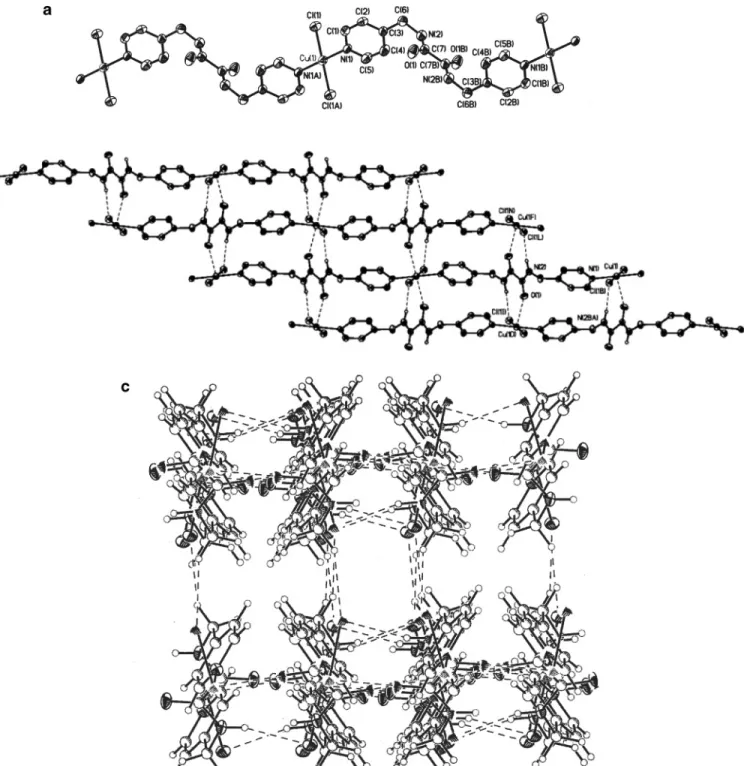
planar Cu(II) center is coordinated by two independent L2 ligands and two Cl ligands with a trans configuration, giving rise to the formation of a 1-D chain structure similar to that of 4. In addition, the Cu(II) center also shows weak interactions (2.55 Å) with the urea’s carbonyl groups from the neighboring L2 ligands in axial positions, which can be considered as a Jahn-Teller effect, a common coordination behavior in d9-metal complexes (especially Cu(II) centers).
Hydrogen-bonding interactions between Cl and amide groups (N2‚‚‚Cl1, 3.261(9) Å), nonclassical CH‚‚‚N (C‚‚‚N, 3.270-(20) Å) interactions, and weak Cu‚‚‚O interactions in 5 are thus expected cooperatively to contribute to the formation of the hydrogen-bonded framework (its 2-D and 3-D frameworks are shown in Figure 6b and c, respectively). Besides, there are two disordered methanol molecules in an asymmetric unit.
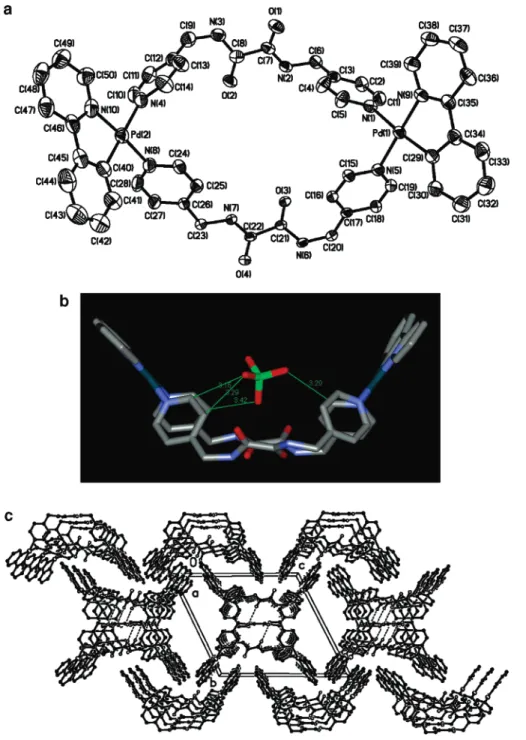
Apart from L1 and L2 as components for the coordination polymers of 1-5, L2 is also successfully used to construct supramolecular entities in this study. To date, only a handful of macrocyclic examples containing pyridyl-amides as bridg-ing ligands have been reported.3h,8,9a,146 crystallizes in the
P1h space group, where the Pd(II) center adopts a square-planar geometry and its molecular structure features an interesting molecular loop, bearing a cyclometallated ligand (PPy) and two L2 ligands as the bridging ligands in Figure
7a. The average Pd-C distance of 2.003(5) Å is longer than that of [Pd(PPy)(OAc)]2 (1.962(4) Å),15 but it is slightly
shorter than the average Pd-N distance of 2.059(5) Å in 6. This may be explained by the steric repulsion between PPy and the pyridyl groups of L2 in the molecular loop. Surprisingly, PPy and Pd2(L2)2are not coplanar, but a boat
form is observed in the solid state, where each side of the boat form of 6 (pseudo-cyclohexane) ranges from 6.12 to 6.39 Å. This intriguing structural motif is possibly ascribed to a syn form of L2 as well as the steric repulsion between PPy and the pyridyl groups of L2 in the structural backbone of Pd2(L2)2, whereas an anti form of L2 exists in the previous
examples of 2, 3, and 5. Actually, the syn form of L2 has been previously observed in the [ZnI2(L2)]2rectangle,9abut
its two L2 ligands are roughly coplanar. In addition, one ClO4
-anion is encapsulated inside the cavity of the molec-ular loop through multiple nonclassical CH‚‚‚O interactions (C5‚‚‚O5, 3.152(9) Å; C24‚‚‚O8, 3.199(8) Å) in Figure 7b, and the other one is only singly hydrogen-bonded to L2 (N3‚
‚‚O6, 2.962(8) Å). Finally, amide-amide hydrogen bonding
(N7‚‚‚O3, 2.766(5) Å; N6‚‚‚O4, 2.871(5) Å; N2‚‚‚O4, 2.992-(6) Å) increases the structural complexity of 6 to a 1-D hydrogen-bonded framework with a ladder pattern in Figure 7c.
Conclusions
In the current study, the different structural flexibility of the urea group (L1), compared with the oxalamide group (L2), may be responsible for the formation of different structural frameworks from a 1-D ladder structure (1) to a 1-D chain structure (2), where theπ···π interaction between the pyridyl rings of each neighboring L1 pair facilitates the axial coordination to the Cd(II) center through one urea’s carbonyl group of the third L1 ligand to give “a dimer of 1-D chains”. With only the difference in the coordinated anions for 2 and 3, the structural framework could change from a 1-D (2) to a 2-D (3) coordination polymer. The delicate change for the seventh coordination from water (2) to L2 (3) seems to play a vital role in this structural difference, but the reason is still unclear. However, as expected, the coordinated anions for 1-3 are all involved in hydrogen bonding with amide groups, where these interactions in 1 and 2 are the only hydrogen-bonding interactions in their hydrogen-bonded frameworks. Contain-ing a tetrahedral Hg(II) center, 4 forms a 1-D chain structure with a typical amide-amide hydrogen bonding of L1 and further a 2-D hydrogen-bonded framework through additional Hg‚‚‚Cl interactions. In 5, the square-planar Cu(II) center coordinates to two L2 ligands in a trans conformation to form a 1-D chain structure, and the Cu(II) center also shows weak interactions with the urea’s carbonyl groups from the neighboring L2 ligands in axial positions (a Jahn-Teller effect). Indeed, weak Cu‚‚‚O interactions, hydrogen-bonding interactions between Cl and amide groups, and nonclassical CH‚‚‚N interactions cooperatively contribute to the formation of this 3-D hydrogen-bonded framework. Moreover, the (14) (a) Baer, A. J.; Koivisto, B. D.; Coˆte´, A. P.; Taylor, N. J.; Hanan, G.
S.; Nierengarten, H.; Dorsselaer, A. V. Inorg. Chem. 2002, 41, 4987. (b) Park, Y. J.; Kim, J.-S.; Youm, K.-T.; Lee, N.-K.; Ko, J.; Park, H.-S.; Jun, M.-J. Angew. Chem., Int. Ed. 2006, 45, 4290. (c) Yue, N. L. S.; Eisler, D. J.; Jennings, M. C.; Puddephatt, R. J. Inorg. Chem.
2004, 43, 7671. (d) Yue, N. L. S.; Qin, Z.; Jennings, M. C.; Eisler, D.
J.; Puddephatt, R. J. Inorg. Chem. Commun. 2003, 6, 1269. (15) Unpublished results. Figure 5. (a) Molecular structure (the ORTEP diagram shows 50%
different structural conformation (i.e., a syn or anti confor-mation) also possibly shows an effect on the formation of different structural motifs (i.e., a syn form in a macrocycle or an anti form in a coordination polymer). The reaction of [Pd(PPy)(OAc)]2 with L2 gives rise to 6, which is an
interesting molecular loop with two square-planar Pd(II) centers, bearing a cyclometalated ligand (PPy) and two L2 ligands as bridging ligands. The formation of the molecular loop (6) can be rationalized by the fact that the Pd(II) center provides two cis coordination sites bonding with two L2 ligands, where the L2 ligands adopt a syn form. Conse-quently, a boat form of 6 is obtained in the solid state to encapsulate one ClO4- anion inside the cavity through
multiple CH‚‚‚O interactions, and further a 1-D hydrogen-bonded framework with a ladder pattern through amide-amide hydrogen bonding.
This work shows that the crystal-engineering study may be carried out by taking advantage of the different structural flexibilities of dipyridyl-amide ligands, metal salts with different anions, metal ions with different coordination geometries, and the geometric isomerism. Actually, the compounds studied here (1-6) have been confirmed to have 1-D, 2-D, and 3-D hydrogen-bonded frameworks, and thus it has been suggested that, by tuning each of the above-mentioned factors, different structural motifs may be ob-tained. Although the assembly process of metal-containing Figure 6. (a) Molecular structure (the ORTEP diagram shows 50% probability ellipsoids) and (b) 2-D and (c) 3-D hydrogen-bonded frameworks of 5.
dipyridyl-amides cannot be totally understood at this moment, useful applications based on the combination of the coor-dinative-bond approach and hydrogen-bonding interactions contributing to crystal-engineering studies in a systematic way have been well demonstrated. In addition, the dipyridyl-amide system with dipyridyl-amides incorporated into spacers as functional units and channels in the solid state could make this interesting family of dipyridyl-amides promising can-didates for crystal-engineering (i.e., construction of porous materials or cages) and molecular-recognition studies (i.e., sensors for anions or volatile organic compounds). In this
context, understanding the basic principle of the assembly process may pave a new way to construct new supramo-lecular functional materials.
Acknowledgment. We thank the National Science Coun-cil and National Chung Cheng University of the Republic of China for financial support.
Supporting Information Available: CIF files for 1-6. This
material is available free of charge via the Internet at http:// pubs.acs.org.
IC061528T
Figure 7. (a) Molecular structure of 6 (the ORTEP diagram shows 50% probability ellipsoids); (b) the boat structure of 6 with an entrapped ClO4-anion inside the cavity through multiple CH‚‚‚O interactions; and (c) the 1-D hydrogen-bonded framework of 6.