Analysis of Grating Detuning on Volume Holographic Data Storage
Shiuan Huei Lin and
Ken
Y. Hsu*
Department of Electro-Physics,
*Jnstitute of Electro-Optical Engineering,
National Chiao Tung University,
Hsin-Chu, 30050, Taiwan
ABSTRACT
Scalar diffraction theory has been utilized to analyze grating detuning effect in a volume holographic data storage system. The general formulas for describing the two-dimensional distribution of the retrieval image under the detuning effect have been derived. Computer simulations show that the smaller writing angle provides better performance for a holographic storage system in terms of the uniformity and the pixel shift of the retrieval image.
Keywords: Holographic data storage, Grating detuning, shrinkage effect, Scalar diffraction theory.
1. INTRODUCTION
Holographic dada storage has been considered as one of the next generation information storage technologies because of its distinct advantages of large storage capacity and fast data access rate [1]. One of unique benefits of the holographic
data storage is the parallel nature of the readout; a given reference beam can retrieve large number of data pixels simultaneously to be imaged onto a 2-D detector array. The optical alignment of such a system for matching the
corresponding pixels between the input SLM and output detector array is therefore very important such that these data can be retrieved correctly [2]. However, the recording materials possess some nature properties of the bulk-index and/or the
dimensional changes (so-called as grating detuning) such that the recorded refractive index grating has different grating spacing from that of the light interference fringes. As a result, the Bragg condition for volume holograms is lost and the recorded information cannot be readout completely. These effects may be induced by either the chemical reactions of the materials during the recording (which is called the shrinkage (or expansion) effect) and/or the environmental changes (such as temperature change).
So far, the most popular materials for volume holographic storage are photorefractive crystals and photopolymers. Photorefractive crystals present good optical properties and large dimensions to store a large number of data pages in a
single volume. However, the larger dimension, the more crucial Bragg condition. The environmental change induces
significantly the grating detuning effect after holographic recording [3]. Photopolymer materials are recently especially
interested because these materials with different compositions are relatively easy to be synthesized. However, these
materials have a disadvantage of the shrinkage (or expansion) effect. These are the dimensional changes induced by the chemical reactions during the holographic recording. The hologram presents a distortion after recording [4]. In this paper,
we present theoretically an analysis of the grating detuning effect induced by the dimensional changes in volume
holographic material. Scalar diffraction theory (also known as "Born approximation") has been utilized to evaluate
two-dimensional distribution on the output plane, which is useful to evaluate pixel mis-registrations and non-uniformity
diffraction efficiency of the retrieval data page. We fmd that the both pixel mis-registrations and non-uniformity of the retrieval data page can be reduced as the recording angle is reduced.
2. TilE PRINCIPLE OF GRATING DETIJNING
Referring to Fig. 1 ,considera holographic data storage system in which the hologram is stored in a thick recording medium centered at the Fourier plane of the object image. During the recording process, a 2-D image is placed at the object plane (xo, yo), illuminated by a plane wave, and Fourier-transferred onto the rear focal plane of lens L1, which is represented Applicationsof Photonic Technology 4, Roger A. Lessard, George A. Lampropoulos,
1286 Editors, Proceedings of SPIE Vol. 4087 2000 SPIE . 0277-786X/OO/$1 5.00
by (x, y). The holographic medium is also placed at the plane (x, y). At the same time, a reference plane wave
R =
exp(—ikR r) illuminates the recording medium at the incident angle of 0. The interference pattern formed by theobj ect beam and the reference beam is recorded in the holographic medium as perturbation of the refractive index. During the readout process, the image is reconstructed by illuminating the medium with the corresponding reference beam and then
inversely Fourier-transferred onto the rear focal plane of lens L2, which is represented by (x1, yi). In an ideal case, the
retrieved image is exactly same as the original image. In reality, a small Bragg-mismatch resulting from grating detuning
leads to a distortion of the retrieved image. This distortion results in mis-registrations and non-uniformity diffraction
efficiency of each pixel on output plane. Because ofthe high-density data page, both effects increase the bit error rate of the memory.
\kR
F
O1 4z\
tT
, f -
f -'>t- f
,.
f
Object plane Volume Output plane Holographic
plane
Figure1 .
A
Fourier holographic memory system where the recording medium is located at common Fouierplane oflenses L1 and L2.
The reconstructed image can be described by scalar diffraction theory (also known as "Born approximation"), which is established by Gu el etc [5] for the case without grating detuning effect. Following the similar procedures, our result for the grating detunung case is given by
g(x1 ,
Yi)
V Joof(xo ,
y)
x sin + x0(l + ax)+
X1 .[
b (
2r Yo(1 + a) + YixsmcI—!ttK
+—
I (1)[2ir
Y ,
j
)
XSinC[±ILKZ +Lfi1x
-(l+a)(x +y)
+a
[2r
)t
j2
where K=kR'-k =
1ki
(1 + a )— k,,
kRY(1 + a) —k,
,k
(1 + a) —k,
j
, isthe difference between the wave vector of the reference beam after detuning kR' and that of the input reading beam k1, the subscripts x, y, z indicate the correspondingcomponents, a, b and t are dimensions of the recording medium in three directions, cci, c and a are the dimensional
shrinkage rate in three directions, Vabt is the volume ofthe recording medium, f(x, y0) is the input object image, g(x1, y1) is the retrieved image, andfis focal length ofthe lens.
Assuming that the transverse dimension of the recording medium is much larger than the spatial bandwidth of the object image, the former two sinc-flinctions in Eq. (1) can be approximated as a 6-function. The distribution of the retrieved image can then be integrated easily as
l( 41
__
g(x1,y1)ocf—
(1+a)
xi÷—A!cl,—
2,r) (1+a)
IYi+—LK
27rxtsin
+y _[1+ (Xi +)2 +
Yi +yJ2]+azf2]]]
(2)
Proc. SPIE Vol. 4087 1287
and the pixeldisplacements in lateral directions on the (x1, Yi) plane can be derived as
x1 =—(1+a)xo—AK,
2ff=—(1
+a)y0
2ff
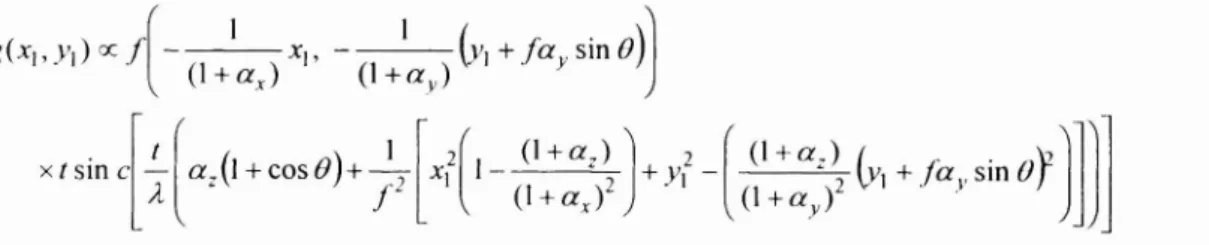
Fora given material parameters and system geometry, the grating detuning effect in the holographic data storage can be analyzed. Typically, we assume that there exists only the dimensional shrinkage in the recording medium and the reading beam is directed same as the original reference beam, which is in the incident plane (y-z plane). Therefore, from Eq. (3) we can obtain that there exists only pure magnification of the image in x1-direction and there are both shift and magnilication of the image in y1-direction. Those magnification and shift effect will result in pixel misregistrations such that the accuracy of the retrieved data degrades. In addition, Eq. (2) can be simplified as
g(x1,v1) [_
(I+a)
x1, — I(1
+fa sin
o)j
(4) 1 1 2(l+a)
2(l+a.)
x tsinc— cr(1+ cos x1 I —________ — 2 + /a1,2
(l+a)2)
(l+a)
It can be seen that the shift and magnification distortion of the retrieved image depends on only the shrinkage
coefficients of the transverse directions. However, the diffraction efficiency of the retrieved image is modulated by a sinc-function profile, which is a sinc-function of the writing angle, shrinkage coefficient, and thickness of the material. '[his provides
us a guideline to analyze properties of the signal-to-noise ratio due to the broadening effect of the signal distribution on
output plane. Here, we should note that the relation (2) and (3) are general formulas for discussing the detuning effect for a volume hologram. The results can be easily extended to the case of any application using volume holograms, such as optical interconnection, holographic filter, display ...andso on.
3. COMPUTER SIMULATiON
As described in section 2. the shift and magnification as well as the non-uniformity diffraction distortion of the
retrieved image are the functions of the material parameters and system geometry. In order to provide better understanding
of the retrieved image under grating detuning, we perform the computer simulation to evaluate the output field by using typical values like the size of the input image=lxlcm2, aaaO.OO5, t=SOFm, f:1ociii pixel size—IOOxlOOttrn, and
X::5 l4nm. For simplification, we assume that the reading beam is directed same as the original reference beam, which lies in the incident plane (y-z plane). For the case of the writing angle 0=150, the retrieved image as illustrated in Figure 2 shifts as well as becomes non-uniform along the both x1 and y1 axes, It is seen that the shill of the retrieval image is not significant
(which is only about two pixels in this case). However, the envelope profile of the retrieval image is modulated by a 2-I)
sine-like function as indicated by the second term in Eq. (4). The distribution of the retrieved image along y, axis is plotted in Figure 3 for various writing angles with 050, 150,30°. It is seen that the distribution is more uniform as the writing angle
is smaller. However, the diffraction efficiency is larger for the case of the larger writing angle.
Figure 2. The 2-D illustration of(a) the original input image; (b) the retrieval image with grating detuning,
1288 Proc. SPIE VoL 4087
Cl)
0
C,) APII
0.8 0.79 0.78 0.77 0.76 0 0.2 0.4 0.6 0.8y (cm)
Fig. 3 The distribution of the retrieved image along y axis for various writing angles.
Cl) C) C)
a-0 -4 -510 20 30 40 50 60
Writing Angle (deg.)
70
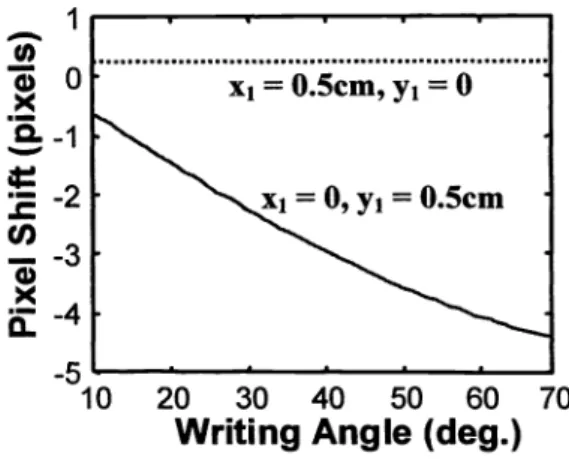
Fig. 4 The pixel shift at two different points of(x1, Yi) (OScm, 0) and (0, 0.5cm) as a function of writing angle.
In addition, the pixel shift at two different points of (x1, y1)(0.5cm, 0) and (0, 0.5cm) is also illustrated as a function of
writing angle, as shown in Figure 4. The shift at (x1, y1)=(0.Scm, 0) is independent with the writing angle, because of only pure magnification occurs along x1-axis. In contract, the pixel shift at (x1, y1)=(0, 0.5cm) contains both magnification and grating shrinkage shift effects. Combining these different distortions on both axes, it is complicated to pre-calculate the distortion for compensating the grating detuning effect. It is also interesting to find out from Figure 4 that the pixel shift resulting from the magnification is in opposite with that from the grating shrinkage shift. Hence, the smaller writing angle provides the smaller pixel shifts. To obtain the better uniformity and smaller pixel shift of the retrieval image, the smaller writing angle is suggested by the above discussions to be utilized in holographic data storage system.
4. CONCLUSION
In summary, by using the Born approximation of the scalar diffraction theory, we have investigated the grating
detuning effect in a volume holographic storage system. The formulas to evaluate the two-dimensional distribution of the retrieval image on the output plane have been derived. They provide us a guideline to characterize the performance of a holographic storage system in terms of the uniformity and the pixel shift of the retrieval image, under the grating distortion induced by the dimensional shrinkage. Computer simulations show that the smaller writing angle provides better uniformity and the smaller pixel shift. However, the diffraction efficiency for the smaller writing angle is smaller than that for the larger writing angle.
5. ACKNOWLEDGEMENT
This research is supported by National Science Council, Taiwan under contract 2112-M-009-040 and
NSC89-22 1 5-E-009-024.
6.REFERENCES
[1]. D. Psaltis and G. W. Burr, "Holographic data storage," IEEE Computer, Vol. 52, pp. 4-12, 1998.
[2]. C. P. Yang, S. H. Lin, M. L. Hsieh, K. Y. Hsu, and T. C. Hsieh,"A holographic memory for digital data storage," Int'l J. ofHigh Speed Electronics & Systems, Vol. 8, No. 4, 749-765, 1997.
[3]. S. Campbell, S. H. Lin, X. Yi, and P. Yeh, "Absorption effects in volume holographic memory systems II: material heating," J. Opt. Soc. Am. B, Vol. 13, No. 10, pp. 2218-2228, 1996.
[4].B.L. Booth, "Photopolymer material for holography", Appi. Opt., Vol. 14, pp.593-601, 1975.
[511.C.Gu, J. Hong, I McMichael, R. Saxena, and F. Mok, J. Opt. Soc. Am. A, 9, 1978 (1992).
Proc.SPIE Vol. 4087 1289