行政院國家科學委員會專題研究計畫 成果報告
Ad hoc 無線網路上具服務品質及排程機制之研究
計畫類別: 個別型計畫 計畫編號: NSC93-2218-E-009-065- 執行期間: 93 年 12 月 01 日至 94 年 07 月 31 日 執行單位: 國立交通大學資訊科學學系(所) 計畫主持人: 趙禧綠 計畫參與人員: 張振龍 詹林峰 宋威德 報告類型: 精簡報告 處理方式: 本計畫可公開查詢中 華 民 國 94 年 10 月 17 日
行政院國家科學委員會補助專題研究計畫成果報告
Ad hoc 無線網路上具服務品質及排程機制之研究
計畫編號:NSC 93-2218-E-009-065-
執行期間:93 年 12 月 1 日至 94 年 7 月 31 日
計畫主持人:趙禧綠
計畫參與人員:張振龍、詹林峰、宋威德
1. 摘要
本年度之計畫主在研究如何在 ad hoc 無線網路上提供多媒體服務,其中我們所課重的議題 是如何讓使用者滿意其所享受到的服務品質。為了讓使用者能滿意其所享受到的服務品質 資源管理(resource management)是一個很重要,同時也是經常被探討的議題。而排程機 制(scheduling mechanism)是實施資源管理最常使用的方法。本計畫針對此議題,考量同 時存在有對服務品質有一定要求之資料流(稱之為 guaranteed flow)和不要求特定服務品 質的資料流(稱之為 best-effort flow)的情形下,提出一公平排程機制(fair schedulingmechanism),稱之為 two-tier slot allocation protocol (2TSAP),讓資源分配的結果能滿足
guaranteed flows 對於頻寬使用之最低需求,並進一步達到 best-effort flows 間使用頻寬的 的公平性。與目前被提出的排程機制不同的是,我們所設計的公平排程機制將考量『多節 點路徑資料流(multihop flow)』以及『節點移動性(node mobility)』等兩個重要議題。藉 由模擬驗證,2TSAP 能保證具服務品質需求的資料流之最少頻寬要求,同時讓所有的資料 流平均分享剩餘可用之頻寬,並具有最佳的網路輸出量 (network throughput)。
2. Abstract
In this project, we studies fair scheduling with Quality of Service (QoS) support in ad hoc networks. The goal is to satisfy the minimum bandwidth requirements of guaranteed flows and to provide fair share of residual bandwidth among all flows. We propose a new cluster-based mechanism called two-tier slot allocation protocol (2TSAP), which improves system throughput and ensures per-cluster fairness while satisfying the requirements of guaranteed flows. With 2TSAP, the network is logically partitioned into clusters, each with a scheduler. The scheduler assigns time slots to mobiles in the affiliated clusters based on the first tier algorithm. The mobiles scheduled to send at the next time slot then in turn assign the time slot to flows determined by the second tier algorithm. We compare the performance of 2TSAP with Q_EMLM-FQ, a virtual-time based fair scheduling mechanism with QoS support. The simulation results show that 2TSAP meets the minimum requirements of guaranteed flows, shares the residual bandwidth fairly among all flows, and improves overall system throughput.
Keywords: multimedia mobile ad hoc networks, fair scheduling, Quality of Service(QoS)
3. Background and Motivation
An ad hoc network is a self-organizing wireless network comprised only of mobile nodes interconnected by a multihop path and without the support of any pre-existing wired infrastructure. To date, research in ad hoc networks has mostly focused on the provision of best-effort service [1,2]. With the increasing popularity of multimedia traffic, one must address how to support QoS in ad hoc networks. Providing QoS in ad hoc networks is challenging, given their peculiar characteristics compared to conventional wired or single hop wireless networks. In wired or cellular networks, only routers or base stations are involved in making scheduling decisions. In ad hoc networks, all nodes may be involved in making decisions. The major problem of a fully distributed scheduling mechanism is that it may cause serious collisions and significantly degrade network throughput. Besides, the spatial channel reuse is another characteristic of wireless ad hoc networks. Due to the broadcast behavior, each node within the sender’s transmission range will receive data packets. That is, simultaneous transmissions of the nodes far enough to be out of the sender’s transmission range are permitted.
According to the decision metrics, scheduling disciplines in wireless ad hoc networks can be classified into two categories: virtual-time based [1,2] and credit based [3]. [1,2] work similarly. Using [2] as an example, each newly arriving packet is locally assigned two timestamps: a start tag and a finish tag [4]. Either timestamp can be chosen as the service tag. [1] and [2] choose the former and the latter to be the service tag, respectively. The packet with the smallest service tag will be sent first. Besides, [2] implement spatial channel reuse by means of the backoff mechanism [5]. Each packet of a flow is associated with a backoff value. This backoff value is equal to the number of flows contending for a channel but with smaller service tags. Once this backoff value reaches zero, the packet is transmitted. These approaches, however, require to sorting all packets in the queue in the increasing order of their service tags, and the virtual clock cannot be reset unless the queue becomes empty [3]. In addition, they tend to distribute resource equally among all flows, which may not support QoS well. In [3], scheduling is based on the credit value, a non-zero positive integer. The unused credit will be cumulated for future use. The one with the highest credit value is allowed to transmit packets first. This approach, however, only consider best effort flows. Directly applying [3] to support QoS for guaranteed flows would starve best-effort flows. In this project, we consider an environment with a mix of guaranteed and best effort flows. Our goal is to guarantee the minimum bandwidth requirements of guaranteed flows, while ensuring fair share of residual bandwidth among all flows (i.e., both best effort and guaranteed)1. We propose a mechanism called Two-Tier Slot Allocation Protocol (2TSAP), which uses the concept of “credit” as in [3], instead of “service tag” in [1,2], to make scheduling decisions.
4. 2TSAP
This section describes the proposed Two-Tier Slot Allocation Protocol (2TSAP), which provides QoS support for guaranteed flows and ensures fairness in resource sharing among all
1
Note that our mechanism can work with different scenarios of residual bandwidth allocation, including fair scheduling for best effort flows only, for a mix of best effort and guaranteed flows, or for a mix of flows but with an upper limit on the resource share for guaranteed flows. In this paper, we just demonstrate the second case, i.e., for a mix of flows without an upper bound on each flow.
flows. The detailed mechanism is described as follows.
4.1 Assumptions
1. Wireless media may exhibit time-varying errors due to co-channel interference, fading, link errors, and collisions. In this paper, we only consider the errors caused by collisions when the two mechanisms are compared.
2. We assume a TDMA-based system on a single channel shared by all hosts. To avoid collisions, CDMA can be overlaid on the top of the TDMA system. We assume a code assignment algorithm is running in the lower layer of our system. Each TDMA frame contains a fixed number of time slots. The network is synchronized on a frame and slot basis. A frame is comprised of a control phase and a data phase. The control phase is used for mobile nodes and schedulers to send time-slot requests and replies. The data phase is used for designated nodes to transmit packets [6].
3. We consider packet-switched multihop wireless networks, but do not consider host mobility as in existing work [1,2].
4.2 Data Structure
(1) Node Allocation Table (NAT): maintained by the schedule; each entry of the NAT is for a (node, service type) pair and has six fields: a node ID, a service type, a Resv, a Credit, a Usage, and an Excess.
(2) Flow Allocation Table (FAT): maintained by the node; each entry of the FAT is for a flow and has seven fields: a flow ID, a scheduler ID, a service type, a Resv, a Credit, a Usage, and an Excess.
4.3 Scheduling Parameters
There are four parameters defined in the two-tier scheduling mechanism: Resv, Credit, Usage, and Excess.
(1) Resv: for the guarantee service, Resv represents the minimum time slot requirement to meet the desired QoS level, with a value between 0 and 1; for the best effort service, the value is always zero.
(2) Credit: the cumulative time slots reserved for a guaranteed flow, or the remaining slot quota for a best effort flow per iteration2. For guaranteed service type, the value of an increase at each time slot is equal to a Resv value. For the best effort service type, the initial Credit value is equal to the total number of best effort flows currently scheduled by the node, and is decreased by one after a slot is assigned. Note that for a best effort flow, the Credit field is only valid in the NAT and is always set to zero in the FAT.
(3) Usage: cumulative time slots assigned to a request. The Usage value could be a zero or any positive integer.
(4) Excess: this value is used to determine to whom the next time slot is assigned. The next slot is assigned to the request with the smallest Excess value. For guaranteed-service entries, the
Excess values are equal to “Usage minus Credit,” and are updated at each time slot. For best
effort-service entries, the initial Excess values are set to zero, and are increment at each
2
“update.” The Excess value only is updated when the corresponding Credit value is count down to zero. Once the Excess value has been updated, the Credit value is reset to a Resv value, and a new iteration starts.
4.4 Cluster-based Mechanism
2TSAP is a cluster-based mechanism. Each cluster has a scheduler (or master). Clusters may be overlapped, each with a designated code. The cluster can be formed as follows. Each mobile node periodically broadcasts beacons. Based on the received beacons, mobile nodes learn their neighbors, and related information, such as node ID, node stability. According to the selected criterion [7,8], each cluster can determine its scheduler. To receive the service, each node must join a cluster and register with the scheduler. Each scheduler periodically advertises itself as the scheduler to its cluster, from which newly arriving mobile nodes learn where to register.
4.5 Path Selection
A flow sender must first determine a flow path before a transmission, using an ad hoc routing mechanism such as [9,10,11]. If the flow needs guaranteed service, the determined path must meet the desired QoS level of the flow. The sender first broadcasts a Route REQuest (RREQ) message with a flow ID, a destination ID, a Resv, and a service type to its neighbors. The value of the Resv depends on the service type of the RREQ, i.e., for guaranteed flow, the Resv value is set between 0 and 1, and for best effort, it is always zero.
On receiving a new request, say request i, to relay the flow’s packets, the node will verify if the summation of the reservation levels (i.e., Resvs) of all flows scheduled by the node, including the newly arriving one, is less than or equal to the target link utilization. If it is the case, the node further sends a resource Allocation ReQuest (ARQ) to its scheduler to ensure that the verification holds at the scheduler as well (i.e., the summation of Resvs of all flows scheduled by the scheduler including the new ARQ is less than or equal to the target link utilization level.) If either verification fails, the request is denied; otherwise, the request is tentatively accepted. The scheduler creates a temporary entry for the node in the NAT, and responds to the node with an acceptance. The node then creates a temporary entry for the flow in the FAT. Once the request is accepted, the node rebroadcasts the RREQ to its neighbors. Duplicated RREQs are dropped. When the destination receives this RREQ, it sends back a Route REPly (RREP) message along the reverse path. The node changes the respective entry from temporary to regular upon receipt of the RREP, and informs its scheduler to do likewise. Those who do not receive the corresponding RREP after a period of time will clear the temporary entries in NAT and FAT, respectively.
4.6 Two-Tier Slot Allocation Algorithm
The slot allocation is based on a two-tier mechanism. The scheduler assigns time slots based on the first tier slot allocation mechanism. The node to whom the time slot is assigned then in turn assigns the time slot to a flow based on the second tier slot allocation mechanism. Both the scheduler and the node allocate slots only to regular entries of their respective tables. The two tier slot allocation mechanisms are repeated as long as there is a flow relayed through any node.
NAT can be divided into two sets: Sg and Sb. Sg and Sb indicate guaranteed and best effort service type, respectively. The first tier slot allocation mechanism works as follows.
(1) The scheduler assigns the next time slot to the node with the smallest Excess value in the NAT at decision time.
The scheduler then updates the values of Credit, Usage, and Excess in all entries of the NAT, as follows.
(2) Increment the Usage value of the entry of the node scheduled to send at the next time slot, say node A, and leave all the others intact, i.e., Usage (A) Å Usage (A) +1, where Excess (A) = min {Excess (x)| x=1,2,…m}.
(3) Increase an amount of Resv to Credit for each guaranteed-service entries in the NAT, i.e., Credit (x) Å Credit (x) + Resv (x), x∈Sg. Besides, if next time slot is assigned to node A with best effort service type, decrement the Credit value of node A, i.e., Credit (A) Å Credit (A) − 1.
(4) Update the Excess values of all guaranteed-service entries in the NAT, i.e., Excess (x) Å Usage (x) – Credit (x), x∈Sg; in addition, if the next time slot is assigned to the best effort service type of node A, and the Credit value equals to zero, the Excess value is increased by one and the Credit value is reset to the Num value, i.e., if Credit (x) = 0, Excess (x) Å Excess (x) + 1, and Credit (x) Å Num (x). Otherwise, the Excess value stays unchanged.
The second tier slot allocation algorithm works as follows.
(1) The node cannot schedule any flow packet unless a time slot is assigned to it. Once a time slot is assigned, the node assigns the time slot to the flow which satisfies the following two conditions: (a) the flow has the smallest Excess value, and (b) the flow’s service type matches the service type of the node granted by the scheduler.
The node then updates the values of Credit, Usage, and Excess in all entries of the FAT, as follows.
(2) Increment the Usage value of the entry of the flow scheduled to send at the next time slot, say flow F, and leave the others intact. Usage (F) = Usage (F) + 1, where Excess (F) = min {Excess (y)| y=1,2,…n}.
(3) Credit (y) = Credit (y) + Resv (y), y=1,2,…n.
(4) Update the Excess values of all entries in the FAT, i.e., Excess (y) = Usage (y) – Credit (y),
y=1,2,…n.
5. Simulation Results
This section evaluates the performance of 2TSAP by simulation. There are 20 mobile nodes randomly distributed in a 670-by-670 area. We randomly selected nodes, some as flow senders and some as flow receivers. Each flow may be best effort or guaranteed. For best effort flows, their Resv values are zeros, and for guaranteed flows, their values are randomly generated between zero and one. Each packet is assumed to occupy one time slot, and has fixed packet length.
We compare the result with [2], a virtual-time based fair scheduling protocol. [2], however, does not consider the QoS aspect while ensuring fairness. Thus we modify the definition of
weight in [2] as follows to enable minimum bandwidth guarantee. We call the modified version as Q_EMLM-FQ in the rest of the paper. For each flow f passing through node N, the flow weight
wf is defined as f } bgflows { i f f N Ri 1 R
w = + −∑∈ , where Rf and Nf are the Resv value of flow f and the total number of flows passing through node N., respectively; bgflows indicates the set of backlogged flows with guaranteed service type. For a best effort flow, its Rf value is zero.
We first randomly generated five flows in a single cluster network. Flows 0 and 1 were guaranteed flows with Resv values of 0.58 and 0.02, respectively. Flows 2, 3, and 4 were best effort flows. Fig. 1(a) shows the slot allocation to all flows for both approaches. The white bars are for 2TSAP, the black bars are for Q_EMLM-FQ, and the gray bars indicate the initial reservation level of each flow. Fig. 3(a) shows that 2TSAP meets the minimum requirement of all flows, and Q_EMLM-FQ fails to satisfy the requirement of flow 1. In fact, Q_EMLM-FQ tends to distribute bandwidth equally among all flows, thus failing to meet the requirements of some guaranteed flows.
We now turn to the residual bandwidth. We define a share degree to better observe the fairness among all flows, as follows. The share degree is the percentage of residual bandwidth shared by each flow, with a value between zero and one. The larger the value, the more bandwidth the flow uses.
Ideally, the share of the residual bandwidth for each flow should be (1-0.58-0.02)/5=0.08, which is indicated as gray bars in Fig. 1(b). Again, 2TSAP allows flows to share the residual bandwidth fairly, as shown in Fig. 1(b), while Q_EMLM-FQ fails to do so.
Next, we generated five flows again, with three guaranteed flows (i.e., flows 0, 1, 2) and two best effort flows (i.e., flows 3 and 4) in the network logically partitioned into three clusters. Flows 1 and 3 are each located in a separate cluster; flows 0, 2, and 4 are located in another cluster. Ideally, flows 0, 2 and 4 share the residual bandwidth in one cluster with each getting a fraction (1-0.54-0.01)/3=0.15. Flows 1 and 3 use all the residual bandwidths of 0.62 and 1 in their respective clusters. Again, from Figs. 2(a) and (b), 2TSAP meets the flows’ minimum requirements, and provides per-cluster based, fairly sharing the residual bandwidth for each flow. Q_EMLM-FQ, however, cannot always meet the requirements.
(a) Slot allocation (b) Share degree of each flow
Figure 1. Single cluster
0 0.1 0.2 0.3 0.4 0.5 0.6 0.7 0 1 2 3 4 Flow ID Slot a lloc ation 2TSAP Q-EMLM-FQ Resv -0.5 -0.4 -0.3 -0.2 -0.1 0 0.1 0.2 0.3 0.4 0 1 2 3 4 Flow ID Share degree 2TSAP Q-EMLM-FQ Ideal
(a) Slot allocation (b) Share degree of each flow
Figure 2. Multiple clusters
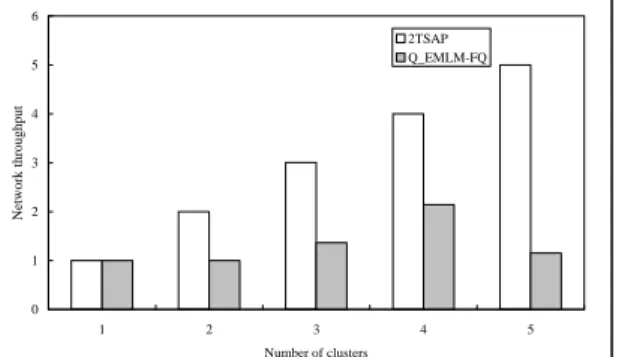
Fig. 3 shows the overall system throughput for both approaches. The white bars are for 2TSAP and the gray bars are for Q_EMLM-FQ. 2TSAP has better overall network throughput as the number of clusters increases, thanks to the cluster-based structure (similar to the channel reuse concept in cellular systems). In addition, nodes in the same cluster are coordinated with the same scheduler, and only one node can transmit a packet in one slot. Thus 2TSAP can further reduce collisions and increase the throughput.
Figure 3. Overall network throughput
6. Conclusion
In this paper, we have proposed a two-tier slot allocation protocol (2TSAP), which provides fair scheduling with QoS support for multihop, multimedia wireless networks. 2TSAP uses the concept of “time-slot usage,” instead of “service tag”, to make scheduling decisions. It is a two-tier scheduling algorithm. The first tier is for schedulers to assign time slots to mobile nodes in their respective clusters. The second tier is for mobile nodes to assign such time slots to the flows passing through. The simulation result shows 2TSAP improves system throughput and ensures per-cluster fairness while satisfying the requirements of guaranteed flows. In the future, we will extend 2TSAP to handle host mobility in ad hoc wireless networks.
7. Reference
[1] Haiyun Luo and Songwu Lu, “A topology-independent fair queueing model in ad hoc wireless networks,” Proc. IEEE ICNP’00, pp. 325-335.
[2] Haiyun Luo and Songwu Lu, “A self-coordinating approach to distributed fair queueing in ad hoc wireless networks,” Proc. IEEE INFOCOM’01, pp. 1370-1379.
[3] E. Hossain and V. K. Bhargava, “A centralized TDMA-based scheme for fair bandwidth allocation in wireless IP networks,” IEEE J. Select. Areas Commun., Vol. 19, No.11, Nov. 0 0.2 0.4 0.6 0.8 1 1.2 0 1 2 3 4 Flow ID Slot a lloc a tion 2TSAP Q_EMLM-FQ Resv -0.2 0 0.2 0.4 0.6 0.8 1 1.2 0 1 2 3 4 Flow ID S h ar e degr ee 2TSAP Q_EMLM-FQ Ideal 0 1 2 3 4 5 6 1 2 3 4 5 Number of clusters Network throughput 2TSAP Q_EMLM-FQ
2001, pp.2201-2214.
[4] P. Goyal, H. M. Vin, and H. Cheng, “Start-time fair queueing: a scheduleing algorithm for integrated services packet switching networks,” IEEE/ACM Trans. Networking, vol. 5, Oct. 1997, pp. 690-704.
[5] N. H. Vaidya and P. Bahl, “Fair scheduling in broadcast environments,” Microsoft Research
Tech. Rep. MSR-TR-99-61.
[6] C. R. Lin and J.-S. Liu, “QoS routing in ad hoc wireless networks,” IEEE J. Select. Areas
Commun., Vol. 17, No. 8, Aug. 1999, pp.1426-1438.
[7] M. Gerla and J. T-C. Tsai, “Multicluster, mobile, multimedia radio network,” ACM J.
Wireless Networks, Vol. 1, No. 3, 1995, pp. 23-29.
[8] H.-C. Lin and Y.-H. Chu, “A clustering technique for large multihop mobile wireless networks,” IEEE VTC 2000, pp. 1545-1549.
[9] C. E. Perkins and E. M. Royer, “Ad-hoc on demand distance vector routing,” Proceedings of
the 2nd IEEE Workshop on Mobile Computing Systems and Applications, Frbruary 1999, pp.
90-100.
[10] C. E. Perkins and P. Bhagwat, “Highly dynamic destination-sequenced distance-vector routing (DSDV) for mobile computers,” ACM SIGCOMM ’94, pp. 234-244.
[11] S. Chen and K. Nahrstedt, “Distributed quality-of-service routing in de hoc networks,” IEEE