One Patient with Klippel-Trenaunay Syndrome:
Treatment with Charles’ Procedure,
──
One Case Report and Literature Review
Pin-Keng Shih, Hsin-Han Chen, Yung-Chang Hsu, Chao-I Wu,
Sophia Chia-Ning Chang, Hung-Chi Chen
Department of Plastic and Reconstructive Surgery, China Medical University Hospital
Background:
Klippel-Trenaunay syndrome (KTS) is a rare congenital disorder of unknown
etiology characterized by venous malformations or varicose veins, cutaneous capillary
malformation and hypertrophy of soft tissues of the limb. Charles’ procedure has been
used for patients with lower limb advanced lymphoedema in selected cases. There are
no literatures talking about Charles’ procedure in KTS patients.
Aim and objectives:
In this report, we present a case of KTS undergoing Charles’ procedure. The
clinical history, surgical procedure and post-operative follow-up are illustrated in this
article.
Materials and Methods:
A 30-year-old male presented to our hospital with chronic infection of right web
and toes, lower limb swelling and pain, and skin atrophy with impending bleeding.
The patient underwent Charles’ procedure with toes amputation due to chronic
infection. Since then, the patient was followed up for 3 years.
Results:
Functional outcomes in the 3-year follow-up period were satisfactory in spite of
two episodes of skin ulceration induced by skin abrasion without any right lower limb
cellulitis.
Conclusion:
This case suggested the Charles’ procedure provided KTS patients with immediate
volume and circumference reduction and reduced opportunity of skin infection. Toes
amputation was necessary if chronic infection over toes were noted. Ambulatory
function was acceptable in 3-year follow-up. (J Taiwan Soc of Plast Surg 2012;21:164
∼168)
Introduction
Klippel-Trenaunay syndrome (KTS) is a rare disease with manifestation of capillary malformation, venous varicosities, and hypertrophy of bone and soft tissues (KTS triad). The vascular malformation leads to venous hypertension impairing venous wall, venous valves, and skin that can eventually result in varicose veins and venous ulcers. How to manage chronic ulcers in KTS patients was a challenge. Sclerotherapy was reported as an effective minimally invasive ambulatory technique, essentially pain-free with excellent short- term results in patients with KTS.1 In addition, an
antiangiogenic strategy, sunitinib, was considered a targeted therapeutic drug for the treatment of symptoms related to KTS.2
Charles’ procedure (subcutaneous and deep fascial excision followed by full-thickness skin grafts) was widely used in patients with lower limb advanced lymphoedema. To completely remove involved vessel seemed to be an acceptable method to prevent recurrent stasis ulcer for KTS patients. So far there is no report of using Charles’ procedure for KTS patients. Here, we present a case of KTS treated with Charles’ procedure.
Case Presentation
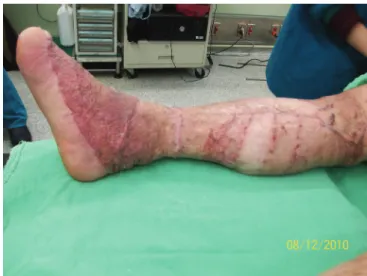
A 30-year-old male was diagnosed as KTS due to arteriovenous malformation, varicose vein and hypertrophy of bilateral lower limbs (Fig. 1). The patient turned to our assistances due to intolerable smell (chronic infections of fungus and bacteria on nail and web, the family usually complained that the patient didn’t wash foot clearly), chronic use of antibiotics (high frequency of nail and web infection (once/month) lead to chronic use of antibiotics), abnormal growth of bone, swelling and pain, and skin atrophy with impending bleeding. Charles’ procedure (the subcutaneous and deep fascia over right lower limb was excised and covered by full-thickness skin grafts) with toes amputation was proceeded due to chronic infection. The post-operative course was uneventful. Three years after surgical treatment, the patient maintain satisfactory functional outcome in spite of 2 episode of skin infection due to skin abrasion (Fig. 2).
Fig. 1. Skin discoloration and venous varicose were noted over bilateral lower limbs. There were apparently enlargement of right toes and engorgement of varicose veins in the right lower limb compared to left lower limb.
Fig. 2. There was no recurrence of infection and functional outcome of right lower limb was acceptable after 3 years follow-up.
Discussion
Klippel-Trenaunay syndrome (KTS) is composed of capillary malformation, venous varicosities, and hypertrophy of bone and soft tissues. The presence of two of the three features is sufficient to make a KTS diagnosis. Capillary malformation is the most common manifestation of KTS, followed by varicosities.3
The detailed angiogenic mechanism was not well demonstrated but the dysregulation of angiogenic factor, VG5Q (formally named AGGF1), is associated with a vascular malformation consistent with KTS. Other genes including TIE2, VEGFR-3, RASA1, KRIT1, MGC4607, PDCD10, glomulin, FOXC2, NEMO, SOX18, ENG, ACVRLK1, MADH4, NDP, TIMP3, Notch3, COL3A1 and PTEN C played different roles in vascular morphogenesis.4 The
hemodynamics in limbs with KTS suggested complex reflux patterns, severe valvular incompetence, calf muscle pump impairment, and venous hypertension.5
In addition, other study reported lymphatic malformation (hyperplasia, hypoplasia, aplasia of lymphatic vessels or lymphedema) is a common component of KTS.6
Stasis ulcer or venous ulcer is a common manifestation of patients with venous hypertension. New types of wound dressings7, topical and systemic
therapeutic agents1 8, surgical modalities9, bioengineered
tissue10, matrix materials, and growth factors11 are all
novel therapeutic options that may be used for venous ulcers. Although different degrees of benefits were reported, the methods mentioned above seemed to show limited values for KTS patients with chronic venous ulcers. In order to resolve chronic ulcers and further infections, we used Charles’ procedure as a solution for KTS induced chronic ulcers.
Charles’ procedure (subcutaneous and deep fascial excision followed by full-thickness grafts) was widely used in patients with lower limb lymphoedema. The study presented by Dandapat et al.12 suggested
patients subjected to Charles' operation had immediate volume and circumference reduction but the cases subjected to Thompson's operation did not have satisfactory reduction in volume and circumference postoperatively. Karri et al.13 suggested Charles’
procedure is an effective method for late-stage lower limb lymphoedema although there were some drawbacks like scared, verrucous, hyperkeratotic lower extremity, poor cosmetic appearance, unstable skin grafts and scar contractures. According to the literature review, few studies reported patient with KTS benefit from Charles’ procedure. In our case of severe lymphoedema with recurrent cellulitis, the patient underwent Charles’ procedure with toes amputation resulted in satisfactory reduction in volume and circumference. There was no more off and on cellulitis over right lower limb. However, few toe infections due to skin breakdown were noted postoperatively and therefore the patient underwent skin grafts. Whether the patients with Charles’ procedure need toes amputation is still controversial. The study presented by Karonidis et al.14
suggested that the toes are the major determinant of future infection after surgery in the treatment of advanced lymphoedema of the lower extremity. When there are already repeated episodes of infection, osteomyelitis of phalanges or verrucous hyperkeratosis, toe amputation should be carried out to get rid of future infection. In our case, the patient suffered from high frequency of toe and web infection (once/month) before operation, that’s why the patient received Charles’ procedure with toes amputation. In the 3-year follow-up period, there were only two episodes of local skin ulceration induced by skin abrasion without any right lower limb cellulitis. The functional outcome was also acceptable.
Conclusion
No effective treatments exist for this KTS disease. Current treatments are directed toward secondary prevention of venous hypertension and preservation of functional integrity of the limbs. Our results suggested that Charles’ procedure provided immediate volume and circumference reduction of the limb and prevented further right lower limb infection for a KTS patient. Amputation of toes may be necessary if the patient still had repeated cellulitis of toes. Post-operative functional outcome was acceptable.
Reference
1. Nitecki S, Bass A. Ultrasound-guided foam sclerotherapy in patients with Klippel-Trenaunay syndrome. Isr Med Assoc J 2007;9:72-5.
2. Nguyen S, Franklin M, Dudek AZ. Skin ulcers in Klippel-Trenaunay syndrome respond to sunitinib. Transl Res 2008;151:194-6.
3. Oduber CE, van der Horst CM, Hennekam RC. Klippel- Trenaunay syndrome: diagnostic criteria and hypothesis on etiology. Ann Plast Surg 2008;60:217-23.
4. Timur AA, Driscoll DJ, Wang Q. Biomedicine and diseases: the Klippel-Trenaunay syndrome, vascular anomalies and vascular morphogenesis. Cell Mol Life Sci 2005;62: 1434-47. 5. Delis KT, Gloviczki P, Wennberg PW et al. Hemodynamic
impairment, venous segmental disease, and clinical severity scoring in limbs with Klippel-Trenaunay syndrome. J Vasc Surg 2007;45:561-7.
6. Liu NF, Lu Q, Yan ZX. Lymphatic malformation is a common component of Klippel-Trenaunay syndrome. J Vasc Surg 2010;52:1557-63.
7. Miller AC, Rashid RM, Falzon L et al. Silver sulfadiazine for the treatment of partial-thickness burns and venous stasis ulcers. J Am Acad Dermatol 2010.
8. Bergan J, Pascarella L, Mekenas L. Venous disorders: treatment with sclerosant foam. J Cardiovasc Surg (Torino) 2006;47:9-18.
9. Cardinal M, Eisenbud DE, Armstrong DG et al. Serial surgical debridement: a retrospective study on clinical outcomes in chronic lower extremity wounds. Wound Repair Regen 2009;17:306-11.
10. Ficarelli E, Bernuzzi G, Tognetti E et al. Treatment of chronic venous leg ulcers by platelet gel. Dermatol Ther 2008;21:S13-7.
11. Danikas D, Theodorou SJ, Wurmser E. Successful treatment of chronic wound in Klippel-Trenaunay syndrome with recombinant human platelet-derived growth factor-BB. Plast Reconstr Surg 2002;109:2608-9.
12. Dandapat MC, Mukherjee LM, Patra SK. Evaluation of different surgical procedures in filarial lymphoedema of lower extremity. J Indian Med Assoc 1991;89:127-9.
13. Karri V, Yang MC, Lee IJ et al. Optimizing Outcome of Charles Procedure for Chronic Lower Extremity Lymphoedema. Ann Plast Surg 2010.
14. Karonidis A, Chen HC. Preservation of toes in advanced lymphedema: an important step in the control of infection. Ann Plast Surg 2010;64:446-50.
Reprints request from: Hung-Chi Chen, M.D.
Division of Plastic Surgery, China Medical University Hospital Address: 2 Yuh Der Road, Taichung City, 404, Taiwan Tel: (886)-4-22052121 ext. 1638
Fax: (886)-4-22029083
以
Charles’ procedure 治療 Klippel-Trenaunay 症候羣病人
──
病 歷 報 告 及 文 獻 回 顧
施秉庚 陳信翰 許永昌 吳肇毅 張家寧 陳宏基
背 景: Klippel-Trenaunay 症候羣是一種罕見病因不明的先天疾病,主要以靜脈畸形或靜脈曲張,皮膚毛 細血管畸形,肢體軟組織肥大為特徵。Charles’ procedure 已被廣泛的使用於特定下肢嚴重水腫的病患。把Charles’ procedure 應用在治療 Klippel-Trenaunay 症候羣病人肥大的軟組織上文獻上從未被提及。
目的和目標:
在這份報告中,我們提出一個 Klippel-Trenaunay 症候羣的病人接受 Charles’ procedure 的過程。
臨床病史,手術方法和術後追蹤都在本文中敘述。 材料和方法: 一位 30 歲 Klippel-Trenaunay 症候羣的男性因為右腳趾及趾缝慢性感染、下肢腫脹和疼痛、皮膚 萎縮併反覆流血來院求診。由於慢性感染,病人接受Charles’ procedure 併腳趾截肢,術後病人追蹤長 達3 年。 結 果: 功能性結果在 3 年的追蹤期間均令人滿意,儘管有兩次皮膚擦傷引發的皮膚潰瘍但是右下肢的感 染沒有再發生過。 結 論:
我們的結果建議 Charles’ procedure 對於 Klippel-Trenaunay 症候羣的病人可以立即減緩下肢腫大
及 不 對 稱 且 避 免 反 覆 的 感 染 , 如 果 後 續 趾 頭 反 覆 的 發 炎 感 染 則 趾 頭 的 截 肢 有 時 候 還 是 需 要 的 , 病 患 行 走的功能在三年的追蹤是可以接受的。