Effects of Sodium Hydroxide Treatment Duration on the Physical
Properties of IRM®/Polylactic Acid Composite Filling Materials
Ching-Wen Lou
1, a, Tzu Hsuan Chao
1, Chao-Tsang Lu
2, b, Po-Ching Lu
3and
Jia-Horng Lin
3, 4, 5, a1Institute of Biomedical Engineering and Material Science, Central Taiwan University of Science
and Technology, Taichung 406, Taiwan, R.O.C.
2Graduate Institue of Biotechnology, Central Taiwan University of Science and Technology,
Taichung 406, Taiwan, R.O.C.
3Laboratory of Fiber Application and Manufacturing, Department of Fiber and Composite Materials,
Feng Chia University, Taichung City 407, Taiwan, R.O.C.
4School of Chinese Medicine, China Medical University, Taichung 40402, Taiwan, R.O.C. 5Department of Biotechnology, Asia University, Taichung 41354, Taiwan, R.O.C.
Corresponding email: a[email protected], b[email protected]
Keywords: sodium hydroxide, Intermediate Restorative Material, polylactic acid fiber Abstract The purpose of this study is to explore the influence of the sodium hydroxide (NaOH)
treatment duration on the physical properties of the composite filling material. This study uses Intermediate Restorative Material (IRM®) as matrix and 2 % of polylactic acid (PLA) fiber as reinforcing material to make the IRM/PLA composite filling material. Before being infused into the IRM matrix, the 2-mm long PLA fiber is treated by NaOH solution for 5, 10, 15, 20, 30, 60, or 90 minutes. The setting time and compressive strength of resulting composite filling materials are evaluated, determining the optimum treatment duration is 60 minutes. The compressive strength is increased by 41 %.
Introduction
Sixty to ninety per cent of children and most adults are reported to have dental caries by World Health Organization (WHO). Root-end treatment, a common treatment for dental caries, treats the tooth pulp and tooth root-end diseases and follows a rule not to damage the tooth type and functions [1]. Filling materials used in root-end treatment seal cavities of the teeth, and prevent the teeth from bacterial and saliva leakage. They should be easy to work, non-absorbent, and non-toxic, in addition to structure stability and good sealing. The filling materials include amalgam, gutta percha, IRM®, mineral trioxide aggregate, and composite resin. Being composed of monomers of lactic acid, PLA is a biomaterial approved by U.S. Food and Drug Administration (FDA) and is nontoxic, biocompatible, thermal plastic and biodegradable [4, 5], due to which PLA is widely used in biotechnology and medicine field [4]. This study aims to reinforce and increase the compressive of IRM matrix by using PLA fiber. In addition, the NaOH treatment duration for the PLA fiber are evaluated for its influence on the setting time and compressive strength of the IRM/PLA composite
filling material.
Experimental Material
IRM® is provided by Dentsply International, U.S. The low melting point PLA fiber is provided by Far Eastern New Century Corporation, Taiwan, R.O.C.
Preparation of Composite Filling Material
PLA fibers are treated by 1 M NaOH solution for 5, 10, 15, 20, 30, 60, or 90 minutes, immersed in deionized water for 30 minutes, rinsed by phosphate buffering solution to remove residual NaOH, and dried in an oven at 50 ℃ for 24 hours. The surface morphology of PLA fibers is then observed by a scanning electron microscope (SEM, HITACHI S3000N, Japan).According to a previous study of this laboratory [21], the zinc-oxide powder and eugenol solvent are mixed with a ratio of 3:1, and then added with 2 % PLA fiber. The mixture is then poured in a stainless steel mold with a height of 6 mm and a diameter of 4 mm. After the mixture finishing curing, it is removed and then forms IRM/PLA composite filling material.
Test
Setting time test
After the IRM® is added with PLA fiber that is treated with NaOH solution for different lengths of time and then poured in the mold. A needle punctures the subject material for 5 seconds in 30-second intervals until it fails to penetrate the subject material. The number of samples is five.
Compressive test
Before this test, the specimen of a 4-mm diameter and 6-mm height is placed in 37 °C±1 °C distilled water for 1 day, and then in 23 °C±1 °C distilled water for another 15 minutes. This test follows the American Dental Association (ADA) #30 with an Instron 5566 (Instron, USA) at a compressive speed of 1 mm/min.
Results and Discussion Setting Time
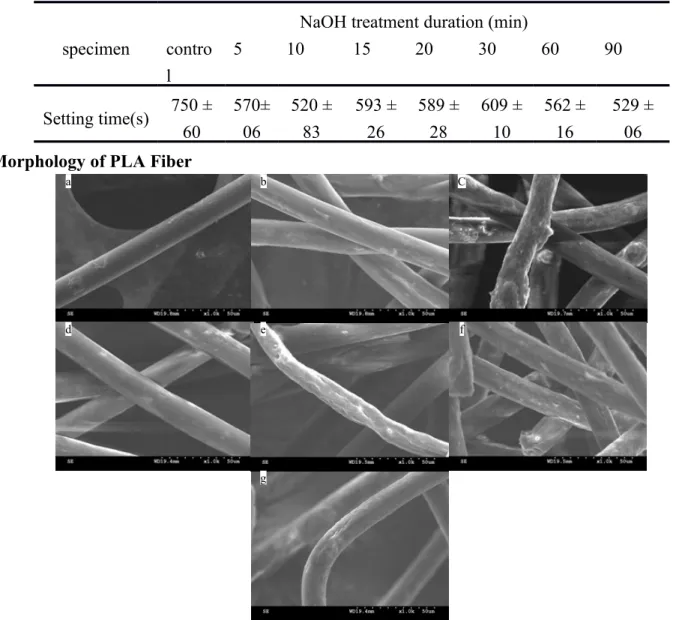
Table 1 shows that the addition of PLA fiber that is treated by NaOH treatment for different lengths of time does not influence the setting time of the IRM/PLA composite filling material. However, compared to pure IRM mixture, the IRM/PLA composite filling material has a shorter setting time. This is due to the PLA fiber, which will absorb a few amount of eugenol solvent while the solvent reacts with zinc-oxide powder, thus decreasing the amount of the solvent and thus the setting time. In addition, the NaOH treatment duration results in etching on the PLA fiber’s surface; however, the etching does not change PLA fiber’s property, and thus does not have an influence on the amount of solvent absorbed to the fiber. As a result, NaOH treatment duration does not influence the PLA fiber.
a e d C b f g
Table 1. The setting time of IRM®/PLA composite filling material as related to NaOH treatment durations.
NaOH treatment duration (min)
specimen contro l 5 10 15 20 30 60 90 Setting time(s) 750 ± 60 570± 06 520 ± 83 593 ± 26 589 ± 28 609 ± 10 562 ± 16 529 ± 06
Morphology of PLA Fiber
Figure 1. SEM images (x1.0 K) of PLA fiber that is treated by 1M NaOH solution for a) 5, b) 10, c) 15, d) 20, e) 30, f) 60, and g) 90 minutes.
When treated by a 1 M NaOH solution for less than 15 minutes, the PLA fiber has a smooth surface, similar to that of untreated PLA fiber. If treated for 15 minutes, PLA fiber starts has etching on its surface, and the longer the duration, the greater the etching. The etching is a result that the molecular chains of PLA fiber are damaged.
Compressive test
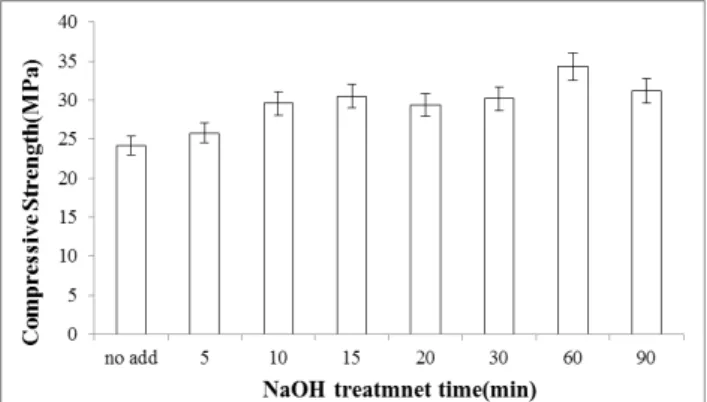
Figure 2 shows that addition of PLA contributes to the compressive strength of the IRM/PLA composite filling material, which is greater than that of the control group. The longer the NaOH treatment duration, the greater the compressive strength of the composite filling material. With a duration of 60 minutes, the compressive strength of the composite filling material reaches its maximum (34 N). However, the compressive strength decreases when the composite filling material is treated for 90 minutes. With an increase in the duration to 60 minutes, the etching becomes more apparent, which helps the interfacial bonding between IRM and PLA fiber. An excessive duration,
however, damages the PLA fiber and decreases its strength. As a result, the compressive strength of the composite filling material decreases.
Figure 2. The compressive strength of the IRM®/PLA composite filling material as related to various NaOH treatment durations.
Conclusion
This study successfully explores the influence of the NaOH treatment duration on the properties of the IRM/PLA composite filling material. The SEM observation shows that the etching on the PLA fiber’s surface becomes apparent with an increase in the NaOH treatment duration. The IRM/PLA composite filling material has the optimum compressive strength of 34 N when it is composed of PLA fiber that is NaOH treated for 60 minutes. Regardless of the NaOH treatment durations, the IRM/PLA composite filling material has a similar setting time, which is in fact shorter than that of pure IRM filling material.
Acknowledgements
This work would especially like to thank National Science Council of the Republic of China, Taiwan, for financially supporting this research under Contract NSC 101-2622-E-039-001-cc3.
References
[1] A.C. Faria, R.C. Rodrigues, R.P. de Almeida Antunes, G.de Mattos Mda, R.F. Ribeiro, Endodontically treated teeth: Characteristics and considerations to restore them. J. Prosthodont Res. 55 (2011) 69-74.
[2] J.A. Lindeboom, J.W. Frenken, F.H. Kroon, van den Akker HP. A comparative prospective randomized clinical study of MTA and IRM as root-end filling materials in single-rooted teeth in endodontic surgery, Oral. Surg. Oral Med. Oral Pathol Oral Radiol Endod. 100 (2005) 495-500.
[3] N. Graupner, A.S. Herrmann, J. Müssig, Natural and man-made cellulose fibre-reinforced poly(lactic acid) (PLA) composites: An overview about mechanical characteristics and application areas. Composites Part A: Appl. Sci. Manuf. 40 (2009) 810-821.
[4] B. Gupta, N. Revagade, J. Hilborn, Poly(lactic acid) fiber: An overview. Prog. Polym .Sci. 32 (2007) 455-482.
[5] H. Zhou, J.G.Lawrence, S.B. Bhaduri Fabrication aspects of PLA-CaP/PLGA-CaP composites for orthopedic applications: A review, Acta Biomater. 8 (2012)1999-2016.