24-W cryogenically cooled Nd:YAG monolithic
946-nm laser with a slope efficiency >70%
C. Y. Cho,1 C. Y. Lee,1 C. C. Chang,1 P. H. Tuan,1 K. F. Huang,1 and Y. F. Chen1,2*
1Department of Electrophysics, National Chiao Tung University, Hsinchu, Taiwan 2 Department of Electronics Engineering, National Chiao Tung University, Hsinchu, Taiwan
Abstract: A high-power efficient monolithic Nd:YAG 946-nm laser is demonstrated at the cryogenic temperature. By exploring the absorption and the fluorescence spectra of the Nd:YAG crystal, it reveals the fact that the absorption bandwidth at 808 nm is narrowing and the fluorescence intensity at 1061 nm is significant enhanced when the temperature is decreased. The temperature dependence of the lasing threshold at 946 nm is found to display a minimum value near a temperature of 170 K. At an incident pump power of 34.5 W, the local heating leads the optimum temperature to be approximately 120 K and the maximum output power can reach 24.4 W with the conversion efficiency of 71% as well as the slope efficiency up to 75%.
©2015 Optical Society of America
OCIS codes: (140.3480) Lasers, diode-pumped; (140.3530) Lasers, neodymium; (140.3580)
Lasers, solid-state; (140.6810) Thermal effects. References and links
1. W. Koechner, Solid-State Laser Engineering, 6th ed. (Springer, 2006), Chap. 2.
2. T. Y. Fan and R. L. Byer, “Modeling and CW operation of a quasi-three-level 946 nm Nd:YAG laser,” IEEE J. Quantum Electron. 23(5), 605–612 (1987).
3. W. P. Risk and W. Lenth, “Room-temperature, continuous-wave, 946-nm Nd:YAG laser pumped by laser-diode arrays and intracavity frequency doubling to 473 nm,” Opt. Lett. 12(12), 993–995 (1987).
4. T. Kellner, F. Heine, and G. Huber, “Efficient laser performance of Nd:YAG at 946 nm and intracavity
frequency doubling with LiJO3, β-BaB2O4, and LiB3O5,” Appl. Phys. B 65(6), 789–792 (1997).
5. C. Czeranowsky, E. Heumann, and G. Huber, “All-solid-state continuous-wave frequency-doubled Nd:YAG-BiBO laser with 2.8-W output power at 473 nm,” Opt. Lett. 28(6), 432–434 (2003).
6. R. Zhou, T. Zhang, E. Li, X. Ding, Z. Cai, B. Zhang, W. Wen, P. Wang, and J. Yao, “8.3 W diode-end-pumped continuous-wave Nd:YAG laser operating at 946-nm,” Opt. Express 13(25), 10115–10119 (2005).
7. R. Zhou, E. Li, H. Li, P. Wang, and J. Yao, “Continuous-wave, 15.2 W diode-end-pumped Nd:YAG laser operating at 946 nm,” Opt. Lett. 31(12), 1869–1871 (2006).
8. H. Y. Zhou, C. W. Xu, J. Zhang, D. Y. Tang, D. W. Luo, and Y. M. Duan, “Highly efficient continuous-wave Nd:YAG ceramic lasers at 946 nm,” Laser Phys. Lett. 10(7), 075802 (2013).
9. D. J. Ripin, J. R. Ochoa, R. L. Aggarwal, and T. Y. Fan, “165-W cryogenically cooled Yb:YAG laser,” Opt. Lett.
29(18), 2154–2156 (2004).
10. D. C. Brown, “The promise of cryogenic solid-state lasers,” IEEE J. Sel. Top. Quantum Electron. 11(3), 587–599 (2005).
11. D. J. Ripin, J. R. Ochoa, R. L. Aggarwal, and T. Y. Fan, “300-W cryogenically cooled Yb:YAG laser,” IEEE J. Quantum Electron. 41(10), 1274–1277 (2005).
12. J. Dong, A. Rapaport, M. Bass, F. Szipocs, and K. Ueda, “Temperature-dependent stimulated emission cross
section and concentration quenchin in highly doped Nd3+:YAG crystals,” Phys. Status Solidi., A Appl. Mater.
Sci. 202(13), 2565–2573 (2005).
13. J. Kawanaka, S. Tokita, H. Nishioka, M. Fujita, K. Yamakawa, K. Ueda, and Y. Izawa, “Dramatically improved laser characteristics of diode-pumped Yb-doped materials at low temperature,” Laser Phys. 15(9), 1306–1312 (2005).
14. J. G. Manni, J. D. Hybl, D. Rand, D. J. Pipin, J. R. Ochoa, and T. Y. Fan, “100-W Q-switched cryogenically cooled Yb:YAG laser,” IEEE J. Quantum Electron. 46(1), 95–98 (2010).
15. L. E. Zapata, D. J. Ripin, and T. Y. Fan, “Power scaling of cryogenic Yb:LiYF4 lasers,” Opt. Lett. 35(11), 1854–
1856 (2010).
16. J. Kawanaka, Y. Takeuchi, A. Yoshida, S. J. Pearce, R. Yasuhara, T. Kawashima, and H. Kan, “Highly efficient cryogenically-cooled Yb:YAG laser,” Laser Phys. 20(5), 1079–1084 (2010).
17. D. A. Rand, S. E. J. Shaw, J. R. Ochoa, D. J. Ripin, A. Taylor, T. Y. Fan, H. Martin, S. Hawes, J. Zhang, S. Sarkisyan, E. Wilson, and P. Lundquist, “Picosecond pulses from a cryogenically cooled, composite amplifier using Yb:YAG and Yb:GSAG,” Opt. Lett. 36(3), 340–342 (2011).
18. N. Bidin, S. E. Pourmand, M. F. S. Ahmad, G. Khrisnan, N. A. M. Taib, N. N. Adnan, and H. Bakhtiar, “Temperature dependence of quasi-three level laser transition for long pulse Nd:YAG laser,” Opt. Laser Technol. 45, 74–78 (2013).
19. T. Y. Fan, D. J. Ripin, R. L. Aggarwal, J. R. Ochoa, B. Chann, M. Tilleman, and J. Spitzberg, “Cryogenic Yb3+
-doped solid-state lasers,” IEEE J. Sel. Top. Quantum Electron. 13(3), 448–459 (2007).
20. D. Rand, D. Miller, D. J. Ripin, and T. Y. Fan, “Cryogenic Yb3+-doped materials for pulsed solid-state laser
applications,” Opt. Mater. Express 1(3), 434–450 (2011).
21. R. W. Wallace and S. E. Harris, “Oscillation and doubling of the 0.946-μ line in Nd3+:YAG,” Appl. Phys. Lett.
15(4), 111–112 (1969).
22. S. J. Yoon and J. I. Mackenzie, “Cryogenically cooled 946nm Nd:YAG laser,” Opt. Express 22(7), 8069–8075 (2014).
23. S. J. Yoon and J. I. Mackenzie, “Implications of the temperature dependence of Nd:YAG spectroscopic values for low temperature laser operation at 946 nm,” Proc. SPIE 9135, 913503 (2014).
24. A. A. Kaminskii, Laser Crystals: Their Physics and Properties, 2nd ed. (Springer-Verlag, 1990), Chap. 6. 25. A. A. Kaminskii, S. N. Bagaev, K. Ueda, A. Shirakawa, T. Tokurakawa, H. Yagi, T. Yanagitany, and J. Dong,
“Stimulated-emission spectroscopy of fine-grained ‘garnet’ ceramics Nd:3+:Y
3Al5O12 in a wide temperature range
between 77 and 650 K,” Laser Phys. Lett. 6(9), 682–687 (2009).
26. C. Y. Cho, P. H. Tuan, Y. T. Yu, K. F. Huang, and Y. F. Chen, “A cryogenically cooled Nd:YAG monolithic laser for efficient dual-wavelength operation at 1061 and 1064 nm,” Laser Phys. Lett. 10(4), 045806 (2013). 27. N. P. Barnes and B. M. Walsh, “Amplified spontaneous emission - application to Nd:YAG lasers,” IEEE J.
Quantum Electron. 35(1), 101–109 (1999). 1. Introduction
High power 946-nm lasers generated from Nd:YAG crystals have been used in many applications such as in pumping Yb-doped materials and measuring the absorption of water vapor. It is relatively difficult to obtain an efficient 946-nm Nd:YAG laser because of the characteristics of the quasi-three-level transition as well as the extremely small stimulated emission cross section compared with those near 1064 nm and 1320 nm [1]. As a result, introducing high loss at near 1064 nm and 1320 nm for the laser cavity and carefully spreading heat on the gain medium were two main requirements to generate an efficient 946-nm Nd:YAG laser [2–8]. In 2006, Zhou et al. have demonstrated a 15.2-W 946-946-nm laser with conversion efficiency of 37.8% by utilizing a composite Nd:YAG rod with a cooling temperature of 276 K. However, the output beam quality (M2 = 15) was suffering from the heat accumulated from a 40-W high power pumping. So far, the output performance of the 946-nm operation was still significantly inferior to that in the 1064-nm operation, which typically has up to 50-% conversion efficiency with excellent beam quality (M2 < 1.5).
In the past few years, several works have shown that cryogenic cooling for the gain medium can effectively enhance the output performance of quasi-three-level lasers [9–19]. The enhancement mainly comes from the fact that the thermal population of the lower laser level can be efficiently reduced to decrease the lasing threshold. In addition, since the thermo-optic properties of the gain medium can be considerably improved at lower temperatures [19,20], not only the power scaling but also the beam quality refining can be simultaneously achieved for the quasi-three-level laser. Although numerous works have demonstrated the enhanced performance in the Yb-doped laser with cryogenic cooling, few of them have paid attention to the Nd-doped laser. In 1969, Wallace et al. have observed the temperature dependence of 946-nm pulse laser from 230 K to 290 K for the first time [21]. Recently, a 3.8-W continuous-wave 946-nm Nd:YAG laser has been demonstrated by Yoon et al. at cryogenic temperature with a conversion efficiency of 30% and a slope efficiency of 47% with respect to the absorbed pump power [22]. However, the experimental configuration suffered the extra losses from the cryostat chamber that was putted inside the laser cavity. Therefore, there is plenty of room to upgrade the efficiency of the Nd:YAG 946-nm laser under cryogenic cooling.
In this work, we design a coated Nd:YAG crystal to form a monolithic 946-nm laser for exploring the output performance without suffering additional losses under cryogenic cooling in the temperature range of 90 K to 290 K. The stimulated absorption and the spontaneous fluorescence spectra of the Nd:YAG crystal are first explored in the temperature range from
90 K to 290 K. We observe the narrowing of the absorption bandwidth at 808 nm and the significantly enhancement of the fluorescence intensity at 1061 nm when the temperature is lower than 170 K [22–27]. The temperature dependence of the lasing threshold at 946 nm is further found to display a minimum value at a temperature near 170 K. Due to the local heating effect, the optimum temperature for obtaining the highest output power under a fixed pump power is found to change gradually from 170 K to 150 K for a pump power of 17.3 W. Experimental results reveal that at an incident pump power of 17.3 W, the highest output power can reach 8.9 W. Finally, we utilize a 35-W high power pump diode to scale up the output power of the monolithic Nd:YAG laser. The output power is up to 24.4 W with the incident pump power of 34.5 W. The optimal temperature decrease to 120 K and the conversion efficiency reached 71% and the slope efficiency is up to 75%.
2. Experimental setup
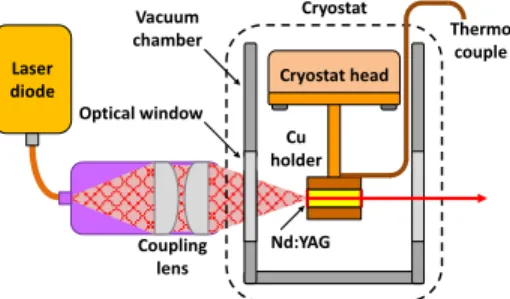
Figure 1 shows the experimental setup of the Nd:YAG laser at cryogenic temperature. We mounted the laser crystal in an oxygen-free copper holder with indium foil to improve the heat spreading efficiency. The copper block was attached to the cold finger of the temperature-controlled cryostat (VPF-100, Janis Research Co.) and placed in a vacuum chamber. We utilized a calibrated Pt-Au thermocouple on the material surface with a nano-voltmeter (Lake Shore 331) to measure the temperature. A 20-W 808-nm fiber-coupled laser diode (Coherent) with a 600-μm fiber core diameter and a numerical aperture of 0.16 was used as the pump source. The pump light was reimaged into the laser crystal through a focusing lens pair with focusing lengths of 50 mm and 25 mm to form a pump spot radius of approximately 150 μm on the laser crystal. The coupling efficiency of the focusing lens pair was approximately 85%, which reduced the maximum pump power to be approximately 17 W. We utilized a 1.1-at.-%-doped Nd:YAG crystal coated with monolithic cavity on two flat end surfaces to efficiently generate the 946-nm laser. The length of the gain medium was 6 mm and the transverse aperture was 3 × 3 mm2. The first facet of the Nd:YAG crystal was coated with high reflection (HR, R > 99.9%) at 946 nm and high transmission (HT, T > 95%) at 808 nm, 1064 nm and 1320 nm. The second facet of the gain medium was coated with partial reflection at 946 nm (R = 97%) and high transmission at 1064 nm and 1320 nm.
Coupling lens Cryostat head Cryostat Laser diode Vacuum chamber Optical window Cu holder Nd:YAG Thermo couple
Fig. 1. Experimental setup for the cryogenically cooled Nd:YAG laser.
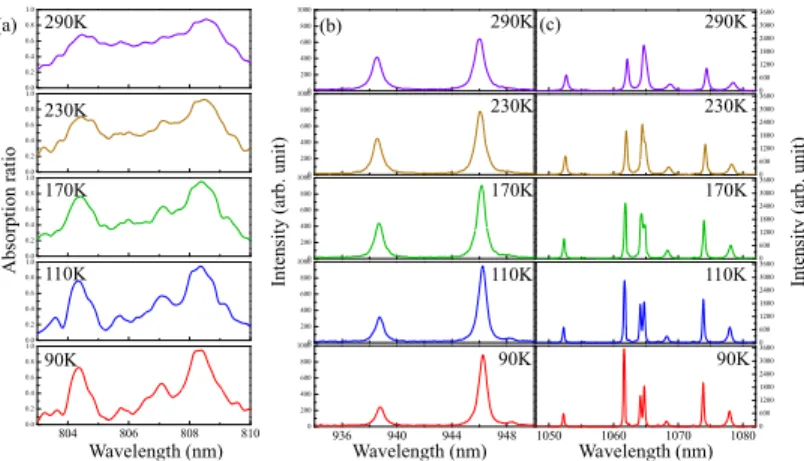
At first, we explored the stimulated absorption and the spontaneous fluorescence for the Nd:YAG crystal at cryogenic temperature. A gain medium with both facets coated to be anti-reflective (AR, R < 0.2%) at 808 nm, 946 nm, 1064 nm and 1320 nm was utilized for the measurement of absorption and fluorescence spectra. The length of the gain medium was 2 mm and the transverse aperture was 3 × 3 mm2. We used an optical spectrum analyzer (Advantest Q8381A) with a resolution of 0.1 nm to monitor the optical spectrum. To observe the absorption spectra from the Nd:YAG crystal, we utilized the broadband amplified spontaneous emission (ASE) from the laser diode operated below the lasing threshold and recorded the ASE spectrum with and without gain medium [22]. Figure 2(a) shows the absorption spectra of the Nd:YAG crystal from 290 K to 90K. We can observe from Fig. 2(a) that although the absorption rate around 808 nm is increased with the decreasing of the temperature, the bandwidth of the absorption spectrum is narrowing. The tendency of the
absorbed ratio at low temperature was similar to the observation of absorption cross section in [23]. We believed that the difference may come from the utilizing of a coupling lens for collecting the residual pump light in [23]. Since the spectra linewidth for the pump laser diode is approximately 2 nm, the narrowing of the absorption bandwidth will reduce the overall absorption efficiency. Figures 2(b) and 2(c) display the spontaneous fluorescence at 4F
3/2 → 4I
9/2 and 4F3/2 →4I11/2 transitions from the Nd:YAG crystal pumped with a low power of approximately 2 W. From Fig. 2(b), we find that the fluorescence intensity at 946 nm is enhanced with the decreasing of the temperature. On the other hand, Fig. 2(c) reveals that the fluorescence intensity at 1061 nm is enlarged more significant especially for the temperature lower than 170 K. The experimental results of the fluorescence spectra were nearly the same as those observed in [23]. 1050 1060 1070 10800 600 1200 1800 2400 3000 3600 0 600 1200 1800 2400 3000 3600 0 600 1200 1800 2400 3000 3600 0 600 1200 1800 2400 3000 3600 0 600 1200 1800 2400 3000 3600 936 940 944 948 0 200 400 600 800 10000 200 400 600 800 10000 200 400 600 800 10000 200 400 600 800 10000 200 400 600 800 1000 Wavelength (nm) Inten sity (ar b. unit) (a) 290K 230K 170K 110K 90K Wavelength (nm) (c) Inten sity (ar b. unit) 290K 230K 170K 110K 90K 0.0 0.2 0.4 0.6 0.8 1.0 0.0 0.2 0.4 0.6 0.8 1.0 0.0 0.2 0.4 0.6 0.8 1.0 0.0 0.2 0.4 0.6 0.8 1.0 804 806 808 810 0.0 0.2 0.4 0.6 0.8 1.0 Wavelength (nm) A bso rptio n ratio 290K 230K 170K 110K 90K (b)
Fig. 2. (a) The absorption spectra and the spontaneous fluorescence spectra of the Nd:YAG
crystal for (b) the 4F
3/2 to 4I9/2 transition and (c) the 4F3/2 to 4I11/2 transition at 290 K, 230 K, 170
K, 110 K and 90 K.
After exploring the absorption and fluorescence spectra of the Nd:YAG crystal, we investigated the output performance for the 946-nm Nd:YAG laser at cryogenic temperature by replacing the gain medium with the monolithic cavity. The threshold pump power of the 946-nm laser is depicted in Fig. 3. The 946-nm threshold pump power at 290 K was found to be approximately 4.1 W. When we adjusted the temperature from 290 K to 90 K, the threshold power at 946 nm displayed a minimum value of approximately 1.2 W near a temperature of 170 K. At a cryogenic temperature of 90 K, the threshold pump power increased to approximately 3.1 W. Since the absorption efficiency was depended on the temperature, we further draw the threshold pump power represented by the absorbed power in Fig. 3. By considering the overlapping of the pump and absorption bandwidth, the absorption efficiency was calculated to be 96% at 290 K and 86% at 90 K. We believed that the improvement of the absorption efficiency at low temperature compared with the results in [22], 48%, came from the shorter linewidth of the laser diode. As a result, selecting a pump diode with a narrow emission linewidth is important for the cryogenic Nd:YAG laser. The result of pump threshold showed that it appeared an optimal temperature for the cryogenically cooled 946-nm laser. The significant enhancement of the fluorescence intensity near 1061 nm at cryogenic temperature is possible to limit the optimal output performance for the 946-nm monolithic Nd:YAG laser by the strong ASE effect [27]. However, the reason for the lasing threshold of the 946-nm laser displaying a minimum value should be further explored with more detail experimental results.
90 120 150 180 210 240 270 300 0 1 2 3 4 5
Incident pump power Absorbed pump power
Thresh old po wer (W) Cooling temperature (K)
Fig. 3. The temperature dependence of the threshold pump power for the monolithic Nd:YAG laser at 946 nm.
Figure 4 displays the output powers at 946 nm with respected to the temperature under numerous fixed pump powers. We found out that due to the local heating from the pump source, the optimal temperature for the laser output power changed gradually from 170 K to 150 K with the increasing of the incident pump power. The output power at 946 nm under the incident pump power of 17.3 W showed a significant improvement from 3.4 W to the maximum value of 8.9 W when we adjusted the temperature from 290 K to 150 K. Transverse distributions of the 946-nm laser at 290 K and 150 K with the incident pump power of 17.3 W are showed in Fig. 5. The comparison between the top-hat and nearly Gaussian distributions at 290 K and 150 K reveals a great improvement for the laser beam quality at lower temperature. The beam quality factor at 150 K was found to be approximately 1.2 by measuring the product of the beam waist and the divergence angle of the laser beam after a 20-mm focusing lens. Finally, we utilized a pump diode with a maximum incident pump power of 34.5 W for power scaling. The experimental result is depicted in Fig. 6. The output power at 946 nm was scaled up to 24.4 W at the incident pump power of 34.5 W. The conversion efficiency can reach 71% and the slope efficiency was up to 75%. The optimal temperature at the incident pump power of 34.5 W decreased to 120 K since the optimal temperature will decrease with the increasing of the pump power. We further plot the output power with respected to the absorbed pump power in Fig. 6. In comparison with results in [22] that 30% conversion efficiency and 47% slope efficiency were achieved, the conversion efficiency and the slope efficiency with respected to the absorbed pump power in our experiment reached 78% and 82%, respectively. The beam quality factor measured at 34.5-W pump power and 120 K was approximately 1.8. We also found that the central peak of the 946-nm laser would shift toward the longer wavelength with a shifting rate of approximately 1.25 × 10⁻³ nm K−1 when the temperature was decreased. The lasing spectrum at 120 K is showed in the inset of Fig. 6.
120 160 200 240 280 0 2 4 6 8 10 Outpu t po wer (W ) Cooling temperature (K) Pin=17W Pin=13W P in=10W Pin=7W Pin=3W
Fig. 4. Output powers of the 946-nm Nd:YAG laser with respected to the cooling temperature for fixed pump powers of 17 W, 13 W, 10 W, 7 W and 3 W.
Fig. 5. Transverse distributions of the 946-nm Nd:YAG laser at the incident pump power of 17.3 W with temperature of (a) 290 K and (b) 150 K.
0 5 10 15 20 25 30 35 0 5 10 15 20 25 O utput pow er ( W ) Pump power (W) Absorbed Incident 930 940 950 960 0.0 0.5 1.0 1.5 2.0 2.5 Inten sity (arb .u nit ) Wavelength (nm)
Fig. 6. Output powers with respected to the absorbed pump power and incident pump power for the 946-nm Nd:YAG laser at a cooling temperature of 120 K with a 35-W pump diode. The inset: the emission spectrum for the Nd:YAG 946-nm laser.
4. Conclusion
In conclusions, we have demonstrated a highly efficient cryogenically cooled Nd:YAG 946-nm laser with a monolithic cavity to improve the output performance. An optimal temperature of 170 K is observed for the lasing threshold of the 946-nm laser with the minimum value of 1.2 W in the temperature range from 90 K to 290 K. We have explored the temperature dependence of the absorption spectra and the fluorescence spectra for the Nd:YAG crystal to investigate the reason for the relationship of the lasing threshold at 946 nm showing an optimum value. It reveals the fact that the absorption bandwidth is narrowing when the temperature is decreased. Furthermore, a strong ASE effect may be induced by the significant enhancement of the fluorescence intensity at 1061 nm with the temperature lower than 170 K. However, the actual reason for the monolithic 946-nm Nd:YAG laser having an optimal temperature at cryogenic temperature should be further investigated with more detail experimental results. For the output power of the 946-nm operation, the optimum value with the incident pump power of 17.3 W is obtained at a lower temperature of 150 K due to the local heating from the pump power. The laser output beam quality is also found to be improved at the cryogenic temperature. To scale up the output power, a 34.5-W laser diode is used as the pump source. The maximum output power for the 946-nm laser reaches 24.4 W at the incident pump power of 34.5 W with the conversion efficiency of 71% and the slope efficiency up to 75%. To the best of our knowledge, it is the highest output power and the highest conversion efficiency for the 946-nm operation.
Acknowledgments
The authors thank the National Science Council for the financial support of this research under Contract No. MOST 103-2112-M-009-0016-MY3.