國
立
交
通
大
學
資訊管理研究所
博
士
論
文
決策球模式之建構與應用
Decision Ball Models: Methods and Applications
研 究 生:馬麗菁
指導教授:黎漢林 教授
決策球模式之建構與應用
Decision Ball Models: Methods and Applications
研 究 生:馬麗菁 Student:Li-Ching Ma
指導教授:黎漢林 Advisor:Han-Lin Li
國 立 交 通 大 學
資 訊 管 理 研 究 所
博 士 論 文
A DissertationSubmitted to Institute of Information Management College of Management
National Chiao Tung University in partial Fulfillment of the Requirements
for the Degree of Doctor of Philosophy
in
Information Management
June 2006
Hsinchu, Taiwan, Republic of China
決策球模式之建構與應用
學生:馬麗菁 指導教授
:黎漢林
國立交通大學資訊管理研究所博士班
摘 要
決策者偏好常受到背景資訊的影響,本研究發展一套決策球系統,提供決策者視覺 化資訊及相似性分析,將決策資訊視覺化,以輔助決策。 此一決策球系統分為法蘭克 運算、對等交換、成對比較、群集分析四模式。 法蘭克運算模式是用於單一方案取捨 的決策問題, 對等交換及成對比較模式主要是解決多個替選方案的排序問題,而群集 分析模式是應用於替選案的分群問題。 本研究成果可廣泛應用於經營管理決策及財務 投資決策等。 關鍵字 : 決策球,視覺化,決策,偏好,不一致性Decision Ball Models: Methods and Applications
Student:Li-Ching Ma Advisor: Han-Lin Li
Institute of Information Management National Chiao Tung University
ABSTRACT
Decision makers’ preferences are often influenced by background information. This
study develops a Decision Ball system to provide visual context and similarity analysis to
help decision makers to reach a better decision. The proposed Decision Ball system includes
four types of Decision Ball models: Franklin’s Moral Algebra models, Even Swap models,
Pairwise Comparison models, and Classification models. Franklin’s Moral Algebra Decision
Ball models solve “Yes” or “No” decision problem. Even Swap and Pairwise Comparison
Decision Ball models are for ranking problems with multiple alternatives. Classification
Decision Ball models treat group problem. The proposed approach can be applied in a variety
of decision problems. For instance, a Decision Ball system can assist decision makers in
personal decision-making problem, operational and managerial decision problems, and
financial decision problems, etc.
誌 謝
終於,我做到了! 博士論文的完成,首先要感謝的是指導教授黎漢林老
師,他除了教導我專業知識外,更讓我學習到如何成為一位受人尊敬的老
師與學者。同時,也要感謝論文口試委員溫于平教授、蘇朝墩教授、陳安
斌教授及林妙聰教授於口試時提供了許多寶貴的意見與建議,使本論文更
趨完善。
在研究室共同奮鬥的日子是令人懷念的,芸珊、昶瑞、明賢、宇謙、志
信、嘉輝、治華、俊慶和玉雯,有幸和你們共渡這段特別的時光,有你們
相伴,讓我在交大的日子總是充實且快樂的。感謝榮發及曜輝,在系統開
發上的協助與支援。此外,也要感謝國立聯合大學同事們的支持與勉勵。
求學期間,感謝公公、婆婆的協助, 讓我無後顧之憂。感謝父母親的教
誨與鼓勵,雖然敬愛的母親已於我博二時往生,她的關愛永遠伴隨著我。
最後,感謝我親愛的老公,一路陪伴著我,分擔我的情緒與壓力,在我脆
弱的時候,給我依靠與鼓勵,讓我有足夠的勇氣繼續往前。也謝謝兩個淘
氣可愛的兒子,沒為我找太多的麻煩,讓我能安心求學,家人的支持是我
最大的力量。
Contents
摘要……….…i Abstract……….. ii 誌謝………...iii Contents……… iv Tables………vii Figures……….viii Chapter 1 Introduction……… 11.1 Research Motivation and Purposes……….. 1
1.2 Advantages of Decision Balls……….. 3
1.3 Framework of the Proposed Decision Ball System……….. 5
1.4 Structure of the Dissertation………10
Chapter 2 Review of Visualization Tools………..12
2.1 Review of Multidimensional Scaling (MDS) Techniques……….. 12
2.2 Review of Gower Plots……….. 15
2.3 Summary……….19
3.1 Properties of Additive Score Functions……….. 20
3.2 Properties of Multiplicative Score Functions………. 22
3.3 Display Techniques………. 24
3.4 An Illustrative Example – Visualization on Decision Balls………25
3.5 Summary………. 28
Chapter 4 Model 1: Moral Algebra Decision Ball Models……….. 29
4.1 Introduction to Franklin’s Moral Algebra………... 29
4.2 Construction of Moral Algebra Decision Ball Models………32
4.3 An Illustrative example – A CEO’s dilemma………. 34
4.4 Summary………..43
Chapter 5 Model 2: Even Swap Decision Ball Models……….45
5.1 Introduction to Even Swaps……… 45
5.2 Construction of Even Swap Decision Ball Models……… 48
5.3 An Illustrative Example – An Office-Renting Problem…………. 54
5.4 Summary……… 61
Chapter 6 Model 3: Pairwise Comparison Decision Ball Models……… 62
6.1 Introduction to Pairwise Comparisons……… 63
6.2 Construction of Pairwise Comparison Decision Ball Models…… 67
Selection of Universities………. 72
6.4 Summary………. 78
Chapter 7 Model 4: Classification Decision Ball Models……… 81
7.1 Introduction to DEA-DA Analysis………. 81
7.2 Constructions of Classification Decision Ball Models………….. 86
7.3 Illustrative Examples – A Corporate Bankruptcy Example……… 91
and Japanese Banks 7.4 Summary……… 101
Chapter 8 Concluding Remarks……… 103
References……… 105
Tables
Table 3.1 Data matrix of Example 3.1……… 26
Table 3.2 Results of Example 3.1 with an additive score function ……… 26
Table 3.3 Results of Example 3.1 with a multiplicative score function………..27
Table 4.1 The relationship between two options……….32
Table 4.2 The mapping table of relationship type and distance………..33
Table 4.3 David’s list of pros and cons for accepting the new position……….. 37
Table 5.1 The consequence table of Example 1……….. 55
Table 6.1 Improvements in inconsistency measured by consistency ratio (CR)…….80
Table 7.1 Financial performance of 83 firms in US electric power industry……….. 92
Figures
Figure 1.1 Visual background in decision environment……….. 2
Figure 1.2 Advantages of Decision Balls………. 4
Figure 1.3 Framework of the proposed Decision Ball System………. 6
Figure 1.4 Structure of the dissertation……….. 11
Figure 2.1 Displaying a distance matrix R1 by non-metric MDS techniques……….15
Figure 2.2 Gower Plots of R2………..18
Figure 3.1 The Decision Ball of Example 3.1 with an additive score function……..27
Figure 3.2 The Decision Ball of Example 3.1 with a multiplicative score function.. 28
Figure 4.1 Pro Ball of Example 4.1……… 38
Figure 4.2 Con Ball of Example 4.1………... 39
Figure 4.3 Pro-Con Ball of Example 4.1……….42
Figure 5.1 Moving trajectory of concurrent points………. 52
Figure 5.2 The decision ball and even swaps after Iteration 1……… 59
Figure 5.3 The decision ball and even swaps after Iteration 2………59
Figure 5.4 The decision ball and even swaps after Iteration 3……… 59
Figure 5.5 The decision ball and even swaps after Iteration 4………60
Figure 5.7 The moving trajectories of A3 and A4 after even swaps………. 60
Figure 6.1 Solution procedure of Pairwise Comparison Decision Ball models……..66
Figure 6.2 Decision Process of Example 6.1……….. 75
Figure 6.3 Decision Process of Example 6.2……….. 78
Figure 7.1 The visual structure of the standard MIP approach………85
Figure 7.2 The visual structure of the two-stage MIP approach………..85
Figure 7.3 The conceptual diagram of the multi-layer Classification Decision Ball models……… 88
Figure 7.4 The multi-stage classifying processes of the proposed Classification Decision Ball models………. 90
Figure 7.5 The Decision Ball of 10 target observations………..94
Figure 7.6 The Decision Ball of observation 62 based on the target observations… 95 Figure 7.7 The first layer Decision Ball of Example 7.2……… 98
Figure 7.8 The second layer Decision Ball of Example 7.2……… 100
Chapter 1 Introduction
Ranking and grouping alternatives are two of major challenges in decision-making. The
more decision alternatives and criteria are being considered, the more difficulties the decision
maker (DM) has to face. Therefore, how to assist the decision maker make a more reliable
and knowledgeable decision is a very important issue.
1.1 Research Motivation and Purposes
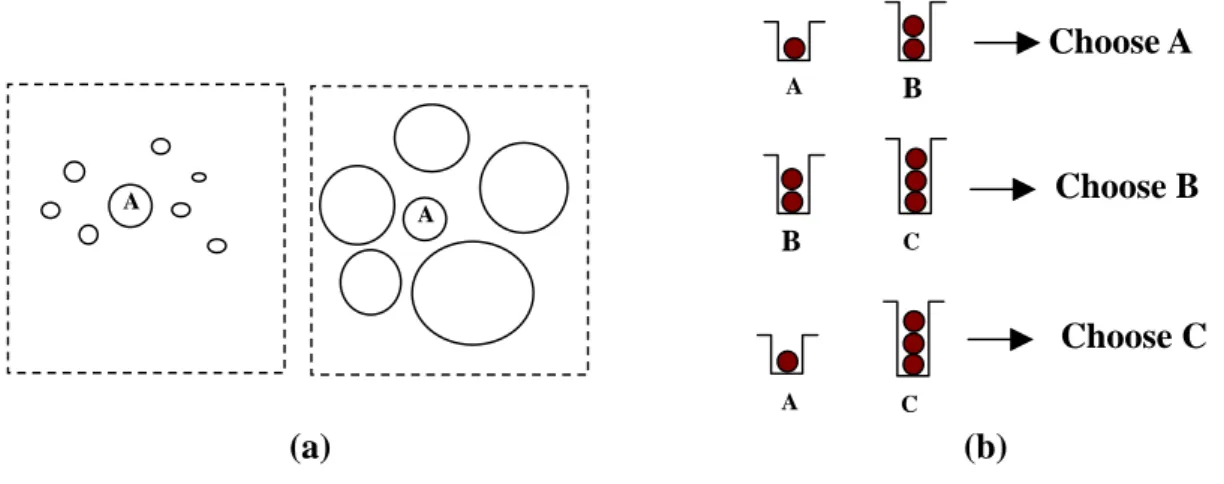
Consumer choice theories show that consumer choice is often affected by context
(Seiford and Zhu, 2003). For instance, a circle appears large when surrounded by small circles
and small when surrounded by larger ones, as shown in Figure 1.1(a). Similarly, a product
may appear attractive against a background of less attractive alternatives and unattractive
when compared to more attractive alternatives (Simonson and Tversky, 1992). Tversky and
Simonson (1993) showed the relative attractiveness of x compared to y often depends on the
presence or absence of a third option z. In addition, Keeney (2002) identified 12 important
mistakes frequently made that limit one’s ability to determine useful value trade-offs, in
which “not understanding the Decision Context” is the first critical mistake.
Even animals’ choice is heavily affected by what visual background they have seen. In
in Figure 1.1(b). There are three options: A, B and C. A is for one raisin in a short tube. B is
for two raisins in a medium length tube, and C is for three raisins in a long tube. When
displaying A and B to a jay, it will choose A. When displaying B and C to a jay, it prefers B.
However, by displaying A and C to a jay, it prefers C. If the choices, A, B and C could be
displayed to the gray jay simultaneously, it might make a better decision. Therefore, how to
assist decision makers visualize the background information is an important issue in
decision-making.
Ranking alternatives is one of the most important challenges in decision-making,
especially when involving inconsistencies. If a decision maker’s judgment is highly
inconsistent, different ranking methods may produce wildly different priorities. That is, the
decision maker may not make a reliable decision. Hence, how to assist the decision makers
detect and improve these inconsistencies is another important issue in decision-making.
This study proposes Decision Ball models to provide visual representation of ranks of
and similarities among alternatives, thus to help the decision makers make a more
Figure 1.1 Visual background in decision environment (a) Influence of visual background (b) Gray jay’s choice
A C A B B C Choose A Choose B A Choose C A (a) (b)
knowledgeable decision. Four types of Decision Ball models are constructed to meet the
decision makers with different decision preferences and requirements. In addition, this study
tries to help a decision maker improve the quality of his/her decision-making by reducing
serious inconsistencies in judgment.
The major advantages of the proposed approach for a decision maker are summarized as
below:
(i) Make a more knowledgeable decision through visualizing background information and
decision processes.
(ii) Make a more reliable decision by improving inconsistencies iteratively.
(iii) Select a type of Decision Ball models based on his/her decision preferences and
requirements.
(iv) Observe the ranks of and similarities among alternatives on Decision Balls directly.
(v) See the grouping relationships among alternatives layer-by-layer on Decision Balls, and
perceive the benchmark alternatives if the DM would like to upgrade the performance of
an alternative from one group to another.
1.2 Advantages of Decision Balls
Decision Ball models display alternatives on the surface of a ball. The arc length
difference, the longer the arc length. In addition, the alternative with a higher score is
designed to be closer to the North Pole so that alternatives will be located on the concentric
circles in the order of rank from top view.
The advantages of Decision Balls are illustrated as follows:
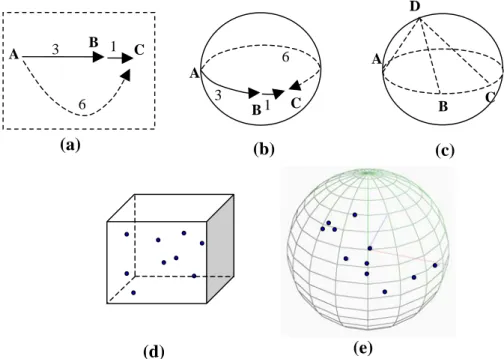
(i) Comparing with 2-Dimensional plane models, Decision Balls can depict three points that
do not obey the triangular inequality (i.e. the total length of any two edges must be larger
than the length of the third edge). For instance, given three options A, B, and C. Suppose
the distance between A and B is 3; the distance between B and C is 1; the distance
between A and C is 6. We cannot draw three lines to connect A, B and C (Figure
Figure 1.2 Advantages of Decision Balls (a) Display line segments on a 2-D plane (b) Display curves on a ball (c) Display four points that are not
on the same plane (d) Display points in a 3-D cube (e) Display points on the surface of a ball
A 3 B 1 C 6 A B C 6 1 3 A B C D (a) (b) (c) (e) (d)
1.2(a)). However, it is convenient to draw three arcs on the surface of a ball to illustrate
their relationships (Figure 1.2(b)).
(ii) Decision Ball models are better than 2-Dimensional plane models because the former
can show four points which are not on the same plane, as shown in Figure 1.2(c).
(iii) Comparing with 3-Dimensional cube models (Figure 1.2(d)), Decision Ball models are
easier for a decision maker to observe the relationship among alternatives than
3-Dimensional cube models because the former can exhibit points on the surface of a
ball, as shown in Figure1.2 (d) and (e).
(iv) Decision Ball models can depict inconsistencies in the decision makers’ judgments.
(Discussed in Chapter 5 and 6).
(v) A Decision Ball can display both ranks of and similarities among alternatives.
(vi) A Decision Ball involves no edges.
1.3 Framework of the Proposed Decision Ball System
Different decision makers may have various decision preferences and requirements
because of personality of a decision maker, complexity of a decision problem, availability of
decision data, …etc. This study summarizes four popular types of decision patterns and
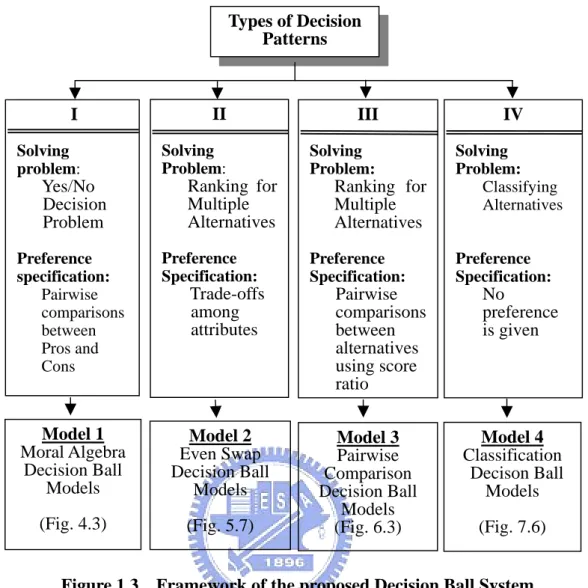
proposes corresponding Decision Ball models as follows: (Figure 1.3)
Types of Decision Patterns
The decision makers are assumed to make a binary choice, or a “Yes or No” decision
problem. This is the simplest decision pattern because the decision makers have not to
estimate the value of each criterion for each alternative in advance.
Franklin (1956) proposed a process to help a decision maker make a rational choice under
this decision pattern, called Franklin’s Moral or Prudential Algebra. Franklin’s Moral Algebra
for making choices was first to divide a sheet of paper into two columns; one for pro, and
another for con. Then, write down the various motives, for or against the choice. If a reason
pro equaled a reason con, then both would be crossed out. If a reason pro equaled two reasons I Solving problem: Yes/No Decision Problem Preference specification: Pairwise comparisons between Pros and Cons Model 1 Moral Algebra Decision Ball Models (Fig. 4.3) Model 2 Even Swap Decision Ball Models (Fig. 5.7) Model 3 Pairwise Comparison Decision Ball Models (Fig. 6.3) Model 4 Classification Decison Ball Models (Fig. 7.6) II Solving Problem: Ranking for Multiple Alternatives Preference Specification: Trade-offs among attributes III Solving Problem: Ranking for Multiple Alternatives Preference Specification: Pairwise comparisons between alternatives using score ratio IV Solving Problem: Classifying Alternatives Preference Specification: No preference is given
con, the three were crossed out. After a day or two of consideration, if nothing new came to
mind for either side, the decision maker could then come to a determination.
Franklin’s Moral Algebra is an intelligent way of simplifying the complexity of a
decision. However, it is not easy for a decision maker to tell explicitly which pro(s) and con(s)
can be eliminated simultaneously.
This study proposes Moral Algebra Decision Ball models to improve the insufficiencies
of Franklin’s Moral Algebra. Decision makers are assumed to be able to make pairwise
comparisons between pro and con reasons with words such as “equally important”, “slightly
more important”, “more important” and “significantly more important”. By visualizing the
relationships between pros and cons on Decision Balls, the decision makers can make a more
knowledgeable decision.
(ii) Type II Pattern
Ranking for multiple alternatives is the major type of decision problem considered here.
This pattern is sophisticated because the decision makers must be capable of making clear
trade-offs among a range of criteria across a range of alternatives.
Hammond et al. (1998) developed a mechanism of Even Swaps to provide a useful way
of making trade-offs. “Even” implies equivalence and “Swap” represents exchange. An even
swap increases the value of one criterion while decreasing the value by an equivalent amount
number of criteria, the most preferred alternative could be found.
Even swap approach is a rational and practically useful way in finding the best
alternative. However, the ranks of rest of alternatives are not known, and there may exist large
inconsistencies among even swaps that the DM could not know.
This study presents Even Swap Decision Ball models to assist the DM observe the ranks
of and similarities among alternatives on the Decision Ball. The superiority relationship
between alternatives can be observed by checking the longitude of alternatives. The
inconsistencies between even swaps can also be known by checking the latitude of
alternatives.
(iii) Type III Pattern
Ranking for multiple alternatives is the type of decision problem solved in this pattern
too. However, instead of making trade-offs explicitly among values of criteria in Type II
pattern, the decision makers of this decision pattern make pairwise comparisons between
alternatives using score ratios.
The analytic hierarchy process (AHP)(Saaty, 1977, 1980; Saaty and Vargas, 1984, 1994)
has been used widely to determine relative ranking of the decision alternatives through the
pairwise comparison of alternatives at each level of the hierarchy. However, if perturbations
from consistency are large, the information available cannot be used to derive a reliable
priorities if a preference matrix is highly inconsistent. Hence, how to help the decision makers
detect and adjust these inconsistencies becomes an important issue in this decision pattern.
This study illustrates Pairwise Comparison Decision Ball models to help the DM make a
more reliable decision by detecting and improving inconsistencies in judgments. In addition
to the ranks of and similarities among alternatives, the DM can observe the suggestions for
effectively reducing inconsistencies on Decision Balls.
(iv) Type IV pattern
In this decision pattern, the decision makers do not have personal preferences about
alternatives. They are interested in classifying alternatives more than ranking alternatives.
Discriminant Analysis (DA) is a statistical technique and popular method for predicting
group membership. The GP (Goal Programming)-based DA, first proposed by Freed and
Glover (1981), can estimate weights of criteria by minimizing sum of deviations (MSD, Freed
and Glover, 1986) or minimizing misclassified alternatives (MMO, Banks and Abad, 1991).
Those weights yield an evaluation score, which is compared with a threshold value for
classifying alternatives. Sueyoshi (1999) first proposed a DEA-DA analysis incorporating the
non-parametric feature of Data Envelopment Analysis (DEA, Charnes et al., 1978) into the
DA. DEA-DA approach can effectively improve hit rates. However, it includes too many
binary variables, and the decision makers cannot “see” the grouping relationships via
This study presents Classification Decision Ball models to aid the decision makers
observe the grouping relationships on Decision Balls layer by layer. In addition to the ranks of
and similarities among alternatives, the DMs can perceive the benchmark alternatives if the
DMs would like to upgrade the performance of an alternative from one group to another. The
number of binary variables can also be reduced significantly.
The framework of the proposed Decision Ball system is shown in Figure 1.3. Each type
of decision patterns is illustrated as solving problem and preference specification parts. The
corresponding Decision Ball models are depicted in the lower part of Figure 1.3.
1.4 Structure of the dissertation
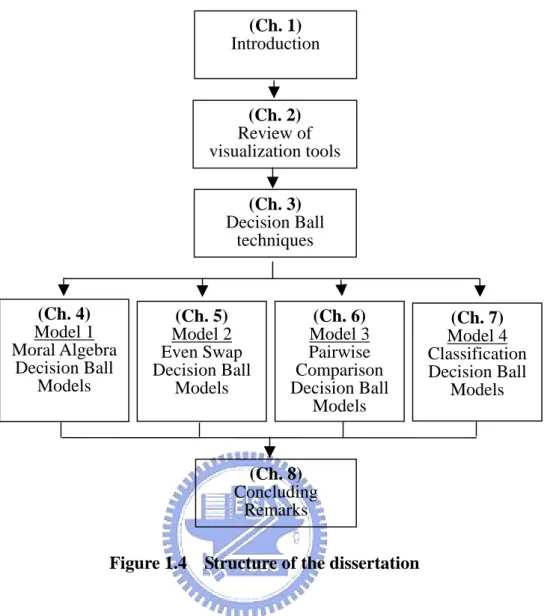
The structure of this dissertation is depicted in Figure 1.4 and briefly introduced as
follows:
Chapter 2 reviews two popular visualization tools: Multidimensional Scaling (Cox and
Cox, 2000) and Gower Plots (Gower, 1977; Genest and Zhang, 1996). Their advantages and
insufficiencies are also discussed.
Chapter 3 introduces Decision Ball techniques. The properties of additive score
functions and multiplicative score functions are discussed first. Then, the Decision Ball
techniques, based on the concept of Multidimensional Scaling, are presented. How to display
Chapter 4 presents Model 1 – Moral Algebra Decision Ball models for Type I decision
pattern. The process of Franklin’s Moral Algebra is described first. Moral Algebra Decision
Ball models are then constructed. An example of a CEO’s dilemma is illustrated to
demonstrate the decision processes.
Chapter 5 discusses Model 2 – Even Swap Decision Ball models for Type II decision
pattern. The method of Even Swaps is introduced. Then corresponding Even Swap Decision
Ball models are built. An office-renting problem is used as an illustrative example. Chapter 6
addresses Model 3 – Pairwise Comparison Decision Ball models for Type III decision pattern.
(Ch. 4) Model 1 Moral Algebra Decision Ball Models (Ch. 5) Model 2 Even Swap Decision Ball Models (Ch. 6) Model 3 Pairwise Comparison Decision Ball Models (Ch. 1) Introduction (Ch. 2) Review of visualization tools (Ch. 8) Concluding Remarks (Ch. 3) Decision Ball techniques
Figure 1.4 Structure of the dissertation
(Ch. 7)
Model 4 Classification Decision Ball
This chapter first describes the basic concept of pairwise comparison, and then creates
Pairwise Comparison Decision Ball models. Gower Plots are adopted to detect alternatives
causing major inconsistencies. Optimization models are proposed to help the DM improve
these inconsistencies conveniently. Two examples, investment in mutual funds and selection
of universities, are demonstrated in this chapter.
Chapter 7 presents Model 4 – Classification Decision Ball models for Type IV decision
pattern. DEA-DA analysis is introduced, and the Classification Decision Ball models are
formed. Then, a corporate bankruptcy example and an example of Japanese banks are
demonstrated. Chapter 8 presents concluding remarks and suggests directions for future
Chapter 2 Review of Visualization Tools
Several graphical techniques have been developed to aid the DM visualize background
information. For instance, Li (1999) used deduction graphs to treat decision problems
associated with expanding competence sets. Gower (1977), Genest and Zhang (1996)
proposed a powerful graphical tool, the so-called Gower Plot, to detect the cardinal and
ordinal inconsistencies in decision maker’s preferences. Multidimensional Scaling (Borg and
Groenen, 1997; Cox and Cox, 2000) is a classical technique used to provide a visual
representation of similarities among a set of alternatives.
This chapter briefly reviews two popular visualization techniques, Multidimensional
Scaling techniques and Gower Plots, which are adopted and compared in this study.
The structure of this chapter is organized as follows. Section 2.1 illustrates the
Multidimensional Scaling technique. Section 2.2 briefly reviews Gower Plots method.
Summary of this chapter is made in Section 2.3.
2.1 Review of Multidimensional Scaling (MDS) Techniques
Multidimensional Scaling (Borg and Groenen, 1997; Cox and Cox, 2000) is a classical
technique to provide a visual representation of similarities among a set of alternatives, which
dimensional space (usually Euclidean).
There are two major forms of MDS: metric and non-metric MDS. In metric scaling, the
dissimilarities between all objects are known numbers, which can be approximated by
distances directly. In non-metric MDS, only the rank order of the dissimilarities is
approximated: the larger the dissimilarity, the longer the distance. Several MDS models (Cox
and Cox, 2000) have been developed. One of commonly used model is proposed by Kruskal
(1964a, 1964b). He developed a numerical measure of the closeness between the
dissimilarities in the lower dimensional and the original spaces, called Stress. Denote di,j as
distance and δi,j as dissimilarity between alternative Ai and Aj. Stress can be formulated as
∑∑
∑∑
> > − = i j i j i i j i j i j i d f d 2 , 2 , , ( )) ( Stress δ , (2.1)where f(δi, j) is the transformation of the δi, j . In metric scaling, f(δi, j) is a linear
transformation of δi, j . In non-metric scaling, f(δi, j) is a weakly monotonic
transformation of δi, j . That is, if δi, j < δp,q , )f(δi,j)≤ f(δp,q . The Stress has a value
between 0 and 1, with 0 indicating perfect fit and 1 implying worst possible fit. The rule of
thumb for the value of Stress is that anything under 0.1 is excellent and over 0.15 is
unacceptable. Based on Kruskal’s approach, an initial configuration is randomly specified.
Then an iterative procedure based on the steepest descent method is applied to move toward a
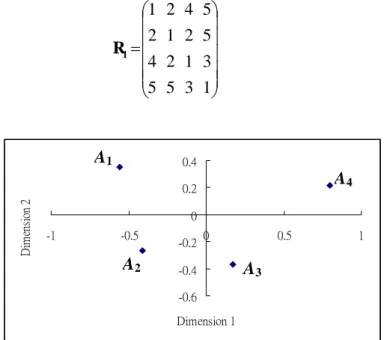
⎟⎟ ⎟ ⎟ ⎟ ⎠ ⎞ ⎜⎜ ⎜ ⎜ ⎜ ⎝ ⎛ = 1 3 5 5 3 1 2 4 5 2 1 2 5 4 2 1 1 R -0.6 -0.4 -0.2 0 0.2 0.4 -1 -0.5 0 0.5 1 Dimension 1 D im en si on 2 A1 A A2 A3 4
Figure 2.1 Displaying a distance matrix R1 by non-metric MDS
techniques
For instance, a distance matrix R1, with four alternative A1, A2, A3, and A4, can be
visualized by non-metric MDS techniques as shown in Figure 2.1. The Stress of this visual
presentation is 0.57%.
Conventional MDS models, including Kruskal’s approach, can effectively provide a
visual representation of dissimilarities among objects. However, the conventional
multidimensional scaling technique cannot show the ranks of alternatives and is incapable of
detecting and adjusting inconsistencies in the decision makers’ preferences.
2.2 Review of Gower Plots
Genest and Zhang (1996) proposed a graphical method, which is close in spirit to MDS,
work of Gower (Gower, 1977), can display both the inconsistencies of data matrix and the
ranks of alternatives. This section briefly introduces the mathematical properties of Gower
Plots. The detail explanations of Gower Plots can refer to Genest and Zhang (1996).
The singular values of a matrix M of rank n are the positive square roots of the
eigenvalues of the symmetric matrix MTM, where MTstands for transposition of M. If M is skew-symmetric, i.e. MT = -M, the singular values of the matrix M are equal to the norm of its purely imaginary eigenvalues.
Let 0λ1 ≥K≥λm ≥ (and λm+1 =0 if n is an odd number) represent those singular
values, with m indicating the integer part of n/2. Using singular value decomposition (Horn
and Johnson, 1985), a skew-symmetric matrix M can be decomposed into the form
) ( 2 1 2 2 2 1 1 T j j T j j m j j − − = − =
∑
U U U U M λ , (2.2)where U2j-1and U2j are orthonormal eigenvectors of MTM corresponding to λ2j.
The matrix M* = (λ1 UVT −VUT) with U = U1 and V= U2 provides the best approximation of a skew-symmetric matrix M of rank two, because the first term of M gives
the best least-squares fit of rank two to M (Eckart and Young, 1936). Let U = (u1, …, un)T
and V = (v1, …, vn)T as n points Pj = (uj, vj) in the plane. A Gower Plot of a skew-symmetric
matrix M is a two-dimensional graph composed of all Pj, 1≤ j≤n, on the graph.
variability
∑
= = = m j j 1 2 2 1 λ λ M M* . (2.3)Consider a set of n alternatives A1, A2, …, An. Denote ri,j as the ratio of the weights of Ai
to that of Aj, specified as,
j i j i j i e w w r, = , , (2.4)
where wi is the weight of Ai, wi > 0, for all . is a multiplicative term accounting for
inconsistencies. It is assumed that r
i ei,j i,j = i j r , 1
, as illustrated in AHP (Saaty, 1977). Let R =
(ri,j), for all i, , be a j preference matrix. Following Genest and Zhang (1996), a
tournament matrix T = (t n n×
i,j) corresponding to R, is defined as ti,j = 1 if ri,j > 1; ti,j = 0 if ri,j = 1;
ti,j = −1 if ri,j < 1.
Since T is a skew-symmetric matrix, a Gower Plot based on T can be depicted, called
the ordinal Gower Plot of R. From the work of Genest and Zhang (1996), we summarize the
following rules to detect the ordinal consistency of R. Examining the ordinal Gower Plot of
R, R is close to be ordinal consistent, if (i) the location of alternatives (points P1, …, Pn )
are equidistant from origin within a 180 degree arc; (ii) the angles between consecutive points
are equal to 180/n degrees; (iii) the faithfulness of the graphical representation is
demonstrated by variability factor, expressed in (2.3), being approximately 1. The points are
arranged counter-clock-wise in the order of preference.
Plot based on S can be depicted, called the cardinal Gower Plot of R. Examining the cardinal
Gower Plot of R, R is close to be cardinal consistent, if (i) P1, …, Pn are collinear, and (ii)
variability factor is approximately 1. The first condition means that *, , for all
* , * ,k k j i j i s s s + = n j k i ≤ ≤ , , 1 .
For instance, suppose a DM specifies a preference matrix as R2. T2 is the tournament
matrix corresponding to R2. The ordinal Gower Plot is depicted in Figure 2.2(a).
Examining the ordinal Gower Plot, the matrix R2is ordinal consistent because (i) all its points
are located on a half-circle; (ii) the angles between every two consecutive points are equal to
180/n degrees; (iii) variability factor = 97.1%. Let S2 = ln(R2), the cardinal Gower Plot of
R2 is depicted in Fig. 2.2(b) representing 99.9% variability. The matrix R2 is not cardinal
consistent because A4 is away from the collinear line. The ranking of alternatives is A1 f A2
⎟⎟ ⎟ ⎟ ⎟ ⎠ ⎞ ⎜⎜ ⎜ ⎜ ⎜ ⎝ ⎛ = 1 3 / 1 5 / 1 5 / 1 3 1 2 / 1 4 / 1 5 2 1 2 / 1 5 4 2 1 2 R ⎟⎟ ⎟ ⎟ ⎟ ⎠ ⎞ ⎜⎜ ⎜ ⎜ ⎜ ⎝ ⎛ − − − − − − = 0 1 1 1 1 0 1 1 1 1 0 1 1 1 1 0 2 T
f A3 f A4 (“f” means superior to).
Gower Plots are powerful tools for detecting inconsistencies in data matrix, and can also
display ranks of alternatives. However, it can neither show the similarities among alternatives
nor provide any suggestions about how to adjust inconsistencies. In addition, a Gower Plot
2.3 Summary
A decision maker’s choice is often affected by background information. This chapter
briefly reviews two commonly used visualization techniques, Multidimensional Scaling and
Gower Plots, and illustrates their advantages and insufficiencies.
-0.6 -0.4 -0.2 0 0.2 0.4 0.6 0.8 -0.8 -0.6 -0.4 -0.2 0 A1 -0.6 -0.4 -0.2 0 0.2 0.4 0.6 0.8 -0.8 -0.6 -0.4 -0.2 0 A1 A A2 2 A3 A3 A4 A4
Figure 2.2 Gower Plots of R2 (a) ordinal Gower Plot of R2 (b) cardinal
Gower Plot of R2
Chapter 3 Decision Ball Techniques
This chapter illustrates the Decision Ball techniques with additive and multiplicative
score functions respectively, based on the concept of Multidimensional Scaling techniques.
An additive score function is the most commonly used form in practice (Belton and
Stewart, 2002) since it is more understandable for the decision maker. However, the linear
additive score function is restricted to a fixed rate of substitution between criteria. A
multiplicative score function is good at reflecting reasonable marginal rate of substitution, but
is more complicated than the additive one. Both score functions are provided here to allow a
decision maker to choose a proper one.
The structure of this chapter is organized as follows. Section 3.1 introduces the
properties of additive score functions. Section 3.2 illustrates the properties of multiplicative
score functions. Section 3.3 proposes the Decision Ball techniques with additive and
multiplicative score functions respectively. Section 3.4 uses an example to demonstrate how
to display alternatives on Decision Balls. Summary of this chapter is made in Section 3.5.
3.1 Properties of Additive Score Functions
Let A = {A1, A2, …, An} be a set of n alternatives for solving a decision problem, where
wk as the weight of criterion k. In order to make sure all weights of criteria are positive, a
criterion ci,k with cost feature (i.e., a DM likes to keep it as small as possible) is transformed
from ci,k to (ck −ci,k) in advance, where ck is the largest value of criterion k.
Notation 3.1 The score function of Ai is assumed in an additive form, expressed below
∑
= − − = m k k k k k i k i c c c c w S 1 , ) (w , (3.1)where (i) wk ≥ 0, ∀k and
∑
.= = m k k w 1
1 w=(w1,w2,K,wm) is a weight vector obtained by other decision methods in advance, (ii)ck and ck are respectively the largest and smallest
values of a criterion k. (iii) 0≤Si(w)≤1.
Notation 3.2 The dissimilarity between Ai and Aj is defined as
∑
= − − = m k k k k j k i k j i c c c c w 1 , , , | | ) (w δ , (3.2) where 10≤δi,j(w)≤ and δi,j(w)=δj,i(w).For the purpose of comparison, we define an ideal alternative A* , where
) , , , ( 1 2 * * A c c cm
A = K and . is designed to be located at the north pole of a ball (radius = 1) with coordinate = (0, 1, 0). Denote
1 * = S A* ) , , (x* y* z* δi,*, as the dissimilarity, distance between A ,* i d
i and A* respectively. We then have following propositions:
Proposition 3.1 δi,*(w)=1−Si(w) (3.3) <Proof>
∑
∑
= = − − − − = − − = m k m k k k k k i k k k k k k k i k i c c c c c c w c c c c w 1 1 , , ,* ) ( ) ( | | ) (w δ) ( 1 ) ) ( ) ( ( 1 1 , w i m k m k k k k k i k k k k k k S c c c c w c c c c w = − − − − − − =
∑
∑
= =Notation 3.3 Denote the Euclidean distance between Ai and Aj as
di,j = 2δi,j, (3.4)
such that if δi,j = 0 then di,j = 0 and if δi,j = 1 then di,j = 2, where 2 is used because the distance between the north pole and equator is 2 when radius = 1. The relationship
between yi and Si is expressed as
Proposition 3.2 yi =2Si −Si2. (3.5)
<Proof> Following Proposition 3.1 and Notation 3.3,
. 2 2 ,* 2 2 2 2 ,* ( i 0) ( i 1) ( i 0) 2 i 2(1 i) i x y z S d = − + − + − = δ = −
Therefore, we can obtain yi =2Si −Si2.
Assume the weights of criteria are obtained from other decision methods in advance. The
scores of and dissimilarities among alternatives can be calculated based on Notation 3.1 and
3.2. From Proposition 3.2, if Si = 0, then yi = 0; if Si =1, then yi = 1. That is, the alternative
with a higher score is located to be closer to the North Pole.
3.2 Properties of Multiplicative Score Functions
Before applying multiplicative score functions, all criterion values have to be normalized into interval [1, 10] with ck =1,and ck =10.
(1928) form with constant return to scale, expressed below m w m i w i w i i w c c c S 0 ,1 ,2 , 2 1 ) (w = K , (3.6) where w0, w1, …, wm ≥ 0 and
∑
. = = m k k w 1 1 Let 1≤ Si ≤10, then w0 =1.Notation 3.5 The dissimilarity between Ai and Aj is expressed as
wm m j m i m j m i w j i j i j i c c Min c c Max c c Min c c Max ] } , { } , { [ ] } , { } , { [ ) ( , , , , 1 , 1 , 1 , 1 , , 1× × = L w δ , (3.7) where )δi,j(w)=δj,i(w and 1≤δi,j(w)≤10.
Notation 3.6 Let the Euclidean distance between Ai and Aj be
di,j = ) 10 ln( ) ln( 2 δi,j , (3.8)
such that if δi,j =1 then di,j =0 and if δi,j =10 then di,j = 2.
Because ) 10 ln( )) , { ln( )) , { (ln( ( 2 1 , , , , ,
∑
= − = m k k j k i k j k i k j i c c Min c c Max wd , the relationship between
and S ,* i d i can be expressed as ) ) 10 ln( ) ln( 1 ( 2 ) 10 ln( )) ln( ) 10 (ln( 2 ) 10 ln( ))) ln( ) (ln( ( 2 1 , ,* i i m k k i k k i S S c c w d = − = − − =
∑
= . (3.9)We then have following proposition:
Proposition 3.3 2 ) ) 10 ln( ) ln( ( ) 10 ln( ) ln( 2 i i i S S y = − (3.10) <Proof> Since 2 2 ,* 2 2 2 ) ) 10 ln( ) ln( 1 ( 2 ) 1 ( i i i i i S d z y x + − + = = − , then 2 ) ) 10 ln( ) ln( ( ) 10 ln( ) ln( 2 i i i S S y = − .
3.3 Display Techniques
From the basis of Multidimensional Scaling techniques, this section proposes Decision
Ball techniques to provide spatial relationships among alternatives. The arc length between
two alternatives is used to represent the dissimilarity between them: the larger the difference,
the longer the arc length. However, because the arc length is monotonically related to the
Euclidean distance between two points and both approximation methods make little difference
to the resulting configuration (Cox and Cox, 1991), the Euclidean distance is used here for
simplification.
In addition, the alternative with a higher score is designed to be closer to the North Pole
so that alternatives will be located on the concentric circles in the order of rank from the top
view.
Let dˆi,j = f(δi,j), where f(δi, j) is a monotonic transformation of δi,j (i.e. if
q p j i, δ ,
δ < , then ). A Decision Ball technique with additive score functions is developed as follows. q p j i d dˆ, < ˆ ,
Model 3.1 (A Decision Ball model – An additive score function)
Min =
∑∑
= > − n i n i j j i j i d d 1 2 , , ˆ ) ( s.t. yi =2Si −Si , ∀i, (3.11) 2 q p j i q p j i d dˆ, ≤ ˆ , −ε , ∀δ , <δ , , (3.12)di j (xi xj) (yi yj) (zi zj) , i,j, (3.13) 2 2 2 2 , = − + − + − ∀ xi2 + yi2 +zi2 =1, ∀i, (3.14) −1≤xi,zi ≤1, , 0≤ yi ≤1 ∀i, ε is a tolerable error. (3.15)
The objective function of Model 3.1 is to minimize the sum of difference between di,j
and dˆi,j. (3.11) is from Proposition 3.2. (3.12) is the monotonic transformation from δi,j to
. All alternatives are graphed on the surface of a semi-sphere (3.14)(3.15). j
i dˆ,
The stress value can be measured by
Stress =
∑∑
= > n i n i j j i d 1 2 , (3.16)If a decision maker chooses to use a multiplicative score function, Model 3.1 can be
reformulated as follows.
Model 3.2 (A Decision Ball model – A multiplicative score function)
Min =
∑∑
= > − n i n i j j i j i d d 1 2 , , ˆ ) ( s.t. 2 ) ) 10 ln( ) ln( ( ) 10 ln( ) ln( 2 i i i S S y = − , (3.17) (3.12) ~ (3.15).3.4 An Illustrative Example – Visualization on Decision Balls
This section uses a numerical example to demonstrate how to display alternatives on
Decision Balls with additive and multiplicative score functions respectively.
<Example 3.1> Visualization on Decision Balls
Suppose a decision maker has three criteria (c1, c2, and c3) to fulfill. He hopes all criteria
values to be as large as possible. Assume the weights of criteria are known as follows: (w1,
w2, w3) = (0.2, 0.5, 0.3). Four alternatives are under considerations as listed in Table 3.1.
Assume the decision maker chooses to use an additive score function. Following
Notation 3.1, the scores of alternatives can be obtained as (S1, S2, S3, S4) = (0.3, 0.66, 0.45,
0.8). The dissimilarities among alternatives are calculated based on Notation 3.2, as listed in
Table 3.2 (a). Applying Model 3.1 to this example yields the coordinate of each alternative, as
Table 3.1 Data matrix of Example 3.1
ci,k c1 c2 c3 A1 20 100 1.2 A2 35 165 0.8 A3 40 140 0.6 A4 30 180 1 (a) (b) Table 3.2 Results of Example 3.1 with an additive score function
(a) dissimilarity (b) coordinates of alternatives
A1 A2 A3 A4 A1 0.76 0.75 0.70 A2 0.31 0.24 A3 0.55 A4 j i, δ x y z A1 -0.78 0.52 -0.34 A2 -0.40 0.89 0.21 A3 -0.60 0.71 0.37 A4 -0.28 0.96 -0.02
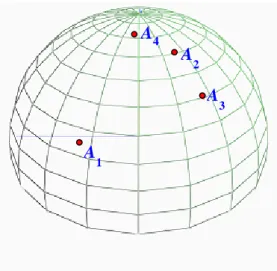
4 A A 2 A 3 A 1
Figure 3.1 The Decision Ball of Example 3.1 with an additive score function
listed in Table 3.2(b). The corresponding Decision Ball is shown in Figure 3.1.
Assume the decision maker selects a multiplicative score function in Example 3.1. From
Notation 3.4, the scores of alternatives are (S1, S2, S3, S4) = (1.06, 4.06, 3.19, 4.45). Based on
Notation 3.5, the dissimilarities among alternatives are calculated, as listed Table 3.3(a).
Applying Model 3.2 to the example yields the coordinates of alternatives, as listed in Table
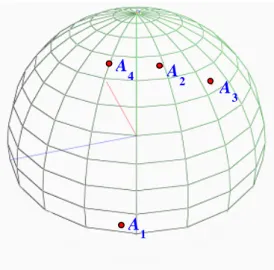
3.3(b). The Decision Ball with a multiplicative score function is depicted in Figure 3.2.
(a) (b) A1 A2 A3 A4 A1 0.00 1.62 1.67 1.54 A2 0.00 0.00 1.22 1.15 A3 0.00 0.00 0.00 1.40 A4 0.00 0.00 0.00 0.00 j i, δ x y z A1 -0.92 0.06 -0.39 A2 -0.52 0.86 -0.01 A3 -0.61 0.74 0.27 A4 -0.41 0.87 -0.29
Table 3.3 Results of Example 3.1 with a multiplicative score function (a) dissimilarity (b) coordinates of alternatives
A 2 A 3 A A 1 4
Figure 3.2 The Decision Ball of Example 3.1 with a multiplicative score function
3.5 Summary
This section proposes Decision Ball techniques with additive and multiplicative score
functions respectively to provide a useful visual representation of ranks and similarities
among alternatives. An illustrative example is also demonstrated about how to display
Chapter 4 Model 1: Moral Algebra Decision Ball Models
This chapter presents Model 1 – Moral Algebra Decision Ball models for Type I decision
pattern. The decision problems solved in this pattern are Yes/No decision problems. This is
the simplest decision pattern because the decision makers have not to estimate the value of
each criterion for each alternative in advance. Decision makers are assumed to be capable of
making pairwise comparisons between pro and con reasons. Based on Franklin’s Moral
Algebra, this study develops a mechanism to visualize the decision alternatives and processes
on Decision Balls.
The structure of this chapter is organized as follows. Section 4.1 introduces the concept
of Franklin’s Moral Algebra. Section 4.2 constructs Moral Algebra Decision Ball models.
Section 4.3 uses an example to demonstrate how to apply Moral Algebra on Decision Balls.
Summary of this chapter is made in Section 4.4.
4.1 Introduction to Franklin’s Moral Algebra
More than 230 years ago, Joseph Priestly, a noted scientist, asked for advice from
Benjamin Franklin about what option to choose when making a decision. Franklin replied to
his friend that he could not advise what to determine, but would like to tell how. Franklin
success in making rational decisions. (The letter from Benjamin Franklin to Joseph Priestly is
listed in the Appendix)
Franklin thought, the difficulty of making decision was because the reasons pro and con
were not present in the mind at the same time; sometimes one set present themselves, and at
other times another, while the first was out of sight.
Franklin’s Moral Algebra for making choices was first to divide a sheet of paper into
two columns; one for pro, and another for con. Then, write down the various motives, for or
against the choice. Franklin then attempted to estimate the respective weights of these reasons
at one time. If a reason pro equaled a reason con, then both would be crossed out. If a reason
pro equaled two reasons con, the three were crossed out. After a day or two of consideration,
if nothing new came to mind for either side, Franklin would then come to a determination.
Franklin thought that since all the reasons lay before him, and since each reason was
considered separately and comparatively; he could judge better, and was less liable to make a
rash choice. In fact, Franklin benefited a lot from this kind of choice method.
Franklin’s Moral Algebra is an intelligent way of simplifying the complexity of a
decision. By eliminating reasons pro and con step-by-step, the original list of pros and cons
can be replaced with an equivalent but compact list. Then, a clear choice can then be reached.
However, this algebra is not used widely today because of the following facts.
However, it is not easy for a decision maker to tell explicitly which pro(s) and con(s) can be
eliminated simultaneously. Second, the key point in Franklin’s Moral Algebra is to present all
the pros and cons to the mind at the same time, the decision maker therefore can make whole
comparisons about these pros and cons. However, the table listing may not be a proper way to
display complete information to a decision maker. Since a table can only list the items of pros
and cons but can not tell the similarities or differences between them.
This study therefore proposes Moral Algebra Decision Ball models to visualize and
enrich Franklin’s Moral Algebra. The merits of this approach in making choices are listed
below:
(i) The decision maker is not required to directly list equivalent pros and cons. But to
roughly express the comparisons between pros and cons with words such as “equally
important”, “slightly more important”, “more important” and “significantly more
important”.
(ii) After making the comparisons, the differences of importance between pros and cons are
displayed on the surface of a ball. By examining the ball, the decision maker can detect
the closest sets of pros and cons, and then eliminate them simultaneously.
(iii) The whole decision process can now be visualized. By “seeing and choosing”, the
decision maker is more confident when making comparisons, updating preferences,
4.2 Construction of Moral Algebra Decision Ball Models
To illustrate the relationship between pros and cons, we can compare the differences
between them. Suppose an option represents a pro or a con. If two options are equally
important, then the difference of importance between them should be small. If one option is
slightly more important than the other, then their difference becomes larger. If one option is
much more important than the other, then their difference is significantly larger. To visualize
the difference of importance means to convert them into physical distances.
Two rules of allocating all options on the surface of a ball are as follows:
Rule 1 : The more the difference of importance between two options, the longer the physical
distance between them.
Rule 2 : The more important an option is, the closer it is to the north pole.
The decision maker’s preferences between two options A and B are classified and
expressed in Table 4.1.
Preference between A and B Expression
A is equally important as B A ≈ B A is slightly more important than B A f B A is more important than B A ff B A is significantly more important than B A fff B
The essence of Franklin’s Moral Algebra is to simultaneously display the complete
information of pros and cons to the decision maker. This study intends to utilize computer
graphic technologies to develop a decision support system to visualize a decision maker’s
preferences on a ball.
On the surface of a Decision Ball, the distance between two reasons is designed to be the
relationship between them: the more the difference of importance, the longer the distance. The
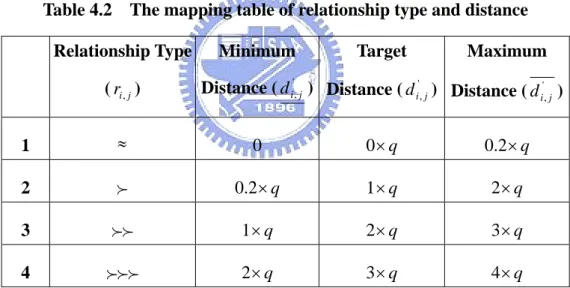
relationship between relationship type and distance is defined as listed in Table 4.2.
Table 4.2 The mapping table of relationship type and distance Relationship Type (ri,j) Minimum Distance (di', j ) Target Distance (di', j) Maximum Distance (di', j) 1 ≈ 0 0×q 0.2×q 2 f 0.2×q 1×q 2×q 3 ff 1×q 2×q 3×q 4 fff 2×q 3×q 4×q
In Table 4.2, q is a scaling constant, and is the relationship type between two
options i and j. There are four relationship types, including “ j
i r,
≈”, “ ”, “ ”and “ ”. Each type of relationship is mapped to a target distance , with upper and lower bound
f ff fff ' , j i d ' , j i
d and di', j respectively. Let di,jbe the actual distance between reason i and reason j, and
radius of the Decision Ball be 1. The Decision Ball is formulated as follows:
Model 4.1 A Pro-Con Decision Ball Model
Min s.t. − ≤di j −di j ≤ ∀ri,j ≠φ , (4.1) ' , , , φ ≠ ∀ ≤ ≤ ij ij ij j i d d r d , ' , , ' , , , (4.2) yi ≥ yj +g, if ri,j ∈{"f","ff","fff"}, (4.3) g ≥ g, q≥q, (4.4) (3.13) ~ (3.15),
where g, q are lower bounds of g and q respectively.
The objective is to minimize the difference between the actual distance and target
distance (4.1). Expression (4.2) is used to set the upper and lower bound of di,j. The latitudes
of Pro or Con reasons stand for the order of importance. If a reason Pi is important than Pj, the
latitude of Pi is designed to be higher than that of Pj, as listed in Expression (4.3), where g is a
gap in y coordinate between two reasons with different importance. The lower bounds of g
and q are set in (4.4) in order to avoid all reasons located too close to each other. The suggested values are g = 0.1, q = 0.25.
4.3 An illustrative Example – A CEO’s Dilemma
<Example 4.1> A CEO’s DilemmaHere we use an example, called a CEO’s dilemma, to illustrate the process of utilizing a
Decision Ball to assist a manager in making choices.
Imagine a manager, David, who faces a difficult choice. David is the department director
of SOFTCOM, a famous software company with 2000 employees. David came to the U.S.A
from Shanghai, China. After obtaining his PhD from Wharton business School, David was
recruited by SOFTCOM. Because of his outstanding ability in analysis, he has been promoted
to a senior position in SOFTCOM. David has a lovely family, his wife Lisa and two children
Ivy and Paul. Ivy is 10 and Paul is 6.
Because of the boom in the Chinese market, SOFTCOM plans to establish a subsidiary
in Shanghai. One week ago, David was asked to be the CEO of the China subsidiary of
SOFTCOM. The rewards of this new position are quite promising. The salary will be doubled,
and David may be promoted to the Asia’s director of SOFTCOM in the future. In addition,
David can take care of his old parents in Shanghai. However, Lisa, Ivy and Paul do not want
to leave. After staying at home for 5 years to take care of kids, Lisa cherishes her current job.
Ivy and Paul love their current schools very much. In addition, Ivy and Paul cannot speak
Chinese and may not make many friends in China. David is very excited about the new
position; however, he does not want to be separated from his family. David needs to choose
this week. How can he make this decision?
since all of these tools ask David to specify explicitly the trade-offs between “job and family”
or between “money and love”. David does not like it. Now we assist David to make his
decision via a Decision Ball.
There are five steps of making a choice:
Step 1 Listing of Pros and Cons
Suppose David lists five pros in order of importance (roughly) for accepting the new
position. First, this is a great promotion opportunity. If he accepts this new position, it is very
possible he will be promoted to be the director of Asia in three years. Second, David’s parents
live in Shanghai. Both of them are over 75 years old. He can give his aging parents attention
if he moves back to China. Third, the salary of the new position is more than twice as high as
his salary now. Fourth, to be the CEO of a Chinese subsidiary, he could make more
contributions to his homeland. Last, David has an aggressive personality and likes a career
that offers a challenge. To be a CEO of Chinese subsidiary is an exciting challenge for him.
David also lists five cons in order of importance (roughly). First, both kids were born in
the U.S.A. They cannot speak Chinese. They may have a tough time transforming to a new
culture. Besides, both kids enjoy their American-style school life very much and object to
leaving. Second, David’s wife is an accountant. Lisa has worked hard and has recently got a
promotion to section manager. She is not willing to quit her job. Third, the population density
a new house in the U.S.A. one year ago. The house has a great view and a beautiful yard. The
family likes the house very much and they are not willing to move out. Finally, David and
Lisa have lived in the U.S.A. for over 16 years. Most of their friends are in the U.S.A. They
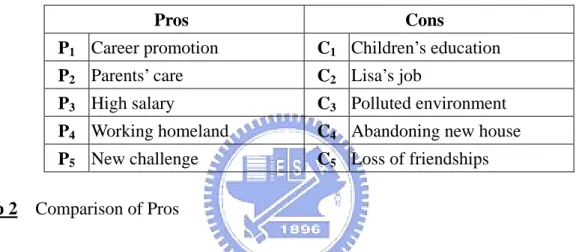
cherish their friendships very much.
The summary of pros and cons are listed in Table 4.3.
Table 4.3 David’s list of pros and cons for accepting the new position
Step 2 Comparison of Pros
David selects some pros for comparison, as listed in Figure 4.1(a).
Comparing Career promotion (P1) with other pros, David thinks career promotion is
equally important as Care for parents (P2), more important than High salary (P3), more
important than Working for the homeland (P4), and significantly more important than a
New challenge (P5). These preferences are expressed as P1≈P2, P1ffP3, P1ffP4, and
P1fff
f
Pros Cons
P5.
P1 Career promotion C1 Children’s education
P2 Parents’ care C2 Lisa’s job
P3 High salary C3 Polluted environment
P4 Working homeland C4 Abandoning new house
P5 New challenge C5 Loss of friendships
Comparing Parents’ care (P2) with other pros, David thinks itis slightly more important
compared to a High salary (P3) as well as Working for homeland (P4), denoted as P2fP3
P1 P2 P3 P4 P5 P1 : Career promotion ≈ ff ff fff P2 : Parents’ care f f P3 : High salary f P4 : Working homeland ff P5 : New Challenge P5 P4 P3 P2 P1
Figure 4.1 Pro Ball of Example 4.1 (a) Relationships among pros (b) David’s Pro Ball
(a) (b)
≈: equally important; f: slightly more important;
ff: more important; fff: significantly more important.
Comparing High salary (P3) with other pros, David is unclear about the comparison of
High salary (P3) and Working for homeland (P4). What he can sure is High salary (P3) is
slightly more important than a New challenge (P5 ) (P3fP5). Working for homeland (P4)
seems more important than a New challenge (P5) (P4ffP5).
After David finishes filling out preferences in Figure 4.1(a), the Decision Ball system
then maps David’s preferences into a Pro Ball in Figure 4.1(b). Figure 4.1(b) illustrates the
relationships among the five pros. The arc length between two pros indicates their differences
of importance: the longer the distance, the larger the difference. For instance, because the
importance of Career promotion (P1) over a New challenge (P5) is higher than that of Career
promotion (P1) over High salary (P3), the distance between P1 and P5 is much longer than that
of P1 and P3. Moreover, the latitude of a pro stands for the order of importance. For example,
latitude of P1 is much higher than P5.
Figure 4.1(b) shows that Career promotion (P1) and Parents’ care (P2) are the closest to
each other, and Career promotion (P1)and a New challenge (P5) are the longest distance apart;
which fit the preference values in Figure 4.1(a). It is noteworthy that High salary (P3) and
Working for homeland (P4) are close to each other, which implies P3 and P4 may be of similar
importance. This relationship was not realized by David before; but it is visually illustrated by
the ball. Moreover, David could also choose to revise the relationship between pro reasons in
Figure 4.1(a) to modify his Pro-Ball iteratively.
Step 3 Comparison of Cons
David selects some cons for comparisons, as listed in Figure 4.2(a).
Considering his Children’s education (C1), it seems slightly more important than Lisa’s
job (C2) (C1fC2), because David thinks Ivy and Paul can only have a childhood once.
C1 C2 C3 C4 C5 C1: Children’s education f f fff C2 : Lisa’s job f C3 : Polluted environment ff C4 : Abandoning new house ff C5 : Loss of friendships C4 C5 C3 C2 C1
Figure 4.2 Con Ball of Example 4.1(a) Relationships among con reasons (b) David’s Con Ball
(a) (b)
≈: equally important; f: slightly more important;
His children’s education is slightly more important than a Polluted environment (C3), and
is significantly more important than Loss of friendships (C5) (C1fC3, C1fffC5).
Lisa’s job (C2) is slightly more important than Abandoning their new house (C4).
Both a Polluted environment (C3)and Abandoning new house (C4) are more important
than the Loss of friendships (C5).
A Con Ball associated with Figure 4.2(a) is depicted in Figure 4.2(b).
Step 4 Comparison between Pro(s) and Con(s)
Next, David needs to specify the relationship between pro and con reasons, as listed in
Figure 4.3(a).
Since Lisa had stayed at home for 5 years to care for the kids before she got her current job, the job means a lot to her. David therefore thinks his Promotion opportunity (P1) is
equally important as Lisa’s job (C2).
It is difficult to compare Care for parents (P2) with any con. David therefore does not
make any comparison here.
Working for homeland (P4) is equally important as the problems caused by a Polluted
environment (C3).
David thinks his family’s emotional reluctance to Abandon their new house (C4) is
slightly more important than the pleasure due to a Higher salary (P3), denoted as P3pC4.
which merges the Pro-Ball in Figure 4.1(b) and the Con-Ball in Figure 4.2(b). During the
merging process, the system reallocates all pros and cons in order to let Career promotion (P1)
and Lisa’s job (C2), Working for homeland (P4) and a Polluted environment (C3) be as close as
possible, to let the latitude of Abandoning the house (C4) be higher than that of a High salary
(P3). This is because David feels P1≈C2, P4 ≈C3, and P3 pC4, as specified in Figure 4.3(a).
Step 5 Swapping Equivalent Pros and Cons
By examining the Pro-Con Ball in Figure 4.3(b), David finds that Career promotion (P1)
and Lisa’s job (C2) are very close to each other, that means P1 and C2 are equally important
(as specified in Figure 4.3(a)); therefore, P1 and C2 can be eliminated (marked with a dash
oval in Figure 4.3(b)). Similarly, a Polluted environment (C3) and Working for homeland (P4)
can be eliminated. It is worthy to notice that Loss of friendships (C5) and a New challenge (P5)
are also close to each other, which means they may be of similar importance although David
did not realize it in Figure 4.3(a). This can only be visualized on a ball. Suppose David
decides to eliminate a New challenge (P5) and the Loss of friendship (C5). The final Decision