IEEE JOURNAL ON SELECTED AREAS IN COMMUNICATIONS, VOL. 22, NO. 9, NOVEMBER 2004 1741
A Lagrangean Relaxation-Based Approach for
Routing and Wavelength Assignment in
Multigranularity Optical WDM Networks
Steven S. W. Lee, Maria C. Yuang, Po-Lung Tien, and Shih-Hsun Lin
Abstract—Optical wavelength-division multiplexed (WDM)
networks often include optical cross-connects with multigranu-larity switching capability, such as switching on a single lambda, a waveband, or an entire fiber basis. In addition, it has been shown that routing and wavelength assignment (RWA) in an arbitrary mesh WDM network is an NP-complete problem. In this paper, we propose an efficient approximation approach, called Lagrangean relaxation with heuristics (LRH), aimed to resolve RWA in multigranularity WDM networks particularly with lambda and fiber switches. The task is first formulated as a combinatorial optimization problem in which the bottleneck link utilization is to be minimized. The LRH approach performs constraint relaxation and derives a lower-bound solution index according to a set of Lagrangean multipliers generated through subgradient-based it-erations. In parallel, using the generated Lagrangean multipliers, the LRH approach employs a new heuristic algorithm to arrive at a near-optimal upper-bound solution. With lower and upper bounds, we conduct a performance study on LRH with respect to accuracy and convergence speed under different parameter settings. We further draw comparisons between LRH and an existing practical approach via experiments over randomly gen-erated and several well-known large sized networks. Numerical results demonstrate that LRH outperforms the existing approach in both accuracy and computational time complexity, particularly for larger sized networks.
Index Terms—Combinatorial optimization problem, La-grangean relaxation, multigranularity switching capabilities, routing and wavelength assignment (RWA), wavelength-division multiplexing (WDM).
I. INTRODUCTION
W
ITH advances in optical wavelength-division-multi-plexing (WDM) technologies [1] and its potential of providing virtually unlimited bandwidth, optical WDM net-works have been widely recognized as the dominant transport infrastructure for future Internet backbone networks. To main-tain high scalability and flexibility at low cost, WDM networks often include switching devices with different wavelength conversion powers [2], [3] (e.g., no, limited- or full-range), and Manuscript received October 27, 2003; revised July 28, 2004. This work was supported in part by the Phase-II Program for Promoting Academic Excellence of Universities, Taiwan, under Contract NSC93-2752-E009-004-PAE, in part by the NCTU/CCL Joint Research Center, and in part by the National Science Council (NSC), Taiwan, R.O.C., under Grant NSC93-2213-E-009-048.S. S. W. Lee is with the Optical Communications and Networking Tech-nologies Department, Computer and Communications Research Labs, Indus-trial Technology Research Institute (ITRI), Hsinchu 310, Taiwan, R.O.C.
M. C. Yuang, P.-L. Tien, and S.-H. Lin are with the Department of Computer Science and Information Engineering, National Chiao Tung University, Hsinchu 30050, Taiwan, R.O.C. (e-mail: [email protected]).
Digital Object Identifier 10.1109/JSAC.2004.835523
multigranularity switching capability [4], [5]. In particular, ex-amples of multigranularity optical crossconnects (MG-OXCs) include switching on a single lambda, a waveband (i.e., multiple lambdas), an entire fiber, or a combination of the above.
One major traffic engineering challenge in such WDM networks has been the routing and wavelength assignment (RWA) problem [3], [6]. The problem deals with routing and wavelength assignment between source and destination nodes subject to the wavelength-continuity constraint [7] in the absence of wavelength converters. It has been shown that RWA is an NP-complete problem [7]. Numerous approxima-tion algorithms [3], [6] have been proposed with the aim of balancing the tradeoff between accuracy and computational time complexity. In general, some algorithms [8], [9] focused on the problem in the presence of sparse, limited, or full-range wavelength converters. Some others made an effort to either reduce computational complexity by solving the routing and wavelength assignment subproblems separately [7], or increase accuracy by considering the two subproblems [10] jointly. However, with the multigranularity switching capability taken into consideration, most existing algorithms become function-ally or economicfunction-ally unviable.
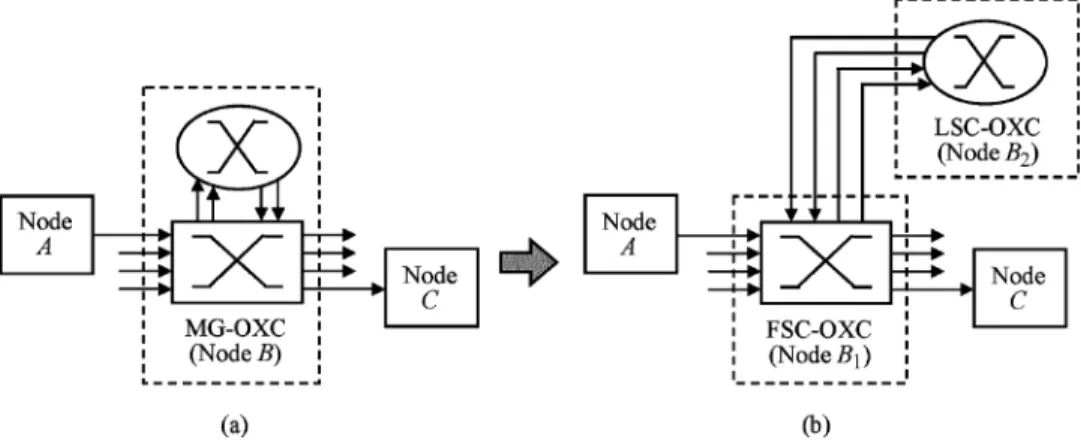
In this paper, our aim is to resolve the RWA problem in multigranularity WDM networks particularly with fiber switch capable (FSC-OXC) and lambda switch capable (LSC-OXC) devices. It is worth mentioning that, as shown in Fig. 1, an MG-OXC node is logically identical to an individual FSC-OXC node in conjunction with an external separated LSC-OXC node. For ease of illustration, we adopt the separated node form throughout the rest of the paper.
The problem is in short referred to as RWA . To tackle the problem, we propose an efficient approximation approach, called Lagrangean relaxation with heuristics (LRH). RWA is first formulated as a combinatorial optimization problem in which the bottleneck link utilization is to be minimized. The LRH approach performs constraint relaxation and derives a lower-bound solution index according to a set of Lagrangean multipliers generated through subgradient-based iterations. In parallel, using the generated Lagrangean multipliers, the LRH approach employs a new primal heuristic algorithm to arrive at a near-optimal upper-bound solution. With lower and upper bounds, we conduct a performance study on LRH with respect to accuracy and convergence speed under different parameter settings and termination criteria. We further draw comparisons between LRH and an existing practical approach [7] via ex-periments over randomly generated and several well-known large sized networks. Numerical results demonstrate that LRH 0733-8716/04$20.00 © 2004 IEEE
Fig. 1. A combined MG-OXC node and its logically identical separated node form. (a) An MG-OXC node. (b) FSC-OXC and LSC-OXC nodes.
outperforms the existing approach in both accuracy and compu-tational time complexity, particularly for larger sized networks. The remainder of this paper is organized as follows. In Section II, we first give the RWA problem formulation. In Section III, we present the LRH approach and its primal heuristic algorithm. In Section IV, we demonstrate numerical results of the performance study and comparisons under ran-domly generated and large sized networks. Finally, concluding remarks are made in Section V.
II. RWA : PROBLEMFORMULATION
The RWA problem is formulated as a linear integer problem stated as follows. Given a physical topology (with FSC-OXCs and LSC-OXCs) and available wavelengths on each link, and re-quested lightpath demands between all source-destination pairs, determine the routes and wavelengths of lightpaths, such that the maximum number of lightpaths on the most congested link is minimized, subject to the wavelength continuity constraint. For ease of illustration, we assume in the sequel that the number of available wavelengths on each link is the same.
Due to the existence of FSC nodes, a graph transformation is first required. For each FSC node with input (and output) fibers, it is replaced by a bipartite subgraph with phantom nodes connecting to input fibers, and another phantom nodes connecting to output fibers. Besides, there are additional
phantom links connecting the phantom nodes. These phantom links describe possible configuration combinations in-side an FSC node. For ease of description, we summarize the notation used in the formulation as follows.
Input values:
set of FSC nodes in the network; set of LSC nodes in the network; set of physical optical links;
set of phantom links within FSC nodes; set of phantom input nodes for node ; set of phantom output nodes for node ;
set of available wavelengths on each link; (assumed to be the same for simplicity);
set of source-destination (SD) pairs requesting light-path setup;
the set of SD pairs where node is the source node; candidate path set for SD pair ;
lightpath demand for SD pair ;
, if path includes link ; , otherwise; , if link is incident to node ; , otherwise; Decision variables:
most congested link utilization (lightpath no. ); , if lightpath uses wavelength ; , otherwise; , if phantom link is selected; , otherwise; Problem (P): subject to (1) (2) (3) (4) (5) (6) or (7) (8) or (9) (10) The objective function is to minimize the highest utilization , namely, the utilization on the most congested fiber link with the maximum number of lightpaths passing through. Constraint (1) requires that the number of wavelengths used on every link be less than that of the most congested link. Constraint (2) is the lightpath routing constraint, and restricts the lightpaths demands of all SD pairs to be satisfied. Constraint (3) indicates that for each link, there can be at most one lightpath using each length. Constraints (3) and (7) jointly correspond to the wave-length continuity constraint. In particular, due to FSC nodes, Constraints (5), (6), and (9) delineate the possible configura-tion of FSC nodes. Constraint (4) states that paths can only
LEE et al.: A LAGRANGIAN RELAXATION BASED APPROACH FOR ROUTING AND WAVELENGTH ASSIGNMENT 1743
Fig. 2. Lagrangean relaxation with heuristics (LRH).
pass through the phantom links determined by (5), (6), and (9). Finally, Constraint (10) is a redundant constraint [11] to Con-straints (3) and (4), which is added for optimization purpose.
The problem is NP-complete [7], and is unlikely to obtain an exact solution for realistic networks in real-time. The problem is approximated using the LRH approach presented in the next section.
III. THELRH APPROACH
The Lagrangean relaxation (LR) method [12]–[16] has been successfully employed to solve complex mathematical prob-lems by means of constraint relaxation and problem decompo-sition. Particularly for solving linear integer problems, unlike the traditional linear programming approach that relaxes integer into noninteger constraints, the LR method generally leaves in-teger constraints in the constraint sets while relaxing complex constraints such that the relaxed problem can be decomposed into independent manageable subproblems. Through such re-laxation and decomposition, the LR method as will be shown provides tighter bounds and shorter computation time on the optimal values of objective functions than those provided by the linear programming relaxation approach in many instances [14]. Essentially, the original primal problem is first simplified and transformed into a dual problem after some constraints are relaxed. If the objective of the primal problem is a minimization (maximization) function, the solution to the dual problem is a lower (upper) bound to the original problem. Such Lagrangean lower bound is a useful by-product in resolving the Lagrangean relaxation problem. Next, due to constraint relaxation, the lower bound solutions generated during the computation might be infeasible for the original primal problem. However, these solutions and the generated Lagrangean multipliers can serve as a base to develop efficient primal heuristic algorithms for achieving a near-optimal upper-bound solution to the original problem. Based on LR, the work reported in [15] and [16] resolved the RWA problems for multifiber WDM networks
and WDM networks with limited-range wavelength converters, respectively. To the best of our knowledge, the LR approach is first time used in this paper to resolve an RWA problem for multigranularity WDM networks.
In the sequel, we first give the transformed dual problem and the derivation of the lower bound. We then present the primal heuristic algorithm for obtaining the upper-bound solution.
A. The Dual Problem and Lower Bound
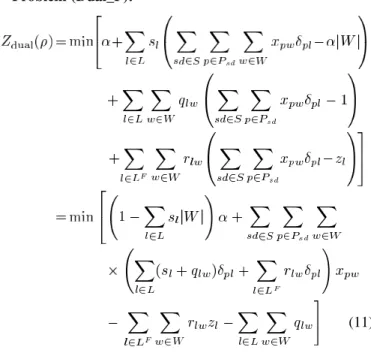
In the relaxation process, Constraints (1), (3), and (4) are first relaxed from the constraint set. As shown in the first line of (11), the three expressions corresponding to the three constraints, are respectively multiplied by Lagrangean multipliers , , and , and then summed with the original objective function. Problem (P) is thus transformed into a dual problem, called Dual_P, given as follows:
Problem (Dual_P):
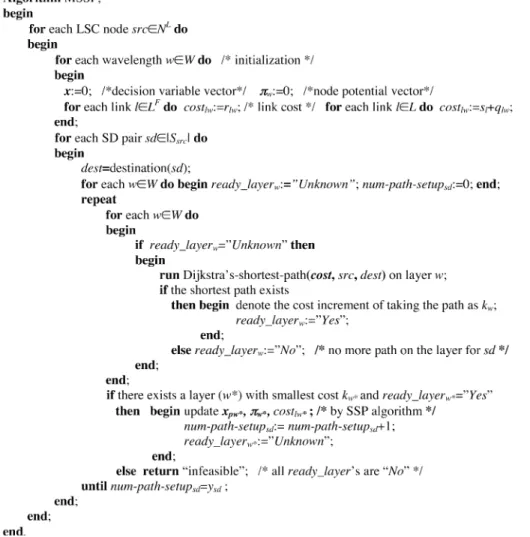
Fig. 3. MSSP algorithm.
subject to constraints (2), (5)–(10), where is
the nonnegative Lagrangean multiplier vector. To compute the Lagrangean multipliers, we adopt the subgradient method as delineated in the LRH algorithm outlined in Fig. 2. By separating decision variable , and decision variable vectors and , Problem (Dual_P) in (11) can be decomposed into three independent subproblems—S1, S2, and S3. Specifically, we have
(12)
where subproblem S1 is given by
, subject to constraint
(8); subproblem S2 is given by
, subject to constraints (2),
(7), and (10); and subproblem S3 is given by
, subject to constraints (5), (6), and (9).
First, subproblem S1 is to determine the decision variable . Clearly, is set to 1 if the corresponding cost
is negative; otherwise, is set to 0. Thus, S1 requires com-putation time. Second, subproblem S2 is to compute the decision variable vector . There exist (one for each source node) independent problems, each of which is an edge-disjoint-path
problem, starting from the given source node and destined to all destination nodes of the SD pairs with nonzero lightpath demands. Due to multiple wavelengths on each link, the network can be viewed as a layered graph with a total of layers, where each layer corresponds to each wavelength. Each layer then
con-tains links and nodes. Notice that each
link can be designated with unit flow capacity and a nonnegative cost, for example, , for each nonphantom link.
Accordingly, the edge-disjoint-path problem for each source corresponds to a minimum-cost flow problem. Ultimately, with layers considered as a whole, the minimum-cost flow problem can be solved by the successive shortest path (SSP) algorithm [14]. However, the integrated problem requires high computational time complexity provided with large values of . To reduce the complexity, we employ a modified successive shortest path (MSSP) algorithm as shown in Fig. 3. In the algorithm, we treat each layer graph individually and perform incremental selection of minimum-cost edge-disjoint path (from one layer). The computational complexity of MSSP
for each SD pair is , where ,
, and . All decision
vari-ables ’s for S2 can be obtained by repeatedly applying the MSSP algorithm for all sources. Finally, subproblem S3 is to resolve decision variable vector . The problem can be further decomposed into (one for each FSC node) independent
LEE et al.: A LAGRANGIAN RELAXATION BASED APPROACH FOR ROUTING AND WAVELENGTH ASSIGNMENT 1745
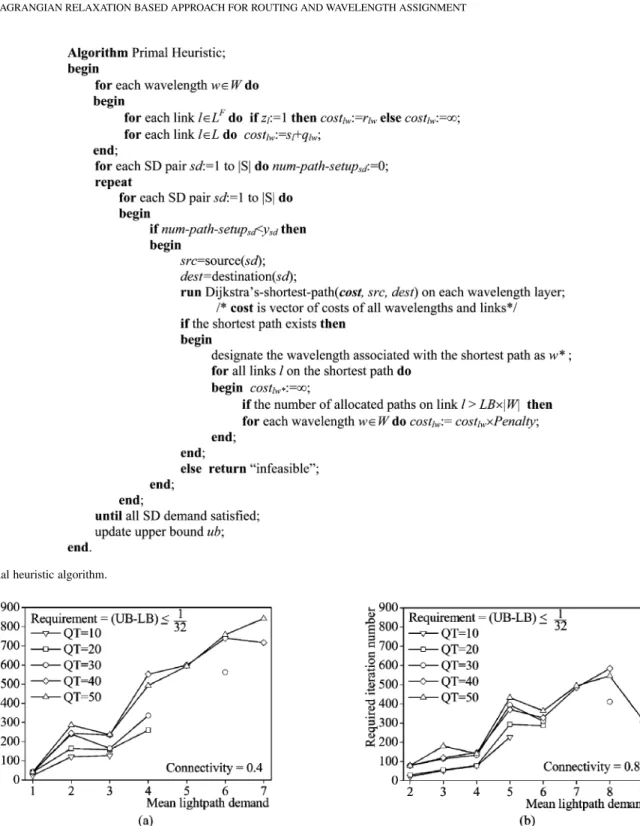
Fig. 4. Primal heuristic algorithm.
Fig. 5. Convergence speed versus accuracy on the basis of using termination requirement. (a) Sparse network. (b) Dense network.
problems, each of which can be optimally solved by a bipartite weighted matching algorithm. Thus, for an bipartite graph, the problem requires computation time.
According to the weak Lagrangean duality theorem [14], in (12) is a lower bound of the original Problem (P) for any
nonnegative Lagrangean multiplier vector .
Clearly, we are to determine the greatest lower bound. Equation (12) can be solved by the subgradient method, as shown as a part of the LRH approach in Fig. 2. As shown in Fig. 2, the algorithm is run for a fixed number of iterations (i.e.,
Itera-tion_Number). (Notice that the algorithm can also be driven by
given a termination requirement, as will be shown in the next
section). In every iteration, the three subproblems (S1–S3) are solved (described above), resulting in the generation of a new Lagrangean multiplier vector value. Then, according to (12), a new lower bound is generated. If the new lower bound is tighter (greater) than the current best achievable lower bound (LB), the new lower bound is designated as the LB. Otherwise, the LB value remains unchanged.
Significantly, if the LB value remains unimproved for a number of iterations that exceeds a threshold, called
Qui-escence_Threshold (QT), the step size coefficient of the subgradient method is halved, in an attempt to reduce oscillation possibility. Specifically, to update the step size and multiplier
Fig. 6. Convergence speed versus accuracy on the basis of using fixed iteration number. (a) Sparse network. (b) Dense network.
Fig. 7. Network topology. (a) NET1 (seven nodes). (b) NET2 (ten nodes). (c) NET3 (11 nodes). vector as specified in Fig. 2, the Lagrangean multiplier vector
is updated as , where is the step size,
determined by , in which
is the step size coefficient, is the current achievable least upper bound obtained from the primal heuristic algorithm described next, and is a subgradient of with vector
size .
B. The Primal Heuristic Algorithm and Upper Bound
The primal heuristic algorithm in the LRH approach is used to find an updated upper bound . Similar to the lower bound case, as given in Fig. 2, if the new upper bound is tighter (smaller) than the current best achievable upper bound (UB), the new upper bound is designated as the UB.
As shown in Fig. 4, the algorithm first settles the phantom links suggested by the solution to subproblem S3 for all FSC nodes, reducing the problem complexity. The cost of each link is designated as the Lagrangean multipliers previously obtained. Clearly, the cost of unaccepted phantom links are set to , excluding them from subsequent path consideration. The rithm then repeatedly applies the Dijkstra’s shortest path algo-rithm in an effort to satisfy the lightpath demands of all SD pairs. At the end of the computation, the costs of those links associ-ated with the selected wavelengths/paths are set to to prevent the links from being considered by other upcoming iterations. If the number of wavelengths (lightpaths) used on a link is greater than the current tightest lower bound multiplied by , indi-cating potential congestion, the cost of the link is then scaled by multiplying by a constant, referred to as the penalty term. This
is to avoid further lightpath setup through this link. The process repeats until either the lightpath demands of all SD pairs are satisfied (i.e., feasible), or there is no remaining resource (i.e., infeasible) in the network.
IV. EXPERIMENTALRESULTS
We have carried out a performance study on the LRH approach, and drawn comparisons between LRH and the Banerjee–Mukherjee approach [7] via experiments over ran-domly generated networks. Given the total number of nodes, say , the greatest possible number of bidirectional links is , where is the combination operation. Then, for a network with nodes and connectivity , it is generated by
randomly selecting out of the bidirectional
links of the network. In the experiments, we used 32 wave-lengths on each fiber link (i.e., ) for all networks.
A. Performance Study
We carried out two sets of experiments over 15-node random networks with two connectivities and , which cor-respond to sparse and dense networks, respectively. In the first set of experiments, the LRH algorithm was terminated when the gap between the UB and the LB on was less than or equal to one out of the maximum number of wavelengths, or the number of iterations exceeds 2000. While the former condition corresponds to reaching a near-optimal upper bound solution, the latter condition represents abnormal termination due to the failure of achieving such accuracy or solution infeasibility. We
LEE et al.: A LAGRANGIAN RELAXATION BASED APPROACH FOR ROUTING AND WAVELENGTH ASSIGNMENT 1747
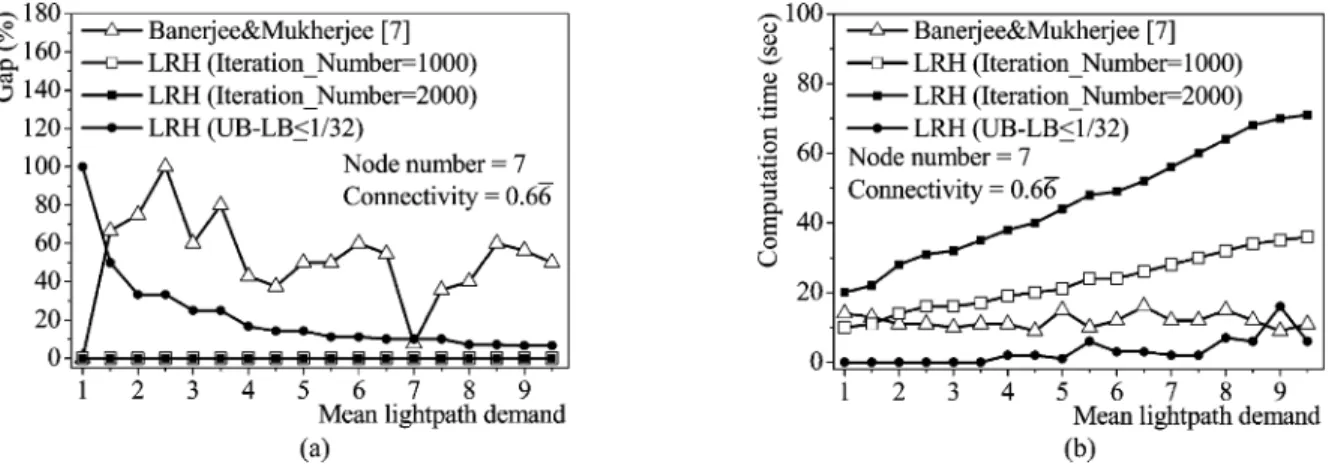
Fig. 8. Comparisons of accuracy and computation time for random network NET1. (a) Accuracy for NET1. (b) Computation time for NET1.
Fig. 9. Comparison of accuracy for random networks NET2 and NET3. (a) NET2 with two FSC nodes. (b) NET3 with two FSC nodes. (c) NET2 with four FSC nodes. (d) NET3 with four FSC nodes.
examine the total number of iterations required as a function of the mean lightpath demand under different QT values. Numer-ical results are plotted in Fig. 5. Notice that the absence of data under certain demands corresponds to abnormal termination.
First, we observe that the dense network in general requires less number of iterations before reaching a near-optimal solu-tion. Significantly, we discover from the figure that parameter QT plays a key role in the performance tradeoff between conver-gence speed and accuracy. Smaller values of QT, which imply frequent updates of the subgradient step-size coefficient, yield faster convergence to near-optimal solutions but at the cost of failing to reach accurate solutions under heavier lightpath
de-mands. Greater QT values on the other hand result in completely opposite performance.
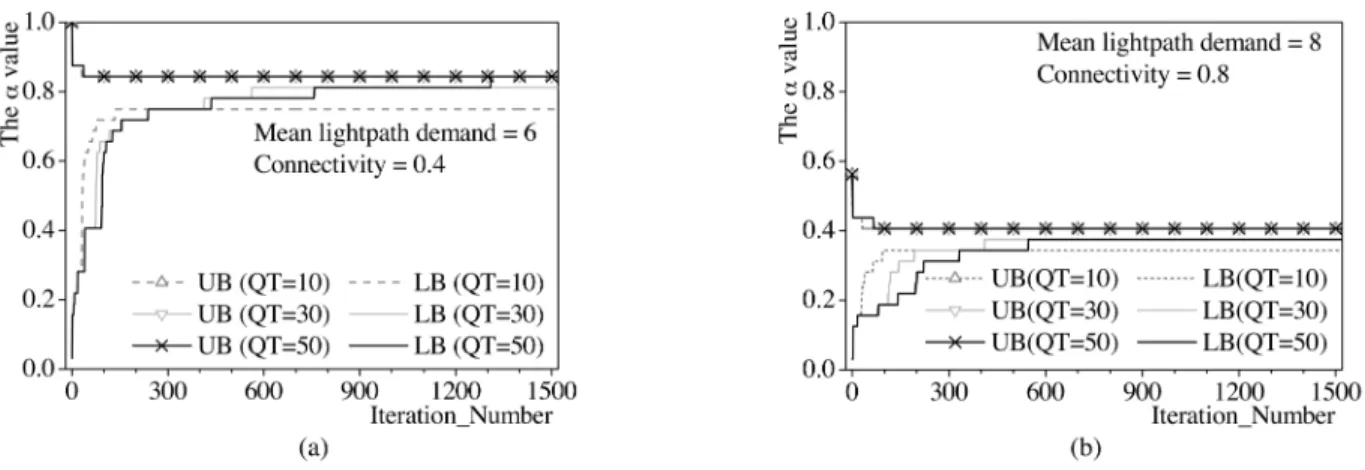
In the second set of experiments, the LRH algorithm was terminated when the number of iteration exceeded a predeter-mined Iteration_Number, ranging from 0 to 1500. Numerical results are displayed in Fig. 6. We study both the lower and upper bounds on under different QT values. We observe that while the upper bound performance is irrelevant to QT, the lower bound performance is highly dependent on the QT setting in the same manner as above. Specifically, smaller QT values yield faster convergence but only to looser lower bounds, while larger QT values result in tighter lower bounds through gradual
con-Fig. 10. Comparison of computation time for random networks NET2 and NET3. (a) NET2 with two FSC nodes. (b) NET3 with two FSC nodes. (c) NET2 with four FSC nodes. (d) NET3 with four FSC nodes.
vergence over a larger number of iterations. This fact reveals that, by adjusting the QT value, the LRH approach is capable of balancing the tradeoff between accuracy and efficiency for re-solving various types of RWA problems.
B. Performance Comparisons
We further draw comparisons of accuracy and computation time between our LRH approach and a linear programming relaxation (LPR)-based method, i.e., Banerjee–Mukherjee [7]. For generating networks, it is impractical to experiment on networks with smaller numbers of nodes and links. However, for networks with greater than 11 nodes, we experienced that the computation time using the LPR method became unman-ageable. Accordingly in the experiment, we considered three random networks, NET1, NET2, and NET3, as shown in Fig. 7. NET1 consists of seven nodes including two FSC nodes, and 14 bidirectional links, corresponding to a connectivity of . NET2 consists of ten nodes including two FSC (nodes 1–2) or 4 FSC (nodes 1–4) nodes, and 20 bidirectional links, corresponding to a connectivity of . Finally, NET3 con-sists of 11 nodes including two FSC (nodes 1–2) or four FSC (nodes 1–4) nodes, and 22 bidirectional links, corresponding to a connectivity of 0.4. Results are plotted in Figs. 8–10.
In the computation using our LRH approach, we adopted QT and three different termination criteria. The three criteria are: Iteration Number , and requirement . The algorithm was written in the C language and operated on a PC running Windows XP with a 2.53 GHz CPU power. In the LPR-based method, by removing
constraints (7) and (9), the original integer linear programming (ILP) problem is relaxed to a linear programming (LP) problem. Thus, the solution to the relaxed problem is a legitimate lower bound of the original ILP problem. The upper bound is then obtained according to the randomization procedure proposed in [7]. In the experiment, the LP problem was solved using the CPLEX software, operating in the same PC environment. For both approaches, the accuracy is measured in terms of the Gap(%), which is defined as the ratio of the difference of the UB and LB values to the LB value in percentage.
First, we draw comparisons of accuracy and computation time between the LRH approach and the LPR method for random network NET1, as plotted in Fig. 8. Notice that the LRH approach using fixed iteration numbers outperforms the LPR method in accuracy under all lightpath demands. How-ever, it appears that the LRH method using the termination requirement yields a high gap under low demands. This is only due to the magnification of the gap resulting from being divided by a small LB value under low demands. In pafrticular, under demand , the algorithm was terminated with UB
and LB , resulting a 100% gap. Surprisingly, we
discover from part of Fig. 8(b) that the LPR method requires less computation time than that of the LRH approach using fixed iterations. This indicates that LPR is an efficient approach particularly for smaller size networks.
For random networks with size over ten nodes (NET2 and NET3) as shown in Figs. 9 and 10, the LPR method yields larger gaps, namely, poorer accuracy, and demands exponen-tially increasing computation time. In contrast, the LRH
ap-LEE et al.: A LAGRANGIAN RELAXATION BASED APPROACH FOR ROUTING AND WAVELENGTH ASSIGNMENT 1749
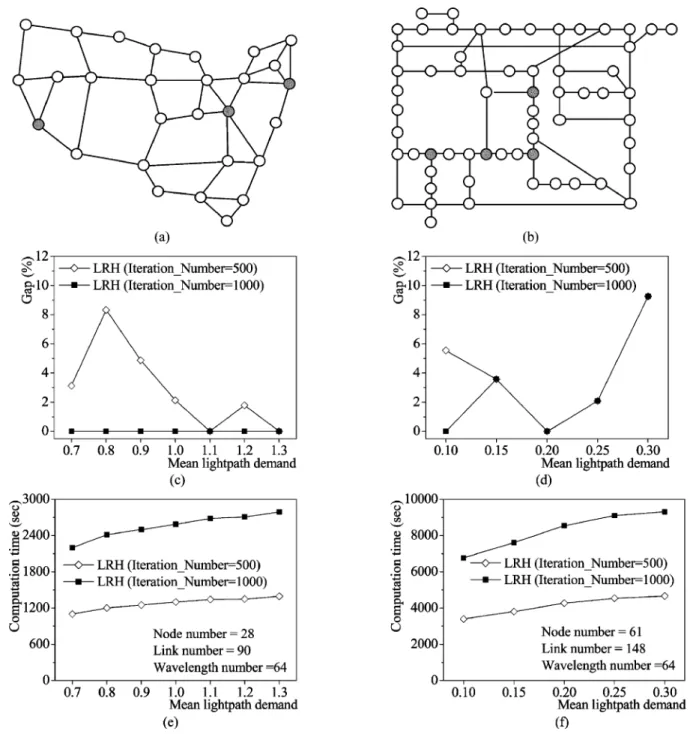
Fig. 11. LRH results for large sized networks. (a) USA network: topology. (b) ARPA network: topology. (c) USA network: computation accuracy. (d) ARPA network: computation accuracy. (e) USA network: computation time. (f) ARPA network: computation time.
proach achieves identical lower and upper bounds, namely, the optimal solutions under several lightpath demand cases. In fact, we discover that both LRH and LPR approaches achieve tight lower bounds. Significantly, the LRH heuristic algorithm ar-rives at much improved upper bounds due to the use of the Lagrangean multipliers derived upon seeking the Lagrangean relaxation solution. It is worth noticing that the results of the LRH approach using the termination requirement are not shown in Figs. 9 and 10. This is due to its high accuracy and low com-putation time, yielding impossible plotting within the figures. Specifically, we discover from Fig. 9 that the LRH approach using the 1000 iterations achieves as high accuracy as that using the 2000 iterations under most demand cases. Significantly, the
approach using the requirement for NET2
reaches the small gap within only a total of (8, 40, 164, 480, 339, 287, 137, 424) iterations for lightpath demands ranging from 1 to 8, respectively.
Furthermore, as shown in Fig. 10, the LRH approach out-performs the LPR method in computation time by at least one order of magnitude under all cases. Notice that the LRH ap-proach using the termination requirement incurs exceptionally low computation times that are equal to (0, 1, 7, 24, 18, 17, 9, 31) for eight lightpath demands, respectively. In this case, compared to the LPR method, the LRH approach offers an improvement of computation time by more than two orders of magnitude.
To observe the performance of our LRH approach for large sized networks, we carried out experiments on two well-known networks, i.e., USA and ARPA, as shown in Fig. 11(a) and (b),
a guarantee of no more than 9.3% gap in less than 9400 s com-putation time. We particularly observe from Fig. 11(d) that the accuracy of the LRH approach based on the 500-iteration ter-mination criterion is as high as that based on the 1000-iteration termination criterion under most lightpath demand cases. This again demonstrates the superiority of the LRH approach to the RWA problem with respect to both computation accuracy and time complexity for large sized networks.
V. CONCLUSION
In this paper, we have resolved a RWA problem using the LRH method, which is a Lagrangean relaxation based approach augmented with an efficient primal heuristic algorithm. With the aid of generated Lagrangean multipliers and lower bound indexes, the primal heuristic algorithm of LRH achieves a near-optimal upper-bound solution. A performance study de-lineated that the performance tradeoff between accuracy and convergence speed can be manipulated via adjusting the qui-escence threshold parameter in the algorithm. We have drawn comparisons of accuracy and computation time between LRH and the LPR-based method, under three random networks. Experimental results demonstrated that, particularly for small to medium sized networks, the LRH approach using a termina-tion requirement profoundly outperforms the LPR method and fixed-iteration-based LRH, in both accuracy and computational time complexity. Furthermore, for large sized networks, i.e., the USA and ARPA networks, numerical results showed that LRH achieves a near optimal solution within acceptable com-putation time. The above numerical results justify that the LRH approach can be used as a dynamic RWA algorithm for small to medium sized networks, and as a static RWA algorithm for large sized networks.
ACKNOWLEDGMENT
The authors deeply thank the anonymous reviewers for the valuable comments and suggestions that greatly improved the presentation of the paper.
REFERENCES
[1] B. Mukherjee, “WDM optical communication networks: progress and challenges,” IEEE J. Select. Areas Commun., vol. 18, pp. 1810–1824, Oct. 2000.
[2] R. Ramaswami and G. Sasaki, “Multiwavelength optical networks with limited wavelength conversion,” IEEE/ACM Trans. Networking, vol. 6, pp. 744–754, Dec. 1998.
[9] H. Qin, S. Zhang, and Z. Liu, “Dynamic routing and wavelength assign-ment for limited-range wavelength conversion,” IEEE Commun. Lett., vol. 7, pp. 136–138, Mar. 2003.
[10] A. Mokhtar and M. Azizoglu, “Adaptive wavelength routing in all-op-tical networks,” IEEE/ACM Trans. Networking, vol. 6, pp. 197–206, Apr. 1998.
[11] B. Gavish, P. Trudeau, M. Dror, M. Gendreau, and L. Mason, “Fiberoptic circuit network design under reliability constraints,” IEEE J. Select.
Areas Commun., vol. 7, pp. 1181–1187, Oct. 1989.
[12] H. Chen, C. Chu, and J. Proth, “An improvement of the Lagrangean relaxation approach for job shop scheduling: a dynamic programming method,” IEEE Trans. Robot. Automat., vol. 14, pp. 786–795, Oct. 1998. [13] M. Guignard, “On solving structured integer programming problems with Lagrangean relaxation and/or decomposition,” in Proc. IEEE
De-cision and Control, Dec. 1989, pp. 1136–1141.
[14] R. Ahuja, T. Magnanti, and J. Orlin, Network Flows: Theory, Algorithms,
and Applications. Englewood Cliffs, NJ: Prentice-Hall, 1993. [15] M. Saad and Z. Luo, “A Lagrangean decomposition approach for the
routing and wavelength assignment in multifiber WDM networks,” in
Proc. IEEE GLOBECOM ’02, pp. 2818–2822.
[16] Y. Zhang, O. Yang, and H. Liu, “A Lagrangean relaxation approach to the maximizing-number-of-connection problem in WDM networks,” in Proc. IEEE Workshop on High Performance Switching and Routing, 2003.
Steven S. W. Lee received the B.S. degree in electrical engineering from Tatung Institute of Technology, Taipei, Taiwan, R.O.C., in 1992 and the Ph.D. degree in electrical engineering from National Chung Cheng University, Chiayi, Taiwan, in 1999.
In 1999, he the joined Computer and Communica-tions Laboratories of Industrial Technology Research Institute (CCL/ITRI), Taiwan, where he is currently a Section Manager in the Department of Optical Com-munications and Networking Technologies. His re-search interests include high-speed communication networks, optimization theory, optical network design, and modeling.
Maria C. Yuang received the B.S. degree in applied mathematics from the National Chiao Tung Uni-versity, Hsinchu, Taiwan, R.O.C., in 1978, the M.S. degree in computer science from the University of Maryland, College Park, in 1981, and the Ph.D. de-gree in electrical engineering and computer science from the Polytechnic University, Brooklyn, NY, in 1989.
From 1981 to 1990, she was with AT&T Bell Lab-oratories and Bell Communications Research (Bell-core), where she was a Member of Technical Staff working on high-speed networking and protocol engineering. She was also an Adjunct Professor in the Department of Electrical Engineering, Polytechnic University, during 1989–1990. In 1990, she joined National Chiao Tung Univer-sity, where she is currently a Professor of the Department of Computer Science and Information Engineering. Her current research interests include optical and broad-band networking, wireless local/access networking, multimedia commu-nications, and performance modeling and analysis.
LEE et al.: A LAGRANGIAN RELAXATION BASED APPROACH FOR ROUTING AND WAVELENGTH ASSIGNMENT 1751
Po-Lung Tien received the B.S. degree in applied mathematics, the M.S. degree in computer and in-formation science, and the Ph.D. degree in computer and information engineering from the National Chiao Tung University, Hsinchu, Taiwan, R.O.C., in 1992, 1995, and 2000, respectively.
In 2000, he joined National Chiao Tung University, where he is currently a Research Assistant Professor of the Department of Computer Science and Infor-mation Engineering. His current research interests in-clude optical networking, wireless local networking, multimedia communications, performance modeling and analysis, and applica-tions of soft computing.
Shih-Hsun Lin received the B.S. degree from the De-partment of Computer Science, National Tsing Hua University, Hsinchu, Taiwan, R.O.C., in 2002. He is currently working toward the Ph.D. degree in the De-partment of Computer Science and Information En-gineering, National Chiao Tung University, Hsinchu. His research interests include wireless data net-works, performance modeling and analysis, and optimization theory.