Experimental characterization of
phenanthrenequinone-doped poly
„
methyl
methacrylate
…
photopolymer for volume
holographic storage
Ken Y. Hsu,MEMBER SPIE National Chiao Tung University Institute of Electro-Optical Engineering Hsin-Chu, Taiwan, R.O.C.
Shiuan Huei Lin,MEMBER SPIE National Chiao Tung University Department of Electrophysics Hsin-Chu, Taiwan, R.O.C. Yi-Nan Hsiao
Wha Tzong Whang
National Chiao Tung University Institute of Materials Science and
Engineering
Hsin-Chu, Taiwan, R.O.C.
Abstract. We present an experimental study on the photopolymer poly-(methyl methacrylate) doped with phenathrenequinone molecules. Mate-rial characteristics for holographic data storage, including optical charac-teristics, scattering effect, relation between diffraction efficiency and number of holograms, and exposure schedule for multiple storage, are investigated. An experimental demonstration of multiple storage of digital data pages in a polymer cube is presented. © 2003 Society of Photo-Optical Instrumentation Engineers. [DOI: 10.1117/1.1564102]
Subject terms: holographic data storage; photopolymer material; PQ:PMMA. Paper 020353 received Aug. 16, 2002; revised manuscript received Oct. 28, 2002; accepted for publication Oct. 29, 2002.
1 Introduction
Holographic data storage has been considered as one of the next-generation information storage technologies because of its large storage capacity and fast data access. By using a suitable multiplexing scheme, thousands of pages of optical information can be recorded onto one location of a record-ing medium. The recorded information can then be read out in a page format with ultrahigh data rate. Holographic data storage systems with large storage capacity, high data read-out rate, good image quality, and low bit error rate have been proposed and demonstrated.1,2
The main components necessary for this technology are optical spatial light modulators 共SLMs兲, a detector array, and a holographic recording medium. The first two are the interface devices for optical data input and output. In recent years, rapid advances in liquid-crystal displays共LCDs兲 and charge-coupled devices 共CCDs兲 have yielded high-quality input and output devices that are capable of operating at one million bits per frame. However, lack of a suitable recording material still obstructs further development of holographic data storage. Recently, many experiments have demonstrated the feasibility of using polymer-based mate-rials for holographic data storage.3–9
For a good holographic recording material, many char-acteristics are required, such as high optical sensitivity, a simple development procedure, uniform spatial-frequency response, large diffraction efficiency, high optical quality, and long-term stability. For volume holographic storage us-ing thick materials, good dimensional stability is the most characteristic requirement. It has been shown that a few percent of dimensional change in the recording material during共or after兲 holographic recording will result in a loss of Bragg condition such that the recorded information can-not be read out completely. The thicker the material, the more serious the shrinkage effect.10–12As a result, typical
photopolymer holographic materials are limited to a few millimeters in thickness.
To alleviate the shrinkage effect in thick materials, some techniques for fabricating photopolymer materials have been proposed and demonstrated.10,13–16Among these re-cording materials, poly共methyl methacrylate兲 共PMMA兲 is one of the most popular polymer bases for the binder, due to its good dimensional stability and good optical quality. Recent research has shown that PMMA doped with phenan-threnequinone共PQ兲 could be very attractive for volume ho-lographic recording because it is easy to form in bulk with negligible photochemically induced dimensional change and good optical quality.7,13–16
In this paper, we present our experimental investigations into bulk PQ-doped PMMA. In Sec. 2, we describe the design strategy and the procedure for making thick polymer samples with good optical quality. Then, in Sec. 3, we in-vestigate the optical characteristics of the material. In Sec. 4, we present the holographic characteristics of the samples for multiple hologram storage. The coefficient in the depen-dence of diffraction efficiency on number of holograms is measured, and exposure schedules for achieving uniform diffraction efficiency are presented. In Sec. 5, multiple stor-age and reconstruction of 250 holograms in a 1⫻1 ⫻1-cm3 cube is demonstrated experimentally. Finally, some conclusions are given in Sec. 6.
2 Material Preparation
We first describe our strategy for making bulk samples of PQ:PMMA. The aim is to make a thick photopolymer ma-terial that undergoes minimal dimensional shrinkage during holographic recording. Typical photopolymer materials consist of a photopolymerizable monomer, a photoinitiator, and a sensitizer in a polymer binder.3–5During the optical
One way to alleviate the shrinkage problem is to sepa-rate the photochemical reaction during holographic record-ing from the polymerization of the host monomer mol-ecules during material preparation. This can be achieved if the material operation can be arranged so that the host poly-mer matrix is responsible for supporting the binder matrix and the doped molecules are only the photosensitive ele-ments responsible for forming the refractive index holo-grams.
In making the PQ:PMMA samples, our strategy is to form the host polymer matrix during the material prepara-tion so that only a few percent of unreacted monomer mol-ecules are left for optical exposure usage during holo-graphic recording. It is known that the polymer matrix PMMA can be formed through the thermal chain reaction of MMA monomers by using the thermal initiator azobi-sisobutyronitrile 共AIBN兲. The key point is to control the environmental parameters for material preparation so that the most of the monomer molecules will be polymerized and only the necessary percentage of unreacted monomer molecules will be left in the material.
After a series of experiments, we have found that a two-step procedure can produce bulk samples of PQ:PMMA with good optical quality.13,14In the first step,⬇0.5 wt% of AIBN and up to 0.7 wt% of PQ molecules were dissolved in a solvent MMA and mixed thoroughly to form a uniform solution. The solution was purified, poured into a glass con-tainer, and then put in a pressured chamber. In this stage, the temperature was kept at room temperature for about 120 h until the solution turned homogeneously viscid. Dur-ing this period, because of the low rate of thermopolymer-ization at low temperature, the nitrogen molecules released from the thermodecomposition of AIBN and the heat pro-duced from the chain propagation of the MMA monomers could leave the liquid completely. This technique could avoid formation of residual air bubbles and thus reduce the scattering centers in the sample. In the second step, the temperature of the chamber was elevated to 45 °C and held for 24 h to accelerate the thermodecomposition of AIBN. The chain reaction was accelerated and the polymerization was completed. The sample then became a solid block with good optical quality.
In order to measure the ratio of the residual MMA mol-ecules in our PQ:PMMA polymers we performed thermal gravimetric analysis using a DuPont thermal gravimetric analyzer. The result is shown in Fig. 1. It is seen that our sample shows a thermally induced weight change in two stages. In the first stage, which occurs at temperatures be-low 304 °C, the weight loss is about 10%. In the second stage, which occurs at temperatures above 304 °C, the weight loss is about 90%. Since an MMA molecule is much smaller than a PMMA molecule, the decomposition tem-perature of the MMA is lower than that of the PMMA.
Hence, we can attribute the weight decrease in the low-temperature regime to the thermally induced loss of MMA molecules, and the weight decrease in the high-temperature regime to the loss of PMMA polymer. This implies that in our PQ:PMMA samples about 90% of MMA molecules are polymerized to form PMMA 共before thermopolymeriza-tion兲 and about 10% of MMA molecules remain as residual monomers. These residual monomers, together with the PQ molecules, can be used for holographic recording.
During the holographic recording, the photosensitive PQ molecules absorb photons and become radicals, so that they can bond with those⬇10% residual monomer molecules. Preliminary studies on the mechanism of holographic re-cording in PQ:PMMA showed that the bonding of PQ to MMA could be made one to one.15 This bonding of the molecules can induce a strong change in the refractive in-dex. Consequently, a large difference in the refractive index between the dark region and the bright region is created. During this exposure procedure, the photosensitizers and residual monomers that are involved in forming the holo-gram are only a small fraction of the material composition. Thus, the host polymer matrix structure can be maintained unaffected during the optical recording. As a result, the dimensional shrinkage and the bulk refractive index change induced by the recording process can be minimized. 3 Optical Characteristics of the Samples
Our PQ:PMMA samples are yellowish, with clear optical transmission. We have measured the optical transmission spectrum of the samples at different thicknesses. The samples possess strong absorption below blue wavelength 共⬍450 nm兲, and they are totally transparent for wave-lengths longer than 540 nm. In the following experiments we used an argon laser with wavelength 514.5 nm. At this wavelength, the absorption of a 1.2-mm-thick sample is ⬇30.2%, and that of a 2.4-mm-thick sample is ⬇44%. The corresponding absorption coefficient is⬇2.7 cm⫺1.
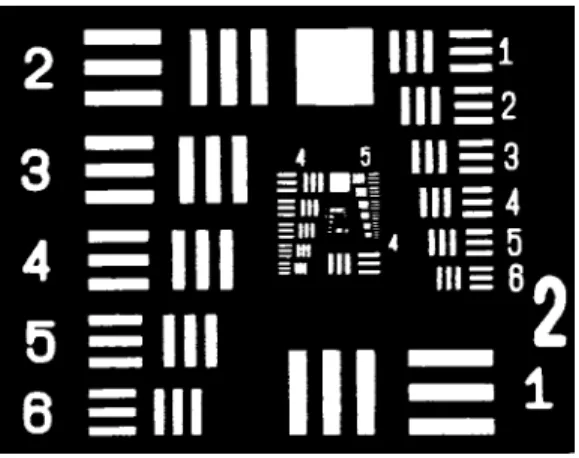
To test the optical quality of our sample, we used a USAF resolution test chart as the input image to illuminate a 4.8-mm-thick sample. The sample is placed near the Fou-rier plane of the imaging lens. Figure 2 shows a photograph of a directly transmitted image. It can be seen that the im-age retains a clear fidelity, which is down to number 6 of group 5. Thus, the resolution capability is estimated to be at ⬃95 lp/mm, which is close to the resolution limit of our CCD. The distortion of the image and the scattered noise Fig. 1 Thermal gravimetric analysis for photopolymer with different prepolymerization temperatures.
seem to be very small. For volume holographic storage, thousands of pages will be superimposed at a single loca-tion of a thick recording material. As the number of re-corded pages becomes large, the diffraction efficiency of each hologram will become very weak共typically less than 10⫺6), and particular attention must be paid to keeping material scattering noise to a minimum. Thus, it is very important to grow a material with very few scattering cen-ters and with high homogeneity in the refractive index. Our two-step technique for material preparation seems to pro-duce samples with satisfactorily uniform refractive index suitable for high-density holographic storage.
4 Characteristics for Holographic Data Storage 4.1 Holographic Recording of the Sample
We first wrote a hologram in a PQ:PMMA sample 4.8 mm thick. Two beams of collimated light from an argon laser were symmetrically incident into the sample with an inter-section angle of 32 deg outside the sample. This recording angle is not optimized for our samples. After a series of experiments at different recording angles, we found that the samples have reasonably wide spatial-frequency response. The details for spatial-frequency response measurement are given in the following section. During the single-grating recording, the diffraction efficiency is measured in real time by use of a weak 632.8-nm He-Ne-laser beam at the Bragg-matched angle. The measured curve is shown in Fig. 3. It is seen that the diffraction efficiency共the diffracted light in-tensity divided by the transmitted light inin-tensity plus the
diffracted light intensity of the reading beam after the sample兲 reaches a maximum of 60% at the exposure energy of 0.3 J/cm2, and then it begins to drop on further exposure. At that moment, we also observed distortions in the geo-metrical shape of the transmitted beam. The beam distor-tion and the drop of diffracdistor-tion efficiency are considered to be caused by noise gratings. The noise gratings were ini-tially formed by the scattered beams, which were produced by scattering centers such as microscopic air bubbles and/or the nonuniformity of the refractive index of the photopoly-mer. Because of the long interaction length in the bulk vol-ume, the scattered beams interfered and the noise gratings were formed and accumulated. This effect could further enhance the nonuniformity of the refractive index of the photopolymer. Thus, the scattering became worse. When the noise gratings became strong, most energy of the inci-dent light was scattered and the diffracted beam became weakened and distorted. The implication of this cumulative effect of the scattered noise is that there should be an upper limit to the exposure time for each holographic recording; otherwise the noise grating will deteriorate the recon-structed image.
In order to determine the upper limit for a single expo-sure time, we have performed an experiment to quantify the scattering effect. A collimated laser beam with 4 mW/cm2 and 6-mm diameter was incident on a 2.4-mm-thick PQ:PMMA block. We measured the transmitted power within the incident beam as a function of time. As the ex-posure continues, the scattered noise arises and the directly transmitted power becomes weaker and weaker. If we plot the scattering ratio, defined as the total power scattered outside the beam geometry divided by the initially trans-mitted beam power, against the exposure, then the dynam-ics of the scattering can be observed, as shown in Fig. 4. It can be seen that the scattering ratio rose to 70% when the exposure energy reached 2.08 J/cm2. This curve implies that, in order to avoid the buildup of the strong scattering of the recording beams, an upper limit for a single exposure time is necessary. In practice, the optimal exposure time can be determined by taking account of the dynamics of the scattering ratio and also the acceptable signal-to-noise ratio of the photodetector device.
4.2 Diffraction Efficiency of the PQ:PMMA Samples The dynamic range of a holographic material is a criterion for describing its capability for multiple recording. For a given number of exposures, larger dynamic range of the material will give higher diffraction efficiency of each ho-logram. Put another way, if the sensitivity of the photode-Fig. 2 Photograph of an image transmitted through a 4.8-mm-thick
photopolymer block.
Fig. 3 Dynamics of a single holographic grating recorded in 4.8-mm-thick photopolymer sample.
tector is given, the minimum detectable power is deter-mined and thus the necessary diffraction efficiency of each hologram is fixed. A material with larger dynamic range will then be able to record more holograms. For a multi-plexed holographic storage with equal diffraction efficiency for each hologram, the diffraction efficiency of each holo-gram is inversely proportional to the square of the number of holograms. If we denote the constant of proportionality by M#, so that
final⫽共M#/N兲2, 共1兲
wherefinalis the diffraction efficiency of each hologram and N is the total number of holograms, then M#represents a characteristic of the material. According to the previous explanation of the minimum required diffraction efficiency,
M# is proportional to the maximum number of recordings and thus is a representation of the dynamic range of the material.17If the each multiplexed hologram has a different diffraction efficiency, then the previous definition of M# can be modified as7,8
M#⫽
兺
i⫽1 N0
冑
i, 共2兲where N0 represents the largest number of holograms that can be recorded in the material before the material has been exhausted.
In order to find the M# of our samples, we performed a hologram recording using the technique of peristrophical multiplexing.18Three hundred fifty plane-wave holograms, each with the same exposure energy 共⬇8 mJ/cm2兲, were recorded at a single location of the polymer samples. The diffraction efficiency of each hologram was measured, and then the square roots of the diffraction efficiencies were summed to obtain a running curve of the cumulative grat-ing strength共defined as C⫽兺iN⫽1
冑
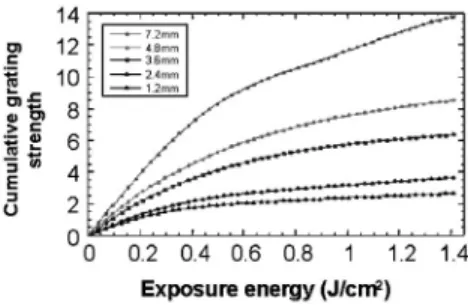
i, where N is the total number of exposed holograms兲 as a function of the cumu-lative exposure energy. Since M#is a systematic parameter, it depends not only on the material but also on the record-ing geometry.First, we measure the running curves for polymer samples with different thickness. The results are given in Fig. 5. These curves indicate the recording dynamics of our PQ:PMMA samples. According to Eq.共2兲, saturation value of the cumulative grating strength is equal to M#. Thus, the
M# of our photopolymer sample with different sample
thickness can be estimated by using Fig. 5, as shown in Fig. 6. It can be seen that in Fig. 6, M# increases linearly with the thickness of the polymer samples, and for the 7.2-mm-thick samples it can be as large as 14. According to the diffraction formula for a volume phase grating, the refrac-tive index change of the photopolymer can be estimated to be 3.1⫻10⫺4.
In addition, we investigated the dependence of M# on recording angle. The results for 1-mm-thick samples are shown in Fig. 7. It can be seen that M#remains constant as the recording angle changes from 10 to 50 deg. These re-sults demonstrate that our PQ:PMMA samples have reason-ably wide spatial-frequency response for the transmission-type holograms. In fact, the material also works well for larger recording angles, such as the 90-deg geometry to be described in Sec. 5.
4.3 The Exposure Schedule for Multiple Holographic Storage
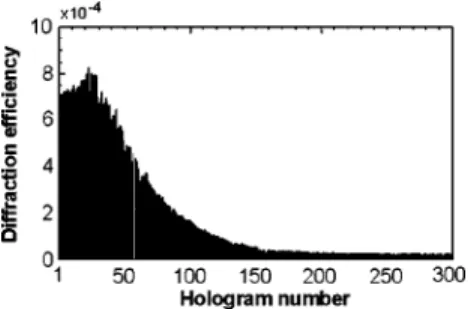
Figure 8 shows the diffraction efficiencies of 355 holo-grams, which were peristrophically共1-deg rotation between holograms兲 multiplex-recorded in a 4.8-mm-thick sample. Each hologram was recorded with the same exposure en-ergy of 8 mJ/cm2. It can be seen that there is a big differ-ence in diffraction efficiencies between the initial and final holograms. For the beginning exposures, the diffraction ef-ficiency of each hologram remains almost constant, and then it decreases as the exposure number is increased. This phenomenon is understandable in that as the exposure is increased the PQ molecules of the photopolymer material start to be exhausted and thus the holograms become weaker and weaker. This behavior is manifested by the Fig. 5 The cumulative grating strength of multiple hologram storage
for photopolymer samples with different thickness. Fig. 6 TheM
#of PQ:PMMA photopolymer versus the sample
thick-ness for a recording angle of 32 deg.
Fig. 7 TheM#of PQ:PMMA photopolymer with respect to the
saturation of the cumulative grating strength shown in Fig. 5. Thus in order to obtain equal diffraction efficiency for the multiple hologram recording, a recording schedule is necessary. The schedule can be obtained from the dynamic behavior of the recording. In order to find a mathematical expression for the dynamic behavior of the recording, we have performed a curve fitting for Fig. 5. The cumulative curves are represented by the solid lines in Fig. 5, given by the exponential function shown below:
C⫽Csat关1⫺exp共⫺E/E兲兴, 共3兲
where Csatrepresents the saturation value of the cumulative grating strength, E represents the cumulative exposure en-ergy, and E represents the characteristic exposure energy for each sample, which can be obtained by the curve-fitting procedure of Fig. 5. Based on this formula, we now pro-pose two methods for achieving equal grating strength: the scheduled exposure method and the incremental exposure method.
4.3.1 Scheduled exposure method (SEM)
The idea of this exposure method is that by assigning the same grating strength to each exposure, uniform diffraction efficiencies can be achieved.9The grating strength of each hologram can be found by dividing the saturation grating strength into N equal intervals Csat/N, where N is the de-sired number of exposures and Csatis the saturation grating strength. Thus, the corresponding exposure energy required for each hologram can be obtained. This method can be performed graphically by use of Fig. 5. Firstly, the grating strength of each hologram, Csat/N, is marked along the vertical axis. Secondly, the exposure energy for each expo-sure can be assigned by mapping the grating strength of the vertical axis to the corresponding point on the horizontal axis. This procedure can also be performed with an analyti-cal method. Assuming that each exposure energy is very small共compared with the total energy required for the satu-ration exposure兲, then by differentiating Eq. 共3兲, the growth rate of the cumulative grating strength as a function of the exposure energy can be obtained as
⌬C⫽CE⌬E⫽Csat
E exp
冉
EE
冊
, 共4兲where⌬C is the grating strength increment corresponding to the exposure energy ⌬E. Furthermore, ⌬E can be
de-fined as I⌬t, where I is the input light intensity and ⌬t is the exposure time for the n’th recording. Denoting ⌬t by
tn, then the exposure schedule can be written as
tn⫽ 1 I ⌬C C/E兩E⫽兺 i⫽1 n⫺1E i ⫽1 I E N exp
冉
1 Ei兺
⫽1 n⫺1 Ei冊
. 共5兲For equal strength of each hologram,⌬C can be obtained as Csat/N, where N is the desired number of recorded ho-lograms. Thus, Ei represents the exposure energy for re-cording the i’th hologram. By using Eq. 共5兲, the exposure time for each hologram can be determined before recording as long as the material characteristics E and system pa-rameters I, N are given. This method is therefore called as
scheduled exposure method共SEM兲.
As a demonstration for the SEM, a 4.8-mm-thick sample was used to record 350 holograms. The parameters are E ⫽0.6 J/cm2, N⫽350, and I⫽4 mW/cm2. The exposure time for each hologram was calculated and is shown in Fig. 9. It is seen that the exposure time is no longer a constant and it increases greatly for the final hologram. The diffrac-tion efficiencies of the first 300 holograms that were re-corded with this exposure schedule were measured and are shown in Fig. 10. Comparing them with those shown in Fig. 8, we see that the diffraction efficiencies are much more uniform.
4.3.2 Incremental exposure method (IEM)
Another method to obtain equal strength of the gratings is to record all holograms successively and repeatedly, using identical exposure energy for each exposure. Each time the exposure energy is much smaller than the characteristic ex-posure energy E. The idea of this recording method is Fig. 8 The diffraction efficiency of 355 holograms each with equal
exposure energy.
Fig. 9 The exposure time for each hologram by use of the SEM schedule.
Fig. 10 The diffraction efficiencies of the 300 holograms recorded with the SEM exposure schedule.
schematically shown in Fig. 11. In the first cycle, all the holograms are successively recorded in the polymer with an identical exposure energy, with a recording sequence from 1 to N共N is the number of holograms兲. In the second cycle, again all the holograms are exposed with the same expo-sure energy, but this time they are recorded with the re-versed recording sequence共i.e., from N to 1兲. The purpose of the second sequence is to provide a compensation for the saturation of the photopolymer in the first cycle. For the third cycle, the exposure sequence is reversed again 共i.e., from 1 to N兲, and so on for the further exposure cycles. This recording procedure is repeated until a steady state of the grating strength is reached. By using the recording dy-namics关Eq. 共3兲兴 and a recursive derivation, the cumulative grating strength of the j’th hologram at the end of the q’th recording cycle can be obtained as follows:
Cj⫽ Csat⌬E E
冋
exp冉
⫺ ⌬E E 共 j⫺1兲冊
⫹exp冉
⫺ ⌬E E共2N⫺ j兲冊册
⫻冋
1⫹exp冉
⫺⌬E E 2N冊
⫹exp冉
⫺ ⌬E E 4N冊
⫹¯ ⫹exp冉
⫺⌬E E 2qN冊册
⬇Csat⌬E E冋
2⫺ ⌬E E 共2N⫺1兲册
冋
1⫺exp冉
⫺⌬E E 2qN冊
1⫺exp冉
⫺⌬E E 2N冊
册
if 共2N⫺1兲 ⌬EⰆE, 共6兲where N is the total number of holograms,⌬E is the expo-sure energy for each expoexpo-sure, and q is the number of re-cording cycles. It can be seen in Eq.共6兲 that the cumulative grating strength for each hologram is a constant, indepen-dent of the hologram number j. Note that this method is similar to the incremental recording method for photore-fractive materials, proposed in Ref. 16. Therefore, this tech-nique can be called the incremental exposure method 共IEM兲.
The SEM and IEM each have their pros and cons. In the SEM the holograms are recorded one after another by using the predetermined recording schedule. The recording pro-cedure is completed in one cycle. Because of the saturation of the photopolymer, the exposure time for a new hologram should be longer than that of the preceding one. The
record-ing time for the last holograms can be very long. For the last holograms the polymer is getting close to material satu-ration, and the noise gratings are easily formed, so that the quality of the stored image can be degraded. However, since all holograms are recorded in one cycle, this method has the advantage of easy addressing of the reference beams. In contrast, the holograms with the IEM method are recorded in many cycles. Hence, to assure the accumulation of the strength of each grating, accurate addressing of the reference beams during all the recording cycles is neces-sary. It requires a precise and stable mechanism for the reference beams to achieve this task. In addition, because of the requirement of many repeated recording cycles, it may take a long time to display the image on the input spatial light modulator, so that the recording procedure is slow. Nevertheless, because the energy for each exposure is much smaller than the characteristic exposure energy, the noise grating may be much weaker and the image quality may be better than that of the SEM recording procedure.
5 Multiple-Image Storage Experiment
We have performed a multiple-hologram storage experi-ment using a PQ:PMMA bulk photopolymer. A 1⫻1 ⫻1-cm3photopolymer cube with 0.6% PQ was used in the experiment. The experimental setup is a typical angle-multiplexing system with 90-deg geometry. The reference and signal beams were incident into the photopolymer sample through adjacent sides of the cube. The intensity of each beam was 2 mW/cm2. Two hundred and fifty Fresnel holograms of a chessboard pattern, which was shown on a liquid-crystal television 共LCTV兲 with resolution of 320 ⫻240 pixels, were recorded in a single location. Each step of the angle separation was about 0.02 deg.
The exposure time for each hologram was conducted by the SEM recording schedule with a characteristic exposure energy constant of 1.6 J/cm2for the photopolymer sample. The original and 11 reconstructed images are shown in Fig. 12. It is seen that the reconstructed images have as good fidelity as the original image. Because the complete images can be reconstructed from such a 1-cm-thick block, we con-clude that shrinkage is negligible in our sample. This ex-perimental result demonstrates that, so far as the shrinkage problem is concerned, our photopolymer samples are suit-able for volume holographic storage.
Fig. 11 Sketch of the recording sequence of the IEM exposure schedule.
Fig. 12 The original (a) and 11 reconstructed images from the vol-ume holographic memory.
6 Conclusions
We have presented a method for synthesizing thick bulk high-optical-quality photopolymer material for volume ho-lographic data storage. Optical properties of the photopoly-mer have been measured, and the limit of a single exposure time for avoiding the building up of scattering noise has been described. By measuring the recording dynamics of multiple holograms in these photopolymer samples, the characteristics of this new recording material have been investigated. Based on these studies, the criterion for evalu-ating the dynamic range for holographic recording, ex-pressed as the M# of the polymer, has been described. The
M# can be as large as 14 for 7-mm-thick samples. The samples have reasonably wide spatial-frequency response. Using the recording dynamics of our polymer samples, two recording schedules for achieving uniform diffraction effi-ciencies for multiple storage have been proposed. These two methods are also applicable for any material with satu-ration recording dynamics. The volume holographic storage of 250 Fresnel holograms in a 1⫻1⫻1-cm3 cube sample has been experimentally demonstrated. The experimental results show that the shrinkage effect in this thick material is negligibly small, so that the material is very attractive for volume holographic data storage.
Acknowledgments
This research is supported in part by the Ministry of Edu-cation under contract 89-E-FA06-1-4, and in part by the National Science Council, Taiwan, under contract NSC90-2112-M-009-032.
References
1. D. Psaltis and F. H. Mok, ‘‘Holographic memories,’’ Sci. Am. 273共5兲, 70–76共1995兲.
2. H. J. Coufal, D. Psaltis, and G. Sincerbox, Holographic Data Storage, Springer, New York共2000兲.
3. H. Franke, ‘‘Optical recording of refractive-index patterns in doped poly-共methyl methacrylate兲 films,’’ Appl. Opt. 23, 2729–2733 共1984兲. 4. B. M. Monroe, ‘‘Improved photopolymer for holographic recording II: Mechanism of hologram formation,’’ J. Imaging Sci. 35, 25–29
共1991兲.
5. S. Piazzolla and B. K. Jenkins, ‘‘Holographic grating formation in photopolymers,’’ Opt. Lett. 21, 1075–1077共1996兲.
6. U. S. Rhee, H. J. Caulfield, C. S. Vikram, and J. Shamir, ‘‘Dynamics of hologram recording in DuPont photopolymer,’’ Appl. Opt. 34, 846 – 853共1995兲.
7. G. J. Steckman, I. Solomatine, G. Zhou, and D. Psaltis, ‘‘Character-ization of phenanthrenequinone-doped poly共methyl methacrylate兲 for holographic memory,’’ Opt. Lett. 23, 1310–1312共1998兲.
8. A. Pu, K. Curtis, and D. Psaltis, ‘‘Exposure schedule for multiplexing holograms in photopolymer films,’’ Opt. Eng. 35, 2824 –2829共1996兲. 9. A. Pu and D. Psaltis, ‘‘High-density recording in photopolymer-based holographic three-dimensional disk,’’ Appl. Opt. 35, 2389–2398
共1996兲.
10. L. Dhar, A. Hale, H. E. Katz, M. L. Schilling, M. G. Schnoes, and F. C. Schilling, ‘‘Recording media that exhibit high dynamic range for digital holographic data storage,’’ Opt. Lett. 24, 487– 489共1999兲. 11. L. Dhar, M. G. Schnoes, T. L. Wysocki, H. Bair, M. Schilling, and C.
Boyd, ‘‘Holographic storage of multiple high-capacity digital data pages in thick photopolymer,’’ Opt. Lett. 23, 1710–1712共1998兲. 12. M. L. Hsieh and K. Y. Hsu, ‘‘Grating detuning effect on holographic
memory in photopolymers,’’ Opt. Eng. 40共10兲, 2125–2133 共2001兲. 13. S. H. Lin, K. Y. Hsu, W. Z. Chen, and W. T. Whang,
‘‘Phenanthrenequinone-doped poly共methyl methacrylate兲 photopoly-mer bulk for volume holographic data storage,’’ Opt. Lett. 25, 451– 453共2000兲.
14. K. Y. Hsu, S. H. Lin, W. Z. Chen, and W. T. Whang, ‘‘Holographic data storage using photopolymer,’’ in SPIE Conf. on Photorefractive
Fiber and Crystal Devices: Materials, Optical Properties, and Appli-cations, Proc. SPIE 3801, 66 –74共1999兲.
15. J. Mumbru, I. Solomatine, D. Psaltis, S. H. Lin, K. Y. Hsu, W. Z. Chen, and W. T. Whang, ‘‘Comparison of the recording dynamics of phenanthrenequinone-doped poly共methyl methacrylate兲 materials,’’
Opt. Commun. 194, 103–108共2001兲.
16. S. H. Lin, W. Z. Chen, W. T. Whang, and K. Y. Hsu, ‘‘Exposure schedule for multiplexing holograms in photopolymer,’’ in SPIE Conf.
on Photorefractive Fiber and Crystal Devices: Materials, Optical Properties, and Applications, Proc. SPIE 3801, 100–106共1999兲.
17. F. Mok, G. Burr, and D. Psaltis, ‘‘A system metric for holographic memory systems,’’ Opt. Lett. 21, 886 – 888共1996兲.
18. K. Curtis, A. Pu, and D. Psaltis, ‘‘A method for holographic storage using peristrophic multiplexing,’’ Opt. Lett. 19, 993–995共1994兲.
Ken Y. Hsu received his BS in electrophys-ics in 1973 and his MS in electronic engi-neering in 1975, both from the National Chiao Tung University in Taiwan, R.O.C. He received his PhD in electrical engineer-ing from the California Institute of Technol-ogy in 1989. He is currently a professor at the Institute of Electro-Optical Engineering at the National Chiao Tung University. His research interests are in the area of optical computing, optical neural networks, optical devices, and holography for information processing.
Shiuan Huei Lin received BSc degree in electrophysics in 1990, and the MSc and the Ph.D. degrees in electro-optical engi-neering in 1992 and in 1996, respectively, all from the National Chiao Tung University in Taiwan, R.O.C. He is currently an assis-tant professor in the Department of Electro-physics at the National Chiao Tung Univer-sity. His research interests are in holographic storage, optical computing, op-tical devices, holographic materials, and holography for information processing.
Yi-Nan Hsiao received his BS in chemical engineering in 1998 from the Chung Yuan Christian University, and his MS in material science and engineering in 2000 from the National Chiao Tung University in Taiwan, R.O.C. He is currently a PhD candidate in the Institute of Material Science and Engi-neering at the National Chiao Tung Univer-sity. His research interests include photo-polymers for holographic storage and organic material synthesis for optics. Whe Tzong Whang: Biography and photograph not available.