Case Report
Prenatal diagnosis and molecular cytogenetic characterization of a de novo
interstitial duplication of 11q (11q22.3
q23.3) associated with abnormal
maternal serum biochemistry
Chih-Ping Chen a,b,c,d,e,f,g *, Yi-Ning Su h, Shuan-Pei Lin b,c,i,j, Schu-Rern Chern b, Jun-Wei Su a,k,
Yu-Ting Chen b, Meng-Shan Lee a and Wayseen Wang b,l
a Department of Obstetrics and Gynecology, Mackay Memorial Hospital, Taipei, Taiwan b Department of Medical Research, Mackay Memorial Hospital, Taipei, Taiwan
c Department of Medicine, Mackay Medical College, New Taipei City, Taiwan d Department of Biotechnology, Asia University, Taichung, Taiwan
e School of Chinese Medicine, College of Chinese Medicine, China Medical University, Taichung, Taiwan f Institute of Clinical and Community Health Nursing, National Yang-Ming University, Taipei, Taiwan g Department of Obstetrics and Gynecology, School of Medicine, National Yang-Ming University, Taipei, Taiwan
h Department of Medical Genetics, National Taiwan University Hospital, Taipei, Taiwan i Department of Pediatrics, Mackay Memorial Hospital, Taipei, Taiwan
j Mackay Medicine, Nursing and Management College, Taipei, Taiwan
k Department of Obstetrics and Gynecology, China Medical University Hospital, Taichung, Taiwan l Department of Bioengineering, Tatung University, Taipei, Taiwan
* Correspondence to: Chih-Ping Chen, MD
Department of Obstetrics and Gynecology, Mackay Memorial Hospital 92, Section 2, Chung-Shan North Road, Taipei, Taiwan
Tel: +886-2-25433535; Fax: +886-2-25433642, +886-2-25232448 E-mail: [email protected]
Abstract
Objective: To present prenatal diagnosis and molecular cytogenetic characterization of a de
novo interstitial duplication of 11q (11q22.3q23.3) in a pregnancy associated with
abnormal maternal serum biochemistry.
Case Report: A 33-year-old woman underwent amniocentesis in the second trimester because of
abnormal maternal serum biochemistry. Her husband was 33 years old. At 17 weeks of gestation, the levels of -fetoprotein (AFP), unconjugated estriol (uE3), total -human chorionic gonadotrophin (-hCG) and inhibin-A were 0.65 multiples of median (MoM), 0.61 MoM, 0.32 MoM and 0.55 MoM, respectively, consistent with a positive trisomy 18 risk of 1/128. Amniocentesis revealed a small de novo interstitial duplication of 11q encompassing 11q23. Array comparative genomic hybridization analysis detected a 9.04-Mb duplication at chromosome 11q22.3-q23.3. Polymorphic DNA marker analysis determined a paternal origin of the duplication. Fluorescence in situ hybridization analysis showed a direct duplication of interstitial 11q. The karyotype was 46,XX,dup(11)(q22.3q23.3). Level II ultrasound was unremarkable. The parents opted to continue the pregnancy. A 2,792-g female baby was delivered at 38 weeks of gestation. When examined at 10 months of age, the neonate was small for age and was abnormal in psychomotor development with apparently facial dysmorphisms, and small hands and feet.
Conclusion: Low levels of AFP, uE3, -hCG and inhibin-A in the second-trimester maternal
serum biochemistry may be a distinctive prenatal feature in pregnancy with fetal chromosome 11q duplication.
Key words: 11q22.3q23.3, duplication 11q, interstitial duplication, maternal serum
Introduction
Partial trisomy 11q with a duplication of 11q (11q21 to q23qter) has been associated with a recognizable pattern of abnormalities such as mental retardation, intrauterine growth restriction, postnatal growth retardation, microcephaly, hypotonia, distinct facial dysmorphisms, atrial septal defect, ventricular septal defect, limb malformations, cryptorchidism, micropenis, inguinal hernia, scoliosis and psychomotor retardation [1-3]. Other rare findings include multiple hemivertebrae, spina bifida with tethered spinal cord, renal agenesis, congenital hip dislocation, diaphragmatic hernia, pulmonary valve stenosis and sensorineural hearing loss [3]. Most reported cases with partial trisomy 11q involve a familial translocation of t(11;22)(q23.3;q11.2) with a 3:1 meiotic segregation and 47 chromosomes, and manifest clinical findings of partial trisomy 11q and partial trisomy 22q and are therefore impure.
Cases of pure partial trisomy 11q with an interstitial duplication of distal 11q are rare and can be caused by an intrachromosomal duplication event or an intrachromosomal insertion event. To date, only 10 cases with distal interstitial 11q duplication have been reported [2,4-12]. Here, we report prenatal diagnosis and molecular cytogenetic characterization of a de novo interstitial duplication of 11q (11q22.3q23.3) in a pregnancy associated with abnormal maternal serum biochemistry.
Case Report
A 33-year-old, primigravid woman underwent second-trimester screening for chromosome abnormalities using maternal serum biochemistry at 17 weeks of gestation. Her husband was 33 years old. The levels of -fetoprotein (AFP), unconjugated estriol (uE3), total -human chorionic gonadotrophin (-hCG) and inhibin-A were 0.65 multiples of median (MoM), 0.61 MoM, 0.32 MoM and 0.55 MoM, respectively. The woman was screened positive for a trisomy 18 risk of 1/128. At 18 weeks of gestation, she underwent amniocentesis which revealed a small interstitial duplication of 11q encompassing 11q23. Array comparative genomic hybridization (aCGH) on cultured amniocytes revealed a 9-Mb duplication of 11q22.3-q23.3. The parental karyotypes were normal. Prenatal ultrasound findings were unremarkable. At 24 weeks of gestation, she consulted our hospital and requested for repeated amniocentesis. Oligonucleotide-based aCGH using CytoChip Oligo Array (BlueGnome, Cambridge, UK) on uncultured amniocytes detected a 9.04-Mb duplication at chromosome 11q22.3-q23.3, or arr cgh 11q22.3q23.3 (109,596,777-118,636,760)3 (UCSC hg18, NCBI build 36, March 2006) (Fig. 1). Quantitative fluorescent
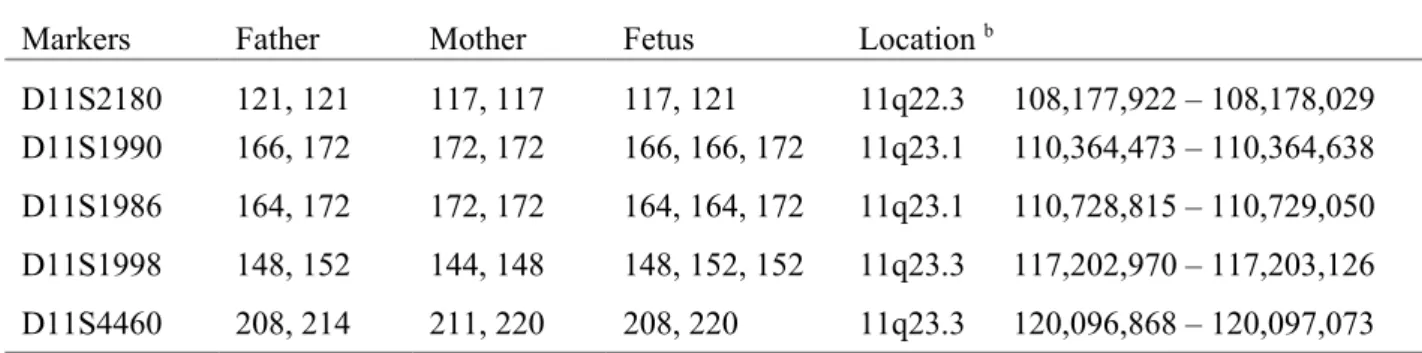
polymerase chain reaction assays on uncultured amniocytes using polymorphic DNA marker specific for chromosome 11q revealed a paternal origin of the duplication (Fig.2, Table 1). For fluorescence in situ hybridization (FISH) determination of the orientation of the duplication of the chromosome 11 [dup(11)], the bacterial artificial chromosome (BAC) clone probes mapping the genomic region of 11q22.3-q23.3 were used. The BAC clone probes RP11-262J9 (111,212,061-111,368,866 bp) (spectrum green) at 11q23.1 and RP11-2O20 (116,250,688-116,416,874 bp) (spectrum red) at 11q23.3 were used to determine the orientation of the duplication. FISH analysis showed an orientation of green-red-green-red (Fig. 3), consistent with the direct duplication of interstitial 11q. The karyotype was 46,XX,dup(11)(q22.3q23.3). Level II ultrasound was unremarkable. The parents opted to continue the pregnancy. At 38 weeks of gestation, a healthy female baby was delivered with a body weight of 2,792 g (15th centile), a body length of 48 cm
(15-50th centile), a head circumference of 34 cm (50th centile) and a chest circumference of 32 cm
(15-50th centile). At 4 months of age, her body weight was 6.2 Kg (15-50th centile) and body
length was 58.7 cm (15th centile). When examined at 10 months of age, her body weight was 7.6
Kg (< 5th centile) and body length was 68 cm (< 5th centile). She was small for age and was
abnormal in psychomotor development with apparently dysmorphisms of frontal bossing, bilateral palpebral fissures, sunken eyes, depressed nasal bridge, dysplastic ears, right ear tag, and small hands and feet.
Discussion
An abnormal maternal serum biochemistry result may incidentally detect rare chromosome aberration in early pregnancy. For instances, we previously reported prenatal diagnosis of partial trisomy 16p and partial monosomy 22q associated with abnormal maternal serum biochemistry in the first trimester [13], and prenatal diagnosis of der(18;18)(q10;q10)del(18)(q11.1q12.1) del(18) (q22.1q22.3) associated with abnormal maternal serum biochemistry in the second trimester [14]. The present case underwent prenatal genetic testing because of a positive screen risk of 1/128 for trisomy 18 calculated by abnormally low levels of AFP, uE3, -hCG and inhibin-A. The present case provides evidence that fetuses with an interstitial duplication of 11q may present low levels of AFP, uE3, -hCG and inhibin-A in the second trimester. We suggest that low levels of AFP, uE3, -hCG and inhibin-A in the second-trimester maternal serum biochemistry may be a distinctive prenatal feature in pregnancy with fetal chromosome 11q duplication.
Previous reports of isolated interstitial 11q duplications that overlapped with the present case have been associated with a wide variability of phenotypic findings [7,10-12,15]. de Die-Smulders and Engelen [15] reported a duplication of 11q22q23 in a 50-year-old female with mental retardation, prominent eyes, hypertelorism, tip of the nose overriding the upper lip and everted lower lip, microcephaly, kyphoscoliosis and prognathism. Delobel et al [7] reported a duplication of 11q23.3 in a 19-year-old girl with atypical Rett syndrome, facial dysmorphism, hypertrichosis, scoliosis and bilateral clinodactyly. Partida-Pérez et al [10] reported a constitutional duplication of 11q23 involving the MLL gene in an 18-month-old boy with mental retardation, trigonocephaly, bitemporal narrowing, relative hypotelorism, short and beaked nose, shotgun nostrils, cupid's bow mouth, thickened and everted lower lip, micrognathia, short neck, corpus callosum hypoplasia and patent ductus arteriosus. Burnside et al [12] later identified a triplication within 11q23.3 involving the MLL gene in a 5-year-and-4-month-old boy who was originally reported by Partida-Pérez et al [10] and was associated with mental retardation, brain anomalies, congenital heart defects, scoliosis and facial dysmorphism. The duplicated region of 11q22.3q23.3 in the present case also contains the MLL gene. The MLL gene (OMIM 159555) is located at 11q23.3 and regulates the HOX gene expression through direct binding to promotor sequences. Translocations involving MLL have been found in acute myeloid leukemia (AML), acute lymphoblastic leukemia (ALL) or mixed linkage leukemia (MLL). MLL amplification has been observed in myeloid malignancies [16]. However, Schnittger et al [17] reported that MLL tandem duplications are less common than previously reported. Schnittger et al [18] found partial tandem duplications of the MLL gene are detectable in peripheral blood and bone marrow of nearly all healthy donors and suggested that MLL duplications are not implicated in the malignant transformation in AML. Zarate et al [11] first reported a de novo interstitial 11q duplication (11q21q23.1) in a 4-year-old boy with normal development and intelligence. Our case is an additional case with abnormal development having a de novo interstitial 11q duplication (11q22.3q23.3), and long-term observation is required.
Acknowledgements
This work was supported by research grants NSC-99-2628-B-195-001-MY3 and NSC-101-2314-B-195-011-MY3 from the National Science Council and MMH-E-101-04 from Mackay Memorial Hospital, Taipei, Taiwan.
References
1. Francke U, Weber F, Sparkes R, Mattson P, Mann J. Duplication 11(q21 to q23-qter syndrome). Birth Defects Orig Artic ser 13. 1977; 3B: 167-86.
2. Zhao H-Q, Rope AF, Saal HM, Blough-Pfau RI, Hopkin RJ. Upper airway malformation associated with partial trisomy 11q. Am J Med Genet 2003; 120A: 331-7.
3. Zimberg-Bossira A, Smolkin T, Gildish A, Moustafa-Hawash N, Blazer S, Gershoni-Baruch R, et al. 'Pure' partial trisomy 11q (11q23.111qter): expanding the phenotype. Clin Dysmorphol 2011; 20: 225-8.
4. Forsythe MG, Walker H, Weiss L, Roberson JR, Worsham MJ, Babu VR, et al. Duplication and deletion 11q23-q24 recombinants in two offspring of an intrachromosomal insertion (“shift”) carrier. Henry Ford Hosp Med J 1988; 36: 183-6.
5. Pfeiffer RA, Schutz C. Tandem duplication 11q23-qter in the dysmorphic child of a retarded mother mosaic for the same anomaly with no apparent abnormalities. Ann Genet 1993; 36: 163-6.
6. Legius E, Wlodarska I, Selleri L, Evans GA, Wu R, Smet G, et al. De novo 46,XX, dir dup(11) (q13.3q14.2) in a patient with mental retardation, congenital cardiopathy and thrombopenia. Clin Genet 1996; 49: 206-10.
7. Delobel B, Delannoy V, Pini G, Zapella M, Tardieu M, Vallée L, et al. Identification and molecular characterization of a small 11q23.3 de novo duplication in a patient with Rett syndrome manifestations. Am J Med Genet 1998; 80: 273-80.
8. Yelavarthi KK, Zunich J. Familial interstitial duplication of 11q; partial trisomy (11)(q13.5q21). Am J Med Genet 2004; 126A: 423-6.
9. Klaassens M, Scott DA, van Dooren M, Hochstenbach R, Eussen HJ, Cai WW, et al. Congenital diaphragmatic hernia associated with duplication of 11q23-qter. Am J Med Genet 2006; 140A: 1580-6. 10.Partida-Pérez M, Domínguez MG, Sánchez-Corona J, Castañeda-Cisneros G, García-González CL,
López-Cardona MG, et al. Constitutional duplication 11q23 de novo involving the MLL gene. Genet Couns 2006; 17: 155-9.
11.Zarate YA, Kogan JM, Schorry EK, Smolarek TA, Hopkin RJ. A new case of de novo 11q duplication in a patient with normal development and intelligence and review of the literature. Am J Med Genet 2007; 143: 265-70.
12.Burnside RD, Lose EJ, Domiínguez MG, Sánchez-Corona J, Rivera H, Carroll AJ, et al. Molecular cytogenetic characterization of two cases with constitutional distal 11q duplication/triplication. Am J Med Genet 2009; 149A: 1516-22.
13.Chen C-P, Ko T-M, Su Y-N, Hsu C-Y, Chen Y-Y, Su J-W, et al. Prenatal diagnosis of partial trisomy 16p (16p12.2pter) and partial monosomy 22q (22q13.31qter) associated with increased nuchal translucency and abnormal maternal serum biochemistry in the first trimester. Taiwan J Obstet Gynecol 2012; 51: 129-33.
14.Chen C-P, Kuo Y-K, Su Y-N, Chern S-R, Tsai F-J, Wu P-C, et al. Prenatal diagnosis and molecular cytogenetic characterization of a derivative chromosome der(18;18)(q10;q10)del(18)(q11.1q12.1) del(18)(q22.1q22.3) presenting as apparent isochromosome 18q in a fetus with holoprosencephaly. Taiwan J Obstet Gynecol 2011; 50: 182-7.
15.de Die-Smulders CEM, Engelen JJ. 11q duplication in a patient with Pitt-Rogers-Danks phenotype. Am J Med Genet 1996; 66: 116-7.
16.Dolan M, McGlennen RC, Hirsch B. MLL amplification in myeloid malignancies: clinical, molecular, and cytogenetic findings. Cancer Genet Cytogenet 2002; 134: 93-101.
17.Schnittger S, Kinkelin U, Schoch C, Heinecke A, Haase D, Haferlach T, et al. Screening for MLL tandem duplication in 387 unselected patients with AML identify a prognostically unfavorable subset of AML. Leukemia 2000; 14: 796-804.
18.Schnittger S, Wörmann B, Hiddemann W, Griesinger F. Partial tandem duplications of the MLL gene are detectable in peripheral blood and bone marrow of nearly all healthy donors. Blood 1998; 92: 1728-34.
Figure Legends
Fig. 1. Oligonucleotide-based array comparative genomic hybridization on uncultured amniocytesshows a 9.04-Mb duplication at 11q22.3-q23.3 (arrow).
Fig. 2. Representative electrophoretograms of quantitative fluorescent polymerase chain reaction assays at short tandem repeat markers specific for chromosome 11q using uncultured amniocytes and parental DNAs. The markers D11S1990 (11q23.1), D11S1986 (11q23.1) and D11S1998 (11q23.3) show two different parental alleles of unequal fluorescent activity with a paternal: maternal dosage ratio of 2:1, indicating a paternal origin of the interstitial duplication.
Fig. 3 Fluorescence in situ hybridization using bacterial artificial chromosome clone probes RP11-262J9 (111,212,061-111,368,866 bp) (spectrum green) at 11q23.1 and RP11-2O20 (116,250,688-116,416,874 bp) (spectrum red) at 11q23.3. A direct duplication of 11q in the orientation of green-red-green-red is evident in the dup(11). The inset shows the amplified dup(11) and chromosome 11. dup(11) = the chromosome 11 with a duplication.
Fig. 4. A karyotype of 46,XX,dup(11)(q22.3q23.3). The arrows indicate the breakpoints.
Table 1. Molecular results using polymorphic DNA markers specific for chromosome 11q a
Markers Father Mother Fetus Location b
D11S2180 121, 121 117, 117 117, 121 11q22.3 108,177,922 – 108,178,029
D11S1990 166, 172 172, 172 166, 166, 172 11q23.1 110,364,473 – 110,364,638
D11S1986 164, 172 172, 172 164, 164, 172 11q23.1 110,728,815 – 110,729,050
D11S1998 148, 152 144, 148 148, 152, 152 11q23.3 117,202,970 – 117,203,126
D11S4460 208, 214 211, 220 208, 220 11q23.3 120,096,868 – 120,097,073
a Alleles (basepair sizes) are listed below each individual. b Location according to NCBI build 36/hg18