Magnetic properties and microstructure of Mn–Al–C thin films
P. C. Kuo and K. J. Ker
Institute of Materials Science and Engineering, National Taiwan University, Taipei 107, Taiwan
Y. D. Yaoa)
Institute of Physics, Academia Sinica, Taipei 115, Taiwan
J. H. Huang
R&D Center, Walsin Energy Corporation, Hsinchu 300, Taiwan
MnxAl1002x2yCy thin films with x535– 65 at. % and y50 – 2.4 at. % were prepared by rf magnetron sputtering. Effects of the chemical composition and annealing temperature on the magnetic properties and microstructure of Mn–Al–C films were investigated. X-ray analysis shows that the as-deposited Mn–Al–C thin films are amorphous, and their saturation magnetization is very low. After annealing at temperatures between 400 and 550 °C in vacuum for 30 min, the magnetic phase with higher carbon concentration shows better thermal stability. The best annealing condition was found to be at 410 °C for 30 min. A ferromagnetictphase with a grain size of roughly 200–250 nm appeared at a composition range between 40 and 60 at. % Mn for MnxAl992xC1thin films; and the sample with Mn50Al49C1has high coercivity and moderate saturation magnetization. The carbon addition can increase the thermal stability of the coercivity of the Mn–Al thin films. © 1999
American Institute of Physics. @S0021-8979~99!60308-5#
I. INTRODUCTION
Magnetic properties of Mn–Al thin films have been ex-tensively studied by the rf magnetron sputtering1–5 and by molecular beam epitaxy ~MBE! techniques.6,7The stabiliza-tion of the metastabletphase in the bulk Mn–Al alloy sys-tem was first described by Kono8in 1958 and Koch et al.9In 1960, they prepared a Mn–Altphase by controlled cooling of a high-temperature e phase. The magnetict phase has a tetragonal L10-type superstructure and a high magnetocrys-talline anisotropy constant as large as about 107erg/cc. The magnetic moment is carried by the Mn atoms and points along the c axis which is, therefore, the magnetic easy axis. The Mn atoms within a Mn sublattice are coupled ferromag-netically, however, the moments of the Mn atoms in the Al sublattice sites are in the opposite direction.10 The bulk Mn–Al alloy with the t phase has a coercivity of Hc 5500– 1000 Oe.
The Mn–Al thin films with atphase can be used in:~1! novel semiconductor devices based on the spatially modu-lated magnetic field or on the injection and detection of spins,11~2! generation of a bias field ~e.g., in magnetic-field sensors! through magnetostatic fields or the exchange interaction,12 ~3! magnetic and magneto-optic recording,2–5 and~4! nonvolatile memories.7
For a bulk alloy, the t phase is formed by cooling the high-temperature nonmagnetic e phase ~hcp! followed by heat treatment at 450–600 °C.13Recent studies of electron microscopy observations and kinetic analysis provide evidence that the e→t transformation may involve a diffusion, nucleation, and growth process.14 In this study, a nonmagnetic e-phase thin film was formed preliminarily by magnetron sputtering and a magnetic t phase is
obtained by heat treatment around 400 °C for pure Mn–Al films.
In this work, we study the effect of carbon doping on the stabilization of the magnetic phase and microstructure of the Mn–Al films.
II. EXPERIMENT
Mn–Al–C films were fabricated by means of a rf mag-netron sputtering system. High-purity aluminum~99.999%!, manganese~99.99%!, and graphite were melted in a graphite crucible at a temperature around 1400 °C. The ingot was cut into 2 mm thickness and polished as a sputtering target. The base pressure in the system was 531027Torr, and the Ar sputtering pressure was kept at 1 mTorr. The sputtering rate was 0.5 nm/s. Films with thickness of 0.8 mm were used in this study. Thermal annealing was carried out at a tempera-ture range between 350 and 550 °C in vacuum and the an-nealing time was 30 min.
The crystal structures and microstructure of the as-deposited and annealed films were characterized by x-ray diffractometer ~XRD! and transmission electronic micro-scope~TEM!. Compositions of the films were determined by an electron probe microanalyzer ~EPMA! calibrated by a standard Mn55Al45 alloy. The magnetic properties of the films were measured with a vibrating sample magnetometer
~VSM! at room temperature with a maximum applied field of
20 kOe and the applied field is parallel to the film plane.
III. RESULTS AND DISCUSSION
The x-ray diffraction patterns of ~a! the as-deposited Mn50Al49C1film and~b! the pure Mn–Al film are shown in Fig. 1. It shows a crystalline e phase in the Mn50Al50 film and an amorphous state in the as-deposited Mn50Al49C1film. The amorphous structure is a nonmagnetic phase. Figure 2
a!Electronic mail: [email protected]
JOURNAL OF APPLIED PHYSICS VOLUME 85, NUMBER 8 15 APRIL 1999
4892
0021-8979/99/85(8)/4892/3/$15.00 © 1999 American Institute of Physics Downloaded 07 Dec 2008 to 140.112.113.225. Redistribution subject to AIP license or copyright; see http://jap.aip.org/jap/copyright.jsp
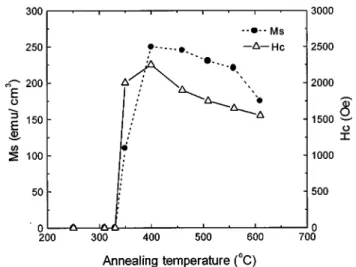
shows the saturation magnetization Ms and coercivity Hcof the MnAlC films with annealing at 410 °C for 30 min. The optimum manganese content is found to be about 50 at. %. Figure 3 shows the Msand Hcvalues of the Mn50Al49C1film as functions of annealed temperatures between 200 and 600 °C. Both Ms and Hc increase rapidly with increasing annealing temperature up to 400 °C due to the formation of the magnetictphase. Above 400 °C they decrease with in-creasing annealing temperature due to the nonmagnetic phases precipitated at high temperature. From the x-ray dif-fraction pattern study of the annealed films with various thickness, it is found that when the film thickness is less than 200 nm, the magnetictphase is difficult to form. Since the formation of the ferromagnetic t phase is a shear transfor-mation, the transformation occurs by cooperative atomic movements. Atoms in the interface region between the
sub-strate and the Mn–Al–C film were hardly expected to move during the shear transformation because the movements of these atoms were restricted by the rigid substrates. This effect15may hamper thet-phase formation, especially in the ultrathin films, and lead to the sharp decrease of Ms. Hcof these Mn–Al–C films is larger than that of the bulk Mn– Al–C alloys. This is due to the magnetoelastic energy arising from the rather high stress between the substrates and Mn– Al–C films during the shear transformation.
Figures 4~a! and 5~a! show the TEM microstructure of the Mn50Al49C1 film for the as-deposited and annealed at FIG. 1. X-ray diffraction patterns of the as-deposited films:~a! Mn50Al49C1;
and~b! Mn50Al50.
FIG. 2.~a! Msand~b! Hcas functions of Mn content for the Mn–Al–C film with 1.0 at. %C.
FIG. 3. ~a! Ms and~b! Hcas functions of annealing temperature for the Mn50Al49C1film.
FIG. 4. TEM analysis of the as-deposited Mn50Al49C1film:~a!
microstruc-ture; and~b! SAD pattern.
4893
J. Appl. Phys., Vol. 85, No. 8, 15 April 1999 Kuoet al.
410 °C samples, respectively. The selective area diffraction
~SAD! pattern in Fig. 4~b! is a typical pattern of an
amor-phous structure, and in Fig. 5~b! shows the t phase is the major phase. The tphase has a plate structure with an aver-age crystal size around 200–250 nm, as shown in Fig. 5~a!. Spots diffraction analysis of thist-phase crystal is presented in Fig. 5~c!. These spots have been analyzed and their indi-ces are shown in Fig. 5~d!.
The temperature coefficient of the coercivity, defined by
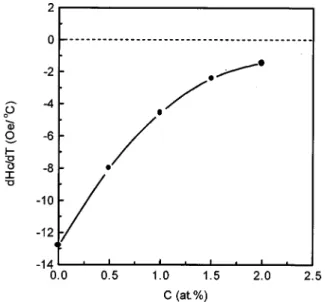
dHc/dT, is determined between 20 and 100 °C. The values of dHc/dT for the Mn50Al502yCy films as a function of the C concentration of y are shown in Fig. 6. The value of
dHc/dT of the film decreases from 213 to 22 Oe/ °C by increasing the C concentration of y from 0.0 to 2.0. There is a large difference in the atomic radius between the Mn~1.31
Å!, Al~1.43 Å!, and metalloid C~0.77 Å!, it is expected that the C atoms would be dissolved in thetphase interstitially.16 However, the reason for the decrease of dHc/dT with in-creasing C content is still not clear. Further investigations are undertaken and will be reported later.
In conclusion, we have studied the magnetic properties and microstructure of Mn–Al–C thin films over a wide com-position range. The carbon addition causes an amorphous structure, which is formed at the sputtering process. An an-nealing treatment between 400 and 550 °C transfers the amorphous structure into the magnetic t-phase structure. Carbon addition can increase the thermal stability of the co-ercivity of Mn–Al thin films.
1A. Morisako and M. Matsumoto, J. Appl. Phys. 61, 4281~1987!. 2J. X. Shen, R. D. Kirby, and D. J. Sellmyer, J. Appl. Phys. 67, 4929
~1990!.
3
A. Morisako, M. Matsumoto, and M. Naoe, IEEE Trans. Magn. MAG-23, 2470~1987!.
4A. Morisako, N. Kohshiro, and M. Matsumoto, J. Appl. Phys. 67, 5655
~1990!.
5
M. Matsumoto, A. Morisako, and J. Ohshima, J. Appl. Phys. 69, 5172
~1991!.
6J. De Boeck, C. Bruynseraede, H. Bender, A. Van Esch, W. Van Roy, and
G. Borghs, MBE VIII Conference, Osaka, Japan, 1994.
7J. De Boeck, W. Van Roy, A. Van Esch, G. Borghs, P. Van Mieghem, R.
O’Handly, J. A. del Alamo, M. Tanaka, J. P. Harbison, T. Cheeks, and T. Sands, 35th Electronic Materials Conference, Santa Barbara, CA, 1993.
8H. Kono, J. Phys. Soc. Jpn. 13, 1444~1958!.
9A. J. J. Koch, P. Hokkeling, M. G. V. D. Sterg, and K. J. DeVos, J. Appl.
Phys. 31, 75S~1960!.
10
B. Braun and J. A. Goodkoop, Acta Crystallogr. 16, 737~1963!.
11A. Matulis, J. M. Peeters, and P. Vasilopoulos, Phys. Rev. Lett. 72, 1518
~1994!.
12T. Jagielinski MRS Bull. 36~1990!. 13
J. J. Van Den Broek, H. Donkersloot, G. Van Tendeloo, and J. Van Landuyt, Acta Metall. 27, 1497~1979!.
14D. P. Hoydick, E. J. Palmiere, and W. A. Soffa, J. Appl. Phys. 81, 5624
~1997!.
15P. C. Kuo, Y. D. Yao, J. H. Huang, S. C. Shen, and J. H. Jou, J. Appl.
Phys. 81, 5621~1997!.
16C. T. Lee, K. H. Han, I. K. Kook, and W. K. Choo, J. Mater. Res. 7, 1690
~1992!.
FIG. 5. TEM analysis of the Mn50Al49C1film annealed
at 410 °C:~a! microstructure; ~b! SAD pattern; ~c! spot pattern of at-phase crystal; and~d! indices of the spot pattern.
FIG. 6. Temperature-dependent coefficient of coercivity dHc/dT as a func-tion of carbon content for the Mn50Al502xCxthin film.
4894 J. Appl. Phys., Vol. 85, No. 8, 15 April 1999 Kuoet al.