
Performance Analysis of Optimum Scheme for IEEE 802.11e EDCAF
6
0
0
全文
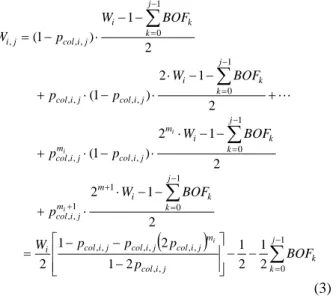
(2) After the delay cycle, the station enters the Transmission cycle to decide whether a packet can be successful transmitted or fail based on the channel status. If the channel status is busy, the packet will have a collision, if the channel status is not busy, the station can transmit the packet successfully. AIFS[PM(r, i)] = AIFSN[PM(r, i)] × TSlot + SIFS (1) TB = random[0, CW] × TSlot (2) where CWmin ≤ CW ≤ CWmax and CWnew = (CWold +1) × PF -1. Fig. 1 EDCAF channel status with four access categories. for CWmin[i] ≥ d3. We define the probability pcol,i,j as the collision probability of AC[i] after the dj. ptr,i,j is the probability as the transmission probability of AC[i] after dj, note that AC[i] just can transmit packet in the duration of BOFj based on the condition of (3-i) ≤ j for i,j=0, 1, 2, 3. i.e., pcol, 3,1 is the collision probability of AC[3] after d1 and ptr,3,1 is the transmission probability of AC[3] after d1, that contain the duration of BOF1, BOF2 and BOF3. At saturation mode, a station will always have a queue of packets to send, so every transmission is preceded by a backoff procedure. Since the backoff is uniformly distributed by [0, …, Wi-1] for the first attempt and the average backoff time is (Wi-1)/2 in slot unit. We can calculate the average number of backoff slots for a AC[i] after d3-i as geometrically distributed with probability of success (1-pcol,i,j). A station transmits a packet multiple times until it receives an acknowledgment or reaches the maximum retransmission limit. The average backoff window size Wi,j for AC[i] after dj is shown as Eq. (3), where (3-i) ≤ j for i,j=0, 1, 2, 3, refer from [7][8]. j −1. 2.2: Formulations. Wi , j = (1 − pcol ,i , j ) ⋅. Wi − 1 − ∑ BOFk k =0. 2 j −1. We make the following assumptions about the analytic model. First, we assume ideal channel condition and packet loss due to collision occurrence. Second, we analyze the EDCAF performance when the system operates under saturation conditions, i.e., each AC always has a packet available for transmission.. 2 ⋅ Wi − 1 − ∑ BOFk k =0. + pcol ,i , j ⋅ (1 − pcol ,i , j ) ⋅. 2. +L. j −1. 2mi ⋅ Wi − 1 − ∑ BOFk k =0. mi + pcol ,i , j ⋅ (1 − pcol ,i , j ) ⋅. 2 j −1. mi +1 + pcol ,i , j ⋅. =. Wi 2. 2m +1 ⋅ Wi − 1 − ∑ BOFk k =0. 2. (. ⎡1 − pcol ,i , j − pcol ,i , j 2 pcol ,i , j ⎢ 1 − 2 pcol ,i , j ⎣⎢. )m ⎤⎥ − 1 − 1 j −1 BOF i. ⎦⎥. 2. ∑. 2 k =0. k. (3) Fig. 2 Analytic Model From Fig. 2, we divide the possible random backoff period into four BOFi for i = 0, 1, 2, 3 in the Delay cycle and define the contention parameter set for a corresponding AC[i] as AIFS[i], CWmin[i] and CWmax[i] for i = 0, 1, 2, 3. For the formulation expressions in the paper, we also define these parameters as four ACs, AC[0], AC[1], AC[2], AC[3], di=AIFSN[3-i]= AIFS[3-i]/TSlot and Wi=CWmin[i]+1 for i=0, 1, 2, 3, di is defined as the length of AIFSN[3-i] in slot unit, Wi is the size of contention window minimum and mi is the maximum numbers of retransmission for AC[i]. From Fig. 2, the priority sequence is AC[3]>AC[2]>AC[1] >AC[0], and AIFS[3] < AIFS[2] < AIFS[1] < AIFS[0]. Therefore d0 < d1 < d2 < d3. BOFi is defined as the period of time between AIFS[2-i] and AIFS[3-i] in slot unit for i=0, 1, 2 thus the length of BOFi is BOFi = d i +1 − d i for i=0,1,2, and BOF3=CWmin[i]-d3. The average backoff window size Wi,j and transmission probability of ptr,i,j can be approximated by Wi , j ≈. =. Wi 1 1 j −1 − − ∑ BOFk 2 2 2 k =0 j −1 j −1 ⎞ ⎞ 1⎛ 1⎛ ⎜ W i − 1 − ∑ BOFk ⎟ ≈ ⎜W i − ∑ BOFk ⎟ ⎟ ⎜ ⎟ ⎜ 2⎝ k =0 k =0 ⎠ ⎠ 2⎝. (4). Since Wi >>1, 1 2 p tr ,i , j = ≈ j −1 Wi , j ⎛ ⎞ ⎜⎜Wi − ∑ BOFk ⎟⎟ k =0 ⎠ ⎝. - 508 -. ≈. 2 2 ≈ (Wi − α ) Wi. where α =. j −1. ∑ BOF k =0. k. and assume α << Wi .. (5).
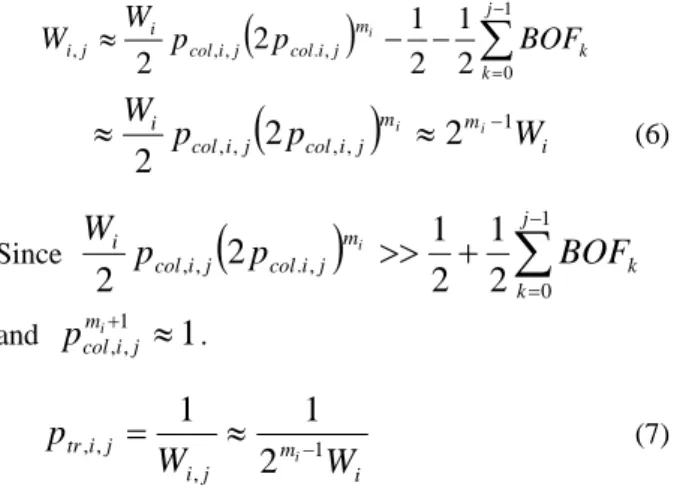
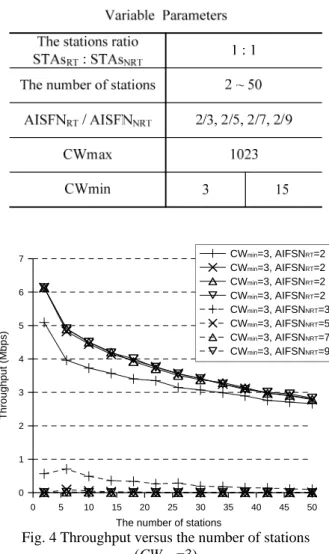
(3) The transmission probability ptr,i,j goes to zero as the number of CWmin increases. This is due to the average backoff window size increases as the number of CWmin increases. Therefore the different contention window minimum CWmin will affect the transmission probability of station, and the lower transmission probability can help to reduce the collision rate. The average backoff window size Wi,j and transmission probability of ptr,i,j can be approximated by. Wi , j ≈. ≈. Wi 1 1 j −1 m p col ,i , j (2 p col.i , j ) i − − ∑ BOFk 2 2 2 k =0. Wi m pcol , i , j (2 pcol , i , j ) i ≈ 2 m i −1Wi 2. (6). Wi 1 1 j −1 m p col ,i , j (2 p col .i , j ) i >> + ∑ BOFk 2 2 2 k =0 mi +1 and p col ,i , j ≈ 1 .. packets to be transmitted on basic access scheme. The simulation results show the best throughput possible with the given parameters and the number of stations.. 3.1: Simulation environment In the simulation environment, we consider the DCF and the EDCAF networks based on IEEE 802.11b standard with a variable number of stations. Other general simulation parameters are summarized in Table 1. In these simulations, the number of stations range from 2 to 50. The expected results of throughput show on following four distinct scenarios. Sections 3.2 and 3.3 show the effect of different values of DIFS and CWmin for legacy IEEE 802.11 DCF respectively.. Since. ptr ,i , j. 1 1 = ≈ mi −1 Wi , j 2 Wi. 3.2: Effect of CWmin in legacy EDCAF. (7). From Eqs. (6) and (7), the minimum contention window has a major effect on the average backoff window size and the transmission probability, in contrast, the differentiated AIFS value has only a small effect on Wi,j and ptr,i,j. When the CWmin value is increased, the average backoff windows size is increased, the probability of two stations to choose the same slot is reduced and the transmission probability is decreased. Considering the results obtained, in the circumstances of lower collision rate, a higher contention window minimum can reduce the transmission probability of stations and reduce the collision rate. A higher differentiated AIFS value can raise the transmission probability of higher priority stations. In the circumstances of higher collision rate, the effect of differentiated AIFS is smaller than contention window minimum, and a higher contention window minimum can reduce the transmission probability of stations and improve the collision rate of system and throughput.. This simulation consists of two traffic classes, real-time (RT) and non-real-time (NRT). Each traffic class has the same default parameters as Table 1. Table 2 shows the variable simulation parameters for RT and NRT traffics, RT has higher priority than NRT. We investigate the impact of differentiated CWmin as shown in Fig. 3. Differentiating the initial contention window minimum (CWmin) has both the functions of tuning collisions ratio and providing priorities. In fact, the throughput differentiation increases a little bit on the same competing stations. High priority stations can receive superior service by having smaller CWmin. A smaller CWmin corresponds to fewer backoff slots being chosen and that increases the transmission probability per transmission.. 3: ANALYSIS of IEEE 802.11e EDCAF In this section, we investigate the relation of system throughput and contention parameters. In order to evaluate the effect of AIFSN and CWmin, we develop a simulator by C++ to determine the realized throughput as a function of offered station numbers based on DCF and EDCAF WLANs. Several assumptions were decided to reduce the complexity of the simulation model : the propagation delay were neglected, the channel is no interference and error free, no hidden node issue and we consider the saturation mode on the basic access scheme which means stations always have. - 509 -. Table 1 Simulation Parameters-1.
(4) Table 2 Simulation Parameters-2. CWmin=3, AIFSNRT=2 CWmin=3, AIFSNRT=2 CWmin=3, AIFSNRT=2 CWmin=3, AIFSNRT=2 CWmin=3, AIFSNNRT=3 CWmin=3, AIFSNNRT=5 CWmin=3, AIFSNNRT=7 CWmin=3, AIFSNNRT=9. 7. AIFSN=2, CWminRT=3 6. AIFSN=2, CWminRT=3. 8. AIFSN=2, CWminRT=3 7. 5. Throughput (Mbps). AIFSN=2, CWminRT=3 AIFSN=2, CWminRT=3. Throughput (Mbps). 6. AIFSN=2, CWminNRT=7 AIFSN=2, CWminNRT=15. 5. AIFSN=2, CWminNRT=31 AIFSN=2, CWminNRT=63. 4. 4. 3. 2. AIFSN=2, CWminNRT=127. 3. 1. 2 0 0. 1. 5. 10. 15. 20. 25. 30. 35. 40. 45. 50. The number of stations. Fig. 4 Throughput versus the number of stations (CWmin=3). 0 0. 5. 10. 15. 20. 25. 30. 35. 40. 45. 50. The number of stations. Fig. 3 Throughput versus the number of stations (AIFSN=2). 4: Performance Evaluation of OPT scheme. 3.3: Effect of AIFSN in legacy EDCAF The simulation investigates the impact of AIFSN and presents the result achieved through different AIFSN and the number of stations. Table 3 shows the variable simulation parameters used in the simulation and keeps the constant of CWmin. We investigate the impact of differentiated AIFSN for RT and NRT traffics and show the simulation results. Figure 4 shows a more intensive differentiation in term of throughput with increase of differentiated AIFSN. In the larger AIFSN differentiation, the NRT traffic may completely lose the opportunity to access medium. The higher priority stations will progress through backoff period relatively faster since they may decrease their backoff counter, while lower priority station still wait for the end of AIFSN, and that can lead the lower priority traffic NRT to be starved.. Table 3 Simulation Parameters-3. The OPT scheme can exist on AP and play a central role of dynamic parameters control. The contention parameters decide QoS level of traffics to service in each AC. Therefore, the contention parameters of EDCAF need to be adjusted by the optimal value to support the required QoS level of traffic in each AC. The tuning scheme of OPT for the contention parameters are achieved by two operations. The first operation is adaptive tuning by the specific duration to find the optimum of contention parameters according to QoS requirements in each AC. The second operation is rescheduling, and stations get the updated contention parameters from AP and contend the channel. In adaptive tuning operation, OPT adjusts contention parameters value according to the throughput of each AC. Throughput are measured and changed by the competition number of stations during a specific duration. AP can adjust the contention parameters by association information to adjust the transmission opportunity of stations. AP is in charge of measuring the system throughput and judging whether the parameters should be changed or not. In rescheduling operation, AP finds the optimum contention parameters and broadcasts. - 510 -.
(5) to all stations in beacon frame. After receiving the beacon frame, each station updates its contention parameters to a new value and to contend the channel. In IEEE 802.11 without QoS environment, the OPT scheme employs measurements of the throughput taken in AP and observes whether the parameters should be modified or not. When AP finds that the present throughput is less than the past measurement, the AP continues to increase CWmin and improves the throughput, otherwise OPT will reduce CWmin to search the optimal value of CWmin. In IEEE 802.11e with QoS environment, OPT first search the optimal ratio of service differentiation by tuning AIFS and CWmin. AP continues to monitor the ratio of service differentiation and change CWmin to give the better differentiated ratio and avoid the bandwidth starvation of low priority. To implement the OPT scheme by C++, we compare the throughput of OPT with the standard of IEEE 802.11 DCF and IEEE 802.11e EDCAF under the same situation. The simulation uses the default DCF and EDCAF parameters as shown in Tables 4 and 5, respectively, and the other parameters as shown in Table 1. Figure 5 compares the throughput of OPT with the standard DCF. From the result, the throughput of OPT is always higher than that of the DCF and OPT, because OPT can optimize the system throughput according to the number of competing stations. OPT can dynamically tune the CWmin to avoid occurrence of higher collision rate and provide higher throughput. Figure 6 compares the service differentiation of OPT and EDCAF. From the result, OPT can provide a stable service differentiation (RT:NRT=2:1) and avoid the bandwidth starvation of low priority NRT, because OPT can dynamically adjust the CWmin and AIFS to maintain a higher throughput and a specific service differentiation respectively.. 5. OPT-RT 4.5. 5. OPT-NRT EDCAF-RT EDCAF-NRT. 4. Throughput (Mbps). 6. Throughput (Mbps). Table 5 EDCAF simulation parameters. 4. 3.5 3 2.5 2 1.5 1 0.5. 3 0 0. 2. 5. 10. 15. 20. 25. 30. 35. 40. 45. 50. The number of stations. OPT DCF. Fig. 6 Throughput versus the number of stations. 1. 5: CONCLUSIONS. 0 0. 5. 10. 15. 20. 25. 30. 35. 40. 45. The number of stations. Fig. 5 Throughput versus the number of stations. Table 4 DCF simulation parameters. 50. The performance of IEEE 802.11 DCF and IEEE 802.11e EDCAF can be improved by turning the contention parameters dynamically. In this paper, we overcome the issues, including how to maximize the channel utilization, how to provide the service differentiation and how to avoid the bandwidth starvation. The proposed OPT has the low complexity. - 511 -.
(6) and is easy to be implemented. The results of simulation show that the OPT scheme gives better performance than the legacy DCF and EDCAF. High priority RT and low priority NRT are well differentiated and NRT is never starved. The simulations also help us to understand and control the behaviors of AIFS and CWmin parameters in WLAN.. REFERENCES. [13]. [14]. [15]. [1] IEEE Std. 802.11b-1999, “Part 11: Wireless LAN Medium Access Control (MAC) and Physical Layer (PHY) specifications: Higher-Speed Physical Layer Extension in the 2. 4 GHz Band”. [2] IEEE 802.11e WG. “Draft supplement to Part 11: Wireless Medium Access Control (MAC) and Physical Layer (PHY) Specifications: MAC Enhancements for Quality of Service (QoS), IEEE Std. 802.11e/D9.0,” August 2004. [3] F. Cali’, M. Conti, E. Gregori, “Dynamic Tuning of the IEEE 802.11 Protocol to Achieve a Throughput Limit,” IEEE Trans. on Networking, Vol. 8, No. 6, pp. 785-799, Dec. 2000. [4] J. W. Robinson and T. S. Randhawa, “Saturation throughput analysis of IEEE 802.11e enhanced distributed coordination function,” IEEE Journal on Selected Areas in Communications, vol. 22, no. 5, pp. 917-928, 2004. [5] Z. Kong, D. H. K. Tsang, B. Bensaou, and D. Gao, “Performance analysis of IEEE 802.11e contentionbased channel access,” IEEE journal on Selected Areas in Communications, vol. 22, no. 10, pp. 2095-2106, 2004. [6] Hayoung Yoon and JongWon Kim, “Saturation Throughput Analysis of IEEE 802.11e ContentionBased Channel Access,” in Proc. of IEEE ISPACS 2005, Hong Kong, Dec. 2005. [7] J. Hui and M. Devetsikiotis, “A Unfied Model for the Saturation Throughput and Delay Analysis of IEEE 802.11e EDCF,” IEEE Transactions on Communications, vol. 53, no. 9, Sep. 2005. [8] Y. C. Tay and K. C. Chua, “A capacity analysis for the IEEE 802.11 MAC protocol,” Wireless Networks, pp. 159-171, Jul. 2001. [9] A. T. Veres, M. Barry Campbell, and L. H. Sun, “Supporting service differentiation in wireless packet networks using distributed control,” IEEE Journal on Selected Areas in Communications, vol. 19, no. 10, pp. 2081-2093. Oct. 2001. [10] L. Gannoune, and S. Robert, “Dynamic tuning of the contention window minimum (CWmin) for enhanced service differentiation in IEEE 802.11 wireless ad-hoc networks,” IEEE international symposium on personal, indoor and mobile radio communications (PIMRC 2004), Barcelona, Spain, Sept. 2004. [11] L. Romdhani, Qiang Ni, and T. Turletti, “Adaptive EDCF: enhanced service differentiation for IEEE 802.11 wireless ad-hoc networks,” IEEE Wireless Communications and Networking, vol. 2, pp. 1373-1378, March 2003. [12] L. Bononi, M. Conti, and E. Gregori, “Runtime Optimization of IEEE 802.11 WLANs Performance,”. [16]. [17]. [18]. - 512 -. IEEE Transactions on Parallel and Distributed. Systems, vol. 15, no. 1, pp. 66-80, Jan. 2004. H. Ma, X. Li, H. Li, P. Zhang, S. Luo, C. Yuan, “Dynamic optimization of IEEE 802.11 CSMA/CA based on the number of competing stations,” Proc. of IEEE ICC, Paris, France, June 2004. Chonggang Wang, Weiwen Tang, Kazem Sohraby, and Bo Li, “A simple mechanism on MAC layer to improve the performance of IEEE 802.11 DCF,” Proc. of BroadNet 2004, Oct. 2004. Filali, Fethi, “Dynamic and efficient tuning of IEEE 802.11 for multimedia applications,” IEEE international symposium on personal, indoor and mobile radio communications (PIMRC 2004), Barcelona, Spain, Sept. 2004. Jianhua He, Dritan Kaleshi, Alistair Munro, Michael Barton, “management of services differentiation and guarantee in IEEE 802.11e wireless LANs,” Proc. of IEEE VTC Spring, Stockholm, June 2005. S. El Housseini, and H. Alnuweiri, “Adaptive Contention-Window MAC Algorithms for QoS-Enabled Wireless LANs,” IEEE International Conference on Wireless Networks, Communications and Mobile Computing, vol. 1, pp. 368-374, June 2005. P. Serrano, A. Banchs and J. F. Kukielka, “Detection of Malicious Parameter Configurations in IEEE 802.11e EDCA,” IEEE Globecom 2005, St. Louis, Missouri, Nov. 2005..
(7)
數據

相關文件
(c) If the minimum energy required to ionize a hydrogen atom in the ground state is E, express the minimum momentum p of a photon for ionizing such a hydrogen atom in terms of E
Wang, Solving pseudomonotone variational inequalities and pseudocon- vex optimization problems using the projection neural network, IEEE Transactions on Neural Networks 17
We explicitly saw the dimensional reason for the occurrence of the magnetic catalysis on the basis of the scaling argument. However, the precise form of gap depends
Define instead the imaginary.. potential, magnetic field, lattice…) Dirac-BdG Hamiltonian:. with small, and matrix
Indeed, in our example the positive effect from higher term structure of credit default swap spreads on the mean numbers of defaults can be offset by a negative effect from
using & integrating a small range of reading strategies as appropriate in a range of texts with some degree of complexity,. Understanding, inferring and
Microphone and 600 ohm line conduits shall be mechanically and electrically connected to receptacle boxes and electrically grounded to the audio system ground point.. Lines in
Experiment a little with the Hello program. It will say that it has no clue what you mean by ouch. The exact wording of the error message is dependent on the compiler, but it might
