ORIGINAL RESEARCH
820
ORIGINAL RESEARCH
C.-C. Wang et al.Published online 7 July 2004
Biomed. Chromatogr. 18: 820–825 (2004)
Published online in Wiley InterScience (www.interscience.wiley.com). DOI: 10.1002/bmc.395
Photolysis of NSAIDs. IV. Photoproducts of zomepirac
determined by LC-ESI-MS
Ching-Chiung Wang,1 Fu-An Chen,2 Chih-Jui Chen,3 Su-Hui Chao3 and An-Bang Wu3*
1Graduate Institute of Pharmacognosy Science, Pharmacy College, Taipei Medical University, Taipei 110, Taiwan, Republic of China 2Department of Pharmacy,Tajen Institute of Technology, Yen-pu 907, Pingtung, Taiwan, Republic of China
3Graduate Institute of Pharmaceutical Sciences, Pharmacy College, Taipei Medical University, Taipei 110, Taiwan, Republic of China
Received 14 November 2003; revised 5 March 2004; accepted 23 March 2004
ABSTRACT: A sample of 10 mM zomepirac in methanol was photo-irradiated with a Hanovia 200 W high-pressure quartz Hg lamp for 14 days. In total, four photoproducts were observed from the HPLC chromatogram. The preparative HPLC included an YMC-Pack Pro C18 column (250 × 20 mm i.d.), a mobile phase of CH3CN–CH3OH–1%HOAc (10:60:30, v/v/v), and UV detection
at 254 nm. The most probable structures of the four photoproducts were determined by LC-MS. Two major photoproducts were separated, and their structures were further confirmed by the spectroscopic methods. A reaction scheme of zomepirac was pro-posed that the photochemical reaction routes occur mainly via bond fission between carbonyl–pyrrolyl groups (α-cleavage of a ketone), and decarboxylation followed by oxidation with singlet oxygen to produce an aldehyde. Copyright © 2004 John Wiley & Sons, Ltd.
KEYWORDS: zomepirac; photolysis; NSAID; LC-ESI-MS
*Correspondence to: An-Bang Wu, Graduate Institute of Pharma-ceutical Sciences, Taipei Medical University, 250 Wu Hsing Street, Taipei 110, Taiwan, Republic of China.
E-mail: [email protected]
Abbreviations used: DEPT, distortionless enhancement by
polariza-tion transfer; HMBC, heteronuclear multiple bond connectivity; HMQC, heteronuclear multiple quantum coherence; NSAID, non-steroidal anti-inflammatory drug.
INTRODUCTION
Zomepirac (Z), 5-(p-chlorobenzoyl)-1,4-dimethyl-1H-pyrrole-2-acetic acid sodium dihydrate, is non-steroidal anti-inflammatory drug (NSAID) which was claimed to be a safe and effective non-narcotic analgesic (Haines
et al., 1985). However, numerous cases of
zomepirac-induced anaphylactic shock have been reported (Levy and Vasilomanolakis, 1984; Corre and Rothstein, 1982). As a result, it was withdrawn from the market in March 1983. A research group reported the metabolism and disposition in animals and man (Grindel et al., 1980; Wu et al., 1980). They identified 3-hydroxy-zomepirac, 4-chlorobenzoic acid, the conjugate glucuronide of zomepirac and glycine conjugate of zomepirac as urinary metabolites. Another research group (Wang
et al., 2001) indicated that zomepirac was metabolized
to a chemically reactive acyl glucuronide conjugate which can form covalent adducts with proteins. In vivo, such adducts could initiate immune or toxic responses. Zomepirac, an acetic acid-derived NSAID containing a benzophenone and a diaryl ketone chromophores,
mediates the development of phototoxic reactions (Giuffrida et al., 1995; Bosca and Miranda, 1998). Anaphylactic symptoms or phototoxicity due to zome-pirac administration can perhaps be related to the photoproducts produced when exposed to light.
Recently, a general survey of the mechanisms in-volved in drug phototoxicity was presented (Quintero and Miranda, 2000). NSAIDs are capable of acting as photosensitizers. The photochemical reaction starts with light radiation absorption by the photosensitizer, which becomes an electronically excited species in the singlet state. Through intersystem crossing, the excited molecule reaches the triplet state. Many photosensit-ization reactions proceed through the triplet state. Four pathways are usually considered available for the excited photosensitizers to exert their phototoxic effects. First, energy transfer from an excited triplet photosensitizer to molecular oxygen can produce singlet oxygen, which might participate in lipid and protein membrane oxidation or induce DNA damage. Second, an electron or hydrogen transfer can lead to the free radical species producing a direct attack on biomolecules. In the presence of oxygen, the secondary free radicals such as peroxyl radicals or the very react-ive hydroxyl radical can be produced, resulting in oxidative damage to DNA. Third, covalent photobind-ing between the photosensitizer and one particular macromolecule can take place, inducing cell damage. Fourth, the photosensitizer can undergo decomposition, so that the resulting photoproducts can act either as toxins or as new photosensitizers.
In a series of photolytic studies of NSAIDs, the stability-indicating HPLC quantitation method of zomepirac was reported recently (Chen et al., 2003). To continue our previous work on the HPLC quantita-tion and validaquantita-tion study of zomepirac, a photolytic degradation pattern and the structural identification of the photoproducts by LC-ESI-MS with the aids of spectropscopic methods are reported. A comparison of the photochemical behavior of tolmetin and zomepirac is also attempted.
EXPERIMENTAL
Chemicals. Zomepirac sodium salt dihydrate was purchased
from Sigma Chemical (St Louis, MO, USA). LC grade methanol and acetonitrile and GR-grade D-methanol were from Merck (Darmstadt, Germany). Glacial acetic acid of reagent grade was the product of Ridel-deHaën (Seelze, Germany).
HPLC apparatus and assay conditions. An Alcott 760
HPLC pump system (Norcross, GA, USA) equipped with a Jasco 875-UV detector (Tokyo, Japan), a CSW 1.7 integrator (Prague, Czech Republic) and a preparative YMC-Pack Pro C18 250 × 20 mm i.d. column (Tokyo, Japan) was used with
a mobile phase of CH3CN–CH3OH–1%HOAc (10:60:30,
v/v/v). The UV detector was set at 254 nm. The flow rate was 10 mL/min, and the injection volume was 200µL with a manual Rheodyne 7725i injector.
LC-MS instrument and conditions. An HP series
1100LC/MSD (Palo Alto, CA, USA) instrument consisted of an Inertsil 5 ODS-80A column (150 × 2.1 mm i.d.) and a mobile phase of CH3OH–0.1%HOAc (55:45, v/v). The UV
detector was set at 254 nm, the flow rate at 0.3 mL/min, and the injection volume at 10µL. The MS conditions were optimized as follows: API electron spray interface, positive mode polarity, a drying gas flow of 10 L/min, a nebulizer gas pressure of 60 psi, a drying gas temperature of 350°C, a fragmentor voltage of 100 V, a capillary voltage of 3500 V, and a scan range of m/z 0–600, at 1.15 s/scan.
Irradiation conditions. A Hanovia 200 W high-pressure
quartz mercury lamp was used as a light source. Irradiation was performed with the Hg lamp mounted horizontally overhead 30 cm from the sample. The light intensity of the monochromatic radiation was measured at 310 nm to be 0.65 mW/cm2 using a UVX Digital Radiometer Serial no. E
16768 (UVP Inc., Upland, CA, USA). The photon flux was equivalent to 1.4 × 10¹³quanta/s.
Various spectrometers. For NMR a Brüker, ACE-500
FT-NMR (500 MHz; Ettlingen, Germany) was used. All samples including zomepirac and the photoproducts were prepared by their dissolution in d-methanol to concentrations of about 10 mg/mL. The distortionless enhancement by polarization transfer (DEPT) technique was used to distinguish quater-nary carbons. Two-dimensional NMR of heteronuclear multi-ple quantum coherence (HMQC) for determining 1J (C, H)
correlation, and heteronuclear multiple bond connectivity (HMBC) for showing the 2J (C, H) and 3J (C, H) long-range
coupling relations was used and analyzed to make sure that the assignments of all signals were as accurate as possible. The
1H and 13C NMR spectra were taken with tetramethylsilane
(TMS) as an internal standard.
For IR a Bio-Rad Digilab, FTS-40 FT-IR (Cambridge, MA, USA) was used. Each sample was mixed with KBr in a 1:100 (w/w) ratio to make the disk to take the IR spectrum.
For UV an Heλions Alpha, Unicam Instruments (Cambri-dge, UK) was used. Each sample of approximately 1 mM in methanol was prepared and placed in a quartz cell for the measurement of UV spectrum.
Sample preparation and Photodegradation of zomepirac.
An amount of 0.349 g of zomepirac was accurately weighed and placed in a 100 mL volumetric flask. Methanol was slowly added to make the concentration of the sample exactly 10 mm. Ten milliliters of each sample were trans-ferred to a quartz vial. The 10 vials were sealed with a stopper and irradiated under a Hanovia 200 W high-pressure mercury lamp for 14 days. The distance of the light source to the sample was maintained at 30 cm. The samples were treated by millipore membrane filtration (0.45µm), and the filtrate then subjected to HPLC separation. The major photoproducts of the irradiated mixture were separ-ately collected using a preparative HPLC. Two fractions containing the proper amounts of the major photo-products, namely 3 and 4, were collected. The solvents were evaporated and then subjected to a series of spectroscopic analyses.
Characterization of zomepirac and photoproducts by spectroscopic methods. Zomepirac,
5-(p-chlorobenzoyl-1,4-dimethylpyrrole-1H-2-acetic acid—1H NMR (in CD
3OD, δ in ppm relative to TMS): 7.593–7.610 (m, 2H, C2′ and C6′), 7.464–7.481 (m, 2H, C3′ and C5′), 5.907 (d, 1H, J = 4.1 Hz, C3, C=C-H), 3.733 (s, 3H, C6, N-CH3), 3.495 (s, 2H, C7, -CH2-), 1.694 (s, 3H, C7, C=C-CH3); 13C NMR (in CD3OD): 187.776 (C8′), 177.4 (C9), 141.517 (C1′), 140.932 (C2), 138.559 (C4′), 132.171 (C4), 131.534 (C2′ and C6′), 130.162 (C5), 129.738 (C3′ and C5′), 113.762 (C3), 37.238 (C8), 33.628 (C6), 14.517 (C7); EI-MS (70 eV), m/z (relative intensity, %): 246 (100), 212 (54), 197 (18), 136 (69), 108 (40); IR (KBr) in cm−1: 3514 (medium broad, O–H stretching), 3107, 2966, and 2915 (medium broad, C–H stretching), 1679.0 (medium, RR′C=O), 1588, and 1564 (strong, HO-C=O), 1494, and 1453 (weak, C=C); UV, λmax in nm (absorbance): 202 (1.318), 254
(0.792), 318 (1.725). p-Chlorobenzaldehyde (Z-3)—1H NMR (in CD 3OD): δ 9.940 (s, 1H, C7′, O=C-H), 7.970–7.987 (m, 2H, C2′ and C6′), 7.456–7.473 (m, 2H, C3′ and C5′); 13C NMR (in CD 3OD): 188.921 (C7′), 140.037 (C1′′), 132.363 (C2′ and C6′), 129.950 (C4′), 129.690 (C3′ and C5′); EI-MS (70 eV), m/z (relative intensity, %): 156 (68), 139 (100), 111 (61); UV, λmax in nm
(absorbance): 203 (1.398), 237 (1.342).
1,2-Dimethylpyrrolyl p-chlorophenyl ketone (Z-4)—1H
NMR (in CD3OD): δ 7.568–7.585 (m, 2H, C2′ and C6′),
7.468–7.485 (m, 2H, C3′ and C5′), 5.823 (s, 1H, C3, C=C-H), 3.701 (s, 3H, C6, N-CH3), 2.244 (s, 3H, C8, C=C-CH3), 1.676
(s, 3H, C7, C=C-CH3); 13C NMR (in CD3OD): 187.601
(C7′), 141.351 (C1′), 140.745 (C2), 138.650 (C4′), 132.403 (C4), 131.480 (C2′ and C6′), 130.006 (C5), 129.792 (C3′ and C5′), 112.915 (C3), 33.271 (C6), 14.735 (C7), 12.281 (C8); EI-MS (70 eV), m/z (relative intensity, %): 246 (100), 212 (52), 136 (71), 108 (40); IR (KBr) in cm−1: 2959, and 2924 (weak, C–H stretching), 1607 (strong, C=O), 1568, and 1546 (weak, C=C); UV, λmax in nm (absorbance): 203 (1.703),
253 (1.308), 322 (1.427).
RESULTS AND DISCUSSION
HPLC separation of photoproducts of zomepirac
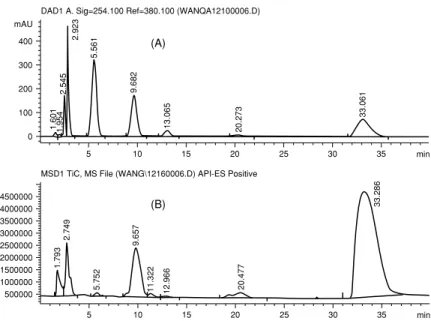
In total, four photoproducts were observed from the HPLC and LC-MS chromatograms (Figs 1 and 2).
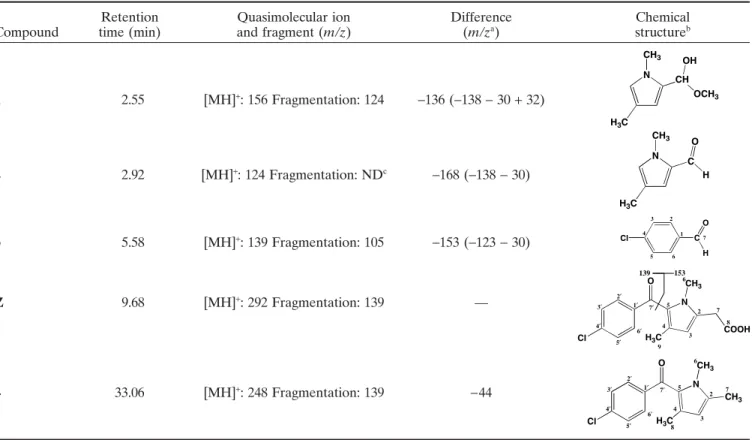
Their retention times are arranged in increasing order of: 1, 2.55; 2, 2.92; 3, 5.58; zomepirac (Z), 9.68 and 4, 33.06 min (Table 1). Two major photoproducts, 3 and 4, were separated according to the elution order by the preparative HPLC. The peaks of 1 and 2 were close together under the present HPLC conditions, implying that they have very similar chemical properties.
Structural characterization of photoproducts
The molecular weights of the four photoproducts were determined by LC-MS using electron spray ion-ization with a positive mode of polarity (Sheu et al., 2003), and their most probable structures are listed in Table 1. The structures of photoproducts, 3 and 4,
Figure 2. (A) LC chromatogram of photoproducts of zomepirac using a
UV detector at 254 nm and (B) separation of photoproducts using an MS detector by LC-ESI-MS.
Figure 1. Preparative HPLC chromatogram of zomepirac in methanol using a UV detector at
Table 1. Structure elucidation based on LC-MS of zomepirac and photoproducts
Retention Quasimolecular ion Difference Chemical
Compound time (min) and fragment (m/z) (m/za) structureb
1 2.55 [MH]+: 156 Fragmentation: 124 −136 (−138 − 30 + 32) 2 2.92 [MH]+: 124 Fragmentation: NDc −168 (−138 − 30) 3 5.58 [MH]+: 139 Fragmentation: 105 −153 (−123 − 30) Z 9.68 [MH]+: 292 Fragmentation: 139 — 4 33.06 [MH]+: 248 Fragmentation: 139 −44 a [MH]+
x–[MH]+z in mass-to-charge ratio units.
b IUPAC names: Z, 1,4-dimethyl-5-(4-chlorobenzoyl)-1H-pyrrole-2-acetic acid; 1, a hemiacetal of 2; 2, 1,4-dimethyl-2-formylpyrrole; 3,
p-chlorobenzaldehyde; 4, p-chloro-benzoyl-1,2,4-trimethyl-5-pyrrolyl ketone. The structures of photoproduct 3 and 4 confirmed by spectroscopic methods.
c ND, no data.
were further identified by spectroscopic methods to be p-chlorobenzaldehyde and p-chlorobenzoyl-1,2,4-trimethylpyrrolyl ketone, respectively.
a-Cleavage of a ketone
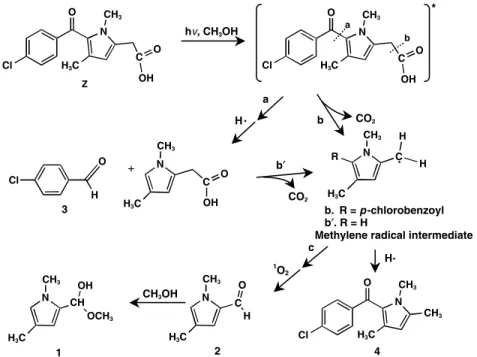
Photoproduct 2 had a molecular weight of 123 g/mol, and its structure is most likely to be 1,4-dimethyl-2-formylpyrrole. The successful identification of 2 repres-ents an interesting finding, which indicates that a typical radical reaction of α-cleavage of a ketone (Turro, 1991) into two moieties occurred. Zomepirac is a diaryl ketone with a phenyl ring on one side and a pyrrolyl group on the other. Consideration of the resonance energy of benzene vs pyrrole in conjugation with the carbonyl group, which equals 36 vs 22 kcal/mo(Carey, 2003), implies the double bond character of C8′–C1′ is stronger than C8′–C5 due to the greater electron distribution of the former bond. The counterpart of the cleavage is photoproduct 3 (MW = 140 g/mol), p-chlorobenzaldehyde, as verified by NMR spectroscopy. Under the photolytic conditions as described previ-ously, due to the apparently weaker bond strength of C8′–C5 in the parent drug, zomepirac, the bond fission
occurs exclusively along C8′–C5 to generate acyl (m/z 139) and pyrrolyl radicals (m/z 152). Next, each of the two radicals picks up a hydrogen atom from the solvent molecules and the former becomes photoproduct 3. The latter pyrrolyl radical forms firstly an acetic acid derivative, which decarboxylates followed by oxidation with singlet oxygen producing photoproduct 2 (MW = 123 g/mol equivalent to m/z 152 − 30 + 1). Meanwhile, zomepirac is a weak acid, which releases protons as the catalyst. An equilibrium reaction of nucleophilic addition of the solvent molecule, methanol, to the carbonyl group of 2 produces a hemiacetal 1 (MW = 155 g/mol).
Decarboxylation and oxidation
Decarboxylation of 1,2,3-trimethyl-2-pyrrolyl acetic acid (m/z decreasing by 44) initially forms a methylene radical intermediate. The following reactions split into two paths. First, the former intermediate intercepts a hydrogen atom from methanol to form compound 4 (MW = 247 g/mol). Second, the intermediate proceeds by oxidation with the singlet oxygen to generate the oxidized form of an aldehyde 3 (MW = 140 g/mol). All
Figure 3. A proposed photodegradation reaction scheme of zomepirac (a)
α-cleavage of a ketone; (b) decarboxylation; and (c) oxidation with singlet oxygen.
CONCLUSION
A proposed reaction scheme of photolysis of zomepirac in methanol is shown in Fig. 3. The highlights include the following: first, a scissoring reaction at C8′–C5 (the so-called α-cleavage of a ketone) occurs; and second, obvious solvent participation of methanol leads to the formation of the hemiacetal 1. In general, the decarboxylation of zomepirac or other NSAIDs with acetic or propionic derivatives is a common occurrence. The radical intermediate proceeds by oxidation with singlet oxygen to produce oxidized products including alcohols, aldehydes or ketones, which have been widely reported and recognized in the literature (Bosca and Miranda, 1998).
Acknowledgment
The authors thank Mr Po-Yu Wang at National Labor-atories of Foods and Drugs, Department of Health, Executive Yuan for performing LC-ESI-MS.
REFERENCES
Bosca F and Miranda MA. Photosensitizing drugs containing the benzophenone chromophore. Journal of Photochemistry and Photobiology B Biology 1998; 43(1): 1.
Carey FA. E-Book t/a Organic Chemistry, CD-ROM, Chap. 11, 5th edn. McGraw-Hill Science, New York, 2003.
Chen CJ. I. Development of stability-indicating high perfor-mance liquid chromatographic assay methods of NSAIDs— tolmetin and zomepirac. II. Photostability of tolmetin. Master
four photoproducts with their chemical structures are listed in Table 1.
Comparison of zomepirac and tolmetin in photochemical behavior
A novel radical reaction of α-cleavage of a ketone occurred when zomepirac or tolmetin was subjected to photo-irradiation with a Hanovia 200 W Hg lamp. Bond fission along C8′–C1 was exclusively for zomepirac, while partial cleavage occurred of the same bond for tolmetin (Chen, 2002), as can be observed from the different pattern of product distribution. The reason is the methyl group at the 4 position of pyrrolyl group in zomepirac exerting a steric effect to force the ring out of coplanarity with the carbonyl group. Thus the resonance of the conjugate π electrons of pyrrole ring contributes much less to the single bond of C8′–C1 for zomepirac than tolmetin. The main structural differ-ences of zomepirac and tolmetin are the p-substituents of Cl vs CH3 of the benzoyl group. In plasma and
urine, tolmetin glucuronide was detected by HPLC (Hyneck et al., 1987). Why have the immune and toxic responses of tolmetin metabolite have never been ob-served? It appears that the phototoxicity can be caused by the photoproducts, or free radical intermediates, or the chloro radical after metablism (Quintero and Miranda, 2000). It is highly probable that these active species could cause anaphylactic shock, as reported by the research groups (Levy and Vasilomanolakis, 1984; Corre and Rothstein, 1982).
Thesis, Taipei Medical University, Taipei, Taiwan (in Chinese), 2002.
Chen CY, Chen FA, Chen CJ, Wu KS and Wu AB. Stability-indicating HPLC assay method of zomepirac. Journal of Food and Drug Analysis. 2003; 11(2): 87.
Corre KA and Rothstein RJ. Anaphylactic reaction to zomepirac. Annals of Allergy 1982; 48: 229.
Giuffrida S, De Guidi G., Sortino S, Chillemi R, Costanzo LL, and Condorelli G. Molecular mechanism of drug photosensit-ization Part 6. Photohaemolysis sensitized by tolmetin. Journal of Photochemistry and Photobiology B Biology 1995; 29(2): 125.
Grindel JM, O’Neill PJ, Yorgey KA, Schwartz MH, McKown LA, Migdalof BH and Wu WN. The metabolism of zomepirac sodium. I. Disposition in laboratory animals and man. Drug Metabolism and Disposition 1980; 8: 343.
Haines DE, Witte GN, Graman HB and Uphold RE. Zomepirac-induced anaphylactic shock: an under-reported phenomenon. American Journal of Medical Science 1985; 290(4): 165.
Hyneck ML, Smith PC, Unseld E and Benet LZ. High-performance liquid chromatographic determination of tolmetin, tolmetin
glu-curonide and its isomeric conjugates in plasma and urine. Journal of Chromatography A 1987; 420(2): 349.
Levy DB and Vasilomanolakis EC. Anaphylactic reaction due to zomepirac. Drug Intelligence Clinical Pharmacology 1984; 18(12): 983.
Quintero B and Miranda MA. Mechanisms of photosensitization in-duced by drug: a general survey. Ars Pharmaceutica 2000; 41(1): 27. Sheu MT, Ho HO, Wang PY, Liou YP and Wu AB. Photolysis of NSAIDs. I. Photodegradation products of carprofen determined by LC-ESI-MS. Journal of Chromatographic Science 2003; 41(4): 200– 04.
Turro NJ. Modern Molecular Photochemistry, 1st edn. University Science Books, Mill Valley, CA, 1991, 224.
Wang M, Gorrell MD, McCaughan GW, and Dickinson, RG. Dipeptidyl peptidase IV is a target for covalent adduct formation with the acyl glucuronide metablite of the anti-inflammatory drug zomepirac. Life Science 2001; 68: 785–797.
Wu WN, Weaner LE, Kalbron J, O’Neill PJ and Grindel JM. The metabolism of zomepirac sodium. II. Isolation and identifica-tion of the urinary metabolites in rat, mouse, rhesus monkey, and man. Drug Metabolism and Disposition 1980; 8: 349.