行政院國家科學委員會專題研究計畫 成果報告
具高效能傳輸及品質服務的適應性整合 MR-WMN 資源管理之
設計
研究成果報告(精簡版)
計 畫 類 別 : 個別型 計 畫 編 號 : NSC 99-2221-E-151-037- 執 行 期 間 : 99 年 08 月 01 日至 100 年 08 月 31 日 執 行 單 位 : 國立高雄應用科技大學電機工程系 計 畫 主 持 人 : 黃文祥 計畫參與人員: 碩士班研究生-兼任助理人員:林永昌 碩士班研究生-兼任助理人員:吳佳達 博士班研究生-兼任助理人員:梁浩銘 博士班研究生-兼任助理人員:許紘銘 博士後研究:林政翰 報 告 附 件 : 出席國際會議研究心得報告及發表論文 處 理 方 式 : 本計畫涉及專利或其他智慧財產權,2 年後可公開查詢中 華 民 國 100 年 10 月 14 日
報告內容
ㄧ、前言近年來,由於無線網路技術的蓬勃發展及具有貼近使用者需求的可移動性(Mobility)特 點,已讓無線網路成為現階段網路建置與設計的主流。在短短數年,無線網路技術已由小涵 蓋範圍及低頻寬傳輸的無線區域網路WLAN,快速衍伸出種類繁多的個人區域網路PAN、無 線 感 測 網 路 WSN (Wireless Sensor Network) 、 無 線 都 會 網 路 WMAN 並 發 展 異 質 交 握 (Heterogeneous handover)技術來整合WWAN 的Cellular通信系統。同時為了提供隨時隨地的無 線傳輸服務(Ubiquitous),更大涵蓋的範圍、更高的傳輸頻寬、更可靠的傳輸服務品質(Quality of Service; QoS),而發展了無線網狀網路(Wireless Mesh Network - WMN)架構。WMN 架構如 圖一所示,透過預先設置的Mesh Router 互相連接形成無線的Mesh Network Backbone,這些 Mesh Router 本身具有電力來源並且採用多個傳輸天線介面,運算能力也高於一般的無線節 點;對同層級的Mesh Router 而言需負責互相之間的路由與傳送,對下可以各式各樣的無線 傳輸技術如IEEE 802.11、WiMAX等連接Mesh Clients,對上則以IGW (Internet Gateway)的Mesh Router,透過外部有線網路連接Internet,與內部WMN 做資料的交換;Mesh clients 可以是直 接連接Mesh Router 或是透過Infrastructure 基地台進行資料傳輸。除此之外,WMN 也保有 MANET 節點的自我組織、自我發現、自我恢復、自我設定等特性,當某一地區無法被Mesh Router 涵蓋時,Mesh clients 間可以透過ad-hoc 模式互相進行資料傳遞,傳輸的可靠性可因 而大幅提高。
圖二、 IEEE 802.11b/g 可用的 ISM 頻道
無線網狀網路 WMN 雖具有上述的優點,但也相對地增加了系統運作複雜度,接下來我 們將介紹WMN 技術的相關背景:首先探討頻道間訊號的相互干擾;在WMN 中的Mesh Router 是具有多重傳輸介面(Multi Radio and Multi Channel)可同時收送資料以提高系統效 能,然而當同一地區內Mesh Router 的密度過高,容易造成彼此頻道訊號干擾的情形發生。 然而在無線網路頻譜資源中,可提供使用的頻道數目很有限;以ISM (Industrial, Science, Medical)的2.401-2.483GHz 頻譜範圍為例,切割出的頻道數目大約是11-13 個(北美11、歐洲 台灣 13),圖二為13個頻道的示意圖;由圖三中可以發現真正獨立的僅1、6、11 等3個頻道 而己。因此如何有效地配置(Assignment)這些有限的頻道,使Mesh Router 可以同時進行封包 傳遞與收送,且避免鄰近Mesh Router 的訊號干擾,將會直接影響到WMN 的傳輸效能。
其次要探討是速率調變,或稱為鏈線適應(Link Adaptation)。在WMN 架構下,Mesh Routers 之間的資料傳收與接送通道(Channel)是使用不同頻率,而且各傳輸通道會有各自當時 的通訊品質,傳輸兩端必須依據該通道的通訊品質動態地調變編碼(Modulation Coding)出傳輸 的速率,甚至必須重新建立路由路徑(Routing Path)或傳送排程(Scheduling);然而在猜測通道 的通訊品質狀況的演算法,目前仍存在有許多改善的研究空間;失誤的判斷將會造成系統效 能的滑落。在實際傳輸中考量環境的變異以決定編碼的方式,則稱之為鏈結適應(Link Adaptation or Rate Adaptation) [1],由於短波長較易受干擾,故僅適用於訊號強度強、收訊良 好的環境下;而傳輸速度低的編碼,對於抗雜訊干擾或訊號微弱的環境下則表現較佳。在IEEE 802.11 協定中並沒有對調變選擇的機制做規範,過去的研究[2][3][4]也有只針對單一協定和 單一空間(Cell)的環境做探討,少有考慮在WMN 下多重傳輸介面與頻道疊蓋等的研究議題。
故調變選擇機制在WMN 的空間傳輸特性下,有必要做進一步的探究。
接下來的研究議題是探討WMN 的流量負載平衡與無線干擾等課題[5]。首先,過多的 IGW 與Mesh Router 數量將會造成干擾嚴重、成本增加等問題;但數量不足則會出現連結度 低、可靠性低等問題。其次,在Mesh client 選擇Mesh Router 時是依據那個參數做決定,也 是值得深入探究的課題;在一個覆蓋率高的WMN 環境裡,通常可以偵測到多個提供傳輸服 務的Mesh Router,這時Mesh client 須決定選用那個Router 來進行傳輸。傳統的做法大多是以 接收訊號強度作為這個選擇的依據;然而近期的研究已開始探討以Mesh Router 的負載、傳 輸封包的成功率來做為的決定要素。 最後的研究議題是WMN 的資料傳輸品質是否可以滿足多媒體傳輸的需求及傳輸是否公 平。近年來的網路應用服務的趨勢已逐漸朝向多媒體服務,譬如網路電話(VoIP)、隨選視訊 (Video on Demand)、網路電視IPTV和遠距居家照護(Telehomecare)。這些影音的應用對頻寬和 即時性有著非常嚴格要求與限制,但是過去的WMN 研究議題較少著墨於QoS 支援上,這是 很值得專注的課題[5]。傳輸公平性的議題則可分為區域不公平性(Local Unfairness)和端點對 端點不公平性(End-to-End Unfairness),區域性的不公平現象是泛指節點在同一空間裡,因所 在位置或訊號衰減、干擾等因素,造成的節點間效能差異[6]。端點對端點的不公平性,是因 為WMN 架構下的流量有集中於IGW 的特性,文獻[7][8]指出節點吞吐量(Throughput)與延遲 (Delay)的表現,與距離IGW 或目的端的跳躍數(Hop)有極大的關聯性。探討如何在Mesh Router 或傳輸的路徑上做出QoS 支援與節點的傳輸公平性,是項很務實且重要的研究課題。 本計畫原本提出三年期計畫,分別探討WMN頻道配置的議題、WMN調變機制的設計與 流量負載平衡演算法、在Mesh Router上建立多媒體服務類別管理政策;由於本計劃被核定為 一年期,本報告內容將著重於第一年的部份,即針對WMN路徑流量與訊號干擾進行量測並收 集網路拓墣資訊,WMN進行頻道配置時將考量路徑流量、訊號干擾程度等網路狀態,已決定 出最適合的頻道配置。 二、研究目的 近年來網路的建置與發展,已逐漸朝向提供便利性與移動性的無線網路,這趨勢使得網 路服務更貼近人們的日常生活所需,無線網狀網路WMN的All Wireless 架構便是以此特性為 訴求;然而在WMN架構下仍有許多議題急待投入更多研究的人力。本計畫即針對WMN網路 資源做整合性的考量與設計並滿足以下三項的特點:(一)WMN 系統效能提升。近年來無線 網路以多重輸入輸出技術(MIMO)來大幅提升其傳輸頻寬,WMN 也不例外,且因有見於頻道 配置與速率調變的管控技術主導了系統的整體傳輸效能,故本計畫將優先探究通道特性與訊 號干擾的影響,並搭配流量負載預測,提出動態頻道配置機制。(二) 流量平衡與傳輸公平性。 Mesh Client 選擇Mesh Router 常採用接收訊號的強弱做為選擇的依據,為避免流量過度集中 而發生擁塞與傳輸不公平等現象,本計畫將分別對Mesh Client 和Mesh Router提出新機制以提 高選擇的正確率與傳輸的公平性。(三) 多媒體影音傳輸。為降低多媒體資料在WMN 中的傳 輸延遲(Delay)或抖動(Jitter),以提高其服務的品質。本計畫將結合前兩項的設計將網路資源 加權化,並將資料分類,以Class-based 方式建立Mesh Router 與IGW 的Per-Hop-Behavior 功 能,達到強化WMN 的差異性對待服務能力。
圖三、 (a) 集中式頻道配置 (b) 分散式頻道配置 三、文獻探討 目前多頻無線網狀網路頻道配置方法依照配置點的不同,大致上分為兩種,分別為集中 式頻道配置以及分散式頻道配置。集中式配置方式由集中式伺服器配置多頻無線網狀網路節 點的頻道,如圖三(a)所示,Mesh Router 須將收集到的網路資訊傳送給伺服器,伺服器整合 多頻無線網狀網路所有資訊後,伺服器將指配個別的Mesh Router 使用經過配置的頻道。雖 然傳遞訊息封包及管理封包會增加額外的頻寬花費,但卻能得到接近最佳的頻道配置結果。 分散式配置方式則由多頻無線網狀網路的Mesh Router 自行配置頻道,如圖三(b)所示,個別 節點收集鄰近節點的相關資訊進行頻道配置,頻道配置所花費的時間較集中式快,需要的額 外頻寬亦較少,但由於未能掌握整體網路拓樸的所有資訊,因此很難對整個WMN 無線網路 的訊號干擾與頻道疊蓋做出良善的頻道配置,故效能難有效提升。總結歸來集中式配置需要 較多的管理封包進行資訊收集與傳遞,但由於能夠掌握整體WMN 的無線網狀網路拓樸,故 效能較分散式配置佳。 針對頻道配置的研究可區分為三類:(a) 靜態頻道配置。在多頻無線網狀網路節點配置頻 道時,不需要事先進行協調。當頻道配置過後,所有節點都無法自行更換頻道,在文獻[9][10] [11][12]皆運用集中式頻道配置方法,切換頻道必須由集中式伺服器決定,透過集中式伺服器 收集多頻無線網狀網路的資訊,並分析網路資訊後決定所有Mesh Router 使用的頻道。靜態 頻道配置優點在於無須擔心接收端自行切換頻道而遺漏封包,但若在網路流量變化大時,則 會造成頻道利用率降低,此作法通常運用於網路流量型態變化不大的環境。(b) 動態頻道配 置。多頻無線網狀網路節點可以透過協調機制,動態地自行改變使用的頻道,而在改變頻道 的同時需要告知鄰近的Mesh Router,如此才能確保頻道改變後不會造成遺漏封包的問題出 現,此配置頻道的方式通常運用分散式頻道配置方法,透過個別的Mesh Router 可以依照目 前的網路環境狀況自行決定頻道設置,因此頻道的利用率較靜態配置佳,但Mesh Router 與 Mesh Router 間切換頻道的協調機制將造成額外的溝通負擔,且在更換頻道的同時可能會造 成其他節點的頻道干擾,因而增加封包的遺失率。(c) 混合頻道配置。混合頻道配置同時包含 靜態頻道配置及動態頻道配置特性,在WMN 下Mesh Router 皆具有兩個以上的通訊介面, 其中一個通訊介面運用靜態頻道配置,其餘則運用於動態頻道配置。 在文獻[13]靜態的通訊介面被當作控制頻道,而動態的通訊介面則為資料傳輸的頻道; 若節點要傳輸資料則必須先在靜態的通訊介面透過協調機制,決定動態通訊介面的頻道。
此作法在傳送資料前必須先進行一連串的協調動作,造成額外的溝通負擔。在多頻無線網狀 網路環境中,有效利用頻譜資源顯得非常重要,文獻[9]提出MesTiC (Mesh-based traffic and interference aware channel assignment)頻道配置的策略,將網路流量樣本及干擾感知加入頻道 配置的考量因素,網路流量樣本即為預期的頻寬使用的狀況,干擾感知則透過衝突圖(conflict graph)[11]的判斷。在過去的文獻中,運用部份重疊頻道進行頻道配置大部份都選擇所有頻道 依干擾關係來配置頻道,其中以2008年Yong Ding學者所提出的Greedy Algorithm[14]最為典 型,透過干擾距離關係表得知鏈結之間的距離與頻道間隔距離的關係,以減少鏈結之間頻道 的干擾影響。2009年Yuting Liu學者所提出的CAEPO頻道配置[15],將運用了Mitchell Burton 學者[16]的分析結果,運用頻道重疊因子(overlap factor, olf)得知網路拓樸干擾關係並配置頻 道。2009年Mohammad A. Hoque學者[17]以及2010年Pedro B. F. Duarte 學者[18]皆運用 Interference model I-Matrix,即時更新網路干擾程度並選擇干擾較小頻道進行頻道配置。 四、研究方法
為了有效提升 WMN 網路資源的利用率,本計畫提出設計一套使用四個部份重疊頻道的 頻道配置策略(Four Partially Overlapping Channels, FPOC),在頻道配置過程中將使用四個部份 重疊頻道(頻道 1、4、8 和 11)同時運用衝突圖(Multi-radio Conflict Graph, MCG)[19]的概念, 讓鏈結干擾範圍內的所有鏈結不會配置到相同頻道,並使得鏈結干擾範圍外的鏈結能運行在 相同的頻道,使得網路拓樸的干擾能大幅降低並提高整體無線網路的頻道利用率。FPOC 頻 道配置程序主要分為三個程序,如圖四所示。首先進行鏈結合併程序(Link Binding),此程序 會將鏈節指派到節點的通訊介面上,同時可以平均節點上通訊介面的網路流量,並合併即將 使用相同頻道的鏈結集合(LinkSet),其次為衝突感知程序,透過前一程序的鏈結合併完成後, 建立衝突圖以及衝突表,此程序會得知網路拓樸中每一個鏈結集合會產生干擾的鏈結集合以 及未具干擾的鏈結集合,完成前面兩個程序後,最後一個程序則選用頻道 1、4、8 和 11 進行 頻道配置,並依序從干擾最嚴重且負載流量最大的鏈結集合優先選擇適當頻道。 圖四、FPOC 頻道配置流程 4.1 鏈結合併程序(Link Binding) FPOC 系統架構如圖五所示,屬於集中式頻道配置,在多頻無線網狀網路中網路資訊將 會透過 MAP 轉送到集中式伺服器,藉由集中式伺服器來分析網路負載流量及計算干擾關係 並進行頻道配置。在鏈結合併程序中會先計算每個 MAP 指派鏈結時的優先順序,來避免負 載較重的 MAP 沒有優先指派導致最後指派到負載流量較大的鏈結集合中,使得網路拓樸中 每個鏈結集合呈現負載不平衡現象,如公式(1)所示。 num Radio num hop num Link node traffic Aggregate order _ * _ _ * ) ( _ (1)
圖五、 FPOC 系統架構圖
圖六、FPOC 鏈結合併示意圖
其中 order 代表每個 MAP 在鏈結合併程序中指派的優先順序,Aggregate_traffic(node)代表每 個 MAP 所匯集的網路總負載流量大小,Link_num 代表每個 MAP 的鏈結數量,hop_num 代 表每個 MAP 的距離集中式伺服器(Gateway)的 hop 數,Radio_num 代每個 MAP 上的通訊介面 數量,此優先順序目是為了讓網路匯集流量較大或是鏈結數目較多的 MAP 能優先指派,在 鏈結指派的過程中,MAP 指派的優先順序不同,結果所產生的鏈結集合也會有算不同,透過 優先順序的計算使得越靠近集中式伺服器的 MAP 或是流量較大 MAP 能優先指派,避免負載 較重的 MAP 最後指派到負載流量較大的鏈結集合中,導致整體鏈結集合的負載不平均的問 題產生。除此之外,當鏈結數量大於通訊介面數量時,其中的通訊介面則可能同時服務兩個 或兩個以上的鏈結,也就是節點上的兩個鏈結可能同時使用相同的通訊介面並且使用相同的 頻道。鏈結合併示意圖如圖六所示,MAPa 有兩個網路通訊介面,分別為 Radio1 和 Radio2, 相鄰的 MAP 與 MAPa 連線的節點有 3 個,鏈結分別為 Linkb、Linkc 和 Linkd 透過鏈結合併 程序平均配置到通訊介面上,最後再將使用相同的頻道的連結合成成為鏈結集合,如圖六中 Linkb 和 Linkc 分別指派到 MAPa 的 Radio1 上並形成鏈結集合,此鏈結集合 Linkb 和 Linkc 在頻道配置程序中,則會配置到相同的頻道上。
圖八、FPOC 鏈結集合衝突圖
表一、鏈結集合的頻道配置表
LinkSet Conflict-Free LinkSets Traffic Channel
LinkSet1 null 47 Ch1 LinkSet2 null 47 Ch4 LinkSet4 LinkSet3 56 Ch8 LinkSet5 LinkSet6 42 Ch8 LinkSet6 LinkSet5 42 Ch11 LinkSet3 LinkSet3 36 Ch11
4.2 衝突感知程序 由圖七的鏈結合併範例示意圖可以得知,此網路拓樸共九個無線存取點(MAP)、十二條 鏈結,每個 MAP 上皆有兩個通訊介面,並且由鏈結程序合併產生六個鏈結集合(鏈結集合 1 到鏈結集合 6)。此程序將分析每個鏈結集合與其他鏈結集合是否產生干擾,一般定義干擾範 圍皆等於兩倍的節點傳輸距離,在此範圍內的節點上的鏈結皆屬於干擾範圍。例如鏈結集合 3 由鏈結 ab 與鏈結 bc 形成且網路流量分別為流量 17 和流量 19,因此拓樸中與鏈結集合 3 干 擾的鏈結集合包含鏈結集合 1、鏈結集合 2、鏈結集合 5 和鏈結集合 6,然而在鏈結集合 3 干 擾範圍外的集合為鏈結集合 4,如圖八為鏈結集合衝突圖。 4.3 頻道配置程序(Channel Assignment) 本計劃在完成鏈結合併程序及衝突感知程序後,最後進行頻道配置程序,此程序主要將 頻道配置給每個鏈結集合,並且本論文所使用的頻道為部份重疊頻道(頻道 1、頻道 4、頻道 8 和頻道 11),屬於頻道重疊干擾最小的四個頻道。從圖七的鏈結合併範例示意圖可以得知,頻 道配置由鏈結集合 1(LinkSet1)且網路流量為 47 並開始配置頻道,因鏈結集合 1 的干擾範圍內 皆與其他鏈結集合皆產生干擾,所以只配置鏈結集合 1 至頻道 1 上,其次選擇鏈結集合 2(網 路流量為 47)且干擾範圍內皆與其他鏈結集合皆產生干擾,並配置鏈結集合 2 至頻道 4,接著 選擇鏈結集合 4(網路流量為 56)並配置頻道 8,由於鏈結集合 4 與鏈結集合 3 彼此皆屬於互不 干擾的鏈結集合,因此也配置頻道 8 至鏈結集合 3,使得鏈結集合 4 與鏈結集合 3 上的鏈結 皆使用相同的頻道,最後,選擇鏈結集合 5(網路流量為 42)並配置頻道 11,因為鏈結集合 5 與鏈結集合 6 彼此皆屬於互不干擾的鏈結集合,因此也配置頻道 11 至鏈結集合 6,使得鏈結 集合 5 與鏈結集合 6 上的鏈結皆使用相同的頻道,如表一為鏈結集合的頻道配置表及圖九為 頻道配置結果範例示意圖。 圖九、FPOC 頻道配置範例示意圖
圖十、無線網路模擬環境
圖十一、平均吞吐量
4.4 系統效能的模擬與分析
本計畫將分析透過 FPOC 頻道配置的 WMN 網路效能,並將結果與 Greedy Algorithm[14] 機制比較。網路拓墣如圖十所示,模擬程式以 Network Simulator 2 軟體撰寫,由 25 個節點組 成,且每一個網路節點都配置兩個通訊介面,網路節點之間的相隔距離為 200 公尺,模擬時 間為 60 秒。
五、結果與討論
平均吞吐量如圖十一所示,圖中 FPOC 在平均吞吐量可以得到約 7914kbps,而 Greedy(All channel)將運行在全頻道上,其平均吞吐量約 5204kbps,然而 Greedy(Four channel)若運行在 四個部份重疊頻道上(頻道 1、4、8 和 11),並且平均吞吐量約 5801kbps,因此,從圖十一可 以清楚的得知,若 Greedy Algorithm 運行在四個部份重疊頻道呈現的網路吞吐量會比運行在 所有頻道上較佳的效能,因為頻道與頻道之間會因重疊頻率導致干擾的產生使得整體效能降 低,然而,採用 FPOC 頻道配置會將干擾關係透過衝突圖理論來避免節點與節點之間鏈結的 干擾,使得網路吞吐量呈現更好的效能,FPOC 頻道配置提昇約 26.6%到 34.2%的平均吞吐量。 網路封包丟棄率如錯誤! 找不到參照來源。二所示,透過 FPOC 頻道配置的封包遺失率 約為 26%,而 Greedy(Four channel)的封包遺失率約為 35%,而 Greedy(All channel)的封包遺 失率約為 33%,採用 FPOC 頻道網路封包丟棄率比 Greedy Algorithm 約降低 7%~9%,因 FPOC 頻道配置避免干擾範圍內的其他鏈結使用相同的頻道,減少封包傳遞競爭的機會而導致封包 丟棄率的上升,而 Greedy Algorithm 頻道配置使用頻道數較多,同時也使頻道與頻道之間重 疊干擾影響相對提高,導致網路效能呈現較差的結果。 從圖十三可以得知,模擬無線網狀網路節點數為 10 個、15 個、20 個和 25 個節點時的網 路整體吞吐量,FPOC 頻道配置在節點數 15、20 和 25 時,網路吞吐量分別為 7914kbps、 11821kbps 和 19599kbps,因為 FPOC 頻道配置選用四個干擾最小的通訊頻道,並且採用衝突 圖理論來避免干擾範圍內使用相同的頻道,不僅避免同頻干擾的產生並降低部份重疊頻道的 干擾影響,同時提昇可用的頻道數,使得網路效能不受干擾影響,並且讓頻道利用率提高來 增加網路效能,然而 Greedy Algorithm(All channel)因所使用的頻道為所有頻道(11 個頻道), 卻沒有考慮頻道之間的重疊干擾影響,導致頻道間隔距離太小使得網路效能呈現最差成效, 相較於 Greedy Algorithm (Four channel)]雖然使用相同的四個最小干擾的頻道,但因 Greedy Algorithm 在頻道配置過程中,並沒有讓干擾最嚴重的鏈結優先選擇較適當的頻道,導致干擾 最嚴重的鏈結最後配置到較不適當的頻道,使得網路效能並無明顯的提昇。
由圖十四的模擬結果可以得知,網路節點增加時 FPOC 頻道配置在系統效能呈現較佳的 結果,因選用的頻道干擾影響較小,使得封包因競爭頻道產生封包遺失較低,並由圖十四可 以得知網路節點數為 10 個、15 個、20 個和 25 個節點時,平均每一個網路存取節點的效能。 此外,Greedy Algorithm(All channel)在網路整體效能的呈現上,以及每個節點平均吞吐量皆為 最低的網路吞吐量,雖然頻道數的增加可減少同頻干擾的發生,但是在頻道配置的過程中, 必須優先考慮干擾影響較大的鏈結優先配置,才能提昇網路吞吐量,因此由圖十四可以得知 FPOC 頻道配置相較於 Greedy Algorithm 在所有頻道下以及四個頻道下,平均各節點的網路吞 吐量約提昇 26.7%到 52.1%。
圖十三、網路總吞吐量
圖十四、平均各節點平均吞吐量
參考文獻
[1] D. Qiao, S. Choi, and K.G. Shin, “Goodput Analysis and Link Adaptation for IEEE 802.11a Wireless LANs,” IEEE Transactions on Mobile Computing, vol.1, pp. 278-292, 2002.
[2] M. Lacage, H. Manshaei, T. Turletti, “IEEE 802.11 rate adaptation: A practical approach,”
INRIA Technical Report Number 5208, 2004.
[3] J. Bickett, “Bit-rate selection in wireless networks,” Master of Science Thesis, MIT, MA,USA, Feb. 2005.
[4] M. Kserawi and J. K. K. Rheel, “Distributed potential field based routing and autonomous load balancing for wireless mesh networks,” IEEE Communications Letters, pp. 429-431, 2009. [5] A. Kamerman and L. Monteban, “WaveLAN-II: A High-Performance Wireless LAN for the
Unlicensed Band,” Bell Labs Technical J., pp. 118-133, Summer 1997.
[6] V. Gambiroza, B. Sadeghi, and E. W. Knightly, “End-to-End performance and fairness in multihop wireless backhaul networks” in Proc. ACM MOBICOM, Sep. 2004, pp.287-301. [7] D. Niyato and E. Hossain, “Radio Resource Management in MIMO-OFDM-Based Wireless
Infrastructure Mesh Networks: Issues and Approaches,” IEEE Communications Magazine, pp. 100-107, 2007.
[8] P. Gupta and P.R. Kumar, The capacity of wireless networks, IEEE Transactions on Information Theory, 46 (2), 388-404, 2000.
[9] A. Raniwala, K. Gopalan, and T. Chiueh, “Centralized Channel Assignment and Routing Algorithms for Multi-channel Wireless Mesh Networks,” ACM Mobile Comp. and Commun. Rev., Apr. 2004, pp. 50-65.
[10] H. Skalli, S. Ghosh, L. Lenzini and M.Conti, “Channel Assignment Strategies for Multiradio Wireless Mesh Networks: Issues and Solution,” Communication Magazine, IEEE, November 2007, pp. 86 – 95.
[11] M. Marina and S. R. Das, “A Topology Control Approach for Utilizing Multiple Channels in Multi-Radio Wireless Mesh Networks,” Proc. Broadnets, Oct 2005, pp. 381-90.
[12] P. Kyasanur and N. Vaidya, “Routing and Link-layer Protocols for Multi-Channel Multi-Interface Ad Hoc Wireless Networks,” Mobile Comp. and Commun. Rev., vol. 10, no. 1, Jan. 2006, pp. 31–43.
[13] S.-L. Wu, C.-Y. Lin, Y.-C. Tseng, and J.-P. Sheu, “A New Multi-Channel MAC Protocol with On-Demand Channel Assignment for Multi-Hop Mobile Ad Hoc Networks,” in Proc. of the International Symposium on Parallel Architectures, Algorithms and Networks (I-SPAN), pp. 232-237, Dec. 2000, Dallas, TX, USA.
[14] Y. Ding, Y. Huang, G. Zeng, and L. Xiao, “Channel Assignment with Partially Overlapping Channels in Wireless Mesh Networks, ” in ICST, Jan. 2008 and WICON, Aug. 2008..
[15] Y. Liu, R. Venkatesan, and C. Li, “Channel Assignment Exploiting Partially Overlapping Channels for Wireless Mesh Networks,” GLOBECOM, Nov. 2009.
[16] M. Burton, “Channel Overlap Calculations for 802.11b Networks, ” White Paper, Cirond Technologies Inc, November 2002.
[17] Mohammad A. Hoque, Xiaoyan Hong and Farhana Afroz, “Multiple Radio Channel Assignment Utilizing Partially Overlapped Channels, ” GLOBECOM, Nov. 2009.
[18] P. B. F. Duarte, Z. Md. Fadlullah, K. Hashimoto, and N. Kato, “Partially Overlapped Channel Assignment on Wireless Mesh Network Backbone”, GLOBECOM, Dec. 2010.
[19] I. Katzela and M. Naghshineh, “Channel Assignment Schemes for Cellular Mobile Telecommunication systems: A Comprehensive Survey, ” in Personal Communications, 1996. [20] M.F.Tsai, T.C.Hung, C.H.Ke, C.K.Shieh, and W.S.Hwang,"Adaptive Hybride Error Collection
Model for Video Streaming over Wireless Networks," ACM/Springer Multimedia System Journal, vol.17, no.4, pp.327-340, Jul. 2011. (SCI, EI)
[21] H.M.Liang, C.K.Shieh, T.C.Huang, W.S.Hwang, and C.H. Ke, "The density based access method: A novel approach to optimizing run-time throughput for IEEE 802.11 DCF access control," Mathematical and Computer Modelling, vol.53, no.3-4, pp.443-457, Feb, 2011. (SCI, EI)
[22] W.P.Chen, W.F.Wang, and W.S.Hwang, "Adaptive DBA Algorithm with Sorting Report Messages for EPON," IET Communications, vol.4, no.18, pp.2230-2239, Dec. 2010. (SCI, EI) [23] C.I Kuo, C.H.Shih, C.K.Shieh, and W.S.Hwang, 2010, "A Fast and Efficient FEC
pp252-255., Oct. 15-17, Darmstadt, 2010. (德國, Darmstadt)
[24] J.Y.Tsai, G.C.Chen, and W.S.Hwang, 2010, "Improve the Efficiency of Preparation Phase in Seamless Handover by using MIIS," NST 2010, Dec. 3-4, 2010.
[25] C.H. Cheng, and W.S.Hwang, 2010, "IA Dynamic Bandwidth Request Algorithm based on Traffic Loading for Best-Effort in IEEE 802.16 Networks," NST 2010, Dec. 3-4, 2010.
[26] P.C.Tseng and W.S.Hwang, 2011, "Toward the Ubiquitously Networked Society: QoS-aware Residential Gateway with ZigBee-based Network," International Symposium on Wireless Pervasive Computing (ISWPC), pp., Feb. 23-25, 2011.Hong Kong
[27] M.F.Tsai, C.H. Shih, C.K.Shieh, and W.S.Hwang, 2011, "Multirate-aware Concurrent Multipath Transmission Mechanism," International Symposium on Wireless Pervasive Computing (ISWPC), pp., Feb. 23-25, 2011. Hong Kong,
[28] W.P.Chen, S.X. Chen, M.J.Xu, and W.S.Hwang, 2011, "The Study of Performance under Asymmetrical Traffic Load for EPON.p," 2011 Conference on Optical Technology, pp.127-132, May 27, 2011.
[29] Y.C Lin, C.H Lin, W.S.Hwang, and C.K.Shieh, 2011, "FPOC: A Channel Assignment Strategy Using Four Partially Overlapping Channels in WMNs," 8th IEEE Asia Pacific Wireless Communication Symposium (APWCS 2011), Session M6: Wireless Network, Aug. 22-23, 2011. Singapore
計畫結果自評
首先感謝國科會給予本人順利完成這個研究計畫的機會。回顧本計劃的研究成果已達成 到計畫申請書的目標,即為在 WMN 無線網路架構上,提出一個新的頻道配置策略(FPOC), 選擇四個互相干擾最小的頻道來改善因頻道不足而造成的同頻影響,同時也藉由衝突理論來 避免頻道之間干擾的產生。FPOC 頻道配置則依據節點網路流量負載程度並依序將鏈結配置 到通訊介面上,並且合併使用相同通訊介面的鏈結成為鏈結集合,並計算每個鏈結集合之間 彼此的衝突干擾程度,得知每個鏈結集合在干擾範圍外的未干擾鏈結集合,最後依據每個鏈 結集合的干擾程度以及負載流量大小,使得干擾程度越嚴重且網路負載流量越大的鏈結集合 能優先選擇頻道,並且讓未干擾的鏈結集合運行在相同的頻道上,如此一來不僅藉由衝突圖 避免干擾問題的影響,同時提高無線網路的頻道利用率,同時也充分的利用網路資訊,更能 夠準確地配置較合適的頻道,最後透過模擬分析,證明網路效能的提升。關於本計畫的研究 相關的著作共計發表了本計畫相關的 3 篇期刊論文[20-21]及 7 篇國內外的會議論文[22-29]。國科會補助專題研究計畫項下出席國際學術會議心得報告
日期:100 年 8 月 26 日
一、參加會議經過
APWCS 2011 第 8 屆亞洲無線通訊研討會議在新加坡 Matrix Building (Singapore)舉行,這是一 個接近新加坡大學的地方,在新加坡只要在捷運系統 EW21 站(Buona Vista)下站,走大約 15 分鐘 就可以到會場,很方便。會議時間是 100 年 8 月 22-23 日,大樓內有多場會議在進行,我們安排 在五樓,會場完成註冊及領取會議資料(大會議程手冊及光碟片) 註冊費很便宜只有 6100 元。本次 會議共有來自中華民國、新加坡、日本、韓國、及由 IEEE Vehicular Technology Society (VTS)協辦, 共接受了 111 篇高品質的論文來發表,大會除了十五場 Technical sessions 外,同時安排了 Professor Michael Yan Wah Chi 的 Keynote speech 及三場 Invited talks 進行。會議探討的課題分別有: Cognitive &Cooperative Wireless, Multiuser & Distributed MIMO, OFDMA, Interference Management for Advanced Wireless Networks, Relay & Cooperation, Antenna & Propagation, Wireless Network, Estimation & Detection, Wireless Resource Allocation & HARQ…等等。我的論文被安排在 8 月 22 日 15 時 50 分的 Session MP6-1。
原本在參與會議後,預定搭乘中華航空 24 日 14 時 30 分的航班返回桃園中正國際機場,圓滿 達成這次的會議之旅;但就在完成出境手續,辦理登機手續時,身體突感不適,天旋地轉無法站 立,機場表達無法讓我登機,並叫救護車載我到 Changi General Hospital 急診,經三個多小時診治 後出院,花了近台幣萬元的救護車費用、參仟多元的醫師證明書費用,還有醫療費用。因判斷是 感冒引起的中耳不衡,在稍作休息後,搭乘隔天 25 日 10 時 10 分的航班返回桃園中正國際機場, 結束這場心驚動魄的旅程。
計畫編號
NSC 99-2221-E-151-037-計畫名稱
具高效能傳輸及品質服務的適應性整合 MR-WMN 資源管理之設計出國人員
姓名
黃 文 祥服務機構
及職稱
國立高雄應用科技大學電機系 教授兼計算機與網路中心主任會議時間
100 年 8 月 22 日至 100 年 8 月 23 日會議地點
新加坡會議名稱
(中文)
第 8 屆亞洲無線通訊研討會議(英文)
The 8th Asia Pacific Wireless Communication Symposium (APWCS 2011)發表論文
題目
(中文)
FPOC:在中型多頻無線網狀網路中使用四個部份重疊頻道之頻道配置策略(英文)
FPOC:A Channel Assignment Strategy Using Four Partially Overlapping
二、與會心得
我每次參加學術會議總會啟發一些研究思考的能量,在本次會議結束後獲得一些新的想法與 見解,對在無線異質網路上的系統資源分配模式,增添了降低無線干擾技術、媒體存取層與實體 層間跨層合作機制與交換的訊息類別,以理論基礎創新品質管控的想法。深信在網路頻寬的不斷 提高及網路交握技術更成熟的今天、多重設計的可擕式嵌入式末端系統之精進,應將使 Ubiquitous 網際網路的各項應用在近期獲得大幅的躍進。我覺得藉由不斷地參加國際學術性會議,可與各國 研究人才交換研究的心得,以在日新月異的網路通訊技術進展中知己知彼調整自己的研究方向、 吸收別人的智慧,進而增進研究的成果。承蒙國科會對本計畫的支持,方能使本人參與這次的國 際會議報告得以順利成行,而有豐碩難得的經驗與收獲,在此特別提出感謝。三、考察參觀活動(無是項活動者略)
本次會議並無安排參觀的活動,但飛行四多個小時才到達新加坡,我自行安排了到新加坡大 學參觀,同時也深入了解新加坡人生活與想法,藉此提高國際觀及增加教學素材。四、建議
此一預算的編列確實對國內學術研究有很好影響,可進而刺激學者不斷精進表達能力,及努 力做好研究工作。五、攜回資料名稱及內容
大會議程手冊及光碟片六、其他
無。發表的論文如下頁:
FPOC: A Channel Assignment Strategy Using Four
Partially Overlapping Channels in WMNs
Yung-Chang Lin Department of Electrical Engineering, National Kaohsiung University of Applied Sciences Taiwan, ROC [email protected] Cheng-Han Lin Department of Electrical Engineering, National Kaohsiung University of Applied Sciences Taiwan, ROC [email protected] Wen-Shyang Hwang Department of Electrical Engineering, National Kaohsiung University of Applied Sciences Taiwan, ROC [email protected] Ce-Kuen Shieh Department of Electrical Engineering, National Cheng Kung University
Taiwan, ROC [email protected]
Abstrat—Due to rapid construction and low cost, Wireless Mesh Network (WMN) is one of the most popular technologies in developing wireless network. In WMN, the channel interference and the limited number of available channel affect the network performance. This paper proposed a channel allocation strategy, Four Partially Overlapping Channels (FPOC), to improve the channel utilization in WMN. Based on the link binding and the analysis of the conflict graph, the FPOC mechanism utilizes four channels which are in the lowest interference of all available channels to determine the channel allocation. The numerical results show that our proposed FPOC mechanism improves the network performance by effective utilization of wireless channels over WMN.
Keywords-Wireless Mesh Network; multi-channel; channel allocation; channel interference.
A. INTRODUCTION
Over the past few years, wireless network has been rapidly developed and accepted as a solution of last hop in Local Area Networks (LANs), such as IEEE 802.11a/b/g standards [1]-[4]. People can connect to Internet via mobile phones, notebooks, Personal Digital Assistant (PDA) or other handheld devices. In order to increase available bandwidth of wireless networks, a new technology (IEEE 802.11n) was proposed. The IEEE 802.11n supports the multi-channel transmission by the multi-radio interface.
Wireless Mesh Network (WMN) is a new technology for constructing wireless network in the ad-hoc mode. The components of WMN are Smart antennas, Dynamic routing router and Security access of Point-to-point architecture. However, due to more and more people connecting Internet via wireless network, the noise interference decreases the performance of wireless transmission. The available frequency spectrum defined in the IEEE 802.11 is from 2.401 to 2.483 GHz [1]. Because of the limited amount of available channel, the problem of the co-channel leads serious signal interference in the IEEE 802.11 wireless network. Accordingly, the previous studies proposed the non-overlapping channel and channel separation mechanisms
[5-6] to reduce the signal interference and improve the performance over multi-channel WMN. Moreover, the partially overlapping channel and interference avoidance for each connection links are also proposed to upgrade the channel utilization and system performance. In [7], Ding et al. proposed a channel separation scheme to allocate wireless channel based on the interference distance and weighted conflict graph. But, the interval between the allocated channels is too small so that the problem of channel overlapping still exists. In [8], Liu et al. proposed the Partially Overlapping Channels scheme which allocates channel based on the network traffic load. The disadvantage of the Partially Overlapping Channels scheme is regardless of the channel interference between the links. In [9], Mohammad et al. proposed an Interference Matrix to select firstly the channel which is in the lowest interference of all channels. Due to the lower priority for the channel in the serious interference, the channel interference is not improved after channel allocation.
This paper proposed a channel allocation strategy, Four Partially Overlapping Channels (FPOC), to improve the channel utilization and the system performance in WMN. In the FPOC mechanism, the determination of the channel allocation is based on the link binding and the analysis of the conflict graph. The FPOC mechanism utilizes four channels which are in the lowest interference of all available channels to allocate the wireless channel.
The remainder of this paper is organized as follows. Section II reviews the background and related works about channel allocation over WMN. Section III outlines the proposed FPOC mechanism. Section IV presents the results of a serious simulations designed to compare the performance of the proposed FPOC and related works. Section V provides some brief concluding remarks.
B. RELATEDWORKS
A. Channel Overlapping
In [10], Mitch Burton presented the performance analysis of channel overlapping in the IEE 802.11 wireless network, as
shown in Fig.1. The notation of chsp means the channel separation which is the interval between allocated channels. The notation of olf presents the factor of channel overlapping. Based on the analysis results, most of the related studies utilize the wireless channels which the interval (chsp) is 5 (i.e. channel 1st, 6th and 11th) and the interference is 0.08%. However, the interferences (olf) of 3 and 4 channel interval are 0.54% and 3.75%, which are acceptable for the wireless transmission.
Accordingly, we observed the performance of two channel allocation schemes, including Partially Overlapping Channel and None Overlapping Channel, by the Networks Simulator 2 (NS-2) [11-12]. There are four wireless nodes in the simulation topology, as shown in Fig.2. Each node has two interfaces for transmitting and receiving. Scenario 1 is none overlapping channel (i.e. channel 1st, 6th and 11th) and scenario 2 is partially overlapping channel (i.e. channel 1st, 4th, 8th and 11th).
As shown in Fig. 3, the average throughput of the wireless nodes in the scenario 1 is about 3000 kbps and in the scenario 2 is about 4000kbps. The partially overlapping channel (scenario 2) provides better performance than none overlapping channel (scenario 1) because of the effective utilization of wireless channel. Therefore, this study will propose a channel allocation scheme based on the partially overlapping channel.
Figure 1. The interference of channel overlapping [7].
Figure 2. Simulation topology.
Figure 3. Performance comparison of two scenarios (Throughput)
B. Greedy Algorithm
In [7], Yong Ding proposed a Greedy Algorithm to improve the performance of channel allocation in wireless network. The Greedy Algorithm evaluates the distance between two links based on the weighted conflict graph, as shown in Table I. Then, the lowest interference channel will be assigned to the links, as shown in Fig. 4. However, the Greedy Algorithm ignores the traffic load of each wireless interface and cause the unbalance of the allocated channels. Moreover, some of the allocated channels are still overlapping and interfering (channel interval is less than 3) in the transmission range.
Table I. THE RELATION OF DISTANCE AND CHANNEL INTERVAL.
Channel Separation
chsp0 chsp1 chsp2 chsp3 chsp4 chsp5
2M 2R 1.125R 0.75R 0.375R 0.125R 0 5.5M 2R R 0.625R 0.375R 0.125R 0 11M 2R R 0.5R 0.375R 0.125R 0
III. FOURPARTIALLYOVERLAPPINGCHANNELS
FPOC is a centralized channel allocation system. The central server is responsible for network load evaluation and channel allocation. There are three steps in the channel allocation procedure of the FPOC scheme, as shown in Fig. 5. Firstly, the transmission links are assigned to the wireless interfaces by Link Binding. This step aims to balance the load of all wireless interfaces and form the LinkSet which means the links are allocated the same interface and channel. Then, FPOC analyzes the interference of the LinkSet by the Multi-Radio Conflict Graph [13]. Finally, the LinkSet in the most interference will be allocated channel first. Moreover, the LinkSets which are out of interference range to each other could be assigned the same channel to upgrade the channel utilization.
Figure 5. The procedure of channle allocation for FPOC.
A. Link Binding
If the amount of the data links is larger than the wireless interfaces on the MAPs (Mesh Access Points), the interface may serve multiple links by the same channel. The previous researches usually allocate the channel only based on “order” [5]-[9].
In this study, the order of link binding is based on the load of MAPs, which means the MAP with heavier load is given higher priority of link binding. However, even with the higher priority of link binding, the MAPs with heavier load do not be guarantee allocated by the channel in good quality. In our proposed FPOC scheme, before link binding, the order of the link binding for each MAP is determined by
(1)
where Traffic(node) is the total amount of traffic flow for each MAP, Link_num is the total number of one-hop links for each MAP, hop_num is the number of hop from the MAP to the Gateway in the shortest path and Radio_num is the number of the network interface on the MAP. Based on the Eq. (1), the order of link binding for the MAP is determined shown as Table II.
Table II. THE ORDER OF LINK BINDING
Order MAP Order factor
1 MAPb 144 2 MAPe 130 3 MAPc 39.5 4 MAPa 37.5 5 MAPd 26.67 6 MAPf 24 7 MAPg 6
Based on the Eq. (1), the MAP with heavier load or more links has higher priority of link binding. The traffic load on the MAP will be averagely distributed to the wireless interfaces. As shown in Fig. 6, there are two interfaces (Radio 1 and 2) on the MAP and j links (Link1, Link2, …, Linkj) between the MAP and neighbor MAPs. The links are allocated to the interface and bound as the LinkSet.
Figure 6. The Link Binding.
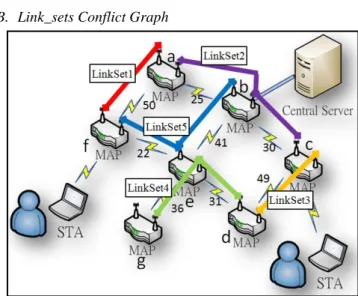
B. Link_sets Conflict Graph
Figure 7. The LinkSet of Link Binding
By the Link Binding, the links using the same interface on the MAP are grouped as a LinkSet and allocated the same channel, as shown in Fig. 7. Then, the conflict of each LinkSet is determined based on the conflict graph. The interference range is assumed as double of transmission rage. The LinkSets are defined as in interference only if the number of hops between the LinkSets is less than three. For example, the none-interference link of the LinkSet1 is the LinkSet3. The conflict graph of the LinkSets in Fig. 7 is presented in Fig. 8.
Figure 8. The Conflict Graph of LinkSets.
num Radio num hop num Link node Traffic order _ * _ _ * ) (
C. Channel Assignment
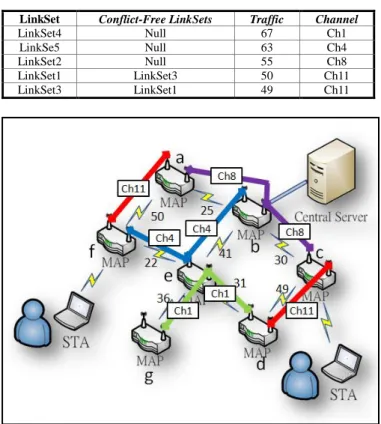
In order to avoid the interference, the channel allocated to the LinkSet must be free conflict. If there is no free conflict LinkSet, such as LinkSet2, LinkSet4 and LinkSet5, the order of the channel allocation is based on the traffic load on the LinkSet. For example, the LinkSet4 has the higher priority of channel allocation than LinkSet5 and LinkSet2 due to the higher traffic load (67). Next, the LinkSet1 and LinkSet3 are allocated the same channel (Ch11) because of free conflict. The channels allocated to all LinkSets are shown in the Fig. 9 and Table III.
Table III. THE ALLOCATED CHANNELS OF THE LINKSETS
LinkSet Conflict-Free LinkSets Traffic Channel
LinkSet4 Null 67 Ch1 LinkSe5 Null 63 Ch4 LinkSet2 Null 55 Ch8 LinkSet1 LinkSet3 50 Ch11 LinkSet3 LinkSet1 49 Ch11
Figure 9. The channel allocation of the FPOC mechanism.
IV. NUMERICALRESULTS
The proposed FPOC mechanism was verified and compared with the Greed-Algorithm [7] using Network Simulation 2 (NS-2) [11-12]. In the simulations, there are 25 wireless nodes and 2 wireless interfaces for each node. The distance of each node is 200 meter. The transmission rage and interference rage of wireless interface is 200 meter and 440 meter. The MAC protocol is IEEE 802.11 and the data rate is 1 Mbps. There are two flows which are Constant Bit Rate (CBR) in 1 Mbps, as background traffic. The packet size is 1000 bytes.
Fig. 10 presents the variation of throughput for FPOC and Greedy Algorithm. Obviously, the throughput of Greedy Algorithm distributes from 400kbps to 600kbps. The FPOC enhances the performance about 20% of Greedy Algorithm to
800kbps. In the beginning of simulation (t=0~5sec), the FPOC provides a more stable performance of throughput than Greedy Algorithm due to the load balancing for each MAP.
As shown in Fig. 11, the distribution of packet dropped rate for the FPOC is from 0.25 to 0.30, but for the Greedy Algorithm is from 0.28 to 0.32. The FPOC enhances about 4% packet dropped rate of Greedy Algorithm. Accordingly, the numerical results show that our proposed FPOC provides better performance, especially in the beginning of the simulations, by dynamical channel allocating with four channels (channel 1st, 4th, 8th and 11th) which are in the lowest interference and overlapping.
Figure 10. Variation of throughput for PFOC and Greedy Algorithm
Figure 11. Variation of packet dropped rate PFOC and Greedy Algorithm
V. CONCLUSION
With the rapid growth of wireless network, the wireless mesh network (WMN) extends the transmission coverage for broadband wireless Internet access. However, the transmissions in WMN tend to be interfered by other wireless devices in the same channel. This phenomenon results in packet loss and degrades the performance of WMN. In this paper, we proposed the FPOC mechanism to improve the channel utilization in WMN. The FPOC equally assigns the channels to wireless interfaces by the proposed link binding process. Furthermore, based on the analysis of the conflict
graph, the FPOC mechanism could effectively reduce the interference by allocating the lowest interfered channel. The simulation results show that the proposed FPOC mechanism improves the performance in terms of throughput and packet drop rate of WMN network.
ACKNOWLEDGEMENTS
This research was supported by the National Science Council (NSC 99-2221-E-151-037) in order to make possible the successful completion of this study, this expression is very grateful.
REFERENCES
[1] IEEE 802.11 Working Group, “Wireless LAN Medium Access Control and Physical Layer specifications, ” 1997.
[2] IEEE Std 802.11a, “Wireless LAN Medium Access Control (MAC) and Physical Layer (PHY) specifications, ” 1999.
[3] IEEE Std 802.11b, “Wireless LAN Medium Access Control (MAC) and Physical Layer (PHY) specifications, ” 1999.
[4] IEEE Std 802.11g, “Wireless LAN Medium Access Control (MAC) and Physical Layer (PHY) specifications, ” 2003.
[5] A. Raniwala, K. Gopalan, and T. Chiueh, “Centralized Channel Assignment and Routing Algorithms for Multi-channel Wireless Mesh Networks, ” ACM Mobile Comp. and Commun. Rev., Apr. 2004. [6] M. Mahesh K. and D. Samir R., “A Topology Control Approach for
Utilizing Multiple Channels in Multi-Radio Wireless Mesh Networks, ” Broadband Networks, Oct. 2005.
[7] Y. Ding, Y. Huang, G. Zeng and L. Xiao, “Channel Assignment with Partially Overlapping Channels in Wireless Mesh Networks, ” in ICST, Jan. 2008 and WICON, Aug. 2008
[8] Y. Liu, R. Venkatesan and C. Li, “Channel Assignment Exploiting Partially Overlapping Channels for Wireless Mesh Networks, ” Global Telecommunications Conference, Nov. 2009.
[9] H. Mohammad A., H. Xiaoyan and A. Farhana, “Multiple Radio Channel Assignment Utilizing Partially Overlapped Channels, ” Global Telecommunications Conference, Nov. 2009.
[10] M. Burton (Cirond Technologies), “Channel overlap calculations for 802.11b Networks, ” White Paper, Nov. 2002.
http://www.cirond.com/white papers/fourpoint.pdf [11] The Network Simulator. http://www.isi.edu/nsnam/ns/
[12] B. Wang, “NS2 Notebook: Multi-channel Multi-interface Simulation in NS2(2.29)”.http://www.cse.msu.edu/~wangbo1/ns2/nshowto8.html [13] I. Katzela and M. Naghshineh, “Channel Assignment Schemes for Cellular Mobile Telecommunication systems: A Comprehensive Survey, ” in Personal Communications, vol. 3, pp. 10–31, Jun. 1996.
國科會補助計畫衍生研發成果推廣資料表
日期:2011/10/11國科會補助計畫
計畫名稱: 具高效能傳輸及品質服務的適應性整合MR-WMN資源管理之設計 計畫主持人: 黃文祥 計畫編號: 99-2221-E-151-037- 學門領域: 計算機網路與網際網路無研發成果推廣資料
99 年度專題研究計畫研究成果彙整表
計畫主持人:黃文祥 計畫編號: 99-2221-E-151-037-計畫名稱:具高效能傳輸及品質服務的適應性整合 MR-WMN 資源管理之設計 量化 成果項目 實際已達成 數(被接受 或已發表) 預期總達成 數(含實際已 達成數) 本計畫實 際貢獻百 分比 單位 備 註 ( 質 化 說 明:如 數 個 計 畫 共 同 成 果、成 果 列 為 該 期 刊 之 封 面 故 事 ... 等) 期刊論文 0 0 100% 研究報告/技術報告 1 1 100% 研討會論文 3 3 100% 篇 論文著作 專書 0 0 100% 申請中件數 0 0 100% 專利 已獲得件數 1 1 100% 件 件數 1 1 100% 件 技術移轉 權利金 60000 60000 100% 千元 碩士生 2 2 100% 博士生 2 2 100% 博士後研究員 1 1 100% 國內 參與計畫人力 (本國籍) 專任助理 0 0 100% 人次 期刊論文 3 3 100% 研究報告/技術報告 0 0 100% 研討會論文 4 4 100% 篇 論文著作 專書 0 0 100% 章/本 申請中件數 0 0 100% 專利 已獲得件數 0 0 100% 件 件數 0 0 100% 件 技術移轉 權利金 0 0 100% 千元 碩士生 0 0 100% 博士生 0 0 100% 博士後研究員 0 0 100% 國外 參與計畫人力 (外國籍) 專任助理 0 0 100% 人次其他成果
![Figure 1. The interference of channel overlapping [7].](https://thumb-ap.123doks.com/thumbv2/9libinfo/8831058.235299/18.892.462.834.86.343/figure-interference-channel-overlapping.webp)