IEEE PHOTONICS TECHNOLOGY LETTERS, VOL. 20, NO. 24, DECEMBER 15, 2008 2093
Tunable Dual-Wavelength Fiber Laser Using
Optical-Injection Fabry–Pérot Laser
Chien-Hung Yeh, Chi-Wai Chow, Member, IEEE, Fu-Yuan Shih, Chia-Hsuan Wang, Yu-Fu Wu, and Sien Chi
Abstract—In this investigation, we propose and experimentally demonstrate a dual-wavelength fiber laser based on a self-in-jected Fabry–Pérot laser diode and an erbium-doped fiber. The dual-wavelength tuning range is 39.49 nm, from 1526.27 to 1565.76 nm. And the mode spacing of the dual-wavelength can be tuned from 1.32 to 39.49 nm. In addition, the output power difference of the dual-wavelength can be controlled and smaller than 1 dB.
Index Terms—Self-injected, Fabry–Pérot (FP), dual-wavelength.
I. INTRODUCTION
R
ECENTLY, multiwavelength fiber lasers have high potential for different applications, such as wavelength-division-multiplexed (WDM) communications, fiber sensing systems, optical instrument testing, and optical signal processing [1]–[4]. In addition, the operation mechanism of a dual-wavelength fiber laser has been reported, such as an erbium-doped fiber (EDF) ring laser with two cavities, a coupled dual-cavity fiber laser with four fiber gratings, a fiber laser with a twin-peak reflection grating, etc. [5]–[7]. However, the homogeneous gain broadening of the EDF would result in wavelength competition. Many studies have been focused on the techniques by using optical filters into the laser loop cavity for single or multiwavelength emissions [4]–[7]. In addition, utilizing a self-injected Fabry–Pérot laser diode (FP-LD) or distributed feedback laser diode (DFB-LD) with a fiber Bragg grating (FBG) or optical filter to generate single or multiple wavelengths have also been analyzed [8]–[10].In this study, we propose and demonstrate a laser scheme using self-injected FP-LD and EDF. It is a ring architecture. Dual-wavelength tuning is also achieved. The tuning range of
Manuscript received July 03, 2008; revised August 15, 2008. First published October 31, 2008; current version published December 12, 2008. This work was supported in part by the National Science Council of R.O.C. (Taiwan) under Contract NSC 96-2221-E-155-038-MY2-1, NSC 96-2221-E-155-039-MY3-1, NSC 96-2218-E-009-025-MY2 and NSC 97-2221-E-009-038-MY3.
C.-H. Yeh is with Information and Communications Laboratories, Industrial Technology Research Institute, Chutung, Hsinchu 310, Taiwan, R.O.C. (e-mail: [email protected]).
C.-W. Chow, F.-Y. Shih, and C. H. Wang are with the Department of Pho-tonics and Institute of Electro-Optical Engineering, National Chiao Tung Uni-versity, Hsinchu 300, Taiwan, R.O.C.
Y.-F. Wu is with the Department of Electro-Optical Engineering, Yuan Ze University, Chungli 320, Taiwan R.O.C.
S. Chi is with Department of Photonics and Institute of Electro-Optical En-gineering, National Chiao Tung University, Hsinchu 300, Taiwan R.O.C. He is also with Department of Electro-Optical Engineering, Yuan Ze University, Chungli 320, Taiwan R.O.C.
Color versions of one or more of the figures in this letter are available online at http://ieeexplore.ieee.org.
Digital Object Identifier 10.1109/LPT.2008.2006192
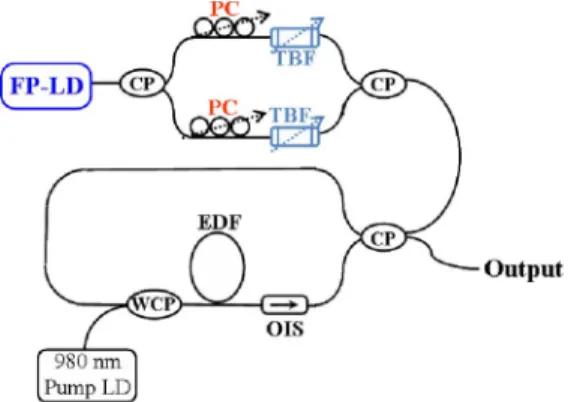
Fig. 1. Experimental setup for the tunable dual-wavelength fiber ring laser scheme.
the dual-wavelength laser is 39.49 nm. The maximum and min-imum mode spacing is 39.49 and 1.32 nm, respectively. The pro-posed laser has the following advantages: 1) two wavelengths can be tuned separately using the two tunable bandpass filters (TBFs); 2) the mode spacing can also be tuned by the TBFs; 3) the laser has a broadly tuning range; and 4) the laser struc-ture is relatively simple.
II. EXPERIMENT ANDDISCUSSION
Fig. 1 shows the experimental setup for the tunable dual-wavelength fiber ring laser. The proposed fiber laser consisted of one 2 2 3-dB coupler (CP), two 1 2 3-dB CPs, two TBFs, two polarization controllers (PCs), an FP-LD, and an erbium-doped fiber amplifier (EDFA). The EDFA was constructed by a 980/1550-nm WDM coupler (WCP), 980-nm pump laser diode (LD), an optical isolator (OIS), and a 10-m EDF.
When the pumping power exceeds 100 mW in the proposed laser, the output power will be saturated. Thus, the 980-nm pump LD was set at 100 mW in the experiment. The 3-dB bandwidth and insertion loss of the TBF used was 0.4 nm and 4 dB, respectively. The tuning range of the TBF was 40 nm (1520–1560 nm). The PCs were used to adjust the polarization states of the feedback lightwave into the FP-LD. According to the past study [11], an injected optical signal at transverse-electric-mode of FP-LD can result in maximum injection locking efficiency.
The threshold pumping power in this experiment was around 14 mW while the FP-LD was operated at 22 mA and 25 C. To measure the output power and wavelength of the proposed dual-wavelength laser, an optical spectrum analyzer (OSA) with 0.05-nm resolution was used in the measurement. Fig. 2 shows the original output spectrum of the free-run FP-LD
2094 IEEE PHOTONICS TECHNOLOGY LETTERS, VOL. 20, NO. 24, DECEMBER 15, 2008
Fig. 2. Original output spectrum of FP-LD operates at 22 mA on 25 C without self-seeding.
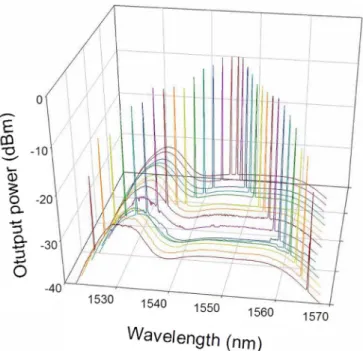
Fig. 3. Output wavelength spectra of the proposed tunable dual-wavelength fiber laser while the pumping power of 980-nm LD and bias current of the FP-LD are 110 mW and 22 mA, respectively, in the wavelength range of 1526.3–1565.8 nm with different mode spacing.
without self-injection. The mode spacing and threshold current of FP-LD are 1.38 nm and 9.5 mA, respectively.
The two TBFs inside the ring cavity were used to align and filter the corresponding modes for two wavelengths lasing simultaneously. Fig. 3 shows the output spectra (wavelength range from 1526.27 to 1565.76 nm with different mode spacing) of the proposed tunable dual-wavelength fiber laser at the pumping power mW and bias current of the FP-LD mA. The mode spacing can also be determined by adjusting the two TBFs to properly align and match the filtering mode of the FL-LD. In Fig. 3, the maximum and minimum mode spacing of the dual-wavelength laser was 39.49 and 1.32 nm, respectively. Over the tuning range, the maximum and minimum power variation ( P and P ) was equal to
Fig. 4. Output power difference and average output power under various mode spacing for the tunable dual-wavelength fiber laser.
0.98 and 0.01 dB when the mode spacing is 36.69 and 17.65 nm, respectively. The proposed laser is limited to step tuning (in this case, it is 1.32 nm). We can also retrieve the continuous wavelength tuning by adjusting the temperature of the FP-LD. While the temperature difference of the FP-LD was 5 C, the central wavelength variation was 0.2 nm. Thus, the dual-wavelength can be tuned continuously by controlling the temperature.
Fig. 4 shows the output power differences and the average output powers under various mode spacing of the fiber laser. The average output power is between 13.56 and 4.33 dBm, as shown in Fig. 4. By increasing of the mode spacing gradually, the average output power is decreasing, as illustrated in Fig. 4. Thus, when the mode spacing is 39.49 nm, the output power will drop to 13.56 dBm due to the smaller gain in both shorter and longer wavelength sides of the FP-LD (in Fig. 2). In addition, the output power differences of the dual-wavelength can be less than 1 dB due to the proper adjusting of the PCs. The nonlinear filter function of the self-injected FP-LD can also improve the noise performance of the proposed laser [12], [13]. We also studied the stability of the proposed laser, and the power variation during a 30-min observation time was negligible. We believe that the inhomogenously broadened FP-LD gain saturation plays a part in suppressing the erbium gain competition. The stability of the proposed laser can be further enhanced by using all polarization-maintaining (PM) components inside the laser cavity.
Fig. 5 shows the optical spectra of the dual-wavelength fiber laser lasing at wavelengths of 1545.08 and 1546.40 nm, when the pumping power was adjusted from 14 to 120 mW. The lasing output power will start to saturate at 100 mW, as shown in Fig. 5. The threshold pumping power of the proposed dual-wavelength laser was 28 mW, as also illustrated in Fig. 5.
III. CONCLUSION
We proposed and experimentally demonstrated a tunable dual-wavelength fiber laser based on a self-injected FP-LD and an EDF. The dual-wavelength output of the proposed fiber laser is widely tunable, and the mode spacing of the two lasing wavelengths can also be adjusted within the tuning range. Two TBFs were used inside the laser cavity to generate the
YEH et al.: TUNABLE DUAL-WAVELENGTH FIBER LASER USING OPTICAL-INJECTION FP LASER 2095
Fig. 5. Output wavelength spectra versus the different pumping power under 14 to 120 mW at the two wavelengths of 1545.08 and 46.40 nm initially.
dual-wavelength output. The dual-wavelength tuning range can be achieved up to 39.49 nm from 1526.27 to 1565.76 nm. The mode spacing of the dual-wavelength can be tuned by using the two TBFs to align the corresponding longitudinal-mode of the FP-LD. The maximum and minimum mode spacing of the laser is 39.49 and 1.32 nm, respectively. The proposed laser is limited to step tuning (in this case, it is 1.32 nm). Moreover, the threshold pumping power and saturated pumping power of the laser are 28 and 100 mW, respectively. The output power difference of dual-wavelength can be controlled to smaller than 1 dB.
REFERENCES
[1] H. Li, H. Ding, and K. T. Chan, “Erbium-doped fiber lasers for dual wavelength operation,” Electron. Lett., vol. 33, pp. 52–53, 1997. [2] J. Chow, G. Town, B. Eggleton, M. Ibsen, K. Sugden, and I. Bennion,
“Multiwavelength generation in an erbium-doped fiber laser using in-fiber comb filters,” IEEE Photon. Technol. Lett., vol. 8, no. 1, pp. 601–662, Jan. 1996.
[3] G. Das and J. W. Y. Lit, “L-band multiwavelength fiber laser using an elliptical fiber,” IEEE Photon. Technol. Lett., vol. 14, no. 5, pp. 606–608, May 2002.
[4] L. Talaverano, S. Abad, S. Jarabo, and M. Lopez-Amo, “Multiwave-length fiber laser sources with Bragg-grating sensor multiplexing ca-pability,” J. Lightw. Technol., vol. 19, no. 4, pp. 553–558, Apr. 2001. [5] H. Okamura and K. Iwatsuki, “Simultaneous oscillation of
wavelength-tunable, singlemode lasers using an Er-doped fibre amplifier,” Electron.
Lett., vol. 28, pp. 461–463, 1992.
[6] S. V. Chernikov, J. R. Taylor, and R. Kashyap, “Coupled-cavity erbium fibre lasers incorporating fibre grating reflectors,” Opt. Lett., vol. 23, pp. 2023–2025, 1993.
[7] S. V. Chernikov, R. Kashyap, P. F. Mckee, and J. R. Taylor, “Dual frequency all fibre grating laser source,” Electron. Lett., vol. 29, pp. 1089–1090, 1993.
[8] Y. J. Kim and D. Y. Kim, “Electrically tunable dual-wavelength switching in a mutually injection-locked erbium-doped fiber ring laser and distributed-feedback laser diode,” IEEE Photon. Technol. Lett., vol. 17, no. 4, pp. 762–764, Apr. 2005.
[9] S. Yang, Z. Li, S. Yuan, X. Dong, G. Kai, and Q. Zhao, “Tunable dual-wavelength actively mode-locked fiber laser with an F-P semi-conductor modulator,” IEEE Photon. Technol. Lett., vol. 14, no. 11, pp. 1494–1496, Nov. 2002.
[10] S. Li, K. T. Chan, Y. Liu, L. Zhang, and I. Bennion, “Multiwave-length picosecond pulses generated form a self-seeded Fabry–Pérot laser diode with a fiber external cavity using fiber Bragg gratings,”
IEEE Photon. Technol. Lett., vol. 10, no. 12, pp. 1712–1714, Dec. 1998.
[11] M. Schell, D. Huhse, W. Utz, J. Kaessner, D. Bimberg, and I. S. Taraov, “Jitter and dynamics of self-seeded Fabry–Pérot laser diodes,” IEEE J.
Sel. Topics Quantum Electron., vol. 1, no. 2, pp. 528–534, Jun. 1995.
[12] D. Zhao, Y. Lai, X. Shu, W. Zhang, L. Zhang, and I. Bennion, “Noise suppression in a harmonically mode-locked fibre ring laser,” in Proc.
ECOC, Sep. 8–12, 2002, vol. 3, pp. 1–2.
[13] P. C. Peng, H. Y. Tseng, and S. Chi, “A tunable dual-wavelength erbium-doped fiber ring laser using a self-seeded Fabry–Pérot laser diode,” IEEE Photon. Technol. Lett., vol. 15, no. 5, pp. 661–663, May 2003.