國 立 交 通 大 學
科技管理研究所
碩 士 論 文
巴拿馬三大工程的影響和投資機會
Impact and Investment Opportunities of the Three Mega Projects in
Panama.
研 究 生:莫潤玲
指導教授:虞孝成 教授
ii
巴拿馬三大工程的影響和投資機會
Impact and Investment Opportunities of the Three Mega Projects in
Panama.
研 究 生: 莫潤玲
Student: Yin Ling Mock
指導教授:虞孝成 教授
Advisor: Dr. Hsiao-Cheng Yu
國 立 交 通 大 學
科 技 管 理 研 究 所
碩 士 論 文
A thesis
Submitted to the Institute of Management of Technology College of Management
National Chiao Tung University In Partial Fulfillment of the Requirements
For the Degree of
Master of Business Administration. In
Management of Technology June 2007
Hsinchu, Taiwan, Republic of China 中華民國九十六年六月
iii
Impact and Investment Opportunities of the Three Mega Projects in Panama.
Student: Yin Ling Mock Wu Advisors: Dr. Hsiao-Cheng Yu Institute of Management of Technology
National Chiao Tung University
ABSTRACT
Currently the focus in Panama is to convert itself into an international hub through the completion of many ambitious mega projects. First, this thesis analyzes three of these mega projects. The first of these is the Expansion of the Panama Canal and this will have a major global impact. Consequently, because of this project another project, the Mega Port on the Pacific Ocean, will be needed to satisfy the future level of global transportation. The final mega project is the Panama Hub Energy that will supply energy to five of the countries which comprise Central America. Generally speaking, a mega project involves a huge investment and is a large-scale construction project contract which is usually broken downed into many smaller subcontracts. In this context, the role of foreign direct investment is considered an important factor. Next, this paper presents a profile of the business infrastructure in Panama. Then, it analyzes the risks involved. Finally, the current involvement of one country, Taiwan, is examined with respect to foreign direct investment in Panama. In conclusion, after careful consideration of all these factors, it will be possible to suggest the opportunities for foreign direct investment in each mega project.
Key Word: Mega Project, Panama Canal Expansion, Mega Port, Hub Energy, SIEPAC, Foreign Direct Investment (FDI), Panama.
iv
TABLE OF CONTENTS
ABSTRACT...iii
TABLE OF CONTENTS... iv
LIST OF TABLES... vii
LIST OF FIGURES ... vii
ACKNOWLEDGEMENTS ... ix
CHAPTER 1. Introduction... 1
1.1 Background... 1
1.2 Analytical Framework ... 2
1.3 Research Objectives... 3
1.4 Scope and Limitations ... 3
1.5 Research Approach... 4
CHAPER2. Literature Review and Framework ... 5
2.1 Mega Project Definition ... 5
2.3. Definition and Nature of Foreign Direct Investment ... 5
2.4. Theories of Foreign Direct Investment ... 6
2.2. SWOT Analysis... 8
CHAPTER 3. Expansion of Panama Canal ... 10
3.1 Background information ... 10
3.2 Expansion of Panama Canal ... 11
3.3 Demand ... 12
3.4. Competition ... 13
3.5. Demand opportunity ... 15
3.5. The capacity challenge. ... 16
3.6. Environmental and social aspects of the third set of locks project ... 17
3.7. Profitability and benefits... 18
3.8. Employment generation and economic benefit... 20
3.8. Main Findings... 21
3.8.1 Controversies of Panama Canal ... 21
3.8.2. Investment opportunities of FDI... 23
3.8.3. Companies involved in the project ... 26
3.8.4. Suggestions for investment ... 28
CHATER 4 Mega Project 2: Construction of the Mega Port on the Pacific Ocean... 30
4.1. Background Mega Port ... 30
4.2. Strategic Development Program ... 31
4.3. Project Description ... 31
v
4.5. Employment generation and economic benefit... 34
4.6. Main Findings... 35
4.6.1 Companies interested in Prequalification Sheets... 35
4.6.2. Investment opportunities... 36
4.6.3. Controversies of the project... 36
4.6.4 Investment Suggestions... 37
CHAPTER 5. Mega Project 3: “SIEPAC -Panama-Energy Hub"... 39
5.1. Background... 39
5.2. Description SIEPAC... 39
5.3. Objective... 41
5.4. Environmental Benefits of the SIEPAC Project ... 41
5.5. Financial structure ... 42
5.6. Demands for energy in the six countries ... 44
5.7. Regional Mega Projects... 46
5.8. Why should Panama be the Regional Energy Hub? ... 47
5.9. Panama's Energy Demand... 49
5.10. Existing Facilities in Panama... 49
5.11. Hub Energy Opportunity ... 50
5.12. Main Findings... 52
5.12.1. Investment opportunities... 52
5.12.3. Companies involved in the Panama Energy Hub ... 55
5.11.4. Current state of affairs and related controversies ... 56
5.11.5. Suggestions for investment opportunities... 56
CHAPTER 6. Why Invest In Panama... 59
6.1 Panama's Competitive Advantages and Risks ... 59
6.1.1 Overview of Panamanian Economy ... 59
6.1.2. Panama`s Industrial and service Clusters ... 59
6.1.3 Economic Stability and the International Banking Center (IBC)... 60
6.1.4. Political Stability and Risk... 60
6.1.6. The Current Situation of FDI in Panama... 61
6.1.7 Legal Framework ... 63
6.1.8. Tariff and Non-Tariff Barriers... 63
6.1.9. Intellectual Property Protection ... 64
6.1.10. Special Economic Zones- ... 64
6.1.11. Free Trade Agreements... 67
6.1.12. Trade Patterns of Panama's External Sector ... 67
6.1.13. Main Exports- Imports by Country... 67
6.1.14. Taxes and Labor... 70
6.1.15. Information Technology Infrastructure... 72
6.1.16. Other sector for investment opportunities in Panama ... 72
vi
7.1. Taiwan's Economic Basis... 75
7.2. Taiwanese Overseas Foreign Investment... 76
7.3. Panama –Taiwan Commercial Relations ... 78
7.3.1 Direct Investment from Taiwan ... 78
7.4 Current Situation of Taiwan-Panama FTA ... 80
7.5. Motivations of Taiwanese companies already invested in the Americas... 81
7.5.1 Table for Motivations for Taiwanese Companies Investing in American Countries... 82
7.6. Problems encountered by Taiwanese Companies in Panama ... 83
CHAPTER 8. Main Findings and Conclusion ... 85
8.1.Summary of Main Findings ... 85
8.2 Conclusion... 88
References... 90
vii
LIST OF TABLES
Table 1 Drivers and sources of National Competitive Advantage ... 6
Table 2 SWOT analysis of the Panama Canal Expansion project from the perspective of the investor. ... 29
Table 3 SWOT analysis of the Mega Port project from the perspective of the investor. ... 38
Table 4 Investor of the SIEPAC project ... 42
Table 5 SWOT analysis of the SEIPAC Panama Energy Hub from the perspective of the investor. ... 58
Table 6 Political and Economic Policy Risk (2005)... 61
Table 7 FDI Inflows to Main Latin American Countries 2004-2005 (USD Billions) .. 63
Table 8 Imports from the Colon Free Zone: year 2004... 70
Table 9 Panama’s labor force in 2004 ... 71
Table 10 The trade in goods, from January 2001 to 2006... 81
Table 11 Motivations for Taiwanese Companies investing in America Countries... 83
Table 12 Advantages and Problems of Companies already investing in Panama (1997) ... 84
LIST OF FIGURES
Figure 1 Research Approach ... 4Figure 2 SWOT analysis framework ... 9
Figure 3 Location of ACP expansion. ... 1
Figure 4 View and Isometric of lock. ... 1
Figure 5 Detail of ACP expansion ... 1
Figure 6 Asia- U.S. Rout. ... 1
Figure 7 ACP’s competition rout... 1
Figure 8 Rout in the Arctic... 1
Figure 9 Maximum Sustainable Capacity ... 1
Figure 10 Information of Vessel through Panama and Suez rout. ... 1
Figure 11 Location of third set of lock Project... 1
Figure 12 Finance structure of ACP expansion project... 1
Figure 13 Labor Distribution at time ACP expansion ... 1
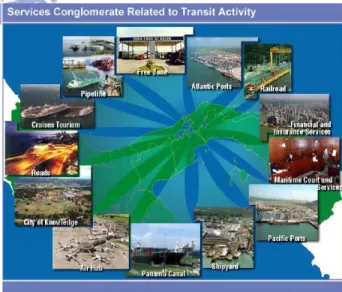
Figure 14 Activities related to ACP activities... 1
Figure 15 Location of Mega port in Pacific Ocean. ... 1
Figure 16 Stage of Mega Port in Pacific. ... 1
Figure 17 Design of Mega Port in Pacific. ... 1
Figure 18 Design of Mega Port in Pacific. ... 1
viii
Figure 20 Demand of Contender in Panama (1994-2005). ... 1
Figure 21 SIEPAC Project... 1
Figure 22 SIEPAC interconnection Line... 1
Figure 23 Reduction of CO2 emissions... 1
Figure 24 Finance structure schedule of the SIEPAC Project. ... 42
Figure 25 Electricity Generation in Central America... 44
Figure 26 Projected energy demands in Central America... 45
Figure 27 Capacity of the hydro electrics power station in Central America ... 47
Figure 28 Description of the energy demand in Panama... 49
Figure 29 Map of old pipeline next to the Canal... 1
Figure 30 List and map of existing facilities in Panama ... 50
Figure 31 Description of Panama energy Hub ... 51
Figure 32 Map of two energy projects in Panama... 53
Figure 33 Energy project design in Maria Chiquita –Atlantic ... 53
Figure 34 Area of energy project in Puerto Armuelle –Pacific-... 54
Figure 35 Existing Facilities of energy project in Puerto Armuelle –Pacific- ... 55
Figure 36 Future interconnection of SIEPAC ... 1
Figure 37 : FDI inflows to Panama 1999 -2006 (USD millions) ... 62
Figure 38: Arranged by author, Map of EPZ, FTZ, Panama Canal and Main Ports. .... 65
Figure 39 DAVIS-EPZ zone... 1
Figure 40 Colon Free Zone... 1
Figure 41 Main Exports by Country... 68
Figure 42 Main Imports by Country... 69
Figure 43 Howard map. ... 1
Figure 44 Banking Area. ... 1
Figure 45 Arranged by author from investment Commission, MOEA (2006). ... 76
Figure 46: Arranged by author from investment Commission, MOEA (1985~2006). . 77
Figure 47: Approved Taiwanese FDI to Panama 2006 by Industry sector total ... 79
Figure 48 : Taiwan’s Approved FDI to Panama 2006 by Industry sector total... 79
ix
ACKNOWLEDGEMENTS
Live as if you were to die tomorrow. Learn as if you were to live forever.
Mahatma Gandhi
First of all, I would like to thank God for giving me life and the opportunity to live this moment. I would also like to thank my diligent mother who has been with me through all the difficult situations in my life, and my sister as well, whom I miss a lot.
I express my gratitude to my advisor, Hsiao-Cheng Yu, for his encouragement, kindness, and support to complete my thesis. I would also like to thank Professors Magar Etmekdjian and Beth Grundy for patiently helping me to construct this study and giving me valuable advice both in the content and the language.
I thank Francisco VillaVerde and Bernado Mendez, my friends in Panama, for opening their hearts and unconditionally helping me to come up with the information for this work; moreover, Saul Salas for his support during my time in Taiwan. Genevieve Gerli (AMP), Carlos E. Rodriguez (Ente Regulador of Panama), Ariel Escala ,Guillermo Viloria and Julio Fabrego (MICI), Jose Vinicio Martinez Ardez (PPP), staff at the offices of Taiwanese businesses in Panama have provided me the fundamental and requited information.
To my friends in Taiwan, all of whom formed a second family for me have provided precious experiences and memories; my sincere thanks. I will treasure the times I have shared with them over last three years. Finally, I have valued the friendships of my MOT classmates during my time in NCTU.
1
CHAPTER 1. Introduction
1.1 Background
In 2000, the United State returned the Panama Canal to the Panamanians. Since that time, the Panamanian government is conspicuous by the emphasis it has placed on growth and in the intensity with which it faces its economic challenges. Thus, it continues to increase its competition with other countries in order to maintain economic development. This competition means that local governments strive, above all, to make themselves attractive to domestic and international investors. The instruments available to cities in pursuing their growth objectives fall into two broad categories: inducements to foreign and local private investors and direct public investments. The former include zoning concessions, tax abatements, low-interest loans, and the use of eminent domain to assemble and prepare large parcels of land, often overlaid on a general pattern of low taxation and minimal business regulation. With these objectives in place, Panama is promoting various Mega Projects utilizing its strategic geographic position to convert itself into a Central American hub.
Actually Panama has mega projects in the area of infrastructure: highways, airports, ports, energy transmitting and generating stations and rail transit systems. Another area for some of these mega projects includes the Expansion of the Panama Canal, the Mega port on the Pacific and Atlantic coastlines, the International Airport. As a result of these projects, the country is developing a port infrastructure on both the Atlantic and Pacific shores. The construction of the second bridge over the Canal; the future development of Howard Airport and its surrounding areas; the presence of an international banking and financial centre; a well developed maritime service industry; the modernization and expansion of the nations’ bunkering storage and distribution facilities; SIEPAC -the Energy hub for Central America ,the construction of a regional refinery project; and the future expansion of the existing port system besides the projected expansion of the Panama Canal among others in combination will give Panama competitive advantages. With all these mega projects the critical element is funding, indeed, all those mega projects have attracted considerable amounts of private, public and foreign investments.
2 1.2 Analytical Framework
A case study can promote a better understanding of a complex issue or event. This is mainly due to the fact that case studies, by their very nature, emphasize detailed contextual analyses of a limited number of events or conditions and their relationships. Researchers have used the case study research method for many years across a variety of disciplines. Wide use has been made of this qualitative research method to examine contemporary real-life situations. Such research thus provides a basis for the forward application of ideas and the extension of methods. Robert K. Yin, a researcher, defines the case study research method as an empirical inquiry that investigates a contemporary phenomenon within its real-life context; when the boundaries between phenomenon and context are not clearly evident and in which multiple sources of evidence are used (Yin, 1984)(1).
This study will supply a qualitative method in order to achieve its objective. As Catherine Hakim indicates, “Qualitative research is concerned with individual accounts of their attitudes, motivations and behavior. It offers richly descriptive reports of perceptions, attitudes, beliefs, view and feelings, the meanings and interpretations given to events and things, as well as behavior; they displays how these are put together, more or less coherently and consciously, into frameworks which connect attitudes and behavior, as well as the discontinuities or even contradictions which make attitudes and behavior, or how conflicting attitudes and motivations are resolved in particular choices made. Although qualitative research is about people as the central unit of account, it is not about individual patterns per se; reports focus rather on the various patterns, or clusters, of attitudes and related behavior that emerge from the interviews”.(54)
The most common method used is the depth interview, which is unstructured, of very variable length, and may be extended into repeat interviews at later dates. Because the qualitative method has the strength of data obtained: individual interviews in sufficient detail for the result are to be taken as true, correct, complete and believable reports of their views and experiences. This study will present interviews of people connected with these Mega projects, get feedback from their working experiences and points of view in order to provide valuable information about these Mega project in Republic of Panama. This study has interviewed hydraulic civil engineer
3
Bernado Mendez and engineer Roberto Méndez, a members of Panamanian society of engineers and architects (SPIA) in Panama, about the expansion of the Panama Canal. Concerning the SIEPAC project and the Panama Energy Hub, Engineer Carlos E. Rodríguez, ex-Manager of “Ente Regulador” in Panama , and Jose Vinicio Martinez Ardez ,official of Plan Puebla Panama, were interviewed in May 2007.
This case study is divided into chapters based upon the following steps involved in the analyses of the mega projects. The first step in this case study is to understand three important mega projects, their potential and impact on the current situation in Panama. The next step, the SWOT analysis structure (an acronym for strengths, weaknesses, opportunities and threats), is used to suggest future possible opportunities for foreign direct investment provided by these mega projects. Then, this case study identifies the competitive advantage of Panama and uses Taiwan as a case investor by examining Panama’s economy and the synergies between the two countries. Finally, based on the details concerning the two countries, the Taiwanese interests in Panama as an investor are identified.
1.3 Research Objectives
This section will strive to:
• Analyze the three Mega projects and suggest investment opportunities in Panama from the foreign direct investment perspective.
• Highlight the Republic of Panama as an investment alternative, especially for Taiwanese investors.
1.4 Scope and Limitations
The major objectives for doing international business are to expand sales, acquire resources, diversify sources and supplier, and finally to minimize competitive risks. This thesis provides alternatives that Taiwanese investors can pursue to achieve their business objectives.
4
During the investigation of this study, it was noted that limited research and literature exists concerning the three Mega projects. Furthermore, the literature about foreign direct investment in Panama was often not up to date. All these made the entire research process difficult.
1.5 Research Approach
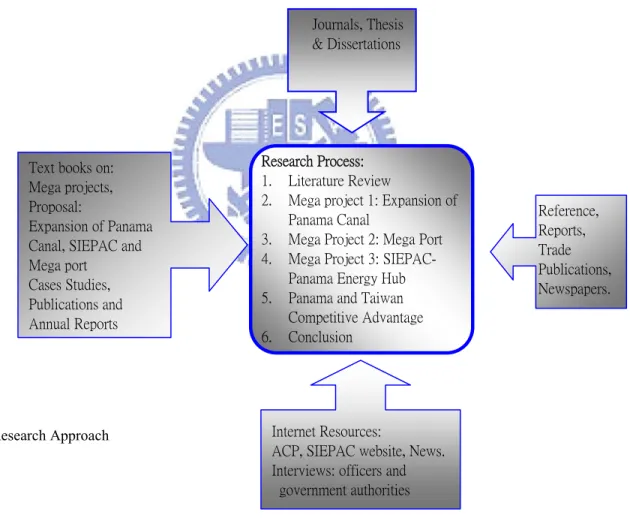
The secondary data collection comprises written and electronic materials, books, and articles from newspapers, journals, government and international organization websites. Finally, the interviews were used for primary data. (Figure 1)
Journals, T & Disserta hesis tions Reference, Reports, Trade Publications, Newspapers. Internet Resources:
ACP, SIEPAC website, News. Interviews: officers and
government authorities Research Process: Text books on:
1. Literature Review Mega projects,
2. Mega project 1: Expansion of Panama Canal
Proposal:
Expansion of Panama Canal, SIEPAC and Mega port
3. Mega Project 2: Mega Port 4. Mega Project 3:
SIEPAC-Panama Energy Hub Cases Studies,
5. Panama and Taiwan Competitive Advantage Publications and
Annual Reports
6. Conclusion
5
CHAPER2. Literature Review and Framework
2.1 Mega Project Definition
The prefix mega to indicate “very large” became common in science and engineering during the late nineteenth century (4).The term mega-project itself dates to the late 1970s, when the Canadian government and the Bechtel Corporation more or less simultaneously adopted it, the former to describe massive energy development projects to which it had recently committed, the latter to describe its general portfolio of very large-scale projects. (5) Another definition is
mega-project as employed initiatives that are physical, very expensive, and public. More specifically,
mega-projects involve the creation of structures, equipment, prepared development sites, or some combination them. Finally ,to the above can be added the detail provided by Bent Flyvbjerg : “ A Mega project typically costs in excess of US$1 billion and attracts high levels of public attention because of substantial impacts on communities, environment, and budgets"(6).
Mega-projects are fundamentally an expression of public authority. Their physical and economic development has been driven overwhelmingly, however, by foreign and private investment. In fact, the major goals for the mega project are supporting the improvement of the country, improving standard of living, increasing efficiency and stabilizing investment with benefit on compensate public investment and increase competitiveness, capital stock and long-term potential growth. In many respects, as a result, local politics has always been an aspect of business in that the two parties are involved in a mutually dependent relationship: the government has the power to attract the investor with mega projects and the investor has the money to realize these new projects for the countries economy(7).
2.3. Definition and Nature of Foreign Direct Investment
According to United Nations Conference on Trade and Development, Foreign Direct Investment
(FDI) is defined as "investment made to acquire lasting interest in enterprises operating outside
of the economy of the investor." Additionally, foreign direct investment (FDI) has the potential to generate employment, raise productivity, transfer skills and technology, enhance exports and
6
contribute to the long-term economic development of the world’s developing countries. More than ever, countries at all levels of development seek to leverage FDI for development (9).
Multinational organizations such as the Organization for Economic Co- Operation and Development (OECD), suggest that FDI should reflect the objective of obtaining a lasting interest by a resident entity in one economy (“director investor”) other than that of the investor (“direct investment enterprise”). Therefore, FDI may take many forms, including purchase of existing assets in a foreign country, new investment in property, plant and equipment, and participation in a joint venture with a local partner(10).
Domestic markets must provide a particular attraction to foreign investors and this is not an easy strategy for a host country, since it involves either a favorable location or a skill base and infrastructure than can provide an advantage, However, much is to be gained by improving human capital development, good infrastructure, open door policies to FDI, liberal trade strategies and stable government policies.
2.4. Theories of Foreign Direct Investment
According to J.H. Dunning (1988), three conditions are necessary for FDI to occur. The first is ownership advantage, then location advantage and finally, internalization advantage. The concept of location advantage means that undertaking a business activity must be more profitable in a foreign location than in a domestic one (11).
In addition, Michael. E. Porter (1990) in “The Competitive Advantage of Nations” uses a theory of competitive advantage to explain economic development within nations and national differences in growth and prosperity (12). More specifically, foreign direct investment is included as part of the overall investment stage in the development of a country and company. He identifies a four -stage development process presented in the following table.
Table 1 Drivers and sources of National Competitive Advantage Driver of Development Source of Comparative
Advantage
Examples Factor Conditions Basic factors of production
(e.g. Natural resources, geographical location,
Canada, Australia, South Korea before 1980
7 unskilled labor)
Investment Investment in capital
equipment and transfer of technology from overseas; also requires presence of and national consensus in favor of investment over consumption
Japan during 1960ss. South Korea during 1980s
Innovation All four determinants for
national advantage interact to drive the creation of new technology
Japan since late 1970’s. Italy since early 1970s: Sweden and Germany during most of the post period
Wealth Emphasis on managing
existing wealth causes the dynamics of the diamond to
reverse; competitive advantage erodes as innovation is stifled investment in advanced factors slows, rivalry ebbs, and individual motivation wanes
U.K. during post-war period; U.S.A., Switzerland, Sweden, and Germany since 1980
Source: Robert M. Grant (1991), “Poter’s Competitive Advantage of Notions’: An Assessment”, Strategic Management Journal, 12, table 1, pag 540.
The characteristics of the host nation play a central role in firm’s international success. The host base shapes the capacity of a company to innovate rapidly in technology and solidifies the competitive advantage created at the host base. To explore the respective competitive advantages of Panama, the diamond Model of Porter will be used, and in doing so, this study will also address significant changes in the competitive global environment.
8
Moreover, a framework of the risk projections of a country is essential to protect investments and to anticipate changes that may impact on competitive advantage. Managerial responses represent the ability of management to predict the likely impact of risk on the firm as well to adopt alternative policies that might protect or enhance profitability. These policies include choices about mode of entry, lobbying political decision markets, intelligence about unfolding events, low tolerance for corruption, financial instruments balancing shareholder and stake holder interests (12).
As mentioned before, using Poter’s theory, this study explores Panama as a host country and Taiwan as a potential foreign investor. Before these countries are analyzed, first the mega projects are described and then the potential foreign investment is determined with respect to these three Mega projects, which are the Expansion of the Panama Canal, the Mega port and the Panama Hub Energy. In fact, these mega projects reflect the fact that Panama has long been a commercial hub and transport center that provides opportunities to many foreign investors seeking to start a business in Panama.
2.2. SWOT Analysis
SWOT Analysis, a strategic planning tool to evaluate the Strengths, Weaknesses, Opportunities, and Threats will be used as tool to analyze the Mega projects. It involves specifying the objective of the Mega project and identifying the internal and external factors that are favorable and unfavorable to achieving that objective. The technique was credited by Albert Humphrey, who led a research project at Stanford University in the 1960s and 1970s using data from the Fortune 500 companies. The following are more detailed explanations of the SWOT Analysis components:
Strengths
Strengths are the resources and capabilities that can be used as a basis for developing a competitive advantage. Examples of such strengths include: patents , strong brand names, good reputation among customers, cost advantages from proprietary know-how , exclusive access to high grade natural resources , favorable access to distribution networks .
9
The absence of certain strengths may be viewed as a weakness. For example, each of the following may be considered a weakness: lack of patent protection, a weak brand name, poor reputation among customers, high cost structure, lack of access to the best natural resources, lack of access to key distribution channels.
Opportunities
The external environmental analysis may reveal certain new opportunities for profit and growth. Some examples of such opportunities include: an unfulfilled customer need, arrival of new technologies, loosening of regulations, and the removal of international trade barriers.
Threats
Changes in the external environmental may also present threats to the firm. Some examples of threats include: shifts in consumer tastes away from the firm's products, emergence of substitute products, new regulations, and increased trade barriers.
Similar to companies Mega Projects can be analyzed using SWOT analysis. The principal impacts of mega projects are relative to macroeconomic variables such as economic growth, private investment, and national inflation rate. These macroeconomic variables affect the external risks of the mega project and the economic stability of the country. Based on a SWOT analysis, this study suggests some sustatible opportunities for forgien direct investment.
10
CHAPTER 3. Expansion of Panama Canal
(ACP in Spanish, PCA in English)
3.1 Background information
The Panama Canal is a major ship canal that traverses the Isthmus of Panama in Central America, connecting the Atlantic and Pacific Oceans. In 1904, control of the Panama Canal Zone was passed over to the U.S in exchange for assistance for Panama to achieve independence from Colombia. The Panama Canal is a waterway with two lanes of locks which were built by the U.S. in 1914 in order to handle the shipping that passes through it and which accounts for 5% percent of the world’s shipping. Ownership of the Canal Zone devolved to Panama at the end of 1999. Actually, the Panama Canal Authority (ACP) is autonomous from the Government of Panama and is in charge of managing, operating and maintaining the Panama Canal. This involves on average of 12,000 ships with carrying cargo of 4500 TEUs passing annually. Since 1948, it has provided service to 120 maritime routes to over 80 countries. Throughout its history, the Canal has continually transformed its structure and adjusted to trade requirements and international maritime transport technologies. However, the number of post-Panamax ships (the largest ships in the world), whose dimensions prevent them from passing through the Canal, has increased substantially. The Panama Canal Authority (ACP) has embarked upon a US$250M program to widen its central path (known as the Culebra Cut) which currently accommodates 2 ships to cross the Canal at any given time by 20 percent.
The Panama Canal Authority (ACP) has developed studies as part of its Master Plan (Proposal) for the construction of a third set of locks, larger than those existing now, with a deadline set for the year 2025 for its completion. This proposal was ratified by Panama on October 22, 2006 in a national referendum in which 76.8% of the voters approved to initiate the Expansion of Panama Canal.
11 3.2 Expansion of Panama Canal
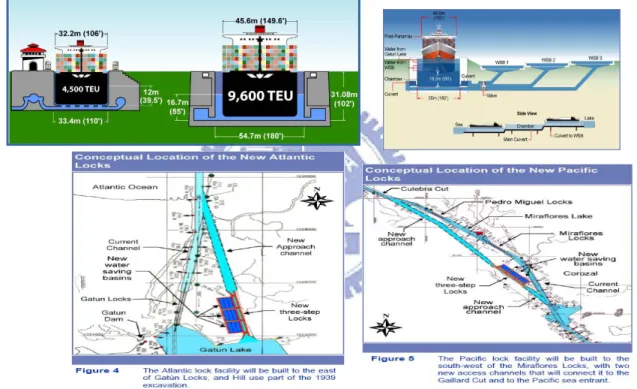
The Panama Canal Authority has proposed the project after years of study. According to the Master Plan, this project will create a new lane of traffic along the Canal by constructing a new third set of locks. The main reason for the expansion of the Canal is the need to accommodate larger container ships. Details of the project, can be seen in Figure 3-4 .
As it can be seen, this project will involve the construction of two lock complexes - one on the Atlantic side and another on the Pacific side - each with three chambers, which include three water-saving basins. As a consequence of this expansion, there will be the need to excavate new access channels to the new locks and to widen the existing navigational channels. Finally, the navigation channels will be deepened and the maximum operating level of Gatun Lake will be elevated.
Figure 3 Location of ACP expansion. Source: ACP proposal
According to the Proposal, the expansion of the Canal will cost US $ 5,200 million dollars, the project is due to be completed and operating in 2025. That is, the Panama Canal Authority (ACP) cites two reasons for the need to expand and deepen the waterway: “1) Existing locks are too small for post-Panamax ships; 2) The Canal faces stiff competition from the U.S. intermodal system that transports cargo over land and from the Suez Canal. As such, providing the Canal with the capacity to transit larger vessels will make it more
efficient by allowing the transit of higher cargo Figure 4 View and Isometric of lock. Source: ACP proposal.
12
volumes with relatively fewer transits and less water use” (13 ).
The Panama Canal Authority anticipates that new locks should be capable of accommodating 12,500 TEU container vessels. At the moment, only 4,500 TEU container ships can transit the waterway. ACP officials report that the dimensions of the new post-panamax locks will be 61m width by 427m length and with 18.3metres of clearance (compared to the existing 33.5m by 305m by 12.5m); however, these dimension might be altered as a result of an investigation of the market demand (Figures 5).
Figure 5 Detail of ACP expansion . Source: ACP Proposal.
3.3 Demand
Based on the projections made by ACP, during the next 20 years, cargo volume transiting the Canal will grow at an average of three percent per year, doubling the tonnage for 2005 by the year 2025. At present, a growing number of container ships have to wait at both ends of the Canal due to congestion: the containership segment constitutes
13 the main driving force of the Canal
According to the proposal, if the Canal does not expand to meet the demands of the lucrative route between East Asia and the U.S. East Coast, its market share would fall from a current 38 percent to 23 percent in 2025. This route now represents more than 50% of the PCUMS volume of the containerized cargo segment transiting the Canal and is anticipated to become a key Canal growth driver.(13)
According to the Panama Canal Authority, currently China, including Hong Kong S.A.R., is the largest shipper involved in Atlantic-bound canal traffic with 17,769,372 long tons (18,054,515 metric tons) of goods reaching the East Coast of the Americas. Nearly 87 percent of the Atlantic-bound cargo from China is destined for the United States.
A post-Panamax containership of 366 m (1,200’) length, 49 m (160’) width and maximum 15-m (50’) draft (TFW) was used as the reference for establishing the ideal lock chamber sizes. This vessel has been identified as the largest type of carrier vessel most frequently used on these routes (13).
It is also reasonable to assume that post-panamax containerships will continue to expand from one generation to the next, as they have done in the past. One of the central points raised by the critics of the canal expansion proposal has been made by a former canal administrator, Fernando Manfredo:…it is unrealistic to attempt to predict canal usage trends over a generation and it is most improbable to expect that U.S. imports from China will continue to grow as they have the past few years; therefore; it is irresponsible to gamble Panama's financial future on such a projection.
3.4. Competition
The two main competitors of the Panama Canal are the U.S. intermodal system and the Suez Canal. The ACP notes that the growing trend in the use of Post-Panamax container ships in transcontinental routes competing with the canal is irreversible. The main ports and merchandise distribution centers on these routes are investing in
capacity, location, and maritime and land infrastructures Figure 7 ACP's competition rout. Source: ACP proposal.
14
to serve these vessels and to handle their cargo volumes. If this trend continues, by the year 2011, approximately 37% of the capacity of the world’s container ship fleet will consist of vessels that do not fit through the canal, and a great part of this fleet will be placed on routes that compete with Panama, such as the transpacific-intermodal route and the Suez Canal route (13).
The proposal identifies other potential routes for cargo ships between Northeast Asia and the U.S. East Coast as possible intermodal connections between ports on the Pacific Coast of Mexico or Canada and the U.S., and the development of intermodal systems through the Central American Isthmus. There are additional potential routes that do not have much chance of materializing as competitive routes, such as a hypothetical route through the Arctic.
source: Canadian Geographic Magazine
Figure 8 Rout in the Arctic On the other hand, hydraulic civil engineer Bernado Mendez and
engineer Roberto Méndez, member of SPIA (Engineers and Architects Association of Panama) in “A bad business for Panama” (June, 2006) says that the hypothetical route through the Arctic will be important in a few years due to the influence of global warming. At the moment, the melting I ce caps in Canada's Great North already allow boat traffic in the Northwest Passage. Moreover, based on this global warming trend, it is predicted that by 2035, as the new route between the Atlantic and Pacific through the Arctic will become available, this will reduce the travel time between Europe and Asia by a third. Furthermore, there is the possibility that there might even be two routes through to Europe and U.S (Figure 8). The advantages of these predicted routes is that they are 40% shorter than through the Panama Canal and, moreover, they require no fee (although icebreakers might be necessary)(14).
15 3.5. Demand opportunity
Figure 9 Maximum Sustainable Capacity Source: ACP proposal.
In an interview with the Financial Times in December 2004, Alberto Alemán Zubieta, the Administrator of the Panama Canal Administration, noted that the Canal is currently working at
around 93% of its capacity and the ACP is making investments to increase its capacity. In 2003, there were more than 13,000 canal transits with approximately 260 million tons of goods. Other than the Mega Project to build new bigger locks, the Panama Canal Administration will increase the current working capacity in the short term by allowing larger vessels to transit outside daylight hours via illuminated lock chambers and deepening some channels. Investments to date with a price tag of $ 1 billion include widening of the Gaillard Cut, hydraulic lock systems, and satellite and navigational technology and should result in a capacity increase to 42 vessels per day. To date, approximately 38 vessels can transit the Canal in a day and the average ship pays $32,000 in tolls. The administration plans to increase traffic to 51 vessels per day by 2020 by expanding the waterway (15).
Moreover, the maximum size vessels that can transit the Panama Canal, Panamax vessels, generally reserved for big bulk carriers, such as oil tankers, account for at least one third of the boats crossing the Canal per year. According to the Fairplay Ship Register, an estimated 600 vessels exit which are larger than Panamax requirements, amounting to approximately 10% of the world’s active fleet. At the same time, approximately 31% of the 646 new vessel orders in 2003 are Post-Panamax and should be ready for service in 2006.
Based on ACP's projections, the driving forces of containerized cargo growth are: (1) world trade growth; (2) growth of containerized cargo as a percentage of world trade; (3) manufacturing relocation to the northeast Asia, particularly to China; and, (4) regional and intraregional demand growth. Therefore, with a 3.5% annual increase in the Canal’s tolls would result in a doubling of present tolls by 2025. In the most probable scenario, Canal containerized cargo will increase at an average annual rate of approximately 5.6%, from 98 million PCUMS tons in 2005 to nearly 296
16
million in 2025. In the highest growth scenario, containerized cargo volume would grow to reach 345 million PCUMS tons in 2025, and in the lowest growth scenario it would reach 279 million PCUMS tons in 2005 (13).
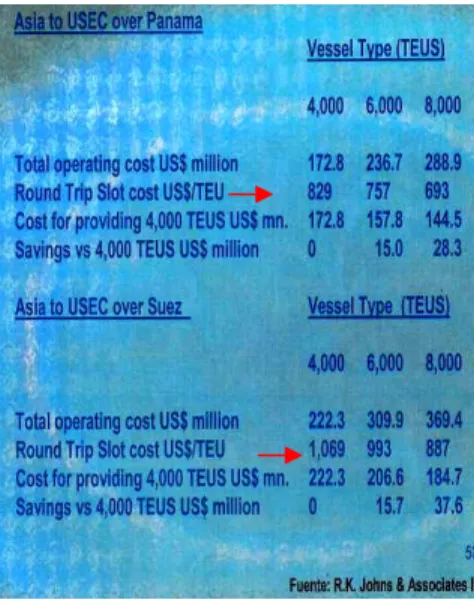
On the opposition’s side, Roberto Méndez, ( June 2006) says that these predictions, such as a Post-Panamax future preference for the Asia –Panama-U.S route, over the Suez route, which offers the advantages of commercial opportunities in India, Arabia, Italy and Singapore, are not reliable. This is reflect in the figure 10 by ACP – RK Johns & Association data about the Panama Rout and Suez Rout (14).
Figure 10 Information of Vessel through Panama and Suez rout. Source: RK, Johns , Association
3.5. The capacity challenge.
According to the expansion document, the Canal will reach its maximum sustainable capacity between the years 2009 and 2012. Once it reaches this capacity it will not be able to continue to handle demand growth, resulting in a reduction in the competitiveness of the Panama maritime route. The proposed expansion of the Canal by the construction of a third set of locks will allow it to capture the entire demand projected through 2025 and beyond. Together, the existing and new locks will have approximately double the capacity of the present Canal (see figure). With the third set of locks, the expanded Canal will be able to transit over 600 million PCUMS tons annually. This represents approximately twice the capacity of the current Canal, and it is sufficient to meet demand beyond fiscal year 2025 (13).
Critics such as former legislator Dr. Keith Holder, co-author of the legislation that created the ACP, point out that canal usage is seasonal and that even during the few months when it is most crowded the bottleneck that slows traffic is not the locks but the narrow Culebra Cut, in which there is a limited capacity for large ships to pass one another (16).
Although the Canal is reaching its maximum capacity, the ACP clarifies that this does not mean that ships will be unable to transit the Canal. However, it does mean that the Canal’s growth capacity will stagnate and that it will not capture additional cargo volumes
17 3.6. Environmental and social aspects of the third set of locks project
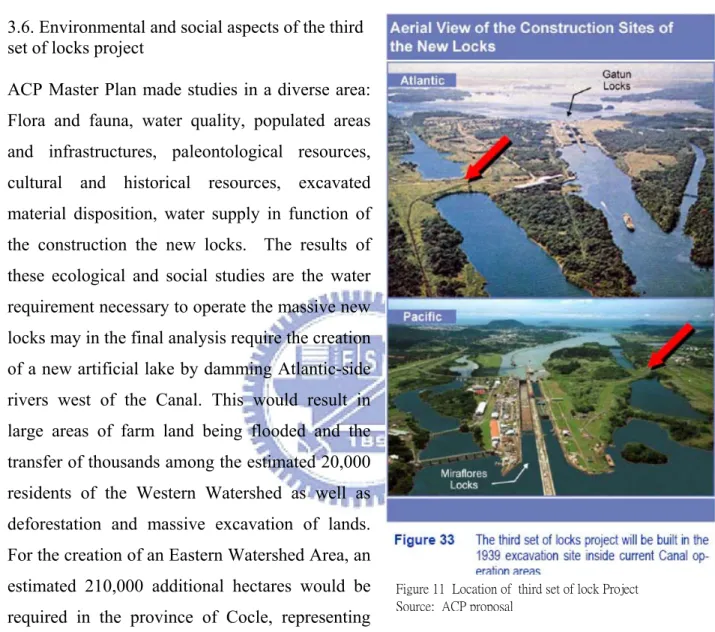
Figure 11 Location of third set of lock Project Source: ACP proposal
ACP Master Plan made studies in a diverse area: Flora and fauna, water quality, populated areas and infrastructures, paleontological resources, cultural and historical resources, excavated material disposition, water supply in function of the construction the new locks. The results of these ecological and social studies are the water requirement necessary to operate the massive new locks may in the final analysis require the creation of a new artificial lake by damming Atlantic-side rivers west of the Canal. This would result in large areas of farm land being flooded and the transfer of thousands among the estimated 20,000 residents of the Western Watershed as well as deforestation and massive excavation of lands. For the creation of an Eastern Watershed Area, an estimated 210,000 additional hectares would be required in the province of Cocle, representing
7% of the national surface area. In conclusion, it makes the following blanket statement “It has been found that all possible adverse environmental impacts can be mitigated through existing procedures and technology and no immitigable or permanent adverse impacts on the population or the environment are anticipated”(13).
Those in opposition of the project say that there are a lot of environmental topics to be considered. For example: the link between El Niño (ENSO) and global warming threat to water supplies. The ACP has commissioned a number of studies by a number of consultants about water supply and quality issues. Eric Jackson (editor of the Panama News internet newspaper) contends that ACP's public statements often do not match the findings of their studies. He says that the Delft Hydraulics, WPSI Inc, and DHI studies all say that no matter what is done to mitigate the
18
problem, the water saving basins feature of the proposed new locks would increase the intrusion of salt water into Gatun Lake, from which about the chosen method to partially mitigate this problem is to "flush" the new locks with fresh water from Gatun Lake — but that tends to defeat the proposed new locks’ water saving feature and raises questions about the security of the urban water supply.
3.7. Profitability and benefits
According with the proposal, the cost to construct the third set of locks is estimated by the ACP at approximately USD $5.25 billion. The most relevant program cost is that of constructing the two new lock complexes — one on the Atlantic side and the other on the Pacific side — with estimated costs of approximately USD $1.110 billion and USD $1.03 billion each, plus a USD $590 million provision for possible contingencies during their construction (13).
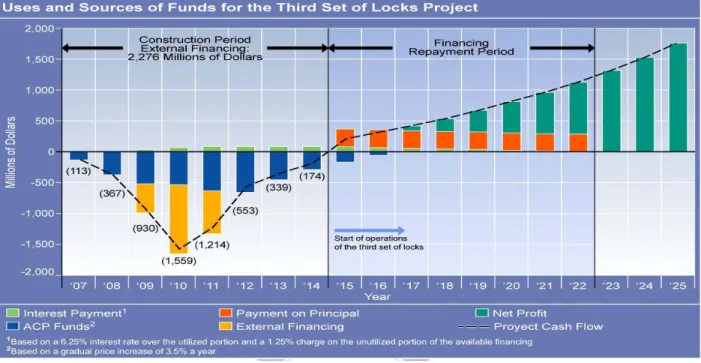
Moreover, the third set of locks is financially profitable, producing a 12% internal rate of return. The third set of locks project is self-financed and its financing will be separate from the Government’s financing. The state will not guarantee or endorse any loans undertaken by the ACP for the project’s execution. With tolls increasing at an annual average rate of 3.5% for 20 years, and according to the most probable traffic demand forecast and construction schedule, the external financing required will be mainly temporary and in the order of USD $2.3 billion to cover peak construction activities between 2009 and 2011. With the cash flows generated by the expanded Canal, investment costs will be recovered in less than 10 years and financing could be repaid in approximately eight years(Figure 12).
19
Figure 12 Finance structure of ACP expansion project. Source: ACP proposal, website: www.panacanal.com
What "self-financing" actually means, however, is disputed. At least half of the money needed for the canal expansion project will have to be borrowed, and the ACP does not calculate the interest on that as part of the project's costs, say the opposition.
The ACP's revenue projections are based on suppositions about increase in canal usage and the willingness of shippers to pay higher tolls instead of seeking competing routes, both of which critics question.
The argument by ACP says that the Canal expansion should not be financed in large part with foreign investment because the canal is inalienable property of the Panamanian people should be re-examined. Let us note that the very user nations of the United States and France had financed the dredging and building of the Panama Canal in order to improve the efficiency of their strategic and trading maritime routes. The Panama Canal is property of the Republic of Panama however the facts that is serves the entire world benefiting all countries and that its toll revenues are constantly reinvested in Canal maintenance and improvements make it international in nature (13).
20
On the other hand, several professionals with high positions in Panama are not confident in the budget of the Panama Canal Authority. They say, the budget the project is based on contains uncertain projections about maritime trade and the world economy. Humberto Reynolds and Tomas Drohan Ruiz, the former head of Engineering and Dredging of the Panama Canal, say that the project will cost much more than currently budgeted for and that it is too risky. Parsons Brinckerhoff is best known for the Boston Big Dig, which ended up costing three times the estimated amount with several structural and safety concerns. Moore Stephens S.A. Published February 16, 2007 – Panama say that “The cost of the project is one of the most controversial issues. The total estimated figure is US$5,250 million. However, the actual cost of the works as stated in the project is US$3,690 million, to which an estimated amount of UD$530 million is added for inflation and another US$1,030 million for contingencies.”(17)
According to the expansion document, in the year 2017 the Canal may be contributing to the State the amount of US$2,000 million therefore its value would be US$50,000 million. But this is not the final value of the Panama Canal. For the year 2025 when the expansion is complete and operating at its maximum capacity, its estimated contributions to the Panamanian State will be US$4,200 million thus having a value of around US$105,000 million (13).
As per the Proposal for the Expansion of the Panama Canal that the Panama Canal Authority (PCA) published in April 24, 2006, the need of external
financing for the expansion amount to US$2,276 million.
Experts suggest, financing using facilities with volumes of $1 billion, possibly more, with maturities not exceeding 15 years. Multilateral institutions that may be asked to underwrite the expansion and bond take-out would be considered at a later stage. International investment firms and banks which may have an interest in funding the expansion follow with interest
the possible alternatives for financing. Figure 13 Labor Distribution at time ACP expansion Source: ACP information
3.8. Employment generation and economic benefit
Master Plan say that during the peak of construction, which will start in 2007 and end in 2014, as many as 7,000 directly-related and 40,000 indirectly-related jobs will be created. And by 2025, as
21
many as 250,000 jobs will have been created. Critics dismiss this as pure demagogy, noting that by the ACP's own studies at the peak of construction there will be fewer than 6,000 jobs created and that some of these will be highly skilled posts filled by foreigners because there are no Panamanians who are qualified to fill them.
Moreover, the labor required for construction of the third set of locks will, in its vast majority, be done by Panamanians. To ensure the availability of Panamanian labor necessary for the third set of locks project and its connected activities, the ACP and public and private authorities will work jointly to train the required workforce with sufficient lead time, so that it has the necessary competencies, capabilities and certifications. The amounts necessary to carry out these training programs are included in the cost estimates of the project.
The opposition says, current labor force in Panama is about 1.4 million, out of a population of about 3.2 million. Assuming that the unemployment rate, currently at 8.9 percent, will stay the same or fall slightly, Panama would need a large foreign labor force to fill all the jobs created by the Canal expansion. Critics also claim the project lacks an accompanying social development plan.
3.8. Main Findings
3.8.1 Controversies of Panama Canal
In summary, by a group of Panamanian experts in opposition of expansion of Panama Canal, claims several consequences and problems in the mega project. Some of the reasons that will affect the project are: reduce the contribution from ACP around 20 years; this is going to affect the Panamanian economic on the needs and the resources to development the country. They say, this is going to have a direct effect in different aspects of the country, first, generate very low or negative yield rate, next, become indebted by thousands of million dollars and could aggravate the actual crisis of the National Social Insurance of Panama (CSS), and finally cause serious ecological and social damages. As the result, it will cause delays and interruptions in Canal traffic and cause the Panama route to become more expensive and affect Canal competitiveness(14).
22
The opposition considerate ACP has a very optimistic prognosis. Because of that, the Chinese economy will decelerate next decade, the two new Arctic routes will absorb part of the transit. It is not sure will coming of post-panamaxes to panama canal, uncertain infrastructure availability for post-panamaxes in America cost in the future and Panama lose competitiveness with Suez route.
The low labor cost in China is ruining industries and generating unemployment in EU, Europe, and Japan. For this reason, the protectionist, (anti-China- OMC) is making growing political pressure. Moreover, the yuan dollars is going up from initiated to half of year 2005, that will increase the price of Chinese exports. It is grow partner-labor conflicts to internal it of China in farmers against industrial contamination, workers by higher wages, middle-class by democratic liberties and against corruption.
Global warming effects the Artic to create two new routes from Asia transit - EU - Europe that will absorb part of the Asia transit during the next few decades. These routes are 40% shorter than the route via Panama, and is free of tolls, although probably it would be necessary to use icebreakers.
After finishing the expansion of Panama Canal, it is not clear if the post-Panamaxes would prefer a route Asia - Panama – EU, there is no market study that demonstrates it because there is no written commitment (from shipping or the governments) that sustains it. Additional there is no infrastructure in the coast of the EU to be ready to receive Post-Panamaxes.
Using Post-panamaxes ships, the route of Suez offers significant commercial opportunities as they can pass via India, Arabia, Italy, Singapore, and other countries. That seems to demonstrate that in the past, panamaxes have not changed their routes even if there is a cheaper Panama Canal route(14).
Finally, they say that for other considerations, use of reserves of CSS to finance the project partially could aggravate crisis of the regime of CSS, generate employment for the project, on
23
average, less than 6.000 direct temporary users per year, the GDP growth for the country is less than 2 percentage in the year for this project compared with the historical rate for Panama which is 4%. The social issue is the dams; thousands of families in that area, would be affected, as well as the ecology. The issues are the inundation of thousands of hectares of land for the construction and the risk of contamination of the lakes or insufficient water to supply bathtubs for the metropolitan sector.
The opposition claims that the only beneficiaries of the project would be some construction companies, banks, lawyers related to shipping; aside from them, shipping and the North American Navy.
3.8.2. Investment opportunities of FDI
The expansion will produce psychological optimism locally and internationally making Panama an important investment target. Under government procurement rules meant to ensure fairness and reliability, the ACP acquires goods and services from providers all over the world. Ports, facilities and land not directly related to the
operation of the Canal have been entrusted by the government to the Interoceanic Region Authority (ARI), which seeks international investors interested in running and improving these assets.
According to the ACP proposal, contracts related to the Panama Canal operation are: provisions, equipment, material, construction and consulting. The total value of these contracted reached $135 million in 2001, not including additional purchases amounting to
Figure 14 Activities related to ACP activities
24
$22 million. The provision of concessionary services to the ports: power, water, fuel, material, food, banking services, telecommunications, maintenance and repair, dredging are estimated to be between $47 and $60 million annually (13).
By Alvaro Aguilar Alfur in the Article “Expansion of Panama Canal Presents Opportunities for International Businesses”, identifies four principal international opportunities for foreign investment. These areas are finance, infrastructure, telecommunications and tourism, and investment opportunities in Howard.
3.8.2.1. Financing the improvements
Aguilar claims that the main sources of revenue for the payment of an expansion are canal tolls, which have increased lately. Under a securitization plan, toll payments would be directed to a separate account controlled by lenders. Funds would be released for the repayment of debt and operating costs. Experts suggest securing finance by using facilities with volumes of $1 billion, possibly more, as collateral, with maturities not exceeding 15 years. Multilateral institutions that may be asked to underwrite the expansion and bond take-out would be considered at a later stage. International investment firms and banks which may have an interest in funding the expansion follow with interest the possible alternatives for financing.
3.8.2.2. Infrastructure in the Canal area
The Panamanian government has granted 25-year concessions for the operations of several ports and railroad facilities at the Atlantic and Pacific entrances of the Panama Canal (Details concerning the latter are provided in following chapter). Opportunities in intermodal transportation currently exist as a result of the opening of a logistics center in Colon and the civilian use of the Howard airbase.
25
3.8.2.3. Telecommunications and Tourism
Among the projects under way by private investors Aguilar identifies the following as investment areas: manufacturing, warehousing and distributing merchandise to/from the Americas; call centers for handling customer service and other telephone operations; the development of housing for foreign retirees and local buyers ; tourist centers for fishing, bird-watching, ecotourism and other activities. The fact that the main fiber optic cables connecting several countries in the Americas at the Canal has attracted providers of data warehousing services which serve information technology companies and users worldwide. Most providers are located in the City of Knowledge complex, as part of the Panama Industrial Technology Park. Business projects at the Park are grouped into a biological sciences cluster (biodiversity, environment, marine and forest resources, aquaculture, tropical medicine and pharmacology, and a communications cluster (information technology and multimodal transportation). Businesses in the City of Knowledge which serve clients outside of Panama have 25-year renewable exemptions from income taxes, capital tax and other taxes, as well as exemptions from customs duties on materials and equipment needed for their activities
Thousands of hectares remain available for development in the areas next to the Canal waterway. These were used as military facilities and many remain vacant, available for use by prospective investors. This real estate is managed by ARI, which must approve any feasibility study proposed by investors and agree to any sale or rent of land.
The canal areas, where these bases were located, comprise 233,000 acres of prime real estate and over 7,000 commercial and residential buildings. Although many assets have already been awarded to private companies or groups from all over the world, there still are unique investment opportunities in the tourism, technology, forestry, maritime, real estate, transport and industry sectors.
3.8.2.4. Power
There is a great potential for growth in the Panamanian electric power sector 20% of Panamanians still do not have access to electricity, especially in the rural areas. It is estimated that a billion-dollar investment is needed for the power sector in Panama for the next few years. As Panama’s maritime industry grows in importance as a container trans-shipment center,
26
additional electric power will be required operate cranes and to run the refrigerated containers transporting perishables.
Panama has proven wind, water and solar resources that have not yet been exploited. The current government is promoting alternative energy projects as part of its plan to reduce dependence on expensive imported diesel fuel. The outlook is positive for the construction of additional power plants as energy demand outpaces power. There is a large potential for hydroelectric power and a law has been proposed to promote mini-hydroelectric projects as a way to reduce oil imports required by thermal plants (16).
3.8.3. Companies involved in the project
The scheduled of expansion of Panama Canal construction is to begin in 2007 and should last 8-10 years. The cost of building a third set of locks is expected to run between $4 and $8 billion, according to unofficial estimates and depending on the plan approved. The ACP paid US$3.5 million for studies for the design of the locks conducted by a Belgian-French consortium (Tractebel Development Engineering, Coynet-Bellier, Technum N.V. and Compagnie Nationale du Rhone) under an international tender and the U.S. Army Corps of Engineers (builders of the original 1914 canal). Moreover, Shearman & Sterling joins Mayer, Brown, Rowe & Maw LLP, the law firm selected to advise the ACP in the procurement and contracting aspects for the Expansion Program".
Apr 2007, from the newspaper Prensa Latina, Germany, Great Britain and Northern Ireland Parliamentary Foreign Affairs Secretary to analyze with the national authorities bilateral issues and the extension project of the Panama Canal. The visitors will meet his Panamanian officer to tackle extradition agreements, technical cooperation and promotion and protection of investments with the European Union and Central America. That is the British businessmen are interested in the extension of Panama Canal, in the maritime sector, logistics, transportation and telecommunications, added the text (17).
27
By Stephen Wingrove in Business News Americas April 23 2007- International competition planning to participate in the bidding rounds for works within the US$5.2bn Panama Canal expansion project. It is believed that construction companies such as Vinci, Hochtief, Bilfinger, Bouygues, Bechtel, OHL, Dragados, Brazilian consortium Inter-oceânico and Mitsubishi will present bids (18).
Website news: blog.nam, May, reports say more than 600 people from 222 companies hailing from 31 nations attended a March conference in Panama to learn what contracts will be up for bids for this big dig. The Houston Chronicleed half-dozen Houston companies, Houston-based Innovative Hydraulic Designs, Deschamps, Pittsburgh-based LB Foster Co and a Colombian co-worker attended the conference (19).
By Jessica Tasón for La Critica, middle of May 2007 - The expansion of the Panama Canal is starting. Companies interested in participating in the bidding process have until 29 June 2007 to present their proposals to the Panama Canal Authority (ACP) for the first contract for the first of five dry excavation (dumping areas, building an access for electrical lines and to build a new highway, building another new access road of gravel and asphalt, installing grills and drainage culverts, removal excavation of material in the area of Cerro Paraiso) of the new locks in the approach to the Pacific side of the canal. This work will all be accomplished on the West shore, between Paraíso, the Pedro Miguel locks and the Corte Culebra on the Pacific (20).
Currently the top user nations include the United States, China and Japan, industrialized and commercially active nations with ample resources for funding large investment projects. These user nations already invest heavily in large projects in defense and local infrastructure and have shown a great deal of good faith in foreign aid programs for social and infrastructure development. There should be a limited degree of financial participation from the user nations in the form of grants. The expansion projects will already cost the Republic of Panama, a heavily indebted developing nation in various ways. The costs include a significant reduction in its territory due to Watershed expansion, expropriation of an estimated 8,000 farmers from their productive lands, a significant decrease in jungle territory and biodiversity, and a possible
28
lowering of its sovereign ratings category for increased debt emissions (higher debt service costs). These are all significant negative externalities for the nation and citizenry in general.
Huge opportunities exist for UK companies in the construction, engineering and consultancy sectors connected to expansion plans for the Panama Canal and the local ports. Barclays and HSBC (the largest foreign-owned bank in Panama) have been selected with other international banks to provide the near US$6 billion required to finance the planned Panama Canal expansion.
3.8.4. Suggestions for investment
The following table is providing the SWOT analysis of the Panama Canal Expansion project from the perspective of the investor. The table summarizes the findings provided previously.
Strengths Opportunities • Geographical location
• Stable local weather
• Existing demand and container flow • Demand for larger container capacity • Access to harbor, road/rail connections,
bridges, and proximity to major markets.
• Stabile ACP management and no government intervention
• Increased project budget
• The increasing number of Post-panamax container ships
• Possible integration with other activities (eg. mega projects).
• Investment in new sectors; financing, infrastructure, telecommunication, tourism and power involved in the expansion of Panama Canal.
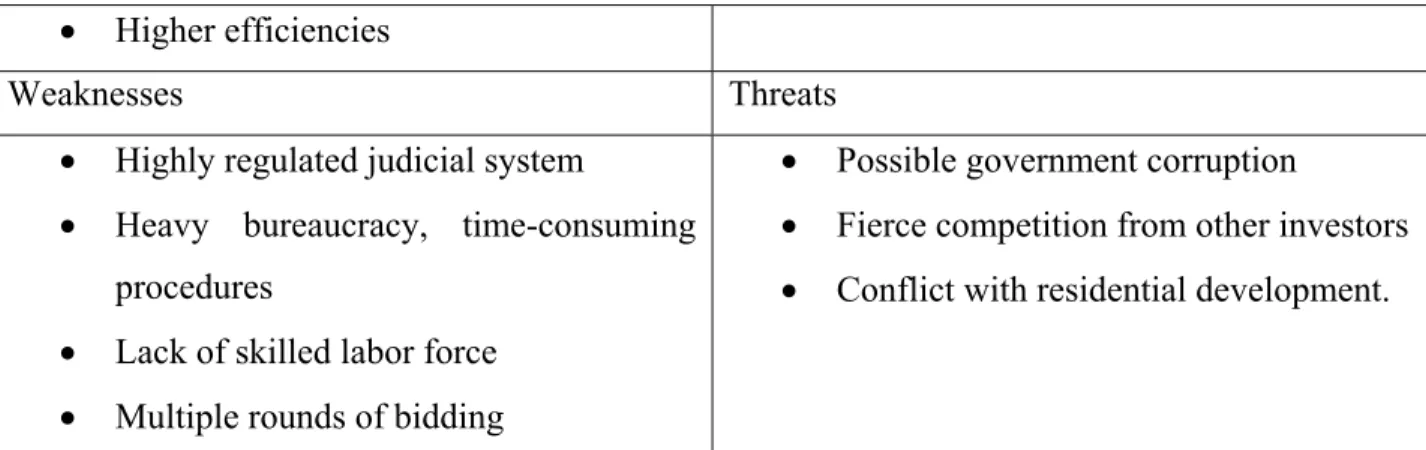
Weaknesses Threats • The lack of labor force
• Strict control of foreign investment of the project
• Inability to accommodate possible larger container ships after expansion • Suez Route
• US Inter-model System.
• New two routes in the Arctic due to global warming
29
Table 2 Arranged by author. SWOT analysis of the Panama Canal Expansion project from the perspective of the investor.
Based on the SWOT analysis it is seen that the Panama Canal has been the subject of much contentious debate, but the opportunities for investment in the expansion of the Panama Canal depend mostly on the objectives of the investors. If their objective is to find one hub point for the Americas, Panama qualifies. Moreover, now is the best time for taking advantage of the opportunities made available by the mega projects in particular, the best suggestions for foreign investment opportunities in the case of the expansion of the Panama Canal are in architecture and engineering, logistics and cargo industries, as well as the areas of telecommunications, banking, insurance and others because at the moment, there provide financial fundament of investment such as security and guarantee come from government, demand, human resource. However, Panama offers many other and better opportunities for foreign investments engage to expansion of Panama Canal, such as: Farfan Multimodal Complex, New Ports, Petroleum Free Zones, Hotels, Resorts and Marinas, Housing Development, Retirement Communities, Hi-Tech Parks, Maritime Services, Ship Repairs, Ship Handling, Ship Chandler and Container Manufacturing & Repairs. In addition, all these opportunities depend on future trade and transport patterns to be defined for medium and long terms investment by the Foreign Direct investor.
30
CHATER 4 Mega Project 2: Construction of the Mega Port on the
Pacific Ocean
4.1. Background Mega Port
The Office of the President of Panama in conjunction with the Panama Maritime Authority (AMP) are bidding for the right to develop and manage the ‘mega port” container terminal at the Pacific entrance to the Panama Canal. A new harbor terminal has been discussed for several years due to the requests of shipping lines who see the need for an alternative harbor terminal on the Pacific. Earlier, the ACP had already prepared a preliminary design, chosen the place and the organisation to management it. The preliminary studies were prepared by the U.S. firm Moffat & Nichol, under the sponsorship of the Panama Canal Authority. Actually, this mega project is completely independent of the Panama Canal expansion project.
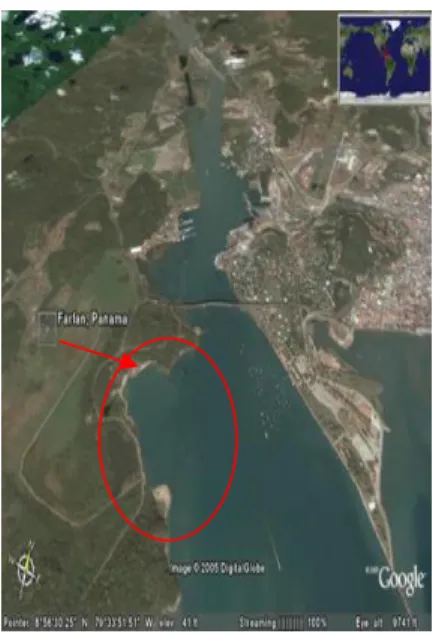
Figure 15 Location of Mega port in Pacific Ocean. Source: Google map
This mega project which offers an excellent strategic location ensured that nearly all the companies took up the request for proposals when it was issued in January 2005. At mid-November of the same year, Lloyd's List journals reported that plans for a new mega port saw 10 of the world's leading container terminal
operators meet in Panama. In terms of total capacity, Panama is placed at the top of the list of busiest ports in Latin America. Finally, new investments totaling about US$ 1.15 billion in the next 3-5 years in port facilities will make Panama the largest transshipment centre in the region. Panama is expected to become the region’s principal multi-modal logistics center in the coming years (21).
Figure 16 Stage of Mega Port in Pacific. Source: AMP, Panama
31 4.2. Strategic Development Program
According to the Panama Maritime Authority (AMP), the main strategic targets for the mega-port project are to impel the competitiveness and economic - social development of Panama as an international service and multimodal logistic centre in the region. That is, the major goals for the mega project are to supply the necessities to meet the demands of the marine industry, improve the strategic position of Panama, increase harbor capacity for containers, offer the opportunity to shipping companies to rationalize and to maximize the use of its assets, and offer alternative destinations due to the load transfer. At the result, this designated project will aim to create new jobs, integrate the project to the national marine strategy and offer a capacity sufficient to satisfy the projected increased demand (21).
4.3. Project Description
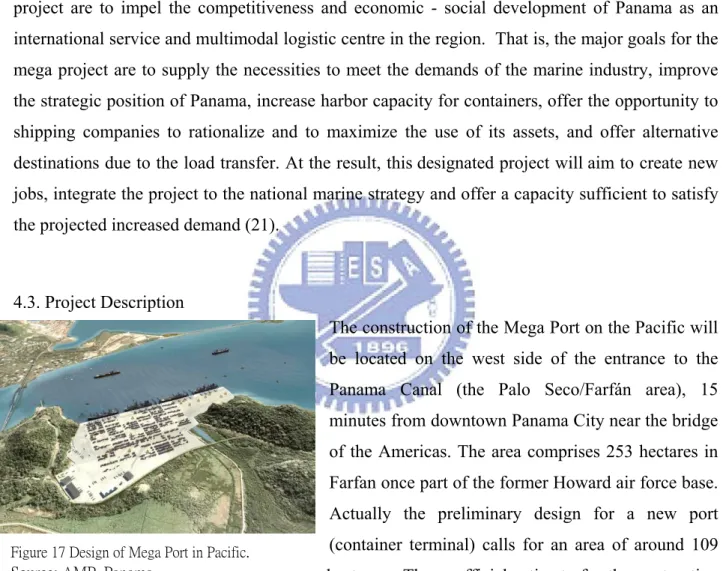
Figure 17 Design of Mega Port in Pacific.
Source: AMP, Panama
The construction of the Mega Port on the Pacific will be located on the west side of the entrance to the Panama Canal (the Palo Seco/Farfán area), 15 minutes from downtown Panama City near the bridge of the Americas. The area comprises 253 hectares in Farfan once part of the former Howard air force base. Actually the preliminary design for a new port (container terminal) calls for an area of around 109 hectares. The unofficial estimate for the contruction of this initial stage is $600 million of an estimated $1bn total cost. The port will handle 2.4 million TEUs (Twenty-foot Equivalent Units) container ships per year with one 1600 m by 750m berth and a total of 18 host post-Panamax cranes which can each handle two post-Panamax ships simultaneously in the first phase. It is expected to take approximately three years to be built. Port operators have begun and are also planning a new expansion phase covering the next five years, increasing the TEUS capacity by 7.3 million. These developments are expected to provide a total capacity of approximately 11 million TEUS in the trans-shipment ports of Panama City and