Quadratic temperature dependence of the electron-phonon scattering rate in disordered metals
S. Y. HsuDepartment of Electrophysics, National Chiao Tung University, Hsinchu 300, Taiwan P. J. Sheng and J. J. Lin
Institute of Physics, National Chiao Tung University, Hsinchu 300, Taiwan 共Received 15 December 1998兲
We have measured the electron-phonon scattering rates 1/e pfrom a weak-localization study of a series of
high-resistivity tin-doped Ti73Al27alloys. The resistivities of these alloys are essentially the same and are so high that the electron elastic mean free path l approaches the interatomic spacing, resulting in a very small value of qphl⬇0.0056 T (qphis the wave number of the thermal phonons, and T is the temperature兲. Based on
as many as about 60 magnetoresistivity measurements between 2 and 22 K, we are able to determine the dependence of 1/e pon T to within a great degree of accuracy and find that 1/e pvaries essentially with T
2 in the dirty limit (qphlⰆ1). This observation is not understood in terms of the current theoretical concept of
electron-phonon interaction in disordered metals.关S0163-1829共99兲05030-4兴
I. INTRODUCTION
The electron-phonon scattering rate 1/e p is one of the most important physical quantities of metals. In the case of pure metals, the temperature behavior of 1/e pis well under-stood both theoretically and experimentally.1In the presence of strong impurity scattering, however, the issue still remains open. Theoretically, electron-phonon interaction in disor-dered metals has been studied by a good number of authors2–5 for over two decades and widely varied results were obtained. Recently, it has been widely accepted that a consensus has finally been reached in theoretical efforts.3–5 On the other hand, few experiments have successfully pro-vided an overall consistency check for the various aspects of the theoretical predictions. For instance, apart from the de-pendence on the electron elastic mean free path l, the ex-pected T4 dependence of 1/e pis very frequently共or almost兲 unseen in experiments.6It has been argued that the absence of the expected T4 law in the various experiments can be
ascribed to the fact that most material systems studied pre-viously are not yet strongly disordered enough for the electron-phonon interactions to strictly satisfy the dirty-limit criterion of qphlⰆ1 共where qph is the wave number of the thermal phonons兲. Information about 1/e p on T in sample systems having smaller values of qphl than those ever ob-tained in the literature is therefore of prime importance for a stringent justification for the electron-phonon interaction theory concerning disordered metals.
It is now well established that weak-localization studies can be used to extract various electron dephasing scattering times in disordered metals, including inelastic scattering time, spin-orbit scattering time (so), and magnetic spin-spin
共or, some kind of intrinsic nonthermal兲 scattering time (s). In particular, in the case of three dimensions, unlike the cases of reduced dimensions, electron-phonon scattering is the sole, significant inelastic process while the small energy-transfer 共‘‘quasielastic’’兲 electron-electron scattering is not important.3Therefore, the value of 1/e p can be reliably ex-tracted from weak-localization studies using bulk samples.
According to the theory, the weak-localization effects in those disordered systems having moderate to strong spin-orbit scattering are controlled by two parameters, 1/so and
1/(T), where the electron dephasing scattering rate 1/ reads7
1/共T兲⫽2/s⫹1/e p⫽2/s⫹ATp. 共1兲 Notice that, for the reason just discussed above, we have identified the inelastic scattering rate with the electron-phonon scattering rate and written 1/e p⫽ATp, where A characterizes the strength of the electron-phonon interaction and p is the exponent of temperature for 1/e p. Theoreti-cally, it is expected that ‘‘weakened’’ electron-phonon inter-action in the presence of strong impurity scattering results in p⫽4 in the dirty limit (qphlⰆ1), compared with p⫽3 in the clean limit (qphlⰇ1).
In this work, we have successfully fabricated a series of bulk crystalline disordered Ti73⫺xAl27Snx alloys with the nominal concentration of tin 0ⱗxⱗ5. The tractable doping of minute amounts of tin atoms into the parent Ti73Al27
phase enhances spin-orbit scattering in the samples in a con-trollable manner, while leaving the amounts of disorder, i.e., resistivities, of the samples barely changed. This unique ma-terial property allows a convincing consistency check of our experimental method and, particularly, a systematic extrac-tion of the electron-phonon scattering rates to within a great degree of accuracy. Based on as many as about 60 weak-localization-induced magnetoresistivity measurements on the various alloys held at various temperatures between 2 and 22 K, we have drawn a conclusion that 1/e p depends essen-tially quadratically on the temperature T in disordered met-als.
II. EXPERIMENTAL METHOD
A series of bulk crystalline disordered Ti73⫺xAl27Snx al-loys were fabricated by a standard arc-melting method as described previously.8 The nominal concentration of tin x had been kept low enough (xⱗ5) so that all the alloy
PHYSICAL REVIEW B VOLUME 60, NUMBER 6 1 AUGUST 1999-II
PRB 60
samples studied were single phased. X-ray diffraction mea-surements confirmed that all of our ternary alloy samples possessed a structure similar to that of the parent Ti73Al27
phase; no noticeable impurity peaks in the diffraction pat-terns were found.
Our alloy system, which was derived from the parent Ti73Al27phase共the so-called ‘‘ordered’’␣2phase in terms of
crystallographic nomenclature兲, had been chosen because the structure and material properties of the Ti73Al27 phase were
well established in the literature.9In addition, it had been one of our aims to compare the electron-phonon scattering rate in this system with that in the dilute Ti100⫺yAly alloy system with yⱗ12 共the so-called ‘‘disordered’’␣ phase in terms of crystallographic nomenclature兲. The electron-phonon scatter-ing rate, particularly its temperature and electron elastic mean free path dependence, has been extensively studied in the latter system.8 It is thus of interest to examine how the inelastic electron-phonon process might, or might not, change from the ␣ phase to the ␣2 phase. Moreover, there
are further advantages for choosing Ti73⫺xAl27Snx as our system material:共1兲 Tractable doping of minute amounts of tin atoms into the parent Ti73Al27 phase, which contains no
heavy atoms and hence possesses moderate spin-orbit scat-tering, is metallurgically feasible, causing a gradual increase in the strength of spin-orbit scattering from the moderate toward the strong limit in a controllable manner. This mate-rial property allows a convincing consistency check of our experimental method and a systematic extraction of the val-ues of 1/e p 共see below兲. 共2兲 The resistivities of these tin-doped alloys are fairly large, being with (300 K) ⬇250⍀ cm and 0⫽(10 K)⬇225⍀ cm. Such large
amounts of disorder, i.e., resistivities, result in measurable weak-localization-induced magnetoresistivities. More impor-tantly, these extremely high values of resistivity 共correspond-ing to an electron elastic mean free path be共correspond-ing on the order of the interatomic spacing兲 put the electron-phonon interaction in this material system much closer to the dirty limit (qphl Ⰶ1) than ever obtained in any other material system previ-ously studied by us, including dilute Ti100⫺yAly alloys8 and Au50Pd50 alloys.10 共3兲 The sample resistivities of
Ti73⫺xAl27Snxalloys barely change with the concentration of tin x. This unique material property therefore enables us to concentrate on the temperature dependence of 1/e p while exempting us from any complications that might arise from a variation of 1/e p with the disorder. 共It is understood that 1/e p is likely mean-free-path dependent in the dirty limit.兲
The magnetoresistivities of our alloy samples, typically 0.2⫻1⫻10 mm3, were measured by a standard four-probe technique between 2 and 22 K and in magnetic fields below 1.4 T. The magnetoresistivities at various measuring tem-peratures for each alloy were compared with three-dimensional weak-localization theory7to extract the electron dephasing scattering rate 1/ and the spin-orbit scattering rate 1/so. The details of the least-squares fitting procedure
had been discussed previously.8Here we merely stress that, for every alloy sample studied in this work, the three-dimensional weak-localization predictions with a moderate to somewhat strong spin-orbit scattering rate, depending on the concentration of tin, can well describe our experimental results. Thus, 1/ and 1/socan be reliably extracted. It is
worth stressing that, between the two adjusting parameters,
only 1/ is temperature dependent while a single value of 1/so is used to describe 10 or more magnetoresistivity curves for a given alloy sample.
III. RESULTS AND DISCUSSION
Figure 1 shows the measured, normalized magnetoresis-tivities 䉭(B)/2(0)⫽关(B)⫺(0)兴/2(0) and the
three-dimensional weak-localization predictions for a representa-tive alloy sample, Ti70Al27Sn3, at several measuring
temperatures as indicated in the caption to Fig. 1. The sym-bols are the experimental data and the solid curves are the theoretical results. It is clearly seen that the theoretical pre-dictions can well describe the experimental data. To compute 1/ from the electron dephasing scattering field B ⫽ប/4eD defined in the weak-localization theory, one
needs the value of the electron diffusion constant D. Using the measured0 and the density of states at the Fermi level, N(0), independently determined from specific heat measurements,11 we estimate the values of D for our alloys through the Einstein relation 1/0⫽N(0)e2D. We obtain D
⬇0.85 cm2/s for all our tin-doped samples having 0
⬇225 ⍀ cm.
Figure 2 shows the variation of the spin-orbit scattering rate 1/so⫽4eDBso/ប 共where Bso is defined in the
weak-localization theory兲 with the concentration of tin x for eight Ti73⫺xAl27Snx alloys studied. It is encouraging to see from Fig. 2 that our experimental value of 1/soincreases linearly from about 5.2⫻1010 to about 3.4⫻1011s⫺1 as x increases from 0 to 5. This observation is strongly suggestive of the fact that our alloy samples possess homogeneous composi-tion and lattice structure at length scales that are consider-ably smaller than the relevant length scale in the weak-localization problem共i.e., the electron diffusion length兲. This result thus provides a convincing crosscheck of our experi-mental method 共sample fabrication, for instance兲 and data analysis. Therefore, our extracted values of 1/e p should be very reliable, which in turn makes our determination of the exponent of temperature p of 1/e p reliable to within a great degree of accuracy.
FIG. 1. Normalized magnetoresistivities 䉭(B)/2(0) as a function of the magnetic field for the Ti70Al27Sn3alloy at共from top down兲 2.00, 5.00, 8.00, 10.0, 15.0, and 20.0 K. The symbols are the experimental results, and the solid curves are the three-dimensional weak-localization predictions.
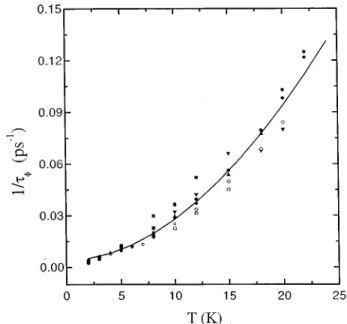
Our main results of the present work, i.e., the extracted values of the electron dephasing scattering rate 1/(T) are summarized in Fig. 3. Figure 3 shows the variation of 1/ with temperature for eight Ti73⫺xAl27Snxalloys studied. Dif-ferent symbols designate the 1/for different alloy samples. However, since the values of 1/ are very similar for all samples 共as is evident in Fig. 3兲, it is thus not necessary to label explicitly each symbol with its associated particular alloy. Inspection of this figure clearly illustrates that spin-orbit scattering has little, if any, effect on either the magni-tude or the temperature dependence of 1/ 共and hence 2/s and 1/e p) in disordered metals. 共Recall that all the alloy samples studied in this work have very similar resistivities. They should then possess very similar values of 1/e p,
re-gardless of how 1/e p might depend on the electron elastic mean free path l.兲
The solid line drawn through the data points in Fig. 3 is a least-squares fit to Eq. 1 with the inelastic electron scattering strength A, the exponent of temperature p, and the residual scattering rate 2/sas adjusting parameters. One sees that Eq. 1 can well describe our experimental data of 1/ over the wide temperature range of 2–22 K. Experimentally, as many as about 60 magnetoresistivity curves, corresponding to about 60 experimental data points for 1/, have been mea-sured on our various alloys and used in the fits with Eq. 1. Therefore, any appreciable statistical uncertainties in the ex-traction of the values of the adjusting parameters can be largely minimized. With all the eight alloy samples taken together in the fits, our best fitted values for the adjusting parameters are the following: the inelastic scattering strength A⬇2.9⫻108 s⫺1/Kp, the exponent of temperature p⫽1.9 ⫾0.2,12and the residual scattering rate 2/s⬇4.0⫻109 s⫺1.
Most noticeably, our experimental value of p implies that 1/e p varies essentially quadratically with temperature in bulk crystalline disordered Ti73Al27alloys. This experimental
result of p⬇2 is substantially lower than the theoretical value of p⫽4 expected for ‘‘weakened’’ electron-phonon scattering in strongly disordered metals. For reference, our fitted value of 1/e p(10 K)⬇2.4⫻1010s⫺1 is reasonably close to that 关⬇(1⫺3)⫻1010s⫺1兴 observed in the above-mentioned dilute Ti100⫺yAly alloys 关where the impurity re-sistivities0⬇60⫺150⍀ cm 共Ref. 8兲兴.
In order to perform a crosscheck and so as to provide further confirmation of the T2 dependence of 1/e p, in addi-tion to tin-doped Ti73Al27alloys, we have in this work made
two Ti73⫺zAl27Auz alloys with z⫽0.5 and 1, respectively, and measured weak-localization-induced magnetoresistivi-ties to extract 1/e p. Again, we obtain p⬇2.1 in these two gold-doped alloys, supporting our above assertion of an es-sentially quadratic temperature dependence of 1/e p in the Ti73Al27 phase. However, because these two gold-doped
al-loys are already quite close to the limit of strong spin-orbit scattering共due to the large atomic number of the heavy gold atoms兲, an experimental determination of a precise value of 1/so is less feasible and, in fact, is not of much interest in
this work.
Since we are most concerned with the electron-phonon scattering in the disordered limit, we examine whether the disorder criterion qphlⱗ1 is satisfied in the present experi-ment, where qph⬇kBT/បvs(vs being the sound velocity兲 is the wave number of the thermal phonons at temperature T. For the high-resistivity Ti73Al27 phase, vs⬇4⫻103 m/s,13
and l⬇1.6 Å.14 We notice that, due to the extremely high value of resistivities, this amount of electron mean free path already approaches that of the interatomic spacing, causing a very small value of qphl. Quantitatively, we obtain qphl ⬇0.0056 T, where T is in K. This indicates that the electron-phonon processes in our alloy samples are well within the disordered limit, i.e., qphlⰆ1, even at our highest measuring temperature of 22 K. We stress that the value of qphl for the present material system is much lower than those in the other material systems which have previously been studied by our group, including dilute Ti100⫺yAly alloys8 关where qphl ⬇(0.0068⫺0.019)T兴 and Au50Pd50 alloys
10 关where qph l ⬇(0.024⫺0.078)T兴. The present experimental result thus
FIG. 2. Spin-orbit scattering rates 1/so as a function of the concentration of tin x for several Ti73⫺xAl27Snxalloys. The straight line is a guide to the eye.
FIG. 3. Electron-phonon scattering rates 1/e p as a function of temperature for several tin-doped Ti73Al27alloys. The solid line is a least-squares fit to Eq.共1兲.
provides valuable evidence in supporting the T2 dependence of 1/e pin disordered metals. This observation should cause us to rethink what heretofore has been taken for granted con-cerning electron-phonon scattering in strongly impure met-als. For comparison, we mention that the T2 dependence of 1/e p has also been observed in our dilute Ti100⫺yAly and Au50Pd50 alloys. On the other hand, there are few
experiments6,15 reported in the literature that had dealt with samples which had values of qphl smaller than those in our various samples of either dilute Ti100⫺yAly, Au50Pd50, or
tin-doped Ti73Al27 alloys.
Recently, the theory for electron-phonon interaction in disordered metals has been re-examined in the literature. For instance, Rammer and Schmid3have treated this problem by considering impurity atoms that move in phase with the other lattice atoms and predicted that 1/e p should be weakened and be of the order of (qphl)(1/e p
0
), where 1/e p0 is the electron-phonon scattering time in the pure metal (1/e p0 ⬃T3). Microscopically, it is predicted that both longitudinal
and transverse phonons would contribute to the weakened electron scattering rate 1/e p, while only longitudinal phonons are responsible for 1/e p0 in the pure case. At low temperatures, since qph⬇kBT/បvs, then 1/e pshould follow the T4l law. This prediction has received wide acceptance from the theoretical community, and it has been indepen-dently confirmed by the calculations of Reizer and Sergeyev4, and Belitz.5Our experimental result of the depen-dence of 1/e pon the square of temperature共Fig. 3兲 is, how-ever, in disagreement with this Rammer-Schmid prediction. The physical origin for the T2 behavior, which has been observed experimentally from time to time in various materials,16is still not understood.17
Using the values of and the values of D given above, we estimate the electron dephasing scattering length, L ⫽
冑
D, for our alloy samples to range from about 300 to about 1600 Å as the temperature decreases from 22 down to 2 K. That is, every alloy sample studied lies well within the dimensional regime, justifying our use of the three-dimensional weak-localization predictions to describe the ex-perimental magnetoresistivities.IV. CONCLUSION
We have measured the electron-phonon scattering rates in a serious of carefully tailored bulk crystalline disordered Ti73⫺xAl27Snxalloys which have a very short electron elastic mean free path being on the order of the interatomic spacing. Such a short electron mean free path causes the electron-phonon interaction to be well within the dirty limit in this material. We find an essentially quadratic temperature de-pendence of the electron-phonon scattering rate 1/e p, i.e., 1/e p⬃T2 at qphlⰆ1. This observation is not understood in terms of the current theoretical concept for the weakened electron-phonon interaction in disordered metals.
ACKNOWLEDGMENTS
We are grateful to J. C. Lue and Y. L. Zhong for help in the early stages of the experiment. We also thank T. M. Chen for performing x-ray diffraction measurements on our alloys. This work was supported by Taiwan National Science Coun-cil through Grant Nos. NSC 87-2112-M-009-004 and NSC 87-2112-M-009-039.
1M.Yu. Reizer, Phys. Rev. B 40, 5411共1989兲; M.L. Roukes, M.R. Freeman, R.S. Germain, R.C. Richardson, and M.B. Ketchen, Phys. Rev. Lett. 55, 422共1985兲.
2G. Bergmann, Phys. Lett. 29A, 492共1969兲; Phys. Rev. B 3, 3797 共1971兲; H. Takayama, Z. Phys. 263, 329 共1973兲.
3
J. Rammer and A. Schmid, Phys. Rev. B 34, 1352 共1986兲; A. Schmid, Z. Phys. 259, 421共1973兲.
4M.Yu. Reizer and A.V. Sergeyev, Zh. E´ ksp. Teor. Fiz. 90, 1056 共1986兲 关Sov. Phys. JETP 63, 616 共1986兲兴.
5D. Belitz, Phys. Rev. B 36, 2513共1987兲.
6Yu.F. Komnik, V.Yu. Kashirin, B.I. Belevtsev, and E.Yu. Beli-aev, Phys. Rev. B 50, 15 298共1994兲.
7H. Fukuyama and K. Hoshino, J. Phys. Soc. Jpn. 50, 2131共1981兲; D.V. Baxter, R. Richter, M.L. Trudeau, R.W. Cochrane, and J.O. Strom-Olsen, J. Phys.共France兲 50, 1673 共1989兲.
8C.Y. Wu and J.J. Lin, Phys. Rev. B 50, 385共1994兲; J.J. Lin and C.Y. Wu, Europhys. Lett. 29, 141共1995兲.
9M. Hansen and K. Anderko, Constitution of Binary Alloys 共McGraw-Hill, New York, 1958兲; and Phase Diagrams of Bi-nary Titanium Alloys, edited by J. L. Murray 共ASM Interna-tional, Metals Park, OH, 1987兲.
10Y.L. Zhong and J.J. Lin, Phys. Rev. Lett. 80, 588共1998兲. 11We are grateful to Y. Y. Chen for performing specific
measure-ments on some of our alloy samples. See, also, J.C. Ho, P.C. Gehlen, and E.W. Collings, Solid State Commun. 7, 511共1969兲. 12If the experimental value of 1/
(T) for each of our alloy sample
is treated separately and fitted to Eq. 共1兲, then we obtain the exponent of temperature p falling in the range 1.7–2.1 for the various alloys.
13This value ofv
sis evaluated using the average speed of sound
vs(Ti)⬇vs(Al)⬇4000 m/s.
14The value of the Fermi wave number k
Ffor the Ti73Al27phase is evaluated using kF(Ti)⬇1.9⫻1010m⫺1 and kF(Al)⬇1.75
⫻1010
m⫺1. The electron elastic mean free path is then obtained through the relation l⫽32ប/(kF
2 e20).
15K.S. Il’in, N.G. Ptitsina, A.V. Sergeev, G.N. Gol’tsmann, E.M. Gershonzen, B.S. Karasik, E.V. Pechen, and S.I. Krasnosvo-bodtsev, Phys. Rev. B 57, 15 623共1998兲.
16R.P. Peters and G. Bergmann, J. Phys. Soc. Jpn. 54, 3478共1985兲; J.F. DiTusa, K. Lin, M. Park, M.S. Isaacson, and J.M. Parpia, Phys. Rev. Lett. 68, 1156共1992兲; A. Stolovits, A. Sherman, T. Avarmaa, O. Meier, and M. Sisti, Phys. Rev. B 58, 11 111 共1998兲.
17A.V. Sergeev and M.Yu. Reizer, Int. J. Mod. Phys. B 10, 635 共1996兲; D. Belitz and M.N. Wybourne, Phys. Rev. B 51, 689 共1995兲.