Analytical Model for Design Criteria of
Passively
Q-Switched Lasers
Y. F. Chen, Y. P. Lan, and H. L. Chang
Abstract—A general and straightforward model was developed for the design of passively -switched lasers. With the second-threshold criterion and using a numerically fitting procedure, the output pulse energy was expressed as an analytical function of the initial transmission of the saturable absorber and the reflectivity of the output coupler. An analytical expression for the optimal output reflectivity was also obtained for maximizing the output pulse en-ergy of a passively -switched laser with a given initial transmis-sion of the saturable absorber. Excellent agreement was studied between the present results and detailed theoretical computations. A Nd:YAG laser with Cr4+:YAG as a saturable absorber was per-formed to illustrate the use of the present model.
Index Terms—Passively -switched laser, saturable absorber, solid-state laser, Cr4+:YAG.
I. INTRODUCTION
P
ASSIVELY -switched solid-state lasers [1]–[5] are still playing an important role in many applications, such as range finders, pollution detection, lidars, and medical systems. Several recent theoretical investigations [6]–[8] were proposed to optimize the performance of -switched lasers. Degnan [6] derived the key parameters of an energy-maximized passively -switched laser as functions of two variables and generated several design curves. More recently, Xiao and Bass [7] and Zhang et al. [8] followed Degnan’s approach to include the ef-fect of excited state absorption (ESA) in the saturable absorber into the analysis. A saturable absorber exhibiting ESA is basi-cally called a reverse saturable absorber. The properties of ESA have important applications in optical limiting devices involving reverse saturable absorbers [9]. In addition, Harter et al. theo-retically demonstrated the possibility of mode-locking a laser containing both a saturable absorber and a reverse saturable ab-sorber [10].By analogy with the analysis of the actively -switched case, Degnan [6] used the variable in the analysis of the passively -switched laser for a convenient comparison. Here, is the initial population density in the gain medium, is the stimulated emission cross section of the gain medium, is the length of the gain medium, and is the nonsaturable intracavity round-trip dissipative optical loss. In the actively -switched laser, is normally proportional to the pump rate. As a
re-Manuscript received January 10, 2000; revised November 17, 2000. This work was supported in part by the National Science Council of the R.O.C. under Contract NSC-89-2112-M-009-059.
Y. F. Chen and H. L. Chang are with the Department of Electrophysics, National Chiao Tung University, Hsinchu, Taiwan 30050, R.O.C. (e-mail: [email protected]).
Y. P. Lan is with the Institute of Electro-Optical Engineering, National Chiao Tung University, Hsinchu, Taiwan, R.O.C.
Publisher Item Identifier S 0018-9197(01)01615-3.
sult, it is practically useful to model the output pulse energy of the actively -switched laser with the variable . However, for the passively -switched laser, does not depend on the pump rate; it is determined by the initial transmission of the sat-urable absorber and the reflectivity of the output mirror . Therefore, it should be more practical to model the output pulse energy of the passively -switched laser with the param-eters and than with the variable . Similarly, it is of great practical interest to determine the optimum output reflectivity as a function of for a given gain medium in a passively
-switched laser.
In this work, we first derive a general formula for the second threshold criterion by including the influence of intracavity fo-cusing and the ESA effect into the rate-equation analysis [11]. With the derived formula, we defined two parameters. One pa-rameter is related to the upper bound of , which can result in normal -switching behavior for a given , a given gain medium and a given saturable absorber. With this parameter, the output pulse energy was explicitly fitted as an analytical function of and . The other parameter is related to the lower bound of , which can result in normal -switching be-havior for a given , a given gain medium and a given saturable absorber. With this parameter, the optimum output reflectivity for maximizing the output pulse energy was successfully fitted as an analytical function of . Finally, a Nd:YAG laser with Cr :YAG as a saturable absorber is examined to illustrate the use of the present model.
II. SECONDTHRESHOLD OFPASSIVELY -SWITCHEDLASERS
The physical meaning of the second threshold is whether the saturable absorber will saturate first, thereby allowing the photon density to turn upward and produce a giant pulse. Al-ternatively, the gain might saturate first, so that the photon den-sity never turns upward to develop a giant pulse. To model the operation of a passively -switched laser, we shall assume uni-form pumping of the gain medium, assume the intracavity op-tical intensity as axially uniform, and assume complete recovery of the saturable absorber, i.e., for a single-shot or low pulse rate. The coupled rate equations have been used to model a passively -switched laser in many investigations [6]–[8]. Here, we ex-tend previous results by including the influence of intracavity focusing and the ESA effect. The coupled equations for three or four level gain media are modified as
(1)
CHEN et al.: ANALYTICAL MODEL FOR DESIGN CRITERIA OF PASSIVELY -SWITCHED LASERS 463
(2) (3) (4) where
intracavity photon density with respect to the ef-fective cross-sectional area of the laser beam in the gain medium;
population density of the gain medium; length of the saturable absorber;
ratio of the effective area in the gain medium and in the saturable absorber;
absorber ground; excited state;
total population densities;
, GSA and ESA cross sections in the saturable ab-sorber, respectively;
reflectivity of the output mirror; inversion reduction factor ( and
correspond to, respectively, four-level and three-level systems; see [6]);
round-trip transit time of light in the cavity optical length , where is the speed of light.
Note that a four-level saturable absorber such as that considered by Hercher [12] is used in the present analyses.
Dividing (2) by (3) and integrating gives
(5) where
(6) and is the initial population inversion density in the gain medium. is determined from the condition that the round-trip gain is exactly equal to the round-trip losses just before the
-switch opens. Thus
(7) To keep the parallels between the present analysis and previous works [6]–[8], we use the following expression:
(8) where is the initial transmission of the saturable absorber. In terms of in (7) can be expressed as
(9) Dividing (1) by (2) and substituting (5) into the result gives
(10)
where
(11) Since the first derivative of with respective to at is equal to zero, the criterion for -switching behavior is whether the second derivative of with respective to at has a positive or a negative sign. If positive, the growth curve for the photon intensity will turn increasingly upward. With (9), we obtain
(12)
Substituting into (12), the criterion for a giant pulse to occur is then given by
(13) Substituting (6) into (13), the criterion for the second threshold becomes
(14)
The main difference between our derivation and the previous result [11] is that we take account of the influence of excited-state absorption and intracavity focusing. Therefore, in the case of and , (14) can be reduced to the previous result [11]. In addition, (14) is practically useful because the parameters used in the present derivation are directly related to the design of a passively -switched laser.
Note that the parameters and are determined from the cavity configuration and the physical properties of the gain medium and the saturable absorber. From (13), it can be found that the initial transmission of the saturable absorber has an upper bound for producing a giant pulse for a given
, a given , and a given value of , i.e.,
(15) On the other hand, the reflectivity of the output coupler has a lower bound to build up a giant pulse for a given , a given , a given , and a given , i.e.,
(16) As described later, the parameters and can be conveniently used to express the output pulse energy and op-timum output reflectivity as an analytical function, respectively. III. ANALYTICALMODEL FOROUTPUTPULSEENERGY AND
OPTIMUMOUTPUTCOUPLING
In [6]–[8] and in many other referenes, it is assumed that the transverse-mode profile is a plane-wave distribution.
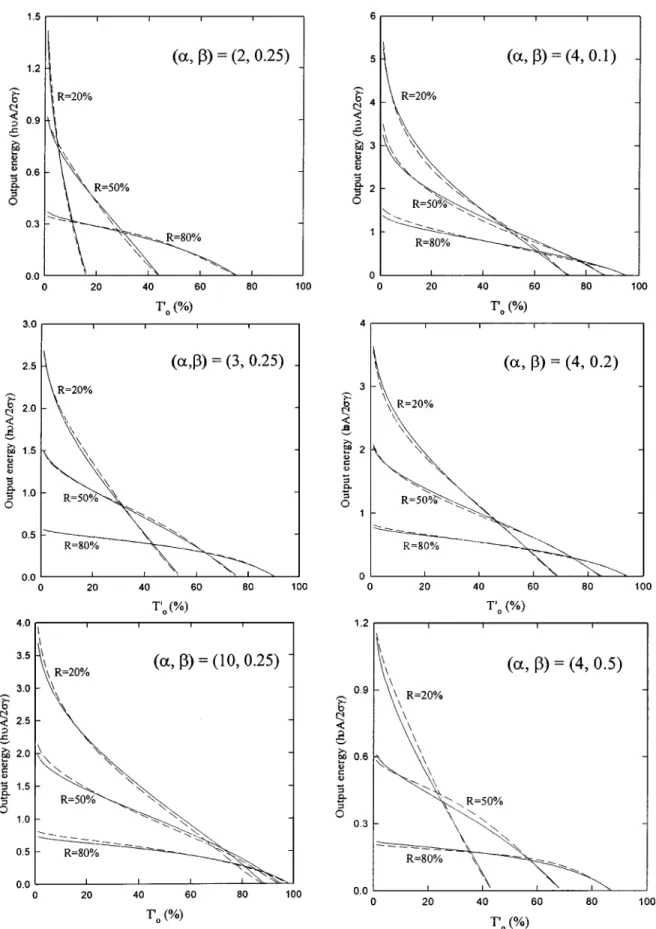
Fig. 1. Calculation results for the output pulse energy as a function ofT for several values of R; and . Dashed lines: results from (26)–(28). Solid lines: results through numerically solving (23) and substituting the solution into (21).
However, an aperture is often used to generate the TEM mode in a stable cavity. Therefore, it is more practical to derive the output energy for the Gaussian beam. Here, we
shall follow specifically the approach developed in [13] to derive the output pulse energy for the Gaussian beam distribution with the ESA effect.
CHEN et al.: ANALYTICAL MODEL FOR DESIGN CRITERIA OF PASSIVELY -SWITCHED LASERS 465
The energy extracting from the gain medium of a pas-sively -switched laser includes three parts. Some of the energy is lost in bleaching of the saturable absorber, some is lost due to intracavity losses or ESA, and another part leaves the cavity as the output energy. The equation for energy balance is given by [13]
(17) Although general expressions for the parameters in (17) were derived in [13] for the Gaussian beam profile, the ESA effect was not considered. To modify the expressions of [13] by in-cluding the ESA effect, we obtain
(18) (19) (20) (21) and (22) where is the laser photon energy. The parameter is the en-ergy density at the maximum of the transverse distribution of the laser mode in the gain medium, normalized to the saturation energy density. The physical meaning of the parameter repre-sents the extraction efficiency of the energy stored in the gain medium through the lasing process [13].
From (17)–(21) using (9), the equation for can be given by
(23)
The output energy can be found from (21) if (23) is solved for . Equation (23) indicates that the parameter can be expressed as a function of the parameters , and . It is worth while noting that the parameter is independent of the pump level , as mentioned early. In other words, above threshold the output pulse energy of a passively -switched laser should not depend on the pump level; it is mainly deter-mined by the properties of the gain medium and the saturable absorber. This is why above threshold, increasing the pump en-ergy only increases the number of output pulses but does not lead to an obvious increase for the output energy per pulse, as shown in [1] and [2] and in our experimental results described later.
With some transformation, (23) can be reduced to the pre-vious formula derived from the plane-wave approximation. If the transverse-mode profile is assumed to be the plane wave, we have
(24)
In this case, if = 1, then (23) becomes
(25)
With the substitution of , (25) becomes the for-mula obtained in previous analysis [7], [8].
Since the output pulse energy is a function of the parameters , and , it is of great practical interest to express the output pulse energy as an analytical function of the parameters , and for the design of passively -switched lasers. Through the numerical calculation, we found that the pulse energy can be satisfactorily fitted as in (26), shown at the bottom of the next page, where
(27) and
(28) The functional form of (26) was based on the fact that the pulse energy is proportional to the modulation losses of the saturable absorber and inversely proportional to the total cavity losses in the situation that the saturable absorber saturates
. The other term
in (26) was used to satisfy the condition of the second threshold. The parameters and were used to obtain a good fitting result. Since the present model can cover the typical extent of and , it is suitable for most passively -switched lasers.
Fig. 1 shows the output pulse energy as a function of for several values of and . Note that one can use a single parameter to omit the dependence of on . Here, we just used in the calculation for convenience. In this figure, we compare the results obtained directly from (26)–(28) with the numerical data obtained through solving (23) and substituting the solution into (21) to show the accuracy of the analytical expression for the output energy. Good agreement is found for all cases.
To illustrate the utility of the present model, a Nd:YAG minia-ture laser with a Cr :YAG crystal as a saturable absorber is considered and performed experimentally. The plane-plane res-onator of the length 8 cm includes the rear mirror, whose reflec-tivity is %, the Cr :YAG crystal is near the rear mirror, the Nd:YAG medium with a 3-mm in diameter and 50-mm in length pumped by a xenon flashlamp, and the output mirror with %. We used several Cr :YAG crystals with dif-ferent initial transmission to test the laser. The input energy of the xenon flashlamp can be adjusted by adjusting the voltage
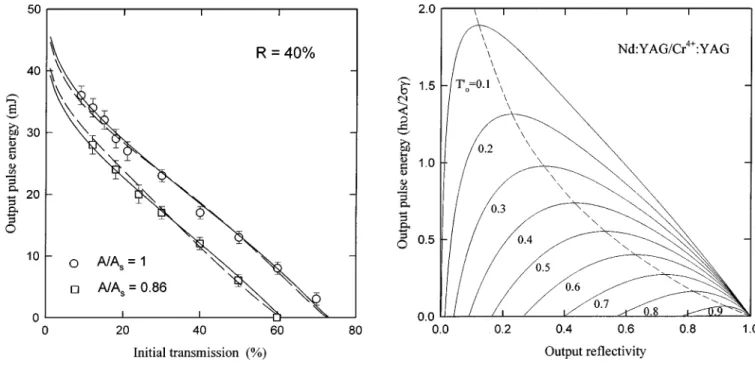
Fig. 2. Plot of the experimental and theoretical results for the output pulse energy as a function of T in the Nd:YAG/Cr :YAG Q-switched laser. Symbols: experimental data. Solid line: numerical data from solving (21) and (23). Dashed line: calculation results from (26)–(28)
Fig. 3. Plot of the experimental output energy as a function of the input voltage of the xenon flashlamp withT = 0:3.
Fig. 4. Plot of the calculation results (solid lines) from (26)–(28) for the output pulse energy as a function of the output reflectivity for several initial transmissionsT with the values of and in Nd:YAG/Cr :YAG
Q-switched laser. Dashed line indicates the position of the optimal output
reflectivity.
of the xenon flashlamp to ensure a single laser pulse to be ob-tained. For a plane–plane cavity, is nearly equal to unity. To demonstrate the influence of , the rear mirror was re-placed by a concave mirror with a radius of curvature of 10-m, where is about 0.86.
The parameters of the Cr :YAG crystal as given in [1] are:
cm and cm . For the
Nd:YAG crystal, and cm [14]. Thus, the
parameters and from (6) and (11) are 3.11 and 0.25, respec-tively. With a beam radius of 1.5 mm, the value of
is 24 mJ. is estimated as 0.03 from the free-running experi-ment. Substituting the values of , and into (26)–(28), the output pulse energy can be predicted as a func-tion of initial transmission .
Fig. 2 shows the experimental and theoretical results for the dependence of the on . For comparison, the theoretical results calculated from (21) with the numerical solution of (23) are also shown in Fig. 2. It can be seen that the prediction of the analyt-ical model agrees well with the experimental data and the theo-retical calculation. In addition, from (15), was found
to be about 0.701 for and for that
for
for
CHEN et al.: ANALYTICAL MODEL FOR DESIGN CRITERIA OF PASSIVELY -SWITCHED LASERS 467
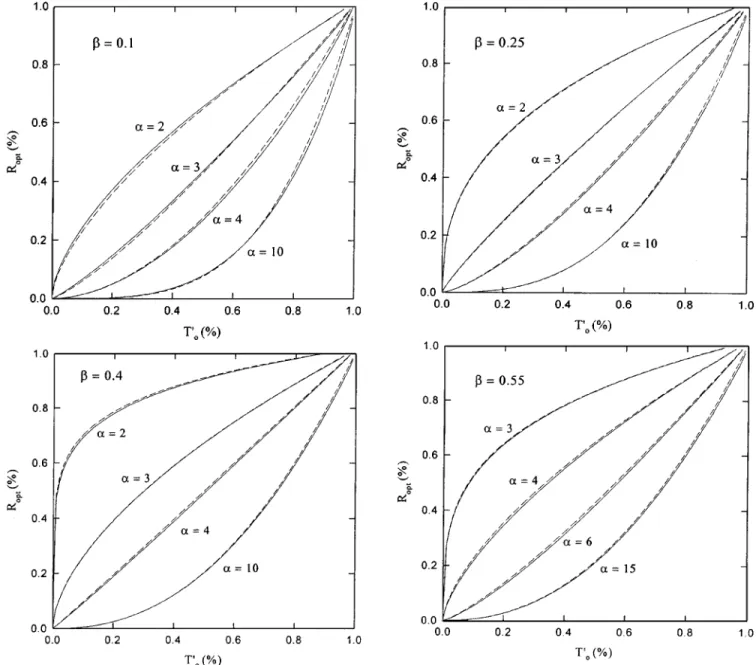
Fig. 5. The calculation results forR as a function ofT for several typical values of and . Solid lines: results obtained from solving (23) and substituting the solution into (21) and finding the optimal output reflectivity. Dashed lines: results calculated from (29) and (30).
is quite close to the experimental results, as shown in Fig. 2. It is worthwhile to mention that the quoted values for and from [1] are small by a factor of 2 when compared with more recent measurements [15]. Nevertheless, the analytical model shown in (26)–(28) indicates clearly that the output energy is seen to be quite insensitive to the absolute values of and when is much greater than 1. This is the case of the present experiment and analysis.
Fig. 3 depicts the experimental output energy as a function of the input voltage of the xenon flashlamp with . The curve reveals three steep steps, each reflecting the appearance of an additional pulse. The output energy per pulse is shown to be nearly unchanged as increasing the pump energy. As mentioned early, the output pulse energy in the passively -switched laser is mainly determined by and , not by the pump energy. The step-like input-output characteristic is a common feature in the
passively -switched laser [1], [2]. With the values of and for the Nd:YAG/Cr :YAG -switched laser and (26)–(28), the output pulse energy was calculated as a function of the output re-flectivity for several valuse of the initial transmission . Fig. 4 shows the calculated results. The dashed line in this figure shows that there is an optimal output reflectivity for maximizing the output pulse energy for a given . Therefore, it is practically useful to obtain the optimal output reflectivity as a function of
, and .
As shown in (16), the output reflectivity should be greater than for normal -switching behavior. Consequently, the optimal output reflectivity for maximizing pulse energy should be larger than . Therefore, we use the following function form to express optimal output reflectivity:
where the factor is smaller than unity. Through numer-ical analysis, we find that can be satisfactorily fitted to
(30)
Fig. 5 shows the calculated results for as a function of for several typical values of and . Once again, we just used in the calculation for convenience. To reveal the accuracy of the analytical function, we compare the results calculated from (29) and (30) with the numerical data obtained from solving (23) and substituting the solution into (21) and finding the optimal output reflectivity. Good agreement is also found for all cases. In general, the optimal output reflectivity is an increasing function of for a given and a given .
IV. CONCLUSION
We have included the effects of the intracavity focusing and ESA in the coupled rate equation to derive the condition of the second threshold for a passively -switched laser. From the criterion of the second threshold, we obtain two parameters and . In terms of , the output pulse energy was explicitly fitted to an analytical function of the variables , and . A passively -switched Nd:YAG laser with Cr :YAG as a saturable absorber was used to verify the validity of the analytical function. Furthermore, we used the parameter to find an analytical function for the optimal output reflectivity. The present model pro-vides a straightforward procedure for the design of passively
-switched lasers.
REFERENCES
[1] Y. Shimony, Z. Burshtein, and Y. Kalisky, “Cr :YAG as passive
Q-switch and Brewster plate in a pulsed Nd:YAG laser,” IEEE J.
Quantum Electron., vol. 31, pp. 1738–1741, 1995.
[2] P. Yankov, “Cr :YAGQ-switching of Nd:host laser oscillators,” J.
Phys. D: Appl. Phys., vol. 27, pp. 1118–1120, 1994.
[3] H. J. Eichler, A. Haase, M. R. Kokta, and R. Menzel, “Cr :YAG as passiveQ-switch for a Nd:YALO oscillator with an average repetition rate of 2.7 kHz, TEM00 mode and 13 W output,” Appl. Phys., vol. B-58, pp. 409–411, 1994.
[4] Y. K. Kuo, M. F. Huang, and M. Birnbaum, “Tunable Cr :YSO
Q-switched Cr:LiSAF laser,” IEEE J. Quantum Electron., vol. 31, pp.
657–663, 1995.
[5] A. Agnesi, S. D. Acqua, E. Piccinini, G. Reali, and G. Piccinno, “Ef-ficient wavelength conversion with high-power passivelyQ-switched diode-pumped neodymium lasers,” IEEE J. Quantum Electron., vol. 34, pp. 1480–1484, 1998.
[6] J. J. Degnan, “Optimization of passivelyQ-switched lasers,” IEEE J.
Quantum Electron., vol. 31, pp. 1890–1901, 1995.
[7] G. Xiao and M. Bass, “A generalized modelQ-switched lasers including excited state absorption in the saturable absorber,” IEEE J. Quantum
Electron., vol. 33, pp. 41–44, 1997.
[8] X. Zhang, S. Zhao, Q. Wang, Q. Zhang, L. Sun, and S. Zhang, “Opti-mization of Cr -doped saturable-absorberQ-switched lasers,” IEEE
J. Quantum Electron., vol. 33, pp. 2286–2294, 1997.
[9] M. Brunel, C. Özkul, and F. Sanchez, “Dynamics of a laser with a reverse saturable absorber,” Appl. Phys. B, vol. 68, pp. 39–44, 1999. [10] D. J. Harter, Y. B. Band, and E. P. Ippen, “Theory of mode-locked lasers
containing a reverse saturable absorber,” IEEE J. Quantum Electron., vol. 21, pp. 1219–1227, 1985.
[11] A. E. Siegman, Lasers. Mill Valley, CA: Univ. Sci. Books, 1986, pp. 1024–1028.
[12] M. Hercher, “An analysis of saturable absorbers,” Appl. Opt., vol. 6, pp. 947–954, 1967.
[13] N. N. Il’ichev, E. S. Gulyamova, and P. P. Pashinin, “PassiveQ switching of a neodymium laser by a Cr :YAG crystal switch,” Quantum
Elec-tron., vol. 27, pp. 972–977, 1997.
[14] W. Koechner, Solid State Laser Engineering, 4th ed, Berlin, Germany: Springer-Verlag, 1996, p. 49.
[15] G. Xiao, J. H. Lim, S. Yang, E. V. Stryland, and M. Bass, “Z-scan mea-surement of the ground and excited state absorption cross sections of Cr in Yttrium Aluminum Garnet,” IEEE J. Quantum Electron., vol. 35, pp. 1086–1091, 1999.
Yung-Fu Chen was born in Lukang, Taiwan, in
1968. He received the B.S. degree in 1990 from National Chiao Tung University, Hsinchu, Taiwan, R.O.C., in electronics engineering. He received the Ph.D. degree from the Institute of Electronics, National Chiao Tung University, Hsinchu, Taiwan, R.O.C., in 1994.
Since 1994, he has been with Precision Instrument Development Center (PIDC), National Science Council, Taiwan, R.O.C., where his research mainly concerns the development of diode-pumped solid-state lasers, as well as quantitative analysis in surface electron spec-troscopy. Since 1999, he has been an Associate Professor in the Electrophysics Department of National Chiao Tung University. His main experiences include quantitative surface analysis and solid-state lasers.
Dr. Chen received the Academic Research Award in electrical engineering from Li-Ching Foundation in 1994, the Tenn-Chia-Bin Youth Academic Award from the Chinese Optical Engineering Society in 1997, the first prize of Team Research Achievement from PIDC in 1997, the Technology Contribution Award from the Chinese Optical Engineering Society in 1998, and the Outstanding Youth Engineer Award from the Chinese Engineer Society in 1998. He is a member of the American Vacuum Society, the Optical Society of America, the IEEE Lasers and Electro-Optics Society, and the Surface Analysis Society of Japan.
Y. P. Lan, photograph and biography available at the time of publication.