Cite this: Phys. Chem. Chem. Phys., 2013,
15, 4651
porphyrin-sensitized solar cells: effects of the
4-tert-butylpyridine additive†
Yu-Cheng Chang,aHui-Ping Wu,aNagannagari Masi Reddy,bHsuan-Wei Lee,b
Hsueh-Pei Lu,aChen-Yu Yeh*band Eric Wei-Guang Diau*a
The effects of the 4-tert-butylpyridine (TBP) additive in the electrolyte on photovoltaic performance of two push–pull porphyrin sensitizers (YD12 and YD12CN) were examined. Addition of TBP significantly increased the open-circuit voltage (VOC) for YD12 (from 550 to 729 mV) but it was to a lesser extent for YD12CN (from 544 to 636 mV); adding TBP also had the effect of reducing the short-circuit current density (JSC) slightly for YD12 (from 17.65 to 17.19 mA cm 2) but it led to a significant reduction for YD12CN (from 16.45 to 9.78 mA cm 2). The resulting power conversion efficiencies of the YD12 devices increase from 6.2% to 8.5% whereas those of the YD12CN devices decrease from 5.8% to 4.5%. Based on measurements of temporally resolved photoelectric transients of the devices and femtosecond fluorescence decays of thin-film samples, the poor performance of the YD12CN device in the presence of TBP can be understood as being due to the enhanced charge recombination, decreased electron injection, and a lesser extent of inhibition of the intermolecular energy transfer.
1. Introduction
Dye-sensitized solar cells (DSSCs) are promising
next-generation photovoltaic devices because of their great advan-tages such as light weight, low cost and easy processing, with colourful and transparent features.1Photosensitizers such as ruthenium complexes,1,2 zinc porphyrins3 and metal-free organic dyes4 have been developed to serve as efficient light harvesters for DSSCs. As a result, the devices made of ruthe-nium complexes5 and porphyrin sensitizers6 have attained remarkable power conversion efficiencies, Z = 11.0–11.5%, under one-sun illumination. Recently, it has been reported that co-sensitization of a push–pull zinc porphyrin (YD2-oC8) with an organic dye (Y123) using a cobalt-based redox electrolyte
boosted the cell performance to Z = 12.3%,7 stimulating the investigation of the development of new porphyrin sensitizers to further enhance the device performance of DSSCs.
The molecular structure of a highly efficient push– pull porphyrin sensitizer features an electron donor group
attached at the meso-position of the porphyrin core
opposite to the meso-substituted linker with a carboxylic acid serving as an anchoring group for dye sensitization of the surface of TiO2. For the YD2-series dyes,6–8 the electron donor is a diarylamino derivative and the p-conjugated linker involves a phenylethynyl (PE) moiety. Previously we found that modification of the PE linker by substituting the phenyl group with a naphthalene unit (YD12) enhances the device performance due to its superior light-harvesting ability.9 In the present study, we design a porphyrin sensitizer (YD12CN) based on the structure of YD12 with the same donor group but using the cyanoacrylic acid as an anchoring group, which is widely employed in the molecular design of
an organic dye.4 The molecular structures of YD12 and
YD12CN are indicated in Chart 1. The effects of the 4-tert-butylpyridine (TBP) additive on photovoltaic performance were examined based on the measurements of charge extraction, transient photoelectric decays, and femtosecond fluorescence decays.
a
Department of Applied Chemistry and Institute of Molecular Science, National Chiao Tung University, Hsinchu 30010, Taiwan.
E-mail: [email protected]; Fax: +886-3-5723764; Tel: +886-3-5131524
bDepartment of Chemistry and Center of Nanoscience & Nanotechnology,
National Chung Hsing University, Taichung 402, Taiwan.
E-mail: [email protected]; Fax: +886-4-22862547; Tel: +886-4-22852264 † Electronic supplementary information (ESI) available: Experimental details of syntheses, device fabrication, photovoltaic and time-resolved investigations, together with supplementary figures, Fig. S1–S12, and supplementary tables, Tables S1–S7. See DOI: 10.1039/c3cp44555k
Received 17th December 2012, Accepted 4th February 2013 DOI: 10.1039/c3cp44555k
www.rsc.org/pccp
2. Results and discussion
The details of synthesis and electrochemical results (Fig. S1 and S2, Table S1, ESI†) of YD12CN are given in ESI.† Fig. 1 shows the absorption spectra of YD12 and YD12CN in THF solutions (solid curves) and on TiO2films (dashed curves). In comparison with the YD12 spectrum in solution, introduction of the cyanoacrylic group in YD12CN leads to a red shift of both Soret and Q bands, but with much smaller absorption coefficients. When both molecules were sensitized on TiO2 films, the spectra became significantly broadened relative to those in solutions with an absorption dip in the 550–600 nm spectral region. These two porphyrin dyes were fabricated into DSSC devices for photo-voltaic and electron-transfer kinetic characterizations.
2.1 Photovoltaic properties
The effects of TBP concentrations on photovoltaic performance of the devices made of YD12 and YD12CN were studied at eight concentrations within a broad range (0.0–1.2 M); the J–V curves and the corresponding photovoltaic parameters are shown in Fig. S3 and S4 (ESI†), respectively. The results indicate that the best performance of the YD12 device appeared at the TBP concentration of 0.5 M, whereas the effect of TBP concentration for the YD12CN device was not evident in the range of 0–0.5 M. Because high TBP concentrations (>0.5 M) led to a significant decrease in photocurrent densities but limited improvement in photovoltages, we thus focus our investigations only on two
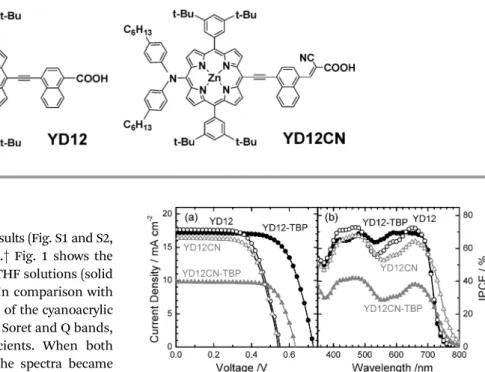
conditions: the absence (0.0 M) and presence (0.5 M) of the TBP additive. Fig. 2a and b show the J–V curves and the corres-ponding IPCE action spectra for the YD12 and YD12CN devices, respectively; the obtained photovoltaic parameters and the amounts of dye-loading (DL) are summarized in Table 1. In those figures, the solid curves represent the devices with the TBP additive (0.5 M) in the electrolyte whereas the dashed curves represent those in the absence of TBP.
TBP is a well-known electrolyte additive to modify the surface of TiO2for increasing the open-circuit voltage (VOC).1b,10 In the absence of TBP, both YD12 and YD12CN devices show similar photovoltaic performance with the short-circuit current density (JSC) of the former being slightly larger than the latter. In the presence of TBP, the VOCof YD12 increased dramatically from 550 to 729 mV while that of YD12CN only increased from 544 to 636 mV. On the other hand, the decrease of JSCof the YD12 device was very small (from 17.65 down to 17.19 mA cm 2)
while the decrease of JSC of the YD12CN device was quite
substantial (from 16.45 down to 9.78 mA cm 2). Therefore, addition of TBP in the YD12 device did help in boosting up Chart 1 Molecular structures of YD12 and YD12CN.
Fig. 1 Absorption spectra of YD12 (black) and YD12CN (gray) in THF (solid curves, absorption coefficients shown on the left axis) and on TiO2films (dashed
curves, absorbance shown on the right axis).
Fig. 2 Optimized photovoltaic properties: (a) current–voltage characteristics and (b) the corresponding IPCE action spectra of devices made of YD12 (black circles) and YD12CN (gray triangles) with (filled symbols) and without (open symbols) addition of TBP.
Table 1 Photovoltaic parameters and amounts of dye-loading of DSSCs fabricated with YD12 and YD12CN adsorbed on the TiO2 films of thickness
(12 + 5) mm under simulated AM-1.5G illumination (power 100 mW cm 2) and an
active area of 0.16 cm2
Dye DL/nmol cm 2 JSC/mA cm 2 VOC/mV FF Z/%
YD12 255 17.65 550 0.643 6.2
YD12-TBP 17.19 729 0.677 8.5
YD12CN 213 16.45 544 0.642 5.8
YD12CN-TBP 9.78 636 0.716 4.5
presence of TBP indicates that either poor electron injection or charge-collection yield is involved. To understand the electron transfer kinetics affecting the photovoltaic performance mentioned above, time-resolved investigations were performed.
2.2 Electron transport and kinetics of charge recombination of devices
The kinetics of electron transport of the devices made of YD12 and YD12CN with and without addition of TBP were deduced from the transient photoelectric (DJSCand DVOCvs. time) and charge-extraction (CE) measurements11 based on eight white-light (WL) intensities as bias irradiation sources (power den-sities in a range of 27–115 mW cm 2); the resulting photo-voltage decays are shown in Fig. S5–S8 (ESI†). Decay curves of the four devices for DVOC vs. time were fitted according to a single exponential decay function to determine time coeffi-cients for charge recombination (tR), transients of the four devices for DJSC vs. time were integrated to give the induced charge (DQ) due to the probe light irradiation, and the potential difference (DV) due to the probe irradiation was determined by the peak amplitude of the transient of DVOC vs. time; the corresponding parameters are provided in Tables S2–S5 (ESI†). As chemical capacitance (Cm= DQ/DV) is proportional to the density of states (DOS) of TiO2at the Fermi level,11the plots shown in Fig. 3 provide direct information on the shift of the
conduction band edge of TiO2 upon uptake of two different
dyes in the presence or absence of TBP. In the absence of TBP, the potential of TiO2 of the YD12CN device is located
above B50 mV compared to that of the YD12 device. In the
presence of TBP, the TiO2potential of YD12CN shifts upward
by only B80 mV whereas that of YD12 shifts upward by as
much asB200 mV, compared to their non-TBP counterparts.
The observed potential shifts are consistent with the enhance-ment in VOCupon TBP addition:10 the increment in VOCis 92 and 179 mV for YD12CN and YD12, respectively (Table 1).
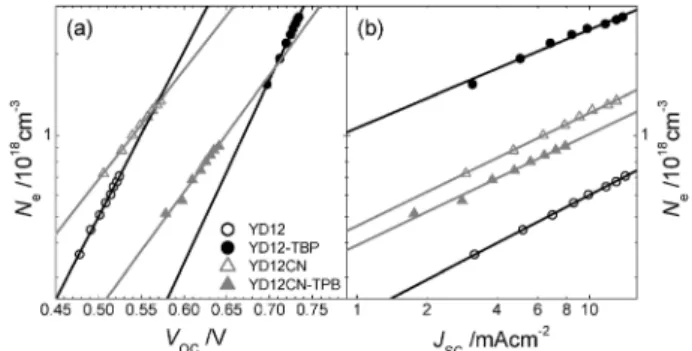
The charge densities (Ne) of the devices under certain bias light irradiation and under open-circuit conditions were deter-mined via CE measurements when the circuit of the system was switched to the short-circuit condition. Fig. 4a and b show plots of log(Ne) vs. VOCand log(Ne) vs. log(JSC), respectively. Because Nerepresents the number of extracted charges under bias light irradiation, the deviation of the Nevs. VOCplots from a standard plot provides information on potential band-edge movements, whereas the deviation of the Nevs. JSC plots from a standard plot gives information on the extent of charge recombination.12 According to the VOCvs. Neplots shown in Fig. 4a, we observed an almost equivalent potential up-shift (B120 mV) upon adding TBP in both YD2 and YD2CN devices. The potential variation is different from what we observed in Fig. 3 because
Ne counts all the charges below the Fermi level whereas
Cmrepresents the DOS only at the Fermi level. This observation is consistent with that of a Z907 system containing various guanidine coadsorbents, for which the plots of Cmvs. VOCreflect the true movement of the conduction band edge whereas interpretation of the Ne vs. VOC variations requires further information on the effect of charge recombination.13
Plots of Ne vs. JSCshown in Fig. 4b predict the effects of charge recombination for the two systems – addition of TBP significantly retarded charge recombination hence the charge density increased for YD12, but it had a negative effect of enhancing charge recombination hence the charge density decreased for YD12CN. The same phenomena for the plots of tRvs. Neare shown in Fig. 5, which shows that TBP in the YD12 device has succeeded in modifying the surface of TiO2 for significant retardation of tR (shown as circle symbols). However, in the case of YD12CN we observed an opposite effect upon addition of TBP (shown as triangle symbols), for which charge recombination became a more severe problem in the presence of TBP. According to the results shown in Fig. 4a, the TiO2potentials were up-shifted byB120 mV upon addition of
Fig. 3 Plots of chemical capacitance (Cm) vs. VOCfor DSSC devices without TBP
(black open circles and gray open triangles for YD12 and YD12CN, respectively) and for those with TBP (black filled circles and gray filled triangles for YD12 and YD12CN, respectively) under eight white bias light irradiations. The active area of the devices is 0.16 cm2.
Fig. 4 (a) Semi-logarithmic plots of electron density (Ne) vs. VOC and (b)
logarithmic plots of Nevs. JSCfor DSSC devices without TBP (black open circles
and gray open triangles for YD12 and YD12CN, respectively) and for those with TBP (black filled circles and gray filled triangles for YD12 and YD12CN, respec-tively) under eight white bias light irradiations.
TBP in both devices; the retardation and acceleration of charge recombination for YD12-TBP and YD12CN-TBP, respectively, reasonably account for the increase of VOCby 179 and 92 mV for the former and the latter, respectively. Such an observation indicates that the YD12CN-TBP device involves poor charge collection yields accounting for the observed low IPCE values leading to the poor JSCas indicated in Fig. 2. We propose that, in the presence of TBP, the floppy YD12CN might be tilted further on the surface of TiO2for the charge recombination to occur more rapidly.14
2.3 Interfacial electron transfer dynamics of sensitized films Femtosecond excitation of the thin-film samples immersed in acetonitrile solvent was performed at 435 nm using a fluorescence up-conversion system described elsewhere.8a,9,15The emissions at the intensity maximum (710 nm for YD12 and 730 nm for YD12CN) were optically gated with the fundamental pulse (870 nm) to yield the emission decays. Fig. 6a–d show the decays of the YD12- and YD12CN-sensitized TiO2films without and with TBP; those of the sensitized Al2O3 films under similar experi-mental conditions are also shown for comparison. The temporal profiles of all samples exhibit a bi-exponential decay feature and the corresponding time coefficients were obtained upon analyzing the data with a parallel kinetic model (Fig. S9 and S10, ESI†). To resolve the kinetics resulting from energy transfer and electron injection, we averaged the time coefficients according to the
amplitude-averaged decay time model,8a the corresponding
rate coefficients were determined according to kTiO2 = tTiO2 1 and kAl2O3 = tAl2O3
1; the average time coefficients of the TiO 2 and Al2O3films are summarized in Tables S6 and S7 (ESI†).
The fluorescence decays of the porphyrin-sensitized Al2O3 films reflect only the intermolecular energy transfer because of aggregation of the dye on the Al2O3surface, but the decays of the porphyrin-sensitized TiO2films not only contain the aggre-gate-induced energy transfer but also reflect the rapid electron injection from the excited state of the dye into the conduction band of TiO2. If we assume that the extent of dye aggregation on
both TiO2 and Al2O3 films is similar,8a,9 based on the same amount of dye molecules adsorbed on the films (Fig. S11, ESI†), the electron injection yields of the YD12 and YD12CN sensitized TiO2films in the absence of TBP were evaluated to be Finj= 0.85 and 0.77, respectively. In the presence of TBP, the emission decays slow down for all cases and the evaluated Finjvalues of the YD12 and YD12CN films are 0.77 and 0.63, respectively. Note that the intrinsic electron injection yield of YD12CN (no TBP addition) is smaller than that of YD12 due to a substantially slower rate of electron injection of the former than the latter. As shown for the results of Al2O3films, addition of TBP reduces the rate of intermolecular energy transfer (kavg/1010s 1) more signifi-cantly for YD12 than for YD12CN (0.8/1.2 vs. 0.8/1.0), but the extent of reduction in the electron injection rate (kinj/1010s 1) is similar for both dyes (2.7/6.9 vs. 1.3/3.6). The role played by TBP
in reducing Finj can thus be understood as being due to
retardation of the electron injection rates and the intermolecular energy transfer rates to a different extent; the former reduction is due to the up-shifts of the TiO2 potentials and the latter reduction arises from the protective effect of TBP surrounding the porphyrin sensitizers.
3. Conclusion
We have examined the effects of the TBP additive on device performance for two push–pull porphyrins (YD12 and YD12CN) based on time-resolved investigations of thin-film samples using femtosecond fluorescence up-conversion spectroscopy, charge extraction and transient photoelectric measurements of the corresponding devices. We found that, without addition of TBP, the device performance of the two dyes is similar, but in the presence of TBP (0.5 M) the power conversion efficiencies of the YD12 device increase from 6.2% to 8.5% whereas those of the YD12CN device decrease from 5.8% to 4.5%. For YD12, Fig. 5 Semi-logarithmic plots of charge recombination time coefficient (tR) vs.
electron density (Ne) for DSSC devices without TBP (black open circles and
gray open triangles for YD12 and YD12CN, respectively) and for those with TBP (black filled circles and gray filled triangles for YD12 and YD12CN, respec-tively) under eight white bias light irradiations.
Fig. 6 Femtosecond fluorescence decays of thin-film samples sensitized with (a) YD12 and (b) YD12CN in the absence of TBP and (c) YD12 and (d) YD12CN in the presence of TBP. The black circles and gray squares represent the data obtained from the dyes sensitized on TiO2and Al2O3films, respectively, and the solid traces
represent the theoretical fits according to a bi-exponential decay function. The excitation was performed at 435 nm and the emissions were optically gated at 710 nm and 730 nm for YD12 and YD12CN, respectively.
potential to a lesser extent, but the dramatic reduction of JSCfrom 16.45 (no TBP) to 9.78 mA cm 2(with TBP) arises from two major factors: (1) the acceleration of charge recombination leading to poor charge-collection yields and (2) the retardation of electron injection leading to poor electron-injection yields. We also found that the intermolecular energy transfer was inhibited in the presence of TBP, and the extent of inhibition was found to be much inferior for YD12CN than for YD12, giving much smaller electron-injection yields for the former than for the latter.
Acknowledgements
National Science Council of Taiwan and Ministry of Education of Taiwan, under the ATU program, provided support for this project.
References and notes
1 (a) M. Gra¨tzel, Acc. Chem. Res., 2009, 42, 1788–1798; (b) A. Hagfeldt, G. Boschloo, L. Sun, L. Kloo and H. Pettersson, Chem. Rev., 2010, 110, 6595–6663.
2 (a) M. K. Nazeeruddin, A. Kay, I. Rodicio, R. Humphry-Baker, E. Mu¨ller, P. Liska, N. Vlachopoulos and M. Gra¨tzel, J. Am. Chem. Soc., 1993, 115, 6382–6390; (b) N. Robertson, Angew. Chem., Int. Ed., 2006, 45, 2338–2345.
3 (a) H. Imahori, T. Umeyama and S. Ito, Acc. Chem. Res., 2009, 42, 1809–1818; (b) M. V. Martı´nez-Dı´az, G. de la Torre and T. Torres, Chem. Commun., 2010, 46, 7090–7108; (c) L.-L. Li and E. W.-G. Diau, Chem. Soc. Rev., 2013, 42, 291–304.
4 (a) G. Zhang, H. Bala, Y. Cheng, D. Shi, X. Lv, Q. Yu and P. Wang, Chem. Commun., 2009, 2198–2200; (b) Z. Ning and H. Tian, Chem. Commun., 2009, 5483–5495; (c) Y. Ooyama and Y. Harima, Eur. J. Org. Chem., 2009, 2903–2934;
M. K. Nazeeruddin, E. W.-G. Diau, C.-Y. Yeh,
S. M. Zakeeruddin and M. Gra¨tzel, Science, 2011, 334, 629–634.
8 (a) H.-P. Lu, C.-Y. Tsai, W.-N. Yen, C.-P. Hsieh, C.-W. Lee, C.-Y. Yeh and E. W.-G. Diau, J. Phys. Chem. C, 2009, 113, 20990–20997; (b) C.-P. Hsieh, H.-P. Lu, C.-L. Chiu, C.-W. Lee, S.-H. Chuang, C.-L. Mai, W.-N. Yen, S.-J. Hsu, E. W.-G. Diau and C.-Y. Yeh, J. Mater. Chem., 2010, 20, 1127–1134. 9 H.-P. Lu, C.-L. Mai, C.-Y. Tsia, S.-J. Hsu, C.-P. Hsieh,
C.-L. Chiu, C.-Y. Yeh and Eric W.-G. Diau, Phys. Chem. Chem. Phys., 2009, 11, 10270–10274.
10 (a) G. Boschloo, L. Haggman and A. Hagfeldt, J. Phys. Chem. B, 2006, 110, 13144–13150; (b) R. Katoh, M. Kasuya, S. Kodate, A. Furube, N. Fuke and N. Koide, J. Phys. Chem. C, 2009, 113, 20738–20744; (c) Z. Ning, Y. Fu and H. Tian, Energy Environ. Sci., 2010, 3, 1170–1181.
11 (a) L. Luo, C.-J. Lin, C.-S. Hung, C.-F. Lo, C.-Y. Lin and E. W.-G. Diau, Phys. Chem. Chem. Phys., 2010, 12, 12973–12977; (b) L.-L. Li, Y.-C. Chang, H.-P. Wu and E. W.-G. Diau, Int. Rev. Phys. Chem., 2012, 31, 420–467.
12 N. Kopidakis, N. R. Neale and A. J. Frank, J. Phys. Chem. B, 2006, 110, 12485–12489.
13 Z. Zhang, N. Evans, S. M. Zakeeruddin, R. Humphry-Baker and M. Gra¨tzel, J. Phys. Chem. C, 2007, 111, 398–403. 14 (a) H. Imahori, S. Kang, H. Hayashi, M. Haruta, H. Kurata,
S. Isoda, S. E. Canton, Y. Infahsaeng, A. Kathiravan, T. Pascher, P. Cha´bera, A. P. Yartsev and V. Sundstro¨m, J. Phys. Chem. A, 2011, 115, 3679–3690; (b) S. Mathew, H. Iijima, Y. Toude, T. Umeyama, Y. Matano, S. Ito, N. V. Tkacheko, H. Lemmetyinen and H. Imahori, J. Phys. Chem. C, 2011, 115, 14415–14424.
15 L. Luo, C.-J. Lin, C.-Y. Tsai, H.-P. Wu, L.-L. Li, C.-F. Lo, C.-Y. Lin and E. W.-G. Diau, Phys. Chem. Chem. Phys., 2010, 12, 1064–1071.