
Self-Synchronization Object Watermarking Scheme Based on shape Subdivision
6
0
0
全文
(2) Int. Computer Symposium, Dec. 15-17, 2004, Taipei, Taiwan.. This work presents a new object-based watermarking scheme to improve the tolerance against geometrical attacks. Proposed scheme is based on the invariance of spatial relationships between a set of subregions in an image object. Combined with the computation of orientation and lengths of principle axes to make the proposed scheme rotation and translation invariant. The procedure of proposed scheme is illustrated in Fig.1. 3. Water mar k embedding and extr action Supposed that an object image f is first transformed into f’ by applying an affine transformation T described as a geometrical attack. The transformed image f’ is then divided into disjoint m x n gray level image blocks ,B’1,B’2,… ,B’mxn, by using the above segmentation method. The parameters m and n can be regarded as secret keys to embed and protect data. Then, all the pixels in object f are classified into one of the blocks B1,B2,… ,Bmxn by performing the following test: if the pixel with coordinates (x, y) mapped by T located in the block Bi’ then p will be assigned into block Bi. We partition all blocks Bi into k groups, G1 , G 2 ,..., G k , when k-bit secret bits required. The remainder of this paper is organized as follows. The following section briefly describes the proposed method of segmenting an object image into numerous small sub-regions based on MPEG-4 BIFS. Section 3 then details the procedures of watermark embedding and extraction. Section 4 describes the experimental results related to some attacks, including mean filter, JPEG compression, rotation, rotation and scaling, and boundary pixel cropping. We also implemented Lu’s[14] method for comparison. Section 5 gives a detailed discussion. The final section summarizes our work.. ir. T r. e ir v .tw. l a. to be embedded as a watermark. Each group Gi can be denoted as m× n m× n Gi ={Bj : (i −1) × +1≤ j ≤ i × k , j ∈ N} k . (2). Besides, we divided Gi into a pair of subsets Ci and Di where Ci contains all the blocks Bj in Gi with odd indices and Di with the even indices, respectively. Finally, the following rule is kept to embed watermark bit wi:. 2. Shape Sub-division for Synchr onization Let f be an object image segmented from gray level or color images and let its corresponding shape S be simply obtained in binary image form by converting all pixel’s illumination of f by all pixels into the same gray value. To ensure the success of embedding /extracting watermarks on specified locations of f, shape subdivision corresponding to the principal axes is performed. This procedure is described as follows:. Dn.. F.zeo. D w w P. m o c. C i − Di ≥ δ u if wi =1 Ci − Di ≤ δ l if wi =0. (3). where C i and Di are the mean gray values of pixel. Step 1: Calculate the second-ordered central moments of S, including µ 02 , µ 20 , and , µ11 .. intensities on their corresponding blocks, respectively. δ u and δ l are the upper and lower threshold to control. Step 2: Calculate the principle angle φ of S from the central moments with:. the out watermarked image quality. We can adaptively modify the values of C i and Di by adding or. n o. e Z ϕ=. 2µ11 1 tan −1 ( ) 2 µ 20 − µ 02. w. (1). Step 3: Determine the minimum bounding rectangle of the rotated object S with rotated around its mass center c at an angle of φ. The length and width of rectangle are equal to the lengths of computed principal axes, respectively.. subtracting a fix value to each pixel of relative blocks to fit the requirement of the rule. Besides, to improve the quality of watermarked image, adjusting the pixel intensities according to the gradient of each pixel is also helpful for reducing the effect of blockness. The gradient of each pixel computed here is defined as (4) g p = max( p − q ), q ∈ D , where D is an area centered by pixel p. To avoid from blockness effect , we adjust the intensity of each pixel by keeping the following constraint .The modified capacity of each pixel is defined as (5) C p = log 2 ( g p ) + 1. Step 4: Divide the object image by segment the bounded rectangles into m by n small similar rectangles. Figure 2(b) shows an example of a doll shape subdivision. .. 656.
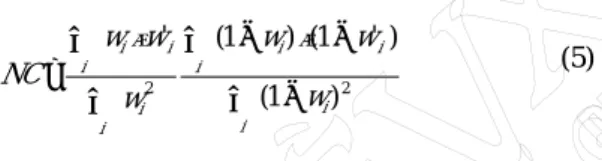
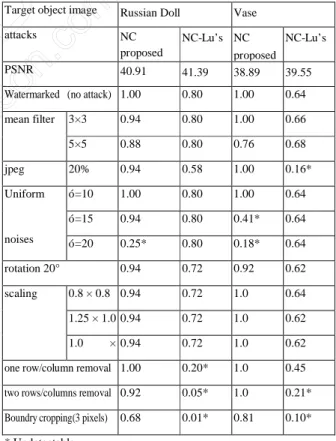
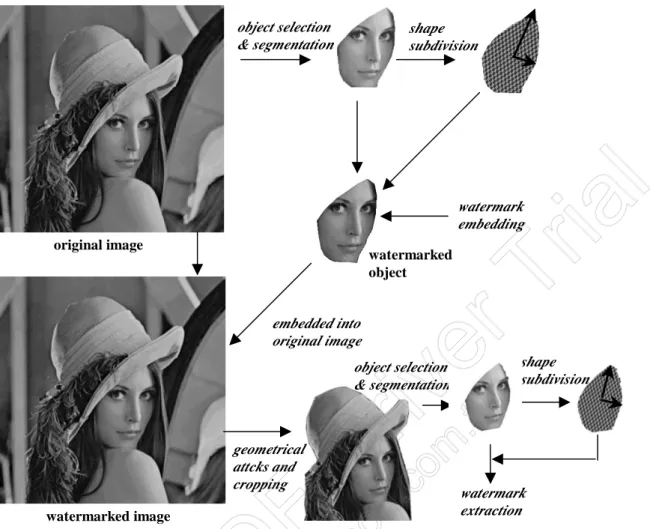
(3) Int. Computer Symposium, Dec. 15-17, 2004, Taipei, Taiwan.. row/column removal and boundary pixel cropping. Attack of removing two continuous lines from watermarked object causes a fatal detection error using the method of Lu. Moreover, certain commercial software such as PhotoImpact and PhotoShop provide a boundary pixel cropping function to erode the boundary pixels of object images. Row/Column removal and boundary pixel cropping attacks refer to that the removal of some pixels of the watermarked object image will reduce the accuracy of synchronization in the watermark detection, thus disabling the ability of the detector to retrieve the watermark blindly. The visual quality of the image that has been applied the attacks mentioned above is usually quite acceptable to the human perception even with a poor watermark detection result. Notably, the watermarking method of Lu tends to be more vulnerable than the proposed method to this type of attack. This difference may exist because each pixel on the removed one row/column of watermarked images contains contributions from all DCT transform. Furthermore, the position translation between the watermarked and the original object images will cause the DCT-based method to fail in watermark detection. Table 1 reveals that the JPEG compression attacks on object images generate new pixels around the boundary regions. This phenomenon significantly reduces the correlation detector.. To extract watermarks from a test object, the same normalization and segmentation procedures in watermark embedding are performed with the specified used secret keys. We can then compute the corresponding blocks and extract watermarks easily by comparing C i and Di , if Ci − Di ≥ (δ u + δ l ) / 2 then watermark bit “1” is extracted, otherwise bit “0” is extracted.. 4. Experimental r esults. To evaluate the proposed scheme, two similarity measurements PSNR and NC are used. The PSNR is used to measure the gray image quality and the NC is used to measure the similarity between two bi-level watermarks. The NC(Normalized Correlation)[15] is defined as follows:. NC =. ∑ wi ⋅ w'i. ∑ (1 − wi ) ⋅ (1 − w'i ). ∑w. ∑ (1 − w ). i. 2. i. i. i. i. i. 2. D w w P w. e Z. 5. Discussion. e ir v .tw. Dn.. F.zeo (5). Different attacks in our experiments including mean filtering, JPEG compression, noises, scaling and boundary pixel cropping. Fig. (3) shows another experiment using the image “Vase”. To evaluate the proposed method under different attacks, Lu’s method[14] which is based on DCT and side information is implemented and compared. Experimental results are shown in Table 1.. n o. ir. T r. An object image “Russian Doll” is used for our watermarking experiments. Fig. 2(a) shows the original object image and its principle angle is obtained as φ =1.29 , and Fig. 2(b) is its corresponding normalized object by transformed. Fig. 2(c) illustrates the shape segmentation result of Fig. 2(a) on where there are totally 24 × 24 small blocks. We embed 32 watermark bits into the object image in Fig. 2(a).. l a. m o c. For non-object-based watermarking scheme, segmenting object from an image could cause a fatally result in watermark detection [16]. The proposed object based watermarking scheme is possible to select relevant objects separately and embed watermarks into the selected objects. Those objects should be the most important parts of the image. When a certain region contained one of these objects is cut from the image and poached, we could still detect the watermarks with the proposed method correctly. Figure 4 gives an example to embed watermarks into a selected object, the face of Lenna. Experimental result shows that even after the attacks of rotation, scaling and boundary pixel cropping, a high NC value of 0.82 is obtained. Besides, adopting simple operations in shape subdivision, the proposed scheme can efficiently achieve the synchronization recovery which is required for recovering from some geometrical attacks such as “skew”. Skew operation will change the locations of the principal axes of image objects. Figure 5 shows an example of synchronization recovery from skewing the image “Vase”. The x and y axes in Figure 5(c) stand for the orientation adjustment of the two principal axes,. Digital watermarking algorithms in the frequency domain are well known to have better characteristics on resisting general image processing attacks. The experimental results show that the method of Lu performed slightly better than the proposed method in some image processing attacks, such as mean filtering and uniform noise adding. However, the proposed method performs much better than that of Lu in resisting general geometrical attacks such as. 657.
(4) Int. Computer Symposium, Dec. 15-17, 2004, Taipei, Taiwan.. respectively. The output value on z axis stands for NC values of watermark detection. [12]. 6. Conclusions This study presented a new object-based watermarking scheme, based on principal axes and selfsimilarity segmentation. This proposed scheme also was compared with the DCT-based method developed by Lu. Three object images taken from product images on the Ebay auction site were used for model testing. Experimental results show that the proposed scheme is preferable to that of Lu for resisting geometrical attacks, particularly under the row/column and boundary pixel cropping attacks.. [13]. [14]. [15]. Refer ences [1]. W. Bender, D.Gruhl, N.Morimoto, and A. Lu, “Techniques for Data Hiding”, IBM System Journa l, Vol. 35, Nos 3&4, 1996, pp.313-336.. [2]. C.-T. Hsu and J.-L. Wu, ”Hidden Signatures in Images”, Proceedings of ICIP , 1996, pp. 223-226. L. M Marvel, C.G. Boncelet, and C.T.Retter, ” Spread Spectrum Image Steganography”, IEEE Trans. On Image Processing, Vol. 8, No. 8, 1999, pp. 1075-1083 I.J. Cox, J. Kilian, F.T. Leighton, and T. Shamoon,”Secure Spread Spectrum Watermarking for Multimedia”, IEEE Trans. On Image Processing, Vol. 6, 1997, pp.1673-1687. [3] [4]. [16]. D w w P. V. Solachidis and I. Pitas,”Circularly Symmetric Watermark Embedding in 2-D DFT Domain”, IEEE Trans. On Image Processing, Vol. 10, No. 11, 2001, pp.1741-1753 [6] H. Inoue, A.Miyazaki, A. Yamamoto, and T. Katsura, “ A Digital Watermark Based on Wavelet Transform and Its Robustness on Image Processing”, Proc. of ICIP , vol.2, 1998, pp.391-395 [7] P. Bas, J-M. Chassery, and F. Davoine,”Using the Fractal Code to Watermark Images”, Proc. of ICIP , vol.1, 1998, pp.469-473 [8] V. Solachidis and F.M. Boland,”Phase Watermarking of Digital Images”, Proc. of ICIP , vol.3, 1996, pp.239242 [9] P. Bas, J.-M. Chassery, and B. Macq, “Geometrically Invariant Watermarking Using Feature Points”, IEEE Trans. On Image Processing, Vol. 11, No. 9, 2002, pp.1014-1028 [10] I.J.Cox, M.L. Miller, and J.A. Bloom, Digital Watermarking, Morgran Kaufmann Publishers, San Francisco, 2002. n o. ir. T r. e ir v .tw. Dn.. l a. Table 1: Experimental results against attacks. w. e Z. m o c. Target object image. Russian Doll. attacks. NC proposed. F.zeo. [5]. Signal Processing, Princeton, NJ, USA, June 1997, pp.369-374. A. Piva, R. Caldell, and A.D. Rosa, “A DWT based object watermarking system for MPEG-4 video streams”, IEEE Int. Conf. On Image Processing, Vancouver, Canada, Sep. 2000, Vol. 3, pp.5-8. H.Guo,and P.F. Shi, “Object-based watermarking scheme robust to object manipulations”, Electronics Letters , Dec 2002, Vol. 38 (25), pp. 1656 –1657. C.S. Lu and H.Y.M. Liao, “Video object-based watermarking: a rotation and flipping resilient scheme” , ICIP 2001. Oct 2001, Vol. 2 , pp. 483 –486. Chen, P.M.,”Robust digital watermarking based on a statistic approach”, ITCC2000, Mar 2000, pp.116-121. Dittmann, J.;Neck, F, Seinmetz, A, Steiumetz, R.,”Interactive watermarking environments”, IEEE conference on Multimedia Computing and Systems, 1998, pp. 286-294.. PSNR. 40.91. 0.80. 1.00. 0.64. mean filter. 3×3. 0.94. 0.80. 1.00. 0.66. 5×5. 0.88. 0.80. 0.76. 0.68. 20%. 0.94. 0.58. 1.00. 0.16*. Uniform ó=10 1.00 object without attack ó=15 0.94. 0.80. 1.00. 0.64. 0.80. 0.41*. 0.64. noises. 0.25*. 0.80. 0.18*. 0.64. 0.94. 0.72. 0.92. 0.62. 0.8 × 0.8 0.94. 0.72. 1.0. 0.64. 1.25 × 1.0 0.94. 0.72. 1.0. 0.62. 1.0. 0.72. 1.0. 0.62. one row/column removal 1.00. 0.20*. 1.0. 0.45. 1.25 two rows/columns removal 0.92. 0.05*. 1.0. 0.21*. Boundry cropping(3 pixels). 0.01*. 0.81. 0.10*. jpeg. scaling. ó=20. * Undetectable. 658. NC-Lu’s NC NC-Lu’s proposed 41.39 38.89 method) 39.55. Watermarked (no attack) 1.00. rotation 20°. [11] M.D. Swanson, B. Zhu, B. Chau, and A.H. Tewfik, ”Object-based transparent video watermarking”, IEEE Workshop on Multimedia. Vase. × 0.94. 0.68.
(5) Int. Computer Symposium, Dec. 15-17, 2004, Taipei, Taiwan.. Or iginal Image. Object segmentation. Shape subdividing based on pr incipal axes. Compute the gr adient Sub-r egion gr ouping water mar k. l ir a T r e ir vm.tw Dn.co. Water mar k embedding. Paste back to the or iginal image. Fig.2(d) Figure 2: Proposed scheme on a “Russia Doll” object Fig.2(a): The test object image “Russia Doll”. Fig.2(b): The shape subdivision of image in Fig.2(a). Fig.2(c): The corresponding detector response using the proposed method. Fig.2(d): The corresponding detector response using Lu’s method.. Water mar ked image. attacks. Water mar ked image. Modified water mar ked image. Object segmentation. Shape subdividing based on pr incipal axes. water mar k. Water mar k extr action. Sub-r egion gr ouping. Fig.3(a). F.zeo D w w Pw. Figure 1: Block diagram of the proposed watermarking scheme. Fig.3(b). Fig.3: Cropped attack experiment. n o e Z. Fig.2(a). Fig.3(c). Fig.2(b) Fig.3(d) Figure 3: Proposed scheme on a “Vase” object Fig.3(a): The test object image “Vase”. Fig.3(b): The shape subdivision of image in Fig.2(a). Fig.3(c): The corresponding detector response using the proposed method. Fig.3(d): The corresponding detector response using Lu’s method.. Fig.2(c). 659.
(6) Int. Computer Symposium, Dec. 15-17, 2004, Taipei, Taiwan.. object selection & segmentation. shape subdivision. l ir a T r e ir vm.tw Dn.co watermark embedding. or iginal image. water mar ked object. embedded into original image. shape subdivision. object selection & segmentation. geometrical attcks and cropping. water mar ked image. F.zeo D w w Pw. watermark extraction. Figure 4: An interactive object watermarking application using the proposed scheme. n o e Z. Fig.(a) Fig.(b) Fig.(c) Fig.(d) Figure 5: The experiment of skew calibration by searching the nearly angles of computed principal axes orientations. Fig.5(a): The skew “Vase” image. Fig. 5(b): The principal axes detection of object in Fig. 5(a) Fig. 5(c): Synchronization recovery by searching correct orientations of the two principal axes. Fig. 5(d): The principal axes after recovery.. 660.
(7)
數據

相關文件
Wang, Solving pseudomonotone variational inequalities and pseudocon- vex optimization problems using the projection neural network, IEEE Transactions on Neural Networks 17
volume suppressed mass: (TeV) 2 /M P ∼ 10 −4 eV → mm range can be experimentally tested for any number of extra dimensions - Light U(1) gauge bosons: no derivative couplings. =>
For pedagogical purposes, let us start consideration from a simple one-dimensional (1D) system, where electrons are confined to a chain parallel to the x axis. As it is well known
The observed small neutrino masses strongly suggest the presence of super heavy Majorana neutrinos N. Out-of-thermal equilibrium processes may be easily realized around the
Define instead the imaginary.. potential, magnetic field, lattice…) Dirac-BdG Hamiltonian:. with small, and matrix
incapable to extract any quantities from QCD, nor to tackle the most interesting physics, namely, the spontaneously chiral symmetry breaking and the color confinement..
• Formation of massive primordial stars as origin of objects in the early universe. • Supernova explosions might be visible to the most
Light rays start from pixels B(s, t) in the background image, interact with the foreground object and finally reach pixel C(x, y) in the recorded image plane. The goal of environment
