Simple technique for directly and accurately measuring the number of atoms
in a magneto-optical trap
Ying-Cheng Chen,1 Yean-An Liao,1Long Hsu,2and Ite A. Yu1
1Department of Physics, National Tsing Hua University, Hsinchu, Taiwan 300, Republic of China 2Department of Electrophysics, National Chiao Tung University, Hsinchu, Taiwan 300, Republic of China
共Received 30 March 2001; published 13 August 2001兲
We have systematically studied a simple technique that accurately determines number of atoms in a magneto-optical trap. Absorption energy of a laser field that interacts with cold atoms is a direct measurement of atom number. The measured energy neither depends on the detuning, intensity, and polarization of the laser field nor is affected by other system parameters. Our work also demonstrates that such technique can be applied to study the phenomenon of coherent population trapping.
DOI: 10.1103/PhysRevA.64.031401 PACS number共s兲: 32.80.Pj, 42.50.Gy
The magneto-optical trap共MOT兲 关1,2兴 is a rather simple setup to produce cold atoms. Atom temperatures below 1 mK that can be easily achieved with a MOT. Doppler broaden-ing, thermal noise, collisional perturbation, and other temperature-related nuisances are greatly reduced at such low temperatures. This desired feature makes cold atoms an ideal system for physics studies. The MOT, or laser cooling and trapping, becomes the first step in many exciting and interesting experiments such as Bose-Einstein condensation
共BEC兲 关3–5兴, high precision spectroscopy 关6兴, ultracold
col-lisions 关7兴, etc. The number of cold atoms produced by a MOT is important information. In this paper, we demonstrate a simple technique that can accurately provide the informa-tion of atom number in the MOT. We have performed the systematic study of the technique. Application of this tech-nique to explore the phenomenon of coherent population trapping关8–10兴 will also be discussed.
We first give a brief review on the method that is often employed to measure the number of cold atoms in a MOT. In the method, cold atoms are irradiated by a resonant or near resonant probe beam driving a cycling transition. One can either detect the fluorescence induced by the probe field or the transmission of the probe field with a photodiode or a charge-coupled-device共CCD兲 camera. The atom number can be inferred from the signal of the photodiode or the CCD camera, if the absorption cross section of the atom and in-tensity of the probe field are known. However, the absorption cross section may depend on many factors such as detuning, polarization, intensity, and linewidth of the probe laser, population distribution among Zeeman sublevels, Zeeman shifts induced by the magnetic field in the environment, etc. To accurately determine the absolute atom number, one has to characterize these measurement parameters and experi-mental conditions accurately. Some of the parameters or con-ditions are even more difficult to be determined. Hence, the atom number measured by such method usually has a large uncertainty.
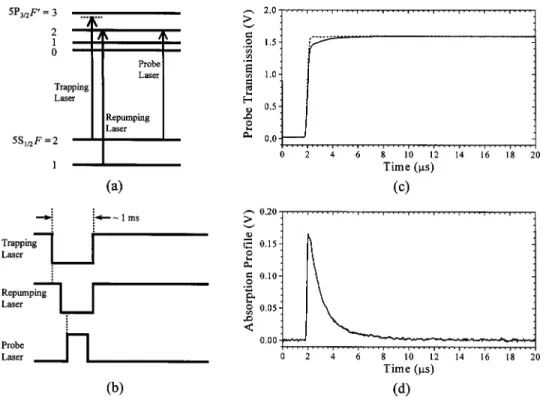
Inspired by the work in Ref. 关11兴, we use the method of optical pumping to determine the number of cold atoms in the MOT. Energy levels of 87Rb atoms in Fig. 1共a兲 are taken as an example. The probe field in this method drives the
兩5S1/2,F⫽2
典
→兩5P3/2,F⬘
⫽2典
transition, instead of the兩5S1/2,F⫽2
典
→兩5P3/2,F⬘
⫽3典
cycling transition in themethod of the previous paragraph. 共The notation of F indi-cates the 兩5S1/2
典
ground state and that of F⬘
indicates the兩5P3/2
典
excited state.兲 Population in 兩F⬘
⫽2典
has the prob-ability of one half to spontaneously decay to兩F⫽2典
and that of one half to spontaneously decay to 兩F⫽1典
. On the aver-age, each atom prepared in兩F⫽2典
initially can be optically pumped to 兩F⫽1典
by absorbing two probe photons. Once the atom is in兩F⫽1典
, it will not interact with the probe field. We detect the transmission of the probe field with a cali-brated photodiode. The absorption energy of the probe field divided by the energy of two photons is the direct measure-ment of the atom number. It is clear that the measured ab-sorption energy does not depend on parameters of the probe field and experimental conditions as those mentioned in the previous paragraph. The absolute atom number is accurately determined. In this method, one can also detect fluorescence during the optical pumping process. Nevertheless, detection of the probe transmission has the advantages that all photon energy of the optical pumping is measured, influence of light from other laser fields or stray light is easily minimized, and the geometric arrangement of the detection system is not critical.In the experiment, we use a standard vapor-cell MOT setup. Our MOT has been described elsewhere 关12兴 and we only mentioned some key points. A CCD camera monitors the fluorescence emitted from the MOT. We continuously capture CCD images and integrate all the pixels of each im-age in real time. The integration value versus time is charted to indicate fluctuation of the atom number in the MOT. De-pending on the daily experimental conditions, the fluctuation can range from 3% to 10%. The probe field comes from a diode laser, which is injection-locked by a master laser. An external-cavity diode laser with a linewidth of about 1 MHz is the master laser. Its frequency is locked to the center of the crossover line between the 兩F⫽2
典
→兩F⬘
⫽2典
and 兩F⫽2典
→兩F
⬘
⫽3典
transitions with saturated absorption spectros-copy. One beam from the master laser is sent through an acousto-optic modulator 共AOM兲 in the double-pass configu-ration and the twice-diffracted output beam from the AOM seeds the probe laser. We adjust the driving frequency of the AOM to change the probe frequency. The circular probe beam is expanded to about 7 mm in 1/e diameter and sent through an aperture with a diameter of 5 mm before itinter-RAPID COMMUNICATIONS PHYSICAL REVIEW A, VOLUME 64, 031401共R兲
acts with atoms. Cold atoms produced by the MOT are com-pletely inside this beam profile.
The trapping, repumping, and probe fields can be switched off by three AOMs or mechanical shutters. When shutters are used, they are always positioned in the focal planes of the beam expansion optics. We have tested that both AOMs and shutters work well in the measurement of atom number. The timing sequence of each measurement is shown in Fig. 1共b兲. The trapping beams are first shut off and the repumping beam is turned off some time later. We set the delay time long enough to allow all population prepared in
兩F⫽2
典
. After the laser fields of the MOT are completely off, a probe pulse is switched on. Width of the probe pulse ranges from 5 to 500 s. Transmission of the probe pulse is col-lected by a lens and then detected by an amplified photo detector 共Thorlabs PDA55兲. The photo detector only detects 70% of the transmission due to attenuation in the optical path. Signals from the photo detector are directly recorded by a digital oscilloscope 共Tektronix TDS 320兲. Typical data are shown in Figs. 1共c兲 and 1共d兲. The two pulses in Fig. 1共c兲 are measured with and without the presence of the cold at-oms. Difference between the two is the absorption profile as shown in Fig. 1共d兲. The area below the absorption profile is a direct measurement of the atom number.Figure 2共a兲 shows that the measured area with the method of optical pumping does not depend on the detuning of the probe field, where ⌫ is the natural linewidth of the 兩5P3/2
典
excited state of Rb atoms. Different data points in the figure have different absorption profiles. Peaks and decay time con-stants of absorption profiles are higher and shorter for the laser detunings closer to the resonance, but the areas below the absorption profiles are all about the same. We also see from the data that fluctuation of the laser frequency during the measurement or the laser linewidth can not affect the measured area either. When the probe field is very far off theresonance, one should be aware that the excitation of 兩F
⬘
⫽3
典
or 兩F⬘
⫽1典
may not be negligible and the measured area can be modified. Figures 2共b兲 and 2共c兲 show that the measured area does not depend on laser intensity and laser polarization. We also perform the measurement of the atom number without the presence of the magnetic field of the MOT. After the solid-state relay that connects the magnet to the power supply is switched off, we turn off the trapping and repumping fields and turn on the probe pulse 1 ms later. This delay time is about 30 folds of the decay time constant of current in the magnet. The measured area 关the triangular data point in Fig. 2共b兲兴 is still about the same as those with presence of the magnetic field. Furthermore, we have com-pared the measured atom number by the method of optical pumping with those by the two methods of fluorescence and probe transmission in the cycling transition. The consistency is satisfactory, e.g., (5.6⫾0.3)⫻107 by the optical pumping and (5.2⫾1.9)⫻107 and (5.0⫾2.0)⫻107 by the other two methods.We make a few notes about the method of optical pump-ing.共i兲 Each measurement typically takes about 1 ms. During the optical-pumping process, each atom only absorbs two photons on the average and can not be knocked away by the probe field. Atoms in兩F⫽1
典
will be immediately recaptured once the MOT are turned on. Therefore, the measurement disturbs the MOT very little.共ii兲 We have also measured the兩F⫽2
典
→兩F⬘
⫽2典
off-resonance excitation of the trapping field. In this measurement, the trapping field is always kept on and the delay time between the event of shutting off the repumping beam and that of turning on the probe beam is varied. The intensity of the probe pulse is high enough that the process of optical pumping only takes about 2 s. The data of the remaining atoms in兩F⫽2典
versus the delay time provide the information of the off-resonance excitation of the trapping field. Such information may be useful for the ex-FIG. 1. 共a兲 Relevant energy levels of 87Rb atoms and excita-tions of the laser fields in the ex-periment.共b兲 The timing sequence of the measurement.共c兲 Transmis-sion of the probe field. Solid and dashed lines are measured with and without presence of the cold atoms, respectively. The probe field is on the resonance and lin-early polarized. Its intensity is about 2 mW/cm2. The gain of thephoto detector is 6.5 V/mW. Data are averaged 16 times by the os-cilloscope.共d兲 is the difference of the two lines in 共c兲 and this ab-sorption profile indicates an atom number of 1.0⫻108.
RAPID COMMUNICATIONS
CHEN, LIAO, HSU, AND YU PHYSICAL REVIEW A 64 031401共R兲
periments utilizing cycling transitions. For our MOT, the above data has a decay time constant of 550s. This indi-cates that it is not necessary to switch off the trapping field in the measurement of atom number as long as the probe field is strong enough.共iii兲 If the density of the atom cloud is so high such that the radiation trapping occurs or the spontaneously emitted photon can be absorbed by another atom, the delay time before the probe pulse should be increased. This allows the atom cloud to expand and lowers the density. Then, the effect of the radiation trapping on the measurement of atom number can be minimized. For the data shown in Fig. 2, the density of atoms is about 5⫻109 cm⫺3 and we do not ob-serve such effect.共iv兲 It is better to keep the magnetic field of the MOT on during the measurement. Simplicity is one reason. Another reason will be explained later.
Figure 3共a兲 shows the absorption profile measured by the optical-pumping method without presence of the magnetic field of the MOT. The area below the profile is in agreement with the area of Fig. 1共d兲. However, the absorption profile exhibits a faster decay initially and a slower decay later. This slower decay does not appear in the other data that are mea-sured with presence of the magnetic field. Such an
unex-pected result has prompted our study on the phenomenon of coherent population trapping 共CPT兲. We explain the slower decay as the following. The probe field driving the 兩F⫽2
典
→兩F
⬘
⫽2典
transition can create dark states in the 兩F⫽2典
level, e.g., 兩F⫽2,mF⫽0典
for the linearly polarized probe field and 兩F⫽2,mF⫽2典
for the right-circularly polarized one. Population can be trapped in the dark state, but Larmor precession caused by some stray magnetic field in the envi-ronment leaks the trapped population to nondark states. If this leak rate is much smaller than the rate of optically pump-ing population to 兩F⫽1典
, a fast decay followed by a slow decay will be observed in the probe absorption. Presence of the quadrupole magnetic field of the MOT during the process of optical pumping can minimize the population trapping of the dark state and avoid potential error in determination of atom number.In order to verify the observation of CPT, we have per-formed further tests. Three pairs of Helmholtz coils are used to cancel the stray magnetic field. Two linearly polarized FIG. 2. Measured area versus detuning, intensity, and
polariza-tion. 共a兲 The probe field is linearly polarized and its intensity is 2 mW/cm2.共b兲 The probe field is linearly polarized and its frequency is on the resonance. The data point in triangle is measured without presence of the magnetic field of the MOT.共c兲 The probe field is on the resonance and its intensity is 2 mW/cm2. Dashed lines indicate the averages. The mark of 1 in all the vertical scales corresponds to 2.0⫻108atoms.
FIG. 3. 共a兲 is the absorption profile measured without presence of the magnetic field of the MOT. Other experimental conditions are the same as those of Fig. 1共d兲. 共b兲 and 共c兲 are absorption profiles of two consecutive probe pulses with installation of the three pairs of Helmholtz coils. The magnetic field of the MOT is off during mea-surements. Intensity of the pulses is about 4.5 mW/cm2. The two
pulses are linearly polarized and their polarization directions are nearly orthogonal in共b兲 and nearly parallel in 共c兲.
RAPID COMMUNICATIONS
SIMPLE TECHNIQUE FOR DIRECTLY AND . . . PHYSICAL REVIEW A 64 031401共R兲
pulses from two probe beams are applied consecutively dur-ing the period that the laser fields and the magnetic field of the MOT are completely off. The first pulse is turned on for 4 s. Decay time constant of the absorption profile of this pulse is about 0.5s. After the first pulse has been switched off for 1s, the second probe pulse is immediately turned on and its polarization direction can be nearly orthogonal or parallel to the first one. Figures 3共b兲 and 3共c兲 show the ab-sorption profiles of the two pulses in the orthogonal and parallel polarization configurations, respectively. There is no slow decay tail observable in the absorption profile of the first probe pulse. This indicates that Larmor precession due to the stray magnetic field is reduced greatly. The peak in the absorption profile of the second pulse in Fig. 3共b兲 is signifi-cantly larger than that in Fig. 3共c兲. It is a clear evidence that a certain fraction of population is trapped in the dark state. If the polarization of the second pulse is exactly the same as that of the first pulse, this trapped population is still intact in the dark state during the period of the second pulse and the second pulse will not be absorbed. On the other hand, if the polarization of the second pulse is very different from that of the first pulse, the state that traps the population is not dark respect to the second pulse and the second pulse will be absorbed by this population. We have also applied two cir-cularly polarized pulses with the same or opposite helicity. The results are similar to those in Figs. 3共b兲 and 3共c兲. When the magnetic field of the MOT is present in the above mea-surements of the two pulses, we do not observe any absorp-tion in all of the second pulses.
CPT was first modeled with a closed three-level system in which two ground states connected to a common excited state by two laser fields. All population will be trapped in a coherent superposition of two ground states共the dark state兲 and are decoupled from the laser fields. Theoretical and ex-perimental studies later show that CPT also exists in an open system consisting multiple Zeeman sublevels关13–19兴. Most
experimental studies explore the CPT phenomenon in the frequency domain. In Ref. 关19兴, a fraction of the population in the dark state as functions of laser intensity, laser polar-ization, and interaction time are theoretically predicted. The experimental method that we have employed in the observa-tion of CPT will be very suitable for these studies. For ex-ample, a fraction of the population in the dark state as a function of laser intensity can be studied with the method of the two pulses as the following. The intensity of the first pulse is varied. The polarization of the second pulse is or-thogonal to that of the first pulse, or the polarization of the second pulse is irrelevant and a magnetic field is only turned on to ensure no CPT during the period of the second pulse. Then, area of the absorption profile of the second pulse pro-vides measurement of trapped population in the dark state induced by the first pulse. For a second example, a fraction of the population in the dark state as a function of interaction time can be studied with the measurement similar to Fig. 3共a兲. Another absorption profile is measured under the same experimental conditions as those of Fig. 3共a兲 except that a large transverse magnetic field is added to the experimental system. Difference between the profile in Fig. 3共a兲 and the other profile provides information on the population in the dark state as a function of time. With our methods, the study of the CPT phenomenon will be more diversified.
In conclusion, we have shown the technique of optical pumping that directly and accurately measures number of cold atoms in the MOT. All the instruments in this technique are not sophisticated and the measurement procedure is rather simple. We also observe the CPT phenomenon in the
兩5S1/2,F⫽2
典
→兩5P3/2,F⬘
⫽2典
excitation of 87Rb atoms and have demonstrated the methods of studying the CPT phenomenon.This work was supported by the National Science Council of the Republic of China under NSC Grant No. 89-2112-M-007-061.
关1兴 E. L. Raab, M. Prentiss, A. Cable, S. Chu, and D. E. Pritchard, Phys. Rev. Lett. 59, 2631共1987兲.
关2兴 C. Monroe, W. Swann, H. Robinson, and C. Wieman, Phys. Rev. Lett. 65, 1571共1990兲.
关3兴 M. H. Anderson, J. R. Ensher, M. R. Matthews, C. E. Wieman, and E. A. Cornell, Science 269, 198共1995兲.
关4兴 K. B. Davis, M.-O. Mewes, M. R. Andrews, N. J. van Druten, D. S. Durfee, D. M. Kurn, and W. Ketterle, Phys. Rev. Lett. 75, 3969共1995兲.
关5兴 C. C. Bradley, C. A. Sackett, and R. G. Hulet, Phys. Rev. Lett. 78, 985共1997兲.
关6兴 M. A. Kasevich, E. Riis, and S. Chu, Phys. Rev. Lett. 63, 612 共1989兲.
关7兴 A. Gallagher and D. Pritchard, Phys. Rev. Lett. 63, 957 共1989兲. 关8兴 E. Arimondo and G. Orriols, Lett. Nuovo Cimento 17, 333
共1976兲.
关9兴 G. Alzetta, A. Gozzini, L. Moi, and G. Orriols, Nuovo Cimento Soc. Ital. Fis. B 36, 5共1976兲.
关10兴 H. M. Gray, R. M. Whitley, and C. R. Stroud, Jr., Opt. Lett. 3, 218共1978兲.
关11兴 K. E. Gibble, S. Kasapi, and S. Chu, Opt. Lett. 17, 526 共1992兲. 关12兴 Y. C. Chen, Y. W. Chen, J. J. Su, J. Y. Huang, and I. A. Yu,
Phys. Rev. A 63, 043808共2001兲.
关13兴 J. R. Morris, and B. W. Shore, Phys. Rev. A 27, 906 共1983兲. 关14兴 F. T. Hioe and C. E. Carroll, Phys. Rev. A 37, 3000 共1988兲. 关15兴 V. S. Smirnov, A. M. Tumaikin, and V. I. Yudin, Zh. E´ksp.
Theor. Fiz. 96, 1613共1989兲 关Sov. Phys. JETP 69, 913 共1989兲兴. 关16兴 F. Renzoni, W. Maichen, L. Windholz, and E. Arimondo, Phys.
Rev. A 55, 3710共1997兲.
关17兴 S. Wang, D. G. Ducreay, R. Pina, M. Yan, and Y. Zhu, Phys. Rev. A 61, 033805共2000兲.
关18兴 V. Milner and Y. Prior, Phys. Rev. Lett. 80, 940 共1998兲. 关19兴 F. Renzoni and E. Arimondo, Europhys. Lett. 46, 716 共1999兲.
RAPID COMMUNICATIONS
CHEN, LIAO, HSU, AND YU PHYSICAL REVIEW A 64 031401共R兲