ORIGINAL ARTICLE
J. Environ. Med. 1: 225–234 (1999)Prevention of Occupational and Environmental Diseases
by Implementation of ISO 14000 and BS 8800 for
Indus-tries
Jung-Der Wang1,2*, Chih-Wen Chung2
1Institute of Occupational Medicine and Industrial Hygiene, National Taiwan University College of Public Health,
Taipei, Taiwan, ROC
2Department of Internal Medicine, National Taiwan University Hospital, Taipei, Taiwan, ROC
KEY WORDS Rapid industrialization usually brings both economic development and environ-environmental diseases mental pollution, which often produces occupational diseases in the workplace occupational diseases and environmental diseases in the nearby community. From experience of docu-ISO 14000 menting 17 occupational diseases, we found that they resulted from a lack of BS 8800 a comprehensive hazard communication system. The spillage of such unknown chemical hazards also produced environmental diseases for the neighbouring factories and community. Because the general treatment of occupational and environmental diseases must include the identification of hazard and taking pre-ventive procedures to avoid further exposure, it is essential to recognize and control the hazard at the start of an industry. Thus, implementation of the life cycle assessment in ISO (International Organization of Standardization) 14000 series will guide an industry to identify and minimize the use of hazardous chemicals. A similar practice of risk assessment and reduction for every unit oper-ation in the production process proposed by BS (British Standard) 8800 will also help to improve occupational health. Although implementation of such systems is a voluntary compliance, actual practice demands the same systems in related or satellite factories and has a strong market implication.
Copyright1999 John Wiley & Sons, Ltd.
Introductiom
During the past three decades, Taiwan has been under a rapid industrial and economic development. As people’s living standard has enjoyed a tremendous improvement from an annual GDP (gross domestic product) of 2.8 billion $US in 1965 (DGB, 1986) to 272.3 billion $US in 1996 (DGB, 1997), such a fast industrialization has also brought pollution, occu-pational and environmental diseases. This review sum-marizes our painful experiences in documenting occu-pational diseases during the past 15 years and shows that they arose from a general lack of hazard recog-nition and communication, which also frequently
*Correspondence to: *Jung-Der Wang, Institute of Occupational Medicine and Industrial Hygiene, National Taiwan University Col-lege of Public Health, No. 1. Jen Ai Road, Section 1, Taipei, Taiwan, R.O.C. E-mail: jdwang얀ha.mc.ntu.edu.tw
Contract/grant sponsor: National Science Council, Executive Yuan, Republic of China
Contract/grant number: NSC88-2314-B-002-344
spilled over to nearby factories and communities and produced environmental diseases. Second, we argue that such a tragedy can be effectively prevented by implementation of life cycle assessment of ISO (International Organization of Standardization) 14000 series and risk assessment and reduction of BS (British Standard) 8800 series, and that they may help compa-nies in developing countries to open a wider market.
Significance of Hazard Communication
System for Workers and Community
People—Painful Experiences in Taiwan
The fast industrialization during the past several dec-ades has pumped approximately 1000 types of new chemicals into the workplace and ecological environ-ment every year (Ames, 1979). The use and manufac-ture of hazardous chemical compounds may also be increasing in developing countries, as they are in the process of industrialization and must import similar manufacturing processes and raw material. Before
226 J-D. WANG, C-W. CHUNG
1993, there was no regulation for a comprehensive sys-tem of hazard communication, eg MSDS (material safety data sheet), in Taiwan. Both workers and com-munity people were relatively unaware of any hazard-ous chemical to which they were exposed. Even employers were ignorant about obtaining such infor-mation. Thus, workers suffering from occupational dis-eases and community people contracting environmental diseases were often ignored or went unnoticed. It was not until the mid 1980s that some occupational phys-icians conducted epidemiological studies at the work-place to document occupational diseases (Wang, 1991). Table 1 summarizes the painful experience of Taiwan. No one in the factories knew what types of chemicals were being used in the manufacturing process at the time of each outbreak of five occupational diseases. Thus, everybody was exposed at the workplace because there were no precautionary or preventive measures, and almost everyone developed the same diseases. For example, 17 of 20 persons who worked in rooms using the same air conditioning system were found to have abnormal liver function, because in one of these rooms carbon tetrachloride was used as a special cleaning agent (Deng et al., 1987). Similarly, 12 of 13 press proofing workers, who slept at the workplace to enjoy the cooling effect of the air conditioning, developed polyneuropathy since n-hexane was used inside the printing room, and no one knew what chemical was being used (Wang et al., 1986).
In eight additional cases, only employers or some
Table 1. Occupational diseases documented in Taiwan during the past 15 years and importance of hazard communications for prevention
Agent Manufacturing process Occupational disease Awareness of agent Reference Workers Employers
Engineers
Carbon tetrachloride Cleaning agent for printing Hepatitis No No Deng et al., 1987
n-Hexane Press proofing Polyneuropathy No No Wang et al., 1986
Lead Tile glazing (pigment) Polyneuropathy No No Yip et al., 1988
Mixture of solvents Paint manufacturing Impaired neuropsychological No No Wang and Chen,
function 1993; Tsai et al.,
1997; Chen et al., 1997
TDI (toluene diisocyanate) Velcro (adhesives) Asthma No No Wang et al., 1988 Bipyridyls Paraquat manufacturing Skin cancer and Bowen’s disease No Yes Wang et al., 1987;
Kuo et al., 1993; Jee et al., 1995 Dimethyl formamide Synthetic leather Hepatitis No Yes Wang et al., 1991
Kerosene Ball bearing Dermatitis No Yes Jee et al., 1996
Isothiazolinone Paint manufacturing Dermatitis No Yes Jee et al., 1985 Lead Battery recycling Polyneuropathy and anaemia No Yes Wang et al., 1998 Manganese Ferromanganese smelting Parkinsonism No Yes Wang et al., 1989 Organophosphorus Pesticide formulation Reduction of cholinesterase No Yes Wu et al., 1989
activity
Vinyl chloride Polyvinyl chloride Hepatocellular carcinoma No Yes Du and Wang,
manufacture 1998; Du et al.,
1995
Asbestos Cement tile, fireproof textile Lung function impairment No/Yes Yes Chen et al., 1992 Chromate Electroplating Nasal septum perforation Yes Yes Lin et al., 1994 Mercury Chloro-alkali Impaired neural functions Yes Yes Chang et al., 1995
Pesticides Spraying Dermatitis Yes Yes Guo et al., 1996
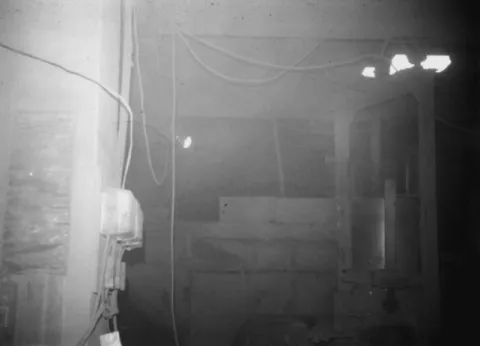
engineers who were responsible for quality control or chemical analysis knew the major composition of the chemicals, but they did not obtain information on the adverse health effects of such compounds. Thus, no proper preventive actions were taken, and occupational diseases occurred. For example, the local exhaust venti-lation system of a ferromanganese smelting plant went out of order and remained unfixed for about 8 months (Figure 1), then six overt cases of Parkinsonism developed (Wang et al., 1989). Had the employer known the detrimental health effect of manganese exposure, he would have fixed the system earlier to prevent the tragedy. Had the workers known the danger of chronic manganism, they would have refused to con-tinue working there until occupational hygiene had been improved.
Importance of Recognizing Health
Effects of Exposed Chemicals
If both the employer and workers only knew the name of the chemical but were ignorant of or failed to recog-nize its health effects, then preventive action was usu-ally not taken and occupational disease would still occur. For example, employers and workers of all six electroplating shops knew that they were using dichro-mates, but no one was aware that it would cause a per-foration of the nasal septum. It was not until we con-ducted a health survey with an otorhinolaryngologist
Figure 1. Workplace full of fumes in a ferromanganese smelter. Because the local ventilation system was out of order, the surfaces of the walls and electricity meters were covered with a thick layer of dust. The workers were unable to breathe if they wore a respirator with a high efficiency filter. Because nobody knew that manganese is neurotoxic and because the ventilation system was not fixed early enough six employees working in this environment developed Parkinsonism.
that perforations in 16 persons were found (Lin et al., 1994). Among these victims, two were employers and one was an employer’s wife who was rarely directly involved in electroplating. However, these were family owned businesses and the couple (and another employer) were directly exposed to chromate mists because their offices were near the electroplating tanks which were neither enclosed nor had exhaust hoods. Similarly, although fruit farmers knew the names of the pesticide they used, the labels pasted on the containers did not provide any toxicological information on skin contact. Thus, 30% of the exposed workers developed hand dermatitis (Guo et al., 1996). In a third case, workers exposed to mercury inside chloro-alkali plants knew that they were exposed to mercury but were unaware of its neurotoxic effect. As the main concern of the whole factory seemed to be productivity only, they were found to have a prolonged neural conduction time of the central nervous system when they were examined (Chang et al., 1995). In the last case, workers and employers in asbestos textile and cement factories knew that they were handling asbestos fibres, but they were not convinced that asbestos causes lung cancer and asbestosis because the latency periods were too long (⬎15 years) and there had been no reported case in Taiwan before 1992. Thus, relatively few effective preventive measures were implemented and the work-ers were found to have developed dose-related impair-ment of lung function when we conducted the health survey (Chen et al., 1992).
Thus, a chemical inventory and the MSDS of each compound should be prepared for every unit operation in the manufacturing process of a product. The material
safety data sheet must include detailed information on the acute and chronic health effects and suitable pre-ventive measures. Then this information should be comprehensively communicated to the employer and employees involved in and around the process to pre-serve worker’s right-to-know (ILO, 1994), and effec-tive monitoring and control measures must be implemented.
Relevance of Community
Right-to-know
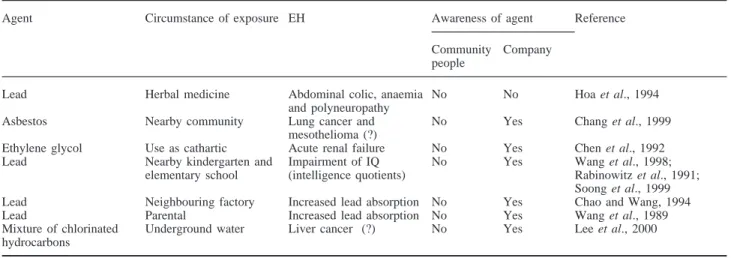
Without proper control of hazardous chemicals, they may spill over to the nearby community and result in environmental diseases, as shown in Table 2. For example, the outbreak of lead poisoning in 48% of workers of a lead battery recycling factory also caused not only an increased lead absorption among workers of a neighbouring forging factory (Chao and Wang, 1994) but also an impairment of IQ (intelligent quotient) among nearby kindergarten children (Wang et al., 1998; Soong et al., 1999). The blood lead measurements are summarized in Table 3 showing that both outdoor workers in the neighbouring factory and children in a nearby kindergarten had a significant increase of blood lead. As the general treatment of mild lead poisoning is to identify the source of lead intake and take appropriate preventive measures to avoid further absorption, we recommended that the recycling factory enclosed its plate cutting and smelting pro-cesses and that the kindergarten move at least 2 km away immediately. Two and half years later, our follow
228 J-D. WANG, C-W. CHUNG
Table 2. Environmental hazards (EH) documented in Taiwan during the past 15 years and importance of community right-to-know
Agent Circumstance of exposure EH Awareness of agent Reference Community Company
people
Lead Herbal medicine Abdominal colic, anaemia No No Hoa et al., 1994 and polyneuropathy
Asbestos Nearby community Lung cancer and No Yes Chang et al., 1999 mesothelioma (?)
Ethylene glycol Use as cathartic Acute renal failure No Yes Chen et al., 1992 Lead Nearby kindergarten and Impairment of IQ No Yes Wang et al., 1998;
elementary school (intelligence quotients) Rabinowitz et al., 1991; Soong et al., 1999 Lead Neighbouring factory Increased lead absorption No Yes Chao and Wang, 1994 Lead Parental Increased lead absorption No Yes Wang et al., 1989 Mixture of chlorinated Underground water Liver cancer (?) No Yes Lee et al., 2000 hydrocarbons
Table 3. Blood lead levels (g dl−1) of the employees in a battery recycling smelter, the workers in neighbouring factory
and the children in the nearby kindergarten: A case of simultaneous occupational and environmental pollution (Wang et al., 1998; Soong et al., 1999)
Employees of battery recycling smelter Workers of neighbouring factory Children of nearby kindergar-ten blood lead median (range) Job category Blood lead (mean±1 SD) Working place Blood lead median (range)
Furnace 87±14 (n=19) Working indoor Before moving
Maintenance 82±8 (n=3) Total (n=11) 11 (6–21)
Dissecting 69±16 (n=10) Male (n=6) 15 (6–21) 15.1 (7.7–31.7) (n=32) Refining 64±16 (n=6) Female (n=5) 11 (9–14)
Crane operator 64±11 (n=6) Working outdoor After moving
Field cleaner 95±35 (n=4) Total (n=25) 24 (10–49) 8.5 (5.0–15.0) (n=28) Office cleaner 48±5 (n=6) Male (n=24) 23 (10–49)
Office guard 38±4 (n=5) Female (n=1) 40 Salesman etc. 8±6 (n=5) New employees or truck 8 (3–14)
drivers (n=5)
up measurements of blood lead and IQ for the same children showed a sound recovery (Soong et al., 1999). Moreover, lack of knowledge of the ecological impact and/or bioaccumulation effect of toxic chemi-cals may also result in irresponsible dumping of these compounds which may pollute underground water and eventually damage human health. For example, an elec-tronic appliances manufacturing company dumped used solvents which contained chlorinated hydrocarbons onto its own backyard ground during 1970–90. The company closed its operation in the early 1990s, and was purchased by another big company, which spent millions of dollars digging a big hole trying to clean the contaminated soil and water, as shown in Figure 2. However, our recent investigation found that the under-ground water taken from the surrounding residential area was still contaminated with such toxic solvents as shown in Table 4. An MOR (mortality odds ratio) study revealed that liver and stomach cancer were increased for the downstream residents compared with those who lived upstream (Lee et al., 2000). Although
the mortality data could not allow for control of poten-tial confounding by other determinants such as hepatitis virus B and/or C infection, the possible causal associ-ation can not be ruled out. Had the company known that these solvents were so soluble, toxic and difficult to eliminate from the contaminated ground soil and water, they would have taken proper precautions to treat them carefully and to prevent this tragedy.
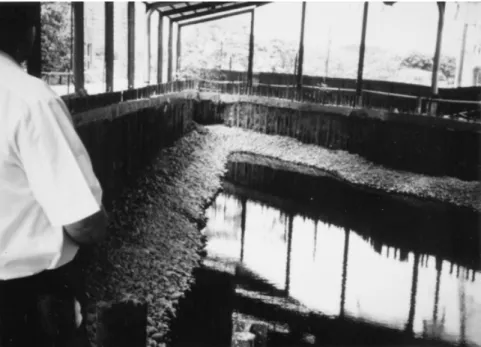
A similar problem occurred for asbestos factories in Taiwan. Asbestos was used widely in manufacturing cement, insulation and friction material, as well as fireproof textile products from the 1960s (Chen et al., 1992). People were using and dumping its waste with-out knowing that exposure can produce lung cancer and/or mesothelioma. Figure 3 taken in the late 1980s showed that the waste was dumped as a regular house garbage at the backyard of a textile factory. In the early 1990s, we were concerned about the risk to the nearby community people of developing lung cancer and mesothelioma. Ambient levels of asbestos fibres were determined by transmission electromicroscopy and the
Figure 2. A hole dug inside a factory. The company which had previously dumped solvents containing chlorinated hydro-carbons spent millions of dollars digging a hole measuring 2012 m2×5.5 m (depth) for cleaning contaminated soil and
under-ground water. However, under-ground water outside the factory still showed persistent pollution.
Table 4. Concentration ranges of the tested volatile organic compounds (VOCs) in groundwater samples collected from 49 civilian wells around a closed electronics-manufacturing factory
VOCs Solubility EPA drinking water standard Concentration range (g l−1)
in water (mg l−1,
at 25°C) MCLGa(g l−1) MCLb(g l−1) Number of wells above Highest level
MCL 1,1-Dichloroethene 2500 7 7 12 (26.5%) 1240.4 cis 1,2-Dichloroethene 3500 70 70 9 (18.4%) 1376.0 Tetrachloroethene 150 0 5 24 (49.0%) 5228.3 1,1,1-Trichloroethane 1495 200 200 5 (10.2%) 1504.4 Trichloroethene 1100 0 5 32 (65.3%) 5479.7
aMaximum contaminant level goal (MCLG): The maximum level of a contaminant in drinking water at which no known or anticipated adverse effect on the health effect of persons would occur, and which allows for an adequate margin of safety. MCLGs are non-enforceable public health goals. EPA stands for Environmental Protection Agency of the United States.
bMaximum contaminant level (MCL): The maximum permissible level of a contaminant in water which is delivered to any user of a public water system. MCLs are enforceable standards. The margins of safety in MCLs ensure that exceeding the MCL slightly does not pose significant risk to public health.
numbers of residents living within a 200 m diameter, between 200–399 m, and between 400–599 m, for each factory were verified by local policemen. Dose response models for lung cancer and mesothelioma were adopted from epidemiological studies and excess risks were calculated and summarized in Table 5 (Chang et al., 1999). The total estimated increased life-time risk for people living within a diameter of 600 m were about 5 excess deaths of lung cancer. Such a danger could have been effectively prevented, if knowledge of the health effect of asbestos had been communicated to people both inside and outside the factory and proper control procedures taken (ILO, 1984). As the treatment of all occupational and
environmental diseases always requires that the pol-lution source be identified and effectively controlled to prevent further intake of toxic chemicals, it is essential for a company to recognize these potential hazards at the planning and/or beginning stage of a factory. Then, appropriate preventive actions can be taken at each step of the life cycle of the product. Such precautionary pro-cedures should also include a comprehensive hazard communication to the workers and community people (US CFR, 1998), so that they knew how to react prop-erly in the case of an emergency spill. In other words, a responsible company should proactively consider improving both occupational and environmental safety and health throughout the life cycle of a product or
230 J-D. WANG, C-W. CHUNG
Figure 3. Asbestos waste of a cement factory. An asbestos cement factory carelessly dumped its waste in the backyard without notifying the community. The pollution could spread extensively to the neighbourhood after a typhoon, a subtropi-cal storm encountered frequently in west Pacific area.
Table 5. Estimation of factory-specific excess deaths of lung cancer resulted from 74-year exposure of airborne asbestos among residents in Taiwan by using the asbestos concentration estimated from geometric mean (GM) (Chang et al., 1999)
Type of asbestos manufacturing No. of Factory Distance from factory ⬍200 m 200–399 m 400–599 m
Cement 21 Lung cancer 0.177 0.714 1.320
Mesothelioma 0.003 0.011 0.021
Friction 13 Lung cancer — — —
Mesothelioma 0.002 0.008 0.006
Textile 3 Lung cancer 0.397 1.601 0.835
Mesothelioma 0.001 0.004 0.002
Ground tile 2 Lung cancer 0.024 0.025 0.319
Mesothelioma ⬍0.001 ⬍0.001 0.005
Insulation 1 Lung cancer 0.006 0.014 0.010
Mesothelioma ⬍0.001 ⬍0.001 ⬍0.001
Refractory 1 Lung cancer ⬍0.001 0.001 0.001
Mesothelioma ⬍0.001 ⬍0.001 0.002
Total 41 Population 2190 7753 21055
Lung cancera 0.604 2.355 2.486
Mesothelioma 0.006 0.024 0.035
aPeople living around asbestos-friction factories were excluded. The authors assumed that friction manufacturing caused no excess lung cancer.
service, which actually can be implemented as an inte-grated portion of ISO 14000 series and BS 8800 (see below).
ISO 14000 and BS 8800—A Systematic
Approach for the Whole Company to
Conduct Hazard Recognition, Risk
Assessment and Pollution Prevention
The International Organization for Standardization (ISO) is an organization affiliated with the United Nations, which provides standards for voluntary com-pliance. It requires votes from three-quarters of the member states of ISO to formally approve a standard. The ISO 9000 series were approved in 1987, which integrated the concept of life cycle into the quality management system. Similarly, the ISO 14000 series passed in 1996 integrated environmental protection systematically into every step of the life cycle. A typi-cal life cycle of a product or service considers every single step from cradle to grave, which includes mar-keting and market research, product design and devel-opment, process planning and develdevel-opment, purchasing (raw material), production or provision of service (unit operations in each manufacturing process), verification (quality control), packaging and storage, sales and dis-tribution, installation and commissioning, technical assistance and servicing, after sales, disposal recycling at the end of useful life (ISO, 1994). To comply with ISO 14000, a company must create an EMS (environmental management system) inside the com-pany, which is to demonstrate its commitment to con-tinuous improvement in environmental protection and pollution prevention, and to show that it is in
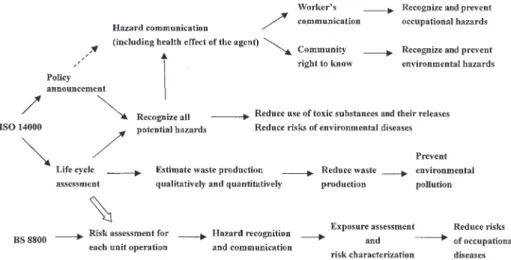
com-pliance with the environmental statutes and regulations of the countries in which it does business. To accomplish this goal, the EMS is based on the follow-ing five general principles: (1) commitment and policy, (2) planning, (3) implementation, (4) measurement and evaluation, and (5) review and further implementation (Murray, 1999). In other words, since the ISO 14000 series stipulate that the top management should make a public policy announcement for environmental pro-tection, the company seeking to be accredited must express its commitment publicly to both workers and the community people. Then, the actual toxic substance control or reduction can be achieved by risk assessment at every step and/or unit operation of the life cycle as proposed in BS (British Standard) 8800 (BSI, 1996), which was later consolidated to OHSAS (occupational health and safety administration system) 18000 and was presumed to be the primary draft for the ISO 18000 series. A typical risk assessment usually takes four steps: hazard recognition, exposure assessment, dose-response relationship and risk characterization (US EPA, 1996). Thus, all types of toxic chemicals involved in the life cycle and their potential adverse health effects will be identified at the beginning of haz-ard recognition. Then, exposure assessment can be car-ried out and the result can be used to estimate the prob-ability of risk and the number of expected cases according to the dose-response curve multiplied by the population-at-risk. If the procedure is conducted at the planning stage, one can still try to obtain exposure information from any current existing or similar work environment to get a rough estimate. After risk assess-ment is performed for different unit operations in the life cycle, cost-effectiveness and priority analysis for alternative options of risk reduction should follow. Pro-per actions to minimize health risk and waste can be taken after the above careful evaluation, as summarized in Figure 4.
Figure 4. Integrated implementation of ISO 14000 series and BS 8800 regulation will enhance life cycle assessment, recog-nition of hazards and risk assessment, which will certainly provide empirical information for prevention of occupational and environmental diseases.
Successful Example of a Dyestuff
Factory
A company producing dyestuff proactively consulted our occupational and environmental health team in the National Taiwan University to provide guidance for pollution prevention in 1991. After some research of the production processes and a walk-through survey at the work environment, we found that the plant was still manufacturing benzidine, a carcinogenic aromatic amine. Moreover, they usually cleaned the reaction tank after each batch job of production. In fact, they washed the tank three times per week. To protect work-ers from direct exposure to the dyestuff, they applied a water jet from outside the tank, which actually increased the production of waste water. Although they once considered building another treatment plant for waste water, they opted for an alternative solution because of the high cost of acquiring the land.
To reduce the occupational risk of developing blad-der cancer, we recommended that they should immedi-ately phase out the production of benzidine and other related aromatic amines. In addition, we asked them to plan each production line to reduce the need for a washing tank. For example, we recommended a careful design and assignment for the reaction tank based on the customer’s order within the next month so that each tank could be repeatedly used without washing. The goal could be easily achieved by arranging to use the same tank for manufacturing dyestuff of the same type and/or the same colour. We further recommended that they set up monitoring systems for water and energy at each production unit or department.
This advice was well received. The manager even invited every engineer and production worker to par-ticipate in a one-day workshop for pollution preven-tion. Everyone on the production line was encouraged to suggest new ideas to decrease the amount of water
232 J-D. WANG, C-W. CHUNG
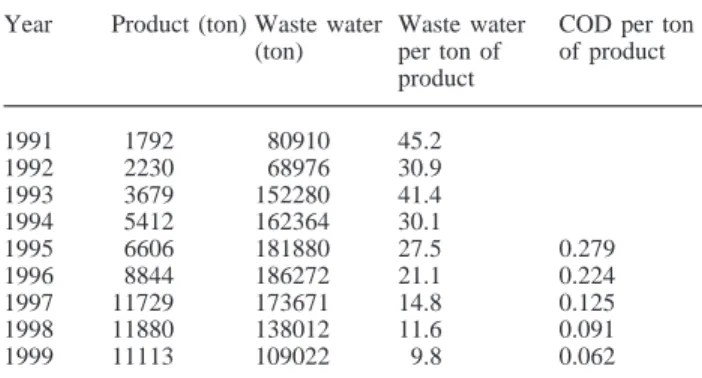
and energy consumed, whilst still producing the same amount of dyestuff with an equal or better quality. However, since the problem-oriented advice from any consultant may only provide a piece meal improvement and have a short term effect, we recommended that they should adopt the process standards of ISO 14000 system to continually improve environmental protec-tion in every aspect of the life cycle of the dyestuff. The manager agreed and the whole company had a dramatic change in creating an EMS to implement the environ-mental policy commitment. To promote the concept and process, the management set up a bonus system for competition among different production lines. The EMS seems to have successfully changed the culture of the whole company to environmental protection. From 1991 to 1998, the amount of waste water and COD (chemical oxygen demand) per ton of product have been consistently reduced as summarized in Table 6. During the past 8 years, there were two major threats to the market of dyestuff production: one was the restriction of aromatic amines imposed by countries of EU (European Union) beginning in 1994. Another was the shrinkage of the Southeast Asian market because of the economic crisis after July 1997. However, the company has continued to thrive and its productivity and profit have increased steadily. In fact, production has increased 5–6 times during this period. Therefore, we believe that the principles of pollution prevention still work in the industry of a developing country, and that they can be implemented effectively by adoption of the concept of pollution prevention and integration of systems proposed by ISO 14000 series and BS 8800.
Limitation of Such Standards
Although ISO 14000 and BS 8800 series may be per-fect guidelines for industry to adopt to accomplish their goal of prevention of occupational and environmental health problems, they are only a process standard instead of a performance standard. As they do not set
Table 6. Trends of the waste reduction of a dye-manufac-turing factory in Taiwan after step-by-step improvements of production processes based upon principles of pollution pre-vention
Year Product (ton) Waste water Waste water COD per ton (ton) per ton of of product
product 1991 1792 80910 45.2 1992 2230 68976 30.9 1993 3679 152280 41.4 1994 5412 162364 30.1 1995 6606 181880 27.5 0.279 1996 8844 186272 21.1 0.224 1997 11729 173671 14.8 0.125 1998 11880 138012 11.6 0.091 1999 11113 109022 9.8 0.062
a minimal regulatory standard, these standards can not be a substitute for governmental performance standard, and some critics have expressed concern that the adop-tion of the ISO 14000 series may undercut efforts to develop and strengthen performance requirements (Stenzel, 2000). Moreover, these standards are com-pletely voluntary and there is no mechanism for incorporating public or non-governmental participation into its activities. The overall performance mainly depends on self-chosen management goals and pri-orities. Thus, certification to these standards should not exempt a company from governmental enforcement of performance standard. Instead, these standards do pro-vide an excellent supplement to governmental regu-lations.
Conclusion
Occupational and environmental diseases frequently arise from a general lack of hazard communication in developing countries. Even if the workers and employer know what types of chemical are used in the production process, it is crucial that they are informed about adverse health effects of these compounds in order to take appropriate preventive measures. We have argued that the integrated implementation of ISO 14000 and BS 8800 series can guide a company toward effective prevention of occupational and environmental diseases. After making a public announcement of a company’s commitment to environmental protection and occupational health, the company must identify all chemicals involved in the life cycle of a product or service, conduct risk assessment for every step or unit operation, prioritize the options for risk reduction, and choose proper action to minimize both waste and health risk. To be consistent with the ISO 14000 guidelines, a company should purchase raw material or assembly parts from another company which is also accredited with the same standard. Therefore, such movements can be a non-tax barrier for a non-accredited company, but they also imply an opportunity for an accredited company from a developing country. As the global resource is limited and our common future decided by how we manage the earth today, we recommend that all people work together toward implementation of such standards for pollution prevention and public health.
Acknowledgements
This study was supported by grant no. NSC88–2314-B-002–344 from the National Science Council, Executive Yuan, Republic of China.
References
Ames BN. Identifying environmental chemicals causing mutations and cancer. Science 1979; 204: 587–593.
British Standard Institute. Occupational Health and Safety
Management Systems. BS 8800. BSI: London, 1996.
British Standard Institute. OHSAS 18000. Occupational
Health and Safety Management Systems and Guidelines
(OHSAS 18001: Management systems). BSI: London, 1999. British Standard Institute. OHSAS 18000. Occupational
Health and Safety Management Systems and Guidelines
(OHSAS 18002: Guidelines). BSI: London, 2000.
Chang HY, Chen CR, Wang JD. Risk assessment of lung cancer and mesothelioma in people living near asbestos-related factories in Taiwan. Arch Environ Health 1999; 54: 194–201
Chang YC, Yeh CY, Wang JD. Subclinical neurotoxicity of mercury vapor revealed by a multimodality evoked potential study of chloralkali workers. Am J Industr Med 1995; 27: 271–279.
Chao KY, Wang JD. Increased lead absorption caused by working next to a lead recycling factory. Am J Industr Med 1994; 26: 229–235.
Chen CR, Chang HY, Suo J, Wang JD. Occupational exposure and respiratory morbidity among asbestos workers in Taiwan. J Formosan Med Assoc 1992; 91(12): 1138–1142. Chen JD, Wang JD, Tsai SY, Chao WI. Effects of occu-pational and non-occuoccu-pational factors on liver function tests in workers exposed to solvent mixtures. Arch Environ Health 1997; 52: 270–274.
Chen YM, Yen TS, Hsieh BS, Tsai TJ, Wang JD. Ethylene glycol intoxication—report of a case. J Nephrology ROC 1992; 6(3): 180–185.
Deng JF, Wang JD, Shih TS, Lan FL. Outbreak of carbon tetrachloride poisoning in a color printing factory related to the use of isopropyl alcohol and an air conditioning system in Taiwan. Am J Industr Med 1987; 12: 11–19.
DGB (Directorate-General of Budget). Statistical Yearbook
of the Republic of China. Accounting and Statistics,
Execu-tive Yuan, Republic of China. 1986; 96.
DGB (Directorate-General of Budget). Statistical Yearbook of
the Republich of China. Accounting and Statistics, Executive
Yuan , Republic of China, 1997; 151.
Du CL, Kuo ML, Chang HL, Sheu TJ, Wang JD. Changes in lymphocyte single strand breakage and liver function of workers exposed to vinyl chloride monomer. Toxicol Lett 1995; 77: 379–385.
Du CL, Wang JD. Increased morbidity odds ratio of primary liver cancer and cirrhosis of the liver among vinyl chloride monomer workers. Occup Environ Med 1998; 55: 528–532. Guo YL, Wang BJ, Lee CC, Wang JD. Prevalence of dermatoses and skin sensitization associated with pesticide use in fruit farmers of Southern Taiwan. Occup Environ Med 1996; 53: 427–431.
Hoa SW, Lin MJ, Kuo EF, Wang JD. Unusual lead intoxi-cation in adults: report of 2 cases. Chin J Family Med (R.O.C.) 1994; 4(3): 169–173. (in Chinese)
International Labor Office. Safety in the Use of Asbestos. ILO: Geneva, 1984.
International Labor Office. Chemicals in the working environ-ment. In World Labor Report, Chapter 5. ILO: Geneva 1994;
7: 79–90.
ISO. The ISO 14000 Handbook, Cascio J (ed.). American Society for Quality (ASQ) Quality Press: Milwaukee, 1998.
Jee SH, Chao KY, Sun CC, Wang JD. Outbreak of contact dermatitis related to Acticide EP paste in a paint-manufactur-ing factory. J Formos Med Assoc 1996; 95: 628–631. Jee SH, Kuo HW, Su WP, Chang CH, Sun CC, Wang JD. Photodamage and skin cancer among paraquat workers. Int J
Dermatol 1995; 34: 466–469.
Jee SH, Wang JD, Sun CC, Chao YF. Prevalence of probable kerosene dermatoses among ball-bearing factory workers.
Scand J Work Environ Health 1985; 12: 61–65.
Kuo HW, Li CS, Wang JD. Occupational exposure to 4,4′ -bipyridyl vapor and aerosol during paraquat manufacturing.
Am Industr Hyg Assoc J 1993; 54(8): 440–445.
Lee JH, Hwang YH, Ma IC, Wang GS, Wang JD. Increased mortality odds ratio of liver cancer in community people exposed to groundwater contaminated with chlorinated hydro-carbons. Environ Health Persp 2000; (Submitted)
Lin SC, Tai CC, Chan CC, Wang JD. Nasal septum lesions caused by chromium exposure among chromium electroplat-ing workers. Am J Industr Med 1994; 26: 221–228. Murray PC. Inching toward environmental regulatory reform—ISO 14000: Much ado about nothing or a reinven-tion tool? Am Bus Law J 1999; 37(1): 35–71.
Rabinowitz MB, Wang JD, Soong WT. Dentine lead and child intelligence in Taiwan. Arch Environ Health 1991; 46: 351–360.
Soong WT, Chao KY, Jang CS, Wang JD. Long-term effect of increased lead absorption on children’s intelligence. Arch
Environ Health 1999; 54: 297–301.
Stenzel PL. Can the ISO 14000 series environmental manage-ment system standards proved a viable alternative to govern-ment regulation? Am Bus Law J 2000; 37(2): 237–298. Tsai SY, Chen JD, Chao WY, Wang JD. Neurobehavioral effects of occupational exposure to low-level organic solvents among Taiwanese workers in paint manufactories. Environ
Res 1997; 73: 146–155.
US Code of Federal Regulations. Title 40, Section 300 and 355. US Government Printing Office. Washington, DC. July 1, 1998.
US Environmental Protection Agency. Proposed Guidelines
for Carcinogen Risk Assessment. Notice 61. USA EPA: 1996.
Wang JD. From conjecture and refutation to the docu-mentation of occupational diseases in Taiwan. Am J Industr
Med 1991; 20: 557–565.
Wang JD, Chang YC, Kao KP, Huang CC, Lin CC, Yeh WY. An outbreak of n-hexane induced polyneuropathy among press proofing workers in Taipei. Am J Industr Med 1986;
10: 111–118.
Wang JD, Chen JD. Acute and chronic neurological symp-toms among paint workers exposed to mixtures of organic solvents. Environ Res 1993; 61: 107–116.
Wang JD, Huang CC, Hwang YH, Chiang JR, Lin JM, Chen JS. Manganese induced parkinsonism: an outbreak due to an unrepaired ventilation control system in a ferromanganese smelter. Br J Industr Med 1989; 46: 856–859.
Wang JD, Huang PH, Lin JM, Su SY, Wu MC. Occupational asthma due to toluene diisocyanate among velcro-like tape manufacturers. Am J Industr Med 1988; 14: 73–78.
Wang JD, Lai MY, Chen JS et al. Dimethylformamide-induced liver damage among synthetic leather workers. Arch
Environ Health 1991; 46: 161–166.
Wang JD, Li WM, Hu FC, Hu KH. Occupational risk and the development of premalignant skin lesions among paraquat manufacturers. Br J Industr Med 1987; 44: 196–200.
234 J-D. WANG, C-W. CHUNG
Wang JD, Shy WY, Chen JS, Yang KH, Hwang YH. Parental occupational lead exposure and lead concentration of new-born cord blood. Am J Industr Med 1989; 15: 111–115. Wang JD, Soong WT, Chao KU, Hwang YH, Jang CS. Occu-pational and environmental lead poisoning: Case study of bat-tery recycling smelter in Taiwan. J Toxicol Sci 1998; 23 (Suppl): 241–245.
Wu YQ, Wang JD, Chen JS, Chung SC, Hwang SY. Occu-pational risk of decreased plasma cholinesterase among pes-ticide production workers in Taiwan. Am J Industr Med 1989;
16: 659–666.
Yip PK, Chang YC, Wang JD, Tsai SY, Chen JS. A small outbreak of lead neuropathy in a tile factory. J Formosan