Opposite temperature effects of quantum-dot laser under
dual-wavelength operation
Hsueh-Shih Fan, Yi-Shin Su, and Fei-Hung Chu
Graduate Institute of Electro-Optical Engineering, National Taiwan University, Taipei, Taiwan 10617, Republic of China
Fu-Yu Chang
Department of Electrical Engineering, National Taiwan University, Taipei, Taiwan 10617, Republic of China
Hao-Hsiung Lin and Ching-Fuh Lina兲
Graduate Institute of Electro-Optical Engineering, National Taiwan University, Taipei, Taiwan 10617, Republic of China; Graduate Institute of Electronics Engineering, National Taiwan University, Taipei, Taiwan 10617, Republic of China; and Department of Electrical Engineering, National Taiwan University, Taipei, Taiwan 10617, Republic of China
共Received 14 February 2007; accepted 6 April 2007; published online 1 May 2007兲
The authors discover opposite temperature effects when the quantum-dot共QD兲 laser is controlled to simultaneously oscillate at two modes in the external cavity. The two modes correspond to the ground state and the first excited state of the QDs. Experiments show that the power of one mode increases, while the power of the other mode decreases as the temperature increases. The power variation between these two modes is similar to the situation of competition and anticompetition of laser modes. The physical reason is discussed in detail. © 2007 American Institute of Physics. 关DOI:10.1063/1.2735543兴
The temperature effects of quantum-dot 共QD兲 laser are important topics in research. In general, as the temperature increases, the threshold current increases.1–6 The slope effi-ciency and the output power decrease.7–9 In addition, the laser gain profile shifts to higher energy levels.7,10 These phenomena are due to the movement of carriers to higher energy levels.10 Previous researches on temperature depen-dence of L-I curves of QD lasers are under single-wavelength operation. However, we discover opposite tem-perature effects when the QD laser is controlled to simultaneously oscillate at two wavelength modes. The two wavelength modes are the long wavelength mode 共LWM兲, corresponding to the ground state共GS兲, and the short wave-length mode共SWM兲, corresponding to the first excited state 共1stES兲. We discover that the temperature-dependent behav-iors of the SWM and the LWM are not the same. Our ex-periments show that the power of the SWM increases, while the power of the LWM decreases as the temperature in-creases. The power variation between the SWM and the LWM is similar to the situation of competition and anticom-petition in laser modes.11–13
The laser we fabricated is a conventional edge emitting laser with a cavity length of 584m. The QD structure was grown by molecular beam epitaxy on the GaAs substrate with a 500 nm thick n-GaAs buffer layer. In the active re-gion, the InAs QDs were grown in an In0.33Ga0.67As/ GaAs quantum well. The n-type and p-type cladding layers are Al0.6Ga0.4As. Si is used for n-type doping and Be for p-type doping. The double-channel waveguide was fabricated on the
p-cladding layer. The waveguide is 2.7m in width. The Ti/ Pt/ Au was deposited as the p-side electrode. The laser chip is bonded on the temperature-controlled heat sink stage.
The output light was first measured using an optical spec-trum analyzer to identify the lasing wavelength. Without the external cavity, this laser oscillates at around 1110 nm, which corresponds to the 1stES. The L-I curves are measured using an InGaAs photodetector. The slope efficiency remains almost constant, the output power decreases, and the thresh-old current increases from 31 to 34 mA as the temperature increases from 18 to 25 ° C.
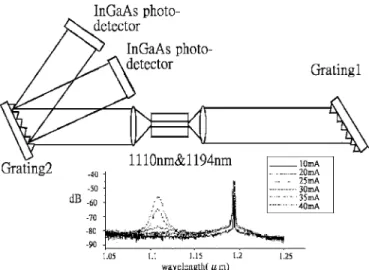
The above measurements show that the temperature ef-fects of this QD laser under single-wavelength operation without the external cavity are similar to previous reports.7–9 However, we find opposite temperature effects when the la-ser is controlled to simultaneously oscillate at two wave-length modes. The configuration of the external cavity laser system is shown in Fig.1. As grating 1 is oriented to give feedback corresponding to 1194 nm at the GS of the QD laser, the QD laser could oscillate at the LWM at low current injection. However, when the operation current is above 38 mA, it oscillates simultaneously at two wavelength modes: the LWM at 1194 nm and the SWM at 1110 nm, even though grating 1 is still controlled to give feedback at 1194 nm. The corresponding spectra are shown in the inset of Fig. 1. The output of the QD laser is delivered to the reflected-type grating 2, so the SWM light and the LWM light are separated. The L-I curves of the LWM and the SWM are measured using two InGaAs photodetectors. We find that when the temperature is above 25.5 ° C, the power of the LWM decreases to zero, so the QD laser oscillates only at 1110 nm above 25.5 ° C. Then it behaves like in the situation of single-wavelength operation. For this reason, the measurements of the temperature dependence under dual-wavelength operation are primarily from 18 to 25.5 ° C.
The L-I curves of the LWM at 1194 nm and the SWM at 1110 nm are shown in Figs.2共a兲and2共b兲, respectively. Fig-ure 2共a兲 shows that the threshold current of the LWM a兲Author to whom correspondence should be addressed; FAX:
886-2-2364-2603; electronic mail: [email protected]
APPLIED PHYSICS LETTERS 90, 181113共2007兲
0003-6951/2007/90共18兲/181113/3/$23.00 90, 181113-1 © 2007 American Institute of Physics
共1194 nm兲 increases and the slope efficiency 共mW/mA兲 of the LWM decreases as the temperature increases, which are similar to those of single-wavelength operation. On the other hand, Fig.2共b兲shows that the threshold current of the SWM 共1110 nm兲 remains almost constant and the slope efficiency of the SWM increases as the temperature increases, which are very different from those of single-wavelength operation at 1110 nm of this device.
The power variations with temperature for the LWM 共1194 nm兲 and the SWM 共1110 nm兲 under dual-wavelength operation at 44 mA are shown by curves A and B in Fig.3, respectively. Also the power variation with temperature un-der single-wavelength operation 共1110 nm兲 at 38 mA is shown by curve C in Fig.3. They are shown together in Fig.
3 for comparison. The power of the single-wavelength op-eration at 1110 nm decreases with temperatures due to the
thermal population of carriers from the 1stES to higher en-ergy levels.10 However, the power of the SWM at 1110 nm under dual-wavelength operation increases slightly from 18 to 20 ° C, decreases slightly from 20 to 22 ° C, and in-creases relatively quickly above 22 ° C. Thus, the power variation with temperatures for the SWM at 1110 nm under dual-wavelength operation is very different from that of single-wavelength operation at 1110 nm.
According to previous reports,10 the change of the ther-mally induced carrier population plays an important role in the temperature effects of QD laser. When the QD laser is operated at single wavelength of 1110 nm, most carriers re-combine in the 1stES. Therefore, the number of carriers that moved from the 1stES to higher energy levels is more than that that moved from the GS to the 1stES as the temperature increases. As a result, the power of the single-wavelength operation at 1110 nm decreases with temperatures. However, when the laser is controlled to simultaneously oscillate at two wavelength modes: the LWM at 1194 nm, correspond-ing to GS, and the SWM at 1110 nm, correspondcorrespond-ing to the 1stES, the carriers recombine at both the GS and the 1stES. When the temperature increases, the carriers in the GS will always move to higher energy levels, so the number of car-riers that recombined in the GS decreases with the tempera-ture, leading to the reduction of LWM power. However, the number of carriers that recombined in the 1stES does not necessarily decrease with the temperature. It depends on whether the number of carriers that moved from the GS to the 1stES is more than that that moved from the 1stES to the higher energy levels. Compared to the single-wavelength op-eration at 1110 nm under the same current-injection level, the SWM power at 1110 nm under dual-wavelength opera-tion is reduced. It means that the populaopera-tion at the 1stES is reduced when the laser is under dual-wavelength operation. The reduction of the carrier number in the 1stES gives rise to the possibility that the number of carriers that moved from the 1stES to the higher energy levels is less than that that moved from the GS to the 1stES.
Under dual-wavelength operation, the power of the LWM increases with the carrier population in the GS and the power of the SWM increases with the carrier population in the 1stES. When the temperature increases in the two tem-perature ranges: 18– 20 ° C and 22– 25.5 ° C, the number of carriers that moved from the GS to the 1stES is more than that that moved from the 1stES to the higher energy levels. FIG. 1. Two-mode QD laser system. The reflected-type grating 1 is oriented
to give feedback corresponding to 1194 nm at the GS of the QD laser. The SWM and LWM are separated by the reflected-type grating 2. The inset shows the spectrum of the dual-wavelength operation at 1194 and 1110 nm.
FIG. 2. 共Color online兲 共a兲 L-I curves of the LWM at 1194 nm under dual-wavelength operation.共b兲 L-I curves of the SWM at 1110 nm under dual-wavelength operation.
FIG. 3. Variation of lasing power with temperature: curve A for lasing mode at 1194 nm under dual-wavelength operation at 44 mA, curve B for lasing mode at 1110 nm under dual-wavelength operation at 44 mA, and curve C for lasing mode at 1110 nm under single-wavelength operation at 38 mA.
181113-2 Fan et al. Appl. Phys. Lett. 90, 181113共2007兲
Therefore, the carrier population in the GS decreases, while the carrier population in the 1stES increases with the tem-perature. As a result, the power of the LWM decreases, while the power of the SWM increases as the temperature increases in these two temperature ranges. When the temperature in-creases from 20 to 22 ° C, the number of carriers that moved from the 1stES to the higher energy levels is more than that that moved from the GS to the 1stES, so the carrier popula-tion in the GS and that in the 1stES both decrease with the temperature. Thus, the power of the LWM and that of the SWM both decrease in this temperature range.
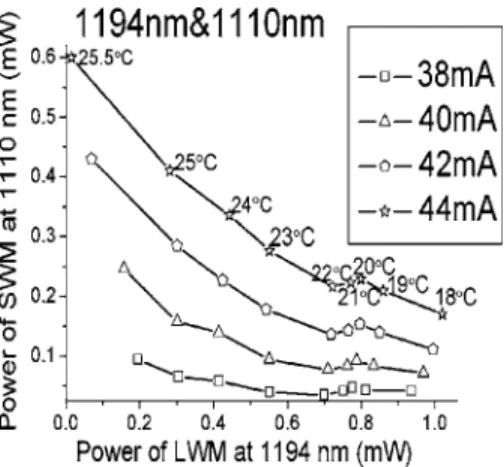
Figure4shows the power of the SWM versus the power of the LWM under dual-wavelength operation at several current-injection levels: 38, 40, 42, and 44 mA. The power variation between the SWM and the LWM is achieved by changing the temperatures from 18 to 25.5 ° C. When the temperature increases, the curves trace from the right hand side to the left hand side. The slopes共mW/mW兲 of the curves in Fig. 4 are negative in the two temperature ranges 共18–20 °C and 22–25.5 °C兲. This means that the power of the SWM increases while the power of the LWM decreases. This is similar to the competition of laser modes.11–13 How-ever, the slopes共mW/mW兲 of these curves are slightly posi-tive from 20 to 22 ° C. This means that the power of the
SWM and that of the LWM both decrease as the temperature increases. In this case, it is similar to the anticompetition of laser modes.12,13 These phenomena similar to the competi-tion and anticompeticompeti-tion of laser modes can be explained by the change of the thermally induced carrier population, as we have discussed before.
In summary, we have shown that the slope efficiency and the output power of the SWM 共1110 nm兲 increase as the temperature increases under dual-wavelength operation, which are very different from those of single-wavelength op-eration at 1110 nm. We conclude that the behaviors between the SWM and the LWM are similar to competition and anti-competition of laser modes. The physical reason is the change of the thermally induced carrier population.
This work was supported in part by the National Science Council of Taiwan, R.O.C. under Grant Nos. NSC 95-2120-M-002-001 and NSC 95-2112-M-002-004.
1T. Yang, S. Lipson, J. D. O’Brien, and D. G. Deppe, IEEE Photonics Technol. Lett. 17, 2244共2005兲.
2G. Park, D. L. Huffaker, Z. Zou, O. B. Shchekin, and D. G. Deppe, IEEE Photonics Technol. Lett. 11, 301共1999兲.
3Z. Zou, O. B. Shchekin, G. Park, D. L. Huffaker, and D. G. Deppe, IEEE Photonics Technol. Lett. 10, 1673共1998兲.
4M. Sugawara, K. Mukai, and Y. Nakata, Appl. Phys. Lett. 74, 1561 共1999兲.
5J.-Y. Yeh, N. Tansu, and L. J. Mawst, IEEE Photonics Technol. Lett. 16, 741共2004兲.
6N.-H. Kim, J.-H. Park, L. J. Mawst, T. F. Kuech, and M. Kanskar, IEEE Photonics Technol. Lett. 18, 989共2006兲.
7S. K. Ray, K. M. Groom, R. A. Hogg, H. Y. Liu, M. Hopkinson, T. Badcock, D. J. Mowbray, and M. S. Skolnick, IEEE Photonics Technol. Lett. 17, 1785共2005兲.
8C. Y. Liu, S. F. Yoon, Z. Z. Sun, and K. C. Yew, Appl. Phys. Lett. 88, 081105共2006兲.
9F. Klopf, R. Krebs, J. P. Reithmaier, and A. Forchel, IEEE Photonics Technol. Lett. 13, 764共2001兲.
10G. Park, O. B. Shchekin, and D. G. Deppe, IEEE J. Quantum Electron.
36, 1065共2000兲.
11C.-F. Lin and P.-C. Ku, IEEE J. Quantum Electron. 32, 1377共1996兲. 12C.-F. Lin, C.-C. Huang, F.-H. Chu, and Y.-S. Su, Appl. Phys. Lett. 82,
3611共2003兲.
13C.-C. Huang, Y.-S. Su, and C.-F. Lin, IEEE J. Quantum Electron. 41, 1共2005兲.
FIG. 4. Power of the SWM vs the power of the LWM at 38, 40, 42, and 44 mA. When temperature increases from 18 to 25.5 ° C, these curves trace from the right hand side to the left hand side.
181113-3 Fan et al. Appl. Phys. Lett. 90, 181113共2007兲