L. Bougé and V.K. Prasanna (Eds.): HiPC 2004, LNCS 3296, pp. 60–70, 2004. © Springer-Verlag Berlin Heidelberg 2004
Considering Non-uniform Traffic Distributions
Kuo-Chung Chu1, 2 and Frank Yeong-Sung Lin1
1 Department of Information Management, National Taiwan University,
2
Department of Information Management, Jin-Wen Institute of Technology, Taipei, Taiwan
Abstract. In this paper, we investigate the load balancing problem by jointly considering sectorization and hybrid F/CDMA scheme in the scenario of non-uniform traffic distributions. The problem is formulated as a mathematical optimization model, and is solved by Lagrangean relaxation approach. The model objective is to minimize weighted blocking probability in terms of distribution diversity. To evaluate the model, performance analysis of adaptive load balancing is conducted by proposed bandwidth segmentation scheme; it is denoted adaptive scheme (AS). Non-adaptive (NA) approach by common power control scheme is compared. Combining sectorization and bandwidth segmentation scheme provides novel adaptive load balancing. Performance improvement that proposed adaptive scheme outperforms common power control scheme is about 50%.
1
Introduction
Code-division multiple access (CDMA) technique has been a promising technique for next generation wireless communication systems since the same bandwidth is shared by all users in the system, i.e. reuse of unity, soft channel capacity, and so forth. Users transmitting in the same frequency band are identified by user-specific code. For the sake of imperfect code orthogonality, interferences are incurred. In a multi-cellular environment, whenever a particular CDMA cell becomes increasingly loaded and the user increases, it will unavoidably affect all users in the system, not only the users in the home cell but also those in neighboring cells, especially in the scenario of hot spot and non-uniform traffic distributions. Hence, the system performance decreases as the number of active users increases.
Generally, a solution to the interference problem is power control mechanism for uniform traffic distribution environment, which attempts to achieve constant received mean power from each mobile within a cell [1]. However, with hot-spot cell, powering up all users in the cell to accommodate more users will result in excessive interference to users in neighboring cells to maintain sufficient signal-to- interference ratio (SIR) levels at their cell sites. Considering linear distribution, as in highway, power control may not be appropriate approach in the scenario. For non-uniform traffic distribution, sectorization is an effective way to maximize the network capacity
[2][3]. The goal of dynamic sectorization is similar to load balancing in previous studies [4][5]. Adaptive load-shedding scheme combines the power control and soft handoff functionality to enforce some users farthest away from cell/base station (two terms are used in turn hereafter) enter forced soft handoffs, and transfer to neighboring cells that are lightly loaded. In such a way, heavily loaded cells dynamically down size their coverage area in order to serve traffics, while adjacent cells that are less heavily loaded increase their coverage to accommodate the extra traffics.
A hybrid F/CDMA scheme has been proposed to moderately mitigate interferences [6]. In consideration of F/CDMA, capacity analysis in multi-band overlaid CDMA is proposed, and maximum bandwidth utilization is obtained [7][8]. Especially, the multi-band spectrum is to provisioning heterogeneous services requirements with sub-bands [8]. In this paper, we investigate the load balancing to maximize system capacity by jointly considering sectorization and allocating appropriate sub-spectrum in a cell. CDMA background is given in section 2. Section 3 presents the model of adaptive load balancing as well as solution approach. Section 4 illustrates the computational experiments. Finally, Section 5 concludes this paper.
2 CDMA Background
2.1 Sectorization and Hybrid F/CDMA Scheme
The common way to reducing the interference between users is sectorization using directional antennas. Sectorization utilizes the spatial domain to introduce orthogonalization [2][3] to the system. Since only a subset of the users is received at each antenna, the interference that each user incurs is less compared to a single antenna system. Without loss of generality, the interferences between users can be treated as the interferences between sectors. If the interference indicator function between sectors is pre-calculated, the interference from other users/cells is easily analyzed.
To do so, sector candidates probably configured in base station (BS) must be defined. Denote K the set of sector configurations. Denote S the set of sector candidates, each sector candidate sk i, is defined by both sector configuration (k) and sector identity (i). Denote B the set of BSs, in this paper, two configurations are given at base station ( K =2), they includes one sector ( 360D with omni-directional antenna) and three sectors (120D per sector), and assign k =1, 2, respectively. For simplicity, sk i, is substituted by s , and denote sectorjs the sector s in BS j (∀sk i, ∈ , j BS ∈ ), where
B is the set of base stations.
In hybrid F/CDMA scheme, the available wideband spectrum is divided into a number of sub-bands with smaller bandwidths. Each sub-band employs direct sequence (DS) spreading with reduced processing gain and is transmitted in one and only one sub-band. The capacity of this F/CDMA system is calculated as the sum of the capacities of the sub-band. Given the whole bandwidth BWWHOLE 60MHZ in both
uplink and downlink (in both , k i DL js W and , k i UL js
W ), which is made up of NFU frequency units (FU) with BWFU=6MHZ, where NFU=BWWHOLE BWFU =10. By integrating FU
a number of frequency segments (FS), so-called sub-band, can be separated. FS instead of whole bandwidth is deployed in sectorjs. The term frequency segment and sub-band
will be used in turn throughout the paper.
We investigate the load balancing by jointly considering sectorization and hybrid F/CDMA scheme in the scenario of non-uniform environment. If there are four frequency segments (FS0, FS1, FS2, and FS3) to be assigned in a cell/sector, for each of traffic distributions in Fig. 1 where shadow cell means heavy loads, the probable assignment would be different. Since the nature of non-uniform traffic distribution, the bandwidth requirement in each cell to satisfying SIR would be varied. The proposed scheme is called “adaptive load balancing” to optimally assigning FS with respect to traffic loads, the interferences between cells/sectors can be mitigated by bandwidth segmentation. For example, if BWWHOLE allocated in downlink connection is
decomposed into five FUs, NFU= FU =BWWHOLE BWFU =5, the frequency segments
(FS) that combined consecutively from FU are categorized into five groups of FS length. Thus, the set FU ={ 1, 2, 3, 4, 5 }, the set FS ={ (1), (2), (3), (4), (5), (1,2), (2,3), (3,4), (4,5), (1,2,3), (2,3,4), (3,4,5), (1,2,3,4), (2,3,4,5), (1,2,3,4,5) }. The total number of FS, NFS= FS = DL
(
DL 1)
2 FU FU N × N + = 5 6 2× =15.FS0 FS0
FS0
FS0
FS0
FS0
FS0
FS1
FS1
FS1
FS2
FS2
FS2
FS3
FS1
FS1
FS2
FS2
FS3
FS3 FS3
(a) uniform model (b) hot spot (c) linear model
Fig. 1. Scenarios of F/CDMA scheme applied in distribution diversity
2.2 Interference Model
Given sector configuration, the interference indicator functions ' '
UL js j s Ω and ' ' DL js j s Ω for uplink (UL) and downlink (DL) from sectorjs to sectorj s' ', respectively, can be pre-calculated. Denote UL
FS and DL
FS the FS set in UL and DL, respectively. Applying bandwidth segmentation scheme, let xjsu(yjsd ) be the decision variable
which is 1 if sectorjs deploys frequency segment
UL
u∈FS ( DL
d∈FS ) or 0 otherwise. Thus, bandwidth allocated for uplink and downlink is calculated by WUL
js = UL UL jsu u FU u FS x L BW ∈
∑
⋅ ⋅ and WDL js = DL DL jsd d FU d F y L BW ∈ ⋅ ⋅length of u(d). Frequency segments deployed in any two sectorjs probably exists
overlapping of FUs. Furthermore, the interference indicator function UL' u u
Ψ from u to '
u can be pre-calculated, and the indicator function DL d d'
Ψ is similar to '
UL u u
Ψ .
For traffic distribution, denote C the set of traffic classes and ( )c t ( ( )c t ∈ ) the C
traffic class of call request from mobile station (MS) t (∀ ∈ ), where t T T is the set of mobile stations. If call type of MS t belongs to class-c, class- ( )c t is equivalent to class-c. Let ( ) UL c t d ( ( ) DL c t
d ) be the information rate in uplink (downlink). Denote zjst the
decision variable which is 1 if MS t is granted by sectorjs or 0 otherwise. Assuming
both link powers are perfectly controlled, it ensures the received power at sectorjs from
MS t with constant value in same traffic class- ( )c t . Denote UL( ) c t
P ( DL( )
c t
P ) the received uplink (downlink) power signal, the signal-to-interference ratio (SIR) , ( )
UL js c t
SIR in
uplink, which consists of processing gain and intra-inter cell/sector interferences, is
defined as ( ) , ( ) ( ) , , (1 ) (1 ) UL UL js c t jst UL js c t UL UL UL UL c t jst intra jst inter W P z V SIR d ρ I I + − = ⋅ − + , where UL
ρ is the uplink orthogonality factor, ( )
UL c t
α is uplink activity factor. A very large constant value V in numerator is to satisfy constraint requirement if MS t is rejected (zjst=0). Denote Djt the distance from MS t
to sectorjs , and given attenuation factor τ =4, the intra-cell interference is
' , ( ') ( ') ' ' UL UL UL t T jst intra c t c t jst t t I ∈α P z ≠ =
∑
and inter-cell , UL jst interI in uplink can be expressed by (1). Equation (1) jointly considers effect of inter-sector and inter-FS on inter-cell interference.
Linear model is a best form to efficiently solve the integer programming problem. Unfortunately, the coupling of decision variables (xjsu, zjst) and decision variables (xj s u' ' ', xjsu, zjst) results to non-linear form in , ( )
UL js c t
SIR and (1), respectively. Here we introduce auxiliary variable γjsut=xjsuzjst (s.t. xjsu+zjst ≥ ⋅2 γjsut, 1xjsu+zjst− ≤γjsut) so that non-linear form can be reduced to linear form. Applying auxiliary variable γjsut,
, ( )
UL js c t
SIR can be rewritten as (2). Based upon γjsut , another auxiliary variable
' ' ' '
j s u jsut
ζ =γj s u t' ' ' 'xjsu=xj s u' ' 'zj s t' ' 'xjsu is also employed (s.t. γj s u t' ' ' '+xjsu ≥ ⋅2 ζj s u t jsu' ' ' ' , ' ' ' ' 1 ' ' ' '
j s u t xjsu j s u t jsu
γ + − ≤ζ ). Applying auxiliary variable ζj s u jsut' ' ' ', (1) can be rewritten as (3).
(
)
' ' , ' ' ( ') ( ') ' ' ' ' ' ' ' ' ' ' ' ' ' ' ' UL UL j t UL UL UL UL UL jst inter j s js c t c t j s t u u j s u jsu j B s S t T jt u FS u FS j j s s t t D I P z x x D τ α ∈ ∈ ∈ ∈ ∈ ≠ ≠ ≠ ⎛ ⎞ = Ω ⎜⎜ ⎟⎟ Ψ ⎝ ⎠∑ ∑∑
∑ ∑
(1)(
)
(
)
(
)
( ) , ( ) ( ) (1 ) , , UL UL UL u FU jsu c t jsut u F UL js c t UL UL UL UL c t jst intra jst inter L BW x P V V SIR d I I γ ρ ∈ ⎡⎣ + − ⎤⎦ = − +∑
(2)' ' , ' ' ' ' ' ' ' ( ') ( ') ' ' ' ' ' ' ' ' UL UL j t UL UL UL UL UL jst inter j s js u u j s u t jsu c t c t j B s S t T jt u FS u FS j j s s t t D I P D τ ζ α ∈ ∈ ∈ ∈ ∈ ≠ ≠ ≠ ⎛ ⎞ = Ω ⎜⎜ ⎟⎟ Ψ ⎝ ⎠
∑ ∑ ∑
∑ ∑
(3)In downlink connection, it is similar to uplink except that the interference of intra-cell is more complicated. Auxiliary variables η =jsdt yjsdzjst and ξj s d jsdt' ' ' '=ηj s d t' ' ' 'yjsd =
' ' ' ' ' '
j s d j s t jsd
y z y are introduced that subject to (yjsd+zjst ≥ ⋅2 ηjsdt,yjsd +zjst− ≤1 ηjsdt)
and (ηj s d t' ' ' '+yjsd ≥ ⋅2 ξj s d t jsd' ' ' ' , ηj s d t' ' ' '+yjsd − ≤1 ξj s d t jsd' ' ' ' ), respectively. Associated models are expressed in (4)-(6).
' ' , ( ') ( ') ' ' jt DL DL DL t T jst intra c t c t jst t t jt D I P z D τ α ∈ ≠ ⎛ ⎞ = ⎜⎜ ⎟⎟ ⎝ ⎠
∑
(4) ' ' , ' ' ' ' ' ' ' ( ') ( ') ' ' ' ' ' ' ' ' DL DL j t DL DL DL DL DL jst inter j s js d d j s d t jsd c t c t j B s S t T j t d FS d FS j j s s t t D I P D τ ξ α ∈ ∈ ∈ ∈ ∈ ≠ ≠ ≠ ⎛ ⎞ = Ω ⎜⎜ ⎟⎟ Ψ ⎝ ⎠∑ ∑ ∑
∑ ∑
(5)(
)
(
)
(
)
( ) , ( ) ( ) (1 ) , , DL DL DL d FU jsd c t jsdt d FS DL js c t DL DL DL DL c t jst intra jst inter L BW y P V V SIR d I I η ρ ∈ ⎡⎣ + − ⎤⎦ = − +∑
(6)3 Adaptive Load Balancing Model
3.1 Performance MeasureIn this paper, we consider multiple traffic classes in adaptive load balancing. Kaufman model [9] is used as a performance measure to effectively analyze blocking probability for each traffic class. Assuming M channels are shared by all traffic requirements. For each traffic class-c (∀ ∈c C) with distinct resource requirements, the traffic arrival is a stationary Poisson process with mean rate λ . The channel requirement b is an arbitrary discrete random variable ( {P b=bc}=qc, ∀ ∈c C). A call request with
channel requirement bc has holding time with mean µc. Thus, traffics with channel
requirement bc generate in Poisson arrival process with mean rate λc =λqc and the
class-c offered load ac =λ µc c. The blocking probability of traffic class-c is defined
as c
( )
, bc01(
)
i
B a b =
∑
=− q M −i , where the distribution of ( )qi , the number of channels occupied for the complete sharing policy, satisfies the equation(
)
( )c c c
c C∈ a b q j b− = jq j
∑
, j=0, 1, ..., M , and ( )q x =0 for x<0 and0 ( ) 1
M j= q x =
3.2 Problem Formulation and Solution Approach
The capacity of each cell/sector is calculated subject to SIR requirement. Probably, the cell that is lightly loaded is incurred more interference from the heavily loaded cell, it results to increasing blocking probability in lightly loaded cell. Appropriately allocating FS in a sector/cell to mitigate interference is considerable in the environment with heterogeneous traffics. The aim of the model is to investigate the load balancing among all cells/sectors in terms of blocking probability. Performance measure, c
js
B the call blocking probability of
traffic class-c in sectorjs, developed by Kaufman is applied. Denote
c js c C js
g =
∑
∈ g the aggregate traffic (in Erlangs) in sectorjs, wherec js
g is the aggregate intensity of class- c ,
and denote mjs
=
c t( )jst t T∈ z m
∑
the number of total channels allocated in sectorjs, where( )
c t
m is the number of channels required for traffic class- ( )c t . The weighted factor w is js
expressed by c c js c C js j B s S c C js
w =
∑
∈ g∑ ∑ ∑
∈ ∈ ∈ g . To objective function (IP) is tominimize weighted blocking probability, in which c
K is the balancing coefficient (BLC) where 1c
c C∈ K =
∑
. If c1K > c2
K , it claims that class-c1 is more concerned than class-c2
about traffic load balancing.
(
)
min c c , IP c C js js js js j B s S Z ∈ K w B g m ∈ ∈ =∑
∑∑
(IP)(
)
(
)
(
)
( ) ( ) ( ) (1 ) , , UL UL UL UL u FU jsu c t jsut u F b UL UL UL ULTOTAL c t c t jst intra jst inter
L BW x P V V E N d I I γ ρ ∈ ⎡ + − ⎤ ⎛ ⎞ ≤ ⎣ ⎦ ⎜ ⎟ − + ⎝ ⎠
∑
, , j B s S t T ∀ ∈ ∈ ∈ (7)(
)
(
)
(
)
( ) ( ) ( ) (1 ) , , DL DL DL DL d FU jsd c t jsdt d F b DL DL DL DLTOTAL c t c t jst intra jst inter
L BW y P V V E N d I I η ρ ∈ ⎡ + − ⎤ ⎛ ⎞ ≤ ⎣ ⎦ ⎜ ⎟ − + ⎝ ⎠
∑
, , j B s S t T ∀ ∈ ∈ ∈ (8) ( ) ( ) c jst c t c t js t T∈z λ µ =g∑
∀ ∈j B s S c C, ∈ ∈ (9) , ( ) c t jst js t T∈ z m =m∑
∀ ∈j B s S, ∈ (10) jst jt js jst z D ≤Rδ ∀ ∈j B s S c C, ∈ ∈ (11) , 1 jst j B s S z ∈ ∈ ≤∑∑
∀ ∈ (12) t T 2⋅γjsut≤xjsu+zjst , , , , UL j B s S t T u FS ∀ ∈ ∈ ∈ ∈ (13) 1 jsu jst jsut x +z − ≤γ , , , , UL j B s S t T u FS ∀ ∈ ∈ ∈ ∈ (14) ' ' ' ' ' ' ' ' 2⋅ζj s u jsut ≤γj s u t +xjsu , ' , ', , ' , ', ' , , ' UL j j B j j s s S s s t T u u FS ∀ ∈ ≠ ∈ ≠ ∈ ∈ (15) ' ' ' ' 1 ' ' ' ' j s u t xjsu j s u jsut γ + − ≤ζ ∀ ∈j j, ' B j, ≠j s s', , '∈S s s t, ≠ ', '∈T u u, , '∈FSUL(16) 2⋅ηjsdt ≤yjsd +zjst , , , , DL j B s S t T d FS ∀ ∈ ∈ ∈ ∈ (17) 1 jsd jst jsdt y +z − ≤η , , , , DL j B s S t T d FS ∀ ∈ ∈ ∈ ∈ (18)' ' ' ' ' ' ' ' 2⋅ξj s d jsdt ≤ηj s d t +yjsd , ' , ', , ' , ', ' , , ' DL j j B j j s s S s s t T d d FS ∀ ∈ ≠ ∈ ≠ ∈ ∈ (19) ' ' ' ' 1 ' ' ' ' j s d t yjsd j s d jsdt η + − ≤ξ , '∀ ∈j j B j, ≠j s s', , '∈S s s t, ≠ ', '∈T d d, , '∈FSDL(20) ( ) ( ) jsc t c t T js jsc t t T z δ ∈ ∈ Φ ≤
∑
∑
∀ ∈j B s S c C, ∈ ∈ (21) , 1 UL jsu u FS x ∈ =∑
∀ ∈j B s S, ∈ (22) 1 DL jsd d FS y ∈ =∑
∀ ∈j B s S, ∈ (23) 0 or 1 jst z = ∀ ∈j B s S t T, ∈ ∈ (24) , 0 xjsu = or 1 UL u∈FS (25) 0 yjsd = or 1 DL d∈FS (26) 0 or 1 jsut γ = , , , , UL j B s S t T u FS ∀ ∈ ∈ ∈ ∈ (27) 0 ηjsdt = or 1 , , , , DL j B s S t T d FS ∀ ∈ ∈ ∈ ∈ (28) ' ' ' ' 0 or 1 j s u jsut ζ = , ' , ', , ' , ', ' , , ' UL j j B j j s s S s s t T u u FS ∀ ∈ ≠ ∈ ≠ ∈ ∈ (29) ' ' ' ' 0 or 1 j s d jsdt ξ = , ' , ', , ' , ', ' , , ' DL j j B j j s s S s s t T d d FS ∀ ∈ ≠ ∈ ≠ ∈ ∈ (30)Denote
(
Eb NTOTAL c t)
UL( ) and(
)
( )DL
b TOTAL c t
E N the QoS requirement of admission control, then SIR constraint for uplink and downlink is expressed by (7) and (8), respectively. Traffic intensity of class- c in sectorjs is calculated in (9), where λc t( ) is mean arrival rate for class-c(t). The number of channels allocated is constrained by (10). Denote δjst indication function which is 1 if MS t is covered by sectorjs or 0 otherwise. MS t can be serviced in the coverage of sectorjs by (11), where Rj s is the power transmission radius and Djt is the distance from sectorjs to MS t. Constraint (12) requires that each mobile user can be homed to only one base station. We do not take soft handoff into account. Since four auxiliary decision variables are introduced, a number of constraints are listed from (13) to (20). A pre-defined service rate Φ for class-c is given in (21). cjs
Using bandwidth segmentation scheme, only one FS can be deployed in uplink and downlink by constraint (22) and (23), respectively. Constraints (24)-(30) are integer properties of the decision variables.
To solving the complicated optimization model, Lagrangean relaxation method is applied [10]. Problem (IP) is transferred to be a dual problem ZD =maxZD( )V by relaxing ten constraints (7), (8), (13)-(20), then multiply the relaxed constraints with corresponding Lagrangean multipliers vector V=(v1, v2, v3, v4, v5, v6, v7, v8, v9, v10), and
problem, which is further decomposed into three independent subproblems, including admission control subproblem related to z , uplink bandwidth allocation subproblem jst
related to xjsu, γjsut, ζj s u jsut' ' ' ', and downlink bandwidth allocation subproblem related to yjsu, ηjsut, ξj s u jsut' ' ' '. All of them can be optimally solved efficiently by proposed algorithms1. According to the weak Lagrangean duality theorem, for anyV ≥ , the 0 objective value of Z V is a lower bound (LB) of ZD( ) IP. Thus, the dual problem (D)
max ( )
D D
Z = Z V subject to V≥ is constructed to calculate the tightest lower bound 0 by adjusting multipliers. Subgradient method is used to solving the dual problem. Let the vector S be a subgradient of Z V at D( ) V≥ . In iteration k of subgradient 0 optimization procedure, the multiplier vector π is updated byπk+1=πk+t Sk k
, in which tk
is a step size determined by
(
*)
2 ( ) k k k IP D t =λ Z −Z π S , where * IP Z is anupper bound (UB) on the primal objective function value after iteration k, and λ is a constant where 0≤ ≤ . To calculate upper bound of (IP), the algorithm of getting λ 2 primal feasible solutions is also proposed 2.
4 Computational Experiments
4.1 Environment and ParameterThe structure of 5 5× two-dimensional array with hexagonal cells is deployed, and given R =5.0km. The required bit energy-to-noise density (QoS) for voice (v) and js
data (d) traffics ( )UL b TOTAL v E N
=
(Eb NTOTAL v)UL=7dB and ( ) UL b TOTAL d E N=
(Eb NTOTAL)ULd =10 dB,respectively, and the information rate UL v d = DL v d =9.6bps, UL d d =19.2bps, DL d d =38.4bps. Activity factor UL v α = DL v α = UL d α = UL d
α =0.5. Number of channel required v
m =1, d
m =4.
Orthogonality factor ρUL
=0.9, ρDL
=0.7. Power is perfectly controlled by UL v P =10dB, DL v P =15 dB, UL d P =15 dB, DL d P =20 dB. Service rate Φvjs
=
d jsΦ
=
0.1. Call requests for voice and data are generated in Poisson arrival process with λv and λd, respectively. The mean call holding time is given µv =180(sec), µd=600(sec). Traffic intensity generated in heavy loaded cells of non-uniform distribution is multiple of five in uniform distribution.For each case of distributions, ZIP is solved with maximum number of 1000
iterations. The improvement counter is given 25. Time consumed in each case is up to 370 (sec). The error gap defined by (UB-LB)/LB*100% is calculated less than 30% in all cases. For the purpose of statistic analysis, 100 tests are experimented in each case. Performance analysis is based on the average of 100 tests.
1, 2
Detailed algorithms are omitted due to the length limitation of the paper. A complete version of the paper is available upon request.
4.2 Performance Analysis
Traffic distributions including uniform (U), linear (L), as well as hop spot (H) models as shown in Fig. 1 are considered, performance analysis of adaptive load balancing is manipulated by proposed bandwidth segmentation scheme; it is denoted adaptive scheme (AS). For the comparison purpose, non-adaptive (NA) approach by common power control scheme [4][5] is implemented. Besides, sectorization is also taken into account. We analyze the weighted blocking
0.024 0.025 0.026 0.027 0.028 0.029 0.03 6 9 12 15 18 21 24 NA-L NA-H NA-U AS-L AS-H AS-U IP Z v js g
Fig. 2. Blocking as a function of voice traffics with d js g =30 and S =1 0.024 0.026 0.028 0.03 0.032 0.034 12 18 24 30 36 42 48 NA-L NA-H NA-U AS-L AS-H AS-U IP Z d js g
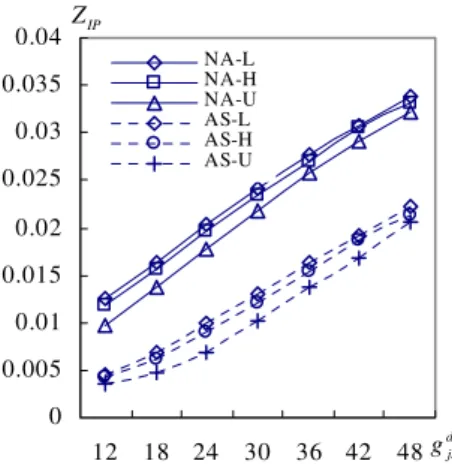
Fig. 3. Blocking as a function of data traffics with v js g =15 and S =1 0 0.005 0.01 0.015 0.02 0.025 0.03 6 9 12 15 18 21 24 NA-L NA-H NA-U AS-L AS-H AS-U IP Z v js g Fig. 4. Blocking as a function of voice traffics with d js g =30 and S =3 0 0.005 0.01 0.015 0.02 0.025 0.03 0.035 0.04 12 18 24 30 36 42 48 NA-L NA-H NA-U AS-L AS-H AS-U IP Z d js g
Fig. 5. Blocking as a function of data traffics with v
js
probability (Z ) as a function of voice (data) traffic intensity with constant data IP
(voice) traffic, in which load balancing scheme v.s. traffic distribution is compared. BLC ratio of v
K vs. d
K (0.5 vs. 0.5) is given.
First of all, without sectorization ( S =1) and given d js
g =30, Z is a function of IP
voice traffic in Fig. 2, while Z is a function of data traffic in Fig. 3 with IP v js
g =15. In
the case of voice intensity v js
g =15 in Fig. 2, no matter which distribution is considered,
proposed AS scheme reduces blocking percentage of (0.0265-0.025)/0.0265*100% = 56.6%. In Fig. 3, much more blocking (up to 0.034) is incurred in case of data intensity
d js
g =48 with NA scheme. Considering sectorization with S =3, Z is harmonically IP
increasing function of data and voice traffics intensity in Fig. 4, and Fig. 5, respectively. This implies that combining sectorization and bandwidth segmentation approaches provides novel adaptive load balancing scheme. In summary, performance improvement that proposed adaptive scheme outperforms power control scheme is about 50%.
5 Conclusion
To maximize entire system capacity in ever-increasing non-uniform distribution, we propose the load balancing mechanism by jointly considering sectorization and hybrid F/CDMA scheme. Experiments show the mechanism is outstanding for performance management. For more practical, further experiments can be conducted, such as more generic cell planning rather than hexagonal cell structure, a great diversity of non-uniform distributions, a lot of BLC combinations.
References
1. W.-M. Tam and F.C.M. Lau, “Analysis of power control and its imperfections in CDMA cellular systems,” IEEE Trans. Veh. Technol., vol. 48, pp. 1706–1717, Sep. 1999.
2. C. U. Saraydar and A. Yener, “Adaptive cell sectorization for CDMA systems,” IEEE J.
Select. Areas Commun., vol. 19, pp. 1041–1051, June 2001.
3. C. Y. Lee, H. G. Kang, and T. Park, “A dynamic sectorization of microcells for balanced traffic in CDMA: genetic algorithms approach,” IEEE Trans. Veh. Technol., vol. 51, pp. 63–72, Jan. 2002.
4. X.H. Chen and K.L. Lee, “A novel adaptive traffic load shedding scheme for CDMA cellular mobile systems,” in Proc. ICCS, 1994, pp. 566–570.
5. X.H. Chen, “Adaptive traffic-load shedding and its capacity gain in CDMA cellular systems,” in Proc. IEE Communications, 1995, pp. 186–192.
6. T. Eng and L. B. Milstein, “Comparison of hybrid FDMA/CDMA systems in frequency selective Rayleig fading,” IEEE J. Select. Areas Commun., vol. 12, pp. 938–951, June 1994. 7. L. Zhuge and V. O. K. Li, “Reverse-link capacity of multiband overlaid DS-CDMA
8. L. Zhuge and V. O. K. Li, “Overlaying CDMA systems with interference differentials,”
Mobile Networks and Applications, vol. 8, pp. 269–278, 2003.
9. J. S. Kaufman, “Blocking in a shared resource environment,” IEEE Trans. Commun., vol. 29, pp. 1474–1481, 1981.
10. M. L. Fisher, “The Lagrangian Relaxation Method for Solving Integer Programming Problems,” Management Science, vol. 27, pp. 1–18, 1981.