LANGUAGE AND LINGUISTICS 4.2:429-455, 2003 2003-0-004-002-000026-1
Doubts About Complementation: A Functionalist Analysis
*Shuanfan Huang
National Taiwan UniversityThe complementation construction in Chinese, like other grammatical constructions, is shown to be highly heterogeneous, and dominated by a number of lexically specific syntactic patterns and schemas. The construction is also shown to be on a grammaticization path, with mental predicates and their subjects having been largely grammaticized as epistemic or deontic formulas or as lexicalized prefabs. In terms of social actions, parties to a conversation in a data base are shown to consistently perform actions with their turns oriented toward the complement clauses, rather than to the matrix clauses. This is demonstrated by looking at adjacency pairs (rather than isolated sentences) and observing what the participants are trying to do. Finally, based on the distribution pattern of the linker morpheme
shuo, an important distinction is seen emerging in spoken Chinese between de dicto and de re complements, with the former marked by the linker shuo, and the
latter by its absence.
Key words: complementation, construction schema, social action, network
1. Introduction
Two leading ideas have emerged from recent research in functional linguistics. One idea is that the study of grammar should be informed by a consideration of language use in the wider context of social interaction. Functionalists and CA researchers have demonstrated that an important dimension of linguistic structures is their moment-by- moment evolving interactive production, which is a consequence of the fact that the notion of indexicality is a pervasive design feature of talk-in-interaction. (Cf. many of the papers collected in Ochs et al.)
A second leading idea is that grammatical structuration is the process of automatization of frequently occurring sequences of linguistic elements. With repetition, what were previously independent sequences of units come to be processed as pre-stored prefabs.
* Earlier versions of this paper were presented at the First International Conference on Cognitive
Linguistics at Chengchi University on January 13-15, 2002, and the Fourteenth North American Conference on Chinese Linguistics at the University of Arizona, May 17-19, 2002. I wish to thank the audiences at these conferences, the two anonymous reviewers of this journal for their very useful comments, and Sandy Thompson for fruitful discussions of some of the issues addressed in the paper. The usual disclaimers apply.
430
This applies to all cases of grammaticization, including what is traditionally termed the complementation construction. In this paper, I propose to discuss ways in which frequency and grammatical category interact in the grammaticization of the complement construction in Chinese.
Complementation constructions have been a major focus of research in linguistics (Kiparsky & Kiparsky 1970, Hooper 1976, Grimshaw 1979, Givon 1980, Noonan 1986, Ransom 1986, Frajzyngier 1995, Thompson 2002, Thompson & Mulac 1991, Diessel and Tomasello 2001, Biber et al. 1999). In much of the current thinking, complementation constructions, based on constructed data, have the following structures:
(i) Complementation refers to structures where a notional sentence functions as an argument of a main clause predicate, i.e., as a subject or object. The complements are in italics below:
(a) That John fell off his horse surprised Mary.
(b) John’s falling off his horse surprised Mary.
(c) For John to fall off his horse surprised Mary.
(ii) There are a variety of complement types: sentential complement, as in (a); gerundial complement, as in (b); infinitival complement, as in (c).
(iii) Some complement types are accompanied by a complementizer which functions to identify the construction as a complement. In (a), the complementizer is
that; in (b) ’s …-ing and in (c), to.
(iv) Choice of a complementizer is jointly determined (controlled) by the meaning of the complement type together with the meaning of the matrix predicate. Recently, a number of empirical findings that challenge this majority view have emerged (Biber et al. 1999, Diessel and Tomasello 2001, Thompson and Mulac 1991, Thompson 2002). Most important is the discovery that a preponderance of the ‘complementation’ utterances in the corpus is organized around just a handful of complement-taking verbs, each with its own characteristic syntactic patterns, not around any system-wide syntactic categories or schemas. And this finding appears to apply to all types of grammatical constructions that have been investigated. These new data are most naturally accounted for by a cognitive-functional approach, in which grammar is characterized in terms of the cognitive and communicative processes involved. What can be inductively observed from current data is that the complementation construction is dominated by a number of lexically specific syntactic patterns and schemas. More abstract linguistic categories and generalized schemas of varying levels of complexity may be justifiable, but at varying degrees of difficulty.
Doubts About Complementation: A Functionalist Analysis
431 In this study I suggest that the best way to understand complementation (and grammatical structure in general) is to treat it as an interactional object in its own right in talk-in-interaction. This approach sees interpretation and action as inherently interconnected and thus allows for a widening of scope to encompass a consideration of the sequences in which a given turn in the use of a symbolic unit is placed and the contribution of the turn itself. I argue that the complementation construction in Chinese, as other grammatical constructions, is a highly heterogeneous construction. A broadly characterized complementation construction is needed to sanction the varied instantiations found in the conversational data. The construction constitutes a vast network of instantiations, which may be linked to one another by a complex relation of extensions and reïnterpretations (Langacker 1987, Diessel and Tomasello 2001). Such a network represents constructions at different levels of abstraction, ranging from item-specific utterances, that are stored as routinized formulæ, to utterances of greater schematicity (Langacker 1987, 2000, Diessel and Tomasello 2001). What is new in my account is an attempt to understand Chinese complementation in terms of the most recent research and theory on grammaticization. I bring a new set of data and observations to bear on the theorizing about complementation, and I argue that an important distinction appears to be emerging in Chinese between de dicto and de re complements, with the former marked by the linker shuo, and the latter marked by its absence.
2. Methodology and database
The present study is based on conversational data taken from the NTU Spoken Chinese Corpus. Forty-six conversational fragments formed the database for this study. They ran to six hours and twenty-five minutes, for a total of 20,780 IUs (approximately 72,500 words).
The corpus was then searched for utterances containing both what would in the traditional analyses count as a matrix clause (complement-taking verb & its subject) and a complement-clause. These verbs were ‘de dicto’ predicates (mental predicates or verbs of saying), but utterances occurring with the main verb shuo ‘say’ were excluded, not because the verb is of no linguistic significance, but because, on the contrary, shuo is the single most common verb overall, both in the entire NTU corpus and in the present corpus, and deserves a separate study in its own right. Utterances meeting the above criteria were coded for the following features (cf. Diessel and Tomasello 2001):
a) The subject of the matrix clause (e.g., 1s.sg.pron, lex NP, etc.); b) The tense and aspect features of the matrix verb;
432
d) The order of the matrix clause relative to the Comp-clause;
e) The presence or absence of the linker morpheme shuo ‘say’ in the matrix clause.
3. Results
3.l Matrix verb types
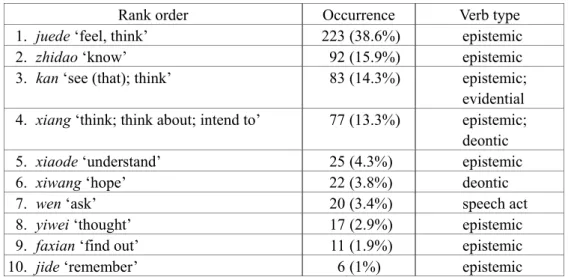
A total of 38 matrix verb types were found in the corpus; half of which (18) occurred only twice or less in the sample. The ten most frequently occurring verbs are given in Table 1.
Table 1: Matrix verbs and their occurrences
Rank order Occurrence Verb type
1. juede ‘feel, think’ 223 (38.6%) epistemic
2. zhidao ‘know’ 92 (15.9%) epistemic
3. kan ‘see (that); think’ 83 (14.3%) epistemic; evidential 4. xiang ‘think; think about; intend to’ 77 (13.3%) epistemic;
deontic
5. xiaode ‘understand’ 25 (4.3%) epistemic
6. xiwang ‘hope’ 22 (3.8%) deontic
7. wen ‘ask’ 20 (3.4%) speech act
8. yiwei ‘thought’ 17 (2.9%) epistemic
9. faxian ‘find out’ 11 (1.9%) epistemic
10. jide ‘remember’ 6 (1%) epistemic
Eight of the top 10 matrix verbs are epistemic verbs (juede, zhidao, kan1, xiang,
xiaode, yiwei, faxian); utterances occurring with a top-ten matrix verb make up 90.8%
(578/636) of all the ‘complementation’ utterances in the database. This means that if we understand the behavior of these top 10 matrix verbs, we shall have come to grips with what ‘complementation’ really is, and this is what we shall do in the following sections.
The top 10 matrix verbs, as do all of the 38 matrix verbs found in the database, fall into four semantic types:
(a) epistemic: juede, zhidao, kan1, xiang1, jide (b) evidential: kan2
(c) speech act: wen
Doubts About Complementation: A Functionalist Analysis
433 It may be of some interest to observe that the top three mental verbs in the present database are also matched by the same three most common mental verbs in English, namely, see, know, and think. Each of these three English verbs was found to have over 2000 occurrences per million words (Biber et al. 1999). Pending a more careful analysis, the occurrences for the top four mental verbs juede, kan, zhidao, and xiang, which together appear to cover the same semantic and functional ranges as the three English verbs, can be shown, based on Table l and the total word count of the database (72,500 words), to be roughly 3,075, 1,269, 1,145 and 1,063 per million words, and they together come to just over 6,000 occurrences, a figure comparable to that for the English verbs.
3.2 Juede
Juede is not only the most commonly occurring matrix verb; it is also unique: 80%
(178/223) of the juede-marked clauses have the same grammatical pattern: they always occur in the present, indicative, active, with a first person singular pronoun as subject, or an anaphoric zero. Wo juede ‘I think’ is always used as an epistemic formula that is loosely adjoined to the Comp-clause (cf. Thompson and Mulac 1991).
True to its status as an epistemic formula, wo juede is found to have three instantiations, placed in different positions in the conversational turn (TCU = ‘turn construction unit’): TCU-initial, TCU-medial, and TCU-final. A total of fifteen tokens of wo juede occurred in these positions, the highest for any matrix verb, which is further evidence that juede has grammaticized furthest along as an epistemic formula. Such syntactic flexibility has been shown to be both a resource to be exploited and a constraint on the interaction (Schegloff 1996). It is thus only natural that wo juede is exploited by interactional exigencies. One possible role for wo juede is to create a possible interactional space for transition to the next speaker.
(1) [Assignment]
705 A: jiushi zheyangzi 就是 這樣子
is precisely so
706 ..qishi zhe zuoye
其實 這 作業 in fact this project
707 ..hai man youqu de.
還 蠻 有趣 的
still very interesting NOM 708 ..wo juede la.
我 覺得 啦
434
709 Erqie,
而且
moreover
710 qishi wo juede yue duo-- 其實 我 覺得 越 多 in fact I think the more 711 xiang zheyang zuoye,
像 這樣 作業
like this project
712 yue duoren taolun,
[越 多人] 討論
Yue more people discuss
713 B: yue duoren
[越 多人]
Yue more people
714 A: jiu yue hao. 就 越 好
then Yue better
715 B: hm.\
A: That’s the way it is. As a matter of fact, the assignment is pretty interesting. (That’s) how I feel. Moreover, I think (with) projects like this, the more people get together and discuss them, the better.
Earlier in the exchange, A and B had been discussing the merits of an assignment for which they and others in a psychological counseling class had been asked to profile personality traits of their fellow students. In the fragment in (1), A’s contribution at line 708 is at a possible end of a TCU; on its possible completion, transition to the next speaker becomes relevant, though that opportunity is not taken by speaker B, whereupon A extends the current topic in a new direction by suggesting an additional merit of the project.
A careful characterization of the differences between TCU-initial, as seen in line 710 in (1), and TCU-final uses of wo juede cannot be undertaken here, but here is a preliminary observation: A TCU-initial wo juede is more likely to be used as a particular type of activity of ‘co-positional’ informing in response to a question raised or a suggestion made, in a prior turn. A repeated use of wo juede in TCU-initial or TCU-medial position, on the other hand, is often heard as a self-repair, a temporizer. A TCU-final wo juede appears to register that the TCU to which it is appended is performing an action that ‘weakly’ runs counter to the response projected in a prior turn. At line 708 in (1), for example, A is coming out much more strongly than B in favor of
Doubts About Complementation: A Functionalist Analysis
435 completing the project. In this position, wo juede also marks the turn as informing; the stance of the speaker, however, is not to endorse, but to suggest an alternative.
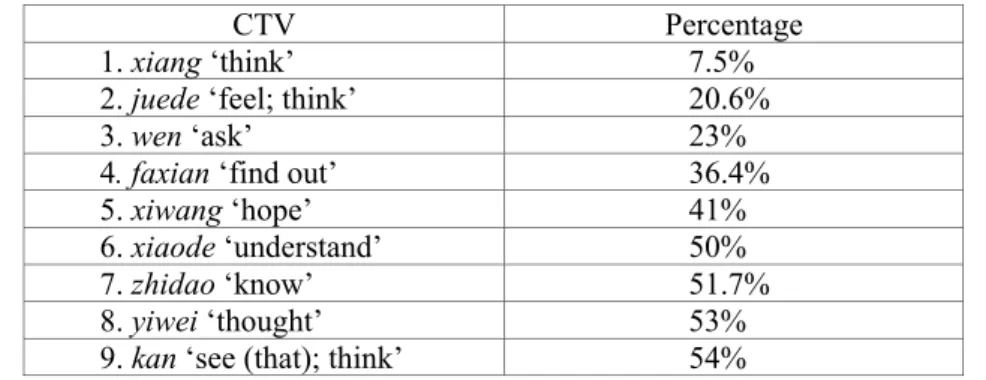
It should be uncontroversial to state that in language production terms, formulaic language would correlate with phases of more fluent speech, with relatively little pausing, and more creative use of language would correlate with more hesitant speech. Given that wo xiang has been shown to be deeply entrenched as an epistemic formula, and that formulaic speech represents pre-packaged information, one would expect the language production mechanism to exploit its cognitive resources for the construction of its complement clause. This would mean, other things being equal, that the production of complement clauses should be in inverse relation to the entrenchedness of the matrix clause. However, the Comp-clauses of wo xiang are often long and complex and require a full turn or TCU to complete; some are never finished or are unfinishable. Only 20.6% (46/233) of its Comp-clauses are completed within one IU, the next lowest of any matrix verb (the lowest being xiang, at 7.5%), while the percentage for another epistemic verb
kan, at 54%, is much higher. Table 2 gives the percentages of Comp-clauses of the top
nine matrix verbs completed within one IU.
Table 2: Percentages of Comp-clauses completed within one IU (in ascending order)
CTV Percentage 1. xiang ‘think’ 7.5%
2. juede ‘feel; think’ 20.6%
3. wen ‘ask’ 23%
4. faxian ‘find out’ 36.4%
5. xiwang ‘hope’ 41%
6. xiaode ‘understand’ 50%
7. zhidao ‘know’ 51.7%
8. yiwei ‘thought’ 53%
9. kan ‘see (that); think’ 54%
Such strong empirical skewings need to be accounted for in a comprehensive study of complementation. Part of the explanation may, however, have to do with the fact that
wo xiang is, as I will show below, the canonical mental predicate involved in occurrent
thought in an utterance in which it occurs.
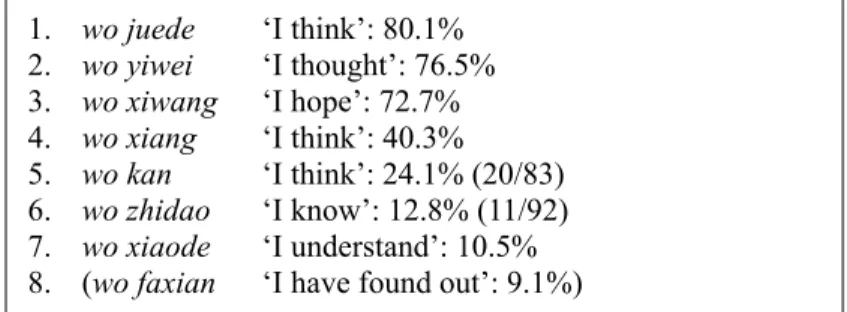
While wo juede has grammaticized as an epistemic formula, most of the other matrix verbs have other more frequent uses. Wo xiang is more often used (59.7%) as a deontic verb (“I am/was thinking about”; “I was to”; “I am deciding”) rather than as an epistemic verb. Table 3 presents the percentages of matrix clauses with first person subject used as epistemic expressions.
436
Table 3: Percentages of matrix clauses used as epistemic expressions (in descending order)
Considering the data in Table 3, we conclude that it is wo juede that functions as the most prototypical member of the category of epistemic expressions.
3.3 Kan
Kan ‘see that, think’ is unique in that it is more often used with a second-person
pronoun subject to form an utterance launcher/story preface ni kan ‘look, you see’ (42.8%). Ni kan ‘you see’ often occurs by itself in a separate IU as an attention getter and thus cannot be analyzed as a CTV taking a complement clause. When kan is used with a (non-anaphoric) zero subject, with a third person subject (often the inanimate na ‘that’), or with a (non-anaphoric) zero subject, to mean ‘that depends on’, the expressions involving ø kan/na kan are always followed by an interrogative clause (19.6%).
3.4 Zhidao
The second most frequent ‘matrix’ verb is zhidao ‘know’, and significantly, 43.4% (40/92) of these items occur in a negative construction, often with first-person subject or non-anaphoric zero subject. Wo buzhidao ‘I don’t know’ is used as a response to a question or, equally frequently, as a “puzzle marker” in turn-medial or turn-final position, with strong pragmatic import. Wo zhidao ‘I know’ is seldom used as an epistemic clause, as indicated above, but more likely used as a continuer, or as a change-of-state formula meaning, “Oh I see; now I understand”. Ni zhidao (NP) (ma) “Do you know” is nearly always used as a story preface, if the NP is not present, or as a referent introducer, if the NP is present (Huang 1999). Interestingly, Buzhidao, with a non-anaphoric zero, has grammaticized into an epistemic adverb and means something like ‘somehow; unbeknownst (to anyone)’. As seen in (2) and (3):
1. wo juede ‘I think’: 80.1% 2. wo yiwei ‘I thought’: 76.5% 3. wo xiwang ‘I hope’: 72.7% 4. wo xiang ‘I think’: 40.3% 5. wo kan ‘I think’: 24.1% (20/83) 6. wo zhidao ‘I know’: 12.8% (11/92) 7. wo xiaode ‘I understand’: 10.5% 8. (wo faxian ‘I have found out’: 9.1%)
Doubts About Complementation: A Functionalist Analysis
437 (2) [KTV]
287 B: ranhou jiu…haoxiang buzhidao…jiushi haoxiang 然後 就 好像 不知道 就是 好像
and then it seems not know PF it seems
buzhidao zhuang dao sheme de, ranhou jiu hen bushuang a
不知道 撞 到 什麼 的 然後 就 很 不爽 啊
not know bump into something and then Jiu very pissed off FP “And then somehow (he) bumped into something and got really pissed off.”
(3) [Theft]
46 L: qianmian yige ren zai kan dianshi,
前面 一 個 人 在 看 電視
in front one person be at watch TV ..houmian liangge ren zai kan dianshi,
後面 兩個 人 在 看 電視
in the back two person at watch TV
..silou yige ren zai shuijiao.
四樓 一個 人 在 睡覺
fourth floor one person at sleep
…a na xiaotou jingran --
啊 那 小偷 竟然
IP that burglar unexpectedly
…buzhidao duo zai sheme difang
不知道 躲 在 什麼 地方
not know hide at what place
…ranhou qianjinqu.
然後 潛進去
and sneak in
We have shown then that zhidao has a wide variety of uses, most of which are formulaic prefabs, stored as processing units. Wo zhidao is either a continuer, or a change-of-state expression; wo buzhidao is a puzzle marker; ni zhidao (ma) is a story preface; and finally buzhidao, with a non-anaphoric zero subject, is an epistemic adverb meaning ‘unbeknownst (to anyone)’.
Xiwang ‘hope’ has a most straightforward grammatical pattern: all of the xiwang-
marked matrix clauses occur in the present indicative; they are never negated; and 72.7% (16/22) of them take a first-person pronoun as subject. These matrix clauses as deontic expressions are highly formulaic.
438
3.5 Xiang as the canonical mental predicate
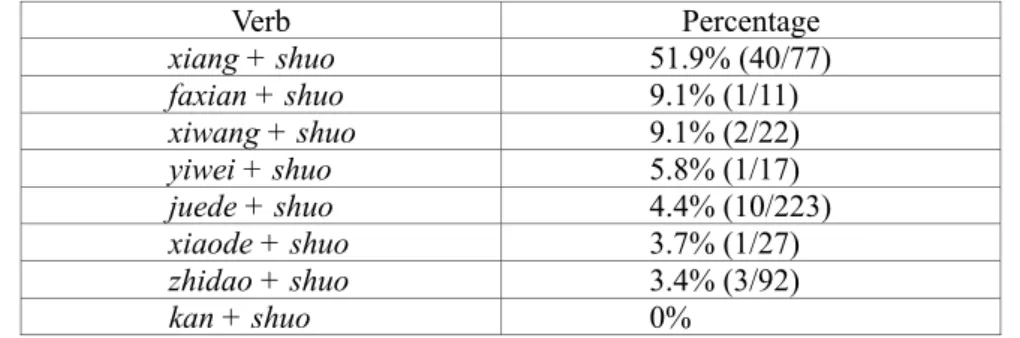
Xiang ‘think, think about, intend to’ is unique because 51.9% (40/77) of the xiang-marked matrix clauses take the linker shuo, the highest rate of any matrix verb. Xiang is used either as an epistemic verb, meaning ‘I think’, or as a deontic verb, meaning
something like ‘I am thinking about, I intend to’, and it is largely in its use as a deontic verb that it is found to occur with the linker shuo. When xiang is used this way, the complement clauses that follow are frequently preceded by the speech act particle yi, or
eh, meaning something like “gee, hey”. I suggest that, contrary to the current popular
analysis, in which it is viewed as an essentially optional complementizer, the linker
shuo in these matrix clauses is best understood as a ‘de dicto introducer’, since it marks
the following clause as being in the semantic domain de dicto, in which reference is made to the elements of speech rather than to the elements of reality (cf. Frazyngier and Jasperson 1991). In other words, an important distinction appears to be emerging in spoken Chinese between de dicto and de re complements, with the former marked by the linker shuo, and latter marked by its absence. It is precisely this division of labor that underpins the existence of multiple epistemic verbs. Table 4 presents the percentages of the matrix verbs occurring with the linker shuo. Note that, according to this table, the verb xiang is the only verb in strong collocation with shuo.
Table 4: Percentages of matrix verbs occurring with the linker shuo (in descending order)
Verb Percentage xiang + shuo 51.9% (40/77) faxian + shuo 9.1% (1/11) xiwang + shuo 9.1% (2/22) yiwei + shuo 5.8% (1/17) juede + shuo 4.4% (10/223) xiaode + shuo 3.7% (1/27) zhidao + shuo 3.4% (3/92) kan + shuo 0%
Xiang is unique in yet another way. It is well known that in the folk model of
thought, thought is inner speech, obviously a case of metaphorizing thought in terms of speech. Since speaking is an act, a canonical mental thought that reflects this folk model must also be a mental act. Xiang is apparently the most canonical of all mental predicates. Of the top ten matrix verbs, it is the only mental-act verb and thus occurs most readily with shuo, which originated as a speech-act verb. These xiang shuo-marked utterances can be used to present what one is or was thinking as a direct quote, although it is true that, as Chafe (1994:221) has observed, such utterances introducing direct thought are relatively infrequent, compared to utterances about indirect thought.
Doubts About Complementation: A Functionalist Analysis
439 Coming back to Table 4, let us observe that kan ‘see (that), think’ never occurred with shuo in the sample. Kan is still strongly perceptual in meaning, making it the least canonical of all mental predicates. Juede is an epistemic predicate, but it is still tied to its perceptual origin (‘to feel’), and its status as a stative predicate disqualifies it as a canonical mental predicate. Similarly, faxian ‘to find out’ is an achieved state, and yiwei ‘thought’ is a mental-act verb, but it reports a belief held up till now rather than an on-line, occurrent thought.
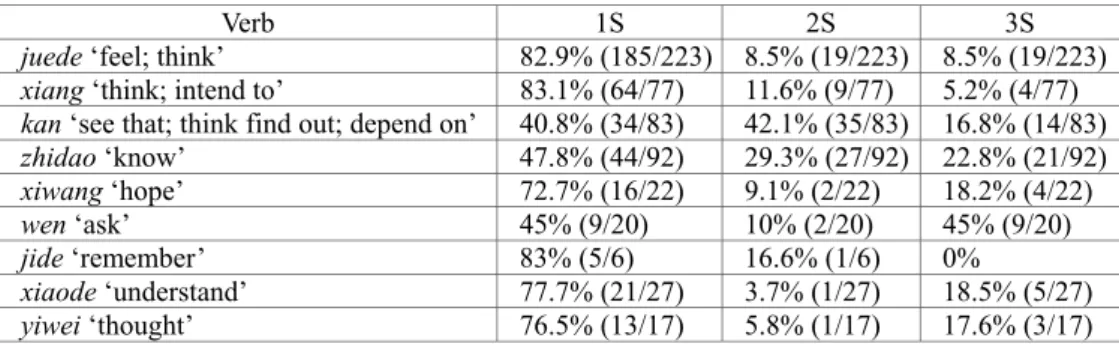
Matrix verbs, as mental predicates, are the domain of subjectivity par excellence. In this domain, one would predict that the first-person singular subject would be the canonical site for the expression of speaker point of view, and that the third-person subject would be the least appropriate. This prediction is indeed borne out by the data. Table 5 presents the percentages of the matrix verbs with first-, second-, and third- person subjects.
Table 5: Percentages of matrix clauses with 1S, 2S, 3S pronoun subjects
Verb 1S 2S 3S
juede ‘feel; think’ 82.9% (185/223) 8.5% (19/223) 8.5% (19/223)
xiang ‘think; intend to’ 83.1% (64/77) 11.6% (9/77) 5.2% (4/77)
kan ‘see that; think find out; depend on’ 40.8% (34/83) 42.1% (35/83) 16.8% (14/83)
zhidao ‘know’ 47.8% (44/92) 29.3% (27/92) 22.8% (21/92) xiwang ‘hope’ 72.7% (16/22) 9.1% (2/22) 18.2% (4/22) wen ‘ask’ 45% (9/20) 10% (2/20) 45% (9/20) jide ‘remember’ 83% (5/6) 16.6% (1/6) 0% xiaode ‘understand’ 77.7% (21/27) 3.7% (1/27) 18.5% (5/27) yiwei ‘thought’ 76.5% (13/17) 5.8% (1/17) 17.6% (3/17)
Table 5 reveals two global trends. First, the most frequent matrix clauses in the corpus are clauses with first person subject, followed by other clause types in a distant second or third place. An overwhelming majority of epistemic matrix clauses with first- person subjects (wo juede; wo xiwang; wo jide, wo yiwei ‘I thought’) consistently communicate the speakers’ subjective stance (epistemic or deontic) with strong pragmatic import, and the basis for the high frequency of these expressions resides in the strong subjectivity of conversational talk.
Secondly, the mental content of ‘other minds’ is generally not accessible to direct observation in a way the content of a first-person subject is, unless it is clothed in verbal garb, i.e., unless it is verbalized by the third person himself. These observations explain most of the distribution patterns shown in Table 5. Truly mental predicates such as
juede, xiang, and jide do not go well with 3S subjects; when they do, they are generally
interpreted as referring to events that have occurred in the past relative to the speech act time; and the attribution of mental state to a third person is then based on that prior
440
verbalized utterance. For example, in order for me to say felicitously, (4) Ta yizhi xiang shuo bu keneng jiehunle.
“She’s always thought that it’d be impossible for her to get married.”
She must have said or hinted, prior to the speech event of (4), something to the effect that it would be impossible for her to get married. In other words, in (4), the mental content of a third person is remembered by the speaker of the utterance in the form of language, or more frequently, as a belief or opinion.
The distribution patterns of the other verbs in Table 5 can also be accounted for. There is no real problem for speech-act verbs such as wen to take a 3S subject. The verb
kan can take a 3S subject, which, however, must be an inanimate pronoun, usually na
‘that’, or a non-anaphoric zero, and the resulting clause means ‘that depends on’. Since ‘depend on’ is not a mental predicate, kan can thus freely take a 3S subject.
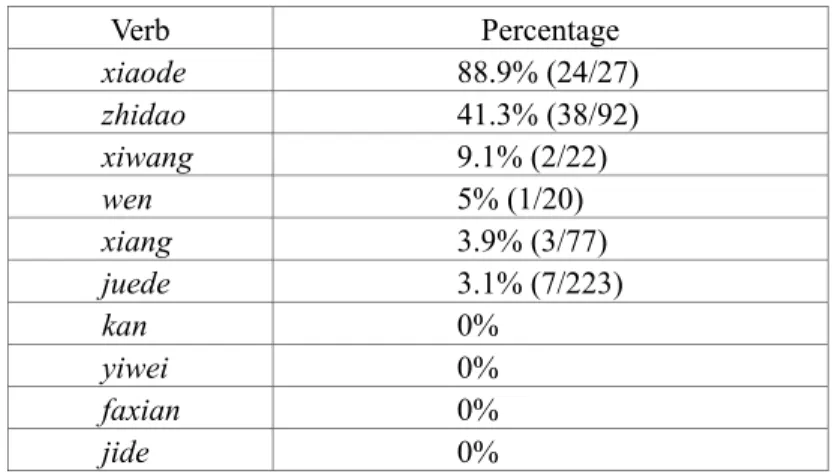
An interesting observation about the verbs xiaode and zhidao is that they appear to create a kind of paradigmatic iconicity by virtue of the syntactic and functional properties they share in common (cf. Krug 200l). Xiaode shows an overwhelming preference for negative contexts; so does also zhidao, though to a lesser degree. (See Table 6 below.) Moreover, the two verbs are also often found to take interrogative complements when negated, as can be seen in (5) and (6).
(5) [Department] 259 F: .. duia,
對啊
yeah 260 : .. tamen buzhidao shuo,
他們 不知道 說 they not know Shuo
261 .. xi limian zuijin you shemeyang de shiqing.
系 裡面 最近 有 什麼樣 的 事情
department inside lately have what kind De matter
262 M: .. duia. 對啊
yeah
Doubts About Complementation: A Functionalist Analysis 441 (6) [Unmarried mother] 380 A: ..danshi ni- - 但是 你 but you
381 … nide pengyou nandao buxiaode ni you yige xiaohai ma.
你的 朋友 難道 不曉得 你 有 一個 小孩 嗎
your freind at all not know you have one child FP A: But didn’t your friend know you had a child?
It is important to observe that it is in these localized contexts, namely negative matrix clauses taking an interrogative complement, that there has come about further grammaticalization of buzhidao as an epistemic adverb (meaning ‘for some unknown reason, unbeknownst to anyone’); this is part of the same general process that has triggered the grammaticization of matrix clauses into epistemic or deontic prefabs. The use of buzhidao as an epistemic adverb is illustrated in (3), repeated below as (7):
(7) [Theft]
46 L: .. qianmian yige ren zai kan dianshi,
前面 一個 人 在 看 電視
in front one person watch TV
47 .. houmian liangge ren zai kan dianshi,
後面 兩個 人 在 看 電視
in the back two person be at watch TV 48 silou yige ren zai shuijiao.
四樓 一個 人 在 睡覺
fourth floor one person be at sleep 49 …(0.7) na xiaotou jingran,
那 小偷 竟然
that burglar unexpectedly
50 …(0.7) buzhidao duo zai sheme difang.
不知道 躲 在 什麼 地方
not know hide in what place 51 .. ranhou qianjinqu.
然後 潛進去
and then sneak in
L: Someone was watching TV in the front and two people were watching TV in the back. And the burglar was hiding somewhere and got into the house without anyone finding out about it.
442
In other contexts, buzhidao is also found to have grammaticized into an epistemic hedge as in (8), a puzzle marker as in (9), or an editing expression in a dominant speakership as in (10). In TCU-final position, it functions to project a turn’s end, as in (11).
(8)
014 F: …(1.14) keshi xiang ta hui juede<L2 Bullets Over
可是 想 他 會 覺得
but like s/he may feel
Broadway L2> jiu hai bucuo a.\ 就 還 不錯 啊
Jiu still okay FP
015 M: …(1.04) na shi yinwei,\ 那 是 因為
that is because
016 M: … shangke yao taolun,\
上課 要 討論
class need to discuss
017 M: .. ta zhihao…(0.95)qiang daqi jingshen lai kan.\
他 只好 強 打起 精神 來 看
s/he had to force keep spirits Lai see
018 F: …(3.45) buzhidao.\ 不知道 not know 019 F: …(0.76) keshi,\ 可是 but 020 F: …(1.06) jiu meiyou le a 就 沒有 了 啊 Jiu nothing Le FP.- 021 F: .. hai you sheme.\
還 有 什麼
still have what
F: (I) don’t know. But then there’s nothing else. What else? (9)
44 E: …<A wo juede zhe hen--A>, 我 覺得 這 很
Doubts About Complementation: A Functionalist Analysis
443 ..<MRC zhe hen MRC> nage ren jiating de jiegou,
這 很 那個 人 家庭 的 結構
this very that person family structure
.. keneng haiyou gen nage ren,
可能 還有 跟 那個 人
maybe further with that person
.. benshen you hen da de guanxi. 本身 有 很 大 的 關係
itself has very big De relation
48 V: …(1.2)oh..(Hx) 49 E: ..(TSK).. buzhidao eh. 不知道 don’t know FP 50 .. nage jiahuo, 那個 傢伙 that guy 51 ..(H) qiguai, 奇怪 strange 52 .. dou meiyou tade xiaoxi.
都 沒有 他的 消息
all have no his information
E: I don’t know. The guy, it’s funny that (we) haven’t heard anything from him.
(10)
168 F: … ranhou,\
然後
and 169 .. wo na shihou kan yugao,\
我 那 時候 看 預告 I that time see preview
170 … nage=…nüzhujiao ta a,
那個 女主角 她 啊
that female actress
171 naxie=,
444
172 …(0.98) buzhidao.\
不知道
don’t know
173 .. haoxiang biaoqing dongzuo dou youdian jia.\
好像 表情 動作 都 有點 假
it seems expression movement all a little phony 174 …(1.09) jiu hen kuazhang nayangzi.\
就 很 誇張 那樣子
Jiu very exaggerate that’s it
175 … jiushi ta zheyang yizhi hen shuai hen shuai
就是 她 這樣 一直 很 衰 很 衰
I mean s/he so always very down
= zheyang.\
這樣
this way
176 M: (0) huN.\
F: And I saw the preview. The actress seems, I don’t know, to act phony. She seems too exaggerated, and so she seems to be completely out of it.
(11)
278 M: .. keshi wo ting qita zhujiao jiang shuo,_
可是 我 聽 其他 助教 講 說
but I heard other assistant say Shuo 279 … ta gaobuhao hui geng gaoxing.\
他 搞不好 會 更 高興
s/he mind you may more happy
280 … keshi,_ 可是 but 281 .. wo juede,_ 我 覺得 I think 282 .. wo buzhidao la.\ 我 不知道 啦 I don’t know FP 283 F: .. na ni jiu xiexiaqu.\ 那 你 就 寫下去
Doubts About Complementation: A Functionalist Analysis
445 M: But I heard from other TAs that maybe he’d be all the happier for it. But, I think--. I don’t know.
Table 6 brings out the spectacular contrast between the behavior of these two verbs in collocation with a negator and that of other matrix verbs.
Table 6: Matrix verbs in collocation with a negator (in descending order) Verb Percentage xiaode 88.9% (24/27) zhidao 41.3% (38/92) xiwang 9.1% (2/22) wen 5% (1/20) xiang 3.9% (3/77) juede 3.1% (7/223) kan 0% yiwei 0% faxian 0% jide 0%
Our point in these sections is that the ten matrix verbs do not really exhibit much homogeneity in their syntactic or functional properties. Each matrix verb is unique in its own way. Only four verbs (juede, yiwei, xiang, and xiwang) occur with first person pronoun subject to a significant degree. Wo xiang, however, is split between its use as a deontic expression and its use as an epistemic expression. Wo yiwei always personalizes the speaker’s previous belief state as being something not in full accord with the present situation. Kan is highly polysemous. Wo kan is epistemic, but kan is much more likely used with a 2S subject to form an utterance launcher. When it occurs with a 3S subject, the collocation means ‘to depend on’ and is thus not a mental predicate anymore. Only two verbs (xiaode and zhidao) are predisposed to occur with a negator and the collocations have developed a number of interesting pragmatic functions, as indicated above.
4. Social action and complementation
Working with child language acquisition data, Diessel and Tomasello (2001) argue that there is a developmental trend leading from parenthetical use of CTV-clauses (i.e.,
446
matrix clauses) via performative use to assertive use. In other words, children acquiring complementation structures in English “learn the noncentral use of CTV/Comp-clauses (i.e., the formulaic use) before they acquire the central or prototypical uses (i.e., the performative and assertive uses)” (Diessel and Tomasello 2001:108). This means that they believe that performative and assertive uses of the CTV-clauses are the norm in adult language and that the Comp-clauses are object complements of the matrix verb.
There are several lines of evidence against taking the Comp-clauses as object complements of the matrix verb. First, superficial grammar notwithstanding, the main verb wen ‘ask’ in (12) and (13) is intransitive:
(12) Ta wen shuo, “dajia dou qule ma.” “He asked, ‘Did everyone go?’” (13) Ta wenshuo dajia dou qule ma.
“He asked if everyone had gone.”
The argument is this: the only possible candidate for object would appear to be the quoted words in (12), but while one can ask by uttering words, the words themselves can’t be said to be asked, i.e., the words constitute a question, but not what was asked. The same consideration applies to the indirect quote in (13). Asking if P is a way of asking, a matter of asking thus, in these terms. Similarly, believing, thinking, or remembering
that P is a matter of believing, thinking, or remembering thus, in these terms. But believing
my words, thinking a strange thought, and remembering my reply are not ways of believing, thinking or remembering, which explains the absence or the impossibility of taking shuo in Chinese (or that in English).
These observations are consonant with the argument by Frajzyngier and Jasperson (1991) that the complementizer that marks the following clauses as belonging to the semantic domain de dicto, in which reference is made to the elements of speech rather than to the elements of reality.
Second, jiushishuo ‘that’s to say, I mean’, an editing expression, frequently appears in the very position in which shuo appears, and functions to coördinate the interaction between speaker and hearer, suggesting that the matrix clause and the Comp-clause are only loosely connected.
(14) [Doctor]
75 L: changchang tixing fumu,
常常 提醒 父母
Doubts About Complementation: A Functionalist Analysis
447 jiushishuo,
就是說
I mean
eh buyao ba jiejie gen didi nalai zuo bijiao.
不要 把 姊姊 跟 弟弟 拿來 做 比較
eh don’t Ba older sister and younger brother do compare L: (You should) constantly remind parents, I mean, hey, do not try to measure older sister and younger brother with the same yardstick.
Third, the Comp-clause is frequently preceded by a speech act particle like eh ‘hey’, as illustrated in (14). Now the speech act particle eh in (14) clearly echoes the speech act verb tixing, repeats its illocutionary force, and signals that what follows is the locus of the speaker’s message.
Another piece of evidence against viewing matrix verbs as main verbs taking Comp- clauses as their objects comes from research findings emanating from CA (Conversational Analysis). A basic analytic concept for CA is an action. Actions are central to the way that participants produce and understand conduct. They are a fundamental part of the meaningfulness of conduct. When we say something, we intend to—and are understood to—perform some action; moreover, we expect an action in response. A pervasive orientation and concern of parties to interaction about any utterance of a speaker is, “What action is that utterance doing or being used to do?”; or, “What is this participant doing in this turn?” A few examples of actions include: greetings, announcing news, acknowledging news, complaining, disagreeing, correcting, telling a joke, and telling a story.
Diessel and Tomasello (2001:102) argue that with verbs like remember, tell, or see
that, the matrix clause expresses the main proposition of the composite structure; and
that the complement proposition serves as a conceptual element of the matrix clause proposition. Examples (15), (16) and (17) are taken from Diessel and Tomasello (2001):
(15) Peter remembered that he had seen this guy before. (16) Peter told Mary that he would not come to the party. (17) Peter saw that Mary was coming.
According to Diessel and Tomasello, (15) describes a cognitive activity, (16) refers to a communicative act (telling), and (17) denotes the perception of an activity (seeing). “Thus the central state of affairs is expressed in the proposition of the CTV-clauses. The Comp-clause proposition is only of second[ary] interest. It is not considered as an independent object of thought. Rather it presents background information that is only
448
relevant in that it plays a certain role within the proposition expressed in the CTV-clause. Thus the Comp-clause is completely embedded in the CTV-clause.” (Diessel and Tomasello 2001:102)
We suggest that to really understand how these matrix clauses work, they need to be seen as parts of larger units, preferably as parts of sequences of turns or TCUs produced by two different speakers, since what the first party in a conversation says both conditions and creates an expectation for what the second party will say. Parties to a conversation are particularly attuned to when to speak and particularly careful at fitting what they have to say with what has just been said. To subject Diessel and Tomasello’s idea to a critical test, the corpus was searched for utterances that contained either the main verb gaosu ‘tell’, or kan, or jide ‘remember’ with a third person subject, as in (15)-(17). A total of just nine utterances in the corpus were found to meet the criteria, seven with the verb kan and two with the verb gaosu. None of them can be shown to work the way Diessel and Tomasello have suggested. Participants in the conversational fragments in which these nine utterances occurred simply do not perform actions with their turns oriented toward the matrix verb, but instead to its complement clause (Schegloff 1996, Thompson 2002). Adjacency pairs in (18)-(21) are fairly typical:
(18) [Dogs]
617 F: wo jide tamen jia you yang yizhi,
我 記得 他們 家 有 養 一隻
I recall they family have kept one 618 ranhou wuyulin chusheng ma?
然後 吳玉麟 出生 嗎
and PN be born QP
619 M: meiyou meiyou. zai ta qian jiu mei yang le
沒有 沒有 在 他 前 就 沒 養 了
no no be at s/he before no keep Le
In (18), at line 617, if all we say is that it is an assertion, done by the ‘main’ verb
jide, ‘remember’, we shall have not said anything really interesting about what F is
doing. F is not asserting that he remembers something, but is indicating his uncertainty (his problem) about the temporal relation between some family’s keeping a dog and the birth of Wu. To which M responds by correcting F’s misunderstanding. Indeed, jide often occurs with hedges like haoxiang or zenme, suggesting that it is largely used as a “weak assertive” to express uncertainty toward a proposition on the part of the speaker. In other words, wo jide in (18) is being used as an epistemic formula.
Doubts About Complementation: A Functionalist Analysis
449 with an important insight into those aspects of language such as actions that speech act theory was meant to study. If we were really interested in what speech does, it would be crucial to look at hearers’ reactions to what is said to them. Speakers use and interpret speech acts as parts of larger sequential units. The adjacency pair is an example of such a large sequential unit. The method of looking at adjacency pairs (rather than isolated utterances) offers a better sense of what speakers are trying to do.
(19) [College]
178 B: ni bujuede wo hen hun ma.
你 不覺得 我 很 混 嗎
you don’t think I very goof around QP 179 A: buhui hen hun a. wo hai bushi yiyang.
不會 很 混 啊 我 還 不是 一樣 not very goof FP I also be not same 178 B: You didn’t think I’m goofing around too much? 179 A: Not at all. I am pretty much the same, right? (20) [College]
220 B: zhe zhende bushi ren zhu de difang. ni bu juede ma. 這 真的 不是 人 住 的 地方 你 不 覺得 嗎 this really not people live De place you not feel QP 221 A: keshi wo yizhi xiangbutong. weisheme jiazhang jiu=,
可是 我 一直 想不通 為什麼 家長 就
but I always not understand why parents Jiu xihuan zijide haizi dou dao taibei lai nianshu.
喜歡 自己的 孩子 都 到 台北 來 唸書
like own kid all to Taipei come study 220 B: This is hardly a livable place. Don’t you think?
221 A: What I don’t understand is why parents would insist on sending their kids to Taipei for schooling.
(21) [News]
66 H: huibuhui juede jiu hen ciji, hen juyou tiaozhanxing.
會不會 覺得 就 很 刺激 很 具有 挑戰性
450
67 C: jueduishi. baifenzhibai juyou tiaozhanxing de gongzuo.
絕對是 百分之百 具有 挑戰性 的 工作
absolutely hundred percent with challenge De work 66 H: Do you think it’s exciting and challenging?
67 C: Absolutely. It’s a 100% challenging job!
In (19), A responds to the ‘complement’ clause in B’s utterance. In (20), A also responds to the ‘complement’ clause in B’s utterance. Here it looks natural and uncontroversial to say that the first part of B’s utterance is his/her main assertion, since the ‘matrix’ clause has now reduced itself to a parenthetical formula. In (21), the matrix verb is in an A-not-A form and would thus, according to traditional accounts, constitute the main focus of the speaker’s assertion, and yet speaker C responds only to her ‘complement’ clause.
Preferred responses such as those shown above give us a sense of what is considered to be normal or expected in such situations. “The meaning of any single grammatical construction is interactionally contingent, built over interactional time in accordance with interactional actualities. Meaning lies not with the speaker nor the addressee nor the utterance alone, but rather with the interactional past, current and projected next moment.” (Schegloff et al. 1996:40).
As a final piece of evidence for claiming that the matrix clause is really not the main clause but is in fact conceptually embedded to the Comp-clause, it is of some theoretical significance to observe that in Tsou, an Austronesian language spoken in southwest Taiwan, one type of ‘matrix clause’, when headed by an epistemic verb, though certainly not all types of matrix clauses, is introduced as a subordinate clause marked by the subordinator ho ‘when, if’, as illustrated in (22).
(22) ho os’o ta’to’tohUngva te asansanno esmi ‘o PaicU when NAF-lst think Fut be sure come Nom PN “I think PaicU will be here” ( Lit., “When I think, PaicU will be here”) The point is that what is traditionally conceived of as the main clause is actually treated as a subordinate clause in this language. The Tsou data thus provide an indirect —yet compelling—support for the position taken in this paper.
5. Interim summary
Doubts About Complementation: A Functionalist Analysis
451 have all the classic symptoms of prefabricated expressions. The are always short and formulaic; the subject of the matrix clause is predominantly 1S pronoun or an anaphoric zero (but interpretable as 1S person); the epistemic matrix verb is nearly always in the present indicative; there are no modals in the matrix clause and the Comp-clause tends to be much longer, more diverse, and takes greater effort (more IUs) to complete. Finally, the order of matrix clause and Comp-clause is variable, especially the epistemic wo juede, (wo) buzhidao, and ni juede ne (cf. Diessel and Tomasello 2001:107). The conclusion is thus inevitable that the so-called complementation construction is actually a composite structure consisting of an epistemic, evidential, or deontic expression, a clause that expresses the main proposition of the whole utterance, and a contingently determined linker shuo mediating the two parts of the structure. Epistemic, evidential or deontic expressions contain mental predicates. Since mental acts or mental states can have an intentional object (an individual, as in John loves Mary; a state of affairs, as in John thinks Mary is
going; or both at once, as in John wishes Mary were happier), we shall say that these
epistemic, evidential, or deontic expressions project a proposition where epistemic truth or evidential validity or deontic plausibility can then be assessed. For instance, epistemic truth depends on a match between the internal structures of (complement) propositions and the way the world is.
6. Complementation and construction schema
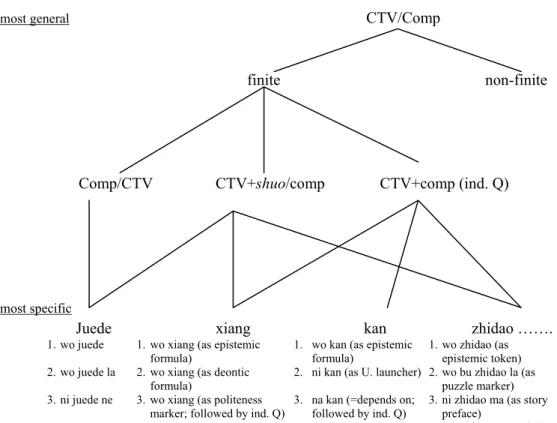
The question that now remains is: How to characterize the Chinese complementation construction, given the above results? Obviously at the highest level of abstraction, the construction can be characterized by means of the schema [Matrix-clause/Comp-clause], where the Matrix-clause is now reïnterpreted as a clause that contains a de dicto predicate (mental predicates or verbs of saying), and the Comp-clause is reïnterpreted as the ‘main’ clause of the composite structure. This is obviously inadequate, however, since it implies that we can take any de dicto clause and combine it with any other clause to form an acceptable “complementation” sentence. In order to avoid this, we need to supplement the syntactic schema with a statement of the kinds of items that can instantiate its various parts. Our ability to form such a highly abstract schema for language use is a question of continuing debate. At any rate, we assume that the more general schemas at a number of levels are emergent from token utterances with more specific schemas. Fig. 1, adapted from Diessel and Tomasello (2001), displays the wide heterogeneity of the complement constructions as instantiated in the corpus data in a complex network relationship. There is, to be sure, evidence for a category of matrix-clause. But not all de dicto predicates are created equal. We have shown that each de dicto, especially epistemic predicate, is unique in its own way. For example, wo juede has been shown to have grammaticized
452
furthest along as an epistemic formula, as evidenced by its ability to appear in a variety of positions both in a turn and in relation to its ‘complement’.
most general CTV/Comp
finite non-finite
Comp/CTV CTV+shuo/comp CTV+comp (ind. Q)
most specific
Juede xiang kan zhidao …….
1. wo juede 1. wo xiang (as epistemic
formula) 1. wo kan (as epistemic formula) 1. wo zhidao (as epistemic token) 2. wo juede la 2. wo xiang (as deontic
formula)
2. ni kan (as U. launcher) 2. wo bu zhidao la (as puzzle marker) 3. ni juede ne 3. wo xiang (as politeness
marker; followed by ind. Q)
3. na kan (=depends on; followed by ind. Q)
3. ni zhidao ma (as story preface)
4. buzhidao (as S. adv.)
Fig. 1: Network of complement constructions in spoken Chinese
7. Conclusion
I hope to have shown in this paper that complementation structures in Chinese are not embedding structures, but are combinations of lexically specific epistemic or deontic expressions, such as wo juede or wo xiang, with a main clause. The Chinese complementation construction, like any other construction, is a grammaticizing construction on a grammaticalization path, with mental predicates and their subjects having being largely grammaticized as epistemic or deontic formulæ or as lexicalized prefabs. They ‘project’, and are loosely joined to, the (following) main proposition.
Mental predicates in the grammaticizing construction appear to be drawn from a set that is largely culturally independent. These results are consistent with recent findings in functional and cognitive linguistics that grammar is a pastiche of lexically
Doubts About Complementation: A Functionalist Analysis
453 skewed and well learned linguistic patterns.
I have also shown that interpretation and action are intimately intertwined, as has been suggested by a number of researchers in functional linguistics and in CA. Parties to a conversation in the corpus indeed consistently perform actions with their turns oriented toward the complement clauses, rather than to the matrix clauses. This is demonstrated by looking at adjacency pairs, rather than at isolated utterances, and observing what speakers are trying to do.
Finally, based on the distribution pattern of the linker shuo, I have argued that an important distinction appears to be emerging in spoken Chinese between de dicto and
de re complements, with the former marked by the linker shuo, and the latter by its
absence.
References
Biher, Douglas et al. 1999. Longman Grammar of Spoken and Written English. London: Longman.
Diessel, Holger, and M. Tomasello. 2001. The acquisition of finite complements clauses in English: A corpus-based analysis. Cognitive Linguistics 12:97-141.
Frajzyngier, Zygmunt. 1995. A functional theory of complementizers. Modality in
Grammar and Discourse, ed. by J. Bybee and S. Fleixchman, 475-502. Amsterdam:
John Benjamins.
Frajzyngier, Zygmunt, and R. Jasperson. 1991. That-clauses and other complements.
Lingua 83:137-153.
Givon, Talmy. 1980. The binding hierarchy and the typology of complements. Studies in
Language 4:333-377.
Grimshaw, Jane. 1979. Complement selection and the lexicon. Linguistic Inquiry 10:279-326.
Hooper, Joan. 1976. On assertive predicates. Syntax and Semantics, vol. 4, ed. by John Kimball, 91-124. New York: Academic Press.
Huang, Shuanfan. 1982. On the (almost perfect) identity of speech and thought.
Proceedings of the 14th International Conference on Sino-Tibetan Languages and Linguistics, 171-186.
Kiparsky, Paul, and Carl Kiparsky. 1970. Fact. Progress in Linguistics, ed. by M. Bierwish. The Hague: Mouton.
Langacker, Ronald. 1987. Foundations of Cognitive Grammar, vol. 1: Theoretical
Prerequisites. Stanford: Stanford University Press.
454
Language, ed. by M. Barlow and S. Kemmer. Stanford: CSLI Publications.
Li, Charles N., and Sandra A. Thompson. 1981. Mandarin Chinese: A Functional
Reference Grammar. Berkeley: University of California Press.
Noonan, Michael. 1985. Complementation. Language Typology and Syntactic Description, ed. by Timothy Shopen, 42-140. Cambridge: Cambridge University Press.
Ochs, E., E. Schegloff, and Sandra Thompson. (eds.) 1996. Interaction and Grammar. New York: Cambridge University Press.
Ransom, Evelyn. 1986. Complementation. Amsterdam: John Benjamins.
Schegloff, Emanuel. 1996. Confirming allusions: Toward an empirical account of action.
American Journal of Sociology 102:161-216.
Schegloff, Emanuel. 1996. Turn organization: One intersection of grammar and interaction.
Interaction and Grammar, ed. by Ochs et al., 52-133. New York: Cambridge
University Press.
Schegloff, Emanuel, Elinor Ochs, and Sandra Thompson. 1996. Introduction. Interaction
and Grammar, ed. by Ochs et al., 1-51. New York: Cambridge University Press.
Thompson, Sandra A. 2002. ‘Object complements’ and conversation: Towards a realistic account. Studies in Language 26:125-163.
Thompson, Sandra A., and Anthony Mulac. 1991. A quantitative perspective on the grammaticalization of epistemic parentheticals in English. Approaches to
Grammaticalization, vol. 2, ed. by B. Heine and Elizabeth Traugott, 313-329.
Amsterdam: John Benjamins.
[Received 14 October 2002; revised 13 December 2002; accepted 16 December 2002] Graduate Institute of Linguistics
National Taiwan University 1, Sec. 4, Roosevelt Road Taipei 106, Taiwan [email protected]
Doubts About Complementation: A Functionalist Analysis 455