Magnetocaloric effect and magnetic properties of Tb
0.9Sn
0.1MnO
3 F. Wolff Fabrisa兲SUPRATECS, Montefiore Institute of Electricity, B28, University of Liège, B-4000, Liège, Belgium M. Pekala
Department of Chemistry, Warsaw University, Al. Zwirki i Wigury 101, 02-089 Warsaw, Poland V. Drozd
Department of Chemistry, National Taiwan University, Roosveld Rd., Section 4, Taipei, Taiwan J-F. Fagnard and Ph. Vanderbemden
SUPRATECS, Montefiore Institute of Electricity, B28, University of Liège, B-4000, Liège, Belgium Ru-Shi Liu
Department of Chemistry, National Taiwan University, Roosveld Rd., Section 4, Taipei, Taiwan M. Ausloos
SUPRATECS, B5, University of Liège, B-4000, Liège, Belgium
共Received 22 November 2006; accepted 13 March 2007; published online 18 May 2007兲
The magnetocaloric effect in magnetic materials is of great interest nowadays. In this article we present an investigation about the magnetic properties near the magnetic transition in a polycrystalline sample of a manganite Tb0.9Sn0.1MnO3. Particularly, we are interested in describing the nature of the magnetic interactions and the magnetocaloric effect in this compound. The temperature dependence of the magnetization was measured to determine the characteristics of the magnetic transition and the magnetic entropy change was calculated from magnetization curves at different temperatures. The magnetic solid is paramagnetic at high temperatures. We observe a dominant antiferromagnetic interaction below Tn= 38 K for low applied magnetic fields; the presence of Sn doping in this compound decreases the Néel temperature of the pure TbMnO3 system. A drastic increase in the magnetization as a function of temperature near the magnetic transition suggests a strong magnetocaloric effect. We found a large magnetic entropy change ⌬SM共T兲 of about −4 J/kg K at H=3 T. We believe that the magnetic entropy change is associated with the magnetic transition and we interpret it as due to the coupling between the magnetic field and the spin ordering. This relatively large value and broad temperature interval共about 35 K兲 of the magnetocaloric effect make the present compound a promising candidate for magnetic refrigerators at low temperatures. © 2007 American Institute of Physics.关DOI:10.1063/1.2732453兴
I. INTRODUCTION
The magnetocaloric effect results in a material tempera-ture change under an external magnetic field change.1 An applied field will tend to align the magnetic spins and thus decreases the total entropy of the spin system. Therefore the magnetocaloric effect is the result of the magnetic entropy change ⌬SM共T兲 arising from the coupling of the magnetic spin system of the solid with the external applied magnetic field. Recall that the total entropy of a magnetic solid is the sum of the lattice, electronic, and magnetic entropies. In most cases, the lattice and electronic entropies are essentially independent of the magnetic field H, whereas the magnetic entropy is strongly dependent on H. Therefore it is of interest to look for materials presenting such high changes, and un-derstand the microscopic causes. It is of interest to search for useful coupling effects.
In fact magnetoelectrics and multiferroics materials, which exhibit mutual coupling of ferroelectricity and magne-tism, have been the subject of great interest in recent years.
This is the case for RMnO3 共R=Sc, Y, Er, Ho, Tm, Yb, Lu, Tb兲 rare-earth manganites; they form an interesting family of compounds showing a wide variety of physical properties. In the orthorhombically distorted TbMnO3 compound, being a reference for our analysis,2,3the coexistence of antiferromag-netism and ferroelectricity is observed at low temperatures. This coexistence and the strong coupling of antiferromag-netism and ferroelectricity suggest the presence of a noncon-ventional coupling mechanism involving competing spin in-teractions. A multiferroic behavior arises as a consequence of the release of frustration of the applied magnetic field H. In this compound, ferroelectricity arises below the Néel tem-perature from a coupling to the lattice of an incommensurate modulation of the magnetic structure below 27 K that2–5 is caused from frustration in the ordering of the Mn d orbitals. In fact, an anomaly has been reported2 in pure TbMnO3 samples at⬃42 K which is attributed to a sine wave ordering of the Mn+3moments.
Recent papers aim to study the doping effect substituting the rare-earth element in these manganite compounds6–9and many interesting effects have been shown on the magnetic properties, particularly on the magnetocaloric effect共MCE兲. a兲Present address: MST-NHMFL, Los Alamos National Laboratory, Los
Ala-mos, New Mexico 87545, USA.
Moreover, the possibility of using magnetic materials, which exhibit this effect as a magnetic refrigerant, has given some fundamental right for the research on the magnetocaloric properties in such magnetic systems. One of the main goals of recent studies on MCE is thus to find useful magnetic materials which have a large entropy change at low magnetic fields.
In this article we present an experimental work on the magnetic properties in a polycrystalline sample of a rare-earth doped manganite Tb0.9Sn0.1MnO3. Particularly, we are interested in studying the nature of the magnetic interactions and the magnetic entropy change⌬SM共T兲 in this compound. It is of interest to find whether magnetic transitions exist and their effect on MCE.
II. EXPERIMENT
The polycrystalline samples Tb0.9Sn0.1MnO3 and TbMnO3 were prepared by conventional solid state reaction method starting from stoichiometric mixtures of the precur-sor powders Tb4O7, MnO2, and SnO2. These reagents were mixed in agate mortar and sintered at 1000− 1400 ° C with intermediate grinding after 24 h of sintering at 1000, 1100, 1200, and 1300 ° C. The ac magnetic susceptibility共at 10 Oe magnetic field amplitude兲, dc magnetization and magnetic isotherms were measured using a Quantum Design PPMS-7 magnetometer. We applied magnetic fields up to 3 T under the protocols zero field cooled共ZFC兲 and field cooled 共FC兲 and the temperature range varies from 9 K up to room tem-perature.
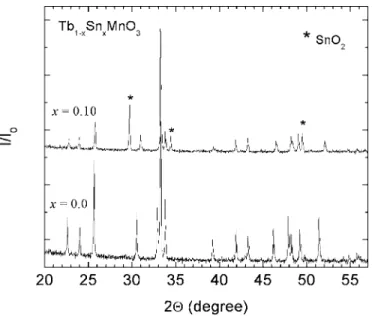
Figure 1 shows x-ray diffraction patterns of the Tb0.9Sn0.1MnO3 sample as compared to the undoped TbMnO3. The SnO2 peaks occur at angles 2= 29.7°, 34.4°, and 49.5°. It is clear that the Sn doping causes structural changes as soon as the peak intensities vary. The lattice pa-rameters of the orthorhombic Tb0.9Sn0.1MnO3 sample are a = 0.529 90共7兲 nm, b=0.576 61共7兲 nm, and c=0.74 273共8兲 nm. The volume of the unit cell is 0.226 94共5兲 nm3. This
proves that a 10% content of Sn causes a lattice compression as the corresponding parameters for TbMnO3 at room tem-perature are as follows: a = 0.5293 nm, b = 0.5838 nm, c = 0.7403 nm and the unit cell volume is 0.228 76 nm3. It is worth noting that the lattice parameters for our TbMnO3 sample are very close to those reported by Cui et al.10for the same system.
III. LOW MAGNETIC FIELD PROPERTIES
The temperature dependence for the dc magnetization at low applied magnetic fields is presented in Fig. 2. We ob-serve a drastic change of the magnetization at the vicinity of the magnetic transition, which is indicative of a large mag-netic entropy change. This figure also shows a divergence between the field-cooled 共FC兲 and zero-field-cooled 共ZFC兲 magnetization developing below the so-called irreversibility temperature. The irreversibility temperature decreases from 33 down to 30 K with the external magnetic field increasing from 0.01 to 0.03 T. From this figure we can see that there is clearly a cusp in ZFC curves at the so-called freezing or spin-glass temperature Tg. The irreversibility phenomenon is a typical feature of spin-glass- or cluster-glass-like states,11 when a frustration between the antiferromagnetic and ferro-magnetic ordering occurs. In a case of manganites these in-teractions are ascribed to the superexchange and double ex-change interactions, respectively.12
Taking the derivative 共dM /dT兲 of the dc magnetization measured as a function of temperature in the case of 0.01 T 共shown in Fig. 3兲 one may ascribe the minimum at TN = 38 K to the Néel temperature of the sine-wave ordering of the Mn3+ magnetic moments. The Néel temperature is slightly reduced as compared with 41 K reported for the Sn-free TbMnO3 system.3 The second minimum in our sample at Tloc= 25 K corresponds to the transition observed for TbMnO3 at 27 K and at zero magnetic field3 likely
re-FIG. 1. X-ray diffraction patterns of our Tb1−xSnxMnO3samples with x = 0
and 0.1.
FIG. 2. Zero-field-cooled共ZFC兲 and field-cooled 共FC兲 dc magnetization as a function of temperature measured at an applied magnetic field of 0.01 and 0.03 T.
veals commensurate-incommensurate transition within the Mn3+ system. The magnetic moments become locked when applying the magnetic field of 0.03 T.
We plot the inverse ac susceptibility curve as a function of temperature, the so-called Curie-Weiss plot, which is shown in Fig.4. Using this plot and adjusting a correspond-ing Curie-Weiss fit given by the relationship = C /共T−兲, we found a linear dependence above 70 K, which extends up to higher temperatures. So, the magnetic behavior obeys a well-defined Curie-Weiss law up to room temperatures and the compound is in a typical paramagnetic state. Several fits were adjusted at this region by changing the temperature range for the fit. In all cases, the extrapolation of this linear regime shows a negative Weiss temperature. The medium value for this temperature was found at= −37共±2兲 K, indi-cating that the nature of the dominant magnetic interactions in this compound is antiferromagnetic. Previous reports of neutron-scattering measurements13–15 on RE-MnO3 com-pounds indicate that the Mn moments lie in an incommensu-rate antiferromagnetic phase.
IV. HIGH MAGNETIC FIELD PROPERTIES
We have measured 共Fig.5兲 magnetic isotherms at
tem-peratures from 9 to 67 K. The temperature interval between the isotherms was 2 K and the magnetic field for each
iso-therm was varied between zero and 3 T, in steps of 0.05 T. For this range of applied magnetic field the magnetic behav-ior of the sample is typically of a ferromagnetic system, however, the saturation magnetization is not fully reached at this maximum applied magnetic field. Thus one may con-clude that in contrast to the antiferromagnetic behavior ob-served at low magnetic fields, the strong magnetic fields overcome the weak local magnetic anisotropy and lead to the ferromagnetic ordering.
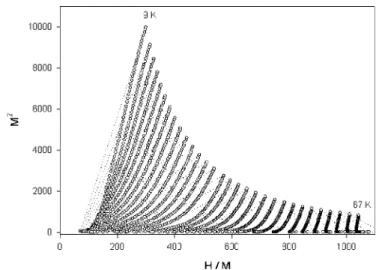
The so-called Arrott plot M2 vs H / M in Fig.6 exhibits the positive slope of the curves at all temperatures studied. This indicates that a transition between the magnetically or-dered and the paramagnetic phases is of the second order.16 The Arrott plot did not allow one to determine a critical temperature of magnetic transition since the extensions of the plots do not reach a center of the M2 and H / M coordi-nate system. This suggests that at least due to a competition between the ferromagnetic and antiferromagnetic interac-FIG. 3. Plot of dM / dT in a function of temperature at a magnetic field of
0.01 T; two minima are seen at low temperatures of 25 and 38 K.
FIG. 4.共Color online兲 Inverse of the magnetic susceptibility as a function of temperature. The line corresponds to the Curie-Weiss fit.
FIG. 5. Magnetic isotherms measured at different temperatures for our Tb0.9Sn0.1MnO3sample.
tions, the magnetic transition is broadly spread both in tem-perature and in magnetic field. The broadening effect may be additionally enhanced by the local inhomogeneities of the sample.
V. MAGNETOCALORIC EFFECT
The isothermal magnetic entropy change⌬SM共T兲, which is associated with the magnetocaloric effect, can be calcu-lated from measurements of magnetization as a function of the applied magnetic field and temperature 共indirect mea-surement technique of the magnetocaloric effect兲. According to the classical thermodynamics theory, the magnetic entropy change produced by varying the magnetic field from 0 to
Hmaxis given by17 ⌬SM共T,H兲 =
冕
0 Hmax冉
S H冊
T dH. 共1兲By using Maxwell’s thermodynamic relation
冉
SH
冊
T =冉
MT
冊
H, 共2兲
the magnetic entropy change can be rewritten as follows: ⌬SM共T,H兲 =
冕
0 Hmax冉
M T冊
H dH. 共3兲The integral in Eq. 共3兲corresponds to the area enclosed be-tween two isothermal magnetization curves M共H,T兲 and
M共H,T+␦T兲, where ␦T is the temperature difference
be-tween two isotherms. We calculated this area using a precise numerical integration. A complete ⌬SM共T兲 versus tempera-ture curve can be derived from a series of isothermal mag-netization curves obtained at discrete temperatures with an appropriate interval共relatively small兲 of temperatures␦T and
magnetic fields⌬H.
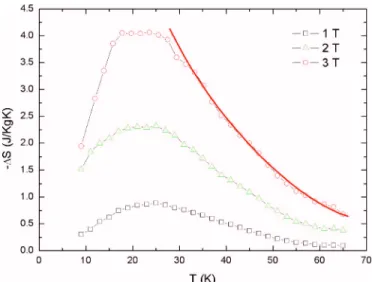
The magnetic entropy change −⌬SM共T兲 as a function of temperature plotted in Fig.7for various magnetic fields, has a characteristic shape.18 It is worth noting that the −⌬SM共T兲 maximum is located near 25 K—around the commensurate-incommensurate transition of the Mn3+ system. The −⌬SM共T兲 maximum magnitude increases with increasing magnetic field up to −4 J / Kg K at 3 T. The −⌬SM共T兲 curve is rather broad and the region of −⌬SM共T兲 maximum is enlarg-ing in higher magnetic fields. One may see in Fig.7that the position of this broad maximum shifts from 25 to 23 K when the magnetic field reaches 3 T. This shift is in contrast to the opposite tendency observed for, e.g., La0.7Ca0.3MnO3 manganites,19 when the Curie temperature is enhanced by a magnetic field. A more detailed inspection of the top part of the −⌬SM共T兲 curve 共especially at 2 and 3 T兲 suggests that it may be composed of two overlapping components corre-sponding to the transitions at TN and Tloc. A similar double peak structure of the −⌬SM共T兲 curve is reported in Ref.20. To clarify whether the broad and smooth maximum corre-sponds to a two peak structure might require further work applying smaller temperature steps. In so doing one may
reconcile the apparently different evolutions of the maximum 共maxima兲 toward a lower or higher temperature region when the magnetic field increases for various manganite families.
The large magnetocaloric effect in perovskite mangan-ites could originate from the spin-lattice coupling in the mag-netic ordering process.20,21The strong coupling between spin and lattice has been shown by the observed lattice changes accompanying magnetic transitions in these manganites.22 The lattice structure changes in the具Mn-O典 bond distance as well as in the 具Mn-O-Mn典 bond angle, would in turn favor the spin ordering. Then, a more abrupt variation of magneti-zation near the magnetic transition occurs and results in a large magnetic entropy change.
The customary estimation of the magnetocaloric materi-als is based on a comparison of the maximum magnetic en-tropy change at a magnetic field of 1 T. Following this pro-cedure, one can see that⌬SM共T兲=−1 J/Kg K of the sample studied is twice as small as compared to the large values reported for La1−xSrxMnO3in Ref. 18and other manganites at higher temperatures.6–9 In order to evaluate the magnetic cooling efficiency one may apply the so-called relative cool-ing power关RCP共s兲兴, which takes into account the width of a temperature interval.19Due to a very sparse study of a mag-netocaloric effect below 100 K, the RCP共s兲 value being about 55 J/kg for a sample studied, may be compared with
55–65 J/kg at 42 and 35 K as reported for
La0.65Ca0.35Ti0.4MnO3 and La0.83Ca0.17Ti0.4MnO3, respectively.19
The experimental data for the case of 3 T and for tem-peratures above 30 K could be scaled as follows:
⌬SM共T兲 ⬃ A/共T − TC兲␣ for T⬎ TC, 共4兲 where the coefficients were found as A = 61.1 J / Kg, TC = 21 K, and ␣= 1.12. The scaling is plotted in the figure by the solid line.
FIG. 7.共Color online兲 Magnetic entropy change determined from isotherms for the Tb0.9Sn0.1MnO3compound at various magnetic fields. The solid line
VI. CONCLUSION
In summary, we have studied the magnetic properties and the magnetocaloric effect of a manganite Tb0.9Sn0.1MnO3polycrystalline sample. The material is para-magnetic above 37 K. For lower temperatures we observe the competition between antiferromagnetic and ferromagnetic interactions. The magnetic transition occurs in temperatures lower than that observed in the pure TbMnO3compound as a consequence of Sn doping. This kind of substitution partially breaks the magnetic network among the magnetic atoms with the consequent modifications on the magnetic-phase diagram of this system. We have obtained a relatively high value of magnetic entropy change associated with the magnetic tran-sition of this manganite. This relatively large value and broad temperature interval 共about 35 K兲 of magnetocaloric effect make the present compound a promising candidate for mag-netic refrigerators at low temperatures, where the heat ca-pacities are remarkably reduced.
ACKNOWLEDGMENTS
This work was supported in part by CGRI共B兲, Ministry of Science and Higher Education 共PL*兲, grant Walonia/286/ 2006兲, *Kasa Mianowskiego 共PL兲, and FNRS 共B兲. F.W.F. was a recipient of a postdoc through FRFC, http://1.5.115.3/, 1.5.115.03 convention.
1E. Werbung, Ann. Phys. Chem. 13, 141共1881兲.
2T. Kimura, T. Goto, H. Shintani, K. Ishizaka, T. Arima, and Y. Tokura,
Nature 426, 55共2003兲.
3T. Kimura, T. Goto, Y. Tokura, and A. P. Ramirez, Phys. Rev. B 71,
224425共2005兲.
4M. Kenzelmann, A. B. Harris, S. Jonas, C. Broholm, J. Schefer, S. B.
Kim, C. L. Zhang, S.-W. Cheong, O. P. Vajk, and J. W. Lynn, Phys. Rev. Lett. 95, 087206共2005兲.
5T. Arima, T. Goto, Y. Yamasaki, S. Miyasaka, K. Ishii, M. Tsubota, T.
Inami, Y. Murakami, and Y. Tokura, Phys. Rev. B 72, 100102共2005兲.
6M.-H. Phan, S. C. Yu, and N. H. Hur, J. Magn. Magn. Mater. 262, 407
共2003兲.
7H. Gencer, S. Atalay, H. I. Adiguzel, and V. S. Kolat, Physica B
共Amster-dam兲 357, 326 共2005兲.
8N. Chau, N. D. Tho, N. H. Luong, B. H. Giang, and B. T. Cong, J. Magn.
Magn. Mater. 303, e402共2006兲.
9L. Morales, R. Zysler, and A. Caneiro, Physica B共Amsterdam兲 320, 100
共2002兲.
10Y. Cui, L. Zhang, G. Xie, and R. Wang, Solid State Commun. 138, 481
共2006兲.
11H. Y. Hwang, S.-W. Cheong, P. G. Radaelli, M. Marezio, and B. Batlogg,
Phys. Rev. Lett. 75, 914共1995兲.
12J. M. D. Coey, M. Viret, and S. von Molnar, Adv. Phys. 48, 167共1999兲. 13E. F. Bertaut and M. Mercier, Phys. Lett. 5, 27共1963兲.
14M. Bieringer and J. E. Greedan, Solid State Chem. 143, 132共1999兲. 15A. Munoz, J. A. Alonso, M. J. Martinez-Lope, M. T. Casais, J. L.
Martinez, and M. T. Fernadez-Diaz, Phys. Rev. B 62, 9498共2000兲.
16S. K. Banerjee, Phys. Lett. 12, 16共1964兲.
17S. Chaudhary, V. Sunil Kumar, S. B. Roy, P. Chaddah, S. R.
Krishnakumar, V. G. Sathe, A. Kumar, and D. D. Sarma, J. Magn. Magn. Mater. 202, 47共1999兲.
18A. Szewczyk, H. Szymczak, A. Wisniewski, K. Piotrowski, R.
Kartaszyn-ski, B. DabrowKartaszyn-ski, S. Kolesnik, and Z. BukowKartaszyn-ski, Appl. Phys. Lett. 77, 1026共2000兲.
19M. H. Phan and S.-C. Yu, J. Magn. Magn. Mater. 308, 325共2007兲. 20M.-H. Phan, S.-C. Yu, N. H. Hur, and Y.-H. Yeong, J. Appl. Phys. 96, 1154
共2004兲.
21Z. B. Guo, Y. W. Du, J. S. Zhu, H. Huang, W. P. Ding, and D. Feng, Phys.
Rev. Lett. 78, 1142共1997兲.
22P. G. Radaelli, D. E. Cox, M. Marezio, S.-W. Cheong, P. E. Schiffer, and