Effects of strain on the electronic structures and T C ’s of the La 0.67 Ca 0.33 Mn O 3
and La 0.8 Ba 0.2 Mn O 3 thin films deposited on Sr Ti O 3
Hsiung Chou, M.-H. Tsai, F. P. Yuan, S. K. Hsu, C. B. Wu, J. Y. Lin, C. I. Tsai, and Y.-H. Tang
Citation: Applied Physics Letters 89, 082511 (2006); doi: 10.1063/1.2335973 View online: http://dx.doi.org/10.1063/1.2335973
View Table of Contents: http://scitation.aip.org/content/aip/journal/apl/89/8?ver=pdfcov Published by the AIP Publishing
Articles you may be interested in
Improvement of the electrical and ferromagnetic properties in La 0.67 Ca 0.33 Mn O 3 thin film irradiated by C O 2 laser
Appl. Phys. Lett. 90, 082505 (2007); 10.1063/1.2679147 In Mn O 3 : A biferroic
J. Appl. Phys. 100, 076104 (2006); 10.1063/1.2356093
Nuclear magnetic resonance study of the Ru Mn valence states and magnetic interactions in Sr Ru 0.9 Mn 0.1 O 3
Appl. Phys. Lett. 89, 102501 (2006); 10.1063/1.2345595
Critical exponents of the La 0.7 Sr 0.3 Mn O 3 , La 0.7 Ca 0.3 Mn O 3 , and Pr 0.7 Ca 0.3 Mn O 3 systems showing correlation between transport and magnetic properties
J. Appl. Phys. 98, 103903 (2005); 10.1063/1.2128467
The effect of Ti O 2 doping on the structure and magnetic and magnetotransport properties of La 0.75 Sr 0.25 Mn O 3 composite
J. Appl. Phys. 98, 043908 (2005); 10.1063/1.2032614
This article is copyrighted as indicated in the article. Reuse of AIP content is subject to the terms at: http://scitation.aip.org/termsconditions. Downloaded to IP: 140.113.38.11 On: Thu, 01 May 2014 01:51:29
Effects of strain on the electronic structures and T
C’s of the La
0.67Ca
0.33MnO
3and La
0.8Ba
0.2MnO
3thin films deposited on SrTiO
3Hsiung Chou,a兲M.-H. Tsai, F. P. Yuan, S. K. Hsu, and C. B. Wu
Department of Physics, National Sun Yat-Sen University, Kaohsiung, Taiwan 804, Republic of China and Center for Nanoscience and Nanotechnology, National Sun Yat-Sen University, Kaohsiung, Taiwan 804, Republic of China
J. Y. Lin and C. I. Tsai
Institute of Physics, National Chiao Tung University, Hsinchu, Taiwan 300, Republic of China Y.-H. Tang
Department of Physics, National Sun Yat-Sen University, Kaohsiung, Taiwan 804, Republic of China and Center for Nanoscience and Nanotechnology, National Sun Yat-Sen University, Kaohsiung, Taiwan 804, Republic of China
共Received 19 April 2006; accepted 5 July 2006; published online 24 August 2006兲
The strain effects on the electronic structures of La0.67Ca0.33MnO3 共LCMO兲 and La0.8Ba0.2MnO3
共LBMO兲 thin films have been studied by O K-edge x-ray absorption near edge structure 共XANES兲 spectroscopy. For LCMO, the first-principles calculations reveal that the features in the XANES spectra are associated with hybridized states between O 2p and Mn minority-spin 3d t2gand eg, La
5d / Ca 3d, and Mn 4s / Ca 4p states. An analysis of these features shows that the tensile strain decreases substantially La–O and Ca–O hybridization and TC for LCMO. For LBMO, the small
compressive strain enhances slightly La–O and Ba–O hybridization and TC. © 2006 American
Institute of Physics. 关DOI:10.1063/1.2335973兴
Since the discovery of colossal magnetoresistance in R1−xAxMnO3共R=rare-earth ion and A=divalent ion兲
materi-als in 1950,1–6the metal-like共M兲-insulator-like 共I兲 transition temperature 共Tp兲 and the ferromagnetic 共F兲-paramagnetic
共P兲 transition temperature 共TC兲 of doped R1−xAxMnO3 thin
films have been found to be affected by the strain7–15due to lattice mismatch with the substrate. When La1−xCaxMnO3
共LCMO兲 was grown on SrTiO3 共STO兲 共001兲 substrates by
pulsed laser ablation, the larger lattice spacing of the sub-strate causes an in-plane tensile strain and a corresponding shrinkage along the out-of-plane axis in the films. The tensile strain was found to reduce TC of LCMO films. In contrast,
TC of the ultrathin La1−xBaxMnO3 共LBMO兲 film was found
to increase up to x = 0.2 and then decrease beyond 0.2. The highest TC reported for LBMO films was 310 K for x = 0.2
with a thickness of 21 nm.15
Up to date, the different behavior between LCMO and LBMO has not been well understood. Kanki et al.14 and Zhang et al.15proposed a dx2−y2orbital stability model based
on the elongation of the in-plane Mn–O bond length to ex-plain the enhancement of TCin thin LBMO films. However,
the elongation of a bond usually results in a weakening of the bond strength. Based on extended x-ray absorption fine structure and high-resolution x-ray diffraction measurements, Miniotas et al.16 observed that the Mn–O bond length is fixed for LCMO deposited either on STO or LaAlO3. Yuan17 also questioned the interpretation of Mn–O bond elongation in LBMO thin films by Zhang et al.15 and argued that the enhancement of TCcould be due to strain-induced alteration
of the Mn–O–Mn bond angles.
In this study, the O K-edge x-ray absorption near edge structure 共XANES兲 technique, which is a powerful tool to elucidate changes of electronic structures associated with the alteration of the bonding environment of O ions, is employed
to study ultrathin and thick LCMO and LBMO films to better understand the effects of lattice-mismatch induced strain on the electronic structures and TC’s of these two manganites.
LCMO 共x=0.33兲 and LBMO 共x=0.2兲 thin films were grown on STO共001兲 single crystal substrates by an off-axis rf magnetron sputtering system. The LCMO films with nesses of 200 and 20 nm and the LBMO films with thick-nesses of 150 and 15 nm were deposited at substrate tem-peratures of 750 and 800 ° C, respectively, followed by an in
a兲Electronic mail: [email protected] FIG. 1. Normalized R-TLCMO films and 150- and 15-nm-thick LBMO films.共a兲 and M-T 共b兲 curves of 200- and 20-nm-thick APPLIED PHYSICS LETTERS 89, 082511共2006兲
0003-6951/2006/89共8兲/082511/3/$23.00 89, 082511-1 © 2006 American Institute of Physics
This article is copyrighted as indicated in the article. Reuse of AIP content is subject to the terms at: http://scitation.aip.org/termsconditions. Downloaded to IP: 140.113.38.11 On: Thu, 01 May 2014 01:51:29
situ annealing at 850° C for 2 h in 500 Torr pure oxygen. The crystal structures and transport properties have been studied by x-ray diffraction and four-point probe measure-ments, respectively. The superconducting quantum interfer-ence device by Quantum Design was used to measure mag-netization. The O K-edge XANES spectra were taken using the high-energy spherical grating monochromator beamline at the Synchrotron Radiation Research Center 共SRRC兲 in Taiwan, operating at 1.5 GeV with a maximum stored cur-rent of 200 mA. The spectra were taken using the fluores-cence yield 共FY兲 and total electron yield 共TEY兲 modes at room temperature 共T=300 K兲 and low temperature 共T = 30 K兲 in a vacuum better than 1⫻10−9Torr. The energy
resolution of the monochromator is around 0.1 eV. The background and the self-absorption effects of spectra were subtracted and corrected by the standard procedure. The final spectra were then normalized to the tabulated standard ab-sorption cross section in the energy range between 600 and 620 eV.
The resistivity and magnetization curves of the films shown in Fig. 1 have typical F→ P and M →I transitions around the Curie temperatures TC and the resistivity-peak
temperatures Tp. The 200-nm-thick LCMO film behaves
bulklike共with a TCof 242 K and a Tpof 235 K兲. TCand Tp
of the 20-nm-thick LCMO film, however, are reduced by 40% and 36% down to 146 and 146 K, respectively. The correlated reduction of TC and Tp suggests that F→ P and
M→I transitions may have the same origin. The drastic re-duction of TC and Tp can be attributed to the localization
effect of Mn 3d majority-spin共↑-spin兲 egorbitals, since the F
property of LCMO was found to be due to Ca induced delo-calization of O 2p and Mn 3d↑-spin egstates near the Fermi
level EF.18 The tensile strain may induce weakening of the
Ca–O hybridization and reduce the density of delocalized Mn↑-spin egstates and consequently TCand Tp.
The 150-nm-thick LBMO film has TCand Tpof 296 and
312 K, respectively, while both TC and Tp are enhanced to
311 and 330 K by 5% and 6%, respectively, for the 15-nm-thick film. This tendency is opposite to that of LCMO. The differences between LBMO and LCMO are that the Ba ion is much larger than Ca and La ions and that Ba has a lower electronegativity.19The STO substrate has a lat-tice constant of a = 3.905 Å.20Along the关110兴 direction, the
periodicity is
冑
2a = 5.523 Å, which is greater and smaller than the a lattice constants of 5.4572 Å for LCMO共Ref. 21兲 and 5.544 45 Å for LBMO,22respectively. Thus, the ultrathin LCMO and LBMO films have in-plane tensile and compres-sive strains, respectively, and have opposite behavior of the changes of TCand Tp. The compressive strain is expected toincrease hybridization between Ba and O orbitals and conse-quently the increase of the Ba induced delocalization of Mn 3d↑-spin egand O 2p orbitals.
Since FY O K-edge XANES measures bulk electronic structures, the substrate contribution overshadows those of ultrathin films, spectra were taken for thick films only. The incident angles of the x-ray beam were chosen to be 0° 共nor-mal兲 and 60° 共oblique兲. Figure 2 show spectra of LCMO and LBMO films at room temperature and 30 K, respectively. And Fig. 3 shows the partial densities of states共PDOSs兲 of the various ions for x = 1 / 4 LCMO obtained by spin-polarized first-principles pseudofunction method.23 Comparison between Figs. 2 and 3 identifies that the leading twin-peak feature at ⬃529 eV is contributed by hybridized states between O 2p and Mn 3d↓-spin t2gand egstates. The
La 6p band also contributes to the spectra in the same energy region. The peaks of Mn 3d↓-spin t2gand egsubbands and
the unoccupied part of the O 2p band are separated by ⬃0.1 eV in good agreement with that of the twin peaks in the 30 K spectra of LCMO. The two other features centered at⬃6.5 and ⬃14 eV above the leading feature can be iden-tified to be the hybridized states between O 2p and La 5d / Ca 3d states at ⬃5 eV and Mn 4s/Ca 4p states at ⬃13 eV, respectively. The agreement between calculation and experi-ment is reasonably good. Note that the assignexperi-ments of these three features are different from those proposed earlier.24–29 The spectra of LBMO also have three major features similar to those of LCMO.
The intensities of the second and third features in the room-temperature O K-edge XANES spectrum of LCMO with the 0° incident angle共out-of-plane direction兲 are higher than those with the 90° angle共in-plane direction兲. This an-isotropy is decreased at 30 K. The anan-isotropy is much less significant and less temperature-dependent for LBMO. The present results suggest that the in-plane tensile and
out-of-FIG. 2. O K-edge XANES spectra in the fluorescence yield mode of the 200-nm-thick LCMO film taken at共a兲 room temperature and 共b兲 30 K. O
K-edge XANES spectra of the 50-nm-thick LBMO film were taken at共c兲
room temperature and共d兲 30 K.
FIG. 3. Partial densities of states共PDOSs兲 for La, Ca, Mn, and O ions in
x = 1 / 4 LCMO.
082511-2 Chou et al. Appl. Phys. Lett. 89, 082511共2006兲
This article is copyrighted as indicated in the article. Reuse of AIP content is subject to the terms at: http://scitation.aip.org/termsconditions. Downloaded to IP: 140.113.38.11 On: Thu, 01 May 2014 01:51:29
plane compressive strains near the LCMO/STO interface re-gion cause enhancement and reduction of the densities of Ca 3d4p / La 5d states, respectively.
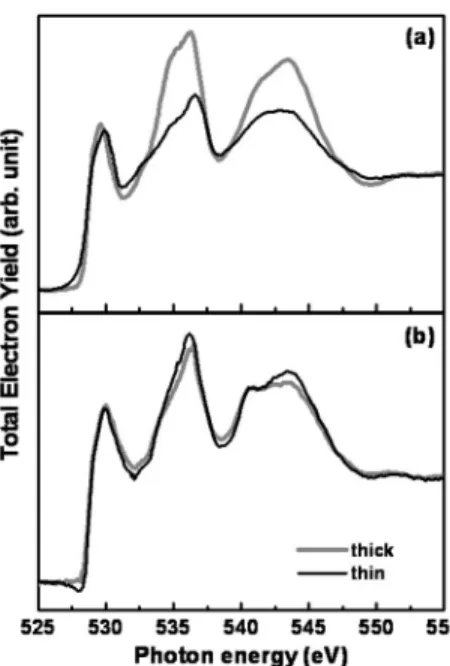
The TEY O K-edge XANES probes dominantly top lay-ers of the film and is used to investigate the differences in the electronic structures of strained ultrathin and relaxed thick LCMO and LBMO films. The TEY spectra are shown in Fig. 4. The intensities of the leading features for the LCMO and LBMO films are insensitive to the thickness, or the strain, while the intensities of the second and third features for the strained ultrathin LCMO film drop by about half from those of the unstrained thick film. In contrast, the intensities of the second and third features for the strained ultrathin LBMO film are slightly enhanced relative to those of the unstrained thick film. Since the leading feature and the second and third features are contributed by O 2p / Mn 3d ↓-spin t2g and eg
hybridized states, O 2p / La 5d / Ca 3d hybridized states, and Mn 4s / Ca 4p states, respectively, the intensity trend for LCMO suggests that the tensile strain weakens substantially the La–O and Ca–O hybridization, but does not significantly affect the relatively localized Mn 3d–O 2p hybridization. Note that the higher-energy Mn 4s state is delocalized, so that it may be also affected. The opposite and less significant changes of the intensities of the second and third features for LBMO are due to that the strain is compressive and that the lattice mismatch is much smaller, respectively.
In summary, a combination of FY and TEY O K-edge XANES measurements for LCMO and LBMO ultrathin and thick films deposited on the STO substrate and spin-polarized first-principles calculation for LCMO suggest that the tensile strain in the ultrathin LCMO film weakens sub-stantially the hybridization between O 2p and La 5d / Ca
3d4p / Mn 4s states and decreases TC, while the compressive
strain in the ultrathin LBMO film enhances slightly the hy-bridization between O 2p and La 5d / Ba 5d6p / Mn 4s states and increases slightly TC. The relatively localized O 2p – Mn
3d↓-spin t2gand eghybridization is insensitive to the strain
for both LCBO and LBMO.
This work was supported by the NSC Core Facilities Laboratory in Kaohsiung-Pingtung Area and by the National Science Council of Taiwan with Contract No. NSC 94-2120-M-110-002.
1G. Jonker and J. van Santen, Physica共Amsterdam兲 16, 337 共1950兲. 2J. van Santen and G. Jonker, Physica共Amsterdam兲 16, 559 共1950兲. 3M. Imada, A. Fujimori, and Y. Tokura, Rev. Mod. Phys. 70, 1039共1998兲. 4Y. Tokura and Y. Tomioka, J. Magn. Magn. Mater. 200, 1共1999兲. 5E. L. Nagaev, Phys. Rep. 346, 387共2001兲.
6E. Dagotto, T. Hotta, and A. Moreo, Phys. Rep. 344, 1共2001兲. 7S. Jin, T. H. Tiefel, M. McCormack, H. M. O’Bryan, L. H. Chen, R.
Ramesh, and D. Schurig, Appl. Phys. Lett. 67, 557共1995兲.
8J. O’Donnell, M. S. Rzchowske, J. N. Eckstein, and I. Bozovic, Appl.
Phys. Lett. 72, 1775共1998兲.
9S. Freisem, A. Brockhoff, D. G. de Groot, B. Dam, and J. Arats, J. Magn.
Magn. Mater. 165, 380共1997兲.
10E. Gommert, H. Cerva, J. Wecker, and K. Samwer, J. Appl. Phys. 85,
5417共1999兲.
11F. Tsui, M. C. Smoak, T. K. Nath, and C. B. Eom, Appl. Phys. Lett. 76,
2421共2000兲.
12Vengalis, A. Maneikis, F. Anisimovas, R. Butkute, L. Dapkus, and A.
Kindurys, J. Magn. Magn. Mater. 211, 35共2000兲.
13J. O’Donnell, M. Onellion, M. S. Rzchowski, J. N. Eckstein, and I.
Bozovic, Phys. Rev. B 54, R6841共1996兲.
14T. Kanki, H. Tanaka, and T. Kawai, Phys. Rev. B 64, 224418共2001兲. 15J. Zhang, H. Tanaka, T. Kanki, J.-H. Choi, and T. Kawai, Phys. Rev. B 64,
184404共2001兲.
16A. Miniotas, A. Vailionis, E. B. Svedberg, and U. O. Karlsson, J. Appl.
Phys. 89, 2134共2001兲.
17Q. Yuan, Phys. Rev. B 70, 066401共2004兲.
18M.-H. Tsai, Y.-H. Tang, H. Chou, and J. B. Wu, e-print cond-mat/0604367
and the bottom two panels shown in Fig. 4 of this study.
19Table of Periodic Properties of the Elements,共Sargent-Welch Scientific
Company, Skokie, IL, 1980兲.
20R. H. Mitchell, A. R. Chakhmouradian, and P. M. Woodward, Phys.
Chem. Miner. 27, 583共2000兲.
21S. J. Hibble, S. P. Cooper, A. C. Hannon, I. D. Fawcett, and M. Greenblatt,
J. Phys.: Condens. Matter 11, 9221共1999兲.
22V. A. Cherepanov, E. A. Filonova, V. I. Voronin, and I. F. Berger, J. Solid
State Chem. 153, 205共2000兲.
23R. V. Kasowski, M.-H. Tsai, T. N. Rhodin, and D. D. Chambliss, Phys.
Rev. B 34, 2656共1986兲.
24M. Abbate, F. M. F. de Groot, J. C. Fuggle, A. Fujimori, O. Strebel, F.
Lopez, M. Domke, G. Kaindl, G. A. Sawatzky, M. Takano, Y. Takeda, H. Eisaki, and S. Uchida, Phys. Rev. B 46, 4511共1992兲.
25M. Abbate, G. Zampieri, F. Prado, A. Caneiro, and A. R. B. de Castro,
Solid State Commun. 111, 437共1999兲.
26E. Pellegrin, L. H. Tjeng, F. M. F. de Groot, R. Hesper, G. A. Sawatzky, Y.
Moritomo, and Y. Tokura, J. Electron Spectrosc. Relat. Phenom. 86, 115 共1997兲.
27J.-H. Park, T. Kimura, and Y. Tokura, Phys. Rev. B 58, R13330共1998兲. 28O. Toulemonde, F. Millange, F. Studer, B. Raveau, J.-H. Park, and C.-T.
Chen, J. Phys.: Condens. Matter 11, 109共1999兲.
29N. Mannella, A. Rosenhahn, M. Watanabe, B. Sell, A. Nambu, S. Ritchey,
E. Arenholz, A. Young, Y. Tomioka, and C. S. Fadley, Phys. Rev. B 71, 125117共2005兲.
FIG. 4. O K-edge XANES spectra of共a兲 LCMO and 共b兲 LBMO films taken at room temperature in the total electron yield mode.
082511-3 Chou et al. Appl. Phys. Lett. 89, 082511共2006兲
This article is copyrighted as indicated in the article. Reuse of AIP content is subject to the terms at: http://scitation.aip.org/termsconditions. Downloaded to IP: 140.113.38.11 On: Thu, 01 May 2014 01:51:29