Persistent properties
of
crises
in
a Duffing oscillator
Yao Huang KaoDepartment ofTelecommunication Engineering, National Chiao Tung University, Hsinchu, Taiwan 30050,Republic ofChina
Jeun Chyuan Huang and Yih Shun Gou
Department
of
Electrophysics, National Chiao Tung University, Hsinchu, Taiwan 30050,Republicof
China (Received 2February 1987)Crises in a two-well forced oscillator ofDuffing type are studied with an analog simulation. Its features are discussed with the aid ofreturn maps and phase portraits. Two types ofboundary crisis in a strange attractor following the Feigenbaum route to chaos are found. One isassociated with a hopping between two strange attractors and is confirmed with the presence of
1/f
noise spectrum. The other isassociated with a hysteresis jump. Aborderline ofdifferentiating these two characters isalso indicated.I.
INTRODUCTIONX+KX+aX+PX
=F
sin(cot) . (3)Studies
of
chaotic motions in nonlinear dissipative sys-tems areof
great interest and have received much atten-tion in recent years.'
The chaotic motion may exhibit a crisis event with sudden qualitative changeof
a strangeattractor as a controlled parameter is varied. According
to Cxrebogi, Ott, and Yorke, the crisis in a one-dimensional quadratic map occurs at certain parameter values, for which the strange attractor collides with an unstable periodic orbit. Since then, the crisis has been confirmed experimentally in several physical systems, in-cluding Josephson junctions ' and some nonlinear driven
oscillators. In particular, the analog simulation
of
the rf-driven Josephson junction performed in our previous work further indicates that the crisis induces either a hopping state with1/f
low-frequence noise or a hysteresis jump for different parameters set. Nevertheless, theoc-currence
of
these two effects related to the crisis isnot yet fully understood. In fact, we note that a global descrip-tionof
persistent propertiesof
the crisis in diverse physi-cal systems isstill necessary to find in order to elucidate a true mechanismof
the crises in chaotic dynamics.To
this end, we shall present an electronic analog studyof
the crisis effects in a symmetrical two-well potential forced oscillator, which also represents the dynamicsof
a buckled beam as well as a plasma oscillator. ' Itsdynamics
of
motion can be modeled by the following equation asThe chaotic motions in Eq. (3) have been investigated by many authors in the past few years.
"
It isknown that, at a certain situation, the motion swings chaotically between the two valleys as a hopping state. The featuresof
the hopping state such as the fractal dimensionof
both the strange attractor and basin boundary, '''
the1/f
low fre-quency spectrum, ' and the similarity exponents' have been found, respectively. In spiteof
such considerable ef-forts sofar, propertiesof
the crisis in this system have not yet been pointed out. The goalof
this paper, therefore, isto increase our understanding
of
the crisis event in the Duffing equation. The important rolesof
the symmetry and nonlinearityof
the central barrierof
the potential well in the occurrenceof
crises are also emphasized.The selection
of
the analog simulator which is con-structed with two usual integrators and two multipliers is based on the following reasons. It has the advantageof
fast response over the numerical calculations as the pa-rameters are varied, so that itenables us to uncover quick-ly a guideline by which a more precise studyof
thenu-O.c—
X+
XX+
d V(X)/dX=F
sin(tot),
where
K
isthe damping coefficient,F
isthe driving force,cois the driving frequency, and V(X)is the potential.
For
atwo-well case, the potential V(X)is given by
V(X)
=
2aX
+
,
f3X—
g(x)
0.
2-—0.2—
with
a
&0
and /3&0. Thus, it has a central potential bar-rier aroundX
=
0 and two stable equilibra atX=+( —
a/P)'~
as shown in Fig. 1. AndEq.
(1) be-comes an ordinary differential equationof
Duffing type asFIG.
1. Symmetrical two-well potential V(X)with a central barrier atX
=0.
merical calculation can be followed. Moreover, together with a sample-hold circuit, it shows directly a return map
of
the attractor on the scope so that the detailed featuresof
the crisis can be effectively traced.II.
EXPERIMENTAL RESULTS0.4 0.3 0.2 -FBD 0.1— -FAD FAB 0 I 0.6 I 1.0
FIG.
2. State diagram in the parameter spaceF
vs co with threshold curves;2,
A': downward jump; B,B':
upward jump; C: period doubling; D: boundary crisis, with damping coefficient%=0.
1. All dashed curves are obtained with an ini-tial state above curveB.
The dotted curve2'
is obtained with an initial state above curvesB'
andB.
As pointed out in our previous paper, the dynamic behaviors in Eq. (3) can be properly investigated by scan-ning either the driving amplitude
F
or frequence co with coefficients K,a,
andP
as parameters. From variationsof
the phase portraitX
versusX
and/or the return map a state diagram which illustrates the thresholdsof
hysteresis jump, period doubling, and crisis inF
versus co space isconstructed. The return map characterizes the voltage
of
variableX
at any instant,X„+&,
as a functionof
the same voltage but one period earlier,X„.
A typical case withK
=
0.
1,a
= —
1,P=
1, and0.
5 &co&l.
4is shown in Fig. 2. In this figure there are two similar groupsof
threshold curves related to the primary and secondary resonances with co in the ranges0.
8—
1.
4 and0.
5—
0.
7, respectively.Both behave in a global manner. '
For
convenience, we focus only on the former case. Curves3
and A' are the downward-jump threshold, curves8
and8'
are the upward-jump threshold, curve C is the period-doubling threshold, and curve Dis the thresholdof
boundary crisis.These curves intersect each other at critical points
(F~~,co~~) for curves A and
B,
(F&D,co&D) for curves A and D, and (F~D,co&D) for curvesB
and D, respectively. With reference to Fig.2, there are two typesof
both crisis and hysteresis, respectively, depending on the scanning procedures. The salient featuresof
each scanning are summarized below.A. Amplitude scanning
1. co
)
cogDFor
a typical demonstrationof
the results, we chooseco=
1.2, a value larger than cozD(=
1.125), and set initially the state at the equilibrium pointX
=1.
0.
As the driving amplitudeF
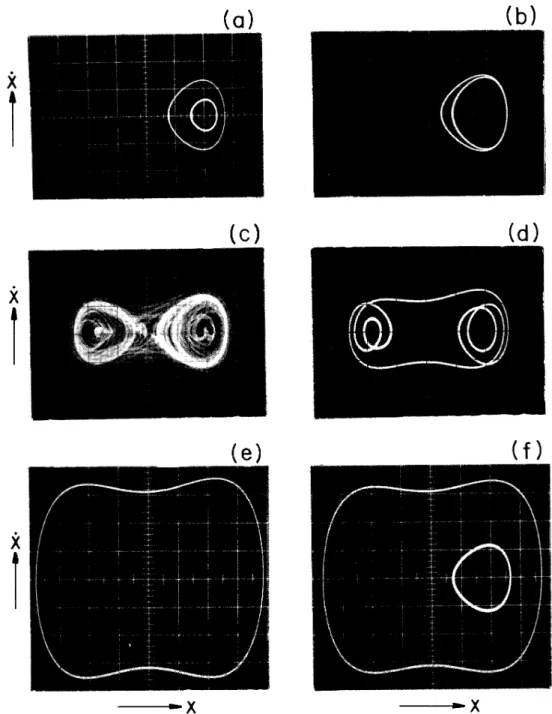
is increased from zero (path I),a sequenceof
transitions occur on the threshold curves. The phase por-traits near these transitions are shown in Fig.3.
Firstof
all, on curve
8
withF=0.
097, the unsymmetrical phase portrait expands abruptly as shown in Fig. 3(a). This behavior is referred as upward jump. On the contrary, whileF
isturned back from above curve8,
the phase por-trait is restored suddenly to the initial shape on curve3
withF=0.
033.
This is referred to as a downward jump.Hence, curves
3
and8
form a hysteresis loop with the motion confined only in the right valley. Note that, in these situations, the nonlinear effect issmall.As
F
is increased to0.
182 on curve C, the thresholdof
period doubling, the phase portrait splits into two cycles as shown in Fig. 3(b). The state undergoes the Feigenbaum's route tochaos soon after period four asF
is further increased. It implies that the nonlinear effect is strong enough to cause the chaotic motion. Due to a less steep slopeof
the potential well around the central barrier, the trajectoryof
the phase portrait in the left-hand side splits much more distinctly and approaches to the unsta-ble equilibrium point atX
=
0.
In other words, the separationof
the trajectory is essentially dependent on the slopeof
the potential well. WhenF
isincreased a little bitto
0.
198on curve D,the onsetof
crisis, the motion beginsto migrate into the left valley and exhibits ahopping state as shown in Fig. 3(c). We refer to it later as crisis-induced hopping.
As
F
is further increased, the state keeps on hopping first and then is locked to some subharmonics. Figure 3(d) shows the phase portraitof
a typical case for —,'subharmonic with
F=0.
268. This state exists in a small intervalof
the driving amplitude. AsF
is increased to0.
321 on curve8',
the hopping state disappears suddenly and becomes stable with a symmetrical phase portrait ex-tending over the two valleys as shown in Fig. 3(e). It im-plies that the central barrier plays no significant effect on the motion for large excitations. In other words, the sys-tem isagain in a situation with small nonlinearity.Alternatively,
if
the amplitudeF
is decreased from above curve8',
adownward jurnp occurs atF=0.
110
on curveA'.
The larger symmetrical phase portrait is re-stored abruptly to asmaller nonsymmetrical one as shown in Fig.3(f).
Note that curve A' is found only when the initial state is above both curves8
and8
.
This unusual typeof
hysteresis with a great contraction implies acatas-trophe associated with a symmetry breaking and ought to
receive more attention.
Now, in order to elucidate the features
of
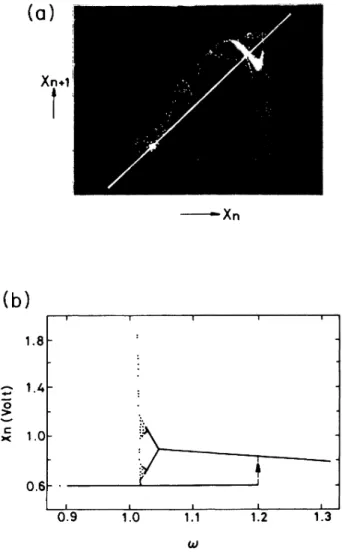
crisisoccur-ring on curve D, the corresponding return maps as shown in Fig. 4are traced. Figure 4(a) shows the return map
of
the chaotic attractor between the cascaded period dou-blings and crisis withF=0.
194. The map is similar to a quadratic form, however, with a back-folded tail (mark).As
F
is further increased, the folded tail extends more and more close to the line withX„+&
—
—
X„.
AtF =0.
198on curve D the tail meets at a point (mark) on the lineX„+&
——X„.
The point is referred to as an unstable fixed point with a slopedX„+~/dX„
larger than 1 as shown inFig. 4(b). This case implies the occurrence
of
a boundarycrisis. In this moment, the motion in the right valley at
X&0
jumps into the left one atX
&0
and, meanwhile,develops anew part
of
the chaotic attractor with the simi-lar quadratic shape. Therefore, it is a nondestructive typeof
boundary crisis with abrupt expansionof
the strangeattractor.
Similarly, the dynamic process
of
the state in the left valley moving to the right one behaves in the same manner asjust mentioned. Thus, a crisis-induced hopping between the two strange attractors appears. This featureEa)
(e)
FIG.
3. Phase portraits forco=1.
2 and (a)F =0.
092, the states just below (small) and above (large) curve B;(b)F=0.
182,the period-doubled state just above curve C; (c)F=0.
198 the hopping state just above curve D;(d)F=0.
268, the ~ subharrnonic state;(e)
F=0.
321,the state just above curveB';
(f)F=0.
110,the state just above (large) below (sma11)curve A'. Xaxis: X,0.5U/div. Y axis: X,0.5U/div.B.
Frequency scanningTo
find the dashed partof
curves A, C, andD
we in-vestigate alternatively the dynamic process by frequency scanning.1.
F)FgD
In the present case we choose
F=0.
100, a value be-tween the critical onesof
FzD (=0.
150) andF„D
(=0.
045) as indicated in Fig. 2. As the frequency co is lower down from 1.3 (path II) with the initial state above curveB,
the Feigenbaum route to chaos is first seen with onsetof
period two atco=1.
048 on curve Cand then the boundary crisis occurs atco=1.
023 on curveD.
The re-turn map is shown in Fig. 6(a) where the strange attractor contracts suddenly to a fixed point either in the original right valley or in the left one rather than hopping. Insuch a case the boundary crisis is referred to as destruc-tive. Figure 6(b) shows the sampled signal
X„as
a func-tionof
frequency. It demonstrates the destructive featureFIG.
4. Return maps withco=1.
2 and (a)F =0.
194, before crisis; (b)F=0.
198,crisis occurring oncurve D.n+1 is due to the nature
of
the symmetrical propertyof
thepo-tential well. According to our observations, the state is about equally likely to be in each valley
of
the potential well and give rise to the low-frequency noise with approx-imateI/f
shape as shown in Fig. 5.2. co
(
cogDIn this range, curves A, C, and D(dashed part) are not found from this scanning process, because the process is reversible. The hopping state above curve
B
directly re-turns back to the initial stable state once the amplitudeF
is lowered just below curveB
and vice versa.(b)
10 Z'. UJ C5 4-O1.
0-C -2 10 LtJ CL 10 10 06-1.2 I1.
3 FREQUENCYFICx. 5. Spectrum of the voltage signal X(t) for
crisis-induced hopping with
F=
0.199and co=
1.2.FIG.
6. (a) Return map of boundary crisis withF=0.
100and
co=1.
023,(b)response ofvoltageX„as
afunction ofcowithwith hysteresis after a cascade
of
period doublings. WhenF
isset larger than FzD, the crisis with hopping occurs on curveD.
The map is similar to Fig. 4(b). Hence curve8
plays an important role in differentiating these two dis-tinct typesof
boundary crisis.2.
F
&FgDHowever,
if
the driving amplitudeF
is chosen between FzD &F &Fztt (0.015),then a hysteresis jump is observed without any bifurcation or crisis occurring. Also, asF
is less thanFzz,
the hysteresis disappears.III.
CONCLUSIONIn this paper we have presented asintensive study
of
an analog simulation for nonlinear oscillation with applica-tion to the Duffing equation. Owing to the nonlinearef-fect, the dissipative system exhibits the following transi-tion sequences: hysteresis, period doublings, and crises with a global manner. The thresholds are shown in a state
diagram from which the transitions can be easily referred
to.
Two types
of
hysteresis are observed. One is accom-panied by a symmetry breakingof
the phase portrait as occurred from a symmetrical two-valley to asymmetrical one-valley motion. The other is confined to a one-valley motion only. The former case with the symmetry break-ing appears to be a large size contractionof
the phasepor-trait.
Two types
of
boundary crisis are also observed. One is associated with a hopping between two strange attractors, and the other is associated with a destructionof
thechaotic attractor accompanying a hysteresis jump. The
former is also confirmed to have
1/f
low-frequency noise. The hysteresis upward-jump curveB
acts as the border-line forthese two distinct typesof
crisis.Our study not only supports the conjecture
of
Grebogi et al., but also further presents the persistent propertiesof
the crisis related to the symmetrical property and the heightof
the central potential barrier in the Duffing equa-tion.E.
Ott, Rev. Mod. Phys. 53,655(1981).J.
P.Eckmann, Rev. Mod. Phys. 53,643(1981).C.Grebogi,
E.
Ott, andJ.
A.Yorke, Phys. Rev. Lett. 48, 1507 (1982); Physica 7D, 181(1983).4E.G.Gwinn and R.M. Westervelt, Phys. Rev. Lett. 54, 1613 (1985); H. Chat'e and P.Manneville, Phys. Rev. A 32, 3065 (1985)~
5Y.H. Kao,
J.
C.Huang, and Y.S.Gou, Phys. Rev. A 34,1682 (1986).B.
A. Huberman andJ.
P. Crutchfield, Phys. Rev. Lett. 23, 1743(1979).R. W.Rollins and E. R.Hunt, Phys. Rev. A 29, 3327 (1984); H. Ikezi,
J.
S.deGrassie, andT.
H. Jensen, Phys. Rev. A 28, 1207 (1983); C. Jeffries andJ.
Perez, Phys. Rev. A 27, 601 (1983).F. T.
Arecchi, R. Badii, and A. Politi, Phys. Lett. 103A, 3 (1984)~F.
C.Moon and P.J.
Holmes,J.
Sound Vib. 65,275(1979).R.
A.Mahaffey, Phys. Fluids 19,1387(1976)."J.
Guckenheimer and P. Holmes, Nonlinear Oscillators, Dynamical Systems, and Bifurcationsof
Vector Field (Springer, New York, 1983).F.
C.Moon and G.-X.Li,Physica 17D, 99 (1985).~
F.
C.Moon, Phys. Rev. Lett. 53,962(1984).F.
T.Arecchi andF.
Lisi, Phys. Rev. Lett. 49, 94(1982);F.
T.Arecchi and A.Califano, Phys. Lett. 10A, 443 (1984).
~5H. Ishii, H. Fujisaka, and M. Inoue, Phys. Lett. 116A, 257 (1986).
U.Parlitz and W.Lauterborn, Phys. Lett. 107A, 351(1985); S. Sato, M.Sano, and Y.Sawada, Phys. Rev. A28, 1654(1983).