Electromagnetic Shielding Effectiveness and Functions of Stainless
Steel/Bamboo Charcoal Conductive Fabrics
ABSTRACT
Following technological advancements, there is a growing population of cellular phone and computer users. However, these electronic instruments cause electromagnetic waves, negatively influencing users’ health or precision instruments’ malfunction. Therefore, shielding electromagnetic wave becomes an important matter. In this study, stainless steel wires and bamboo charcoal roving are made into conductive yarn with 6 turns/cm by ring spinning machine. On a 14-gauge automatic horizontal knitting machine, the resulting yarn is then knitted into stainless steel/bamboo charcoal conductive fabrics and then evaluated for the electrical property and functions. According to experimental testing, electromagnetic shielding effectiveness (EMSE) of the fabrics increases with an increase in stainless steel content and number of lamination layers. In particular, when laminated at an angle of 0°/45°/90°/-45°/0°/45°, the fabrics have an EMSE of above 30 dB at an incident frequency between 2010 and 2445 MHz. The far infrared emissivity increases with bamboo charcoal content, reaching the maximum of 0.9 , when the fabric was made by one-cycle PET/stainless steel/bamboo charcoal plied yarn in the first feeder and
four-cycle PET/bamboo charcoal plied yarn in the second feeder.
Keywords: Industrial Fabrics, Technical Yarns, Knitting, Electromagnetic shielding, Far infrared emissivity
INTRODUCTION
The current trend in many studies is to stress the use of natural and eco-friendly materials. Bamboo matures within four years [1, 2], and can be carbonized for further application. Carbonization is the process that carbonaceous materials undergo thermal cracking, becoming low molecular compound and carbon residuals and simultaneously eliminating non-carbon materials including hydrogen, oxygen, nitrogen, and sulfur in the form of volatile gas and solid tar. When carbonization processing temperature reaches up to 450℃ ~ 800℃, bamboo accomplishes the “primary carbide” process, and its micro structure, hardness, carbonization ratio, resistance coefficient, and functional groups are changed. In order to have special functions, bamboo can be carbonized in a temperature between 800 to 1200 ℃ to become a secondary carbide. As a secondary carbide, bamboo charcoal can emit far infrared rays of 4-14 μm, a wavelength which is the same as that of all living organisms. Far infrared rays, called growth rays, have tepidity effectiveness, retaining
Most hospitals prohibit the use of wireless devices, such as cellular phones, on hospital grounds, as they may disrupt medical equipment. Currently, no studies report a positive impact of mobile telephones on human health. Kramarenko et al. studied the effects of the electromagnetic field (EMF) emitted by cellular phones on the human electroencephalogram in adults and children, stating that the EMFs may be harmful for the human brain. They found the slow wave activity was more pronounced in children, indicating that children may be more vulnerable to the adverse health effects than adults [5]. Stainless steel wires, which have tensile strength and an elasticity coefficient, are often used as reinforcing fibers for composites [6]. Stainless steel wires are electrically and thermally conductive, as well as heat and corrosion resistant, and thus are used in shielding electromagnetic waves [7]. Previous studies have used metallic plates and fibers, conductive composite materials, the surface-coating of metallic colloids, metal-coated fabrics, conductive polymers, and conductive fabrics for shielding electromagnetic waves [8-11]. Among them, there are many literatures about shielding electromagnetic waves with fabrics constitute containing nonwoven, woven, and knitting [12-15]. After being imparted with electrical conductivity, insulating materials are able to block static electricity and electromagnetic waves. At the same time, the resulting increase in weight and production cost makes the application of the materials to relevant products difficult.
Therefore, in this study, conductive yarn composed of bamboo charcoal (BC) roving and stainless steel (SS) wires was firstly produced by ring spinning machine, which is different from our previous studies on plied yarn made by filaments [16, 17]. Conductive yarns were knitted with PET reinforcement, forming into fabrics based on textile manufacturing techniques. Ultimately, the functions of EMSE and far infrared emissivity of PET/SS/BC knitted fabrics were discussed in relation to stainless steel amount, lamination number and lamination angle, comparing with that of PET and BC knitted fabrics. The conductive fabric made in our study was expected to be used as the livelihood clothes which account for the majority of market due to their better softness, air permeability and wear comfortability.
EXPERIMENTAL MATERIAL
Stainless steel wires (King Metal Fiber Technology Company, Taiwan, R.O.C) have a diameter of 0.05 mm, elongation of 26.4%, tenacity of 700-800 N/mm2,
electrical conductivity of 156Ω. Bamboo charcoal roving (Tung Ho Textile Co., Ltd, Taiwan, ROC) with 1.72 dtex fineness and 38 mm length is composed of 70% viscose rayon staple fiber (35~40mm length) and 30% bamboo charcoal staple fibers (40 mm length). Bamboo charcoal filaments (Hua Mao Nano-Tech Co., Ltd, Taiwan, R.O.C) with 70 denier contain 3% bamboo charcoal powders have elongation of 26.2%, tenacity of 2.8g/d. Polyester filaments (Yi Jinn Industrial Co. Ltd, Taiwan, R.O.C) is
140 denier, 23.5% elongation and 3.7g/d tenacity.
PREPARATION of CONDUCTIVE YARN
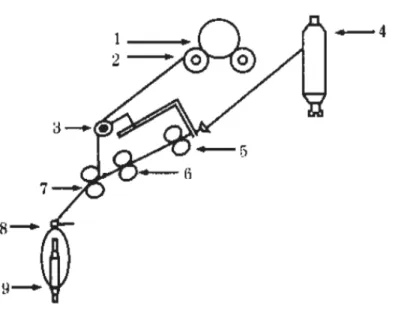
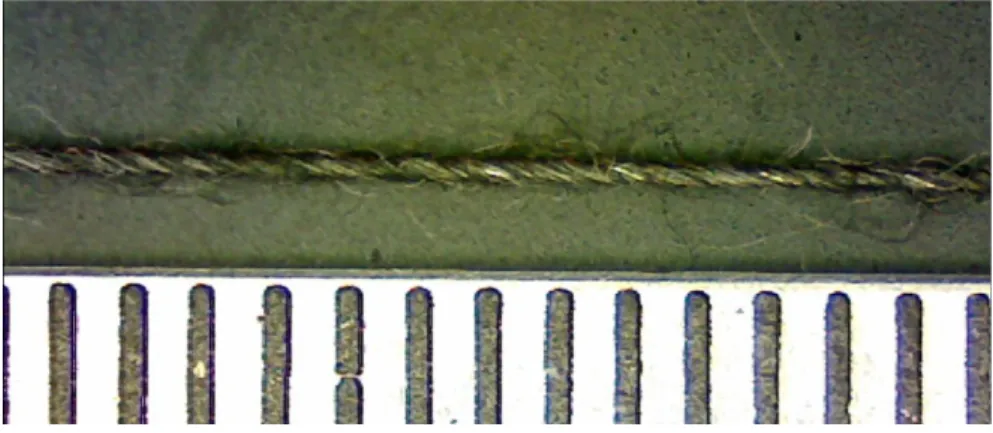
Conductive yarn was made on a ring spinning machine (SM-06, Sun Mien Mechanical Co., Ltd., Taiwan, ROC), as shown in Figure 1. Bamboo charcoal roving (4) passed through the horn mouth and then the drafting zone (5-7). After being unwrapped from the bobbin (1), stainless steel wires first went through a tension device (2) and then a V-type thread carrier (3), finally converging with the bamboo charcoal roving to be twisted together. The two materials passed through the front roller (7) and into the yarn guide (8), collecting on a bobbin (9) that was mounted with a draw winder (8). The twist number of blend yarn is suggested to be 3-10 twist/cm. Figure 2 shows an image of the resulting conductive yarn with 6 turns/cm. In addition, this study uses only bamboo charcoal roving to make bamboo charcoal yarn for further diversity in manufacturing.
1 mm
Figure 2. Image of the conductive yarn with a twist amount of 6 turns/cm with the count of 9.67
PREPARATION of CONDUCTIVE FABRICS
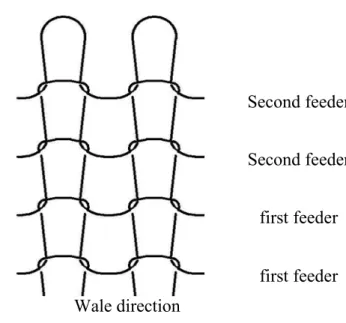
The 14-gauge automatic horizontal knitting machine (KH-626TS, Kauo Heng Precision Machinery Co., Ltd) is used for knitting into fabrics. During processing, it is found that conductive yarn is easily broken during knitting, therefore, two strands of PET plied yarn are fabricated with the conductive yarn for reinforcement. Two groups of yarn feeder were used during processing. The first feeder was incorporated into two yarns including SS/BC conductive yarn and two-strand PET plied yarn (PET plied yarn), while the second was fed into three yarns containing two-strand bamboo charcoal yarn (BC plied yarn), one-strand PET yarn (PET yarn), and one-strand bamboo charcoal filament (BC filament) as shown in Figure 3. In addition, PET plied yarn fed from first feeder and BC plied yarn form second feeder were considered as the control group, thus respectively producing PET and BC knitted fabric. During
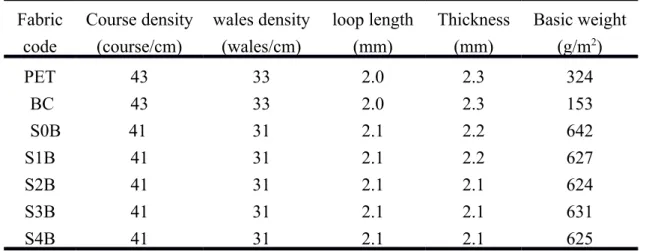
knitting process, one cycle for knitted fabrics is defined as yarn feeder moving back and forth for one time, meaning that two courses of loops were produced after one-cycling knitting as displayed in Figure 3. As the cycles of the second feeder increase, the amount of bamboo charcoal increases accordingly. All the resulting fabrics, name codes and feeding condition were displayed in Table 1, and their physical parameters were shown in Table 2. Moreover, the surface of S0B knitted fabrics was represented in Figure 4.
In this study, in addition with bamboo charcoal amount, lamination number from 1-layer to 6-layer, and lamination angles including 0°/0°/0°/0°/0°/0°, 0°/45°/90°/-45°/0°/45°, and 0°/90°/90°/0°/90°/0° were also changed as related to the EMSE, far infrared emissivity and air permeability of resulting fabrics. EM wave would penetrate through opening between loops of SS blended conductive fabrics. Intended to improve the EMI SE, the cover area of conductive fabric would be transformed by varying their lamination angle.
Second feeder Second feeder first feeder first feeder Wale direction
Figure 3. The structural diagram of conductive knitted fabrics
Table 1. The composition yarn and feeding ways of resulting knitted fabric. Fabric
code 1
st feeder yarn 2nd feeder yarn 1
st feeder
cycles
2nd feeder
cycles PET PET plied yarn
BC BC plied yarn S0B PET plied yarn + SS/BC
conductive yarn S1B PET plied yarn + SS/BC
conductive plied yarn
BC plied yarn+ PET
yarn +BC filament 1 1 S2B PET plied yarn + SS/BC
conductive yarn
BC plied yarn+ PET
yarn +BC filament 1 2 S3B PET plied yarn + SS/BC
conductive yarn
BC plied yarn+ PET
yarn +BC filament 1 3 S4B PET plied yarn + SS/BC
conductive plied yarn
BC plied yarn+ PET
yarn +BC filament 1 4 Course direction
1 mm
Table 2. The physical parameters including density, thickness and areal weight of resulting fabrics. Fabric code Course density (course/cm) wales density (wales/cm) loop length (mm) Thickness (mm) Basic weight (g/m2) PET 43 33 2.0 2.3 324 BC 43 33 2.0 2.3 153 S0B 41 31 2.1 2.2 642 S1B 41 31 2.1 2.2 627 S2B 41 31 2.1 2.1 624 S3B 41 31 2.1 2.1 631 S4B 41 31 2.1 2.1 625
MEASUREMENT EMSE
A coaxial transmission line method specified in ASTM 4935-99 is used to test the EMSE of the knitted fabrics. The spectrum analyzer (Burgeon Instrument Co., Ltd., Advantest R3132A) and shielding effectiveness test fixture (Electro-Metrics, Inc., EM-2107A) are used to measure the EMSE. The testing frequency of incident electromagnetic waves is between 300 kHz-3 GHz. The EMI shielding effectiveness (SE) is expressed in decibel (dB). It is the logarithm of the ratio of transmitted power,
electrical intensity or magnetic intensity with no shield ( P1,E1, H1 ) to those with
a shield ( P2,E2,H2 ) as shown in Eq. (1) [18].
SE=10log( P
1/
P
2)=20log( E
1/
E
2)=20log( H
1/
H
2)
(1)Far Infrared Emissivity
The far infrared emissivity tester (HOTECH EMS 302 M) was connected to the computer. The far infrared emissivity test program was employed with the specimens (6.8×6.8π cm2) at a temperature of 34℃ (see Figure 5). The measurements were
saved and then charts of the results are created for further comparison and analysis. The far infrared emissivity () was determined by ratio of far-infrared intensity from
samples to that from black-body.
Air Permeability
A Textest FX3300 is used to measure the air permeability of the samples, according to ASTM D0730.Twelve samples each with 30 × 30 cm2 are tested
repeatedly for air permeability for the definitive value.
RESULTS AND DISCUSSION
Influence of Stainless Steel Content and Incident Frequency on EMSE of SS/BC Conductive Fabrics
For stainless steel conductive fabric, fiber dispersion, weaving structure and fabric thickness all have influence on its EMSE property. The increase of stainless steel content in conductive fabric helps to form conductive web, and thus shielding more electromagnetic waves and achieving good EMI shielding effect.
Neither PET fabric nor BC fabric is conductive. Both cannot shield electromagnetic waves, and at the same time serve as control groups. Figure 5 shows the influence of the stainless steel content on the EMSE of the 6-layer SS/BC conductive fabric. Stainless steel wires have good conductivity and permeability, and are able to reflect electromagnetic waves, thereby exhibiting a greater EMSE. The greater the cycles of the second yarn feeder were, the lower the amount of stainless
steel and the smaller the stainless steel coverage area of SS/BC conductive fabrics were. Therefore, with an increase in the cycles of the second yarn feeder, a greater level of electromagnetic waves penetrating the SS/BC conductive fabrics results in a lower EMSE. Accordingly, S0B fabrics containing the largest amount of stainless steel, display the optimal EMSE. Because SS fiber is constituted of γ-austenite phase and ferromagnetic ά-martensite crystalline phases
and its
ά phase exhibited magnetic hysteresis loops, the magnetic loss has occurred to absorb EM wave power during one magnetization-demagnetization cycle.In addition, PET/SS/BC conductive fabrics exhibit better EMSE at a low frequency. The lower the incident frequency is, the greater the EMSE is. Furthermore, the wavelength of electromagnetic waves is longer at a low frequency, and electromagnetic waves do not easily penetrate conductive materials. As a result, the intensity of both electrical and magnetic fields of electromagnetic waves attenuates easily.
Figure 5. Influence of stainless steel content on EMSE of PET/SS/BC conductive fabrics. Stainless steel wires have a diameter of 0.05 mm; the twist amount of PET/SS/BC conductive yarn is 6 turns/cm; the number of lamination layer is 6; the lamination angle is 0°/0°/0°/0°/0°/0°; and the frequency of incident electromagnetic waves is between 300 kHz -3 GHz.
Influence of Number of Lamination Layers and Incident Frequency on EMSE of PET/SS/BC Conductive Fabrics
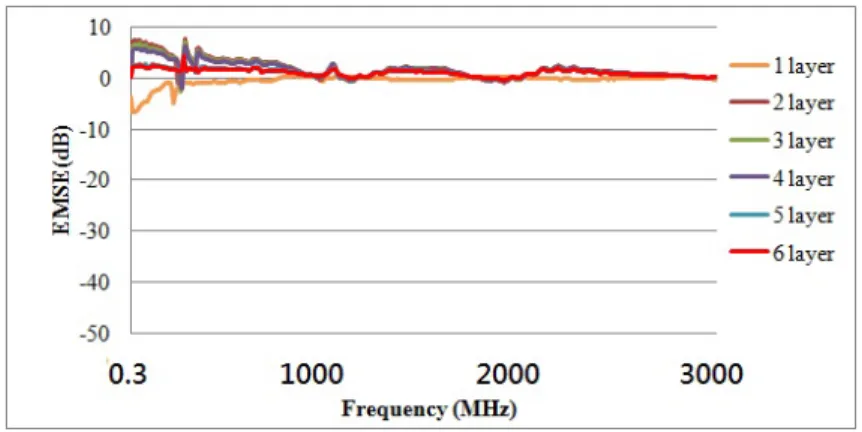
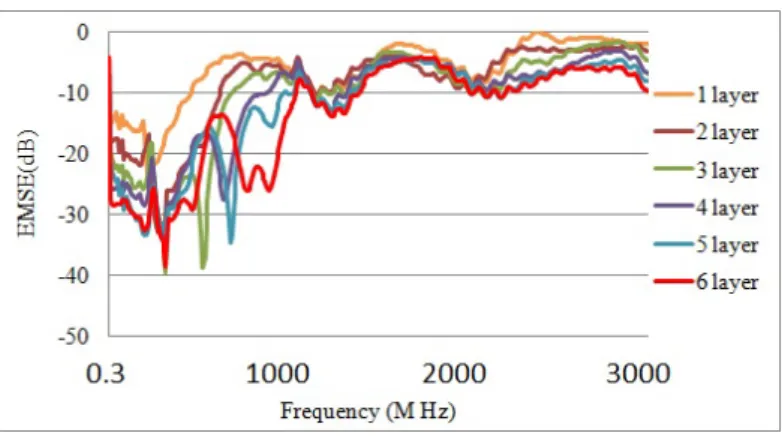
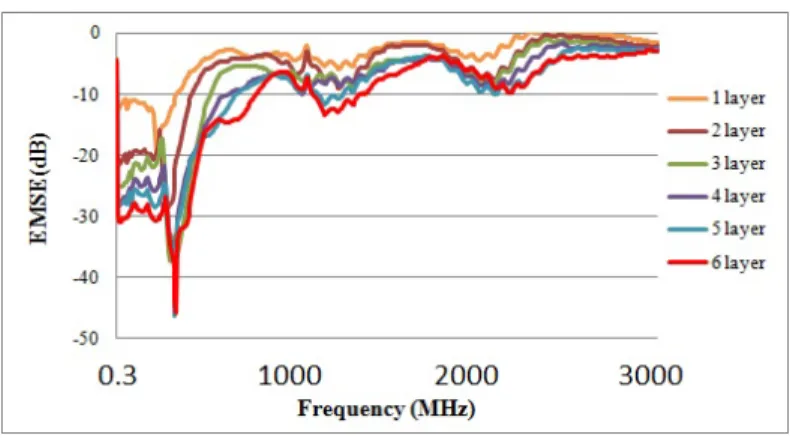
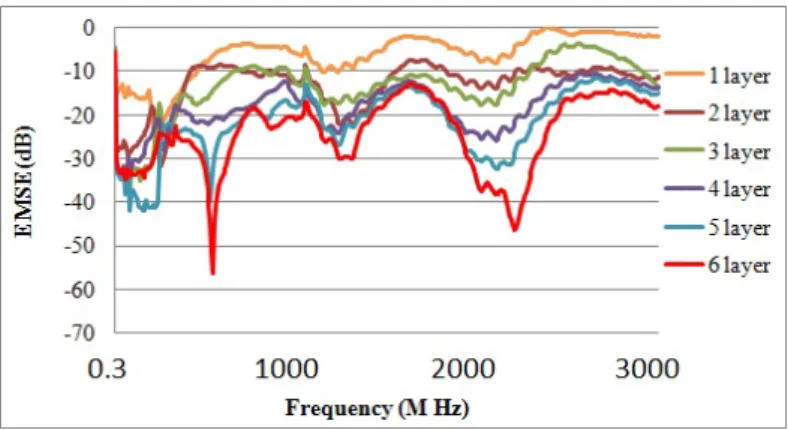
Containing no metallic wires, both PET fabric and BC fabric serve as control groups, EMSE of PET and BC fabrics is shown in Figures 6 and 7. Figures 6-12 show the influence of the lamination number and incident frequencies on EMSE of the PET/SS/BC conductive fabrics.
EMSE of the PET/SS/BC conductive fabrics increases with an increase in the number of lamination layers, from 1 to 6 layers, which helps the multiple reflections of conductive fabrics and attenuates the energy that electromagnetic waves transmit. This attributes to the absorbing ability of the soft magnetic SS fiber for the EM wave. Moreover, the greater the lamination number, the fewer the pores in the conductive fabrics. This prevents electromagnetic waves from penetrating the fabric. Therefore, 6-layer conductive fabrics exhibit the optimal EMSE.
present different when the incident electrical frequency is between 1300 and 2200 MHz, which is due to the fact that the electrical magnetic wave travels in the form of orthogonalized wave. PET/SS/BC conductive fabrics have special loop structure, thus producing better EMSE at a specific frequency due to their quarter-wave length interference. Generally speaking, these interferences are composed of constructive interference and destructive interference.
With 6 lamination layers and a wave registering at 2618 MHz, the EMSE of PET/SS/BC conductive fabrics (S1B, S2B, S3B, and S4B) are lower than 10dB. S0B fabrics, on the other hand, are greater than 10dB. Because S0B fabrics contain a larger amount of stainless steel evenly distributed throughout the fabric structure, S0B fabrics thus display the optimal EMSE. As far as production cost is concerned, S0B fabrics demonstrate a greater EMSE in comparison to other conductive fabrics; however, the difference is not significant.
Figure 6. EMSE of BC fabrics as related to varying numbers of lamination layers (1-6). Bamboo charcoal filaments have a fineness of 70 denier and the lamination angle
is 0°/0°/0°/0°/0°/0°.
Figure 7. EMSE of PET fabrics as related to varying numbers of lamination layers (1-6). PET filaments have a fineness of 140 denier and the lamination angle is 0°/0°/0°/0°/0°/0°.
Figure 8. EMSE of S0B fabrics as related to varying numbers of lamination layers (1-6). Stainless steel wires have a diameter of 0.05 mm; the twist amount of PET/SS/BC conductive yarn is 6 turns/cm; and the lamination angle is 0°/0°/0°/0°/0°/0°.
Figure 9. EMSE of S1B fabrics as related to varying numbers of lamination layers (1-6). Stainless steel wires have a diameter of 0.05 mm; the twist amount of PET/SS/BC conductive yarn is 6 turns/cm; and the lamination angle is 0°/0°/0°/0°/0°/0°.
Figure 10. EMSE of S2B fabrics as related to varying numbers of lamination layers (1-6). Stainless steel wires have a diameter of 0.05 mm; the twist amount of PET/SS/BC conductive yarn is 6 turns/cm; and the lamination angle is 0°/0°/0°/0°/0°/0°.
Figure 11. EMSE of S3B fabrics as related to varying numbers of lamination layers (1-6). Stainless steel wires have a diameter of 0.05 mm; the twist amount of PET/SS/BC conductive yarn is 6 turns/cm; and the lamination angle is 0°/0°/0°/0°/0°/0°.
Figure 12. EMSE of S4B fabrics as related to varying numbers of lamination layers (1-6). Stainless steel wires have a diameter of 0.05 mm; the twist amount of PET/SS/BC conductive yarn is 6 turns/cm; and the lamination angle is 0°/0°/0°/0°/0°/0°.
Influence of Lamination Angles on EMSE of PET/SS/BC Conductive Fabrics It is concluded that conductive fiber dispersion, weaving structure and fabric
thickness have certain influence on EMISE property of conductive fabric. Of the whole shield material, varying lamination angle converts the transfer path of conductive network when conductive fabric was exposed among electromagnetic field. Furthermore, the cover area of conductive fabric was also changed, and thus the integrity of conductive network resulting in EMI shielding property would be improved.
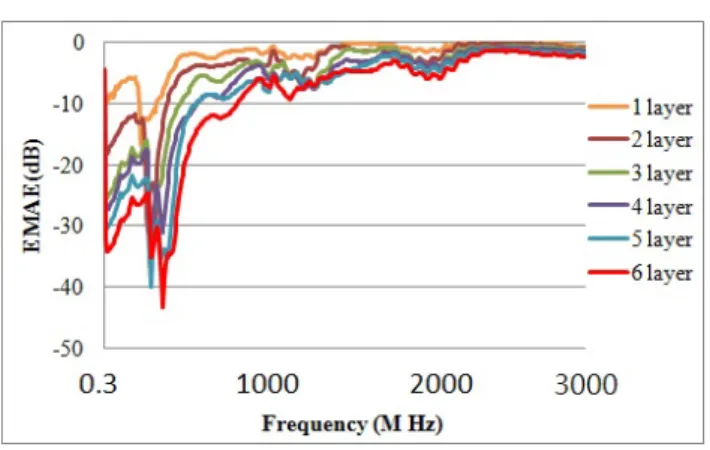
According to Figures 8 and 13, S0B fabrics exhibit a significant increase in EMSE when laminated at 0°/90°/90°/0°/90°/0°. Following a change in lamination angle of the PET/SS/BC conductive fabrics, the constituent stainless steel wires change their arrangement angles, giving the conductive fabrics a greater coverage area of stainless steel to attenuate and reflect the electromagnetic waves. An increase in the number of lamination layers improves the EMSE of the conductive fabrics by creating multiple reflections against electromagnetic waves; when the lamination angle of the 6-layer conductive fabrics are changed, the EMSE is significantly increased.
Figures 13 and 14 show the influence of the lamination angle on the EMSE of the conductive fabrics. S0B fabrics demonstrate a significant increase in the EMSE, either laminated at 0°/45°/90°/-45°/0°/45° or 0°/90°/0°/90°/0°/90°, indicating that the
distribution of stainless steel wires plays an important role in the EMSE. This role is a result of an increase in coverage area of stainless steel in conductive fabrics. In particular, S0B fabrics exhibit an EMSE of 46dB at 2198 MHz when laminated at 0°/90°/0°/90°/0°/90°, and an EMSE of 62dB at 2393 MHz when laminated at 0°/45°/90°/-45°/0°/45°.
Figure 13. EMSE of S0B fabrics with a lamination angle of 0°/90°/0°/90°/0°/90°.The number of lamination layers varies from 1, 2, 3, 4, 5, to 6; the incident frequency is between 300k and 3GHz; stainless steel wires have a diameter of 0.05 mm; and the twist amount of PET/SS/BC conductive yarn is 6 turns/cm.
Figure 14. EMSE of S0B fabrics with a lamination angle of 0°/45°/90°/-45°/0°/45°.The number of lamination layers is 1, 2, 3, 4, 5, or 6; the incident frequency is between 300k and 3GHz; stainless steel wires have a diameter of 0.05 mm; and the twist amount of PET/SS/BC conductive yarn is 6 turns/cm.
Influence of Bamboo Charcoal Content and Number of Lamination Layers on Far Infrared Emissivity of PET/SS/BC Conductive Fabrics
With improvement of life standard, human have proposed higher requirements for textiles functionality, such as convenience, comfort, care and protection. Far-infrared fabric is one of representative products in health-care functional textiles. In this study, EMI shielding fabric prepared by us simultaneously has far-infrared emissivity efficiency, which could promote metabolism and meanwhile shield EM interference to human people.
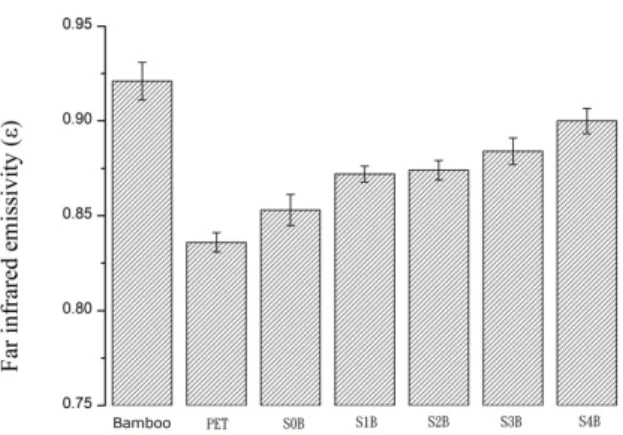
Figure 15 shows the influence of bamboo charcoal content on far infrared emissivity of PET/SS/BC conductive fabrics. Containing no bamboo charcoal, PET fabrics serve as the control group. Bamboo charcoal content of conductive fabrics is raised with an increase in the cycles of the second feeder, from 0 to 4, resulting in a greater far infrared emissivity. Bamboo charcoal is composed of metal elements, such as potassium, magnesium, and calcium, and has a compact structure with a great deal
of pores. It can absorb the heat from the human body or surrounding environment to emit far infrared rays that the human body can absorb, and impart the resulting fabrics with far infrared emissivity property. The greater the bamboo charcoal content, the higher the far infrared emissivity, hence far infrared emissivity increases with the cycles of the second feeder. This far infrared emissivity tendency presents the same with previous study [19], that is, far infrared emissivity improves with the bamboo charcoal content of fabrics.
Figure 16 shows that, the far infrared emissivity decreases with an increase in the number of lamination layers. An increase in fabric thickness prevents the heat from distributing evenly. Fabrics release far infrared rays as atoms create electron excitation triggered by the energy after atoms are heated or electromagnetically interacted. Electrons are transited from the orbit of i = k to i = L, and then back to a stable status after being transited back to the orbit of i = k. The latter process creates electromagnetic waves. Therefore, if heat cannot be transmitted to the upper layer of fabrics within a short time, the fabrics are not able to release far infrared rays, resulting in a decrease in far infrared emissivity.
Figure 15. Far infrared emissivity of PET/SS/BC conductive fabrics as related to bamboo charcoal content. The number of lamination layers is 1; the twist amount of PET/SS/BC conductive yarn is 6 turns/cm; the diameter of stainless steel wires is 0.05 mm; and bamboo charcoal content of 70D bamboo charcoal filaments and bamboo charcoal roving is 3% and 30%, respectively.
Figure 16. Far infrared emissivity of PET/SS/BC conductive fabrics as related to varying numbers of lamination layers (1-6). The twist amount of PET/SS/BC conductive yarn is 6 turns/cm; the diameter of stainless steel wires is 0.05 mm; and bamboo charcoal content of 70D bamboo charcoal filaments and bamboo charcoal
roving is 3% and 30%, respectively.
The Influence of Bamboo Charcoal Content and Number of Lamination Layers on Air Permeability of PET/SS/BC Conductive Fabrics
Figures 17 and 18 show the influence of bamboo charcoal content and number of lamination layers on the air permeability of the PET/SS/BC conductive fabrics. Low air-permeability PET fabrics, not containing bamboo charcoal, serve as the control group. Due to a high shrinkage ratio, the size of the pores between the loops of the PET fabrics is small, resulting in poor air permeability. According to Figure 17, air permeability of S0B fabrics is slightly greater than that of PET fabrics. This is due to the distribution of stainless steel wires in the S0B fabrics, which increases the fabric stability and prevents the voids of loops from shrinking easily.
However, S0B fabrics have the lowest air permeability when compared with various SS/BC conductive fabrics. Because S0B fabrics is made by only the first feeder, which uses SS/BC conductive yarn, the larger diameter of yarn causes smaller sized pores and thus a lower air permeability. The air permeability of SS/BC conductive fabrics decreases with an increase in the cycles of the second feeding. The greater the cycles of the second feeder, the lower the stainless steel content and the greater the resulting fabric shrinkage, resulting in a decrease in air permeability.
to 6, the air permeability descends. The thickness of the SS/BC conductive fabrics increases with an increase in the number of lamination layers, thereby preventing the air from penetrating the fabrics, and thus decreasing the air permeability. When the number of lamination layers is 1 and 6, the optimal air permeability of the SS/BC conductive fabrics is 107-125 cm3/cm2/s and 18-24 cm3/cm2/s respectively.
Figure 17. Air permeability of SS/BC conductive fabrics as related to bamboo charcoal content. The number of lamination layers is 1; the twist amount of SS/BC conductive yarn is 6 turns/cm; the diameter of stainless steel wires is 0.05 mm; and bamboo charcoal content of 70D bamboo charcoal filaments and bamboo charcoal roving is 3% and 30%, respectively.
Figure 18. Air permeability of SS/BC conductive fabrics as related to varying numbers of lamination layers (1-6). The twist amount of SS/BC conductive yarn is 6 turns/cm; the diameter of stainless steel wires is 0.05 mm; and bamboo charcoal content of 70D bamboo charcoal filaments and bamboo charcoal roving is 3% and 30%, respectively.
CONCLUSION
This study successfully produced PET/SS/BC conductive fabrics with stainless steel wires/bamboo charcoal conductive yarn and PET plied yarn on an automatic horizontal knitting machine. According to EMSE testing, with an increase in the cycles of the second feeder, from 0 to 4, EMSE of SS/BC conductive fabrics decreases; EMSE of the S0B fabrics is the greatest. With an increase in the number of lamination layers from 1 to 6, EMSE of S0B fabrics increases slightly. Regardless of the number of lamination layers, EMSE of the S0B fabric reaches 10dB at 2618 MHz. This difference is not significant. With 6 lamination layers and a lamination angle of
0°/45°/90°/-45°/0°/45°or 0°/90°/90°/0°/90°/0°, EMSE of S0B fabrics increases above 30dB at 2012-2318 MHz, which is because maximum electromagnetic absorption occurs at this frequency range. Moreover, 0°/45°/90°/-45°/0°/45° lamination reaches 22.5 dB at 900 MHz, indicating that conductive fabrics successfully shield electromagnetic waves from cell phones.
Far infrared emissivity of SS/BC conductive fabrics increases with an increase in the cycles of the second feeder; and S4B fabrics have the greatest far infrared emissivity of 0.9ε. However, far infrared emissivity of SS/BC conductive fabrics decreases with the increasing number of lamination layers.
In addition, when the number of lamination layers is 1, the optimal air permeabiltiy of all SS/BC conductive fabrics exceeds 100 cm3/cm2/s. The greater the
number of lamination layers, the lower the air permeability.
The resulting SS/BC conductive fabrics are able to shield electromagnetic waves, and can be applied in the shielding room or electromagnetic wave shielding clothes for workers in communication and medicine. The fabrics also have the function of far infrared emissivity and can be used for thermal-retention and health-care blankets, sheets, clothes, and protective clothing.
Acknowledgements
This work would especially like to thank National Science Council of the Taiwan, for financially supporting this research under Contract NSC-102-2622-E-468-001-CC3.
References
[1] Gonzalez D., Santos V., and Parajo J. C. (2011). Manufacture of fibrous reinforcements for biocomposites and hemicellulosic oligomers from bamboo, Chemical Engineering Journal, 167: 278–287.
[2] Hameed B. H., Din A. T. M., and Ahmad A. L. (2007). Adsorption of methylene blue onto bamboo-based activated carbon: kinetics and equilibrium studies, Journal of Hazardous Materials, 141: 819–825.
[3] Mizuta K., Matsumoto T., Hatate Y., Nishihara K. and Nakanishi T. (2004). Removal of nitrate-nitrogen from drinking water using bamboo powder charcoal, Bioresource Technology, 95: 255–257.
[4] Chiou S. S. (2002). The recent development of functional anion textile in Japan. Taiwan Textile Research Journal, 119(10): 48.
[5] Kramarenko A. V., and Tan U. (2003). Effects of High-frequency Electromagnetic Fields on Human EEG: A Brain Mapping Study, International Journal of Neuroscience, 113: 1007–1019.
[6] Bhagat R.B. (1988). High pressure squeeze casting of stainless steel wires reinforced aluminium matrix composites, Composites, 19(5): 393–399.
[7] Chen H. C., Lee K. C., Lin J. H., and Koch M. (2007). Comparison of electromagnetic shielding effectiveness properties of diverse conductive textiles via various measurement techniques, Journal of Materials Processing Technology, 192–193: 549–554.
[8] Dou Z., Wu G., Huang X., Sun D., and Jiang L. (2007). Electromagnetic shielding effectiveness of aluminum alloy–fly ash composites, Composites Part A: Applied Science and Manufacturing, 38: 186–191.
[9] Su C. C., and Chang S. H. (2011). Radial growth of carbon nanocoils on stainless steel wires coated with tin particles using chemical vapor deposition from acetylene, Materials Letters, 65: 1114–1116.
[10] Wei Q., Xiao X., Hou D., Ye H., and Huang F. (2008). Characterization of nonwoven material functionalized by sputter coating of copper, Surface & Coatings Technology, 202 : 2535–2539.
[11] Akansson E. H., Amiet A., and Kaynak A. (2006). Electromagnetic shielding properties of polypyrrole/polyester composites in the 1–18 GHz frequency range, Synthetic Metals, 156 : 917–925.
electrocardiogram signals, Journal of Industrial Textiles, 42: 303-318
[13] Rajendrakumar K and Thilagavathi G. (2012), A study on the effect of construction parameters of metallic wire/core spun yarn based knitted fabrics on electromagnetic shielding, Journal of Industrial Textiles, 1528083712441960. [14] Marina M., Romuald Brazis, V K, Jadwiga B, Izabella K. (2006) Nonwovens
with Implanted Split Rings for Barriers Against Electromagnetic Radiation, FIBRES & TEXTILES in Eastern Europe, 14:64-68.
[15] Ramachandran T, Vigneswaran C. (2009) Design and Development of Copper Core Conductive Fabrics for Smart Textiles, Journal of Industrial Textiles, 39: 81-93.
[16] Lin J. H., Chen A. P., Hsieh C. T., Lin C. W., Lin C. M., and Lou C. W. (2011). Physical properties of the functional bamboo charcoal/stainless steel core-sheath yarns and knitted fabrics, Textile Research Journal, 81(6): 567-573.
[17] Lin J. H., Chen A. P., Lin C. M., Lin C. W., Hsieh C. T., and Lou C. W. (2010). Manufacture Technique and Electrical Properties Evaluation of Bamboo Charcoal Polyester/Stainless Steel Complex Yarn and Knitted Fabrics, Fibers and Polymers, 11(6): 856-860.
[18] Wieckowski TW, Janukiewicz JM. (2006) Methods for Evaluating the Shielding Effectiveness of Textiles, Fibers and Textiles in Eastern Europe, 14(5): 18-22. [19] Lin J. H., Chen A. P., Hsieh C. T., Lin C. W., Lin C. M. and Lou C. W. (2010).
hysical properties of the functional bamboo charcoal/stainless steel core-sheath yarns and knitted fabrics, Textile Research Journal, 86(6): 567-573.