Analytical Solution for Tidal Propagation in a Leaky Aquifer
Extending Finite Distance under the Sea
Mo-Hsuing Chuang
1and Hund-Der Yeh
2Abstract: This paper focuses on groundwater dynamics in response to the tidal fluctuation in a coastal aquifer system. An analytical
solution is derived to describe groundwater level fluctuation in a leaky aquifer extending finite distance under the sea. Based on this solution, the joint effects of various parameters, such as the dynamic effect of water table fluctuation and the leakages of the inland and offshore, on the behavior of the groundwater level fluctuations in the inland part of the leaky confined aquifer can be thoroughly analyzed. When the roof length is increased, the dynamic effect of the water table fluctuation on the dimensionless groundwater amplitude, intrusion distance, and fixed phase shift in the unconfined aquifer become more important and the water table fluctuation approaches constant values when the roof length is greater than a threshold value. However, given the same values of dimensionless leakage and roof length, the dimensionless groundwater amplitude, intrusion distance, and fixed phase shift in the leaky aquifer with considering the dynamic effects are always larger than those of neglecting such effects.
DOI: 10.1061/共ASCE兲0733-9429共2008兲134:4共447兲
CE Database subject headings: Aquifers; Leakage aquifer; Leakage; Analytical techniques; Tidal currents.
Introduction
The subject of dynamic relation between groundwater and seawa-ter has received a great deal of attention in the recent years共e.g., Jacob 1950; Gregg 1966; Carr and Van der Kamp 1969; Van der Kamp 1972; Taigbenu et al. 1984; Pandit et al. 1991; Farrell 1994; Svitil 1996; Sun 1997; Oki et al. 1998; Uchiyama et al. 2000兲. These studies included aquifer parameter estimation, beach dewatering, marine environment, marine retaining structures, and/or seawater intrusion. These papers mentioned that the evalu-ation of water-table fluctuevalu-ation in a coastal aquifer is important for various hydrogeological, engineering, ecological, and environ-mental problems. Some previous studies showed that dynamic effects of the phreatic aquifer on the tidal head fluctuations in the confined aquifer plays an active role in solving coupled leaky-confined/phreatic coastal aquifer problems. For example, based on the assumption that the water-table fluctuation in the shallow unconfined aquifer was negligible, Jiao and Tang 共1999兲 pre-sented an analytical solution to study the groundwater head fluc-tuations in the confined aquifer of a coastal aquifer system by ignoring the elastic storage of the leaky layer. They found that the leakage has a significant damping effect on the groundwater fluc-tuation amplitude in the confined aquifer. Li et al. 共2001兲 used perturbation approach to derive an approximate solution in
exam-ining dynamic effects of the overlying aquifer. Volker and Zhang 共2001兲 used the finite element program 2DFEMFAT to assess the errors induced by neglecting water level changes in the uncon-fined aquifer of a leaky aquifer system subjected to tidal sea boundary condition. However, Jiao and Tang 共2001兲 mentioned there is no significant error to neglect dynamic effects of the overlying aquifer, because it is inappropriate to use the leakage value which is as great as 1 per day. Jeng et al.共2002兲 presented an analytical solution for the tidal response in a fully coupled leaky confined aquifer system considering the effects of the water table fluctuations in the unconfined aquifer. They concluded that the dynamic effects are important under a relatively large leakage and phreatic aquifer transmissivity. Ignoring these effects could lead to errors in estimating aquifer properties based on the tidal signals. Li and Jiao共2001a,b兲 presented complete analytical solu-tions to describe tidal groundwater wave propagation in coastal two aquifer systems with considering both the leakage and the storativity of the leaky layer. They found that the assumption of neglecting the effects of the leakage and storativity of the leaky layer is valid only when the storage ratio of the semipermeable to the confined aquifers is less than 0.5 and the storage of the semi-permeable layer is small.
The other important topic involved in this study is that the roof of a coastal aquifer may extend for a certain distance under the tidal water. Van der Kamp 共1972兲 derived a solution to describe the groundwater fluctuation in the aquifer with considering an extreme assumption that the roof length is infinite. Chuang and Yeh 共2007兲 developed an analytical solution to investigate the effects of tidal fluctuations and leakage on the groundwater head of leaky confined aquifer extending an infinite distance under the sea. They found the effects of the storativity and transmissivity of the unconfined aquifer on the head fluctuation of the leaky con-fined aquifer are obvious when the leakage of the inland aquitard is larger than 0.001 per day. In addition, those effects are com-paratively noticeable when the leakage of the inland aquitard is large and that of the offshore aquitard is small. In contrast, Li and Chen共1991a,b兲 considered the situation where the roof length is
1
Assistant Professor, Dept. of Urban Planning and Disaster Manage-ment, Ming-Chuan Univ., Gweishan District, Taoyuan 333, Taiwan.
2
Professor, Institute of Environment Engineering, National Chiao Tung Univ., Hsinchu, Taiwan 共corresponding author兲. E-mail: hdyeh@ mail.nctu.edu.tw
Note. Discussion open until September 1, 2008. Separate discussions must be submitted for individual papers. To extend the closing date by one month, a written request must be filed with the ASCE Managing Editor. The manuscript for this paper was submitted for review and pos-sible publication on November 13, 2006; approved on August 12, 2007. This paper is part of the Journal of Hydraulic Engineering, Vol. 134, No. 4, April 1, 2008. ©ASCE, ISSN 0733-9429/2008/4-447–454/$25.00.
finite. They assumed that there is no leakage from the confining layer. Li and Jiao 共2001a兲 presented an analytical solution for tidal-induced groundwater fluctuation in a coastal leaky confined aquifer extending under the sea to investigate the influences of tidal efficiency, roof length, and leakage of the semipermeable layer on tide-induced groundwater fluctuations. They relaxed the assumption that there is no leakage from the confining layer but the water table fluctuation in the unconfined aquifer is assumed negligible and considered that the leakage of the offshore aquitard is the same as that of the inland aquitard. They showed that there exists a finite threshold value共lu兲 of roof length 共l兲, and when l ⱖlu, the tidal propagation in the inland aquifer will behave as if
the roof length were infinite. They found that the impacts of leak-age from the offshore and inland portions of the confining unit are different and the fluctuation increases with the tidal efficiency when the roof length is large and the leakage is small.
The objectives of this paper are to derive a new analytical solution for describing groundwater level fluctuation in a leaky aquifer extending finite distance under the sea and to investigate the dynamic response of the aquifer system to the tidal fluctua-tion. The leakages of the offshore and inland aquitards are con-sidered different. The leakage effects of both inland and offshore aquitards on the head distribution of the tidal leaky confined aqui-fer are therefore analyzed. This new solution difaqui-fers form the solutions of Li and Jiao共2001a兲 with following two situations: 共1兲 the offshore and inland parts of the aquifer have different hydrau-lic properties and 共2兲 the water table in the unconfined aquifer fluctuates with tide. The consideration of fluctuation in the uncon-fined aquifer makes the solution closer to the physical reality of the real world problem. An attempt is made to investigate the influence of those two situations on the behavior of the ground-water level fluctuations in the inland part of the leaky aquifer. In addition, the solution of Chuang and Yeh 共2007兲 can be consid-ered as a special case of this newly derived solution when the roof length extends to infinity under the sea. The joint effects of vari-ous parameters, such as dynamic effect of water table fluctuation, roof length, and the leakages of the inland and offshore, on the behavior of the groundwater level fluctuations in the inland part of the leaky confined aquifer can be thoroughly examined.
Problem Setup and Boundary Conditions
Fig. 1 presents a coastal aquifer system with an unconfined aqui-fer, a leaky aquiaqui-fer, and an aquitard between them. The origin of the x axis is at the intersection of the mean sea surface and both the coastal line and the x axis are horizontal, positive landward. Consider that both the unconfined and the leaky aquifers,
inter-acting with each other through leakage, have dynamic responses to the tidal fluctuation. The unconfined aquifer terminates at the coast, whereas the aquitard and the leaky aquifer extend finite distance共l兲 under the sea. Assume that there is a sea trench lo-cated beyond the distance l as indilo-cated in Fig. 1. The leakages of the offshore and inland aquitards are different and the bottom of the leaky aquifer is impermeable.
Assume that the aquifer is homogeneous and isotropic and the thickness of the unconfined aquifer is very large in comparison with the magnitude of the tidal fluctuation, therefore allowing the application of confined-aquifer theory to the unconfined one. The flow velocity in the leaky aquifer is assumed horizontal, and a vertical leakage through the aquitard exists. The initial hydraulic head in the whole system is uniform and equals hMSL, which is the
distance from the groundwater level to a convenient reference datum. In addition, the aquitard storage is negligible and leakage is linearly proportional to the head difference of the unconfined aquifer and leaky confined aquifer共Bear and Verruijt 1987; Li and Jiao 2001a兲. Accordingly, the governing equations for the head fluctuation of the inland unconfined and the leaky confined aqui-fers 共x⬎0兲 can be written, respectively, as 共Bear and Verruijt 1987; Li and Jiao 2001a兲
S1 h1 t = T1 2h 1 x2 + Li共h2− h1兲 共1兲 and S2 h2 t = T2 2h 2 x2 + Li共h1− h2兲 共2兲
and for the offshore aquifer共−l⬍x⬍0兲 is
S2 h2 t = T2 2h 2 x2 + S2Te dhs dt + Lo共hs− h2兲 共3兲
where h1and h2= hydraulic heads in the unconfined and the leaky
aquifers, respectively; hs= hydraulic head of the sea tide; S1and
S2, as well as T1and T2= storativities and transmissivities of these
two aquifers, respectively; Loand Li= leakages of the offshore and
inland aquitards, respectively; and Te= tidal efficiency, which
re-flects the fluctuation of groundwater level caused by compression of both the aquifer skeleton and groundwater due to the tidal loading above the offshore aquitard共Jacob 1950兲. The leakage is defined as the hydraulic conductivity of the aquitard over the thickness of the aquitard. Note that the hydraulic conductivity and/or thickness of the inland aquitard are distinct from those of the offshore aquitard due to the difference of depositional sedi-ment.
The tidal boundary conditions may be written as
h1共0,t兲 = hs共t兲 = hMSL+ A0cos共 · t兲 共4兲
h2共− l,t兲 = hs共t兲 = hMSL+ A0cos共 · t兲 共5兲
where h1共0,t兲=hydraulic head at x=0; −l=distance extending
under the sea; A0= amplitude of the tidal change; and =tidal
speed and is equal to 2/t0, where t0= tidal is the tidal period.
The continuity conditions of the hydraulic head and flux at x = 0 require, respectively
lim
x↓0h2共x,t兲 = limx↑0 h2共x,t兲 共6兲
and
Fig. 1. Schematic diagram of a leaky aquifer
lim x↓0 h2共x,t兲 x = limx↑0 h2共x,t兲 x 共7兲
The boundary conditions for Eqs. 共1兲 and 共2兲 on the inland side may be expressed, respectively, as
lim x→⬁ h1 x = 0 共8兲 and lim x→⬁ h2 x = 0 共9兲 Analytical Solution
Some normalized parameters used in Li and Jiao共2001a兲 are also adopted hereinafter for the convenience of comparison. The tidal propagation parameter is defined as a1=
冑
S1/2T1=冑
S1/T1t0for the unconfined aquifer and a2=
冑
S2/2T2=冑
S2/T2t0for theconfined aquifer. The dimensionless leakage is ui= Li/S2for the
inland aquitard and uo= Lo/S2 for the offshore aquitard. The
dimensionless storativity is defined as n = S2/S1. The hydraulic
heads for the unconfined and the inland leaky aquifers共x⬎0兲 can be assumed, respectively, as
h1共x,t兲 = hMSL+ Re关A0X1共x兲e−it兴 共10a兲
and
h2共x,t兲 = hMSL+ Re关A0X2共x兲e−it兴 共10b兲
and that for offshore aquifer共−l⬍x⬍0兲 is
h2共x,t兲 = hMSL+ Re关A0X2共x兲e−it兴 共10c兲
where Re denotes the real part of the complex expression and i =
冑
−1. The variables X1共x兲 and X2共x兲 are unknown and functionsof x.
The solutions for the X1共x兲 and X2共x兲 with the conditions
共4兲–共9兲 can be obtained by substituting Eqs. 共10a兲–共10c兲 into Eqs. 共1兲–共3兲 共Chuang and Yeh 2007兲. Note that a no-flow boundary at
x→−⬁ is specified as the remote boundary condition in Chuang
and Yeh 关2007, Eq. 共9兲兴, whereas a free boundary at x=−l is chosen as the tidal boundary condition, Eq.共5兲, in this paper. The results of X1共x兲 and X2共x兲 for the inland aquifer 共x⬎0兲 are:
X1共x兲 = ␣1e−1x+␣2e−2x 共10d兲 X2共x兲 = ␣11e−1x+␣22e−2x 共10e兲
and that for offshore aquifer共−l⬍x⬍0兲 is
X2共x兲 = ␣3e3x+␣4e−4x+3 共10f兲
The variables␣1,␣2,␣3,␣4,1,2,3,1,2, and3are defined
as ␣1= D1 D 共11a兲 ␣2= D2 D 共11b兲 ␣3= D3 D 共11c兲 ␣4= D4 D 共11d兲 D = e−3l共 13−11−23+22兲 + e3l共 13+11−23−22兲 共11e兲 D1= e−3l共33+22−23兲 + e3l共33−22−23兲 − 2共3−33兲 共11f兲 D2= e−3l共13−11−33兲 + e3l共13+11−33兲 + 2共33−3兲 共11g兲 D3=13−11−23+22−133+131+233 −232+ e3l共232+121−122−131兲 共11h兲 D4=13+11−23−22−133−131+233 +232+ e−3l共131−232+122−121兲 共11i兲 1= 1 − B1 2a12nui− i nui 共11j兲 2= 1 − B2 2a12nui − i nui 共11k兲 3= Tei − uo i − uo 共11l兲 1=
冑
B1 共11m兲 2=冑
B2 共11n兲 and 3= 2a2冉
uo− i 2冊
0.5 共11o兲 with the variables B1and B2, respectively, defined asB1= − c1−
冑
c12− c2 共11p兲and
B2= − c1+
冑
c1 2− c2 共11q兲
and the variables c1and c2defined, respectively, as
c1= −共na12+ a22兲ui+共a12+ a22兲i 共11r兲
and
c2= − 4a12a22共1 + nuii + uii兲 共11s兲
Special Cases
If the roof length extends to infinity, the new solutions, Eqs. 共10a兲–共10f兲, will reduce to the solutions for tidal responses in a coupled coastal aquifer system consisting of a semipermeable
layer and a leaky aquifer extending infinite distance under the sea. When l→⬁, the variables ␣1,␣2,␣3, and␣4of Eqs.共11a兲–共11d兲
become␣1a,␣2a,␣3a, and␣4a, respectively, and
␣1a= 33−22−23 13+11−23−22 共12a兲 ␣2a= 13+11−33 13+11−23−22 共12b兲 ␣3a= 232+121−122−131 13+11−23−22 共12c兲 and ␣4a= 0 共12d兲
Those equations, Eqs. 共12a兲–共12d兲, are equal to the solution of groundwater response to tidal fluctuation in a leaky aquifer pre-sented in Chuang and Yeh共2007兲. Eqs. 共11j兲–共11s兲 are exactly the same as those defined in Chuang and Yeh共2007兲 except that the variables of1,2,3,3, c1, and c2are in terms of dimension-less parameters.
In addition, when both n and T1→0, the water level in the
phreatic aquifer can be considered as a constant. Under this cir-cumstance, the variables␣1,␣2,␣3, and␣4become␣1b,␣2b,␣3b, and␣4b, respectively, if u = ui= uo. Based on Eqs.共11a兲–共11d兲, one
can obtain:
1=2=3= a2共2u − 2i兲0.5= a共p − qi兲 共13a兲
3= u − iTe
u − i = − i 共13b兲
X2共x兲 = ␣1b1e−1x+␣2b2e−2x=共␣1b1+␣2b2兲e−1x=␥e−1x
共14a兲 for inland aquifer共x⬎0兲, and
X2共x兲 = ␣3be−3x+␣4be3x+3 共14b兲
for offshore aquifer共−l⬍x⬍0兲 with the variables ␥, ␣3b, and␣4b
defining, respectively, as ␥ = 共1 − 3兲e−3l+ 3 2 + 3 2e −23l= C 1− C2= C3 共15a兲 ␣3b= − 3 2 = C2 共15b兲 ␣4b=共1 − 3兲e−3l+ 3 2e −23l= C 1 共15c兲
Note that the variables a, p, q,, , C1, C2, and C3have the same
definition as those in Li and Jiao 共2001a兲. The equations, Eqs. 共14a兲 and 共14b兲, are identical to the solution of groundwater re-sponse to tidal fluctuation in a leaky aquifer presented in Li and Jiao 关2001a, Eqs. 共A9b兲 and 共A9a兲兴. However, the complex ex-pression used in Li and Jiao共2001a兲 is Re共eit兲, whereas that used in this study is Re共e−it兲.
Results and Discussion
Eqs.共10a兲 and 共10b兲 are the solutions for the groundwater heads in the inland part of unconfined and confined aquifers, respec-tively, and Eq.共10c兲 is the solution in the offshore part of aquifer. Most field studies on coastal aquifers focus mainly on the inland part of aquifer and the measurement of groundwater heads in the offshore area is not available. Thus, only the groundwater heads in the inland part of aquifers are discussed in this paper. The dimensionless fixed phase shift共ph兲 used in Li and Jiao 共2001a兲 is defined as ph= Re共␣1+␣2兲/Im共␣1+␣2兲 where Im denotes the imaginary part of complex expression. The amplitude of the tidal fluctuation, A0, is assumed constant and the normalized
ground-water amplitude,兩H2兩/A0or simply HA, is defined as the
ground-water fluctuation amplitude of the inland confined leaky aquifer over the tide amplitude. In addition, HA is denoted as HAx0when
x = 0. Consider that the tidal intrusion distance 共xmax兲 is the
far-thest landward distance from the coastline to the location where
HA is less than 10−2. In the following section, the influences of
the water table fluctuation, the dimensionless roof length 共a2l兲,
and the leakages on the tidal fluctuations are analyzed through two case studies.
Joint Effects of Water Table Fluctuation and Roof Length
In the first case, the dimensionless inland and offshore leakages are set equal, therefore the dimensionless leakage u is u = ui= uo. Consider that u varies from 1 to 30 and a1= 10a2 for the tidal
propagation parameters and the tidal efficiency Te is equal to 0.
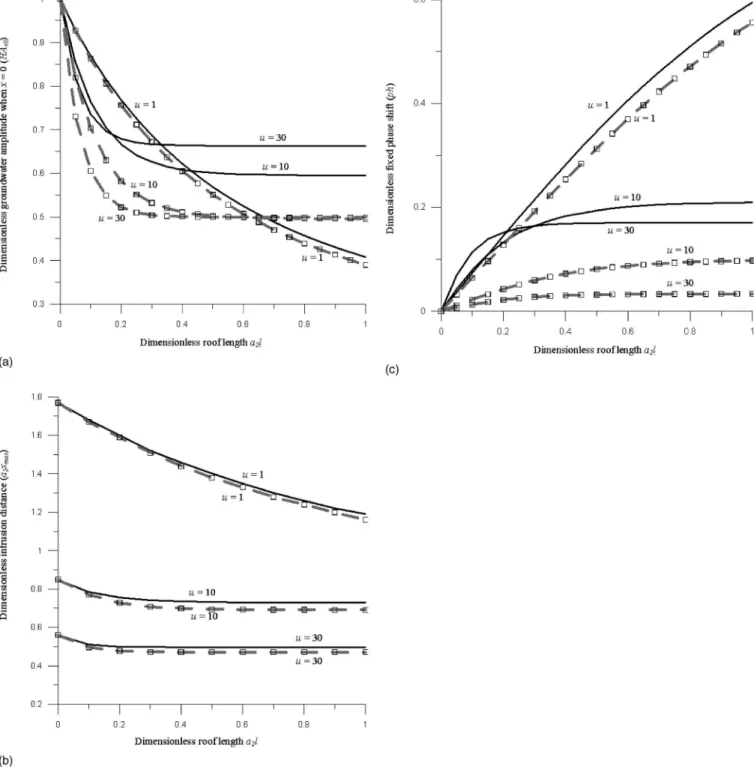
Figs. 2共a–c兲 show the curves of the normalized groundwater am-plitude at x = 0, HAx0, dimensionless fixed phase shift, ph, and
dimensionless intrusion distance in the leaky aquifer, a2xmax,
ver-sus the dimensionless roof length, a2l. The solid lines denote the
present solution, the dash lines represent the present solution when n or T1→0, and the square symbol stands for the solution
of Li and Jiao共2001a兲 without considering the effect of the fluc-tuation of groundwater level in the unconfined aquifer. The solid lines of Figs. 2共a and b兲 clearly show that both HAx0and a2xmax
decrease with increasing a2l and their decreasing rates increase
with u for small a2l and decrease with u for large a2l. In contrast,
the solid lines of Fig. 2共c兲 display that ph increases with a2l and
its increasing rate increases with u for small a2l and decreases
with u for large a2l. The solid lines in Figs. 2共a–c兲 demonstrate
that the HAx0, a2xmax, and ph in the leaky aquifer will approach constant values when a2l is greater than a threshold value. In
other words, when a2l increases, the HAx0, a2xmaxand ph become
less and less sensitive to the a2l. In addition, the threshold value
of a2l decreases with increasing u.
Figs. 2共a–c兲 also indicate that when the a2l is increased, the
dynamic effect of the water table fluctuation in the unconfined aquifer becomes more and more import to a2l and the water table
fluctuation approaches a constant value when a2l is greater than a
threshold value. In addition, the dynamic effect becomes more and more important when the dimensionless leakage is increased. However, given the same values of u and a2l, the HAx0, a2xmax,
and ph in the leaky aquifer with considering the dynamic effect are always larger than those of neglecting such effects.
Effects of the Inland and Offshore Leakages
The second case is to demonstrate how the inland and offshore leakages affect the tidal fluctuation when a2l = 0.5. Figs. 3共a–c兲
show the distributions of HAx0, a2xmax, and ph for various
dimen-sionless leakage values of inland and offshore aquitards with a1
= 10a2, a2= 0.00123/m, a2l = 0.5, and Te= 0. The dash line
repre-sents the dimensionless leakage, u, that ui= uo. Fig. 3共a兲
demon-strates that the HAx0 increases significantly with uo when uo
ranges from 0 to 30. When uochanges from 0 to 30, HAx0varies
from 0.54 to 0.87 when ui= 0, HAx0varies from 0.44 to 0.69 when
ui= 15, and HAx0 varies from 0.46 to 0.66 when ui= 30.
Obvi-ously, the effect of uoon HAx0is large when uiis small. On the
other hand, when uichanges from 0 to 30, HAx0varies from 0.54
to 0.46 when uo= 0, HAx0varies from 0.81 to 0.61 when uo= 15,
and HAx0varies from 0.87 to 0.66 when uo= 30. Apparently, HAx0
decreases with increasing uiand the effect of uion HAx0 is most
important when uo is large. The effect of ui on HAx0 when uo
= 0 is less than that of uowhen ui= 0. The dash line in Fig. 3共a兲
shows HAx0varies from 0.54, 0.62, to 0.66 when u changes from
0, 15, to 30 indicating that the HAx0 increases with the
dimen-sionless leakage.
Fig. 3共b兲 displays that a2xmaxdecreases significantly with
in-creasing uiwhen uiranges from 0 to 30. On the other hand, a2xmax
is independent of uowhen uiis small and slightly increases with
uo when ui is relatively large. In addition, a2xmax decreases
Fig. 2. The curves of共a兲 HAx0;共b兲 ph, and 共c兲 a2xmaxversus a2l when the dimensionless leakage共u=ui= uo兲 varies from 1 to 30 with parameters
a1= 10a2and Te= 0. The solid lines denote the present solution, the dash lines represent the present solution when n or T1→0, and the square symbol stands for solution of Li and Jiao共2001兲 without considering the fluctuation of groundwater level in the unconfined aquifer.
quickly with increasing ui when ui⬍5 and slowly when ui⬎5.
The dash line of Fig. 3共b兲 shows that the a2xmaxincreases
con-spicuously as u decreases. Fig. 3共c兲 shows that the ph decreases as ui increases when ui⬍4 and then increases with ui after ui
⬎6. The effect of uion ph is obviously most significant when uo
is large. On the other hand, the ph decreases as uoincreases when
uiranging from 0 to 30. The dash line in Fig. 3共c兲 shows that the
ph decreases quickly with increasing u for small u and slowly for large u.
Conclusions
New analytical solutions had been derived to analyze the influ-ences of the roof length, dynamic effect of water table fluctuation, and leakages of the inland and offshore on tidal responses in a coupled coastal aquifer system consisting of an unconfined aqui-fer, aquitard, and leaky aquifer. The unconfined aquifer ends at the coast, whereas the aquitard and leaky aquifer extend finite distance under the sea. These newly derived solutions can reduce
Fig. 3. The distributions of共a兲 HAx0,共b兲 a2xmax, and共c兲 ph for various dimensionless leakage values of inland and offshore aquitards with a1 = 10 a2, a2= 0.00123/m, a2l = 0.5, and Te= 0. The dashed line represents the case that ui= uo.
to the solutions of Li and Jiao 共2001a兲 with the assumption of neglecting water-table fluctuation in the unconfined aquifer. In addition, these solutions also reduce to the solutions of Chuang and Yeh共2007兲 when both the aquitard and leaky aquifer extend to an infinite distance. Both offshore and inland leakages are two dominant factors controlling the groundwater level fluctuations. The groundwater level fluctuation in the inland part of leaky aqui-fer increases significantly with the leakage of offshore aquitard. The dimensionless intrusion distance from the coast decreases significantly with the increasing leakage of inland aquitard. The dimensionless intrusion distance in the leaky aquifer decreases quickly with the increasing leakage of inland aquitard when the inland leakage is smaller than 5 and decreases slowly when the inland leakage is larger than 5. The dimensionless fixed phase shift decreases with the increasing dimensionless inland leakage 共ui兲 when ui⬍4 and then increases with ui after ui⬎6. The
di-mensionless fixed phase shift also decreases with the increasing dimensionless offshore leakage. When the roof length is in-creased, the dynamic effect of the water table fluctuation on the dimensionless groundwater amplitude, intrusion distance and fixed phase shift in the unconfined aquifer become more and more important and the water table fluctuation approaches constant val-ues when the roof length is greater than a threshold value. How-ever, given the same values of dimensionless leakage and roof length, the dimensionless groundwater amplitude, intrusion dis-tance and fixed phase shift in the leaky aquifer with considering the dynamic effects are always larger than those of neglecting such effects. In addition, the dynamic effect increases with the dimensionless leakage.
Notation
The following symbols are used in this paper: A0 ⫽ amplitude of the tidal change;
a1 ⫽ unconfined aquifer’s tidal propagation
parameter;
a2 ⫽ confined aquifer’s tidal propagation parameter; HA ⫽ normalized groundwater amplitude;
HAx0 ⫽ normalized groundwater amplitude when
x = 0;
hs ⫽ hydraulic head of the sea tide;
h1 ⫽ hydraulic head in the unconfined aquifer; h2 ⫽ hydraulic head in the leaky aquifer; Li ⫽ leakage of the inland aquitard;
Lo ⫽ leakage of the offshore aquitard;
l ⫽ roof length;
lu ⫽ threshold value of roof length;
n ⫽ dimensionless storativity;
ph ⫽ dimensionless fixed phase shift;
S1 ⫽ storativity of the unconfined aquifer; S2 ⫽ storativity of the leaky aquifer; Te ⫽ tidal efficiency;
T1 ⫽ transmissivity of the unconfined aquifer; T2 ⫽ transmissivity of the leaky aquifer;
t0 ⫽ tidal period;
u ⫽ dimensionless leakage when inland leakage is
equal to offshore leakage;
ui ⫽ dimensionless inland leakage;
uo ⫽ dimensionless offshore leakage;
xmax ⫽ tidal intrusion distance is the farthest
landward distance from the coastline to the location where HA is less than 10−2; and
⫽ tidal speed.
Acknowledgments
This research was partly supported by the Taiwan National Sci-ence Council under the Grant No. NSC 95-2211-E-009-017. The writers sincerely thank three anonymous reviewers for construc-tive comments and suggested revisions.
References
Bear, J., and Verruijt, A.共1987兲. Modeling groundwater flow and pollu-tion, Reidel, Dordrecht, The Netherlands.
Carr, P. A., and Van der Kamp, G.共1969兲. “Determining aquifer charac-teristics by the tidal methods.” Water Resour. Res., 5共5兲, 1023–1031. Chuang, M. H., and Yeh, H. D.共2007兲. “An analytical solution for the head distribution in a tidal leaky aquifer extending an infinite distance under the sea.” Adv. Water Resour., 30共3兲, 439–445.
Farrell, E. R.共1994兲. “Analysis of groundwater flow through leaky ma-rine retaining structures.” Geotechnique, 44, 255–263.
Gregg, D. O.共1966兲. “An analysis of groundwater fluctuations caused by ocean tides in Glynn County, Georgia.” Ground Water, 4共3兲, 24–32. Jacob, C. E.共1950兲. “Flow of groundwater.” Engineering hydraulics, H.
Rouse, ed., Wiley, New York, 321–386.
Jeng, D. S., Li, L., and Barry, D. A.共2002兲. “Analytical solution for tidal propagation in a coupled semi-confined/phreatic coastal aquifer.” Adv. Water Resour., 25共5兲, 577–584.
Jiao, J. J., and Tang, Z.共1999兲. “An analytical solution of groundwater response to tidal fluctuation in a leaky confined aquifer.” Water Re-sour. Res., 35共3兲, 747–751.
Jiao, J. J., and Tang, Z.共2001兲. “Reply to comment by Volker R. E., and Zhang Q. on ‘An analytical solution of groundwater response to tidal fluctuation in a leaky confined aquifer’ by Jiao J. J., and Tang Z.” Water Resour. Res., 37共1兲, 187–188.
Li, G., and Chen, C.共1991a兲. “Determining the length of confined aquifer roof extending under the sea by the tidal method.” J. Hydrol., 123, 97–104.
Li, G., and Chen, C. 共1991b兲. “‘The determination of the boundary of confined aquifer extending under the sea by analysis of groundwater level fluctuations.” Earth Sciences-Journal, 16共5兲, 581–589 共in Chi-nese兲.
Li, H., and Jiao, J. J.共2001a兲. “Tide-induced groundwater fluctuation in a coastal leaky confined aquifer system extending under the sea.” Water Resour. Res., 37共5兲, 1165–1171.
Li, H., and Jiao, J. J.共2001b兲. “Analytical studies of groundwater-head fluctuation in a coastal confined aquifer overlain by a leaky layer with storage.” Adv. Water Resour., 24共5兲, 565–573.
Li, L., Barry, D. A., and Jeng, D. S.共2001兲. “Tidal fluctuations in a leaky confined aquifer: Dynamic effects of an overlying phreatic aquifer.” Water Resour. Res., 37, 1095–1098.
Oki, D. S., William, R. S., Edward, L. B., and Glenn, R. B. 共1998兲. “‘Numerical analysis of the hydrogeologic controls in a layered coastal aquifer system’ Oahu, Hawaii, USA.” Hydrogeol. J., 6, 243– 263.
Pandit, A., El-Khazen, C. C., and Sivaramapillai, S. P.共1991兲. “Estima-tion of hydraulic conductivity values in a coastal aquifer.” Ground Water, 29共2兲, 175–180.
Sun, H.共1997兲. “A two-dimensional analytical solution of groundwater response to tidal loading in an estuary.” Water Resour. Res., 33共6兲, 1429–1435.
Svitil, K. A.共1996兲. “Groundwater secrets.” Discover, 17共9兲, 28. Taigbenu, A. E., James, A. L., and Alexander, H. D. C.共1984兲.
“Bound-ary integral solution to seawater intrusion into coastal aquifers.” Water Resour. Res., 20共8兲, 1150–1158.
Uchiyama, Y., Nadaoka, K., Roelke, P., Adachi, K., and Yagi, H.共2000兲.
“Submarine groundwater discharge into the sea and associated nutri-ent transport in a sandy beach.” Water Resour. Res., 36共6兲, 1467– 1479.
Van der Kamp, G. 共1972兲. “Tidal fluctuations in a confined aquifer ex-tending under the sea.” 24th Int. Geological Confress, Montreal, J. E.
Gill, ed., Section 11, 101–106.
Volker, R. E., and Zhang, Q.共2001兲. “Comments on ‘An analytical solu-tion of groundwater response to tidal fluctuasolu-tion in a leaky confined aquifer’ by J. J. Jiao and Z. Tang.” Water Resour. Res., 37共1兲, 185– 186.