This article was downloaded by: [National Chiao Tung University 國立交通大學] On: 26 April 2014, At: 03:53
Publisher: Taylor & Francis
Informa Ltd Registered in England and Wales Registered Number: 1072954 Registered office: Mortimer House, 37-41 Mortimer Street, London W1T 3JH, UK
Liquid Crystals
Publication details, including instructions for authors and subscription information: http://www.tandfonline.com/loi/tlct20
Synthesis and mesomorphic properties of fluoro and
isothiocyanato biphenyl tolane liquid crystals
Yung‐Ming Liao a
, Narayanasamy Janarthanan a , Chain‐Shu Hsu a , Sebastian Gauza b & Shin‐Tson Wu b
a
Department of Applied Chemistry , National Chiao Tung University , Hsinchu 30010, Taiwan, R.O.C
b
College of Optics and Photonics , University of Central Florida , Orlando, FL 32816 Published online: 06 Dec 2006.
To cite this article: Yung‐Ming Liao , Narayanasamy Janarthanan , Chain‐Shu Hsu , Sebastian Gauza & Shin‐Tson Wu (2006)
Synthesis and mesomorphic properties of fluoro and isothiocyanato biphenyl tolane liquid crystals, Liquid Crystals, 33:10, 1199-1206, DOI: 10.1080/02678290601008497
To link to this article: http://dx.doi.org/10.1080/02678290601008497
PLEASE SCROLL DOWN FOR ARTICLE
Taylor & Francis makes every effort to ensure the accuracy of all the information (the “Content”) contained in the publications on our platform. However, Taylor & Francis, our agents, and our licensors make no
representations or warranties whatsoever as to the accuracy, completeness, or suitability for any purpose of the Content. Any opinions and views expressed in this publication are the opinions and views of the authors, and are not the views of or endorsed by Taylor & Francis. The accuracy of the Content should not be relied upon and should be independently verified with primary sources of information. Taylor and Francis shall not be liable for any losses, actions, claims, proceedings, demands, costs, expenses, damages, and other liabilities whatsoever or howsoever caused arising directly or indirectly in connection with, in relation to or arising out of the use of the Content.
This article may be used for research, teaching, and private study purposes. Any substantial or systematic reproduction, redistribution, reselling, loan, sub-licensing, systematic supply, or distribution in any
form to anyone is expressly forbidden. Terms & Conditions of access and use can be found at http:// www.tandfonline.com/page/terms-and-conditions
Synthesis and mesomorphic properties of fluoro and isothiocyanato
biphenyl tolane liquid crystals
YUNG-MING LIAO{, NARAYANASAMY JANARTHANAN{, CHAIN-SHU HSU*{, SEBASTIAN GAUZA{ and SHIN-TSON WU{
{Department of Applied Chemistry, National Chiao Tung University, Hsinchu 30010, Taiwan, R.O.C {College of Optics and Photonics, University of Central Florida, Orlando, FL 32816, USA
(Received 15 May 2006; accepted 21 July 2006 )
Four series of high birefringence biphenyl tolane liquid crystals having a terminal isothiocyanato or fluoro group were synthesized; their mesomorphic properties were studied by optical polarizing microscopy and DSC. These biphenyl tolane compounds exhibit reasonably low melting points and high birefringence of 0.37–0.49. By using these compounds a eutectic mixture was formulated exhibiting a wide nematic range, high figure-of-merit and low viscosity.
1. Introduction
High birefringence (Dn) liquid crystals (LCs) are useful in super twisted nematic LC displays [1] polarizer-free reflective displays such as polymer-dispersed LCs [2], cholesterics [3], holographic switching devices [4], polarizers and directional reflectors [5, 6]. Apart from these display applications, these materials are also useful for laser beam steering using optical phased arrays and for spatial light modulators [7–9]. The Dn values of the LC materials are determined mainly by their electron conjugation, differential oscillator strength and order parameter [10].
To achieve high Dn, molecules that contain highly polar groups and high electron density, such as biphenyl rings or acetylene linking groups, are the preferred candidates. However, materials having high optical anisotropy may also possess high melting point and high viscosity which are detrimental to practical applications [11–21]. Several molecular structures with high Dn values, e.g. diphenyldiacetylene [22, 23], bistolane [17, 24, 25], naphthalene tolanes [26], and thiophenyldiacetylene [27, 28] have been widely studied. The Dn values of these compounds were reported in the range 0.4–0.6. Among them the diacetylene compounds do not have adequate UV and thermal stabilities, and thus their application is limited [29].
In this work, we report four series of highly birefringent tolane liquid crystals having a terminal isothiocyanato or fluoro group. Phenyl or biphenyl
rings linked by an ethynyl unit were used as the core structure [30]. The synthesized compounds were char-acterized by low melting point, relatively low viscosity, and high optical anisotropy, and some may be suitable for immediate practical applications.
2. Experimental
2.1. Characterization techniques
1
H NMR spectra were measured with a Varian 300 MHz spectrometer. Infrared spectra were obtained by using a Perkin-Elmer Spectrum One spectro-photometer in the range 400–4000 cm21. Differential scanning calorimetry (DSC) was performed on a Perkin-Elmer Pyris Diamond DSC instrument at a heating rate of 10uC min21
. A Carl-Zeiss Axiophot polarizing microscope equipped with a Mettler FP 82 hot stage and a Mettler FP 80 central processor was used to observe the mesomorphic textures. The mole-cular mass and elemental analysis results were obtained from a T-200 GC/MS spectrometer and Heraeus CHN-OS RAPID instrument, respectively.
For electro-optic measurements homogenous cells with cell gap d,8mm were used. An a.c. voltage with 1 kHz square waves was used to drive the LC cell whose inner surfaces were coated with indium tin oxide (ITO) electrodes. On top of the ITO, the substrate was covered with a thin polyimide alignment film. The cell was placed on a heating/cooling stage with a temperature stability of 0.2uC. Commercial LCs 1565 and ZLI-1132 (Merck) were used as the host. A conventional
*Corresponding author. Email: [email protected]
Liquid Crystals
ISSN 0267-8292 print/ISSN 1366-5855 online # 2006 Taylor & Francis http://www.tandf.co.uk/journals
DOI: 10.1080/02678290601008497
guest–host method was applied to extrapolate the Dn value at T , 23.5uC.
2.2. Synthesis
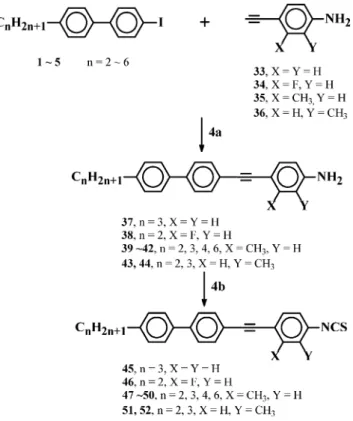
The compounds 1–5, 6–8, 18–23 and 33–36 were prepared by reported methods [31–33]. As mentioned above, a large variety of high birefringence compound structures have been investigated. However, in all cases the synthesis of the final materials is greatly facilitated by the use of palladium-catalysed cross-coupling reac-tions [34–42]. Indeed, in the synthesis of some materials this procedure is virtually essential. Schemes 1 and 2 show the synthesis of several fluoro-substituted materi-als, scheme 3 shows the synthesis of several alkyl-substituted materials, and scheme 4 shows the synthesis of several isothiocyanato-substituted materials.
Despite the advanced development of palladium-catalysed cross-coupling reactions, and their exceptional versatility and extremely wide tolerance to a wide range of functional groups, those coupling reactions involving isothiocyanato substituents fail [41]. The use of thio-phosgene and chloroform in aqueous calcium carbonate on an aromatic amine is a very useful and efficient method of introducing the isothiocyanato group [41, 42]. and this method is used in this research (scheme 4). 2.2.1. 1-(4-Ethylbiphenyl)-2-(4-fluoro-3-methylphenyl)
acetylene, 9. Compound 1 (1.54 g, 5 mmol),
Pd(PPh3)2Cl2 (0.07 g, 0.1 mmol), triphenylphosphine
(0.1 g, 0.4 mmol), CuI (0.04 g, 0.2 mmol) and dry triethylamine (100 ml) were mixed and stirred at room temperature for 30 min under nitrogen. A solution of compound 6 (0.66 g, 5.5 mmol) dissolved in 50 ml of triethylamime was added dropwise and the mixture
stirred at 60uC for 24 h. After cooling to room temperature, the mixture was filtered and filtrate concentrated in vacuo to remove triethylamine. The crude product was dissolved in diethyl ether and extracted with aqueous ammonium chloride solution. The organic phase was then washed with saturated aqueous NaCl and dried over MgSO4. The crude
product isolated by evaporating the solvent was
purified by column chromatography using ethyl
acetate/n-hexane51/4 as eluant to give a white solid; yield 1.12 g (75%). 1H NMR (d, CDCl3): 1.25–1.32 (t, 3H), 2.57–2.62 (q, 2H), 7.00–7.58 (m, 12H).13C NMR (d, CDCl3): 15.4, 28.7, 87.8, 92.9, 112.7, 113.0, 116.3, 116.6, 119.2, 121.9, 126.9, 128.9, 131.3, 131.8, 133.4, 133.5, 137.7, 140.9, 142.8, 143.9, 160.7, 164.0. IR (KBr) nmax (cm21): 2960, 2929, 2251, 1604, 1510, 1467, 1089,
837. MS m/z 300 (M+), 285. Anal: calc. for C22H17F, C
87.97, H 5.70; found, C 87.83, H, 5.85%.
2.2.2. 1-(4-Fluorobiphenyl)-2-(4-ethylphenyl)acetylene, 24. Compound 18 (1.5 g, 5 mmol), Pd(PPh3)2Cl2(0.07 g,
0.1 mmol), triphenylphosphine (0.1 g, 0.4 mmol), CuI (0.04 g, 0.2 mmol) and dry triethylamine (100 ml) were mixed and stirred at room temperature for 30 min under nitrogen. A solution of compound 19 (0.72 g, 5.5 mmol) dissolved in 50 ml of triethylamime was added dropwise
Scheme 1. Synthesis of compounds 9–17.
Scheme 2. Synthesis of compounds 24–28.
Scheme 3. Synthesis of compounds 29–32.
1200 Y.-M. Liao et al.
and the mixture stirred at 60uC for 24 h. After cooling to room temperature, the mixture was filtered and the filtrate concentrated in vacuo to remove triethylamine. The crude product was dissolved in diethyl ether and extracted with aqueous ammonium chloride solution. The organic phase was then washed with saturated aqueous NaCl and dried over MgSO4. The crude
product isolated by evaporating the solvent was
purified by column chromatography using ethyl
acetate/n-hexane51/10 as eluant to give a white solid; yield 1.20 g (80%). 1H NMR (CDCl3): d 1.21–1.26 (t, 3H), 2.62–2.69 (q, 2H), 7.09–7.69 (m, 12H).13C NMR (CDCl3): d 15.3, 28.8, 88.5, 90.4, 115.6, 115.9, 120.3, 122.4, 126.8, 128.0, 128.4, 128.5, 128.6, 131.6, 132.0, 133.0, 139.7, 144.8, 161.0, 164.2. IR (KBr) nmax(cm21): 2969, 2932, 2866, 2251, 1594, 1510, 1457, 1071, 833. MS m/z 300 (M+), 285. Anal: calc. for C22H17F, C 87.97, H
5.70; found, C 87.74, H 5.81%.
2.2.3. 1-(4-Propylbiphenyl)-2-(4-amino-2-methylphenyl)
acetylene, 40. Compound 2 (1.61 g, 5 mmol),
Pd(PPh3)2Cl2 (0.07 g, 0.1 mmol), triphenylphosphine
(0.1 g, 0.4 mmol), CuI (0.04 g, 0.2 mmol) and dry triethylamine (100 ml) were mixed and stirred at room temperature for 30 min under nitrogen. A solution of
compound 35 (0.72 g, 5.5 mmol) dissolved in 50 ml of triethylamime was added dropwise and the mixture stirred at 70uC for 24 h. After cooling to room temperature, the mixture was filtered and filtrate concentrated in vacuo to remove triethylamine. The crude product was dissolved in diethyl ether and extracted with aqueous ammonium chloride solution. The organic phase was then washed with saturated aqueous NaCl and dried over MgSO4. The crude
product isolated by evaporating the solvent was
purified by column chromatography using ethyl
acetate/n-hexane51/4 as eluant to give a yellow solid; yield 1.05 g (64%). 1H NMR (d, CDCl3): 0.96–0.98 (t, 3H), 1.65–1.69 (m, 2H), 2.45 (s, 3H), 2.60–2.66 (q, 2H), 6.50 (s, 2H), 7.00–7.57 (m, 11H), IR (KBr) nmax(cm21): 3561, 3388, 2960, 2943, 2860, 1630, 1490, 1400, 1110, 1003, 823. 2.2.4. 1-(4-Propylbiphenyl)-2-(4-isothiocyanato-2-methylphenyl)acetylene, 48. Compound 40 (1.0 g, 3.1 mmol) was dissolved in 15 ml of chloroform and the solution added to a stirred, cooled (0uC) mixture of water (10 ml) calcium carbonate (0.46 g, 4.6 mmol), chloroform (8 ml) and thiophosgene (0.39 g, 4.0 mmol), then stirred at 0uC for 4 h. The stirred mixture was allowed to come to room temp, then heated to 45uC and held for 20 min before pouring into water. The aqueous layer was washed with dichloromethane and the combined organic extracts were washed with 1% aqueous HCl, water, brine and then dried (MgSO4).
The crude product isolated by evaporating the solvent was purified by column chromatography using ethyl acetate/n-hexane51/10 as eluant to give a white solid; yield 0.91 g (80%). 1H NMR (d, CDCl3): 0.93–0.98 (t, 3H), 1.63–1.70 (m, 2H), 2.49 (s, 3H), 2.59–2.64 (q, 2H), 7.00–7.57 (m, 11H). 13C NMR (d, CDCl3): 13.8, 20.6, 24.5, 37.7, 87.8, 95.2, 121.5, 122.4, 123.0, 126.4, 126.6, 126.7, 126.8, 127.0, 128.9, 129.0, 130.5, 131.8, 131.9, 132.8, 136.0, 137.5, 141.3, 141.9, 142.5. IR (KBr) nmax (cm21): 2954, 2923, 2863, 2215, 2040, 1634, 1498, 1464, 1382, 1003, 823. MS m/z 367 (M+), 338. Anal: calc. for C25H21NS, C 81.71, H 5.76, N 3.81; found, C 81.53, H
5.77, N 3.98%.
3. Results and discussion
3.1. Thermal transitions and mesomorphic properties The chemical structure, phase transition temperatures, associated enthalpies and optical anisotropy values for the reported novel compounds and some known materials for comparison are shown in tables 1–5.
Table 2 summarizes the phase transitions of com-pounds 9–17. They all exhibit an enantiotropic nematic
Scheme 4. Synthesis of compounds 45–52.
phase. Compounds 9–12 contain the same terminal fluoro group on the phenyl ring and different alkyl chain lengths on the biphenyl ring. Their phase
transitions are plotted against the carbon number of the alkyl chain in figure 1. It can be seen that both melting and clearing points show an odd–even effect
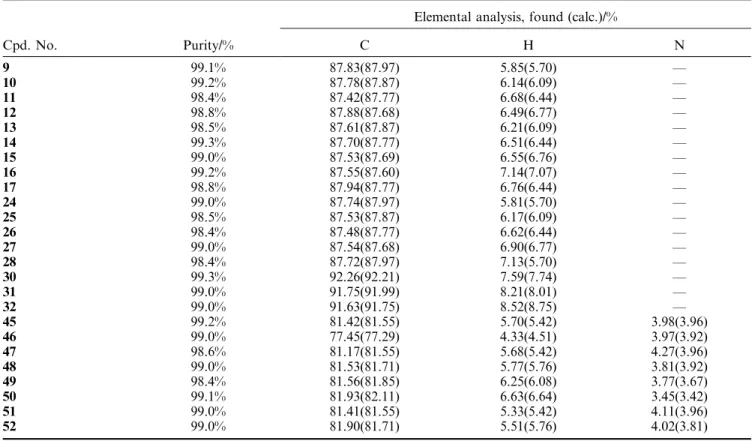
Table 1. Purity and elemental analysis data for some representative bistolanes.
Cpd. No. Purity/%
Elemental analysis, found (calc.)/%
C H N 9 99.1% 87.83(87.97) 5.85(5.70) — 10 99.2% 87.78(87.87) 6.14(6.09) — 11 98.4% 87.42(87.77) 6.68(6.44) — 12 98.8% 87.88(87.68) 6.49(6.77) — 13 98.5% 87.61(87.87) 6.21(6.09) — 14 99.3% 87.70(87.77) 6.51(6.44) — 15 99.0% 87.53(87.69) 6.55(6.76) — 16 99.2% 87.55(87.60) 7.14(7.07) — 17 98.8% 87.94(87.77) 6.76(6.44) — 24 99.0% 87.74(87.97) 5.81(5.70) — 25 98.5% 87.53(87.87) 6.17(6.09) — 26 98.4% 87.48(87.77) 6.62(6.44) — 27 99.0% 87.54(87.68) 6.90(6.77) — 28 98.4% 87.72(87.97) 7.13(5.70) — 30 99.3% 92.26(92.21) 7.59(7.74) — 31 99.0% 91.75(91.99) 8.21(8.01) — 32 99.0% 91.63(91.75) 8.52(8.75) — 45 99.2% 81.42(81.55) 5.70(5.42) 3.98(3.96) 46 99.0% 77.45(77.29) 4.33(4.51) 3.97(3.92) 47 98.6% 81.17(81.55) 5.68(5.42) 4.27(3.96) 48 99.0% 81.53(81.71) 5.77(5.76) 3.81(3.92) 49 98.4% 81.56(81.85) 6.25(6.08) 3.77(3.67) 50 99.1% 81.93(82.11) 6.63(6.64) 3.45(3.42) 51 99.0% 81.41(81.55) 5.33(5.42) 4.11(3.96) 52 99.0% 81.90(81.71) 5.51(5.76) 4.02(3.81)
Table 2. Phase transition temperatures and corresponding enthalpy changes of the fluorinated biphenyl tolanes: Cr5crystal, S5smectic, N5nematic, I5isotropic.
Cpd. No. n X Y Phase transition temperature/uC and enthalpy change/kcal/molheating scan cooling scan 9 2 H H Cr 130:7 6:39ð Þ SmX 133:1 {ð Þa N 136:2 0:14ð Þ I I 134:1 0:13ð Þ N 124:4 2:77ð Þ SmX 84:0 3:35ð Þ Cr 10 3 H H Cr 185:7 3:41ð Þ N 212:9 0:20ð Þ I I 209:7 0:28ð Þ N 179:7 3:44ð Þ Cr 11 4 H H Cr 172:5 3:27ð Þ N 183:3 0:12ð Þ I I 176:5 0:18ð Þ N 164:2 3:40ð Þ Cr 12 5 H H Cr 178:6 3:01ð Þ SmX 183:8 {ð ÞaN 199:2 0:13ð Þ I I 93:5 0:27ð Þ N 179:0 {ð Þa SmX 173:8 3:13ð Þ Cr 13 2 CH3 H Cr 130:0 5:68ð Þ N 169:2 0:12ð Þ I I 165:9 0:11ð Þ N 98:1 3:47ð Þ Cr 14 3 CH3 H Cr 102:6 4:99ð Þ N 172:9 0:18ð Þ I I 169:9 0:17ð Þ N 102:4 0:17ð Þ SmA 83:5 1:02ð Þ SmX 58:3 2:87ð Þ Cr 15 4 CH3 H Cr 84:8 4:94ð Þ SmA 98:4 0:20ð Þ N 149:5 0:16ð Þ I I 147:5 0:15ð Þ N 96:3 0:23ð Þ SmA 81:3 4:34ð Þ Cr 16 5 CH3 H Cr 84:9 5:19ð Þ SmA 126:4 0:23ð Þ N 166:5 0:13ð Þ I I 164:1 0:19ð Þ N 123:8 0:26ð Þ SmA 81:2 5:20ð Þ Cr 17 3 H CH3 Cr 117:1 2:45ð Þ SmX 140:3 2:05ð Þ N 148:8 0:07ð Þ I I 142:7 0:16ð Þ N 131:8 2:26ð Þ SmX 57:5 2:06ð Þ Cr a Overlapped transition.
1202 Y.-M. Liao et al.
Table 3. Phase transition temperatures and corresponding enthalpy changes of the 4-fluorophenyl-49-alkyl tolanes: Cr5crystal, S5smectic, N5nematic, I5isotropic.
Cpd. No. n Phase transition temperature/uC and enthalpy change/kcal/molheating scan cooling scan 24 2 Cr 173:0 4:36ð Þ I I 143:0 4:14ð Þ Cr 25 3 Cr 174:3 3:66ð Þ N 210:9 0:14ð Þ I I 206:5 0:16ð Þ N 170:2 2:68ð Þ Cr 26 4 Cr 169:9 2:63ð Þ N 188:7 0:11ð Þ I I 182:5 0:14ð Þ N 163:6 2:71ð Þ Cr 27 5 Cr 176:6 2:72ð Þ N 203:8 0:16ð Þ I I 199:9 0:22ð Þ N 170:9 2:99ð Þ Cr 28 6 Cr 174:9 2:58ð Þ N 188:6 0:15ð Þ I I 186:0 0:2ð Þ N 171:0 3:19ð Þ Cr
Table 4. Phase transition temperature and corresponding enthalpy changes of dialkyl-substututed biphenyl tolanes: Cr5crystal, S5smectic, N5nematic, I5isotropic.
Cpd. No. n Phase transition temperature/uC and enthalpy change/kcal/molheating scan cooling scan 29 3 Cr 147:8 3:25ð Þ N 209:2 0:18ð Þ I I 205:4 0:37ð Þ N 141:3 3:26ð Þ Cr 30 4 Cr 141:0 3:3ð Þ N 203:0 0:19ð Þ I I 199:0 0:35ð Þ N 134:0 3:29ð Þ Cr 31 5 Cr 137:7 2:17ð Þ N 200:7 0:21ð Þ I I 196:0 0:15ð Þ N 131:2 2:16ð Þ Cr 32 6 Cr 130:2 3:22ð Þ N 195:4 0:24ð Þ I I 190:4 0:34ð Þ N 124:4 3:34ð Þ Cr
Table 5. Phase transition temperature and corresponding enthalpy changes of the isothiocyanato biphenyl tolanes: Cr5crystal, S5smectic, N5nematic, I5isotropic.
Cpd. No. n X Y Phase transition temperature/uC and enthalpy change/kcal/molheating scan cooling scan 45 3 H H Cr 200:0 5:32ð Þ SmA 209:0 0:35ð Þ N 266:0 0:06ð Þ I I 261:5 0:06ð Þ N 184 0:31ð Þ SmA 136:2 4:70ð Þ Cr 46 2 F H Cr 146:9 6:86ð Þ N 247:9 0:24ð Þ I I 243:1 0:13ð Þ N 137:7 3:64ð Þ Cr 47 2 CH3 H Cr 152:0 5:75ð Þ N 201:4 0:06ð Þ I I 196:7 0:06ð Þ N 122:0 4:67ð Þ Cr 48 3 CH3 H Cr 117:2 5:35ð Þ N 188:1 0:18ð Þ I I 181:4 0:10ð Þ N 104:2 4:89ð Þ Cr 49 4 CH3 H Cr 107:1 6:36ð Þ N 194:6 0:21ð Þ I I 192:6 0:13ð Þ N 67:6 4:89ð Þ Cr 50 5 CH3 H Cr 82:5 6:75ð Þ SmC 147:5 0:23ð Þ N 208:4 0:81ð Þ I I 205:9 0:16ð Þ N 145:8 0:21ð Þ SmC 78:5 5:84ð Þ Cr 51 2 H CH3 Cr 137:0 4:76ð Þ SmA 151:9 0:19ð Þ N 214:5 0:23ð Þ I I 212:9 0:27ð Þ N 150:0 0:19ð Þ SmA 119:0 {ð ÞaSmX 115:1 4:22ð Þ Cr 52 3 H CH3 Cr 147:5 7:01ð Þ N 207:7 0:24ð Þ I I 205:8 0:23ð Þ N 135:8 {ð Þa SmX 133:1 5:41ð Þ Cr a Overlapped transition.
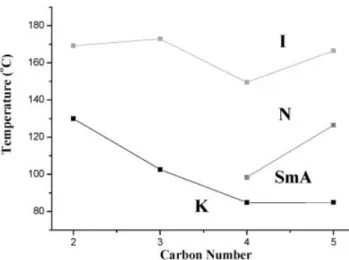
with increasing carbon number. Compounds 9 and 12 show an ordered smectic phase which can not be identified by optical microscopy. Compounds 13–16 contain similar structures to those of compounds 9–12, with an additional lateral methyl group at the C-2 position of the phenyl ring. Their phase transition temperatures are plotted against the carbon number of the alkyl chain in figure 2. In this case the clearing points show an odd–even effect with increasing carbon number, while melting temperatures decrease gradually. Compared with compounds 9–12, both melting and clearing points decreased on introducing a lateral methyl group. This is reasonable since the lateral group can hinder effective molecular packing and thus decrease transition temperatures. An exception was found for compound 13 which shows a similar clearing
point to compound 9. The reason could be due to their short ethyl group. Both compounds 15 and 16 reveal an enantiotropic smectic A phase in addition to the nematic phase.
For comparison purposes, we synthesized compound 17 which contains a lateral methyl group at the C-3 position of the phenyl ring. Its melting and clearing
points are lower than those of compound 10.
Nevertheless, in comparison with compound 14, its melting point is higher but clearing point is lower.
Table 3 lists the phase transition temperatures of compounds 24–28. Compound 24 shows no meso-morphic properties, which may be due to the short ethyl group. Compounds 25–28 exhibit an enantiotropic nematic phase; their phase transition temperatures are plotted against the carbon number in figure 3. Both melting and clearing points show an odd–even effect with increasing carbon number. Comparing the chemi-cal structures of this series of compounds with those of compounds 9–12, the difference is the locations of the fluoro and alkyl terminal groups which are reversed in both cases. The mesomorphic behaviour of the two series of compounds is very different. For example, compound 9 exhibits enantiotropic nematic and smectic phases while compound 24 shows no mesophase.
Table 4 summarizes the properties of the asymmetric dialkyl-substituted biphenyl tolanes 29–32. In this series an ethyl group was placed on the biphenyl ring and, on the other side, different alkyl chains were introduced on the phenyl ring. They show enantiotropic mesomorphic behaviour, and only a nematic phase is observed. Their phase transition temperatures are plotted against the carbon number in figure 4. Both melting and clearing temperatures are decreased slightly with increasing
Figure 1. Dependence of transition temperature on the number of terminal group carbon atoms for compounds 9–12.
Figure 3. Dependence of transition temperature on the number of terminal group carbon atoms for compounds 25– 28.
Figure 2. Dependence of transition temperature on the number of terminal group carbon atoms for compounds 13– 16.
1204 Y.-M. Liao et al.
carbon number. This series of biphenyl tolanes shows much lower melting points than the fluorinated biphenyl tolanes 9–12 and 25–28.
Table 5 summarizes the phase transition tempera-tures of the isothiocyanato biphenyl tolanes 45–52. The chemical structures of these compounds are similar to those of compounds 9–17, with replacement of the terminal group by an isothiocyanato group. Compound 45 shows the highest transition temperature because of its linear structure without lateral substitutents. As in
the introduction of a lateral methyl or fluoro group in compounds 46–52, the melting and clearing points are both decreased. In comparing compounds 46 and 47, the nematic range is increased on replacing the methyl with a fluoro group. Turning to compounds 47–50, the melting points are decreased with increasing alkyl chain length. Compounds 51 and 52 contain a lateral methyl group at the C-3 position of the phenyl ring. Both exhibit smectic phases in addition to a nematic phase, while their corresponding compounds 47 and 48 show only a nematic phase. Furthermore, both 51 and 52 exhibit much higher clearing points. On comparing the phase transition temperatures of isothiocyanato biphe-nyl tolanes 47–50 with those of the corresponding fluorinated biphenyl tolanes 13–16, it is seen that the isothiocyanato compounds show much higher melting and clearing points.
3.2. Optical anisotropy
The Dn value, defined as the difference between the two principal refractive indices of a uniaxial material, was estimated by the guest–host method. The Dn value of a guest–host system can be approximated from the equation:
Dn
ð Þgh~xðDnÞgz 1{xð Þ Dnð Þh: ð1Þ In equation (1), the subscripts g, h, and gh denote guest, host, and guest–host cells, respectively, and x is the concentration (in wt %) of the guest compound. By
Figure 4. Dependence of transition temperature on the number of terminal group carbon atoms for compounds 29– 32.
Table 6. Values of Dn for single compoundsa.
Cpd. No. Compound structure Dn
10 0.36 14 0.35 25 0.37 46 0.49b 47 0.48b 51 0.45* a
Data calculated from the guest–host systems using. host mixture ZLI-1565: Cr–20.0 N 85.0 I (uC), Dn50.12 at T523.5uC
b
Host mixture ZLI-1132 was used.
comparing the measured results for the guest–host mixtures with those of the host mixture, the Dn values of the guest compounds can be extrapolated.
The Dn values of some of the synthesized compounds are listed in table 6. Commercial LCs 1132 or ZLI-1565 were used as host mixture. It can be seen that Dn values of these compounds are in the range 0.35–0.49. For those compounds with a terminal isothiocyanato group, the Dn value is higher than that of the corresponding fluoro compounds. This is because the isothiocyanto group has an elongated electron conjuga-tion than the fluoro group. On comparing compounds 10 and 14, the Dn value was slightly decreased on introducing a lateral methyl group at the C-2 position. Compound 46 has the highest Dn of 0.49 and is expected to be useful for PDLC, cholesteric display, and laser beam steering applications.
4. Conclusions
Four series of novel high birefringence biphenyl liquid crystals with a terminal isothiocyanato or fluoro group were synthesized. A lateral methyl or fluoro group was introduced to modify their LC properties. Some of these compounds exhibit an odd–even effect in phase transi-tion temperatures. The Dn value was determined by the guest–host method using a commercial LC as host matrix. Compounds containing both biphenyl and
isothiocyanato moieties have a high Dn value.
Compound 46 has the highest Dn of 0.49, and may be a good candidate for many display applications. Acknowledgement
The authors would like to thank the National Science Council (NSC) of the Republic of China (NSC 94-2216-E-009-001) for financial support of this research. References
[1] S.T. Wu, D.K. Yang. Reflective Liquid Crystal Displays. Wiley, New York (2001).
[2] J.W. Doane, N.A. Vaz, B.G. Wu, S. Zumer. Appl. Phys. Lett., 48, 269 (1986).
[3] J. Li, C. Hoke, D.S. Fredly, P.J. Bos. SID Symp. Dig., 96, 265 (1996).
[4] R.L. Sutherland, L.V. Natarajan, V.P. Tondiglia, T. Bunning. J. chem. Mater., 5, 1533 (1993).
[5] C.C. Bowley, H. Yuan, G.P. Crawford. Mol. Cryst. liq. Cryst., 331, 209 (1999).
[6] T. Tokumaru, K. Iwauchi, Y. Higashigayi, M. Matsuura. In proceedings of the Anglo Japanese Seminar on Liquid Crystals., p. 72 (1999).
[7] P.F. Mcmanamon, et al. Proc. IEEE., 84, 268 (1996). [8] P.F. Mcmanamon, E.A. Waston, T.A. Dorschner, L.J.
Barnes. Opt. Eng., 32, 2657 (1993).
[9] S.T. Wu, U. Efron, J. Grinberg, L.D. Hess. SID tech. Dig., 16, 262 (1985).
[10] S.T. Wu. Phys. Rev. A, 33, 1270 (1986). [11] S.T. Wu. Mol. Cryst. liq. Cryst., 261, 79 (1995). [12] J.W. Baran, Z. Razewski, R. Dabroswski, J. Kedzierski,
J. Rutkowska. Mol. Cryst. liq. Cryst., 123, 237 (1985). [13] M.D. Wang, R. Vohra, S. Monahan. Liq. Cryst., 15, 269
(1993).
[14] Y. Goto, T. Inukai, A. Fujita, D. Demus. Mol. Cryst. liq. Cryst., 260, 23 (1995).
[15] D.G. Mcdonnell. J. mater. Chem., 5, 1 (1995).
[16] G.J. Cross, A.J. Seed, K.J. Toyane, J.W. Goodby, M. Hird, M.C. Artal. J. mater. Chem., 10, 1555 (2000). [17] C. Sekine, N. Konya, M. Minai, K. Fujisawa. Liq. Cryst.,
28, 1495 (2001).
[18] K-II. Huh, Y.B. Kim. Jpn. J. appl. Phys., V41, 6484 (2002).
[19] A. Spadlo, R. Dabrowski, M. Filipowicz, Z. Stolarz, J. Prezdmojski, S. Gauza, Y.H. Fan, S.T. Wu. Liq. Cryst., 30, 191 (2003).
[20] M. Hird, K.J. Toyane, G.W. Gray, S.E. Day, D.G. Mcdonnel. Liq. Cryst., 15, 123 (1993).
[21] C. Sekine, M. Ishitobi, K. Iwakura, M. Minai, K. Fujisawa. Liq. Cryst., 29, 355 (2000).
[22] S.T. Wu, J.D. Margerum, B. Meng, L.R. Dalton, C.S. Hsu, S.H. Lung. Appl. Phys. Lett., 61, 630 (1992). [23] S.T. Wu, M. Neubert, S.S. Keast, D.G. Abdallah, S.N.
Lee, M.E. Walsh, T.A. Dorschner. Appl. Phys. Lett., 77, 957 (2000).
[24] S.T. Wu, C.S. Hsu, K.F. Shyu. Appl. Phys. Lett., 74, 344 (1999).
[25] S.T. Wu, C.S. Hsu, Y.Y. Chuang, H.B. Cheng. Jpn. J. appl Phys., 39, L38 (2000).
[26] A.J. Seed, K.J. Toyne, J.W. Goodby, M. Hird. J. mater. Chem., 10, 2069 (2000).
[27] C. Sekine, N. Konya, M. Minai, K. Fujisawa. Liq. Cryst., 28, 1361 (2001).
[28] C. Sekine, M. Ishitobi, K. Iwakura, M. Minai, K. Fujisawa. Liq. Cryst., 29, 355 (2002).
[29] P.T. Lin, S.T. Wu, C.Y. Chang, C.S. Hsu. Mol. Cryst. liq. Cryst., 411, 243 (2004).
[30] O. Catanescu, L.C. Chien. Liq. Cryst., 33, 115 (2006). [31] T.M. Juang, Y.N. Chen, S.H. Lung, Y.H. Lu, C.S. Hsu,
S.T. Wu. Liq. Cryst., 15, 529 (1993).
[32] C.S. Hsu, K.F. Shyu, Y.Y. Chuang, S.T. Wu. Liq. Cryst., 27, 283 (2000).
[33] A.L. Bailey, G.S. Bates. Mol. Cryst. liq. Cryst., 198, 417 (1991).
[34] N. Miyaura, T. Yanagi, A. Suzuki. Synth. Commun., 11, 513 (1981).
[35] A.O. King, E. Negishi, F.J. Villani, A. Silveria. J. org. Chem., 43, 358 (1978).
[36] A.M. Echavarren, J.J. Stille. J. Am. chem. Soc., 109, 5478 (1987).
[37] G.W. Gray, M. Hird, D. Lacey, K.J. Toyne. J. chem. Soc., Perkin Trans., 2, 2041 (1989).
[38] E. Negishi, A.O. King, N. Okukado. J. org. Chem., 42, 1821 (1977).
[39] M. Hird, G.W. Gray, K.J. Toyne. Mol. Cryst. liq. Cryst., 206, 187 (1991).
[40] N. Miyaura, A. Suzuki. Chem. Rev., 95, 2457 (1995). [41] M. Hird, A.J. Seed, K.J. Toyne, J.W. Goodby, G.W.
Gray, D.G. McDonnell. J. mater. Chem., 3, 851 (1993). [42] R. Dabrowski, J. Dziaduszek, T. Szczucinski. Mol. Cryst.
liq. Cryst., 124, 241 (1985).
1206 Biphenyl tolane liquid crystals