IEEE TRANSACTIONS ON MAGNETICS, VOL. 27, NO. 2, MARCH 1991
SYNTHESIS AND SUPERCONDUCTING PROPERTIES OF T1-Ba-Ca-Cu-0 FILMS
S.H. Liou, V.I<. Chan, F. Foong
Behlen Laboratory of Physics and Center for Materials Research and Analysis University of Nebraska, Lincoln, Nebraska 68588-01 11
W.Y. Lee
IBM Almaden Research Center San Jose, California 95120-6099
Y.S. Gou and T.M. Uen Institute of Electrophysics
National Chiao Tung University, Hsinchu, Taiwan
Abstract
The T1-Ba-Ca-Cu-0 superconducting films were synthesized by sputtering either from a single target or from two oxide tar- gets in a symmetric configuration. Films with zero resistance T, of up t o 122 I< were obtained after various post annealing treatment a t 870 - 950°C under oxygen atmosphere. We have studied morphology, structure, magnetic and superconducting properties of these films. Films prepared by two different sput- tering techniques have similar results which depend mostly on the film compositions and their annealing conditions. We found that the induced magnetic flux in the film decrcases rapidly with increasing temperature, indicating the weak flux pinning.
Introduction
Following the initial discoveiy of superconductivity in the T1- Ba-Ca-Cu-0 system,’,’ the highest T, (R=O) a t 125K has been observed in the compound of T12BazCazCu3010 (2223)3*4. Thin film research on the T1-based superconductors is particularly important because their T,’s (R=O) are much higher than those of the rare earth based Y1BazCu307-, compounds. Further- more, it is likely t o obtain more stable high critical current densities in excess of 10’ - IO6 A/cm’ a t 77I< in the T1-based system.
Recently, polycrystalline films 0.7 p m thick containing pre- dominantly T l ~ B a z C a l C u z O s (2212) phase with T, (R=O) a t 97K and a transport J, of 1.1 x lo5 A/cm’ a t 76K have been obtained by Ginley e t al.‘ using electron beam evaporation. Highly oriented films 0.4 p m thick (with the c-axis perpendic- ular t o the film plane) containing nearly a single phase of 2212 as well as having a T, (R=O) a t 102K and a transport J, of 1.2 x lo’ A/cm’ a t 77I< have been prepared by Ichikawa et using R F magnetron sputtering and a single oxide target. Highly textured c-axis oriented films 2.0 - 4.0 p m thick contain- ing both 2223 and 2212 phases with a T, (R=O) a t 120K and a J, by magnetic measurement of 1.5 x lo4 A/cm’ at 77K have bccn reported by Lee et al.7 using two identical oxide targets in a symmetrical R F diode sputtering system.
The ability to produce thin films with the pure high T, Tl2BazCazCu3O1o phase not only can further improve J,’s a t higher temperatures but may also provide a useful material for
1227
a fundamental study on the T1-based superconducting oxides. In this paper, we discuss the preparation conditions for films with T, (R=O) a t 122I<. The results of magnetic proper- ties of these films are presented.
Film Growth
T h e T1-Ba-Ca-Cu-0 films were prepared on Mg0(100), Y-ZrOz (random orientation) and LaA103 (100) substrates by sputter- ing either from a single targets or from two oxide target in a symmetric configuration. The details of the sample syn- thesis have been reported in our previous papers7,’. Due t o the volatility of the T1-oxide, the optimal processing of the T1-based films requires good control of the T1-vapor partial pressure. We have used two different methods t o control the T1-vapor partial pressure. One is annealing the film in a sealed gold box with a composite T1-compound. The other one is an- nealing the film in a two zone-furnace, in which the T1-vapor partial pressure is controlled by the zone temperature. The first method is much simpler and the results are reproducible. T h e second method requires a fine adjustment which we need t o study further. The films reported here were prepared by the first method. The annealing steps have been shown t o be a crucial determinant of the quality of T1-based supercon- ducting filmsg. In this study, we show that the films consist of nearly pure T l ~ B a ~ C a z C u 3 0 1 0 phase with T, (R=O) in the range of 1OOK t o 122K and c-axis perpendicular t o the film plane were obtain after annealing 870
-
895 for up to 3 hours. T h e major factors that lead t o achieve a higher T, than that of the previous study are perhaps due t o the better control of T1-vapor partial pressure and annealing a t higher temperature for a longer time. We also observed a substantial improve- ment in the superconducting properties for films subsequently annealed a t low temperature (< 700°C) either in air or oxy- gen. The detailed study of low temperature annealing will be discussed elsewhere”.ComDosition. Structure and Processinn Conditions T h e film compositions were determined by x-ray fluorescence microprobe spectroscopy. A typical composition of as-deposited films is Tlz.lBa2.4Caz.oCu3,10x. The composition of the as- deposited film was very homogeneous, but the composition of hlaniiscript received September 24, 1990.
1228
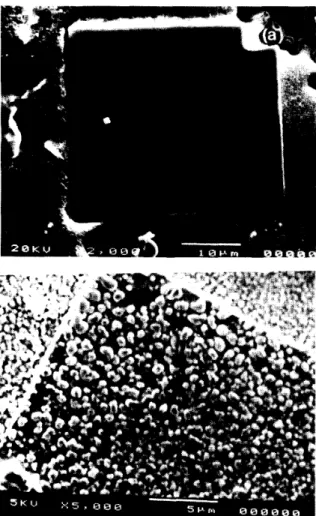
the post-annealed film was not homogeneous, especially the T1 and Ca content. As a n example, we have tested the stability of T1 in a single crystal. As showii in Figure l ( a ) , a singlc crystal with 2223 phase was prepared on a MgO(100) Substrate. Af ter we had annealed this crystal a t 800°C without providing
additional T1-vapor for 15 minnte, we found t h a t the phase of this crystal was changed, its surface became rough, and its T1-content was lost completely. Its morphology, as shown in Figure l(b). is completely different from the original crystal. The T1 content can vary widely depending on the annealing temperature and the duration of the annealing time a t the high temperature. The amount of Ba, C a and Cu in the annealed films was found t o be insensitive to the processing conditions if we average over a large area. However, the micro-scale com- position of annealed filnis has some variation? which drpend on the processing conditions. In order t o investigate the effect of the processing conditions on the micro-scale composition, we have prepared two films with similar superconducting and structural properties. The morphology and the composition of
Fig. 1 Scanning electron micrographs of T1-Ba-Ca-Cu-0 film on hIgO(100) (a) a single crystal with 2223 phase, j b ) after annealed a t 800°C without additional TI-vapor in the gold box.
W Z
I
Fig. 2 X-ray (6' - 26' scans normal to the film plane for a Tl-Ba- Ca-Cu-0 film containing primarily the 2223 phase. The film is grown on a Y-Zr02 substrate. (The Y-ZrOz single crystal substrate is cut randomly and is not along (100) orient at ion).
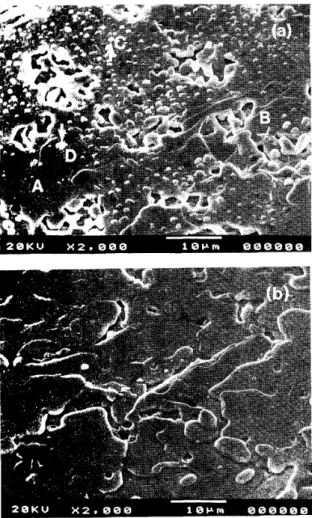
the films were studied by scanning electron microscope with energy dispersive x-ray analysis. These films are highly c-axis oriented with mostly (OO!?) peaks of TlzBazCaZCii3Ol0 phase as revealed by the x-ray diffraction pattern (as shown in Figure 2). The miciographs of films on Y-ZrOz substrates after an- nealing at 890°C for 3 hours and a t 895°C for 1 hour are shown in Figures 3(a) and 3(b) respectively, The films annealed a t 890°C for 3 hours had plate-like grains with many small Ca- rich grains on their surface. The film composition a t different portions is marked in Figure 3(a) and is listed in Table I. Table I. The film composition a t various portions
The morphology of the film annealed at 895°C for 1 hour is shown in Figure 3(b). The plate-likc grains were connected much closer than that of the prrvious film. The composition of this film is T11 sBal sCal 8Cu300x and it does not change from place to place. However, we still observe many submicron Ca- rich dots in the plate-lilie grains.
Transport Flux Trapping, and Granularity T h e superconducting and transport properties were measured by the standard four-point mcasurement using a dc method by switching tlie polarization of the applied current diiriiig the measnrement . Critical current tlciisitics ( Jc's) were measured in the van der pauw configuration with aiid without a litho- graphic patt>eriiing. Figure 4 slmvs the data of resistance ver- sus temperature of the film annealed at 895°C for 1 hour. This
1229
Fig. 3 Scanning electron micrographs of T1-Ba-Ca-Cu-O films on Y-ZiO2. ( a ) annealed at 830°C for 3 hours, (The composition of marked portions are listed in Table I.) (11) annealcd a t 895°C for 1 hour. (The white dots are thc Ca-iich poi tions.)
film liave a T, onset a t 130K and a T, (R=O) at 122IC The .J,.'s at zero magnetic field is about l o 4 A/cm2.
We follnd the superconducting transition temperature of oiir filins with T12Ba2Ca2Cu3010 pha.se vary from 1OOK to 122Ii, and it is very sensitive to the processing conditions. The J,'s of thc filins prepared on Y-Zr02 and MgO substrates were in the range of lo3
-
10' A/cm2 a t 77IC The Jc's of the films prrpnrrd on SrTi03 and LaA103 substrates were in the range of 10'' A/ciii2-
lo6 A/cm2 a t 77Ii.Tlic, magnetic properties of the films were studied by using SQUID magnetometer. The dia.magnetic shielding and Meiss- nrr cffcct cla.ta were sliown in Figure 5. The diamagnetic shield- ing &ita was obtained after cooling in zero field, followed by i1.pplying a field of 20 Oe and taliing data on warming. T h e M ( k i i e r effect data was measured on cooling in an applied ficld of 20 Oe. The diamagnetic shielding and Meissner signals
100 0 ti j 75
p
50!
25 0-
mostly1
TIzBa&&u30. phase 0 60 120 180 2401
300 Temperature (K)Fig. 4 A typical Resistance vs. temperature curve of the TI- based superconducting film annealed a t 895°C for 1 hour under 0 2 . 2.0
,
0.01
mostlyr
20 Oe -1.6 I 0 25 50 75 100 125 150 T (K)Fig. 5 The diamagnetic shielding effect (ZFC) and the Meiss-
ner effect (FC) of the T1-based superconducting film an- nealed a t 895°C for 1 hour under O z .
at 61< are estimated t o be 30% and 15% of those for a per- fect diamagnetic of the same shape and volume, respectively. The low values of the diamagnetic shielding and the Meiss- ner signals indicate a serious film-substrate interactions or a substantial portion of non-superconductor in the film.
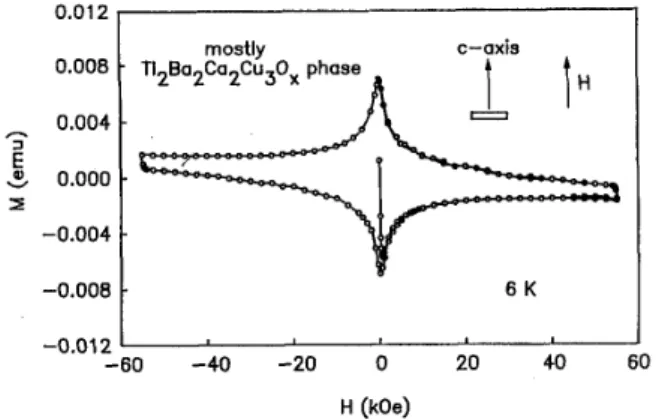
Figure 6 shows a magnetization curve a t 6K for the film annealed at 895"C, the applied fields were up to &55 kOe and were perpendicular to the films' surface. Analysis of these d a t a using the standard Bean method indicates a critical current density of 7.5 x l o 4 A/cmZ a t 6 I< under 55 kOe". J, of 7.5 x lo5 A/cmZ at GI< and 4.2 x lo4 A/cm2 a t 77K under zero field were obtained for this film. The flux trapping data, as shown in Figure 7, was obtained after cooling in the applied field. The induced flux in the film decrease rapidly with increasing temperature. This clearly indicates the weak flux pinning a t higher temperature. The flux trapping d a t a correspond t o the J, function of temperature a t zero field. This rapid decrease in J,, wliich is similar t o that of some YBazCu307-, granular films, may be due t o the granular nature of these films".
1230 0.01 2 0.008
-
Tl2Ba2Ca2Cu3OX phaseI
mostly c-axis -0.008 3t
0.004 p.5
0.000-
6 K H -0.004 r) 7 -2
x 5 - I-
a5
3 - I 1 -Fig. 6 Magnetization versus field curve at 61i for the film an- nealed a t 895°C for 1 hour. The magnetic field was ap- plied normal t o the film surface.
9 ,
1
-1 1 I
0 25 50 75 100 125 150 T (K)
Fig. 7 Flux trapping versus temperature for the film annealed a t 895°C for 1 hour. This data were obtained after cooling in the applied field of 50 kOe, removing the field and taking the d a t a on warming in zero field.
Summary
Superconducting films of T1-Ba-Ca-Cu-0 have been prepared by sputtering. Films with zero resistance T, of up t o 122Ii were obtained after various post annealing a t 870 N 895°C
from 1 hour to 3 hours. The composition of filnis is not very
homogenous in sub-micrometer scale. The critical current at 77K of the these films are in the lo3 A/cniZ to lo4 A/cni* range, which is much smaller than that of the films prrpared on SrTi03 and LaA103 substrates. The low critical current density in these films are likely due to the granularity in these films.
*
This work is supported by NASA Lewis grant N B G 3-866. the Nebraska University Foundation and the Nebraska Energy Office.References
1. Z.Z. Sheng and A.M. Hermann, Nature. 332, 13S( 19SS). 2. R.M. Hazen, L.W. Finger, R.J. Angel, C.T. Prewit,t. N.L. Ross, C.G. Hadidiacos, P. J. Heaney, D.R. l’eblen. Z.Z. Sheng, A. El Ali, and A.M. Hermann, Phys. Rev. Lett..
60, 1657(19SS).
3. C.C. Torardi, M.A. Subramanian, J.C. Calabrese. J. Gopalakrishnan, ICJ. Morrissey, and T . Sleight, Sci-
ence, 240, 631( 1988).
4.
S.S.P.
Parkin, V.Y. Lee, E M . Engler, A.I. Nazzal, T.C. Huang, G. Gorman, R. Savoy, and R. Beyers, Phya. Rev.Lett., 60: 2539(1988).
5. D.S. Ginley, J.F. Iiwak, R.P. Hellmer, R.L. Baughmen. E.L. Venturini, and B. Morosin, Appl. Phys. Lett.. 53.
406(198S).
6. Y. Ichikawa, H. Adachi, I<. Setsune, S. Hatta, I<. Hirochi. and I<. \Vasa, Appl. Phys. Lett., 53, 919(1988). 7. W.Y. Lee, V.Y. Lee, J. Salem, T.C. Huang. R. Savory.
D.C. Bullock, and
S.S.P.
Parkin, Appl. Phys. Lett., 53,329( 198s).
8.
S.H.
Liou, M. Hong, A.R. Kortan, J. Iiwo, D.D. Bacon. C.H. Chen, R.C. Farrow, G.S. Grader, PTOC. of the Con- ference o n the Science and Technology of Thin Film Su- perconductors, Colorado Springs, Colorado 1988 editedby Robert D. AIcConnell and Stuart A. Wolf (Plenum. New York). $29.
9. S.H. Liou, PTOC. of Material Research Society, Vol. 169,
(1990).
10. S.H. Liou, unpublished.
11. C.P. Bean, phys. Rev. Lett., 8 , 250(1962).
12. S.S. Yom,