明新科技大學 校內專題研究計畫成果報告
鐵、鈹含量以及固溶處理對 A319.0 鑄鋁合金腐蝕特性之影響 Effects of Fe,Becontent and solution treatment on the corrosion
Abstract
The influences of Fe, trace Be and solution heat treatment temperature on the corrosion characteristics of the A319.0 aluminum casting alloys are investigated. The experimental results of microstructure observations, corrosion current and Tafel tests, and CV tests indicate that the corrosion current of the A319.0 aluminum casting alloy increases with the Fe content. The anti-corrosion potential of the A319.0 aluminum casting alloy is decreased with higher amount of iron-bearing phases. The corrosion currents of the A319.0 aluminum casting alloys decrease with the increasing solution treatment temperatures. However, raising the solution temperature to 530℃ will induce the melting phenomena on the dendrite and grain boundary, consequently resulting with non-structural microstructures on quenching which increases the corrosion currents. The optimizing solution treatment temperatures for anti-corrosion and mechanical properties of the A319.0 aluminum alloys are 510℃ and 520℃ for the Be-free alloy with low iron content (0.17 wt%) and for the Be-free and Be-containing alloys with high iron content (1.0 wt%), respectively.
表 1-1 常用鑄造鋁合金之成份表(wt.% ) [1]. Chemical Composition AA No. Pro-duc ts(a) Si Fe Cu Mg Zn Other 201.0 S <0.10 <0.15 4.6 0.35 - 0.7Ag, 0.35Mn A206.0 S, P <0.05 <0.10 4.6 0.25 - 0.35Mn 319.0 S, P 5.5~6.5 <1.0 3.0~4.0 <0.10 <1.0 - 356.0 S, P 7.0 <0.6 <0.25 0.35 <0.35 - A356.0 S, P 7.0 <0.2 <0.2 0.35 <0.10 - 357.0 S, P 7.0 <0.15 <0.05 0.55 <0.05 - A357.0 S, P 7.0 <0.2 <0.2 0.55 <0.10 0.05Be 380.0 D 8.5 <2.0 3.5 <0.10 <3.0 - 390.0 D 17.0 <1.3 4.5 0.55 <0.10 <0.1Mn 413.0 D 12.0 <2.0 <1.0 <0.1 - -
2.2 電化學反應 由於電流通過而發生的化學反應,及稱之為電化學反應。一個電化 學反應發生時,他必須有陽極(anode)、陰極(cathode)、電解液(electrolyte) 和電子通路或負載(load),如此才能產生一個完整的電路。在一個電化學 反應中,電極板上進行著電荷轉移的現象,陽極板上發生氧化反應或稱 陽極反應,放出電子,對金屬而言,他被氧化成離子而游離出來或成為 金屬化合物,即所謂的腐蝕行為;對電池而言,他是電流流入的接收點, 是一個負極。而陰極板上發生還原反應,或稱陰極反應,吸收電子,電 解液中某一成分被氧化還原;對電池而言,電流由陰極流出,它是一個 正極。電解液在反應槽內提供離子使電流流通,反應槽外則是由負載以 電子提供電流的流通,完成電路的流通,圖 2.2 為一個電化學反應槽
(electrochemical cell)的示意圖。電化學反應的驅動力(driving force)是兩極
之間存在的電位差,這個電位差可以是由於電極反應自由能變化不同,
自然存在的電動勢差,譬如電池即是;它也可以由電源供應器提供,譬
2.5 腐蝕電位和腐蝕電流
腐蝕進行中的金屬,其腐蝕電位和腐蝕電流可以藉由混合電位原理
求得。以鋅在鹽酸中的腐蝕現象說明,鋅的氧化和氫離子的還原(氫氣冒
泡)均發生在金屬鋅表面。金屬鋅為一良好導電體,故兩極必有同一電位,
極混合電位(mixed potential)或腐蝕電位(corrosion potential)。根據混合電
的電化學反應裝置,進入惰性氣體(氮氣)除有攪拌作用之外,尚可驅除溶 解的氧氣,電流的量測可以藉由恆電位儀(Potentiostat)的控制電位而獲 得。一般以陰極極化測試比較易於控制,因為沒有金屬溶解的問題。以 金屬樣本為工作電極(陽極)(working electrode),陰極電流藉由輔助電極 (auxiliary electrode)(通常為惰性的金屬如白金)的控制提供定電流,電位的 測量則相對於參考電極。未通電流時,參考電極顯示的是金屬的腐蝕電 位。通電時,每一陰極電流可測得一電位,以電位相對於電流的對數繪 圖。電流很低時,曲線並非直線。當電流大到一定程度時,則兩者關係 呈半對數直線(電位約在 50mV 以上),即為 Tafel 公式。直線的延長和腐 蝕電位的平行線交點極為腐蝕電流,也就是金屬的腐蝕速率。此線延長 至和氫平衡電位的交點,則可獲得氫在該金屬表面的交換電流。上述腐
蝕電流測量方法稱之為Tafel 外插法(Tafel extrapolation),迅速準確,而且
可以測得很低的腐蝕電流。測定時必須注意選取確定為一直線的區段,
而且不可以受到其他還原反應的干擾;此為該法測量腐蝕電流的最大困
圖 2.7 電化反應極化測量示意圖[11]
正在進行,形成很有趣的動態畫面。這些裂縫的前進,有些是沿晶界(碳
鋼),而有些是穿晶前進(鋁銅合金)。這種氫氣冒泡的行為可以藉由陰極
防蝕加以阻止,可見這些應力腐蝕的進行是一種電化學反應。
3.4 腐蝕液調配
以電動天秤秤取 90g (±0.0001g)之試驗級 NaCl 藥品,倒入 2910 ml
的去離子水(DI water)中均勻攪拌,可得 3% NaCl 水溶液,溶液至少在實
驗前 5 天配置完成,已確定內部含氧量之穩定性,其在 25℃時 pH 值約
6.4。
3.5 腐蝕電流與Tafel 斜率之量測[12]
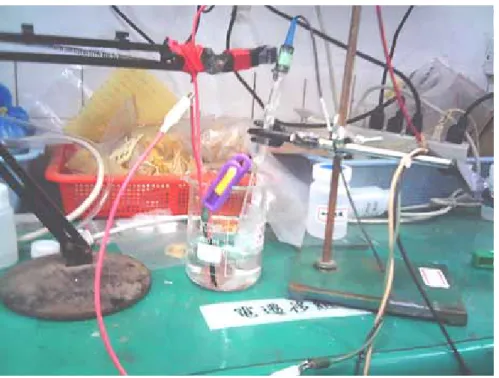
將試片架於Potentiostat上,並將所有導線接妥如圖 3.3,確定沒有短路
現象以防止機器顯示Over Load;接著操作電腦內 352 SoftCorr III軟體,
四、實驗結果與討論: 4.1 微結構(Microstructure) 三種合金經不同溫度固溶處理後暨時效處理之組織分別如圖 4-1、圖 4-2 以及圖 4-3 所示。 A合金之微結構如圖 4-1 所示。A合金在 490℃固溶處理後,其β -FeSiAl5之尺寸或形狀(圖 4-1(a))與鑄態並無明顯差異[3]。但是,富銅相的 含量則明顯減少,矽粒子則有球化傾向。若將固溶溫度提升為510℃時, β-FeSiAl5發 生 明 顯 溶 解(dissolution) 而 斷 裂 成 許 多 小 段 的 現 象 ( 圖 4-1(b)),此時富銅相幾乎已不存在,而矽粒子則明顯產生球化與粗化。隨 著固溶溫度更加提升,β-FeSiAl5之溶解斷裂、尖端鈍化現象加速進行, 而矽粒子也更為球化與粗化(圖 4-1(c))。當固溶溫度達 530℃時(圖 4-1(d)),雖然β-FeSiAl5之溶解斷裂、尖端鈍化更為明顯,甚至也有球化 之現象,但在枝晶間或晶界處發生熔化(melting)的現象,此熔化區域在淬 火時形成複雜的微細組織,此組織經X光映像分析後,結果顯示其中含有
Si, Fe, Cu以及Mg等合金元素[3]。
含高鐵量的B合金經T6 處理後微結構如圖 4-2 所示,其β-FeSiAl5之
溶解與斷裂行為、富銅相的溶解以及矽粒子的球化與粗化均如前述A合
圖 4-1 低鐵不含鈹A合金在不同固溶溫度之OM照片: (a) 490℃, (b) 510
℃, (c) 520℃, (d) 530℃。(箭頭: 1:β-FeSiAl5, 2:矽粒子, 3:CuAl2, 4:超微細
圖 4-2 高鐵不含鈹之B合金在不同固溶溫度之OM照片: (a) 490℃, (b)
510℃, (c) 520℃, (d) 530℃。(箭頭: 1:β-FeSiAl5, 2:矽粒子, 3:CuAl2, 4:超微
圖 4-3 高鐵含鈹之C合金在不同固溶溫度之OM照片: (a) 490℃, (b) 510℃,
(c) 520℃, (d) 530℃。 (箭頭: 1:β-FeSiAl5, 2:矽粒子, 3:CuAl2, 4:α
原因則尚未深入探討。
至於三種合金之Tafel 電壓數據顯示差異不大且未有明顯趨勢。
表4.1 Tafel 電壓電流數據結果表
試片編號 固溶溫度(℃) E(I=0) [mV] Icorr(R) [μA]
圖4.4(a) A490 曲線
圖4.4(b) A510 曲線
圖4.5(a) B490 曲線
圖4.5(b) B510 曲線
圖4.6(a) C490 曲線
圖4. 6(b) C510 曲線
圖4. 6(c) C520 曲線
(a) B490
(b) B520
(a) C510
(b) D520
六、參考文獻(References):
1. J.E. Gruzleski and B.M. Closset: The Treatment of Liquid Aluminum-Silicon
Alloys, AFS Inc., Illinois, (1990), p.13.
2. Paih-Shiarng Wang, Sheng-Long Lee, Ching-Yi Yang and Jing-Chie Lin: “Effects of Be and Nonequilibrium Heat Treatment On Mechanical Properties of B319.0 Alloy with 1.0% Fe”, 20 (2004) pp. 539-545.
3. P.S. Wang, Y.J. Liauh, S.L. Lee and J.C. Lin: "Effects of Be addition on microstructures and mechanical properties of B319.0 alloys", Mater. Chem. and
Physics, 53 (1998) pp. 195-202.
4. Yoshihiro Shimizu, Yoji Awano and Motoyuki Nalamura: “Heating in the solid liquid coexisting temperature range for improvement of the impact strength of Al- Si- Cu alloy castings”, 輕金屬, 40 (1990), pp. 409-415.
5. Y. Shimizu, Y. Awano and M. Nakamura: “New solution treatment for Al-Si-Cu alloy castings at non-equilibrium eutectic melting temperatures”, 輕金屬, 38
(1988), pp. 202-207.
6. L. A. Narayanan, F. H. Samuel and J. E. Gruzleski: “Crystallization behavior of iron-containing intermetallic compounds in 319 aluminum alloy”, Metall. and
Mater. Trans. A, 25A (1994), pp. 1761-1773.
7. J. Gauthier, P. R. Louchez and F. H. Samuel: “Heat treatment of 319.2 aluminum automotive alloy, part 2, aging behavior”, AFS Int. Cast Metals, 8 (1995), pp. 107-114.
8. J. Gauthier, P. R. Louchez and F. H. Samuel: “Heat treatment of 319.2 aluminum automotive alloy, part 1, solution heat treatment”, AFS Int. Cast Metals, 8 (1995), pp. 91-106.
dissolution and melting of Al2Cu phase in Al-Si alloys during solution heat treatment”, Metall. and Mater. Trans. A, 27A (1996), pp. 1785-1798.
10. L. A. Narayanan, F. H. Samuel and J. E. Gruzleski: “Crystallization behavior of iron-containing intermetallic compounds in 319 aluminum alloy”, Metall. and
Mater. Trans. A, 25A (1994), pp. 1761-1773.
11. 柯賢文編著: 腐蝕及其防制, 全華圖書.
12. Herbert H. Uhlig: "Corrosion and Corrosion Control", 2nd ed., Wikey, New York, (1971).
![表 1-1 常用鑄造鋁合金之成份表(wt.% ) [1] . Chemical Composition AA No. Pro-duc ts (a) Si Fe Cu Mg Zn Other 201.0 S <0.10 <0.15 4.6 0.35 - 0.7Ag, 0.35Mn A206.0 S, P <0.05 <0.10 4.6 0.25 - 0.35Mn 319.0 S, P 5.5~6.5 <1.0 3.0~4.0 <0.10](https://thumb-ap.123doks.com/thumbv2/9libinfo/9022718.308576/9.892.140.776.315.785/常用鑄造鋁合金之成份ChemicalAAProducOtherSAgMnSP5lt14625MnSP3.webp)
![圖 2.2 Electrochemical Cell [11] 2.3 極化現象 進行中的運動或反應必然會有一種阻力,如同機械運動的摩擦和電 流線路上的電阻,電化學反應的阻力則以極化現象(polarization)存在。極 化現象可分為活性極化(activation polarization)及濃度極化(concentration polarization)兩種,它們同時而且獨立的發生於電化學反應過程。電化學 反應時,電極和電解液界面 進行著電荷的轉移。電荷轉移後,電極上的化合物](https://thumb-ap.123doks.com/thumbv2/9libinfo/9022718.308576/13.892.332.584.131.361/進行中有一種阻力極化現象存在化現象可分為活性極化極和液界進行.webp)
![圖 2.5 鋅在鹽酸中腐蝕的電極動力(電位)曲線示意圖 [11] 2.6 極化和腐蝕控制 電化反應的阻抗除了極化反應之外,電解液的電阻有時也不能忽 略。抗阻的主宰可分四種情況討論:(1)阻抗集中在陽極的活性極化,則 腐蝕電位接近陰極的平衡電位,腐蝕速率為陽極控制,譬如含銅雜質的 鉛浸入硫酸,此時硫酸鉛蓋住了大部分的鉛陽極,並曝露出銅陰極;(2) 阻抗集中在陰極的活性極化,則腐蝕電位接近陽極的平衡電位,腐蝕速 率為陰極控制,譬如鐵在水中的腐蝕;(3)電解液的電阻很大,以致腐蝕 電流不足以](https://thumb-ap.123doks.com/thumbv2/9libinfo/9022718.308576/19.892.210.707.139.464/電位腐蝕速率為陽極控制譬如含銅雜質的鉛浸入硫酸此時硫酸鉛了大.webp)
![圖 2.7 電化反應極化測量示意圖 [11]](https://thumb-ap.123doks.com/thumbv2/9libinfo/9022718.308576/22.892.254.665.137.390/圖27電化反應極化測量示意圖11.webp)
![圖 2.9 典型的鈍化陽極曲線 [11]](https://thumb-ap.123doks.com/thumbv2/9libinfo/9022718.308576/24.892.258.660.345.798/圖29典型的鈍化陽極曲線11.webp)