Effects of trunk belt on the dynamics of rowers
Chen Wen-Her
∗Abstract
Trunk belt was used mostly for weightlifting, body-building and resistance training. It was quite vital for the protection of erector spinae. Purposes: To assess the effects of electromyography of trunk muscles and the dynamics of rowers using a trunk belt. Methods: Ten (10) university male rowers (age 20.3
± 1.1 years; height 176.8 ± 5.0 cm; weight 71.9 ± 10.1 kg) used trunk belt and perform sprint rowing for 10 oars on rowing ergometer. Load cell was used to record force and the electromyography of erector spinae, rectus abdominis were simultaneously recorded. Results: (1) Dynamics: No significant differences were observed between trunk belt and without trunk belt in peak force (574.2 ± 40.7 v.s 559.5 ± 59.4 NT), mean force (984.1 ± 94.0 v.s 954.3 ± 99.5 NT), integrated force (80.8 ± 29.5 v.s 368.2 ± 34.6 NT*sec) and slope (3260.5 ± 410.7 v.s 3323.5 ± 420.1 NT/sec). (2) EMG signals: The normalized values of erector spinae (0.154 ± 0.024 v.s 0.142 ± 0.032), rectus (0.150 ± 0.041 v.s 0.154 ± 0.032) and ecternal oblique (0.120 ± 0.029 v.s 0.103 ± 0.043) also show no differences between trunk belt and without trunk belt.
Conclusions: The use of trunk belt can not reduce rowers’ back loads. Also, trunk belt can not improve the mechanics of rowing. The value of trunk belt use in rowing need further discussion.
Key words: rowing, trunk belt, dynamics, EMG, Intra-abdominal pressure, trunk
∗ National Taiwan Sports University
I. Introduction
1. Issue Background
The rowing stands the most important stage is the feature of rowing, which the upper limbs and the lower limbs as well as the muscles on waist and back muscles are tightened meanwhile to conquer the extreme resistance from the paddle. Therefore, waist and back muscles play a significant role. When rowing forward, the abdominal muscle encounters less resistance. Back and waist muscle force is larger than that of abdominal muscle, which may result from the long-term training (Sanderson and Martindale, 1986).
At the peak of rowing, men have 848 ± 133 N and women have 717 ± 69 N, and at the same time the pressure load is close to seven times of the weight on both men and women which is also connected to the musculature potential electrical activities of spinal side. Besides, in rowing sweep, the back is slightly twisted in order to obtain the maximum stroke when entering the water, which, however, increases the burden of back muscles. In the long run, rowers will suffer from lower back injuries and their rowing performances will be affected as well.
According to Hickey et al. (1997) in a ten-year survey on sports injuries on excellent rowers, female rowers suffer 1.58 times of continuous sports injuries on an average while male counterparts suffer 0.85 time; 72.1% of women rowers suffer from chronic sports injuries while 69.8% of male rowers, Among these injuries, back and knee injuries account for most (Hosea, et al., 1989), and 82.2%
of female from lower back pain (Howell, 1984).
Intra-abdominal pressure (IAP) refers to the pressure inside the abdominal, it is generally believed that when IAP increases, it pushes upward from the belly to squeeze the diaphragm, downward to pelvis and outward to abdominal wall. It also generates a torque that extends the back (McGill, et al., 1990). Barron and Feuerstein (1994) list five possible mechanisms of action for back belts. The three biomechanical or physiological mechanisms are (1) redistribution of spinal forces during lifting as a result of increased IAP, (2) decreased muscular fatigue and strain during lifting as a result of increased muscle support, and (3) decreased
ROM as a result of limiting spinal ROM. The two biobehavioral mechanisms are (1) the use of biomechanically safe lifting techniques as a result of proprioceptive input and (2) the existence of a soothing effect as a result of increased local tissue temperature and a sense of safety. These five mechanisms are those put forth most often by proponents of back belt use as the reasons why back belts help prevent occupational low back injuries .
Application of abdominal pressure significantly reduces the load of lower back muscles while supporting the body. It also protects lower back muscles and further enhances body kinetics. Lander et al (1990) investigated erector spinae muscle EMG activity in six male subjects without low back pain involved in weight lifting. Three belt conditions were tested: no belt, lightweight belt, and heavyweight belt. During lifting of heavy loads at 70% of one repetition maximum , there was a reduction in erector spinae muscle EMG activity for both belt conditions when compared with the no-belt condition . In a separate study conducted 2 years later, however, Lander et al (1992) determined that there were no reductions in erector spinae muscle EMG activity while performing multiple squat lifts in either belt condition when compared with the no-belt condition.
Based on the above background, body support and kinetics transmission of rowers is very important in rowing, which is caused by the particularity of rowing skills. As with the effects of IAP , the literature concerning decreases in muscular fatigue and strain are contradictory, thus, belts are widely used in weight lifting and greatly protect the spine by increasing IAP. Therefore, the purpose in this research is to assess the effects of electromyography of trunk muscles and the dynamics of rowers using a trunk belt, whether rowers with strong load of back muscles can reduce the back muscles and lumbar vertebra by wearing trunk belts in games is deliberated.
2. Research Range and Limitations
In this research, the rower who simulate actual rowing in the fixed ergometer in the laboratory which not affected by the weather and water flow, the results may not be completely the same as the condition of outdoor competitions.
3. Operative Definitions
(1) Trunk belts: The trunk belts used in this research are flexible with bendable support.
(2) Electromyography signals: the data is measured by Biovision system on the tested rowers erector spinae, rectus abdominus muscle and abdominal oblique muscle RMS and average EMG vibration amplitude with and without using the trunk belts.
(3) Kinetics of rowing: Concept II Model C with load cell is used to measure the value of 10 strokes mean force (N), peak force (N), integrated force (N*sec) and slope (N/sec) on the rowers with and without using the trunk belts.
II. Study Methods and Steps
1. Target
The testes in this research are 10 male members from rowing team in National Kaohsiung Marine University. Average age were 20.27 ± 1.09 years, average height were 176.8 ± 4.98 cm, average weight were 71.91 ± 10.12 kg, and the years under training were 2.77 ± 3.14 year.
2. Experiment location: Biomechanics Laboratory, National Taiwan Normal University
3. Experiment equipment and instruments
(1)Trunk belts: the lumbar belts, from Scott Specialties, U.S.A., are made of stretchable material, with. plastic shafts at the lumbar vertebra as support, tied at the waist with Velcro to adjust the lumbar belts.
(2)Ergometer: two Concept II Model C, Morrisville, VT, U.S. are used—one for warm-up and the other for experiment.
(3)Electromyography signals: Biovision surface electromyography system,
16-channel signal receiver and A/D signal converter.
(4)Kinetic of rowing: Biovision load cell (Wehrheim, Germany, 2000N with enlarger, frequency 600Hz), Biovision electromyography system (with 16-channel signal receiver and A/D signal converter) and a notebook with DasyLab 6.0 software to collect data.
4. Experiment steps (1) Trunk belts wear:
Trunk belt is a soft canvas belt, between 11.5 and 15.0 cm in height. This canvas belt circles the waist, covering the lumbar region of the spine. The trunk belt used in the study has adjustable elastic side pulls with Velcro fasteners and flexible stays. The rowers were given verbal instructions on the use of the trunk belt to stretch the elastic component as tight as possible and than were instructed to wear the trunk belt at all times during rowing.
(2) Experiment test
Each subjects who made a one-minute warm-up ergometry rowing (stroke frequency of 30-34) before test. Before rowing test, which random distribution of with and without used trunk belt, and than implementation of 20 stroke sprint rowing, and synchronize record all parts of the muscle EMG data and the kinetic values during rowing performance.
(3)Electromyography signals:
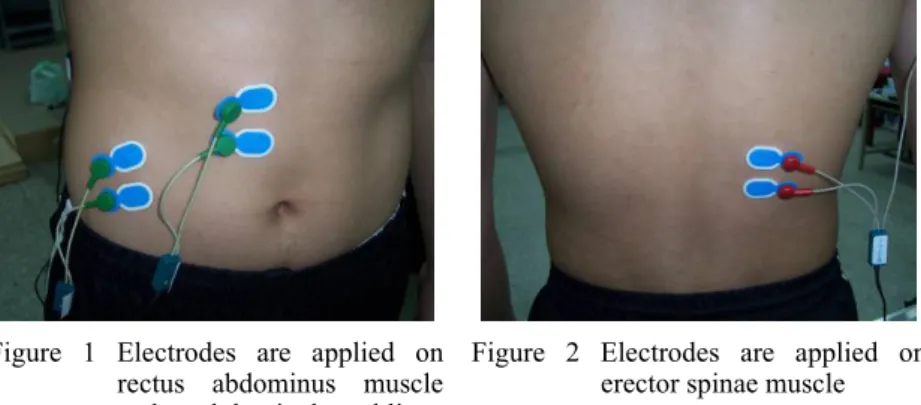
The experiment measures the EMG with surface electrodes to detect the abdominal muscle powering with and without using the trunk belts. Electrodes in pairs are attached on the muscles to be measured. The electrodes are Ag/AgCl with diameter of 20 mm. Before applying electrodes, the muscles are smeared with medical alcohol to remove skin dirt for better accuracy. The EMG signals measures are on erector spinae, rectus abdominus muscle and abdominal oblique muscle. The locations of surface electrodes are in reference of the research by McGill et al. (1990). Electrodes are applied on around 3-4 cm on the right side of
erector spinae L3/L4 (Figure 2), around 2-3 cm on the right side of navel of rectus abdominus muscle and front end of thighs between ASIS and pubic symphysis of abdominal oblique muscle (Figure 1).
Application of electrodes is along the direction of muscle fiber and centered on the sport spot. The pitch between the centers of the two electrodes is 30 mm to obtain the most obvious muscle signals (Vink, et al., 1989). A pre-amplifier is placed on the front end of the electrode in order to be fixed on the skin to reduce signal interruption. Before the test, each test will have a one-minute warm-up rowing (rowing frequency 30-34). Before the formal start, there are many drawings needed to decide the order of the 20 rows; in synchronicity, muscle electromyography performance data and tension values are recorded.
Figure 1 Electrodes are applied on rectus abdominus muscle and abdominal oblique muscle
Figure 2 Electrodes are applied on erector spinae muscle
(4) Kinetic of rowing
Place the Biovision load cell between the handle-bar and chain of the Concept II Model C in order to collect the pulling value as rowing. Before the experiment, the load cell must be adjusted. To adjust the load cell is to hang bars of different weights under the load cell. This way, resulting in the relation of different weights and load cell voltage, the voltage can be transformed into power value (unit: Newton). Mainly, Biovision system (16-channel signal receiver and A/D signal converter) and a notebook with DasyLab 6.0 software collect the data.
5. Data collection and analysis
(1) Electromyography signals collection and analysis:
The researcher uses DasyLab 6.0 to conduct time domain analysis in processing EMG data. The electromyographic data were sampled with band-pass filtered (low frequency 10Hz and high frequency 500 HZ) based on the original EMG signals. The researcher uses normal way (average EMG vibration amplitude/maximum MVC) to analyze. Data were normalized to the percentage of maximal voluntary isometric contraction to allow for comparison between subjects. The MVC condition involved subjects having maximally contract to against a fixed steel cable. The percent maximum voluntary contraction (%MVC) is the percentage ratio of the applied force EMG signal to the MVC EMG signal for the same muscle group in the same posture and expressed in the same units.
(2)Kinetic data collection and analysis:
The Biovision load cell was installed between the handle-bar and chain of Concept II Model C to test the power of 20 paddle with and without the trunk belt. The collection data were used DasyLab 6.0 to analysis 10 strokes mean force (N), peak force (N), integrated force (N*sec) and slope (N/sec).
(3) Statistical analysis:
The data from the experiment are analyzed with SPSS 10.0 Chinese version on electromyography signals, rowing kinetics test and focusing on paired t test on the samples with and without trunk belts. The experiment results are expressed in M ± SD and distinctive deviation level is at P < .05.
III. Results
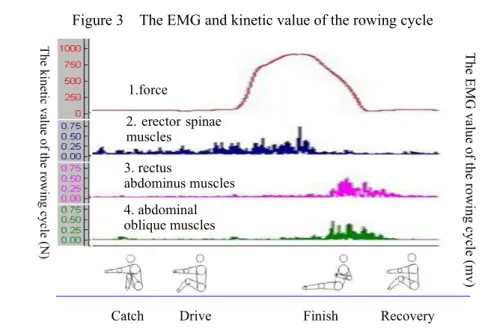
Figure 3 which retrieved the data for the use of DasyLab 6.0 analysis software, the first was the load cell into account the kinetic changes in rowing cycle, the second was EMG changes of erector spinae muscles in rowing cycle, the third was EMG changes of rectus abdominus muscles in rowing cycle, the the fourth was EMG changes of abdominal oblique muscles in rowing cycle.
Figure 3 The EMG and kinetic value of the rowing cycle
Catch Drive Finish Recovery
1. Kinetics of rowing:
The researcher mainly discusses the mean force, peak force, integrated force, and slope with and without using trunk belts for rowers. The Mean Force is the average force in rowing cycle, the Peak Force is the maximum force in rowing cycle, the Integrated Force is the force-time curve, that is the area posed by impulse, while the Slope of the reaction is the rowers explosive force. . The analysis results as below:
Table II Analysis of load cell With trunk belt
(M±SD)
Without trunk belt
(M±SD) p vaule Mean force (N) 574.18 ± 40.67 559.47 ± 59.35 .548 Peak force (N) 984.13 ± 93.97 954.30 ± 99.49 .523 Integrated force (N*sec) 380.83 ± 29.49 368.15 ± 34.61 .415 Slope (N/sec) 3323.54 ± 420.14 3260.48 ± 410.65 .752
3. rectus
abdominus muscles 4. abdominal oblique muscles
2. erector spinae muscles
The EMG value of the rowing cycle (mv)
The kinetic value of the rowing cycle (N)
The time of the rowing cycle (sec) 1.force
格式化: 置中 格式化: 置中 格式化: 置中 格式化: 置中
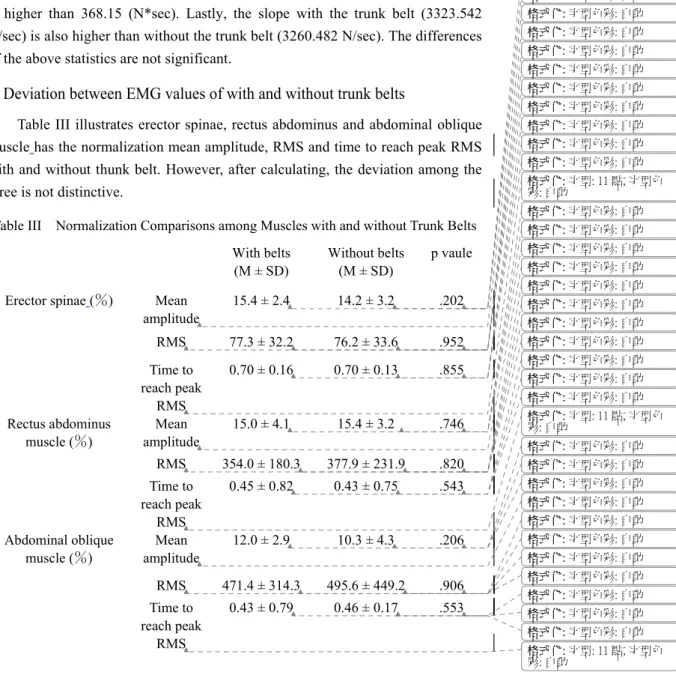
Table II shows the mean force with the trunk belt is 574.18 N, higher than without the trunk belt 559.47 N. The peak force with the trunk belt 984.129 N is higher than 954.303 N, without the trunk belt. The integrated force 380.83 (N*sec) is higher than 368.15 (N*sec). Lastly, the slope with the trunk belt (3323.542 N/sec) is also higher than without the trunk belt (3260.482 N/sec). The differences of the above statistics are not significant.
2. Deviation between EMG values of with and without trunk belts
Table III illustrates erector spinae, rectus abdominus and abdominal oblique muscle has the normalization mean amplitude, RMS and time to reach peak RMS with and without thunk belt. However, after calculating, the deviation among the three is not distinctive.
Table III Normalization Comparisons among Muscles with and without Trunk Belts
With belts
(M ± SD)
Without belts (M ± SD)
p vaule
Mean amplitude
15.4 ± 2.4 14.2 ± 3.2 .202 RMS 77.3 ± 32.2 76.2 ± 33.6 .952 Erector spinae (%)
Time to reach peak
RMS
0.70 ± 0.16 0.70 ± 0.13 .855
Mean amplitude
15.0 ± 4.1 15.4 ± 3.2 .746 RMS 354.0 ± 180.3 377.9 ± 231.9 .820 Rectus abdominus
muscle (%)
Time to reach peak
RMS
0.45 ± 0.82 0.43 ± 0.75 .543
Mean amplitude
12.0 ± 2.9 10.3 ± 4.3 .206
RMS 471.4 ± 314.3 495.6 ± 449.2 .906 Abdominal oblique
muscle (%)
Time to reach peak
RMS
0.43 ± 0.79 0.46 ± 0.17 .553
格式化: 字型色彩: 自動 格式化: 字型色彩: 自動 格式化: 字型色彩: 自動 格式化: 字型色彩: 自動 格式化: 字型色彩: 自動 格式化: 字型色彩: 自動 格式化: 字型色彩: 自動 格式化: 字型色彩: 自動 格式化: 字型色彩: 自動 格式化: 字型色彩: 自動 格式化: 字型色彩: 自動 格式化: 字型: 11 點, 字型色 彩: 自動
格式化: 字型色彩: 自動 格式化: 字型色彩: 自動 格式化: 字型色彩: 自動 格式化: 字型色彩: 自動 格式化: 字型色彩: 自動 格式化: 字型色彩: 自動 格式化: 字型色彩: 自動 格式化: 字型色彩: 自動 格式化: 字型色彩: 自動 格式化: 字型色彩: 自動 格式化: 字型色彩: 自動 格式化: 字型: 11 點, 字型色 彩: 自動
格式化: 字型色彩: 自動 格式化: 字型色彩: 自動 格式化: 字型色彩: 自動 格式化: 字型色彩: 自動 格式化: 字型色彩: 自動 格式化: 字型色彩: 自動 格式化: 字型色彩: 自動 格式化: 字型色彩: 自動 格式化: 字型色彩: 自動 格式化: 字型色彩: 自動 格式化: 字型色彩: 自動 格式化: 字型: 11 點, 字型色 彩: 自動
IV. Discussions
1. kinetics of rowing:
Integrated force (N*sec) representative of power - time curve of the area is composed of impulse (Liu, 2000), while the slope (N/sec) is response to explosive force. During rowing cycle in doing work to achieve the maximum impulse in the shortest time possible for maximum power values, and to maintain this value until the end of drive phase. An interesting feature of rowing is that the energy consumption rate changed significantly between the drive and recovery phases. In the drive phase, a large power was generated over a short period, and in the recovery phase, the power was minimal over a long period. A study shows that seventy-five percent of the energy in one rowing cycle was consumed in the drive phase, which occupied 37% in the time of one rowing cycle. Such polarization of the energy consumption became more remarkable, as the rowing cadence became slower (Hase, Andrews et al. 2002).
In the research findings, there is no distinctive difference between with and without using the trunk belts on the body muscle activity. Thus, trunk belts cannot make any further effect of stability on body muscles, leading to no progress in rowing speed. Moreover, there is no distinctive difference in each statistics of rowing process.
To seek the reason, in the first we can find that the trait of rowing is to fasten the feet on the step board to do the lower limbs exercise, which is a common closed chain exercise (Rennison, 1996). It is one of the multiple joints exercise.
However, rowing is not completely a close chain exercise, the kinetic chain of the rowing turns from legs to sliding seat, the function of body muscle stability has already supported by the sliding seat. Hence, the effect of the belts becomes limited. Besides, rowing is a kinetic process. The angle of the body will change continually, along with the changing of the traction of muscles. Thus, when a single muscle contracts, the erector spinae also changes with the different angle as rowing.
Second, the potential effects of using the back belts to decrease ROM in the
lurnbar spine has been investigated by Lantz and Schultz (1986) and by McGill et al. (1994) Lantz and Schultz determined that movements of the trunk were restricted in subjects using three types of rigid orthotic devices. The motional restricted least was spinal flexion. The findings of McGill et al. are very similar to those of Lantz and Schultz with subjects wearing either a leather weight belt or no belt, McGill et al. measured ROM during spinal rotation, flexion, and lateral bending. Spinal flexion was not restricted, whereas decreased ROM was measured for spinal rotation and lateral bending. Therefore, control of moderate-to-extreme movements of spinal rotation is considered to be important because spinal rotation is thought to be a primary cause of low back injuries in occupational settings (Marras, Lavender et al. 1993). In this study, we used fixed ergometer to measured rowers kinetics of rowing, the spinal ROM during rowing just flexion, not rotation and lateral bending. Therefore, we can not find any differences between with and without used trunk belt.
2. EMG values of with and without trunk belts
Lander et al. (1990) point out that weight lifting trunk belts compress the abdominal cavity to increase abdominal pressure, enhancing the support of front vertebra in the lower back in order to support the body. Hence, tension of the erector spinae in the lower back will be alleviated. Without using weight lifting trunk belts, the support is entirely generated by the contraction of erector spinae in the lower back. Therefore, lifting heavy objects with wearing weight lifting trunk belts, the contraction on erector spinae will be reduced (Faibenbaum, 1994).
However, there is no distinctive deviation between using and no using the trunk belts on erector spinae. Table III also shows there is no distinctive deviation of rectus abdominus and abdominal oblique muscle with or without trunk belts. That is, trunk belts do not affect the strength of muscle activities. The reason why there is no deviation in this research is rowing is that a dynamic exercise. Angles of the body are constantly changing and one is unable to explore the electromyography changes in a certain angle during the movement. The electromyography signal of using the belt may increase in a certain angle and decrease in another. Compared with the average electromyography amplitude of vibration, the belt however
shows no increasing or decreasing effect on the traction of body muscles. Lin (1997), in exploring the relation between static lumbar vertebra angles and body electromyography signals, found that the activity level of back extensor electromyography activities has negative correlation with lumbar vertebra activity angle changes. That is, larger intervertebral angles lead to smaller electromyography signals close to rest value. Therefore, in the maximum forward bending angle, the electromyography changes of body back extensor are smallest and closest to the rest value. However, if one only observes the electromyography signals of back extensor in the maximum bending, one is unable to compare the different forward leaning angles and electromyography signals of back extensor during the movement.
In addition, the other reason might be that players are not used to using trunk belts; thus, it limits their body activities and leads to the effect under the average.
In the research by Lantz & Schults (1986), when testes wear soft trunk belts, reduction of back muscle activities ranges between 9% and 44%. Those who wear hard trunk belts have between 27% and 25%. Those wearing thoracolumbosacral belts have between 38% and 19%. It seems that there is no kind of trunk belts to effectively reduce the back muscle activities. It is conjectured that wearing trunk belts may work sometimes, but may not sometimes. It is therefore disadvantageous to back muscle activities and human mechanical performance.
V. Conclusion and Suggestions
1. Conclusion
Recent, physical and epidemiological studies pertaining specifically to soft canvas back belts are extremely limited. Studies of the biomechanical and physiological mechanisms of action concerning the prophylactic use of back belts to prevent occupational low back injuries are limited in number and present conflicting findings. In this research explores the body muscle electromyography and rowing force when players use trunk belts. After the experiment and analysis, the conclusion yields as the following:
Using trunk belts does not have significant effects on lower body muscle load
and stabilizing body muscles. The reason is that, when rowing, body angles are constantly changing; muscle contraction changes with different angles. In other way, the spinal ROM during rowing, spinal flexion was not restricted. Therefore, we can not find any differences between with and without used trunk belt. Based on the above conclusion, in the high-tension rowing process, using trunk belts does not alleviate the load of body muscles.
2. Suggestions
In this study, we used fixed ergo meter to measured rowers kinetics of rowing, it cannot test spinal rotation and lateral bending, therefore we suggestions that to measured sweep rowing in the condition of outdoor rowing.
As using trunk belts does not alleviate load or stabilize the body muscles to enhance rowing performance, players can enhance their body muscles, by taking up more muscle training and lower limbs to stabilize and improve rowing kinetics by muscle support if they would like to increase the stability of body muscles to bear the long load.
Reference
Barron, B. and M. Feuerstein (1994). Industrial back belts and low back pain:
mechanisms and outcomes. Journal of Occupational Rehabilitation, 4(3), 125-139.
Beynnon, B. D., Johnson, R. J., Fleming, B. C., Stankewich, C. J., Renstrom, P. A.
& Nichols, C. E. (1997). The strain behavior of the anterior cruciate ligament during squatting and active flexion-extension. A comparison of an open and a closed kinetic chain. American Journal of Sports Medicine, 25(6),823-829.
Bourgois, J., A. Claessens, et al. (2000). Anthropometric characteristics of elite male junior rowers. British Medical Journal, 34(3), 213.
Faibenbaum, A. D. & Liastos, N. S. (1994). The use and abuse of weightlifting belts. Strength and Conditioning , 16 (4), 60-62
Harman, E. A., Rosenstein, R. M., Frykman, P. N. & Nigro, G. A. (1989). Effects of a belt on intra-abdominal pressure during weight lifting. Medicine and Science in Sports and Exercise, 21(2), 186-190.
Hase, K., B. Andrews, et al. (2002). Biomechanics of Rowing. JSME International Journal Series C, 45(4), 1082-1092.Hickey, G. J., Fricker,P. A. & McDonald, W. A. (1997). Injuries to elite rowers over a 10-yr period.
Medicine and Science in Sports and Exercise, 29(12), 1567-1572.
Hosea, T. M., Boland, A. L. & Simon, S. (1987). Myoelectric and kinematic analysis of the lumbar spine while rowing. Journal of Sports Medicine, 15(6), 625.
Hosea, T. M., Boland, A. L., McCarthy, K. & Kennedy, T. (1989). Rowing injuries. Postgraduate Advance Sports Medicine, 3(9), 1-16.
Howell, D. W.(1984). Musculoskeletal profile and indicence of musculoskeletal injuries in light weight common rowers. American Journal of Sports Medicine, 12(4), 278-282.
Lander J, Hundley J, Simonton R, (1992). The effectiveness of weight belts during
multiple repetitions of the squat exercise. Medicine and Science in Sports and Exercise, 24, 603-609.
Lander, J. E., Hundley, J. R. and Simonton, R.L. (1992). The effectiveness of weight-belts during multiple repetitions of the squat excise. Medicine and Science in Sports and Exercise, 24(5), 603-609.
Lander, J. E., Simonton, R. L. and Giacobbe, J. K. F. (1990). The effectiveness of weight-belts during the squat excise. Medicine and Science in Sports and Exercise, 22(2), 117-126.
Lander, J., R. Simonton, et al. (1990). The effectiveness of weight-belts during the squat exercise. Medicine & Science in Sports & Exercise, 22(1),117.
Lantz, S.A. & Schultz, A.B. (1986). Lumbar spine orthosis wearing: I. Restriction of gross body motions. Spine, 11(8), 834.
Lantz, S.A. & Schultz, A.B. (1986). Lumbar spine orthosis wearing II. Effect on trunk muscle myoelectric activity. Spine, 11(8), 834-842.
Lin, Y. H., Chiu, W. K., Lee, Y. H., Chen, W. Z. (1997). Relationship between Lumbar Vertebra Angles and Body Electromyography Singals. Journal of the Physical Therapy of the R.O.C., 22 (4), 1-6.
Liu (2000). Biomechanics. Contained in the Republic of China National Society of Physical Education (editor), Sports Biomechanics. Taipei: Republic of China National Society of Physical Education.
Marras, W., S. Lavender, et al. (1993). The role of dynamic three-dimensional trunk motion in occupationally-related low back disorders: the effects of workplace factors, trunk position, and trunk motion characteristics on risk of injury. Spine, 18(5), 617.
McGill, S. M., Norman, R. W. & Sharratt, M. T. (1990). The effect of an abdominal belt on trunk muscle activity and intra-abdominal pressure during squat lifts. Ergonomics, 33, 147-160.
McGill, S., J. Seguin, et al. (1994). Passive Stiffness of the Lumber Torso in Flexion, Extension, Lateral Bending, and Axial Roatation: Effect of Belt
Wearing and Breath Holding. Spine, 19(6), 696.
Nachemson, A. L., Andersson, G. B. J. & Schultz, A. B. (1986). Valsava maneuver boimechanics. Effects on the lumbar trunk loads of elevated intra-abdominal pressure. Spine, 11(5), 476-479.
Palmitier, R. A., Kai-Nan, A., Scott, S. G. (1991). Kinetic chain exercise in knee rehabilitation. Sports Medicine, 11,402-413.
Rennison, M. (1996). Open versus closed chain Kinetic exercise after anterior cruciate ligament reconstruction. A prospective randomized study. The American Journal of Sports Medicine, 24,125-130.
Sanderson, B. and W. Martindale (1986). Towards optimizing rowing technique.
Medicine & Science in Sports & Exercise, 18(4), 454.
Vink, P., Veld, E. A. & Verbout, A. I. (1989). A functional studies of lumbar extensor muscularature: vercuitement patterns and force-RA-EMG relationships under isometric conditions. Electromyography and Clinical Neurophysiology, 28, 517-525.
腰帶使用對划船運動員 軀幹動能之影響
陳文和
∗摘 要
腰帶在運動中的使用大都在舉重或健美等力量型的項目上,對豎脊肌群等 需要承擔很大阻力的運動中有非常重要的作用。目的:探討划船選手使用 腰帶對軀幹肌肉肌電訊號、划槳動能的影響。方法:以十名大學男性划船 選手(年齡20.3±1.1 歲;身高 176.8±5.0 公分;體重 71.9±10.1 公斤),
在安裝拉力計(Load cell)的划船測功儀上實施使用及不使用腰帶各十槳
的衝刺划槳測驗,同步記錄划槳過程中豎脊肌、腹直肌與腹外斜肌肌電圖 及拉槳過程中之拉力值。結果:(一)動力學方面:有無使用腰帶在最大 力量(574.2±40.7 v.s 559.5±59.4 牛頓)、平均力量(984.1±94.0 v.s 954.3
±99.5 牛頓)、時間-力量曲線(380.8±29.5 v.s 368.2±34.6 牛頓*秒)及 斜率(3260.5±410.7 v.s 3323.5±420.1 牛頓∕秒)均無顯著差異;(二)
各肌肉正規化數值在有無使用腰帶下,豎脊肌(0.154 ± 0.024 v.s 0.142
± 0.032)、腹直肌(0.150±0.041 v.s 0.154±0.032)與腹外斜肌(0.120
±0.029 v.s 0.103±0.043)均無顯著差異。結論:在高強度的划船運動中,
使用腰帶並無法減緩軀幹肌群的負荷,也無法穩定軀幹增加划船效能,划 船時腰帶的使用,在動力學上的價值尚需進一步的討論。
關鍵詞:划船、腰帶、動力學、肌電圖、軀幹
∗ 國立體育大學體育研究所博士班