Research Express@NCKU Volume 23 Issue 7 - March 22, 2013 [ http://research.ncku.edu.tw/re/articles/e/20130322/4.html ]
White-emissive tandem-type hybrid organic/polymer
diodes with (0.33, 0.33) chromaticity coordinates
Tzung-Fang Guo1,*, Ten-Chin Wen2, Yi-Shun Huang2, Ming-Wei Lin1, Chuan-Cheng Tsou3, and Chia-Tin Chung3
1 Institute of Electro-Optical Science and Engineering, Advanced Optoelectronic Technology Center, National Cheng Kung University, Tainan, Taiwan
2 Department of Chemical Engineering, National Cheng Kung University Tainan, Taiwan 3 Chi Mei Optoelectronics Corporation, Tainan Science-Based Industrial Park, Tainan, Taiwan [email protected]
OPTICS EXPRESS (2009) Vol. 17, No. 23, p. 21205-21215
1.
I
ntroductionWhite-emissive organic/polymer light-emitting diodes (O/PLEDs) have received considerable interest recently, because of their potential applications in back-lighting or as solid-state-lighting sources. As a decent solid-state-lighting source, the electroluminescence (EL) of O/PLEDs should include broad emissions that cover the entire visible range of the spectrum with Commission Internationale de l’Eclairage (CIE) chromaticity coordinates of close to (0.33, 0.33).
Several researchers have reported the generation of the white-emissive EL from O/PLEDs by the partial energy transfer processes. Some researchers have presented strategy based on stacking differently emissive components to fabricate white-emissive O/PLEDs. The luminous efficiencies of white-emissive OLEDs are substantially enhanced when devices (or emissive components) are serially stacked or linked by various connecting structure or charge-generation layer (CGL) to form sophisticated and tandem-type device configurations. The preparation of the proper connecting structure in the stacked devices is a major challenge to the effective transport of opposite charge carriers in the junction interface and to the overall performance.
Here we demonstrate the application of a poly(ethylene glycol) dimethyl ether (PEGDE)/Al/molybdenum oxide (MoO3) complex structure as a CGL to stack serially one OLED and another PLED of complementary EL emissions to fabricate the white-emissive, tandem-type and hybrid devices. The application of the CGL layer in the tandem-type configuration facilitates the transport and injection of opposite charge carriers at the junction interface and the recombination in each emissive component. The output EL spectra of the tandem-type devices represent complementary colored emissions from O/PLEDs, which can be modulated by varying the charge- transport or –generation properties of the CGL. The optimized CGL structure yield an output EL spectrum with CIE chromaticity coordinates of (0.33, 0.33). The EL spectrum covers the visible range of the human’s eyes from 400 to 750 nm, corresponding to a high color rendering index (CRI) of ~90 for illumination.
2.Experimental results and discussion
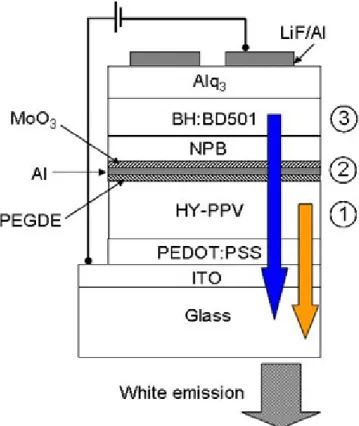
The white-emissive devices presented in this study are composed of a “high-yellow” phenyl-substituted poly - (para-phenylene vinylene) (HY-PPV) copolymer-based PLED as the bottom, yellow-emissive component, an PEGDE/Al/MoO structure as the CGL and an OLED as the top, blue-emissive part. Figure 1 schematically
3
depicts the configuration of the tandem-type device. These layers are thermally deposited on the CGL in series at high vacuum (10-6 torr). The OLED of the same configuration without the CGL was also fabricated on ITO/glass substrate to measure the EL spectrum of the blue-emissive component. All of these steps, except for the casting of the PEDOT:PSS layer, were implemented inside a nitrogen-filled glove box.
Fig. 1. A schematic plot presents the configuration of the tandem-type device in this study.
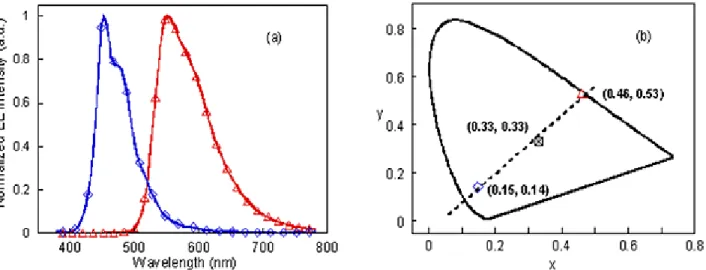
Figure 2(a) shows the EL spectra of both the yellow-emissive HY-PPV-based PLED and the blue-emissive OLED, individually fabricated on ITO/glass substrates. The EL of the HY-PPV-based PLED has a broad emission maximized at ~550 nm, which covers the spectral range of 500~750 nm (green-yellow-red) and corresponds to a CIE coordinate of (0.46, 0.53). The EL of the single blue-emissive OLED has a peak at ~ 450 nm and a shoulder at ~ 480 nm. The CIE coordinates of the blue EL spectrum are (0.15, 0.14). Figure 2(b) displays a CIE chromaticity diagram that marks the CIE coordinates of the EL emissions from the yellow- and blue-emissive devices. A straight line that connects these pairs of two CIE coordinates passes through the white- emissive zone near the CIE coordinates (0.33, 0.33) in the diagram, indicating that the stack of the yellow- and blue-emissive devices fabricated herein can generate white-emissive EL.
Fig. 2. (a) The EL spectra obtained from (Δ) the yellow-emissive HY-PPV-based PLED and (◇) the blue- emissive OLED, individually fabricated on ITO/glass substrates. (b) The CIE chromaticity diagram that marks the CIE coordinates of the EL emissions from the (Δ) yellow- and (◇) blue-emissive devices. A straight line that connects these pairs of two CIE coordinates passes through the white-emissive zone near the ( ) CIE coordinates (0.33, 0.33) in the diagram.
Fig. 3. EL spectra of the stacked device with (○) 30 Å (●) 60 Å ( ) 90 Å thickness of the Al layer in the CGL, PEGDE(45 Å)/Al(X Å)/MoO3(40 Å).
Figure 3 presents the EL spectra of the tandem-type, hybrid devices with the Al layers of different thicknesses in the CGL. In Fig. 3, the EL spectrum of the stacked device with the CGL of PEGDE(45 Å)/Al(30 Å)/MoO3(40 Å) is dominated by the blue-emissive OLED, and corresponds to CIE chromaticity coordinates of (0.26, 0.25).
However, the EL, with CIE coordinates of (0.38, 0.40), is dominated by the yellow-emission from the bottom PLED when PEGDE(45 Å)/Al(90 Å)/MoO3(40 Å) was used as the CGL. Apparently, the relative intensities of the yellow- and blue-emissions from the bottom and top components, respectively, of the stacked O/PLED, vary with the thickness of the Al layer from 30 to 90Å. The maximum brightness and the luminous efficiency of the devices decline as the thickness of the Al layer in CGL structure increases from 30 to 90 Å. The light turn-on voltages also shift from 5.5 to 6.5 V. The bluish tandem-type device has the higher EL intensity, luminous
efficiency, and the lower device turn-on voltage. It is found that the thickness of the Al layer determines the overall output performance of the device. Two possible mechanisms may be responsible for the variations in the output EL spectra. i) The thick Al layer (90Å) interferes with and reduces blue emission from the top OLED component of the stacked device, because of its low optical transmittance. ii) Our earlier studies had shown that the injection of electrons through the PEGDE/Al cathode into the HY-PPV film is associated with the formation of the poly(ethylene oxide)/Al complex at the polymer/metal junction. The Al layer should have sufficient coverage on the PEGDE film to form the poly(ethylene oxide)/Al complex layer in the CGL structure and thus to support the effective injection or generation of electrons to the bottom yellow-emissive PLED.
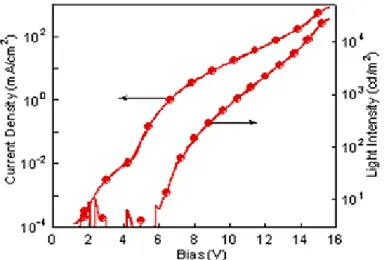
Fig. 4. I-L-V curves of the tandem-type, hybrid device with PEGDE(45 Å)/Al(60 Å)/MoO3(40 Å) as the CGL.
Fig. 5. Luminous efficiency versus the current density of the tandem-type, hybrid device with with (○) 30 Å (●) 60 Å ( ) 90 Å thickness of the Al layer in the CGL, PEGDE(45 Å)/Al(X Å)/MoO3(40 Å).
Figure 4 plots the I-L-V curves of the tandem-type, hybrid device with PEGDE(45 Å)/Al(60 Å)/MoO3(40 Å) as the CGL and 350 Å of NBP as the hole-transport layer. The light turn-on voltage of the EL is about 5.8 V and the EL intensity exceeds 25,000 cd/m2, upon biasing at 15.5 V. Figure 5 plots the luminous efficiency versus the current density of the tandem device. The maximum luminous efficiency of the tandem-type device with PEGDE(45 Å)/Al(60 Å)/MoO3(40 Å) as the CGL is approximately 4.2 cd/A, and remains stable in the high- current density and high-brightness regime. The maximum luminous efficiencies for tandem-type devices of 30 and 90 Å of Al in the CGL is about 5.8 (bluish) and 1.7 cd/A (yellowish), respectively. The luminous efficiency for the device of 30 Å of Al in the CGL is higher, probably due to the better optical transmittance for the blue
emission at the top component than that of device with 90 Å of Al in the CGL.
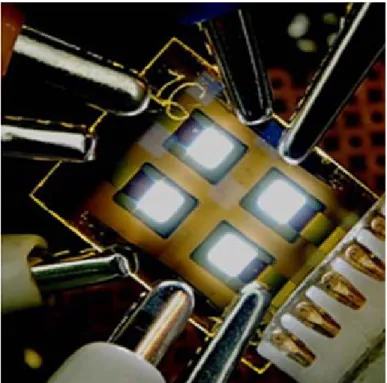
Figure 6 presents a photograph of the white-emissive device, with CIE coordinates (0.33, 0.33), which was fabricated herein. The stabilities and uniformities of the emissive color and EL intensity across the light-emissive region are excellent, as revealed by a microscopy and also measured by a PR-650 luminosity meter. We noted that the photograph, as shown in Fig. 8, is a decent white-emissive device. The yellow-emissive light as observed in the edge of the device is due the wave-guiding effect of the yellow emission from the bottom PLED device.
Fig. 6. A photograph presents the white-emissive device fabricated in this study with CIE coordinates (0.33, 0.33).
3.Conclusion
The fabrication of white-emissive, tandem-type and hybrid devices by the serial stacking of two light-emitting diodes with complementary emissions and a PEGDE/Al/MoO3 complex structure as the CGL is demonstrated.
The performance of the device and the output EL spectra of the stacked O/PLEDs are modulated by changing the thicknesses of the Al layer and the hole-transport layer in the CGL and the OLED component, respectively.
We understood the adjustment of the thickness in Al layer to reach the optimized optical performance as applied for the white-light illumination probably would sacrifice the current efficiency. The application of different CGL with or without thin Al and another yellow PLED with higher performance would be the strategies to enhance the efficiencies of our current tandem devices.
Acknowledgements
The authors would like to thank the National Science Council (NSC) of Taiwan NSC96-2113-M-006-009-MY3, the Asian Office of Aerospace Research and Development (AOARD-09-4055) and NCKU Landmark project for financially supporting this research. Dr. Ruei-Tang Chen from Eternal Chemical Co., Ltd is highly appreciated for providing the HY-PPV polymer.