A.1 The first challenge of this exercise is to obtain the instruction mix. The instruction frequencies in Figure A.27 must add to 100, although gap and gcc add to 100.2 and 99.5 percent, respectively, because of rounding error. Because each total must in reality be 100, we should not attempt to scale the per instruction average frequen- cies by the shown totals of 100.2 and 99.5. However, in computing the average fre- quencies to one significant digit to the right of the decimal point, we should be careful to use an unbiased rounding scheme so that the total of the averaged fre- quencies is kept as close to 100 as possible. One such scheme is called round to even, which makes the least significant digit always even. For example, 0.15 rounds to 0.2, but 0.25 also rounds to 0.2. For a summation of terms, round to even will not accumulate an error as would, for example, rounding up where 0.15 rounds to 0.2 and 0.25 rounds to 0.3.
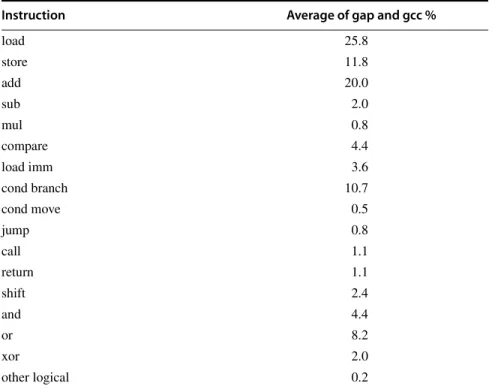
For gap and gcc the average instruction frequencies are shown in Figure S.12.
The exercise statement gives CPI information in terms of four major instruction categories, with two subcategories for conditional branches. To compute the
Instruction Average of gap and gcc %
load 25.8
store 11.8
add 20.0
sub 2.0
mul 0.8
compare 4.4
load imm 3.6
cond branch 10.7
cond move 0.5
jump 0.8
call 1.1
return 1.1
shift 2.4
and 4.4
or 8.2
xor 2.0
other logical 0.2
Figure S.12 MIPS dynamic instruction mix average for gap and gcc.
Appendix A Solutions
(by Rui Ma and Gregory D. Peterson)
average CPI we need to aggregate the instruction frequencies in Figure S.12 to match these categories. This is the second challenge, because it is easy to mis- categorize instructions. The four main categories are ALU, load/store, condi- tional branch, and jumps. ALU instructions are any that take operands from the set of registers and return a result to that set of registers. Load/store instructions access memory. Conditional branch instructions must be able to set the program counter to a new value based on a condition. Jump-type instructions set the pro- gram counter to a new value no matter what.
With the above category definitions, the frequency of ALU instructions is the sum of the frequencies of the add, sub, mul, compare, load imm (remember, this instruction does not access memory, instead the value to load is encoded in a field within the instruction itself), cond move (implemented as an OR instruction between a controlling register and the register with the data to move to the desti- nation register), shift, and, or, xor, and other logical for a total of 48.5%. The fre- quency of load/store instructions is the sum of the frequencies of load and store for a total of 37.6%. The frequency of conditional branches is 10.7%. Finally, the frequency of jumps is the sum of the frequencies of the jump-type instructions, namely jump, call, and return, for a total of 3.0%.
Now
A.2 See the solution for A.1 (above) for a discussion regarding the solution methodol- ogy for this exercise.
As with problem A.1, the frequency of ALU instructions is the sum of the fre- quencies of the add, sub, mul, compare, load imm (remember, this instruction does not access memory, instead the value to load is encoded in a field within the instruction itself), cond move (implemented as an OR instruction between a con- trolling register and the register with the data to move to the destination register), shift, and, or, xor, and other logical for a total of 51.1%. The frequency of load/
store instructions is the sum of the frequencies of load and store for a total of 35.0%. The frequency of conditional branches is 11.0%. Finally, the frequency of jumps is the sum of the frequencies of the jump-type instructions, namely jump, call, and return, for a total of 2.8%.
Effective CPI Instruction category frequency×Clock cycles for category categories
∑
=
0.485
( ) 1.0( )+(0.367) 1.4( )+(0.107) 0.6(( ) 2.0( )+(1–0.6) 1.5( ))+(0.03)+(1.2)
= 1.24
=
CPI = 1.0×51.1%+1.4×35.0%+2.0×11.0%×60%+1.5×11.0%×40%+1.2×2.8%=1.23
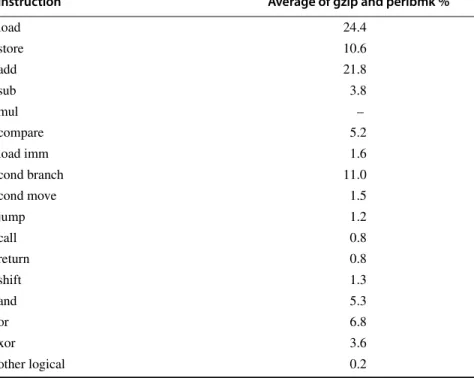
A.3 This exercise is similar to A.1 and A.2, but focuses on floating point intensive programs.
Instruction Average of gzip and perlbmk %
load 24.4
store 10.6
add 21.8
sub 3.8
mul –
compare 5.2
load imm 1.6
cond branch 11.0
cond move 1.5
jump 1.2
call 0.8
return 0.8
shift 1.3
and 5.3
or 6.8
xor 3.6
other logical 0.2
Figure S.13 MIPS dynamic instruction mix average for gzip and perlbmk.
Instruction Average of gzip and perlbmk %
Load 9.8
Store 2.4
Add 17.8
Sub 3.0
Mul 0.6
Compare –
load imm 5.6
cond branch 1.0
cond move –
Jump –
Call –
Return –
Shift 1.0
Figure S.14 Continued
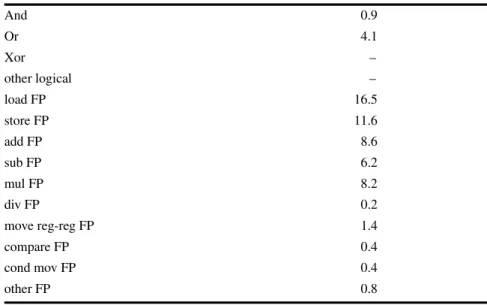
ALU instructions: (17.8% + 3.0% + 0.6% + 5.6% + 1.0% + 0.9% + 4.1%) = 33.0%
Load-stores: (9.4% + 2.4%) = 11.8%
Conditional branches: 1.0%
Jumps: 0%
FP add: (8.6% + 6.2%) = 14.8%
Load-store FP: (16.5% + 11.6%) = 28.1%
Other FP: (1.4% + 0.4% + 0.4% + 0.8%) = 3.0%
CPI = 1.0 × 33.0% + 1.4 × 11.8% + 2.0 × 1.0% × 60% + 1.5 × 1.0% × 40% + 6.0
× 8.2% + 4.0 × 14.8% + 20 × 0.2% + 1.5 × 28.1% + 2.0 × 3.0% = 2.12 A.4 This exercise is similar to A.3.
And 0.9
Or 4.1
Xor –
other logical –
load FP 16.5
store FP 11.6
add FP 8.6
sub FP 6.2
mul FP 8.2
div FP 0.2
move reg-reg FP 1.4
compare FP 0.4
cond mov FP 0.4
other FP 0.8
Figure S.14 MIPS dynamic instruction mix for lucas and swim.
Instruction Average of applu and art %
Load 16.0
Store 1.4
Add 30.2
Sub 1.2
Mul 1.2
Compare 3.7
load imm 6.8
cond branch 7.0
cond move 0.2
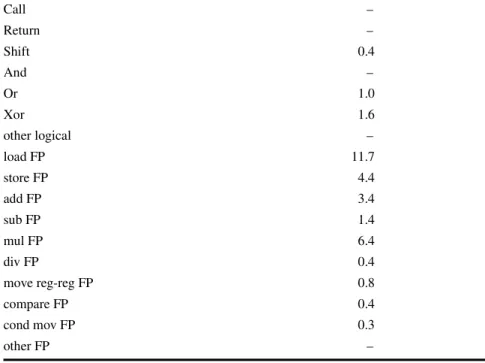
ALU instructions: (30.2% + 1.2% + 1.2% + 3.7% + 6.8% + 0.2% + 0.4% + 1.0% + 1.6%) = 46.3%
Load-stores: (16.0% + 1.4%) = 17.4%
Conditional branches: 7.0%
Jumps: 0%
FP add: (3.4% + 1.4%) = 4.8%
Load-store FP: (11.7% + 4.4%) = 16.1%
Other FP: (0.8% + 0.4% + 0.3%) = 1.5%
CPI = 1.0 × 46.3% + 1.4 × 17.4% + 2.0 × 7.0% × 60% + 1.5 × 7.0% × 40% + 6.0 × 6.4% + 4.0 × 4.8% + 20 × 0.4% + 1.5 × 16.1% + 2.0 × 1.5% = 1.76 A.5 Take the code sequence one line at a time.
Call –
Return –
Shift 0.4
And –
Or 1.0
Xor 1.6
other logical –
load FP 11.7
store FP 4.4
add FP 3.4
sub FP 1.4
mul FP 6.4
div FP 0.4
move reg-reg FP 0.8
compare FP 0.4
cond mov FP 0.3
other FP –
Figure S.15 MIPS dynamic instruction mix for applu and art.
1. A = B + C ;The operands here are given, not computed by the code, so copy propagation will not transform this statement.
2. B = A + C ;Here A is a computed value, so transform the code by substituting
A = B + C to get
= B + C + C ;Now no operand is computed
3. D = A – B ;Both operands are computed so substitute for both to get
= (B + C) – (B + C + C) ;Simplify algebraically to get
= – C ;This is a given, not computed, operand
Copy propagation has increased the work in statement 2 from one addition to two. It has changed the work in statement 3 from subtraction to negation, possi- bly a savings. The above suggests that writing optimizing compilers means incor- porating sophisticated trade-off analysis capability to control any optimizing steps, if the best results are to be achieved.
A.6 No solution provided.
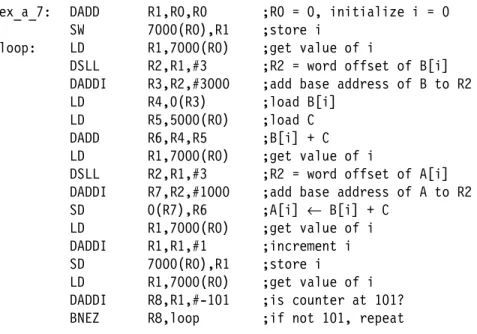
A.7 a. The point of this exercise is to highlight the value of compiler optimizations.
In this exercise registers are not used to hold updated values; values are stored to memory when updated and subsequently reloaded. Because all the addresses of all the variables (including all array elements) can fit in 16 bits, we can use immediate instructions to construct addresses. Figure S.16 shows one possible translation of the given C code fragment.
The number of instructions executed dynamically is the number of initializa- tion instructions plus the number of instructions in the loop times the number of iterations:
Instructions executed = 2 + (16 × 101) = 1618
The number of memory-data references is a count of the load and store instructions executed:
Memory-data references executed = 0 + (8 × 101) = 808 ex_a_7: DADD R1,R0,R0 ;R0 = 0, initialize i = 0
SW 7000(R0),R1 ;store i
loop: LD R1,7000(R0) ;get value of i
DSLL R2,R1,#3 ;R2 = word offset of B[i]
DADDI R3,R2,#3000 ;add base address of B to R2
LD R4,0(R3) ;load B[i]
LD R5,5000(R0) ;load C
DADD R6,R4,R5 ;B[i] + C
LD R1,7000(R0) ;get value of i
DSLL R2,R1,#3 ;R2 = word offset of A[i]
DADDI R7,R2,#1000 ;add base address of A to R2
SD 0(R7),R6 ;A[i] ← B[i] + C
LD R1,7000(R0) ;get value of i
DADDI R1,R1,#1 ;increment i
SD 7000(R0),R1 ;store i
LD R1,7000(R0) ;get value of i DADDI R8,R1,#-101 ;is counter at 101?
BNEZ R8,loop ;if not 101, repeat
Figure S.16 MIPS code to implement the C loop without using registers to hold updated values for future use or to pass values to a subsequent loop iteration.
Since MIPS instructions are 4 bytes in size, code size is the number of instructions times 4:
Instruction bytes = 4 × 18 = 72
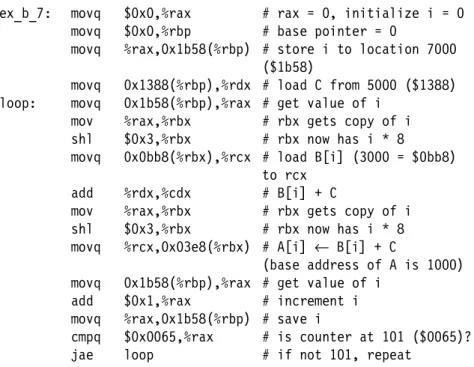
b. This problem is similar to part (a), but with x86-64 instructions instead.
The number of instructions executed dynamically is the number of initializa- tion instructions plus the number of instructions in the loop times the number of iterations:
Instructions executed = 3 + (13 × 101) = 1316
A.8 This problem focuses on the challenges related to instruction set encoding. The length of the instructions are 12 bits. There are 32 registers so the length of the register field will be 5 bits for each register operand. We use addr[11] to addr[0] to represent the 12 bits of the address as shown in the tables below.
a. In the first case, we need to support 3 two-address instructions. These can be encoded as follows:
addr[11:10] addr[9:5] addr[4:0]
3 two-address instr. '00', '01', '10' '00000' to '11111' '00000' to '11111'
Other instructions '11' '00000' to '11111' '00000' to '11111'
ex_b_7: movq $0x0,%rax # rax = 0, initialize i = 0 movq $0x0,%rbp # base pointer = 0
movq %rax,0x1b58(%rbp) # store i to location 7000 ($1b58)
movq 0x1388(%rbp),%rdx # load C from 5000 ($1388) loop: movq 0x1b58(%rbp),%rax # get value of i
mov %rax,%rbx # rbx gets copy of i shl $0x3,%rbx # rbx now has i * 8
movq 0x0bb8(%rbx),%rcx # load B[i] (3000 = $0bb8) to rcx
add %rdx,%cdx # B[i] + C
mov %rax,%rbx # rbx gets copy of i shl $0x3,%rbx # rbx now has i * 8
movq %rcx,0x03e8(%rbx) # A[i] ← B[i] + C
(base address of A is 1000) movq 0x1b58(%rbp),%rax # get value of i
add $0x1,%rax # increment i movq %rax,0x1b58(%rbp) # save i
cmpq $0x0065,%rax # is counter at 101 ($0065)?
jae loop # if not 101, repeat
Figure S.17 x86 code to implement the C loop without using registers to hold updated values for future use or to pass values to a subsequent loop iteration.
Hence, for the one-address and two-address instructions must be mapped to the remaining 10 bits with the upper two bits encoded as ‘11’. The one- address instructions are then encoded with the addr[9:5] field using ‘00000’
to ‘11101’ for the 30 instruction types, leaving the addr[4:0] field or the regis- ter operand. This leaves the patterns with ‘11’ followed by ‘11110’ in the upper seven bits and ‘00000’ to ‘11111’ in the lower five bits to encode 32 of the zero-address instructions. The remaining zero-address instructions can be encoded using ‘11’ followed by ‘11111’ in the upper seven bits and ‘0000’ to
‘01100’ in the lower five bits to encode the other 13 zero-address instructions.
Hence, it is possible to have the above instruction encodings.
b. This scenario is similar to above, with the two-address instructions encoded with the upper two bits as ‘00’ to ‘01’. The one-address instructions can be encoded with the upper two bits as ‘11’ and using ‘00000’ to ‘11110’ to dif- ferentiate the 31 one-address instructions. The pattern ‘11’ and ‘11111’ in the upper seven bits is then used to encode the zero-address instructions, with the lower five bits to differentiate them. We can only encode 32 of these patterns, not the 35 that are required; hence, it is impossible to have these instruction encodings.
c. In this part, we already have encoded three two-address instructions as above.
Moreover, we have 24 zero-address instructions encoded as below with
‘00000’ in the addr[9:5] field and ‘00000’ to ‘10111’ in the addr[4:0] field.
We would like to fit as many one-address instructions as we can. Note that we cannot take advantage of any of the unused encodings with ‘11’ and ‘00000’
in the upper seven bits because we would need to use the entire addr[4:0]
field for the single address of the operand. Hence, we can use the encodings with ‘00001’ to ‘11111’ in addr[9:5] for the one-address instructions and save the last five bits for the register address. Because this includes 31 patterns, we can support up to 31 one-address instructions. Note that we could also add up to eight additional zero-address instructions if we wish as well.
addr[11:10] addr[9:5] addr[4:0]
3 two-address instr. '00', '01', '10' '00000' to '11111' '00000' to '11111' 30 one-address instr. '11' '00000' to '11101' '00000' to '11111'
45 zero-address instr. '11' '11110' '00000' to '11111'
'11' '11111' '00000' to '01100'
addr[11:10] addr[9:5] addr[4:0]
3 two-address instr. '00', '01', '10' '00000' to '11111' '00000' to '11111'
24 zero-address instr. '11' '00000' '00000' to '10111'
X one-address instr. '11' '00001' to '11111' '00000' to '11111'
A.9 a. 1) Stack:
Push A // one address appears in the instruction, code size = 8 bits (opcode) + 64 bits (memory address) = 72 bits;
Push B // one address appears in the instruction, code size = 72 bits;
Add // zero address appears in the instruction, code size = 8 bits;
Pop C // one address appears in the instruction, code size = 72 bits;
Total code size = 72 + 72 + 8 + 72 = 224 bits.
2) Accumulator
Load A // one address appears in the instruction, code size = 8 bits (opcode) + 64 bits (memory address) = 72 bits;
Add B // one address appears in the instruction, code size = 72 bits;
Store C // one address appears in the instruction, code size = 72 bits;
Total code size = 72 + 72 + 8 + 72 = 216 bits.
3) Register-memory
Load R1, A // two addresses appear in the instruction, code size = 8 bits (opcode) + 6 bits (register address) + 64 bits (memory address) = 78 bits;
Add R3, R1, B // three addresses appear in the instruction, code size = 8 bits (opcode) + 6 bits (register address) + 6 bits (register address) + 64 bits (mem- ory address) = 84 bits;
Store R3,C // two addresses appear in the instruction, code size = 78 bits;
Total code size = 78 + 84 + 78 = 240 bits.
4) Register-register
Load R1, A // two addresses appear in the instruction, code size = 8 bits (opcode) + 6 bits (register address) + 64 bits (memory address) = 78 bits;
Load R2, B // two addresses appear in the instruction, code size = 78 bits;
Add R3, R1, R2 // three addresses appear in the instruction, code size = 8 bits (opcode) + 6 bits (register address) + 6 bits (register address) + 6 bits (register address) = 26 bits;
Store R3, C // two addresses appear in the instruction, code size = 78 bits;
Total code size = 78 + 78 + 26 + 78 = 260 bits.
b. Assume all the data size are 64 bits. Assume there is no complier optimiza- tion.
1) Stack
The total code size is 672/8 = 84 bytes. The number of bytes of data moved to or from memory is 576/8 = 72 bytes. There are 3 overhead instructions. The number of overhead data bytes is 24 bytes.
2) Accumulator
The total code size is 576/8 = 72 bytes. The number of bytes of data moved to or from memory is 512/8 = 64 bytes. There is 1 overhead instruction. The number of overhead data bytes is 8 bytes.
Code
Destroyed
data Overhead
Code size (bits)
Size of mem data
Push A no 72 64
Push B no 72 64
Add A and B 8
Pop C C 72 64
Push E no 72 64
Push A no yes 72 64
Sub A and E 8
Pop D D 72 64
Push C no yes 72 64
Push D no yes 72 64
Add C and D 8
Pop F no 72 64
Total 672 576
Code
Destroyed
data Overhead
Code size (bits)
Size of mem data
Load A 72 64
Add B A 72 64
Store C 72 64
Load A C yes 72 64
Sub E A 72 64
Store D 72 64
Add C D 72 64
Store F 72 64
Total 576 512
3) Register-memory
The total code size is 564/8 = 71 bytes. The number of bytes of data moved to or from memory is 384/8 = 48 bytes. There is no overhead instruction. The number of overhead data bytes is 0 bytes.
4) Register-register
The total code size is 546/8 = 69 bytes. The number of bytes of data moved to or from memory is 384/8 = 48 bytes. There is no overhead instruction. The number of overhead data bytes is 0 bytes.
A.10 Reasons to increase the number of registers include:
1. Greater freedom to employ compilation techniques that consume registers, such as loop unrolling, common subexpression elimination, and avoiding name dependences.
2. More locations that can hold values to pass to subroutines.
3. Reduced need to store and re-load values.
Code
Destroyed
data Overhead
Code size (bits)
Size of mem data
Load R1, A 78 64
Add R3, R1, B 84 64
Store R3, C 78 64
Sub R2, R1, E 84 64
Store R2, D 78 64
Add R4, R3, R2 84
Store R4, F 78 64
Total 564 384
Code
Destroyed
Data Overhead
Code size (bits)
Size of mem data
Load R1, A 78 64
Load R2, B 78 64
Add R3, R1, R2 26
Store R3, C 78 64
Load R4, E 78 64
Sub R5, R1, R4 26
Store R5, D 78 64
Add R6, R3, R5 26
Store R6, F 78 64
Total 546 384
Reasons not to increase the number of registers include:
1. More bits needed to represent a register name, thus increasing the overall size of an instruction or reducing the size of some other field(s) in the instruction.
2. More CPU state to save in the event of an exception.
3. Increased chip area and increased power consumption.
A.11 This program illustrates how alignment impacts data structures in C/C++. Note that the struct definition is for C++ because it includes a bool type.
So, on a 32-bit machine:
This structure requires 1 + 1 + 4 + 8 + 2 + 4 + 8 + 4 + 4 + 4 = 40 bytes in total.
Because of alignment requirements, the char and bool will be padded by two bytes so the int c is aligned. Similarly, the short e is also padded by two bytes so the float f will be aligned. Hence, as written this C++ struct will require 44 bytes on a 32-bit processor.
With rearranging the order of the elements, the minimum size required to store the structure achieves this 40 byte total. We can do this by placing the largest ele- ments in the struct first followed in order by the smaller elements. See below:
struct foo { double d;
double g;
char * cptr;
float * fptr;
int c;
int x;
float f;
short e;
char a;
bool b;
}
On a 64-bit processor, this structure requires 1 + 1 + 4 + 8 + 2 + 4 + 8 + 8 + 8 + 4 = 48 Data type
Data size on 32-bit machine (bytes)
Data size on 64-bit machine (bytes)
char 1 1
bool 1 1
int 4 4
long 4 8
double 8 8
short 2 2
float 4 4
pointer 4 8
As with the 32-bit processor, two bytes are added after the bool b so the int c is aligned and two more are added after the short e so the float f is aligned. Finally, the final int x has four bytes added to the end to make the struct aligned with an 8 byte boundary. Hence, the original struct requires 56 bytes on a 64-bit processor. By reordering the contents of the struct in the same manner as with the 32-bit machine above, the additional padding requirements are eliminated and the 48 byte size can be achieved for the struct.
A.12 No solution provided.
A.13 No solution provided.
A.14 No solution provided.
A.15 No solution provided.
A.16 No solution provided.
A.17 No solution provided.
A.18 Accumulator architecture code:
Load B ;Acc ← B Add C ;Acc ← Acc + C Store A ;Mem[A] ← Acc Add C ;Acc ← "A” + C Store B ;Mem[B] ← Acc
Negate ;Acc ← − Acc
Add A ;Acc ← “− B” + A Store D ;Mem[D] ← Acc Memory-memory architecture code:
Add A, B, C ;Mem[A] ← Mem[B] + Mem[C]
Add B, A, C ;Mem[B] ← Mem[A] + Mem[C]
Sub D, A, B ;Mem[D] ← Mem[A] − Mem[B]
Stack architecture code: (TOS is top of stack, NTTOS is the next to the top of stack, and * is the initial contents of TOS)
Push B ;TOS ← Mem[B], NTTOS ← * Push C ;TOS ← Mem[C], NTTOS ← TOS Add ;TOS ← TOS + NTTOS, NTTOS ← * Pop A ;Mem[A] ← TOS, TOS ← *
Push A ;TOS ← Mem[A], NTTOS ← * Push C ;TOS ← Mem[C], NTTOS ← TOS Add ;TOS ← TOS + NTTOS, NTTOS ← * Pop B ;Mem[B] ← TOS, TOS ← *
Push B ;TOS ← Mem[B], NTTOS ← * Push A ;TOS ← Mem[A], NTTOS ← TOS Sub ;TOS ← TOS − NTTOS, NTTOS ← * Pop D ;Mem[D] ← TOS, TOS ← *
Load-store architecture code:
Load R1,B ;R1 ← Mem[B]
Add R3,R1,R2 ;R3 ← R1 + R2 = B + C Add R1,R3,R2 ;R1 ← R3 + R2 = A + C Sub R4,R3,R1 ;R4 ← R3 − R1 = A − B
Store A,R3 ;Mem[A] ← R3
Store B,R1 ;Mem[B] ← R1
Store D,R4 ;Mem[D] ← R4
A.19 This problem is similar to A.7, but students are asked to consider how to implement a looping structure for the different architecture styles as in problem A.18. We assume A, B, C, and i are held in memory using addresses 1000, 3000, 5000, and 7000 as in problem A.7.
For the register-register case, we can use the MIPS code from A.7. In this case we assume the locations for each of the variables as with A.7.a.
ex_19_1: DADD R1,R0,R0 ;R0 = 0, initialize i = 0
SW 7000(R0),R1 ;store i
loop: LD R1,7000(R0) ;get value of i
DSLL R2,R1,#3 ;R2 = word offset of B[i]
DADDI R3,R2,#3000 ;add base address of B to R2
LD R4,0(R3) ;load B[i]
LD R5,5000(R0) ;load C
DADD R6,R4,R5 ;B[i] + C
LD R1,7000(R0) ;get value of i
DSLL R2,R1,#3 ;R2 = word offset of A[i]
DADDI R7,R2,#1000 ;add base address of A to R2
SD 0(R7),R6 ;A[i] ← B[i] + C
LD R1,7000(R0) ;get value of i
DADDI R1,R1,#1 ;increment i
SD 7000(R0),R1 ;store i
LD R1,7000(R0) ;get value of i DADDI R8,R1,#-101 ;is counter at 101?
BNEZ R8,loop ;if not 101, repeat
For the register-memory case, we can use the x86-64 code as in A.7 b):
ex_7_2: movq $0x0,%rax # rax = 0, initialize i = 0
movq $0x0,%rbp # base pointer = 0
movq %rax,0x1b58(%rbp) # store i to location 7000 ($1b58)
movq 0x1388(%rbp),%rdx # load C from 5000 ($1388) loop: movq 0x1b58(%rbp),%rax # get value of i
mov %rax,%rbx # rbx gets copy of i
shl $0x3,%rbx # rbx now has i * 8
movq 0x0bb8(%rbx),%rcx # load B[i] (3000 = $0bb8) to rcx
add %rdx,%cdx # B[i] + C
mov %rax,%rbx # rbx gets copy of i
movq 0x1b58(%rbp),%rax # get value of i
add $0x1,%rax # increment i
movq %rax,0x1b58(%rbp) # save i
cmpq $0x0065,%rax # is counter at 101 ($0065)?
jae loop # if not 101, repeat
For the stack machine case, we will add an indirect addressing mode where an address can placed on the stack. If a pushind (push with indirect addressing) is used, it will take the value from the top of the stack as the address for the push.
For popind (pop with indirect addressing), the top of the stack is the address for the target and the next entry on the stack is the value to be saved. We also assume a jle instruction exists that takes the top three elements from the stack and junps to the target (top of stack) if the second element is greater than the third element from the top of the stack (the third is less than or equal to the second).
ex_7_3: push 0 # put 0 on stack
pop i # save i
loop: push i # put i on stack push 3 # push 3
shl # shift left by three (multiply by 8) pop tmp # temporary storage for i*8
push tmp # load i*8
push 3000 # load address of B add # compute address of B[i]
pushind # push with indirect addressing to get B[i]
push C # read value of C add # get sum of B[i] + C push 1000 # load address of A push tmp # load i*8 (offset for A) add # compute address of A[i]
popind # pop with indirect addressing to assign sum to A[i]
push i # get value of i add 1 # increment by one pop i # save value of i push i # get value of i push 100 # termination value
push loop # push loop target address
jle # jump to next iteration if i <= 100 For the accumulator machine, we can use the accumulator to compute an address for indirect addressing when we read a value from memory. Unfortunately, when we want to compute an address for saving a value to memory we will lose the value to be saved while computing the address! So A[i] = expression becomes hard to express. One could either add another register to support indirect address- ing, which makes the machine no longer fit into the accumulator category. Alter- nately, one can employ self-modifying code to compute the A[i] address and then
each instruction includes two words, one for the opcode and the other for the immediate value. We can then use loadind in which the value in the accumulator is used as the address for the load and store as before in which the value in the accumulator is stored to a direct address (but we modify the address in the code to patch it to what we need at the time).
ex_7_4: load 0 # put 0 in acc
store i # save i
loop: load i # put i in acc
shl 3 # shift left by three (multiply by 8) store tmp # temporary storage for i*8
load tmp # get i*8 in acc add 1000 # get address for A[i]
store Aaddress # store to immediate value for instruction at label Astore load tmp # get i*8 in acc
add 3000 # compute address of B[i]
loadind # use indirect addressing to get B[i]
add C # get sum of B[i] + C
Astore: storeind # store to location in immediate value of this instruction
load i # get value of i
add 1 # increment by one
store i # save value of i cmp 101 # compare i to 101
jle # jump to next iteration if i <= 100
A.20 The total of the integer average instruction frequencies in Figure A.28 is 99%. The exercise states that we should assume the remaining 1% of instructions are ALU instructions that use only registers, and thus are 16 bits in size.
a. Multiple offset sizes are allowed, thus instructions containing offsets will be of variable size. Data reference instructions and branch-type instructions con- tain offsets; ALU instructions do not and are of fixed length. To find the aver- age length of an instruction, the frequencies of the instruction types must be known.
The ALU instructions listed in Figure A.28 are add (19%), sub (3%), com- pare (5%), cond move (1%), shift (2%), and (4%), or (9%), xor (3%), and the unlisted miscellaneous instructions (1%). The cond move instruction moves a value from one register to another and, thus, does not use an offset to form an effective address and is an ALU instruction. The total frequency of ALU instructions is 47%. These instructions are all a fixed size of 16 bits. The remaining instructions, 53%, are of variable size.
Assume that a load immediate (load imm) instruction uses the offset field to hold the immediate value, and so is of variable size depending on the magni-
comprise load (26%), store (10%), and load imm (2%), for a total of 38%.
The branch-type instructions include cond branch (12%), jump (1%), call (1%), and return (1%), for a total of 15%.
For instructions using offsets, the data in Figure A.31 provides frequency information for offsets of 0, 8, 16, and 24 bits. Figure 2.42 lists the cumula- tive fraction of references for a given offset magnitude. For example, to deter- mine what fraction of branch-type instructions require an offset of 16 bits (one sign bit and 15 magnitude bits) find the 15-bit magnitude offset branch cumulative percentage (98.5%) and subtract the 7-bit cumulative percentage (85.2%) to yield the fraction (13.3%) of branches requiring more than 7 mag- nitude bits but less than or equal to 15 magnitude bits, which is the desired fraction. Note that the lowest magnitude at which the cumulative percentage is 100% defines an upper limit on the offset size. For data reference instruc- tions a 15-bit magnitude captures all offset values, and so an offset of larger than 16 bits is not needed. Possible data-reference instruction sizes are 16, 24, and 32 bits. For branch-type instructions 19 bits of magnitude are necessary to handle all offset values, so offset sizes as large as 24 bits will be used. Pos- sible branch-type instruction sizes are 16, 24, 32, and 40 bits.
Employing the above, the average lengths are as follows.
b. With a 24-bit fixed instruction size, the data reference instructions requiring a 16-bit offset and the branch instructions needing either a 16-bit or 24-bit off- set cannot be performed by a single instruction. Several alternative imple- mentations are or may be possible.
First, a large-offset load instruction might be eliminated by a compiling opti- mization. If the value was loaded earlier it may be possible, by placing a higher priority on that value, to keep it in a register until the subsequent use.
Or, if the value is the stored result of an earlier computation, it may be possi- ble to recompute the value from operands while using no large-offset loads.
Because it might not be possible to transform the program code to accom- plish either of these schemes at lower cost than using the large-offset load, let’s assume these techniques are not used.
For stores and branch-type instructions, compilation might be able to rear- range code location so that the store effective address or target instruction address is closer to the store or branch-type instruction, respectively, and thus require a smaller offset. Again, let’s assume that this is not attempted.
ALU length = 16 bits
Data-reference length = 16 × 0.304 + 24 × (0.669 – 0.304) + 32 × (1.0 – 0.669)
= 24.2 bits
Branch-type length = 16 × 0.001 + 24 × (0.852 – 0.001) + 32 × (0.985 – 0.852)
= 25.3 bits
Average length = 16 × 0.47 + 24.2 × 0.38 + 25.3 × 0.15
= 20.5 bits
Thus, code needing an offset greater than 8 signed magnitude bits and written with 24-bit fixed-size instructions will use additional instructions to change the program counter in multiple steps. If adding the available offset to the low-order PC register bits is all that is available, then to achieve an offset with a 15-bit magnitude requires adding up to 28 8-bit offsets (only 7 magnitude bits each) to the initial PC value. Clearly, this is beyond tedious and perfor- mance-robbing.
To avoid this performance penalty we assume that there are two new jump instructions to help with changing the PC. They are JUMP_Shift7 and JUMP_Shift14. These instructions add an 8-bit offset not at the low-order bit positions, but rather at a position shifted left by 7 and 14 bits, respectively, from the least significant bit. During the addition low order bit positions are filled with 7 or 14 zeros. With these two instructions and the original JUMP with unshifted offset, offsets of 8, 15, or 22 total bits including sign can be accomplished piece wise. First an 8-bit offset is added to the PC using JUMP.
Next, another 8-bit offset is added to the PC using JUMP_Shift7. Finally, a third 8-bit offset is added to the PC using JUMP_Shift14. If the needed signed magnitude offset can be represented in 8 bits then the original instruc- tions are sufficient. If up to 15 bits are needed for an offset, then a JUMP_Shift7 precedes the original instruction, moving the PC to within the range that can be reached by an 8-bit signed magnitude offset. To keep pro- gram instruction layout in memory more sequential a JUMP_Shift7 can be used to restore the PC to point of the next sequential instruction location fol- lowing the first JUMP_Shift7. Similarly, if up to 22 offset bits are needed, then a JUMP_Shift7 followed by a JUMP_Shift14 changes the PC value to within the range of an 8-bit offset of the intended address. Analogously, a JUMP_Shift14 and a JUMP_Shift7 would follow the original instruction to return the PC to the next sequential instruction location.
From Figure A.31 no data reference instruction requires more than a 15-bit offset, so JUMP_Shift14 is not needed. JUMP_Shift7 instruction pairs are needed for offsets greater than 7 magnitude bits but less than or equal to 15 bits, or 100% – 66.9% = 33.1% of data reference instructions. Similarly, JUMP_Shift14 and JUMP_Shift7 pairs are needed for 100% – 98.1% = 1.9%
of branches, and JUMP_Shift7 pairs alone are needed for 98.1% – 85.2% = 12.9% of branches. Thus, the number of fetched instructions increases by a factor of
(2)(0.331)(0.38) + [(2)(0.129) + (4)(0.019)](0.15) = 30.2%
The number of bytes fetched on a per-instruction basis for the byte-variable- sized instructions of part (a) is
(20.5 bits/instr)((1/8)byte/bit) = 2.56 bytes/instr.
Because extra instructions must be added to the original code, we compare the number of bytes fetched for the fixed length 24-bit instructions on a per
c. With a 24-bit fixed offset size, the ALU instructions are 16 bits long and both data reference and branch instructions are 40 bits long. The number of instructions fetched is the same as for byte-variable-sized instructions, so the per-instruction bytes fetched is
(16 bits/instr)(0.47) + (40 bits/instr)(0.38 + 0.15) = 3.59 bytes/instr.
This is less that the bytes per original instruction fetched using the limited 8- bit offset field instruction format. Having an adequately sized offset field to avoid frequent special handling of large offsets is valuable.
A.21 No solution provided.
A.22 Same as HP3e problem 2.3
a.
b.
c. 4F4D, 5055, and 5455. Other misaligned 2-byte words would contain data from outside the given 64 bits.
d. 52 55 54 4D, 55 54 4D 50, and 54 4D 50 43. Other misaligned 4-byte words would contain data from outside the given 64 bits.
A.23 [Answers can vary.]
ISAs can be optimized for a variety of different problem domains. We consider different features in ISA design, considering typical applications for desktop, server, cloud, and embedded computing, respectively.
1) For desktop, we care about the speed of both the integer and floating-point units, but not as much about the power consumption. We also would consider the compatibility of machine code and the software running on top of it (e.g., x86 code). The ISA should be made capable of handling a wide variety of applica- tions, but with commodity pricing placing constraints on the investment of resources for specialized functions.
2) For servers, database applications are typical, so the ISA should be targeting integer computations, with support for high throughput, multiple users, and virtu- alization. ISA design can emphasize integer operations and memory operations.
Dynamic voltage and frequency scaling could be added for reduced energy con- sumption.
43 4F 4D 50 55 54 45 52
C O M P U T E R
45 52 55 54 4D 50 43 4F
E R U T M P C O
3) Cloud computing ISAs should provide support for virtualization. Integer oper- ation and memory management will be important. Power savings and facilities for easier system monitoring will be important for large data centers. Security and encryption of user data will be important, so ISAs may provide support for these concerns.
4) Power consumption is a big concern in embedded computing. Price is also important. The embedded ISAs may provide facilities for sensing and controlling devices with special instructions and/or registers, analog to digital and digital to analog converters, and interfaces to specialized, application-specific functions.
The ISA may omit floating point, virtual memory, caching, or other performance optimizations to save energy or cost.