行政院國家科學委員會專題研究計畫成果報告
高分子聚合物對三鹵甲烷生成前質的影響
Evaluation of Polyelectrolytes for Removing Organics Matter 計畫編號:NSC 91-2211-E-038-001
執行期限:91 年 8 月 1 日至 92 年 7 月 31 日 計畫主持人:張怡怡教授 台北醫學大學醫學系
共同主持人:蔣本基教授 國立台灣大學環境工程研究所 計畫參與人員:唐瑋彥 國立台灣大學環境工程研究所
趙素慧 台北醫學大學醫學系
摘要
利用高分子聚合物加強混凝去除水中之三鹵甲烷有機前質的研究結果,顯示 p-DADMAC 之添加有助於腐植酸及單寧酸之去除並降低混凝劑的使用量。與未 加高分子聚合物的混凝程序相比較,應用高分子聚合物為助凝劑時,雖然隨著顆 粒與凝絮間的連結性強化下,濁度有增加的傾向,但其有助於起初漂浮的凝絮凝
集而沉降。此外,藉由處理後水中之濁度與總有機碳之線性關係可知,『沈降』
為總有機碳去除之主要機制。
關鍵字:加強混凝、高分子聚合物、聚丙烯醯胺、聚氯化己二烯二甲基胺、對羥 基苯甲酸、單寧酸、腐植酸、三鹵甲烷生成
Abstract
The results of this investigation reveal that enhanced coagulation with polymer, p-DADMAC, was found to be very effective for removing high-molecular-weight THM precursors humic acids and tannic acids, and markedly reduced the alum dosages required for turbidity removal. Like the removal of organic precursors, THM formation was reduced by p-DADMAC addition. Comparing with the experimental data without polymers in coagulation process, although turbidity increased with increasing on enhancing the effectiveness of linkage between particles and flocs contributed by p-DADMAC, which helped the primarily unsettled flocs to agglomerate and precipitate. In addition, a linear relationship between turbidity and total organic carbon (TOC) removal was observed and suggested “precipitation” be the predominant mechanism for TOC removal in high turbidity water.
KEY WORDS: Enhance coagulation, polymer, polyacryamide, p-diallyldimethyl ammonium chloride, p-hydroxybenzoic acid, tannic acid, humic acid, trichloromethane (THM) formation.
INTRODUCTION
The coagulation process, as operated in many water treatment plants in Taiwan, is optimized primarily for the removal of turbidity. NOM is also removal by coagulation, but removal efficiency is variable, depending on the physical and chemical characteristics of the water and the operating conditions (Ratneaweera et al., 1999). Unless the NOM of the raw water has a low TOC concentration, coagulant dosages required are determined by the content of NOM in a water supply rather than by turbidity (O’Melia et al., 1999). Generally, the higher-molar-mass fraction of organic matter (OM) is removed readily by coagulation (Collins et al., 1986). The type of OM is also a factor in removal by coagulation. Functional groups influence the solubility of organic compounds, which also affects removal by coagulation because hydrophobic OM generally thought to be more easily removed than hydrophilic OM (White et al., 1997; Collins, M.R., 1986). Owen et al have shown that a large percentage of DBPs is formed from the nonhumic fraction of NOM. This fraction is generally more hydrophilic than humic substances and thus more difficult to remove by coagulation.
Polymers have particular advantages over inorganic coagulants for NOM removal (Glaser and Edzwald, 1979; Schlauch, 1981; Amy and Chadik, 1983; Rebhun et al., 1984; Edzwald, 1986; Vik and Eikebrokk, 1989; Coccagna, 1989; Bolto, 1995).
The performance is less dependent on pH and there is a lower level of dissolved ions in the product water (Bolto et al., 1999). Mallevialle (1984) found that chlorination of polyacryamide (PAM) and acryamide monomers shows low reactivity, and generated a small amount of total organic halides (TOX) and trihalomethane. Chang et al., (1999) found the polydiallyldimethyl ammonium chloride (p-DADMAC) can not only effectively remove the turbidity but also reduce the formation of trichloromethane (CHCl3). The optimum dosage of p-DADMAC for reducing the turbidity, TOC and CHCl3 in the humic acid and source water samples was depended upon the nature of organics. Evaluation of cationic polyelectrolytes for the removal of UV absorbers ,the best achieved with alum followed by cationic polymethacrylate (CPMA), p-DADMAC or cationic polyacryamide (CPAM). Higher charge density (CD) is more effective to reduction of UV absorption than low CD (Bolto et al., 1998).
However, a much clearer understanding of the reaction mechanism is required to optimize the choice of polymer. Also, possible negative consequences could arise from the reaction of polymers with other water treatment chemicals such as disinfectants in the form of chlorine. Therefore, the objectives of this paper were intended to investigate the effects of three organics as the model compounds (i.e.
humic acid, tannic acid and p-hydroxybenzoic acid) on coagulation and trihalomethanes (THM) formation potential, determine the most suitable polymer as coagulant-aid in the coagulation process.
MATERIALS AND METHODS
research design
Three model organic compounds with different molar masses and degrees of hydrophobicity were used to simulate some of the wide range of compounds found in NOM (Exall, 2000). Humic acid (Aldrich co.,) represented fairly hydrophobic, high-molar-mass (MW = 10 to 100 thousands) natural compounds and is a negatively charged polyelectrolyte due to the dominance of carboxylic acid groups. Aldrich humic acid was prepared by the base extraction of coal by the manufacturer and was not isolated from natural waters. A number of previous studies have utilized this material, it represents a good model humic substance (Chang, 2001; Mustafa, 2001).
Tannic acid represented relatively hydrophilic compounds of medium molar mass (MW = 1700.24), and p-hydroxy benzoic acid (MW = 138.12) represented small organic molecules found in nature. All of the model compounds containing carboxylic and phenolic groups. Jar tests that used rapid mixing, and settling steps were conducted to evaluate how well the coagulant and coagulant-aid removed these compounds and reduced turbidity, THM formation potential under different pH conditions.
polymers
Two types of polyacryamide (SNF Co.) used were non-ionic polyacryamide of high molecular weight (MW) ranging from 5 to 15 million, and cationic polyacryamide of positively-charged, with charge density (CD) < 15% are available in very high molecular weight (3 to 15 million). And another cationic polymer of diallyldimethyl ammonium chloride (Aldrich Co.,) which has a high CD (100%) and varying MW.
synthetic water
Synthetic water was made up to resemble the alkalinity, turbidity, and OM (HA, TA, and PHBA) levels of natural water. In 1 L of distilled water, 1.764 g of sodium bicarbonate was added to produce a final alkalinity of 100 ± 10 mg/L as CaCO3, and 13.897 g (0.662 mg/L) bentonite was added to bring an approximate turbidity of 200 ntu. The total organic carbon (TOC) of the resulting solution was near 7 mg /L as C.
This solution was mixed on a stir plate for 1 h before being made up to 21 L. The water was then left in a closed container overnight (> 18 h) and the pH was regulated before it was used in jar tests.
jar tests and analyses
how well the coagulants removed the various types of OM and reduced turbidity at different pH condition. A six-place paddle stirrer with 1- L square beakers was used for the jar tests; five jars received various fixed dosages of coagulant, and control jar received zero coagulant dosage. Coagulant was added with a micropipet, and the solutions were rapid-mixed at 100 rpm for 3 min, slow-mixed at 30 rpm for 15 min, and allowed to settle for 20 min. After the suspensions sellting, 50-mL samples were obtained from a sampling tap located 50 mm above the bottom of the beaker. A 25-mL aliquot was taken for measurement of turbidity on a turbidimeter (Hach Co.,).
TOC, chlorine demand, CHCl3, pH, and alkalinity analyses were measured in treated water samples. All the detailed analyses followed the QA/QC programs set forth in Standard Methods (APHA, 1998). Water samples for TOC and UV254 analyses were first filtered trough a TOC instrument (O.I. Corp. model 700), and UV spectroscopy (Hitachi U-2000). The TOC analysis was performed following the UV-persulfate technique using the infrared carbon dioxide analyzer and calibrated with the potassium hydrogen phthalate standard.
THM (CHCl3) formation
The formation potential experiments for DBPs were conducted with a 7-days incubation period following the introduction of the NaOCl solution and phosphate buffer (pH 7.0). The applied chlorine concentration were about 3 to 40 mg/L, which were depending on the chlorination period and would provide a free residual chlorine of at least 0.018 to 5 mg/L at the end of the incubation period (Standard Methods, 2350B). The analyses of residual chlorine was performed using the DPD (N,N-diethyl-p-phenylene-diamine) ferrous titration method.
RESULTS AND DISSCUSSION
Figure 1 presents the results of jar test for water samples containing humic acid (HA), tannic acid (TA) and p-hydroxybenzoic acid with alum coagulant under pH 7.
Under the neutralized condition, the concentration of flocs that formed by Al(OH)3
was low and, therefore, flocs could not sweep the particles in water rather they contribute to the concentration of suspension that the reverse of turbidity in alum-treated water (Adin,1998). The DOC in raw water was converted to a non-settling particulate form at low alum dosage and contributed to turbidity increasing “negative effect” phenomenon (White et al., 1997; Singer et al., 2002).
Manahan (1994) analyzed the humic substances and found that they could bind the metal ions such as aluminum and iron. This binding can occur as chelation between a carboxyl group and a phenolic hydroxyl group. It was evidently shown in Figure 1
NTU. Compared with the HA-containing water, it requires less dosage of alum for treating the TA and PHBA containing water. At a specific alum dosage, the residual turbidity decreased with increasing molecular weight of organic. The complexity of structure and functional groups in organic material may affect the stability of colloidal system. The more complex structure and functional groups, the higher chemical dosage is needed to destabilize the system (Divakaran, 2001).
According to the requirement of TOC removal for enhanced coagulation in the USEPA’s D/DBP Rules, 35% of TOC removal was required in this research. While treating humic acid water, the point of diminishing returns (PODR) was reached. It could be seen from Figure 2 that the slope became steeper over 100 mg/L of alum and, therefore, 100 mg/L was the threshold dosage for humic acid water. In tannic acid water, the PODR requirement was at the same alum dose, 60 mg/L. It was obvious that tannic acid was relatively easy to be removed by coagulation than humic acid. It might be due to the less negative charge tannic acid carried and, therefore, more aluminum-tannic precipitates were formed under the same alum concentration. 110 mg/L of alum dosage was the threshold dosage, and the same phenomenon could be observed in turbidity curve at the same alum dose. It was evident that alum had very little effects on PHBA removal at lower alum dosage, although it could remove the turbidity quite successfully.
0 50 100 150 200 250 300
0 20 40 60 80 100 120 140 160
Alum dose -- mg/L
Residual Tur -- NTU
0 20 40 60 80 100 120
Tur removal -- %
Risidual turbidity (HA) Risidual turbidity (TA) Risidual turbidity (PHBA) Percent removal (HA) -- % Percent removal (TA) -- % Percent removal (PHBA) -- %
<2NTU
Figure1 Results of Jar tests by introducing alum dose at pH 7. (Raw water:
7 mg/L HA, TA and PHBA, 200 NTU, 100 mg/L as CaCO3)
0.0 1.0 2.0 3.0 4.0 5.0 6.0 7.0 8.0 9.0 10.0
0 20 40 60 80 100 120 140 160
Alum dose -- mg/L
TOC -- mg/L
0 20 40 60 80 100
TOC removal -- %
Residual TOC (HA) Residual TOC (TA) Residual TOC (PHBA) TOC removal (HA) TOC removal (TA) TOC removal (PHBA)
PODR
Step 1 percent removal 0.3mgTOC
/10mg alum
Figure 2 Results of Jar tests by introducing alum dose at pH 7 (Raw water:
7±0.7 mg/L HA, TA and PHBA, 200±3 NTU, 100±10 mg/L as CaCO3)
Effects of polymers on coagulation enchancement
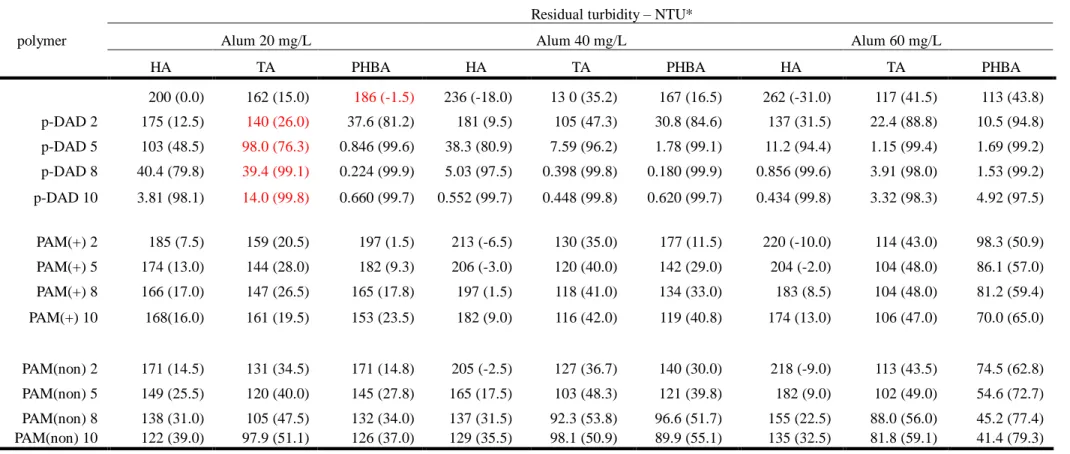
Three kinds of polymers, p-DADMAC (diallyldimethyl ammonium chloride), cationic PAM (polyacrylamide) and nonionic PAM, were used as coagulant-aids at slow mixing time in the coagulation process. While treating humic acid water, the addition of PAMs could only reduce turbidity slightly. Nonionic PAM had better effects than cationic PAM with 35% to 12% average percent removals respectively (Table 1). However, the residual turbidity was still much higher than drinking water standard (2 NTU) even at a high dosage. On the other hand, cationic PAM not only could not adsorb on positive charged flocs but also could not neutralize the charge of particles due to its low charge density. Contrarily, using p-DADMAC as coagulant-aid, the residual turbidity could be reduced to a lower level, even less than 1 NTU at higher dosages. When dosing of 20 mg/L alum, 80% of turbidity was removed with 8 mg/L p-DADMAC. If the dosage of alum increased to 40 mg/L, it needed only 5 mg/L p-DADMAC to remove 80% of turbidity, and reduce turbidity to 5 NTU with 8 mg/L. As dosing 60 mg/L of alum, the results were similar to those for 40 mg/L, but the residual turbidities are lower at the same dosages of p-DADMAC. Over 90% of turbidity was removed at 5 mg/L of p-DADMAC.
Similarly, while treating tannic acid, nonionic PAM had better performance, in lowering the turbidity, than cationic PAM. However, the effects of p-DADMAC on
8 mg/L p-DADMAC was sufficient to remove over 99% of turbidity and lowered the turbidity to 1.7 NTU. While increasing the dosage of alum, less p-DADMAC was needed to achieve higher turbidity removal. For example, about 6 mg/L p-DADMAC was sufficient with 40 mg/L of alum (7.6 NTU with 5 mg/L of p-DADMAC) and about 4 mg/L p-DADMAC with 60 mg/L of alum (1.5 NTU with 5 mg/L of p-DADMAC). The results implied that even the turbidity became lower with increasing alum dosage, the addition of p-DADMAC improved the removal efficiency as a result less alum was needed.
While treating PHBA water, both PAMs had better effects on enhancing the turbidity removal (Table 1) than treating humic acid or tannic acid water. PAM was still better than cationic PAM in turbidity removal, but even at the highest chemical dosage, 60 mg/L of alum and 10 mg/L of nonionic PAM, the residual turbidity of treated water, 41 NTU, was still higher than the Drinking Water Standard. About 4 mg/L p-DADMAC was sufficient to reduce the turbidity of treated water to lower than 2 NTU, regardless of the amount of alum dosage. It was evident that the addition of p-DADMAC had significant improvement on turbidity removal.
Among three kinds of polymers, p-DADMAC exhibits the most efficient performance for turbidity removal. Its high charge density makes up the disadvantage of low molecular weight. As a result, charge density of polymers might be a better index for the evaluation of turbidity removal. Comparing with the experimental data without polymers in coagulation process, although turbidity increased with increasing on enhancing the effectiveness of linkage between particles and flocs contributed by p-DADMAC, which helped the primarily unsettled flocs to agglomerate and precipitate. In this investigation, it was found that the organic composition in water would affect the efficiency of turbidity removal. The organic compounds with complex structures and functional groups demanded higher chemical dosages to produce sufficient positive charged flocs for turbidity removal by charge neutralization and adsorption. Therefore, the sequence of the amounts of chemical needed was: HA>TA>PHBA.
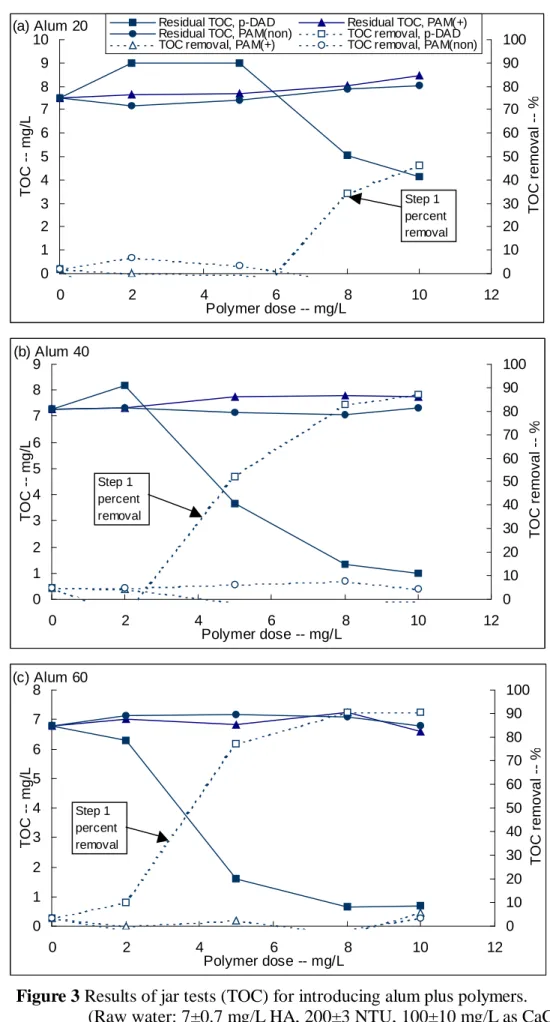
Figures 3 to 5 show TOC removal efficiency of three kinds of organic precursors water treated with polymers.
While treating humic acid water, p-DADMAC is the only one coagulant-aid to
coagulation requirement over 35% TOC removal. Both cationic and nonionic PAM had little effects on TOC removal. Moreover, higher PAM dosage would remain in treated water and result in an excess of TOC concentration. p-DADMAC could help the linkage between particles and flocs, which enlarge the size of flocs and make them easier to precipitate. Furthermore, the organic matter might adsorb on the flocs and be removed along with the precipitates. However, insufficient dosage of p-DADMAC would increase TOC concentration in treated water, and it was even much significant than the over-dosage of cationic and nonionic PAM. While dosing 20 mg/L of alum, over 8 mg/L of p-DADMAC was needed to achieve the percent TOC removal requirement (Figure 3). Similar patterns could be observed that over 4 mg/L p-DADMAC was needed when 40 mg/L of alum dosage was applied and 3 mg/L of p-DADMAC with 60 mg/L of alum. Thus, it is assumed that the higher the alum dosage, the lower concentration of p-DADMAC is needed for TOC removal.
Consequently, lower concentration of p-DADMAC could easily link the particles and flocs together due to its high positive charge density and results in formation of precipitates followed by sedimentation as polymer-floc complexes.
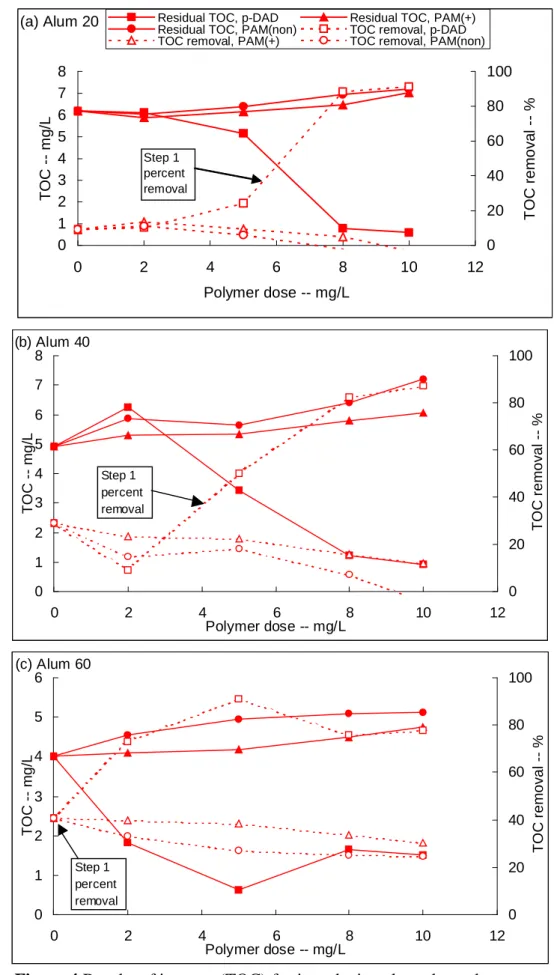
Results of the treatment water containing tannic acid were similar to those of humic acid containing water. Dosing 60 mg/L of alum could reduce TOC concentration effectively, polymers might not be necessary unless higher removal requirement is needed. Both PAMs not only had little effects on TOC removal, but also impeded the coagulation performances no matter what the concentration of alum dosage was. Most of the added PAMs remained in treated water and contributed excess TOC. On the other hand, p-DADMAC improved the efficiency of TOC removal. When the dosage of alum was 20 mg/L, more than 6 mg/L of p-DADMAC was needed to achieve the enhanced coagulation requirement. The highest percent removal was 91% at 10mg/L of p-DADMAC. At 40 mg/L of alum dosage, 5 mg/L of p-DADMAC could reduce 50% of TOC, thus about 4 mg/L of p-DADMAC might be sufficient to achieve the 35% reduction requirement. The highest percent removal was 87% at 10 mg/L p-DADMAC dosage. At both 20 and 40 mg/L of alum dosage, insufficient polymer dosage would also lead to excess TOC concentration (2 mg/L of p-DADMAC in Figure 4), but this “negative effect” was not observed at higher p-DADMAC dose.
Table 1 Turbidity removal of three kinds of synthetic water treated by coagulation process
Residual turbidity – NTU*
polymer Alum 20 mg/L Alum 40 mg/L Alum 60 mg/L
HA TA PHBA HA TA PHBA HA TA PHBA
200 (0.0) 162 (15.0) 186 (-1.5) 236 (-18.0) 13 0 (35.2) 167 (16.5) 262 (-31.0) 117 (41.5) 113 (43.8) p-DAD 2 175 (12.5) 140 (26.0) 37.6 (81.2) 181 (9.5) 105 (47.3) 30.8 (84.6) 137 (31.5) 22.4 (88.8) 10.5 (94.8) p-DAD 5 103 (48.5) 98.0 (76.3) 0.846 (99.6) 38.3 (80.9) 7.59 (96.2) 1.78 (99.1) 11.2 (94.4) 1.15 (99.4) 1.69 (99.2) p-DAD 8 40.4 (79.8) 39.4 (99.1) 0.224 (99.9) 5.03 (97.5) 0.398 (99.8) 0.180 (99.9) 0.856 (99.6) 3.91 (98.0) 1.53 (99.2) p-DAD 10 3.81 (98.1) 14.0 (99.8) 0.660 (99.7) 0.552 (99.7) 0.448 (99.8) 0.620 (99.7) 0.434 (99.8) 3.32 (98.3) 4.92 (97.5)
PAM(+) 2 185 (7.5) 159 (20.5) 197 (1.5) 213 (-6.5) 130 (35.0) 177 (11.5) 220 (-10.0) 114 (43.0) 98.3 (50.9) PAM(+) 5 174 (13.0) 144 (28.0) 182 (9.3) 206 (-3.0) 120 (40.0) 142 (29.0) 204 (-2.0) 104 (48.0) 86.1 (57.0) PAM(+) 8 166 (17.0) 147 (26.5) 165 (17.8) 197 (1.5) 118 (41.0) 134 (33.0) 183 (8.5) 104 (48.0) 81.2 (59.4) PAM(+) 10 168(16.0) 161 (19.5) 153 (23.5) 182 (9.0) 116 (42.0) 119 (40.8) 174 (13.0) 106 (47.0) 70.0 (65.0)
PAM(non) 2 171 (14.5) 131 (34.5) 171 (14.8) 205 (-2.5) 127 (36.7) 140 (30.0) 218 (-9.0) 113 (43.5) 74.5 (62.8) PAM(non) 5 149 (25.5) 120 (40.0) 145 (27.8) 165 (17.5) 103 (48.3) 121 (39.8) 182 (9.0) 102 (49.0) 54.6 (72.7) PAM(non) 8 138 (31.0) 105 (47.5) 132 (34.0) 137 (31.5) 92.3 (53.8) 96.6 (51.7) 155 (22.5) 88.0 (56.0) 45.2 (77.4) PAM(non) 10 122 (39.0) 97.9 (51.1) 126 (37.0) 129 (35.5) 98.1 (50.9) 89.9 (55.1) 135 (32.5) 81.8 (59.1) 41.4 (79.3)
* The removal percentage of turbidity is indicated in parentheses.
(a) Alum 20
0 1 2 3 4 5 6 7 8 9 10
0 2 4 6 8 10 12
Polymer dose -- mg/L
TOC -- mg/L
0 10 20 30 40 50 60 70 80 90 100
TOC removal -- %
Residual TOC, p-DAD Residual TOC, PAM(+) Residual TOC, PAM(non) TOC removal, p-DAD TOC removal, PAM(+) TOC removal, PAM(non)
Step 1 percent removal
(b) Alum 40
0 1 2 3 4 5 6 7 8 9
0 2 4 6 8 10 12
Polymer dose -- mg/L
TOC -- mg/L
0 10 20 30 40 50 60 70 80 90 100
TOC removal -- %
Step 1 percent removal
(c) Alum 60
0 1 2 3 4 5 6 7 8
0 2 4 6 8 10 12
Polymer dose -- mg/L
TOC -- mg/L
0 10 20 30 40 50 60 70 80 90 100
TOC removal -- %
Step 1 percent removal
Figure 3 Results of jar tests (TOC) for introducing alum plus polymers.
(Raw water: 7±0.7 mg/L HA, 200±3 NTU, 100±10 mg/L as CaCO3, pH=7)
HA
(a) Alum 20
0 1 2 3 4 5 6 7 8
0 2 4 6 8 10 12
Polymer dose -- mg/L
TOC -- mg/L
0 20 40 60 80 100
TOC removal -- %
Residual TOC, p-DAD Residual TOC, PAM(+) Residual TOC, PAM(non) TOC removal, p-DAD TOC removal, PAM(+) TOC removal, PAM(non)
Step 1 percent removal
(b) Alum 40
0 1 2 3 4 5 6 7 8
0 2 4 6 8 10 12
Polymer dose -- mg/L
TOC -- mg/L
0 20 40 60 80 100
TOC removal -- %
Step 1 percent removal
(c) Alum 60
0 1 2 3 4 5 6
0 2 4 6 8 10 12
Polymer dose -- mg/L
TOC -- mg/L
0 20 40 60 80 100
TOC removal -- %
Step 1 percent removal
Figure 4 Results of jar tests (TOC) for introducing alum plus polymers.
(Raw water: 7±0.7 mg/L TA, 200±3 NTU, 100±10 mg/L as CaCO3, pH=7)
TA
(a) Alum 20
0 1 2 3 4 5 6 7 8 9
0 2 4 6 8 10 12
Polymer dose -- mg/L
TOC -- mg/L
-20 0 20 40 60 80 100
TOC removal -- %
Residual TOC, p-DAD Residual TOC, PAM(+) Residual TOC, PAM(non) TOC removal, p-DAD TOC removal, PAM(+) TOC removal, PAM(non)
(b) Alum 40
0 1 2 3 4 5 6 7 8 9
0 2 4 6 8 10 12
Polymer dose -- mg/L
TOC -- mg/L
-20 0 20 40 60 80 100
TOC removal -- %
(c) Alum 60
0 2 4 6 8 10
0 2 4 6 8 10 12
Polymer dose -- mg/L
TOC -- mg/L
0 20 40 60 80 100
TOC removal -- %
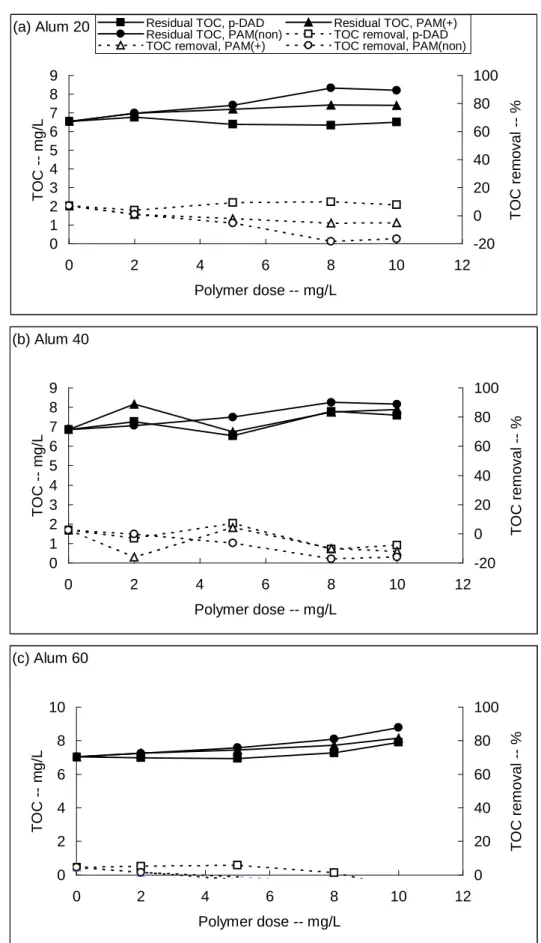
Figure 5 Results of jar tests (TOC) for introducing alum plus polymers.
(Raw water: 7±0.7 mg/L PHBA, 200±3 NTU, 100±10 mg/L as CaCO3, pH=7)
PHBA
Although the percent TOC removal requirement was achieved at 60 mg/L of alum dosage, experiments on the addition of polymers as coagulant-aids were performed as to compare the results with lower alum dosages. It could be observed that 5 mg/L of p-DADMAC could remove the most organic matter, but the performance efficiency decreased at higher dosage. Similar trend could also be observed in turbidity curve in Figure 4 (c). It could be explained that over dosage of positive charged polymer would cause restabilization. The excess cationic polymers interact with positively charged particles and flocs to form another diffuse system.
Since alum was not capable of removing p-hydroxybenzoic acid (PHBA) (Figure 5), different polymers were dosed to improve the coagulation performance. However, none of the polymers used in this research could enhance coagulation performance but inhibited it. The highest removal percentage was 11.4% when treated with 20 mg/L alum. When the dosage of alum and polymer increased, removal percentage decreased on the contrary.
High / low turbidity.
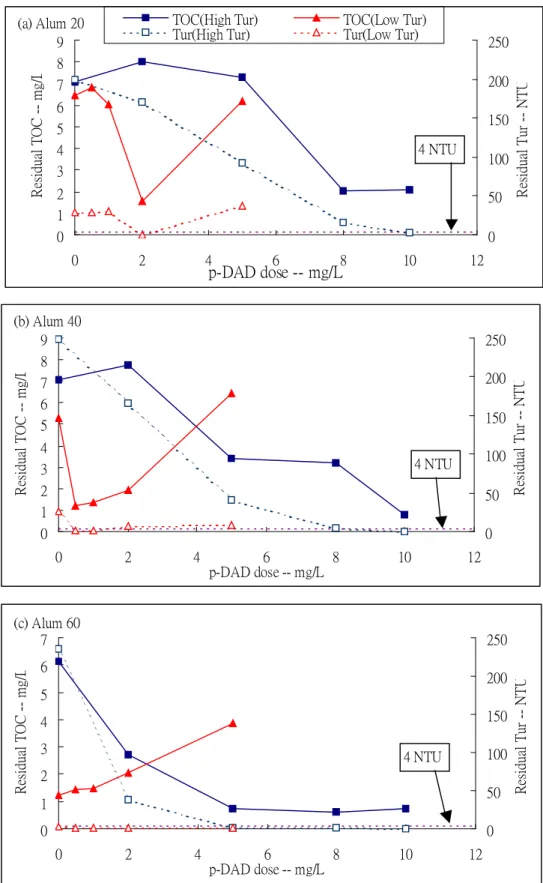
When dosing 20 mg/L of alum, 2 mg/L p-DADMAC could remove 77% of TOC.
However, only 11% of TOC was removed while the dosage of p-DADMAC increased to 5 mg/L. Similar pattern could be observed when dosing 40 mg/L of alum that 0.5 mg/L p-DADMAC could remove 83% of TOC, but the removal percentage decreased with increasing dosage. These results imply that the concentration of p-DADMAC added in coagulation process must be controlled carefully or even a slight change would lead to the restabilization of the whole system and cause a poor performance.
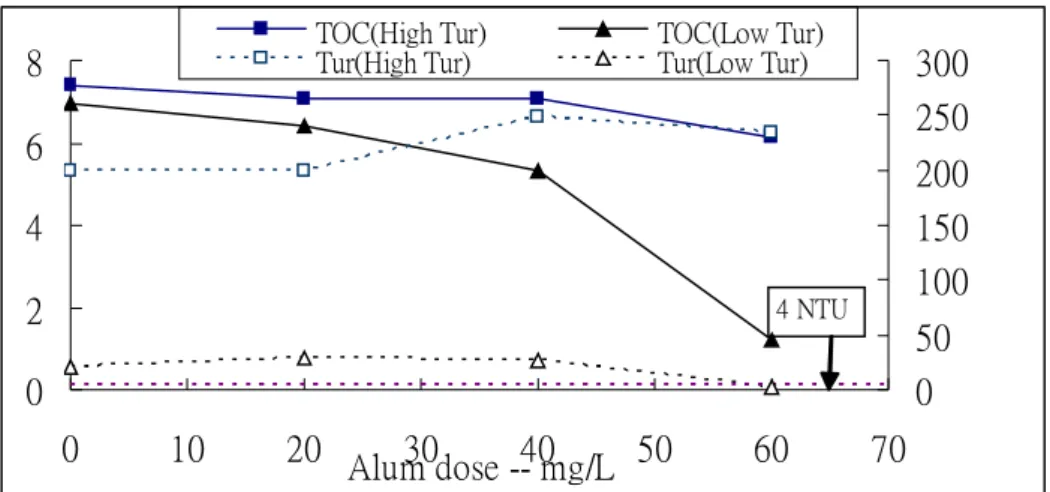
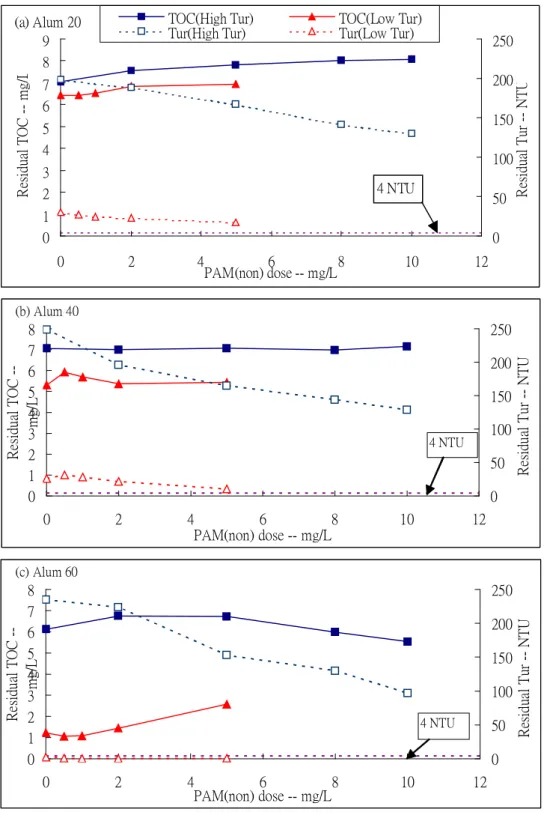
Unlike high turbidity water, dosing 60 mg/L of alum could remove over 80% of TOC in low turbidity water Therefore, it was not necessary to use polymers as coagulant-aids. The addition of polymer would lead to higher residual TOC in the treated water (Figure 7 for p-DADMAC; Figure 8 for nonionic PAM).
We can conclude that treating low turbidity water by alum only is a better way than with polymers, because higher alum concentration could remove most of TOC and turbidity in water, but polymers as coagulant-aids might tend to impede the performance of coagulation.
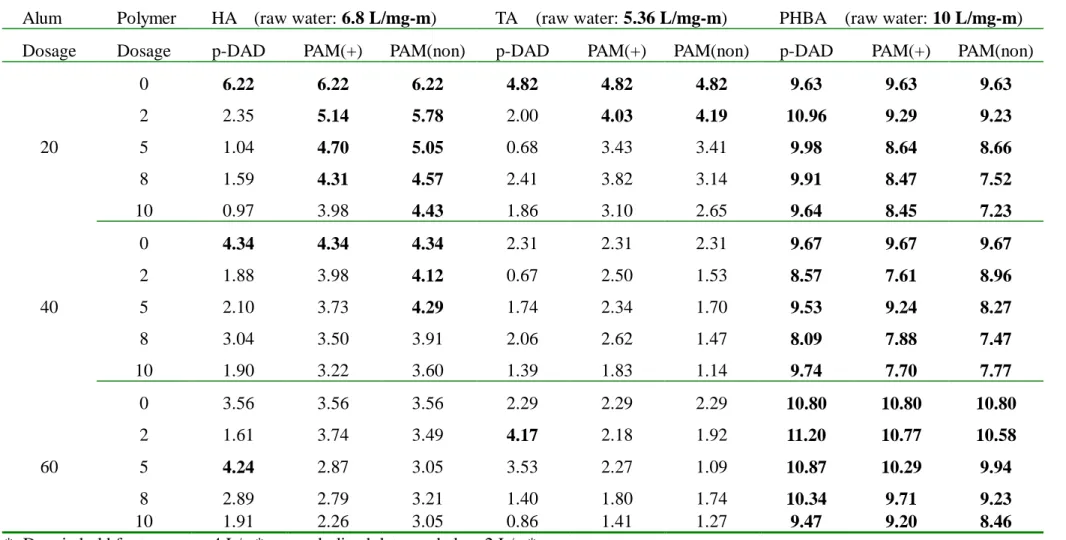
Table 2 Residual UV254/TOC (L/m-mg) values of treated water
*: Data in bold font are over 4 L/m*mg; underlined data are below 2 L/m*mg
Alum Polymer HA (raw water: 6.8 L/mg-m) TA (raw water: 5.36 L/mg-m) PHBA (raw water: 10 L/mg-m)
Dosage Dosage p-DAD PAM(+) PAM(non) p-DAD PAM(+) PAM(non) p-DAD PAM(+) PAM(non)
0 6.22 6.22 6.22 4.82 4.82 4.82 9.63 9.63 9.63
2 2.35 5.14 5.78 2.00 4.03 4.19 10.96 9.29 9.23
20 5 1.04 4.70 5.05 0.68 3.43 3.41 9.98 8.64 8.66
8 1.59 4.31 4.57 2.41 3.82 3.14 9.91 8.47 7.52
10 0.97 3.98 4.43 1.86 3.10 2.65 9.64 8.45 7.23
0 4.34 4.34 4.34 2.31 2.31 2.31 9.67 9.67 9.67
2 1.88 3.98 4.12 0.67 2.50 1.53 8.57 7.61 8.96
40 5 2.10 3.73 4.29 1.74 2.34 1.70 9.53 9.24 8.27
8 3.04 3.50 3.91 2.06 2.62 1.47 8.09 7.88 7.47
10 1.90 3.22 3.60 1.39 1.83 1.14 9.74 7.70 7.77
0 3.56 3.56 3.56 2.29 2.29 2.29 10.80 10.80 10.80
2 1.61 3.74 3.49 4.17 2.18 1.92 11.20 10.77 10.58
60 5 4.24 2.87 3.05 3.53 2.27 1.09 10.87 10.29 9.94
8 2.89 2.79 3.21 1.40 1.80 1.74 10.34 9.71 9.23
10 1.91 2.26 3.05 0.86 1.41 1.27 9.47 9.20 8.46
0 2 4 6 8
0 10 20 Alum dose -- mg/L30 40 50 60 70 0 50 100 150 200 250
TOC(High Tur) TOC(Low Tur) 300
Tur(High Tur) Tur(Low Tur)
4 NTU
Figure 6 Comparisons of alum coagulation in high and low turbidity waters
pH effect
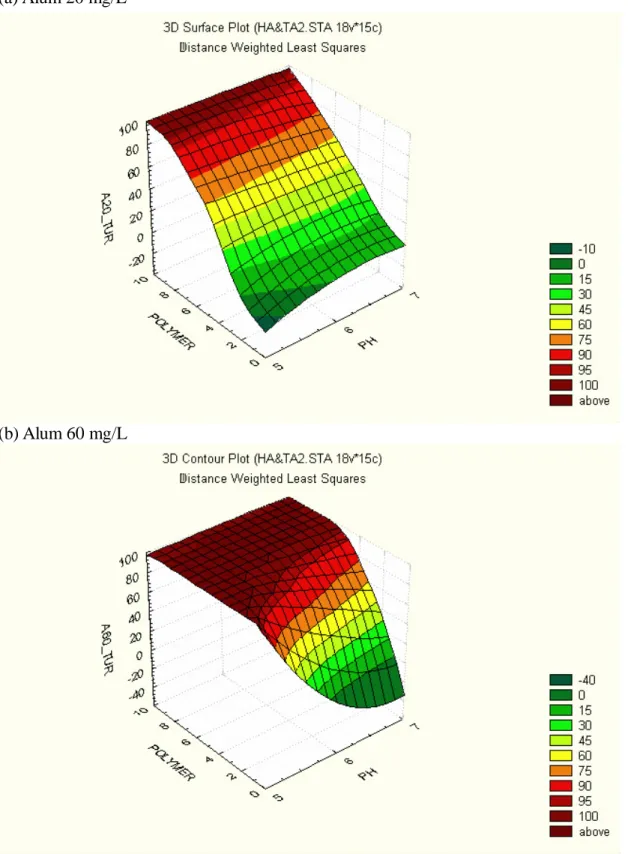
While treating the humic acid water, p-DADMAC could help to remove most of the turbidity in water. At low alum dosage, e.g., 20 mg/L, the coagulation effects mainly were contributed by p-DADMAC, is pH-independent polymer (Figure 9).
When the alum dosage was increased to 60 mg/L, pH effects became obvious, which indicated that the percent turbidity removal at pH 5 is higher than that at pH 6 or 7.
The addition of p-DADMAC became useless at pH 5 for dominated performance of alum and high dosage of p-DADMAC decreased the performance slightly.
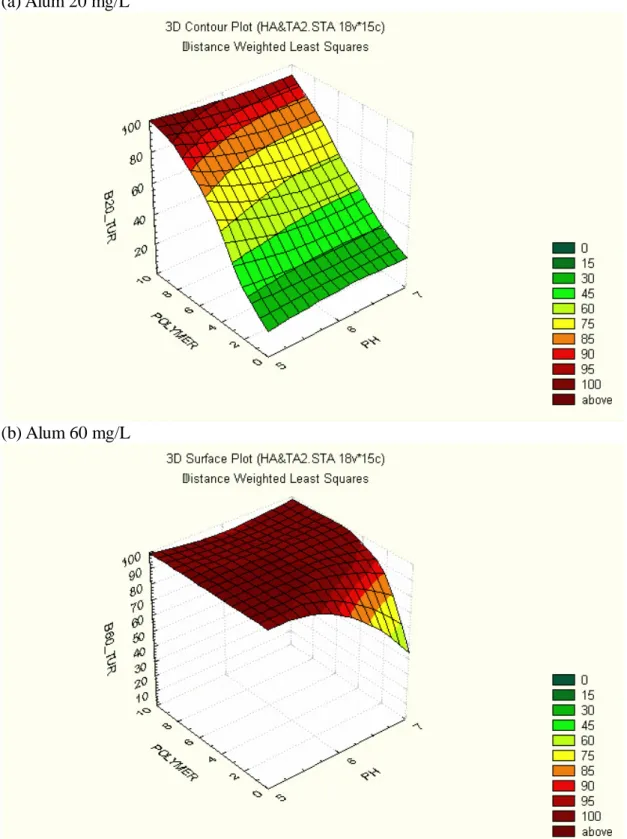
The role of p-DADMAC on treating tannic acid water is similar to that in treating humic acid water. In general, the effects of pH became obvious with increasing alum dosage. However, it was noted that at low pH, the high chemical dosage applied at low pH might decrease the removal efficiency of turbidity due to the restabilization phenomenon, which was observed in Figure 10. In comparison of the turbidity in water samples containing PHBA with those containing humic acid and tannic acid, it is much easier to remove the turbidity in PHBA water. Even at low alum dosage, e.g., 5 mg/L of p-DADMAC is sufficient to remove over 90% of turbidity (Figure 11). It was shown that alum at pH 5 or 6 could remove turbidity effectively, so the addition of p-DADMAC was only required under higher pH or lower alum dosage condition.
It was concluded that pH adjustment influenced the performance of alum obviously but not of p-DADMAC. Therefore, low p-DADMAC dosage in cooperation with high alum dosage would be affected by pH adjustment. High p-DADMAC dosage overwhelming the effects of alum is less affected by pH adjustment. Since a slight reverse of turbidity removal at high polymer dosage and low pH was observed for treating the above organic precursors, the dosage of polymer must be controlled
(a) Alum 20
0 1 2 3 4 5 6 7 8 9
0 2 4 6 8 10 12
p-DAD dose -- mg/L
Residual TOC -- mg/L
0 50 100 150 200 250
Residual Tur -- NTU
TOC(High Tur) TOC(Low Tur) Tur(High Tur) Tur(Low Tur)
4 NTU
(b) Alum 40
0 1 2 3 4 5 6 7 8 9
0 2 4 6 8 10 12
p-DAD dose -- mg/L
Residual TOC -- mg/L
0 50 100 150 200 250
Residual Tur -- NTU
4 NTU
(c) Alum 60
0 1 2 3 4 5 6 7
0 2 4 6 8 10 12
p-DAD dose -- mg/L
Residual TOC -- mg/L
0 50 100 150 200 250
Residual Tur -- NTU
4 NTU
Figure 7 Comparisons of alum plus p-DADMAC coagulation in high turbidity and low turbidity waters
(a) Alum 20
0 1 2 3 4 5 6 7 8 9
0 2 4 6 8 10 12
PAM(non) dose -- mg/L
Residual TOC -- mg/L
0 50 100 150 200 250
Residual Tur -- NTU
TOC(High Tur) TOC(Low Tur) Tur(High Tur) Tur(Low Tur)
4 NTU
(b) Alum 40
0 1 2 3 4 5 6 7 8
0 2 4 6 8 10 12
PAM(non) dose -- mg/L Residual TOC -- mg/L
0 50 100 150 200 250
Residual Tur -- NTU
4 NTU
(c) Alum 60
0 1 2 3 4 5 6 7 8
0 2 4 6 8 10 12
PAM(non) dose -- mg/L Residual TOC -- mg/L
0 50 100 150 200 250
Residual Tur -- NTU
4 NTU
Figure 8 Comparisons of alum and nonionic PAM combined coagulation in high turbidity and low turbidity waters
(a) Alum 20 mg/L
(b) Alum 60 mg/L
Figure 9 Percent turbidity removal (%) as a function of polymer dosage and pH for humic acid water
(a) Alum 20 mg/L
(b) Alum 60 mg/L
Figure 10 Percent turbidity removal (%) as a function of polymer dosage and pH for tannic acid water
(a) Alum 20 mg/L
(b) Alum 60 mg/L
Figure 11 Percent turbidity removal (%) as a function of polymer dosage and pH for p-hydroxybenzoic acid water
In Figure 12, it was observed that TOC removal increased with decreasing pH value at 20 mg/L of alum dosage. It took about 5 mg/L of p-DADMAC to achieve the same percent TOC removal requirement at pH 5, while higher dosage was needed at higher pH. However, when dosing 60 mg/L of alum at pH 5, higher dosage of p-DADMAC decreased TOC removal. High concentration of aluminum hydroxide species and hydrogen ions neutralized the negative charges on suspended particles during rapid mixing, part of the applied added p-DADMAC was utilized to bridge the particles. Therefore, the exceeded p-DADMAC dose would remain in water sample and contribute to TOC concentration.
On the other hand, while treating tannic acid water, polymer dosage exhibits more impact than pH adjustment on the performance of the coagulation process than pH adjustment at low alum dosage (Figure 13). For instance, at low polymer dosage, residual polymer caused negative effect, but this phenomenon disappeared with increasing polymer dosage. 10 mg/L of p-DADMAC had the best performance of 88% TOC removal efficiency at pH 5. However, since tannic acid was easily remove by coagulation process, over-dosage reversed TOC removal efficiency at pH 5 and 6.
While treating the most irresponsive-to-coagulation organic matter, PHBA, pH adjustment combining polymer addition is still inoperative, and there is no obvious relationship between chemical dosage and TOC removal efficiency. Figure 14 shows that 20 mg/L of alum combining p-DADMAC might have better performance than 60 mg/L of alum, but the highest percent TOC removal is only 26%. As a result, other alternated treatment methods, such as Fenton-related process (Rivas, 2000, 2002;
Beltran-Heredia, 2001 a.&b), ozonation process (Beltran-Heredia, 2000, 2001 c.;
Benitez, 2000) and UV radiation (Beltran-Heredia, 2001 c.), might be needed before or after coagulation process to remove small molecular organics such as PHBA.
Table 3 shows the UV254/TOC of raw and treated waters. This index cannot be used to evaluate the performance of coagulation for treating higher UV254/TOC ratio (> 10 L/m-mg) eg. HBA water, it can be used for treating humic acid water and tannic acid water. Most of the low UV254/TOC values (< 2 L/m-mg) were found in the pH 5 and pH 6 columns of humic acid and tannic acid, which implies that most of the hydrophobic organic matters were removed by coagulation process under this pH ranges. Table 3 indicates that the number of treated tannic acid samples having UV254/TOC value below 2 L/m-mg is more than that of treated humic acid water. It suggests that tannic acid should be easier to be removed by coagulation than humic acid.
(a) Alum 20 mg/L
(b) Alum 60 mg/L
Figure 12 Percent TOC removal (%) as a function of polymer dosage and pH for humic acid water
(a) Alum 20 mg/L
(b) Alum 60 mg/L
Figure 13 Percent TOC removal (%) as a function of polymer dosage and pH for tannic acid water
(a)Alum 20 mg/L
(b)Alum 60 mg/L
Figure 14 Percent TOC removal (%) as a function of polymer dosage and pH for p-hydroxybenzoic acid water
THM formation potential.
The THMFP results of raw water and treated water were shown in Table 4. In most of the cases for humic acid, THMFP was found to decrease with increasing chemical dosage. Coagulation treatment at pH 5 could decrease THMFP by 91% in average, 77% at pH 6, and 87% at pH 7. On the other hand, if eliminating the data that were not able to reduce the turbidities to a level lower than 2 NTU, coagulation treatment at pH 5 could decrease THMFP by 91% in average, and 93% at pH 7. The results suggest that if strict standard (turbidity < 2 NTU) is adopted for treating high turbidity water, high dosage of polymer is necessary and, therefore, pH effect is not critical in this condition.
For tannic acid, THMFP decreased after coagulation treatment in all cases. By dropping some points based on TOC percent removal criterion, coagulation treatment at pH 5 could reduce 75% of THMFP in average, 81% at pH 6, and 78% at pH 7. If the elimination is based on residual turbidity standard, coagulation at pH 5 could reduce 76% of THMFP in average, 90% at pH 6, and 89% at pH 7. Low percent THMFP reduction at pH 5 is due to the poor performance of TOC removal caused by over-dosage of p-DADMAC. As a result, while treating tannic acid water, higher pH will prevent over-dosage and lead to better THMFP reduction.
Figure 21 further illustrated these relationships between THMFP and TOC for humic acid water and tannic acid water, respectively. The linear relationship could be observed in both humic acid water and tannic acid water which were consistent with the findings suggested by other researchers (Page, 2002; Singer, 2002). The regression equations in Figure 15 (a) estimates that a 90μg/L decrease in THM formation for every 1mg/L decrease in TOC concentration (90μg/L THM/1mg/L TOC) and a 41μ g/L THM/1mg/L TOC for humic acid and tannic acid water, respectively, which are both higher than the result, 26μg/L THM/1mg/L TOC, proposed by Singer (2002). It could be explained by that the selected organic precursors in this research are more generative in THM formation than the raw water from the river of United States.
The distribution of THMFP at various polymer doses is illustrated in Figure 16.
It was observed that both the median THMFP decreased and the range of the measured THMFP data narrowed with increasing polymer dose. This evidence is fairly consistent with our previous findings suggested that that high dosage of polymer, p-DADMAC, always possesses great removal performance for treating humic acid and tannic acid waters.
Table 3 Residual UV254/TOC (L/m-mg) values of treated water at various levels of alum and p-DADMAC dosages
*:
Dat a in bold font are over 4 L/m*mg; underlined data are below 2 L/m*mg
Alum p-DADMAC HA (raw water: 6.8 L/mg-m) TA (raw water: 5.36 L/mg-m) PHBA (raw water: 10 L/mg-m)
Dosage Dosage pH 5 pH 6 pH 7 pH 5 pH 6 pH 7 pH 5 pH 6 pH 7
0 4.09 5.45 6.22 1.81 2.20 4.82 11.76 8.82 9.63
2 1.40 2.14 2.35 0.82 0.07 2.00 12.37 8.89 10.96
20 5 1.42 1.07 1.04 2.07 0.20 0.68 11.62 9.94 9.98
8 1.27 2.40 1.59 1.89 0.15 2.41 11.48 9.25 9.91
10 2.22 1.45 0.97 1.43 0.42 1.86 11.18 9.14 9.64
0 1.52 2.97 4.34 6.89 1.61 2.31 14.41 11.12 9.67
2 2.05 1.92 1.88 1.72 1.29 0.68 14.22 11.97 8.57
40 5 3.41 2.11 2.10 1.69 1.90 0.64 12.88 11.41 9.53
8 1.56 1.03 3.04 1.07 2.15 1.15 12.87 9.46 8.09
10 1.12 2.17 1.90 0.88 1.72 1.11 12.76 8.07 9.74
0 3.87 1.63 3.56 3.14 2.03 2.29 13.17 9.59 10.80
2 2.54 3.45 1.61 1.41 0.38 4.17 12.86 9.48 11.20
60 5 1.23 3.43 4.24 0.51 0.90 3.53 12.12 8.52 10.87
8 0.99 2.17 2.89 0.22 1.64 1.40 11.79 7.00 10.34
10 0.54 1.51 1.91 0.27 1.28 0.86 11.27 7.72 9.47
Table 4 THMFP (μg/L) of humic acid water before and after coagulation process
*: If percent TOC removal > 35%; Y: yes; N: no
**: If residual turbidity < 2 NTU; Y: yes; N: no
Humic acid pH 5 pH 6 pH 7
Sample TOC* Tur** THMFP Percent decrease TOC Tur THMFP Percent decrease TOC Tur THMFP
Percent decrease THMFP
Raw 1001 846 816
A20 N N 898 10 N N 843 0 N N 666 18
A20p-DAD2 N N 784 22 N N 848 0 N N 846 -4
A20p-DAD5 N N 393 61 N N 742 12 N N 730 11
A20p-DAD8 Y N 69 93 Y N 284 66 N N 278 66
A20p-DAD10 Y Y 59 94 Y Y 107 87 Y Y 86 89
A40 N N 900 10 N N 769 9 N N 540 34
A40p-DAD2 N N 306 69 N N 744 12 N N 739 9
A40p-DAD5 Y Y 70 93 Y N 668 21 Y N 341 58
A40p-DAD8 Y Y 53 95 Y N 83 90 Y N 76 91
A40p-DAD10 Y Y 64 94 Y Y 52 94 Y Y 31 96
A60 Y Y 145 85 N N 582 31 N N 654 20
A60p-DAD2 Y Y 139 86 Y N 356 58 N N 566 31
A60p-DAD5 Y Y 113 89 Y Y 124 85 Y N 85 90
A60p-DAD8 Y Y 73 93 Y Y 56 93 Y Y 41 95
A60p-DAD10 Y Y 75 92 Y Y 54 94 Y Y 60 93
Table 5 THMFP (μg/L) of tannic acid water before and after coagulation process
*: If percent TOC removal > 35%; Y: yes; N: no
**: If residual turbidity < 2 NTU; Y: yes; N: no
Tannic acid pH 5 pH 6 pH 7
Sample TOC* Tur** THMFP Percent decrease TOC Tur THMFP Percent decrease TOC Tur THMFP
Percent decrease THMFP
Raw 277 389 414
A20 N N 233 16 N N 300 23 N N 363 12
A20p-DAD2 Y N 205 26 N N 302 22 N N 308 26
A20p-DAD5 Y N 104 62 N N 227 42 N N 237 43
A20p-DAD8 Y N 48 83 Y N 102 74 Y N 129 69
A20p-DAD10 Y Y 39 86 Y N 53 86 Y N 129 69
A40 Y N 218 21 N N 267 31 N N 300 28
A40p-DAD2 Y Y 85 69 N N 211 46 N N 255 38
A40p-DAD5 Y Y 50 82 Y N 79 80 Y N 114 72
A40p-DAD8 Y Y 51 81 Y Y 43 89 Y Y 58 86
A40p-DAD10 Y Y 50 82 Y Y 36 91 Y Y 51 88
A60 Y Y 91 67 Y N 239 38 Y N 276 33
A60p-DAD2 Y Y 73 74 Y Y 85 78 Y N 195 53
A60p-DAD5 Y Y 77 72 Y Y 43 89 Y Y 69 83
A60p-DAD8 Y Y 83 70 Y Y 40 90 Y Y 48 88
A60p-DAD10 Y Y 75 73 Y Y 35 91 Y Y 41 90
Factor analysis
In this research work, several water quality parameters including TOC concentration, turbidity, UV254, fluorescence, chlorine demand, and THM concentration, were utilized to examine their correlations to generate the empirical formula for controlling THM formation. Although TOC, UV254 and fluorescence are all surrogate parameters for measuring for the organic matters in water, UV254 and fluorescence represent some specific type of organic matters and, therefore, they were utilized as the principal parameters in these analyses.
In order to find out the relationships between these parameters, factor analysis was performed to determine the principal components among these variables. The results of factor analysis for humic acid water were shown in Table 6, in which the numerical values named “factor loadings” above 0.7 indicate their significant interrelation. In Factor 1, the marked variables including TOC, turbidity, fluorescence, UV254, polymer dose (negative linearity), chlorine demand and THM concentration represented that these variables were highly related and, therefore, the THM concentration, the most concerned index in this research, could be predicted by these suggested variables.
Table 7 also shows the results of factor analysis for tannic acid water that they are similar to that for humic acids. It suggests that humic acids and tannic acids might have similar mechanisms in organics removal and THM formation in the course of coagulation and chlorination processes.
Conclusions
Enhanced coagulation with the addition of a polymer, p-DADMAC, was found to be very effective for removing high-molecular-weight THM precursors, such as humic acids and tannic acids, from the synthetic waters, and markedly reduced the alum dosages required for turbidity removal. With this evidence, THM formation potential was also reduced by 60-95% and 60-90% for water containing humic acid and tannic acid, respectively. However, the removal of low-molecular-weight THM precursors, such as p-hydroxybenzoic acids, was found to be unfavorable to coagulation.
(a) HA
y = 90.775x R2 = 0.8851
0 100 200 300 400 500 600 700 800 900 1000
0.0 2.0 4.0 6.0 8.0 10.0 12.0
TOC -- mg/L
THMFP -- μg/L
HA treated HA raw
(b) TA
y = 41.239x R2 = 0.8287
0 50 100 150 200 250 300 350 400 450
0.0 2.0 4.0 6.0 8.0 10.0
TOC -- mg/L
THMFP -- μg/L
TA treated TA raw
Figure 15 Correlation between THMFP and TOC
(a) Humic acids
(b)Tannic acids
Figure 16 Distribution of THMFP at various polymer doses
Table 6 The results of Factor analysis for treated water samples containing humic aids (N = 180)
Factor 1 Factor 2 Factor 3
TOC 0.917 0.068 0.156
Turbidity 0.839 0.047 -0.396
Fluorescence 0.776 0.118 0.294
UV254 0.854 0.109 -0.103
pH 0.287 0.174 0.705
Alum dose -0.37 0.003 -0.457
Polymer dose -0.833 -0.061 0.468
Reaction time 0.11 -0.861 0.087
Chlorine demand 0.897 -0.248 0.171
Chlorine dose 0.032 -0.958 -0.079
THM 0.889 -0.296 0.093
Residual Chlorine -0.576 -0.721 -0.188
UV254/TOC 0.255 0.069 -0.542
VARIANCE EXPLAINED BY ROTATED COMPONENTS
Factor 1 Factor 2 Factor 3
5.794 2.401 1.584
PERCENT OF TOTAL VARIANCE EXPLAINED
Factor 1 Factor 2 Factor 3
44.57 18.467 12.185
Table 7 The results of Factor analysis for treated water samples containing tannic acids (N = 180)
Factor 1 Factor 2 Facto 3
TOC 0.859 -0.109 0.397
Turbidity 0.924 -0.091 0.187
Fluorescence 0.789 -0.094 -0.287
UV254 0.745 -0.053 -0.354
pH -0.041 0.062 0.308
Alum dose -0.362 0.079 -0.615
Polymer dose -0.835 0.07 0.286
Reaction time 0.109 0.863 0.042
Chlorine demand 0.818 0.412 0.119
Chlorine dose 0.091 0.958 0.034
THM 0.842 0.371 0.176
Residual Chlorine -0.559 0.746 -0.058
UV254/TOC 0.149 0.034 -0.81
VARIANCE EXPLAINED BY ROTATED COMPONENTS
Factor 1 Factor 2 Facto 3
5.332 2.574 1.662
PERCENT OF TOTAL VARIANCE EXPLAINED
Factor 1 Factor 2 Facto 3
41.016 19.803 12.788
Residual TOC concentration, UV absorbance, fluorescence, turbidity, THM formation potential, and chlorine demand in humic acid and tannic acid waters, except for p-hydroxybenzoic acid waters, were all substantially lower as a result of p-DADMAC as coagulant-aid in alum coagulation as compared to alum coagulation alone. The other two polymers, cationic PAM and nonionic PAM, which had higher molecular weight but lower charge density than p-DADMAC, were not capable of removing effectively any of the parameters mentioned above. The results implied that charge density was a very specific characteristic of polymer affecting the performance of coagulation process obviously. It was thus concluded that enhanced coagulation with polymer, p-DADMAC, could be considered as a promising technique for removal of NOMs in water treatment plants. On the other hand, while treating low turbidity water with p-DADMAC, its high charge density narrowed the optimum dosage and was impeditive to the performance of coagulation. As a result, using polymer to treat low turbidity water is not recommended.
Two mechanisms of coagulation, i.e. adsorption and precipitation, were generally expressed in the experimental data quite successfully in the literature. However, in this investigation, a linear relationship between turbidity and TOC removal, was observed and revealed that “precipitation” is the predominant mechanism for TOC removal in high turbidity water. Acidic condition, low pH, was found to be conductive to alum coagulation. However, it became negligible in alum and p-DADMAC combined coagulation or triggered negative effect between alum and p-DADMAC at high chemical dosage.
REFERENCES
Adin, A, Soffer, Y, and Aim RB. Effluent pretreatment by iron coagulation applying various dose-pH combinations for optimum particle separation. Wat. Sci. Tech. Vol.38, No.6, pp.
27-34, 1998
American Water Works Association Research Foundation. Reaction of polyelectrolytes with other water treatment chemicals and subsequent effects on water quality and operational efficiencies. Research Project #2509, American Water Works Association Research Foundation, Denver.
APHA, Standard Methods for the examination of Water and Wastewater, nineteenth ed.
American Public Health Association, Washington, DC. 1995.
Amy, G.L. and Chadik, P.A., Cationic Polyelectrolytes as Primary Coagulants for Removing Trihalomethane Precursors, J. AWWA, 75, pp. 527-531, 1983.
AWWA Standard for poly(diallydimethylammonium chloride). AWWA B451-87. AWWA, Denver, Colo., 1987.
Beltran De Heredia, J, Torregrosa, J, Dominguez, JR, Peres, JA. Comparison of the degradation of p-hydroxybenzoic acid in aqueous solution by several oxidation process.
Chemosphere 42, pp. 351-359, 2001a.
compound oxidation by Fenton’s reagent. Chemosphere 45, pp. 85-90, 2001b.
Beltran De Heredia, J, Torregrosa, J, Dominguez, JR, Peres, JA. Oxidation of p-hydroxybenzoic acid by UV radiation and by TiO2/UV radiation: comparison and modeling of reaction kinetic. Journal of Hazardous Materials B83, pp. 255-264, 2001c.
Benitez, FJ, Beltran De Heredia, J, Peres, JA, Dominguez, JR. Kinetics of p-hydroxybenzoic acid photodecomposition and ozonation in a batch reactor. Journal of Hazardous Materials B73, pp. 161-178, 2000
Bolto, B.A., Soluble Polymers in Water Purification, Prog. Polym. Sci., 20, pp. 987-1041, 1995.
Bolto B.A., Dixon, D.R., Eldridge, R.J. and King, S.J., The Use of Cationic Polymers as Primary Coagulants in Water Treatment. In: Chemical Water and Wastewater Treatment V, H.H. Hahn, E. Hoffmann and H.Odegaaed (ed.), Springer, Berlin, pp.
171-185, 1998.
Bolto, B.A., Dixon, D.R., Eldridge, R.J., King, S.J. and Toifl, M., Cationic Polyelectrolytes as Primary Coagulants in Drinking Water Treatment, Proc. 18th Fed.
Conv., Aust. Water & Wastewater Assocn., Adelaide, Aouth Australia, 1999.
Chang, E. E., Chaing, P. C., Chao, s. H. and Liang, C. H., Effects of Polydiallyldimethyl Ammonium Chloride Coagulant on Formation of Chlorinated by Products in Drinking Water. J. Chemosphere, 39, 8, pp. 1333-1346, 1999.
Chang, E. E.; Chiang, P. C.; Ko, Y. W. and Lan, W. H., Characteristics of Organic Precursors and Their Relationship with Disinfection By-Products. J. Chemosphere, 44, pp. 1231-1236, 2001.
Coccagna, L., Direct filtration. In: Water, Wastewater, and Sludge Filtration, S. Vigneswaran and R. Ben Aim (ed.), CRC Press, Boca Raton, Florida, pp.57-78, 1989.
Collins, M.R.,Amy, G.L. and Steelink, C., Mollecular Weight Distribution, Carboxylic Acidity, and Humic Substances Content of Aquatic Organic Matter. Implications for Removal During Water Treatment, Envir. Sci. Technol., 20:10:1028, 1986.
Divakaran, R, and Pillai, VNS. Flocculation of kaolinite suspensions in water by chitosan.
Wat. Res. Vol. 35, No. 16, pp. 3904-3908, 2001.
Edzwald, J.K., Conventional Water Treatment and Direct Filtration: Treatment and Removal of Total Organic Carbon and Trihalomethane Oprecursors. In: Organic Carcinogens in Drinking Water, N.M. Ram, E.J. Calabrese and R.F. Christman (ed.), Wiley, New York, pp.
199-236, 1986.
Exell, K. N. and Vanloon, G. W., Using Coagulants to remove organic matter. J. AWWA, 92, 12, pp. 93-102, 2000.
Glaser, H.T. and Edzwald, J.K., Coagulation and Direct Filtration of Humic Substances with Polyethyleneimine, Environ. Sci. Technol., 13, pp. 299-305, 1979.
Mallevialle, J., Bruchet, A. and Fiessinger, F., How Safe are Organic Polymers in Water Treatment, J. AWWA, 76, pp.87-93, 1984
Manahan, SE. Environmental chemistry. Lewis Publishers, pp. 80-81, 1994
Mustafa, M. Bob. and Harold W. Walker., Effect of Natural Organic Coatings on the polymer-Induced Coagulation of Colloidal Particles. Colloids and Surfaces A:
Physicochemical and Engineering Aspects 177, pp. 215-222, 2001.
O’Melia, C.R., Becker, W. C. and Au, K. K., Removal of Humic Substances by Coagulation, Wat. Sci. Technol., 40, 9, pp. 47-54, 1999.
Page, DW, van Leeuwen, JA, Spark, KM, Drikas, M, Withers, N, Mulcahy, DE. Effect of
and synthetic waters. Water Research 36, pp.4884-4892, 2002.
Ratnaweera, H., Gjessing, E. and Oug, E., Influence of Physical-Chemical Characteristics of Natural Organic Matter (NOM) on Coagulation Properties: An Analysis if Eight Norwegian Water Sources, Wat. Sci. Technol., 40, 4-5, pp. 89-95, 1999.
Rebhun, M., Fuhrer, Z. and Adin, A., Contact Flocculation Filtration of Humic Substances, Water Res., 18, pp. 963-970, 1984.
Rivas, FJ, Beltran, FJ, Frades, J, Buxeda, P. Oxidation of p-hydroxybenzoic acid by Fenton’s reagent. Wat. Res. Vol. 35, No. 2, pp. 387-396, 2001.
Rivas, FJ, Beltran, FJ, Garcia-araya, JF, Navarrete, V, Gimeno, O. Co-oxidation of p-hydroxybenzoic acid and atrazine by the Fenton’s like system Fe(III)/H2O2. Journal of Hazardous Materials B91, pp. 143-157, 2002.
Schlauch, R.M., Coagulation for Gravity Type Clarification and Thickening. In:
polyelectrolytes for Water and Wastewater Treatment, W.K. Schwoyer (ed), CRC Press, Boca Raton, Florida, pp.91-144, 1981.
Singer, PC, Bilyk, K. Enhanced coagulation using a magnetic ion exchange resin. Water Res.
36, 4009-4022, 2002.
Vik, A.E. and Eikebrokk, B., Coagulation Process for Removal of Humic Substances from Drinking Water. In: Aquatic Humic Substances, I.H. Suffet and P. MacCarthy (ed.), Adv.
Chem. Series, vol 219, Am. Chem. Soc., Washington, pp.385-394, 1989.
White, MC, Thompson, JD, Harrington, GW, and Singer, PC. Evaluating Criteria for Enhanced Coagulation Compliance, Jour. Am. Water Works Assoc., 89:5:64, 1997.