National Cheng Kung University Institute of Electrical Engineering
Number 1 University Road Tainan City 70101
Taiwan Kun-Wei Lin
Sunplus Technology Co., LTD. Multimedia Development Division
Science Based Industrial Park 19 Innovation Road 1
Hsinchu 30010 Taiwan
Abstract. JPEG2000 Standard (ISO/IEC 15444, ITU-T T.800) is a new-generation image compression technique, enabling encoding images at low bit rates with acceptable quality. Since JPEG2000 is based on wavelet transforms, the reconstructed image will contain perceivable ringing artifacts in medium- and low-bit-rate regimes of lossy compression. We utilize a quad-tree partitioning scheme for postprocessing the reconstructed image in a spatially varying man-ner and presents a voting strategy to determine a set of morphologi-cal filters to be used for reducing the ringing artifacts. All this pro-cessing is performed at the encoder side, and the set of selected filters is conveyed to the decoder in the form of side information. Specifically, the adopted (eight) morphological filters are generated through the use of four predefined structuring elements (SEs) in conjunction with two morphological operations, namely, dilation and erosion. A voting strategy is used to select the morphological filter for each partition block to optimize the postprocessed image quality—through minimizing the sum of absolute differences under the constraint of a fixed quad-tree partition. Applying the chosen morphological filters to their corresponding blocks typically en-hances the reconstruction quality—in the worst case, leaving it un-changed. Simulation results demonstrate that the proposed tech-nique enhances reconstructed image quality compared to unprocessed JPEG2000 output at an equivalent bit rate, accounting for the side information overhead, in terms of both peak SNR (PSNR) and visible ringing measure (VRM). © 2005 SPIE and IS&T. 关DOI: 10.1117/1.2132317兴
1 Introduction
Part 1 of the new still-picture compression standard JPEG20001 was recently settled.*Compared to JPEG, the new standard promises to produce better quality in all bit-rate regimes and in particular, at low bit bit-rates. JPEG2000’s enhanced performance, enabling image compression at very low bit rates with acceptable quality, stems from a number of new and innovative features incorporated in its definition, with its use of wavelet transforms being one such prominent feature. A wavelet-based coder can use only a very small fraction of the transform coefficients and can rather coarsely quantize the rest, still to achieve an acceptable reconstruction. However, lossy wavelet-based image compression generally induces ringing artifacts around edges in the compressed image. These artifacts arise due to the fact that high-frequency components of the im-age are either annihilated or coarsely represented by the quantization process in wavelet-based coders.
It is desirable to obtain an image free of compression related artifacts, practically with reduced compression re-lated artifacts, thus improving image quality at low bit rates. An artifact-free image can be estimated from the compressed image by maximum a posteriori 共MAP兲 estimation.2,3 The problem is to estimate the artifact-free image given a compressed image. For transform-based codes, the conditional probability is modeled in the
trans-Paper 02111 received Nov. 11, 2002; revised manuscript received Jun. 19, 2003 and Aug. 23, 2004; accepted for publication Apr. 14, 2005; published online Nov. 7, 2005.
1017-9909/2005/14共4兲/043002/12/$22.00 © 2005 SPIE and IS&T.
*“At the Rochester meeting of JPEG in August 2000, the Final Draft International Standard was issued, put out to all interested national bodies in ISO for vote, and accepted as a full International Standard in December 2000. It may now be purchased from ISO, ITU-T or your national standards body.”
form domain, while the prior probability is modeled in the spatial domain. In POCS 共projections onto complex sets兲 approaches,4,5the problem of obtaining an artifact-free im-age involves finding an imim-age that satisfies the constraints being derived to explicitly model coding artifact induced degradation severity. These methods define constraint sets from observed data or prior knowledge of the solution, and try to reconstruct the original image by POCS. Both MAP estimation and POCS approaches require iterative algo-rithms to find a solution. Since each iteration involves for-ward and inverse transforms to switch back and forth be-tween transform and spatial domains, MAP estimation and POCS-based algorithms in this context introduce a further computational load in addition to the usual complexity of iterative algorithms. This aspect increases the computa-tional complexity significantly.
The filter against ringing artifact proposed by Shen and Kuo,6 which is also described in JPEG2000 VM 7.0, is considered to be a suitable postprocessor for JPEG2000. The filter against ringing artifact replaces each pixel value with a function of the values of neighboring pixels that are within a specified window. To smooth a sharp edge, the filter against ringing artifact uses a number of adaptive noise reduction algorithms. Essentially, the filter against ringing artifact attempts to detect edges in the image in a different way to preserve them. Shen and Kuo also intro-duced the idea of image ringing artifact reduction through nonlinear filtering by using different kinds of potential functions. Clearly, modeling the compression noise in the spatial domain is a difficult problem, particularly for ring-ing artifacts.
The filter against ringing artifact proposed by Oguz7and Oguz et al.8is capable of reducing the ringing artifact. The mathematical morphology based post-processing algorithm first employs edge detection followed by some binary mor-phological operations to isolate the regions of an image containing visible ringing artifacts. Then, a gray-level
mor-phological filter is applied to eliminate ringing within a constraint region. This algorithm has an edge- and fine-detail-protection performance, possesses a very low com-putational complexity, and is very suited for hardware implementation.
This paper adopts the quad-tree partitioning scheme for postprocessing the compressed image and presents a set of morphological filters for reducing the ringing artifacts of natural images. The proposed voting strategy is used to select the morphological filter for each quad-tree partition block to optimize the filtered image quality关in the sense of minimizing the sum of absolute differences共SAD兲兴. Apply-ing the appropriate morphological filter to each block can enhance image quality. Section 2 reviews the quad-tree de-composition. Mathematical morphology is introduced in Sec. 3, along with the set of morphological smoothing fil-ters employed in this paper. Section 4 describes the overall algorithm proposed against ringing artifacts and details the encoder and decoder side components of the algorithm. Section 5 presents simulation results and Sec. 6 draws con-clusions.
2 Quad-Tree Decomposition
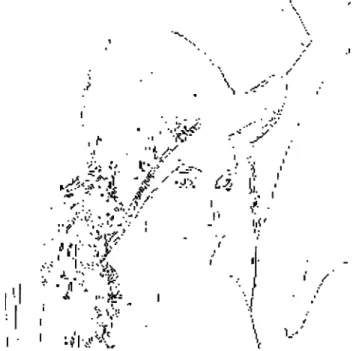
Before applying the proposed filter against ringing artifacts to the compressed image, it is important to extract informa-tion on edge pixels, since the pixels along the around the edges must be processed carefully. Therefore, this process aims to preserve the image detail while trying to reduce the ringing artifact around the edges. Ringing artifact regions are detected using the following sequence of operations. First, an edge map is generated using the Canny edge detector.9Figure 1 displays the output from the Canny edge detector.
This paper adopts the efficient quad-tree partitioning scheme,10–12 to postprocess the compressed image. The main purpose of applying quad-tree partitioning is to enable Fig. 1 Output from the Canny edge detector.
Fig. 2 Sample quad-tree partitioning executed on a compressed
the postprocessing method to adapt to the local features of the compressed image to promote global image quality. Ini-tially, a threshold is required to classify block smoothness as well as a predefined minimum block size to stop the process of iteratively subpartitioning nonsmooth blocks. To determine block smoothness, this study simply calculates the absolute difference between the maximum and the minimum gray-level values in a block. If this absolute dif-ference exceeds the predefined threshold, the block is fur-ther divided into four equal-sized subblocks. The partition-ing process is iterated in each block until either the smoothness meets the predefined criterion or the block size equals the predefined minimum size.
As a result of quad-tree partitioning, the image is di-vided into different sized blocks according to its local fea-tures. In large blocks, namely, 8⫻8 or larger, the gray-level values in the block are almost the same. A main concern here is that the details within small blocks, i.e., size 4⫻4 or 2⫻2, may carry important information for natural images, such as edge or texture, in addition to ringing artifacts. Figure 2 shows an example of quad-tree partitioning in the compressed image “Lena.”
3 Mathematical Morphology
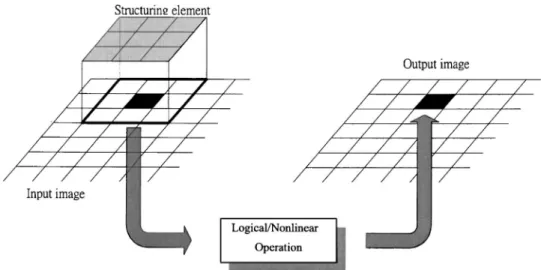
After dividing the image into blocks, the main operation of the postprocessing algorithm can be performed efficiently. In each block, morphological filtering13–16 is performed to enhance image quality. The concept of morphological fil-tering is illustrated in Fig. 3. The best performing structur-ing element 共SE兲 and morphological operation pair is de-termined for each partition block using the SAD measure between the filtered and the original image blocks. The al-gorithm selects the best filter as the one that minimizes the sum of absolute differences between the two blocks with “no filtering at all” being a viable option. The gray-scale morphological dilation operation performed in this paper proceeds as follows: it selects the maximum pixel value within the domain of the SE and all elements in the SE are set to be zero. Similarly, the gray-scale morphological ero-sion operation performed in this paper proceeds as follows: it selects the minimum pixel value within the domain of the
SE and all elements in the SE are set to be zero. Gray-scale dilation and erosion are represented as follows:
Gray-scale dilation of f by b: denoted f丣b, is defined as 共f 丣b兲共s,t兲 = max兵f共s − x,t − y兲 + b共x,y兲兩关共s − x兲,共t − y兲兴
苸 Df;共x,y兲 苸 Db其. 共1兲
Gray-scale erosion of f by b: denoted f⌰b, is defined as 共f⌰b兲共s,t兲 = min兵f共s + x,t + y兲 − b共x,y兲兩关共s + x兲,共t + y兲兴
苸 Df;共x,y兲 苸 Db其, 共2兲
where Df and Dbare the domains of f and b, respectively. Mathematical 共gray-scale兲 morphology provides an in-teresting collection of nonlinear filters with smoothing properties and low implementation complexity, making it more coherent with the presented algorithm. Nonlinear fil-ters have become very important tools in signal processing, and especially in image analysis and computer vision. Geo-metrical structures, i.e., shape and size, of image objects are frequently crucial features, and so they should be processed Fig. 3 Concept of a morphological filter.
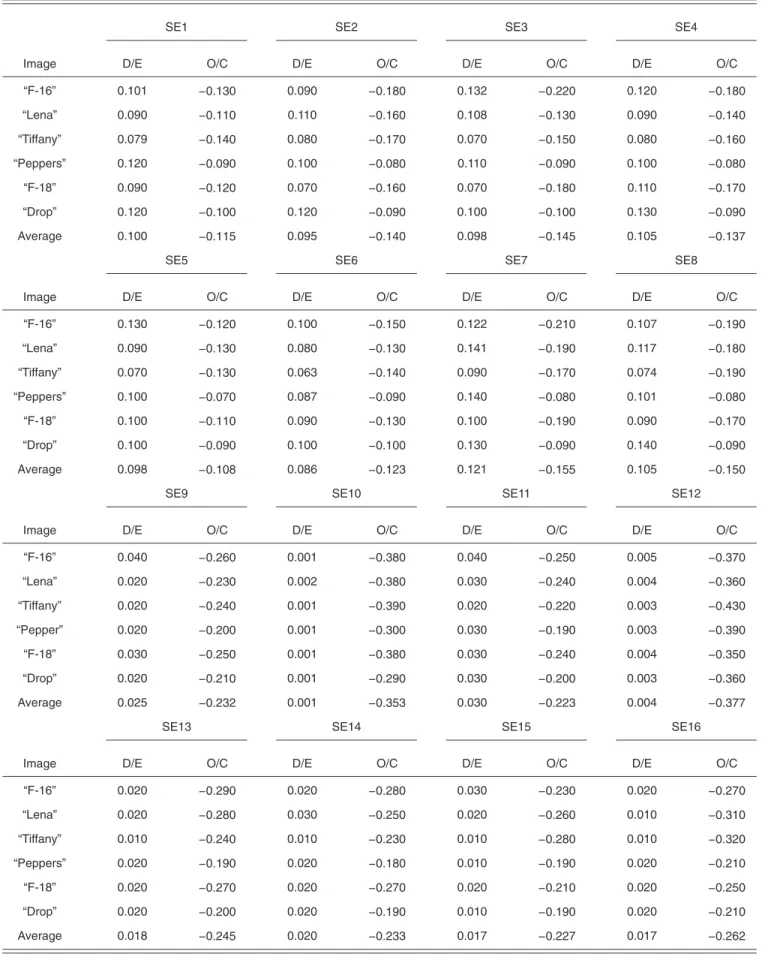
Table 1 Simulation-based analysis of mean PSNR improvement achieved by each structural element in Fig. 4.
Image
SE1 SE2 SE3 SE4
D/E O/C D/E O/C D/E O/C D/E O/C “F-16” 0.101 −0.130 0.090 −0.180 0.132 −0.220 0.120 −0.180 “Lena” 0.090 −0.110 0.110 −0.160 0.108 −0.130 0.090 −0.140 “Tiffany” 0.079 −0.140 0.080 −0.170 0.070 −0.150 0.080 −0.160 “Peppers” 0.120 −0.090 0.100 −0.080 0.110 −0.090 0.100 −0.080 “F-18” 0.090 −0.120 0.070 −0.160 0.070 −0.180 0.110 −0.170 “Drop” 0.120 −0.100 0.120 −0.090 0.100 −0.100 0.130 −0.090 Average 0.100 −0.115 0.095 −0.140 0.098 −0.145 0.105 −0.137 Image
SE5 SE6 SE7 SE8
D/E O/C D/E O/C D/E O/C D/E O/C “F-16” 0.130 −0.120 0.100 −0.150 0.122 −0.210 0.107 −0.190 “Lena” 0.090 −0.130 0.080 −0.130 0.141 −0.190 0.117 −0.180 “Tiffany” 0.070 −0.130 0.063 −0.140 0.090 −0.170 0.074 −0.190 “Peppers” 0.100 −0.070 0.087 −0.090 0.140 −0.080 0.101 −0.080 “F-18” 0.100 −0.110 0.090 −0.130 0.100 −0.190 0.090 −0.170 “Drop” 0.100 −0.090 0.100 −0.100 0.130 −0.090 0.140 −0.090 Average 0.098 −0.108 0.086 −0.123 0.121 −0.155 0.105 −0.150 Image
SE9 SE10 SE11 SE12
D/E O/C D/E O/C D/E O/C D/E O/C “F-16” 0.040 −0.260 0.001 −0.380 0.040 −0.250 0.005 −0.370 “Lena” 0.020 −0.230 0.002 −0.380 0.030 −0.240 0.004 −0.360 “Tiffany” 0.020 −0.240 0.001 −0.390 0.020 −0.220 0.003 −0.430 “Pepper” 0.020 −0.200 0.001 −0.300 0.030 −0.190 0.003 −0.390 “F-18” 0.030 −0.250 0.001 −0.380 0.030 −0.240 0.004 −0.350 “Drop” 0.020 −0.210 0.001 −0.290 0.030 −0.200 0.003 −0.360 Average 0.025 −0.232 0.001 −0.353 0.030 −0.223 0.004 −0.377 Image
SE13 SE14 SE15 SE16
D/E O/C D/E O/C D/E O/C D/E O/C “F-16” 0.020 −0.290 0.020 −0.280 0.030 −0.230 0.020 −0.270 “Lena” 0.020 −0.280 0.030 −0.250 0.020 −0.260 0.010 −0.310 “Tiffany” 0.010 −0.240 0.010 −0.230 0.010 −0.280 0.010 −0.320 “Peppers” 0.020 −0.190 0.020 −0.180 0.010 −0.190 0.020 −0.210 “F-18” 0.020 −0.270 0.020 −0.270 0.020 −0.210 0.020 −0.250 “Drop” 0.020 −0.200 0.020 −0.190 0.010 −0.190 0.020 −0.210 Average 0.018 −0.245 0.020 −0.233 0.017 −0.227 0.017 −0.262
by systems that can accurately detect and properly modify them. A broad and useful class of nonlinear filters with such properties, is based on the general framework of math-ematical morphology. An interesting feature of these non-linear filters is their performance in handling various types of non-Gaussian noise. As is well known, linear filters can optimally关in the sense of maximizing the SNR or minimiz-ing the mean square error 共MSE兲兴 suppress additive white Gaussian noise. In contrast, if the signal is corrupted by impulse noise, i.e., salt and pepper noise, then nonlinear filters such as morphological or order statistics filters, can be very effective in reducing it. A ringing artifact is a strongly signal dependent distortion in terms of location and visibility. Notably, mathematical morphological filter-ing can capture certain characteristics of rfilter-ingfilter-ing artifacts and hence be applied with success to filter out these arti-facts from the edge structures.
To reduce the complexity and computation time, this study only considers 3⫻3 SEs and dilation and erosion as morphological filters. This study assessed 16 predefined SEs. They are differentiated by their domains, as shown in Fig. 4. Notice that all elements in the 3⫻3 windows are set
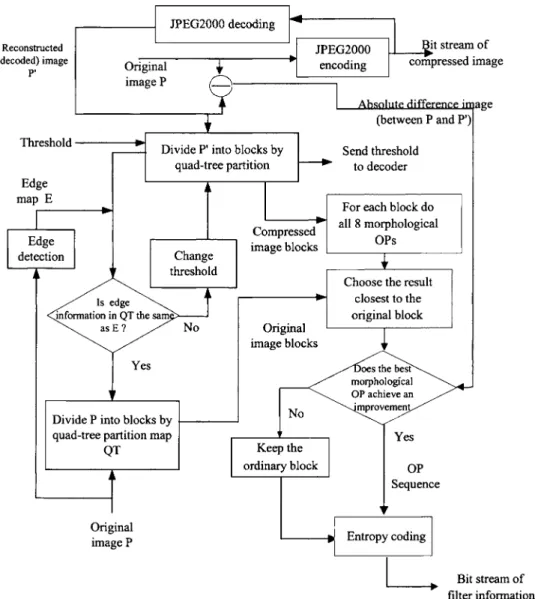
Fig. 5 Flowchart of the encoder side processing for the filter against ringing artifacts.
Fig. 6 Flowchart of the decoder side processing for the filter against
to be zero. However, only the dark pixels are included in the domain of each SE. Figure 4 covers all possible orien-tations and used dilation, erosion, opening, and closing. For all possible SE and operator combinations, peak SNR 共PSNR兲 improvements were measured. Table 1 lists the simulation of mean PSNR improvement achieved by each structural element in Fig. 4. Data analysis yields the follow-ing guidelines for filter design. Most notably, the experi-mental results show that SE1 to SE8 are more successful in enhancing the compressed image contaminated with ring-ing artifacts and that each SE can improve specific features of the compressed image. In its final form as employed in this work, for a quad-tree partition block, the filter can se-lect one of the four SEs共SE7, SE8, SE4, SE1兲 and use it in conjunction with one of the two morphological operations 共dilation, erosion兲 according to the criterion of achieving the greatest improvement in SAD.
4 Ringing Artifact Filtering Algorithm, Encoder and Decoder Components
On the encoding end, this study uses the voting strategy to choose the most suitable filters. That is to say, the encoder postprocessor applies all eight morphological filters to each quad-tree partition block in the compressed image and mea-sures the SAD improvement brought about by each filter. The filter leading to the minimum SAD value is selected. To reduce the bandwidth required by the side information, the sequence of filter choices must be further encoded in a
lossless manner. On the decoding end, once the decoder postprocessor recovers the exact filter information, it ap-plies the selected morphological filters to each block.
The postprocessing algorithm can be summarized as fol-lows:
At the encoder end input: Original image P, compressed image P
⬘
, quad-tree partition threshold, minimum block di-mension, edge map E and morphological operations共four SEs with both dilation and erosion兲 OP共1兲 to OP共8兲.The output is side information for filter against ringing artifact.
Step 1. Partition P
⬘
into unequal-sized blocks using quad-tree partition, and check whether the edge infor-mation in quad-tree partition共QT兲 is consistent with E. If so, partition P using QT and go to step 2. Oth-erwise, change threshold and repeat step 1. The edge map E generated from the Canny edge detector is determined to be consistent with the edge information extracted from the QT representation if more than 90% of the edge pixels in E is a subset of the pixels forming all 2⫻2 and 4⫻4 blocks in the QT repre-sentation.Step 2. Calculate the sum of absolute differences for every block of QT, Diff共i兲=兺labs关P共x,y兲− P
⬘
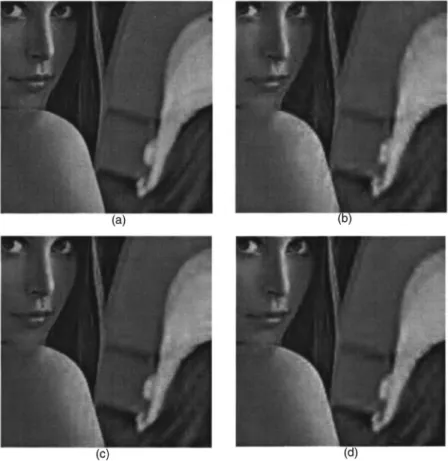
共x,y兲兴, where共x,y兲 are the coordinates of a pixel in the i’th block. The summation is taken over all pixels in the i’th block.Fig. 7 共a兲 “Lena,” 共b兲 compressed image 共0.096 bpp,28.63 dB兲, 共c兲 filtered image
共0.153 bpp,30.39 dB兲, and 共d兲 JPEG2000 compressed image at a bit rate accounting for the side information overhead共0.153 bpp,30.08 bpp兲.
Step 3. Select an unprocessed block P
⬘
共i兲 and apply all eight morphological filters. Save the outputs from all eight filters, say MP⬘
共1兲 to MP⬘
共8兲.Step 4. Sort MP
⬘
共k兲 according to their SAD measures with respect to the same block of the original uncom-pressed image. Select the number k if MP⬘
共k兲 yields the smallest SAD value and the SAD value is smaller than Diff共i兲. Otherwise, leave the block unchanged. Step 5. Repeat starting from step 3 until all blocks areprocessed.
Step 6. Compress the filter information by entropy coding.
At the decoder end input: compressed image R
⬘
, thresh-old of quad-tree partition, minimum block dimension, and the sequence of morphological filters determined by en-coder side postprocessingThe output is filtered image Q. Step 1. Copy P
⬘
to Q.Step 2. Partition P
⬘
into unequal-sized blocks using quad-tree partitioning in a manner identical to the encoder side postprocessing.Step 3. Select an unprocessed block P
⬘
共i兲 and apply the signaled morphological filter to it. Assume that the filtered block is MP⬘
共k兲.Step 4. Replace the corresponding block in Q with
MP
⬘
共k兲. However, if the side information of this block indicates that no suitable predefined filter ex-ists, leave the block unchanged.Step 5. Repeat starting from step 3 until all blocks are processed.
Figures 5 and 6 illustrate flowcharts of the ringing arti-fact filter’s encoder and decoder components respectively.
The algorithm uses 2 or 4 as dimension threshold and uses 共20,40,60,80,100兲 as partition threshold. If algorithm begins from 共512,100兲, the “change threshold” step will determine next threshold in one of 共256,80兲, 共256,100兲, 共512,80兲. The criterion is depending on result of total 1 bit in QT and E. If all 1 in E is higher than 90% subset of 1 in edge information of QT, it can conclude that QT is the same as E. The number of bits needed to represent the side information associated with the filter against ringing arti-fact can be expressed as
Bring=共Nn+ ¯ + N4+ N2兲BSE, 共3兲
where Nnrepresents the number of n⫻n blocks. The value of BSE depends on the number of SEs, and can be
repre-sented as
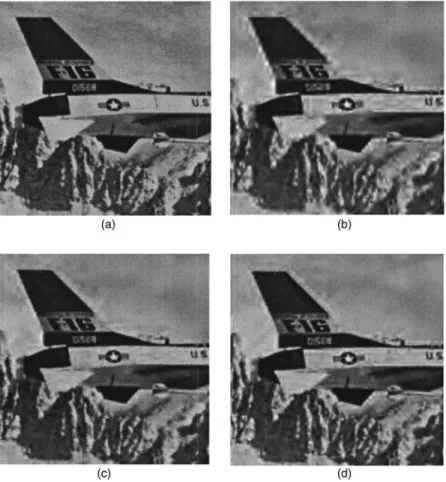
Fig. 8 共a兲 “F16,” 共b兲 compressed image 共0.098 bpp,27.34 dB兲, 共c兲 filtered image 共0.186 bpp,30.61 dB兲, and 共d兲 JPEG2000 compressed image at a bitrate accounting for the side information overhead共0.186 bpp,30.31 dB兲.
BSE= ceil兵log2关共2*number of SEs兲 + 1兴其, 共4兲
where ceil共.兲 is the ceiling function, rounding all positive real numbers to the nearest integer equal to or greater than its argument. The multiplicative factor 2 is required due to the allowed use of both dilation and erosion operations with each SE, and the additive term 1 is required due to the option of not using any kind of filtering at all for a particu-lar block. Equations共3兲 and 共4兲 provide an upper bound on what can be achieved by an entropy coder acting on the side information. It can use the correlation of filter choices
in neighboring blocks to advantage for reducing the amount of side information through actual entropy coding. 5 Simulation Results
This section demonstrates some simulation results on the proposed postprocessing algorithm. As described, this pa-per uses quad-tree partitioning as a preliminary step of the proposed postprocessing algorithm. Two parameters strongly influence the quad-tree partition in the system de-scribed here. The first parameter is the partition threshold; the smaller the threshold is, the more blocks the image is divided into. The second parameter is the minimum block size. Generally, smaller blocks can preserve finer image features than larger blocks.
Table 2 Simulation based analysis of the influence of varying the
quad-tree partitioning threshold.
Total number of Filters
Minimum Dimension
Partition
Threshold PSNR共dB兲 Blocks Number 8 2 20 30.96 24787 8 2 40 30.53 15007 8 2 60 30.13 10261 8 2 80 29.76 7120 8 2 100 29.42 4675 8 2 120 29.20 3283
Table 3 Simulation based analysis of the influence of varying
quad-tree partitioning minimum block dimension.
Total Number of Filters
Minimum Dimension
Partition
Threshold PSNR共dB兲 Blocks Number 8 2 60 30.13 10261 8 4 60 29.57 5449 8 8 60 29.02 2266 8 16 60 28.77 817
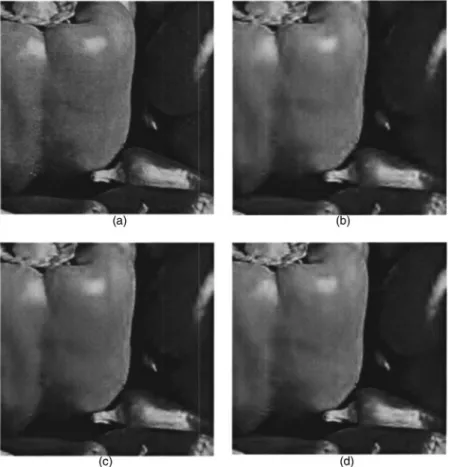
Fig. 9 共a兲 “Peppers,” 共b兲 compressed image 共0.099 bpp,28.63 dB兲, 共c兲 filtered image
共0.175 bpp,30.73 dB兲, and 共d兲 JPEG2000 compressed image at a bitrate accounting for the side information overhead共0.175 bpp,30.42 dB兲.
Two different objective measures were employed in our simulations for quantitative performance evaluation. The classical performance is evaluated by the following crite-rion: PSNR expressed in decibels. PSNR is a pixel fidelity measure that can be calculated as
PSNR = 10 log10 2552 1 T
兺
i=0 n−1兺
j=0 n−1 共xi,j− xi,j⬘
兲2 , 共5兲where T denotes the total number of pixels in an image of size n⫻n, hence T=n2, while x and x
⬘
represent theorigi-nal and decoded/postprocessed pixels, respectively. PSNR has been widely adopted as a fidelity measure in the field of
image compression. In this study, a new objective measure, the so called visible ringing measure7,8共VRM兲 is also used, which aims to quantify the amount of ringing in a given image consistent with human visual perception. It uses sample pixel intensity variance in 4⫻4 subimages in the exposed regions of the HVS-adjusted filtering mask7,8as a measure of visible ringing. VRM is calculated as follows: VRM =1 q
兺
p=1 q var共k,l兲, var共k,l兲 =兺
m=1 4兺
n=1 4 关兩x⬘
共m,n兲 − ave共k,l兲兩兴2, 100 2 0.153 30.39 31.08 10.2965 10.3821 0.149 30.34 80 2 0.233 32.23 32.02 10.5152 10.5633 100 2 0.203 31.72 31.53 10.4914 10.5489Table 5 Simulation results on the image “F-16.”
Bit Rate of JPEG2000 Compressed Image共bpp兲 PSNR of JPEG2000 Compressed Image共dB兲 Partition Threshold Minimum Dimension Total Bit Rate 共bpp兲 PSNR after Filter Against Ringing共dB兲 PSNR of the Same Bit Rate
JPEG2000 Compressed Image共dB兲 VRM after Filter Against Ringing VRM of the Same Bit Rate JPEG2000 Compressed Image 0.049 24.60 80 2 0.155 29.78 29.37 15.8983 16.1490 100 2 0.123 28.86 28.37 15.9212 16.2672 0.078 26.40 80 2 0.196 30.87 30.51 16.0695 16.3146 100 2 0.164 30.07 29.65 15.9526 16.2715 0.098 27.34 80 2 0.221 31.36 31.11 15.9947 16.1270 100 2 0.186 30.61 30.31 16.0513 16.3466 0.150 29.28 80 2 0.277 32.44 32.24 15.9969 16.1284 100 2 0.242 31.83 31.61 16.0052 16.1568
ave共k,l兲 = 1 16m=1
兺
4兺
n=1 4 兩x共m,n兲兩, 共6兲where q denotes the total number of 4⫻4 blocks that the bit map of edge information in quad-tree partition is 1, k and l denote the index of the 4⫻4 ringing block, while x
and x
⬘
represent the original and decoded/postprocessed pixels respectively.In this study, some experiments were conducted on 512⫻512 gray-scale images with 8 bits/pixel. A total of eight morphological filters were used. The minimum block size was set to 2 for a partition threshold of 100 and 2 for a Table 6 Simulation results on the image “Peppers.”
Bit Rate of JPEG2000 Compressed Image共bpp兲 PSNR of JPEG2000 Compressed Image共dB兲 Partition Threshold Minimum Dimension Total Bit Rate 共bpp兲 PSNR after Filter Against Ringing共dB兲 PSNR of the Same Bit Rate
JPEG2000 Compressed Image共dB兲 VRM after Filter Against Ringing VRM of the Same Bit Rate JPEG2000 Compressed Image 0.049 25.60 80 2 0.139 29.96 29.53 20.1085 20.4796 100 2 0.118 29.30 28.84 20.0385 20.4725 0.079 27.58 80 2 0.177 30.82 30.46 20.1686 20.5465 100 2 0.154 30.39 30.01 20.3391 20.6012 0.099 28.63 80 2 0.198 31.20 30.90 20.2958 20.6161 100 2 0.175 30.73 30.42 20.1513 20.5360 0.150 30.23 80 2 0.246 31.91 31.69 20.5833 20.7683 100 2 0.224 31.67 31.42 20.4840 20.7251
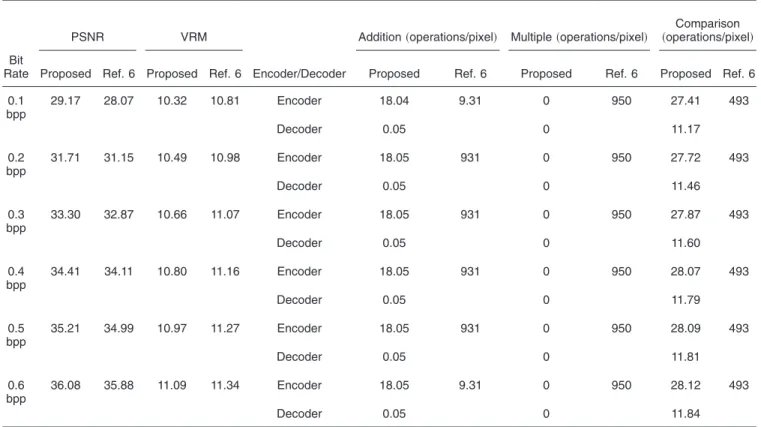
Table 7 Average computational overhead analysis of the proposed algorithm in comparison to the algorithm described in Ref. 6, using the
potential function共x兲=min兵rx2, 1其, the size of the filtering window w⫻w is 25.
Bit Rate
PSNR VRM
Encoder/Decoder
Addition共operations/pixel兲 Multiple 共operations/pixel兲
Comparison 共operations/pixel兲
Proposed Ref. 6 Proposed Ref. 6 Proposed Ref. 6 Proposed Ref. 6 Proposed Ref. 6 0.1 bpp 29.17 28.07 10.32 10.81 Encoder 18.04 9.31 0 950 27.41 493 Decoder 0.05 0 11.17 0.2 bpp 31.71 31.15 10.49 10.98 Encoder 18.05 931 0 950 27.72 493 Decoder 0.05 0 11.46 0.3 bpp 33.30 32.87 10.66 11.07 Encoder 18.05 931 0 950 27.87 493 Decoder 0.05 0 11.60 0.4 bpp 34.41 34.11 10.80 11.16 Encoder 18.05 931 0 950 28.07 493 Decoder 0.05 0 11.79 0.5 bpp 35.21 34.99 10.97 11.27 Encoder 18.05 931 0 950 28.09 493 Decoder 0.05 0 11.81 0.6 bpp 36.08 35.88 11.09 11.34 Encoder 18.05 9.31 0 950 28.12 493 Decoder 0.05 0 11.84
mum block dimension allowed in quad-tree partitioning. It can be clearly seen that quad-tree partitioning with a mini-mum block dimension larger than 4 can hardly capture and preserve the image’s texture. For comparative purposes, this study also lists the related objective measures, PSNR and VRM, in Tables 4–6. The total consumed bit rate is recalculated to include the side information.
Table 7 lists average computational overhead of “Lena” image required by this technique in comparison with Ref. 6. If the potential function共x兲=min兵rx2, 1其, which is
rec-ommended by Shen and Kuo, is used and, the size of the filtering window w⫻w is 25, then Shen and Kuo’s algo-rithm requires, in the worst case: 1250 multiplications, 1225 additions, and 626 comparisons for each image pixel, or on average: 950 multiplications, 931 additions, and 493 comparisons for each image pixel, or on best case: 501 multiplications, 489 additions, and 286 comparisons for each image pixel. It is clear from this discussion that the proposed method is computationally more efficient than Shen and Kuo’s algorithm.
6 Conclusions
Reducing storage requirements and increasing data transfer efficiency are two reasons for applying compression to natural images. The new still image compression standard, JPEG 2000, is superior to JPEG in dealing with the trans-mission and storage of images. When images共natural im-age, generated images, cartoons, and graphics image兲 are compressed at medium bit rate, about 0.6 bpp, by JPEG2000, the compression is near by distortion free and image quality appears to remain unchanged. As the com-pression ratio exceeds 12:1, the compressed images de-velop ringing artifacts. The proposed filter against ringing artifact is simpler and only needs 1.9% of additions, 0% of multiplications, and 8.2% of comparisons for each image in comparison with JPEG2000 VM 7.0 deringing filter.6 The proposed method can efficiently eliminate ringing artifact for images coded at different bit rates without requiring a large computation overhead. Owing to its low complexity, the proposed filter is very suitable for hardware implemen-tation.
The main attribute of the proposed algorithm is that it can, to a large extent, preserve the image information while smoothing out ringing artifacts. For regions with strong texture and edge detail, we perform the introduced quad-tree partitioning and utilize information from an edge
de-1. JPEG2000 Standard, ISO/IEC 15444, ITU-T T.800共Dec. 2000兲. 2. T. P. O’Rourke and R. L. Stevenson, “Improved image
decompres-sion for reduced transform coding artifacts,” IEEE Trans. Circuits
Syst. Video Technol. 5共6兲, 490–499 共Dec. 1995兲.
3. S. Yang, Y.-H. Hu, T. Q. Nguyen, and D. L. Tull, “Maximum-likelihood parameter estimation for image ringing-artifact removal,”
IEEE Trans. Circuits Syst. Video Technol. 11共8兲, 963–973 共2001兲.
4. Y. Yang and N. P. Galatsanos, “Removal of compression artifacts using projections onto convex sets and line process modeling,” IEEE
Trans. Image Process. 6共10兲, 1345–1357 共1997兲.
5. A. J. Patti and Y. Altunbasak, “Artifact reduction for set theoretic super resolution image reconstruction with edge adaptive constraints and higher-order interpolants,” IEEE Trans. Image Process. 10共1兲, 176–186共2001兲.
6. M.-Y. Shen and C. C. Jay Kuo, “Artifact reduction in low bit rate wavelet coding with robust nonlinear filtering,” in Proc. IEEE 2nd
Workshop on Multimedia Signal Processing, pp. 480–485共1998兲.
7. S. H. Oguz, “Morphological post-filtering of ringing and lost data concealment in generalized lapped orthogonal transform based image and video coding,” PhD Dissertation, University of Wisconsin, Madi-son共1999兲.
8. S. H. Oguz, Y. H. Hu, and T. Q. Nguyen, “Image coding ringing artifact reduction using morphological post-filtering,” in Proc. IEEE
Signal Processing Society 1998 Int. Workshop on Multimedia Signal Processing, pp. 628–633, Redondo Beach, CA共1998兲.
9. J. Canny, “A computational approach to edge detection,” IEEE Trans.
Pattern Anal. Mach. Intell. PAMI-8共6兲, 679–698 共1986兲.
10. E. Shusterman and M. Feder, “Image compression via improved quad-tree decomposition algorithms,” IEEE Trans. Image Process.
3共2兲, 207–215 共1994兲.
11. G. J. Sullivan and R. L. Baker, “Efficient quad-tree coding of images and video,” IEEE Trans. Image Process. 3共3兲, 327–331 共1994兲. 12. Y.-C. Chang, B.-K. Shyu, and J.-S. Wang, “Region-based fractal
im-age compression with quad-tree segmentation,” in Proc. ICASSP, pp. 3425–3428, Munich共1997兲.
13. C. R. Giardian and E. R. Dougherty, Morphological Methods in
Im-age and Signal Processing, Prentice-Hall, Upper Saddle River, NJ
共1998兲.
14. R. C. Gonzalez and R. E. Woods, Digital Image Processing, Addison-Wesley, Reading, MA共1993兲.
15. J. A. Bangham and S. Marshall, “Image and signal processing with mathematical morphology,” Electron. Commun. Eng. J., pp. 117–128 共Jun. 1998兲.
16. P. Salembier, L. Torres, F. Meyer, and C. Gu, “Region-based video coding using mathematical morphology,” Proc. IEEE 83共2兲, 843–857 共1995兲.
Yen-Yu Chen received his BS and MS
de-grees in computer science from Tamkang University, Tamsui, Taiwan, in 1991 and 1993, respectively, and his PhD degree in electrical engineering from the National Cheng Kung University, Tainan, Taiwan, in 2004. From 1994 to 1995, he was a Re-serve Officers’ Training Corps共ROTC兲 of-ficer in the airforce. He is currently an as-sociate professor with the Department of Information Management, ChungChou In-stitute of Technology, Yuanlin, Taiwan. His research interests include biomedical signal processing, image processing, and data compres-sion.
Shen-Chuan Tai received his BS and MS
degree in electrical engineering from the National Taiwan University, Taipei, Taiwan, in 1982 and 1986, respectively, and his PhD degree in computer science from the National Tsing Hua University, Hsinchu, Taiwan, in 1989. He is currently a professor of electrical engineering at the National Chen Kung University, Tainan, Taiwan. His teaching and research interests include de-sign automation of VLSI, data compres-sion, biomedical engineering, and computer algorithm.
Chao-Hsu Wang received his BS degree
in information engineering and computer science from the Feng Chia University, Tai-wan, in 1994. From 1996 to 1999, he worked with Holtek Semiconductor Incor-porated, Hsinchu Science Park, as a senior engineer. He then studied at the Cheng Kung University, Taiwan, and received his MS degree in electrical engineering, in 2001. Since 2001 he has been working with ELAN Microelectronics Corporation, Hsinchu Science Park. His research interests include VLSI SOC design and image processing.
Kun-Wei Lin is currently a manager of the Multimedia Development
Division at Sunplus Technology Company, Limited, Hsinchu Science Park. His research interests include VLSI SOC design and image processing.