Investigation of the Structural Performance of Beam and Column Connections Using Hidden Threaded Rods
1)Min-Chyuan Yeh,
2,3)Yu-Li Lin,
2)Su-Yu Deng
2)【 Summary】
A traditional wooden beam and column joint was revised using an embedded threaded rod with the assistance of dowels, and the structural performance of the joint in resisting the bending moment was examined in the study. Beam and column members of Japanese cedar and southern pine timber with a size of 120×120 mm were used to construct a T-structure which was then subjected to a cantilever load. The results indicated that the joint tightened with a threaded rod with 150 mm of embedded length in the side beam member showed a higher bending moment compared to those with 120- and 180-mm embedded lengths. The bending moment resistance of a joint in which a threaded rod was embedded at the upper location of the cross-section on the beam member was 4 times that at the lower location while exhibiting only 25.3% of the moment-rotation coefficient value. The bending moment capacity of joints tightened with a 60×60-mm washer was 40.2 and 36.2% higher than values of joints with 50×50-and 60×80-mm washers, respectively.
The critical failure of a joint tightened with an embedded rod may have been due to the weak com- pressive strength perpendicular to the grain on the column member. When epoxy reinforcement was applied to the joint, the bending moment resistance of the Japanese cedar member joint with 2 embedded threaded rods improved 39.5%, and the internal rotation angle and moment-rotation co- efficient were reduced by 21.6 and 40.6%, respectively. Overall, similar bending resistance values of beam and column joints assembled with both Japanese cedar and southern pine members were found after epoxy reinforcement was applied. The results also demonstrated a reduction of 68.4%
in the moment-rotation coefficient for the joint with additional epoxy reinforcement.
Key words: joint, beam and column connection, Japanese cedar, bending moment resistance.
Yeh MC, Lin YL, Deng SY. 2012. Investigation of the structural performance of beam and column connections using hidden threaded rods. Taiwan J For Sci 27(4):383-95.
1)This study was supported by a grant (NSC98-2622-B-020-001-CC2) from the National Science Council of Taiwan and Der-Fung Wood Co. 本研究承國科會(NSC98-2313-B-020-002-MY3)及德豐 木業股份有限公司補助經費,謹此致謝。
2)Department of Wood Science and Design, National Pingtung University of Science and Technology, 1 Shuehfu Rd., Neipu Township, Pingtung 91201, Taiwan. 國立屏東科技大學木材科學與設計系,
91201屏東縣內埔鄉學府路1號。
3)Corresponding author, e-mail:[email protected] 通訊作者。
Received August 2012, Accepted November 2012. 2012年8月送審 2012年11月通過。
研究報告
內藏式螺桿應用於梁與柱接合結構性能之探討1)
葉民權
2,3)林玉麗
2)鄧書宇
2)摘 要
本研究採用以內藏式螺桿配合木釘作為傳統木材梁與柱之接合改良,並進行接合處之彎矩抵抗的 結構性能分析。在試驗中採用斷面尺寸120×120 mm之柳杉及南方松作為梁與柱構材,並組成T字型結 構進行懸臂之載重。結果顯示螺桿埋入梁端部深度150 mm之接合條件,較120及180 mm深度條件有較 佳之彎矩抵抗。同時,螺桿埋入位置在梁構材斷面上方者,其彎矩抵抗為埋入梁斷面下方者之4倍,且 彎矩旋轉係數僅為後者之25.3%。在梁接合處以60×60 mm尺寸之墊片緊固之條件下,其彎矩承載力分 別較50×50-及60×80-mm尺寸墊片之接合條件高40.2及36.2%。以內藏螺桿接合之破壞關鍵多因柱構 材材面之側向壓縮強度不足所致。在接合處以環氧樹脂補強方面,柳杉材以雙支螺桿接合者其彎矩抵 抗可以改善39.5%,且內部旋轉角度及彎矩旋轉係數分別降低21.6及40.6%。整體而言,環氧樹脂補強 處理後,柳杉及南方松之梁與柱構材接合均有相近彎矩抵抗性能,同時也顯示接合處之彎矩旋轉係數 可以降低68.4%。
關鍵詞:接合、梁與柱連結、柳杉、彎矩抵抗。
葉民權、林玉麗、鄧書宇。2012。內藏式螺桿應用於梁與柱接合結構性能之探討。台灣林業科學 27(4):383-95。
INTRODUCTION
Wood-frame structures classified as light- framed buildings featured better seismic re- sistance. However, over 70% of the damaged historic buildings were wooden structures during the 921 Chi-Chi earthquake in 1999 in Taiwan (NCKU R&D Foundation 2000).
Among these wooden structures, Chuan-dou wooden frame structures constituted 44%
followed by Japanese post and beam frame (20%) and Dei-dou wooden frame structures (6%). Yeh et al. (2001) also reported 27%
failure due to weak seismic resistance of post and beam structures in newly constructed wood-frame residential buildings which were damaged during the 921 Chi-Chi earthquake.
The report also indicated that 62% of failures could be attributed to a lack of resistance to lateral forces by the main structures. These
results revealed the importance of the struc- tural performance of joints to resist lateral and vertical forces which is usually ignored when designing and constructing wood-frame buildings in Taiwan. Actually, a hinge or pin joint was assumed in wood-frame design practice based on the current code sugges- tion, which resulted in errors in the structural analysis due to neglecting any bending mo- ment resistance of a joint (Chang and Hsu 2005).
The structural performance of traditional
wood joints was recently examined. Chao
(2004) suggested that failure always occurred
at the joint between the column and beam for
a traditional Dei-dou wood frame subjected
to a vertical load. Beam members were de-
tached from the mortises owing to the large
displacement during simulated seismic loads.
A reduction in 58% in the relative displace- ment at the column and beam joint could be achieved when a horizontal diaphragm was added to the roof system in the simulation.
Lee et al. (2007) found that the maximum bending moment and rotational stiffness of a through tenon were 350 and 320%, respec- tively, higher than those of a straight tenon.
And the stepped dovetail tenon also showed better bending moment resistance than did a straight tenon. However, the fit between the mortise and tenon of a traditional joint was set to 0 in the test, which is difficult to achieve at job sites. Chang et al. (2006) sug- gested the complexity of Taiwan Nuki joints is significant because of the gap between the column and beam compared to a similar joint used in Japanese traditional wood structures.
They identified an initial slip behavior due to the rigid body motion and limited compres- sion length in the early stage, and joints can be regarded as hinges. However, no signifi- cant relation was found between the 2 types of slip. To improve the structural performance of traditional wood joints, Hsieh (2005) sug- gested that high-strength stepped-dovetail connections be obtained by adding a wood wedge and 2 bamboo pegs, and adding 2 steel plates with 3 screws for Go-dou connections.
On the other hand, no improvement in the joint strength of Go-dou connections was found when polyvinyl acetate glue was ap- plied to the wedges before assembly.
Further, Harada et al. (2005) found that the maximum moment and stiffness of joints assembled with bolts and nails improved when wood members were dried with differ- ent moisture contents from green to 5%. But no clear effect of the moisture content on the joint strength was found for dovetail joints or mortise and tenon joints with precut pro- cessing. Pan et al. (2011) suggested that the
tension strength perpendicular to the grain is an important property of a Korean traditional dovetail joint. The moment resistance of a joint increased as the cross-beam shoulder length and wood density increased. They pointed out that failure modes included split failure parallel to the grain at the post, rolling shear failure at the mortise branch, and split failure parallel to the grain at the beam shoul- der.
To prevent a critical split or breaking
failure of mortise and tenon joints and reduce
the initial slip owing to an improper fit at the
joint, a new connection between the column
and beam members which can sustain a load
through an adequate shearing capacity of the
wood was proposed. Eckelman (1989) had
a similar approach using through-bolt and
dowel-type nuts in furniture rail member as-
sembly and found the bending strength of a
joint could be expressed as a relationship of
the compressive strength parallel to the grain,
the internal moment arm of the joint, and
the end embedment distance of the dowel-
type nut. Eckelman et al. (2007) further
expanded this approach to construct a small
timber truss with a through-bolt and cross
pipe as heel connectors. They reported that
the trusses did not fail catastrophically when
the cross pipe began to yield, but continued
to carry the load. In this study, a beam and
column joint was designed to connect with
a tension rod which was embedded inside
the wood members and could be tightened
with a nut and washer. The size of the washer
and the embedded length of the threaded
rod on the beam member which resulted in
different shearing areas of the wood were
considered. Also, the effect of the location
and number of tension rods and reinforce-
ment with epoxy adhesive application on
the structural joint performance were exa-
mined.
MATERIALS AND METHODS Material preparation
The 35~40-yr-old Japanese cedar (Cryp-
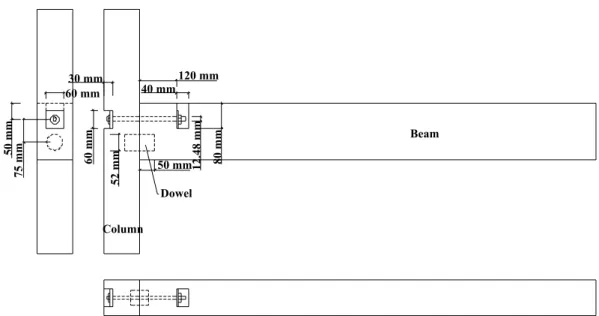
tomeria japonica) plantation timber was har-vested from the Hsinchu Forest District, Tai- wan Forestry Bureau. Logs were then sawn, kiln-dried to a moisture content of 13%, and planed to 120×120×800 mm for column members and 120×180×1500 mm for beam members. Commercial southern pine tim- ber (S) imported from North American was processed into the same dimensions with a moisture content of 15% and used for com- parison in the study. “T”-shaped beam and column structures were assembled with bolts as shown in Figs. 1~3. The bolts had threads on both ends for 30 mm in length and were embedded inside both the column and beam members. Holes were first drilled from the cross-section of a beam end and in the middle of a column member. Notches were also made on the surface where bolt holes were located to accommodate washers and nuts for the assembly. A 52-mm-diameter wood dowel
with a length of 100 mm was inserted into predrilled holes at the juncture of the joint to hold the beam member during assembly. The bolts were embedded in the beam to 3 differ- ent depths, i.e., 120, 150, and 180 mm from the end as shown in Table 1. The sizes of washers used on the beam members were 50 (length, l)×50 (width, w)×6 (thickness, t), 60 (l)×60 (w)×6 (t), and 60 (l)×80 (w)×9 (t) mm, respectively. The size of the washer on the column side was 60×60 mm. Both 12- and 15-mm bolts were used for beam and column specimen assembly. The arrangement of the bolt either at the top (T) or bottom (B) or both (D) locations on the cross-section of a beam member was also examined. Bolts were further reinforced with epoxy resin adhesives (E) by injection into gaps between the bolt and hole during the assembly process for both Japanese cedar and southern pine timber in some test conditions.
Joint test of the beam and column assembly Moment-resistance testing of the bolted joint in a T-shaped beam and column structure
Fig. 1. Beam and column joint configuration with 1 threaded rod at the top location.
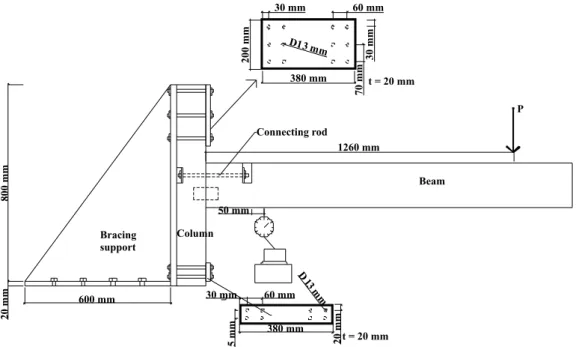
was performed as shown in Fig. 4. Specimens were fastened in different designated ap- proaches, and a concentrated load was applied at a speed of 490 N·mm
-1at the cantilevered member end. The span between the loading point and interface of the joint was 1260 mm, which was 7-times the beam depth to ensure acceptable bending moment behavior as sug-
gested by Lin (1998). Each test condition had 4 replicates. The ultimate bending moment at rupture (M, kN·m) was obtained from the maximum load (P
max) and cantilever span.
Flexural displacement (y) was recorded at 50 mm from the notches where the end of an em- bedded bolt was fixed with a nut and washer to estimate the internal rotation angle (θ, rad) Fig. 2. Beam and column joint configuration with 1 threaded rod at the bottom location.
Fig. 3. Beam and column joint configuration with double threaded rods.
of joints as follows:
θ(rad) = y/d; (1)
where d is the distance between the beam and column juncture and transducer location.
Table 1. Experimental conditions of embedded threaded rods used for beam and column connections
Treatment No. Diameter of rod Size of washer End distance Location Glue of rods (mm) (mm) in beam (mm) of rod reinforcement
JT12-60-120
1)1 12 60×60 120 top none
JT-12-60-150 1 12 60×60 150 top none
JT12-60-180 1 12 60×60 180 top none
JT12-50-150 1 12 50×50 150 top none
JT12-80-150 1 12 80×80 150 top none
JB12-60-150 1 12 60×60 150 bottom none
JT15-60-150 1 15 60×60 150 top none
JD12-60-150 2 12 60×60 150 top/bottom none
JT12-60-150E 1 12 60×60 150 top epoxy
JD-12-60-150E 2 12 60×60 150 top/bottom epoxy
ST12-60-150E 1 12 60×60 150 top epoxy
ST12-60-180E 1 12 60×60 180 top epoxy
SD-12-60-150E 2 12 60×60 150 top/bottom epoxy
J, Japanese cedar; S, southern pine; T, top; B, bottom; D, top/bottom; 12, 15, bolt diameters; 50, 60, 80, sizes of the washer; 120, 150, 180, embedded distances from the beam end.
Fig. 4. Configuration of a moment-resisting test for a T-shaped beam and column specimen
fastened with an embedded rod.
A moment-rotation coefficient (R) was then obtained as follows:
R = θ/M. (2)
Mechanical property evaluation of the wood
Compressive tests performed in a per- pendicular wood fiber orientation followed the CNS453 standard (BSMI 2006). The compressive strength was then measured at 5% deformation of a specimen along the loading directions, i.e., tangential, radial, and 45˚ between 2 wood surfaces. The ultimate shearing stress parallel to the grain was tested according to the CNS455 standard. Shearing areas in both the tangential and radial direc- tions were tested. Cleavage tests were done on both the radial and tangential surfaces of wood with the CNS 6716 standard. Each test condition had 12 replicates.
RESULTS AND DISCUSSION Mechanical properties of the wood
Table 2 shows the basic mechanical properties of Japanese cedar and southern pine wood. The compressive stresses perpen- dicular to the grain measured in the radial di- rection (F
c┴r) were higher than those measured in the tangential (F
c┴t) and 45˚-oriented (F
c┴45) cases for both wood species. The compressive
stress of Japanese cedar was only 53.5% on average that of southern pine. Density may have been an important parameter influencing the mechanical properties, and the density of Japanese cedar was only 74.5% that of south- ern pine. A similar trend was noted for the shear strength of southern pine, being 45.5%
higher compared to Japanese cedar speci- mens. However, no significant difference was found when the wood sheared between the radial and tangential faces. Further, the results of cleavage strength for both wood species and splitting in 2 different directions were similar and showed no influence due to the density parameter.
Flexural properties of the beam and col- umn joints
(I) Effect of the embedded length and washer size
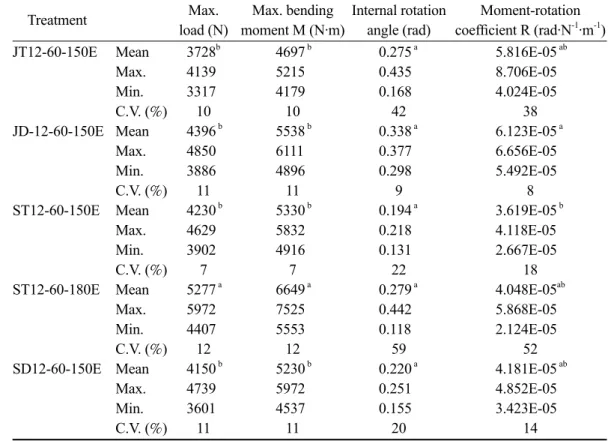
The performance of the bending moment resistance of a beam and column joint without epoxy reinforcement was first evaluated us- ing Japanese cedar members. With different embedded lengths of threaded rods, results showed that the joint with a rod embedded for 150 mm sustained a slightly higher load and bending moment at failure than those em- bedded for 120 mm (Table 3). This indicated that increasing the shear area of the wood by
Table 2. Mechanical properties of the 2 wood species
Species Density F
c┴r1)F
c┴tF
c┴45F
vrF
vtF
sprF
sptkg·m
-3MPa MPa MPa MPa MPa kN·m
-1kN·m
-1Japanese 410 7.64 6.08 4.51 6.47 7.06 24.4 29.1
cedar (60)
2)(1.57) (1.37) (1.08) (0.98) (1.27) (9.3) (6.1)
Southern 550 16.07 8.62 9.41 10.09 9.60 30.4 28.4
pine (60) (4.51) (2.06) (1.47) (1.76) (2.06) (6.6) (2.4)
1)
F
c┴r, F
c┴t, F
c┴45, compressive stress perpendicular to the grain tested in the radial, tangential, and 45˚
directions, respectively; F
vr, F
vt, shearing strength in the radial and tangential directions, respective- ly; F
spr, F
spt, cleavage strength in the radial and tangential directions, respectively.
2)