行政院國家科學委員會專題研究計畫 成果報告
研究 HTm4 和 KAP 的應對關係和對血細胞分化的影響
計畫類別: 個別型計畫
計畫編號: NSC93-2320-B-038-032-
執行期間: 93 年 08 月 01 日至 94 年 07 月 31 日 執行單位: 臺北醫學大學醫學系
計畫主持人: 柯順龍
報告類型: 精簡報告
處理方式: 本計畫可公開查詢
中 華 民 國 95 年 1 月 27 日
行政院國家科學委員會補助專題研究計畫 ■ 成 果 報 告
□期中進度報告
研究 HTm4 和 KAP 的應對關係和對血細胞分化的影響
Study the interaction between a hematopoietic cell-cycle regulator HTm4 and KAP and their effects on the differentiation of hematopoietic progenitor cells
計畫類別:■ 個別型計畫 □ 整合型計畫 計畫編號:NSC 93-2320-B-038-032-
執行期間:93 年 08 月 01 日 至 94 年 07 月 31 日
計畫主持人:柯順龍 共同主持人:
計畫參與人員:
成果報告類型(依經費核定清單規定繳交):■精簡報告 □完整報告
本成果報告包括以下應繳交之附件:
□赴國外出差或研習心得報告一份
□赴大陸地區出差或研習心得報告一份
□出席國際學術會議心得報告及發表之論文各一份
□國際合作研究計畫國外研究報告書一份
處理方式:除產學合作研究計畫、提升產業技術及人才培育研究計畫、
列管計畫及下列情形者外,得立即公開查詢
□涉及專利或其他智慧財產權,□一年□二年後可公開查詢
執行單位:台北醫學大學
中 華 民 國 95 年 01 月 25 日
計畫中文摘要。
血液細胞, 血液細胞分化, HTm4, KAP, CDK2
血液細胞週期的適當調理對於血液系統保持恆久性的自我還原(Self-renewal),分化 (differentiation) 和制橫 (homeostasis)上而言是非常重要的。 這個調理的失控是會有巨 大的壞的後遺症譬如自我免疫的失調(autoimmune disorder),blood dyscrasias,和血細胞 腫瘤等等各種病變.細胞週期調理控制的机制不但是複雜而且是有許多尚未了解的地方.
我們最近有發現一個新的蛋白質,HTm4,在血球細胞週期的控制机制上扮演一個非常 重要的角色.我們的實驗顯示HTm4 和cyclin-dependent phosphatase (KAP)和CDK2 形成 一個很重要的複合物那可以參與血細胞週期管理的机制。外加生產(exogenous expression) 的HTm4 會增加KAP 的活性而導致CDK2 的去磷化 (dephosphorylation) 和細胞週期在 G0/G1 的中齗此外,我們最近發現 調控HTm4 的表現和造血幹細胞的分化過程密切相 關,這項發現再次凸顯了進一步研究在正常或不正常造血過程和胚胎發育中
HTm4-KAP-CDK2 相互影響的重要性。為達成此目的,本計畫將設計一系列 in vitro 和 in vivo 的實驗來證實我們的假說,我們推想 HTm4、KAP 和CDK2 會形成一複合物,
而改變HTm4 的表現將影響正常造血幹細胞的分裂、分化和細胞週期的變化,在本計畫 所設計的一系列實驗將提供我們足夠的數據來瞭解造血過程,以及造血幹細胞的調控機 制,此結果將有助於臨床上預防、治療造血或免疫失調的病人。
為達成上述的目的,本計畫有如下五點目標:
(一) 決定HTm4/KAP 複合物和CDK2 活性的關係。
(二) 深入瞭解HTm4 在細胞循環表現週期和KAP/ CDK2 複合物的比較與其表現對細 胞循環中止的影響
(三) 製造抗HTm4 抗体
(四) 製造細胞不表現的KAP 的Ba/F3 的細胞株和HTm4 外加表現對細胞循環中止的 影響
(五) 產生老鼠不表現HTm4 的鼠種和研究其對B 細胞分化成長的影響。
I
計畫英文摘要。
Hematopoietic cell, hematopoietic cell differentiation, HTm4, KAP, CDK2
Regulation of hematopoietic cell cycle progression is critical in controlling the constant self-renewal, differentiation, and homeostasis of the hematopoietic system. Dysregulation of this process has profound consequences, evidenced by the development of autoimmune disorders, blood dyscrasias, and hematologic malignancies with all their associated morbidity and mortality. The complex molecular machinery underlying cell cycle regulation remains ill-defined. We recently described a novel molecule, HTm4, which appears to play a critical role in controlling hematopoietic cell cycle. recently, in the Journal of Clinical Investigation, we showed that HTm4 forms a functionally relevant complex with cyclin-dependent
kinase-associated phosphatase (KAP), and CDK2. Exogenous expression of HTm4 stimulates KAP, leading to dephosphorylation of CDK2 and cell cycle arrest at the G0/G1 phase, thus identifying HTm4 as a novel modulator of the hematopoietic G1-S cell cycle transition.
Furthermore, we recently found that HTm4 expression is tightly regulated during the differentiation of hematopoietic stems cells. These findings highlight the importance of further elucidating the function of the HTm4-KAP-CDK2 interaction in normal and
dysregulated hematopoiesis, as well as during embryogenesis. In order to achieve this goal, we have proposed a series of in vitro and in vivo experiments to be carried out in a murine in vitro system . We hypothesize that HTm4, KAP, and CDK2 form a complex and that altered expression of HTm4 will affect proliferation, differentiation and the cell cycle status of normal hematopoietic stem cells. The proposed investigations will provide data that will contribute to the fundamental understanding of hematopoiesis and hematopoietic stem cell regulation, of clear significance to the prevention and treatment of hematologic and immune disorders. To achieve the stated goals, we propose the following specific aims
Specific Aim 1: Studying the regulation of CDK2 activity by KAP/HTm4 complex in murine
system.Specific Aim 2: Determining the temporal expression of mHTm4 and that of KAP and CDK2
during cell cycle progression, and the ectopic expression of mHTm4 and G0cell cycle arrest.
Specific aim 3: The production of rabbit anti-mHTm4 polyclonal antibodies.
Specific Aim 4: The generation of KAP-negative Ba/F3 pro-B cell line and the effect of
ectopic expression of mHTm4 on this cell line.Specific Aim 5: The generation of a conditional mHTm4-knock down transgenic mouse.
Report:
A. Introduction:
HTM4 is considered a hematopoietic cell-specific cell cycle regulator in human system. It can regulate cell cycle progression through the interaction with a cyclin-dependent kinase (CDK) associated phosphatase (KAP) that modulates the kinased status of CDK2. In human, it has been demonstrated that the ectopic expression of HTm4 can bring about G0/G1 cell cycle arrest. Additionally, the expression of HTm4 is modulated during the differentiation of U937 cell in an in vitro induction assay with a portion of differentiated granulocyctes showing positive expression of HTm4, while the remaining population showing negativity for HTm4 expression. The induction of U937 different ion to erythrocytic phenotype abolishes the expression of HTm4. Thus, it is pertinent to study the role of HTm4 played during
hematopoietic cell differentiation, particularly the differentiation hematopoietic stem cell.
B. Purpose:
For an in vitro system, murine embryonic stem cell has demonstrated its own potential role in the studies of hematopoietic cell differentiation, regarding to the differentiated blood cell phenotypes that include lymphocytic, myelocytic and erythrocytic cell population found in the murine blood system. One of the advantage of using murine system is the ability of using animal model for the verification of all the observations obtained from an in vitro system like that of murine embryonic stem cell. Thus, we have proposed to study the functionality of HTm4 in a murine system. Our proposal comprised (1). the evaluation of the interaction between HTm4 and KAP in a yeast two hybrid system and in cell line, and (2). the production of anti-murine HTm4 polyclonal antibody. The items 2, 4 and 5 of specific aims listed in the abstract of the grant proposal were outlined for a three-year grant, however the grant was approved for only one year, therefore only aim#1 and 3 were accomplished.
C. Methods:
1. Murine total spleen RNA preparation: Mashed spleen cells from two C57BL/6 mice were pooled, wash once with PBS buffer, red blood cell lysed, and RNA extracted using Trizol ( Invitrogen, Carlsbad, CA, USA).
2. Vectors used: pCDNA3 (Invitrogen, Carlsbad, CA, USA) was used for the cDNA cloning of murine HTm4 and KAP. pACT2 and pGBKT7 ( Clontech, USA) were used for the construction of expression vectors to be used in a yeast two hybrid assay system.
pGEX5.1 (Amersham, USA) was used for the construction of GST fusion proteins, which were used for the analysis of in house produced rabbit anti-murine HTm4 polyclonal antibodies
3. cDNA synthesis: SuperScript III first-strand synthesis system for RT-PCR kit from Invitrogen was used for the procurement of cDNAs that were then subcloned into pcDNA3 vector and fidelity of sequences verified before the construction of corresponding expression vector for yeast two hybrid analysis.
1
4. Yeast strains used: AH109 (MATa) and Y187 (MATα) were both obtained from Clontech,
USA, for yeast two hybrid assay through mating method as outlined by the manufacturer.
5. Rabbit anti-murine HTm4 Polyclonal antibody production: EETGGSVYQPLDESRH VQR is a stretch of amino acid sequences derived from murine HTm4 ranging from aa#4-22. This region is predicted to be the most antigenic of the entire coding region of 213 amino acids in length. It was used in a conjugated form with keyhole limpet
hemocyanin (KLH) for the immunization of two rabbits. Primary immunization was done in the presence of complete Freund’s adjuvant (Sigma, USA) and the subsequent boosters were done in the presence of incomplete Freund’s adjuvant (Sigma, USA) as needed. The entire immunization course was accomplished for a period of about 5 months upon the identification of murine HTm4 protein in tissues derived from mouse.
6. Tissue distribution for murine HTm4: Three methods were used to determine the tissue distribution of murine HTM4; a. dot-blot assay derived from total RNA of various tissues;
b. Northern blot analysis of various murine tissues; c. Western blot analysis of protein samples from various murine tissues.
D. Results and Discussions:
1. The procurement of murine HTm4 and KAP cDNAs:
The yield of single-stranded murine HTm4 and KAP cDNAs was accomplished as outlined in the method section for both total RNA isolation and RT-PCR cDNA. The cDNA
sequence was based on AY184359 of NCBI database and KAP NM_009421. Our sequence analysis of in-house murine HTm4 (mHTm4) revealed that it is hundred percent identical to that of AY184359 but different in two amino acids (AA# 162 alanine to serine and AA#
211 threonine to serine) when compared to that of AF321128. These differences might have been the reflection of different methods used for the generation of cDNAs, although both laboratories use the same C57BL/6 strain. There is no difference between our in-house murine KAP (mKAP) and NM_009421. Both mHTm4 and mKAP were used as template for the construction of yeast expression vectors using pACT2 and pGBKT7 vectors.
2. The construction of yeast expression vectors containing either the C-terminus of mHTm4 or the entire mKAP.
pGBKT7 was used for the expression of C-terminus of mHTm4., while pACT2 for mKAP.
Human HTm4 (hHTm4) is one amino acid longer than that of mHTm4. The last 48 amino acids, C-terminus, of mHTm4 was used for the insertion into pGBKT7 vector. The first 25 amino acids of this 48-amino acid fragment are comparable to the last 25 amino acids of hHTm4 showed to have interacted with hKAP in our previous publication. Topologically, the N-terminus of hHTm4 is 23 amino acids longer than mHTm4, while the C-terminus of mHTm4 is 23 amino acids longer than that of hHTm4. For yeast two hybrid assay, the entire mKAP was inserted into pACT2, since currently the binding domain of hKAP for
3. The C-terminus of mHTm4 binds to mKAP in a yeast two hybrid assay:
In a yeast two hybrid assay, the C-terminus of mHTm4 was shown to interact with mKAP.
Basically, AH109 carrying mKAP expression vector was mated with Y180 harvesting C48-mHTm4 expression vector. The positive clones after mating were identified by their growth in a quadruple dropout selection medium. This observation is in consistence with our previous human system.
4. Tissue distribution of mHTm4:
Two Northern blot assays were performed to determine the tissue distribution of mHTm4 in the murine system. First is the dot-blot assay and the second is a Northern blot assay.
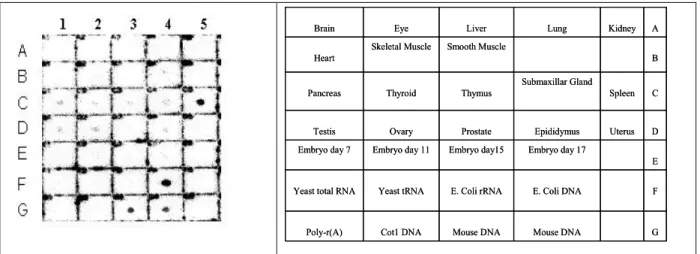
The dot blot was purchased from Clontech and probed with mHTm4-P32 as specified by the manufacturer (Fig. 1). Sample derived from spleen showed the expression of mHTm4 is detected in spleen. There is a false positive interaction with E. coli DNA. In the second Northern blot assay, the mHTm4 transcript was detected in the RNA sample derived from spleen. Overall the expression pattern strongly implicates that mHTm4 is likely also hematopoietic cells specific, like its human counterpart.
G Mouse DNA
Mouse DNA Cot1 DNA
Poly-r(A)
F E. Coli DNA
E. Coli rRNA Yeast tRNA
Yeast total RNA
E Embryo day 17
Embryo day15 Embryo day 11
Embryo day 7
D Uterus Epididymus
Prostate Ovary
Testis
C Spleen Submaxillar Gland Thymus
Thyroid Pancreas
B Smooth Muscle
Skeletal Muscle Heart
A Kidney Lung
Liver Eye
Brain
G Mouse DNA
Mouse DNA Cot1 DNA
Poly-r(A)
F E. Coli DNA
E. Coli rRNA Yeast tRNA
Yeast total RNA
E Embryo day 17
Embryo day15 Embryo day 11
Embryo day 7
D Uterus Epididymus
Prostate Ovary
Testis
C Spleen Submaxillar Gland Thymus
Thyroid Pancreas
B Smooth Muscle
Skeletal Muscle Heart
A Kidney Lung
Liver Eye
Brain
Fig1. Dot-blot assay. Cross reacted with sample from E. coli. Spleen is positive for mHTm4
Fig 2. Northern blot analysis:
samples analyzed are shown on the top. Only spleen showed positive for mHTm4 mRNA.
3
5. The procurement of rabbit anti-mHTm4 polyclonal antibodies:
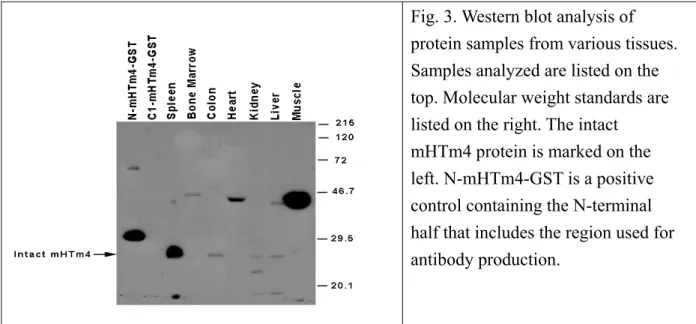
As described in the Methods section, amino acids# 4-22 was used as the immunogen for the production of rabbit anti-mHTm4 polyclonal antibodies. This in-house antibody was shown to be able to identified mHTm4 protein produced in spleen and in GST recombinant form (Fig.3). Again, it is illustrated that mHTm4 is likely hematopoietic cell specific (please see also Fig. 4 for its presence in p815 mouse mast cell)
Fig. 3. Western blot analysis of protein samples from various tissues.
Samples analyzed are listed on the top. Molecular weight standards are listed on the right. The intact
mHTm4 protein is marked on the left. N-mHTm4-GST is a positive control containing the N-terminal half that includes the region used for antibody production.
6. mHTm4 interact with mKAP in vivo:
mHTm4 was also shown to interact with mKAP in vivo (Fig. 4). Briefly, mouse mast cell p815 lysate was immunoprecipitated with antii-mKAP and anti-mHTm4 anibodies, separately, analyzed in a SDS-PAGE gel electrophoresis and subsequently probed with anti-mKAP in a Western blot assay. The detection of mKAP in both samples signifies the true interaction between mHTm4 and mKAP in an in vivo situation.
Fig. 4. Western blotting analysis after immunoprecipitation. Sample is derived from P815 mouse mast cells. Lysate was subjected to acetone precipitation before loading. The other two sample were ip with antibodies stated on the top right of the figure. Samples were subjected to Western blotting with mouse anti-KAP monoclonal antibody. The top and lower bands in KAP sample lane were the heavy and light chains of murine immunoglobulin , respectively
E. Conclusion:
Our goal for the first year of this proposal is to evaluate if our previous data on human HTm4 can be accurately extrapolated to the murine system has been met with confidence. Further studies into the functionality of HTm4 in hematopoietic cell differentiation can be procured in the convenience of murine system and probably extrapolated to that of human.
5