Chapter Two Literature Review
In order to examine listeners’ metacognitive strategies and the effect of topic familiarity on their listening comprehension, the following issues are reviewed in this chapter. First of all, the nature and the feature of listening comprehension are discussed in Section 2.1, with an emphasis on the active and complicated process of listening itself. Second, the influence of background knowledge on listeners’
comprehension is elaborated in Section 2.2. Third, learners’ listening comprehension strategies are discussed in Section 2.3 and metacognitive strategies in listening are reviewed in Section 2.4. Next, factors affecting learners’ choices of language learning strategies are discussed in Section 2.5. Finally, a summary of this chapter is given in Section 2.6.
2.1 Introduction to Listening Comprehension 2.1.1 Definition of Listening Comprehension
Listening comprehension has been emphasized for its significant role in second/foreign language teaching and learning since the last two decades (Morley, 1990) Listening, by definition, is “everything that impinges on the human processing which mediates between sound and the construction of meaning” (Morley, 1990:318).
It involves making sense of the spoken text, usually accompanied by other sounds and visual input, with the help of relevant background knowledge and the context where the activity occurs. To be precise, it is considered as “a bundle of related process—recognition of the sounds uttered by the speaker, perception of intonation patterns showing information focus, interpretation of the relevance of what is being
said to the current topic” (Lynch & Mendelsohn, 2002:193).
Listening comprehension, furthermore, refers to “an active and conscious process in which the listener constructs meaning by using cues from contextual information and from existing knowledge, while relying upon multiple strategy resources to fulfill the task requirements” (O’Malley & Chamot, 1990:133). It concerns listeners’ speech perception and continuous reconstruction in interpreting what is heard (Lin, 2003). Both are continuous, following the speaker’s speech. Both are overlapping; then interpretation construction of the previous utterance co-occurs with the perception of following utterance. Both are mutually informing process;
perception leads to interpretation and interpretation, in turn, leads to the prediction of following perception (Lin, 2003).
2.1.2 Features of Listening Comprehension
According to Richards (1983), listeners make use of two kinds of knowledge (knowledge of the syntax and real world knowledge) to attain their comprehension. It involves the following process (Richards, 1983:221):
(1) The listener takes in raw speech and holds an image of it in short-term memory.
(2) An attempt is made to organize what was heard into constitutions, identifying their content and function.
(3) As constituents are identified, they are used to construct propositions, grouping the propositions together to form a coherent message.
(4) Once the listener has identified and reconstructed the propositional meanings, there are held in long-term memory, and the form in which the message was originally received is deleted (Clark and Clark, 1977:49)
In the theoretical framework of cognitive psychology, listening comprehension is
viewed by Anderson (1983, 1995) as an active and complex process in which listeners construct meaning from aural input. He further differentiated listening comprehension into three interrelated and interdependent stages. The first stage is perceptual processing, in which listeners pay attention, or “selective attention,” to the spoken text
and the sounds are kept in echoic memory. The second stage is parsing, a process “by which the words in the message are transformed into a mental representation of the combined meaning of the words” (1995:375). The third stage is utilization, by which listeners relate a meaningful representation of the text to existing knowledge. Through these stages, listening comprehension is enhanced and retention of the information occurs (O’Malley & Chamot, 1990).
Mendelsohn (1994) elaborated four features of listening process. First of all, listening is an interpretive process. Similar to reading, listeners generate their own ideas from a listening context rather than a word-by-word association. Second, listening is an active process, in which listeners must discriminate between sounds, understand vocabulary and grammatical structures, interpret stress and intonation, retain above-mentioned information and interpret it within the immediate as well as the larger sociocultural context of the utterance. Third, listening is often interactive.
There are two types of listening: one-way and two-way listening. One-way listening, as the function of transaction, is “listening in order to learn” (Lynch & Mendelsohn, 2002:196). Two-way listening, to be more precise, listening-and-speaking, involves dialogues and discussions. It can function reciprocally or interactively. In addition, speaking proficiency can be achieved by developing proficiency in listening comprehension (Dunkel, 1986). Finally, listening comprehension can be attained by two resources: bottom-up and top-down1. The former has been viewed as “listener as
1 Bottom-up processing means piecing the parts of what is heard in a linear order, one by one, in sequence. Top-down processing is holistic, going from whole to part, focusing on interpretation of meaning instead of recognition of sounds, words, and sentences. Listeners actively formulate
tape recorder” and the latter “listener as active model-builder” (Anderson & Lynch, 1988:9, 11).
The following psycholinguistic principles of L2 listening and learning are summarized by Vandergrift (2003b:426):
(i) Listening has emerged as an important component in the process of second language acquisition (Feyten, 1991; Oxford, 1993). Current theories of L2 language acquisition emphasize the key role of listening in language, especially in the early stage of language learning (Dunkel, 1991).
(ii) Listening comprehension is more than extracting meaning from incoming speech. It is a process of matching speech with what listeners already know about the topic. Therefore, when listeners know the content of a message, they can activate prior knowledge and make the appropriate inferences essential to comprehending the message (Dunkel, 1986).
(iii) Listeners use ‘top-down’ process when they use prior knowledge to build a conceptual framework for understanding the meaning of a message. Prior knowledge can be knowledge of the topic, the listening context, the text-type, the culture or other information stored in long-term memory as schemata (typical sequences or common situations around which world knowledge is organized). Listeners use content words and contextual clues to make predictions in an exploratory fashion (Anderson & Lynch, 1988; Lynch, 2002).
(iv) Listeners use ‘bottom-up’ process when they use linguistic knowledge to understand the meaning of a message. They accumulate meaning, building from lower level sounds to words to grammatical relationships to word meanings in order to arrive at the final message (Anderson & Lynch, 1988;
hypotheses concerning speakers’ meaning and confirm or modify them when necessary.
Lynch, 2002).
(v) Listening comprehension, however, is not either top-down or bottom-up processing, but an interactive, interpretive process where listeners use both prior knowledge and linguistic knowledge in understanding messages (Rost, 2002). The degree to which listeners use the one process or the other will depend on their knowledge of the language, familiarity with the topic, or the purpose for listening.
(vi) Listeners do not pay attention to everything; they listen selectively, according to the purpose of the task. Knowing the communicative purpose of a text will help the listener determine what to listen for and, therefore, which processes to activate (Mendelsohn, 2001).
(vii) Listener use metacognitive, cognitive, and socio-affective strategies to facilitate comprehension and to make their learning more effective.
Metacognitive strategies, or self-management strategies, oversee, regulate, or direct listening process. Cognitive strategies (e.g., inferencing) are the actual mental steps listeners use to understand what they hear.
Socio-affective strategies describe the techniques listeners use to collaborate with others, to verify understanding or to lower anxiety. Research shows that skilled listeners use more metacognitive strategies than their less-skilled counterparts (O’Malley & Chamot, 1990; Vandergrift, 1997; 2003a).
(viii) When listeners know how to (a) analyze the requirements of listening task;
(b) activate the appropriate listening process required; (c) make appropriate predictions; (d) monitor their comprehension; (e) problem-solve to guess the meaning of what they do not understand; and (f) evaluate the success of their approach, they are using metacognitive knowledge for successful listening comprehension (Chamot et al., 1999). This is critical to the development of
self-regulate listening, the basis for independent listening outside the classroom (Wenden, 1998).
(ix) Classrooms with dual focus, teaching both language content and learning processes, can foster a greater sensitivity to the learning process overtime (Nunan, 1996) and successfully raise consciousness of the process of listening in children (Vandergrift, 2002), adolescents (Vandergrift &
Belanger, 1998) and adults (Goh, 2000).
In conclusion, listening comprehension is am active and complicated process.
Listening tasks usually demand for learners’ ability to decode the input, to activate relevant prior knowledge, or even to express themselves on the basis of the input. All the listeners do is not passively register the message. Instead, good listeners are as active when listening as speakers are when speaking. And it will benefit a lot to investigate good listeners’ listening process.
2.2 Schema Theory and Listening Comprehension
Research on cognitive psychology and reading comprehension has confirmed the critical role of schema in comprehension process (Teng, 1996). According to schema theory, written text and spoken discourse do not carry meaning in and of themselves;
meaning results from the interaction between the reader’s and listener’s knowledge about the world, the structure of text, or the content of speech. Anderson and Lynch (1998) regarded schematic knowledge as one of the “information sources in comprehension” (p. 13). Brown and Yule (1983) described schemata as “organized knowledge which leads us to expect or predict aspects in our interpretation of discourse” (p. 248). Therefore, a lack of familiarity in the topic of the discourse leads ESL or EFL students to have difficulty understanding and recalling information in the discourse (Carrell, 1983; Connor, 1984).
As literature shows, the activation of schemata can be interpreted in the following ways: (1) learners’ cultural or religious background, (2) learners’
knowledge about the theme and discourse format (content and formal schema), (3) topics taught/covered in the learners’ textbooks, and (4) the use of visual cues and advance organizers. The following studies adapted different methodological approaches to investigating the influence of topic familiarity on listening comprehension.
2.2.1 Background Knowledge and Listening Comprehension
Markham and Latham (1987) assessed the influence of religious-specific background knowledge on adult ESL students’ listening comprehension, quantitatively and qualitatively. Sixty-five university students with approximately the same English proficiency level participated in the study, divided into religious-neutral, Moslem, and Christian groups according to their self-report. They listened to one expository prose describing the prayer rituals of Islam and the other explaining those of Christianity. Their comprehension was measured by immediate written recall reports. A retrospective interview was conducted on six participants immediately after they completed the protocol. The results showed that religious background knowledge did significantly influence ESL students’ listening comprehension. When recalling the passage concerning their own religion, the participants provided more elaborations and fewer distortions. Due to the lack of religious background knowledge in the process of listening to the unfamiliar passage, ESL students had to rely on their inadequate linguistic knowledge to puzzle out the global meaning.
In a study of the listening comprehension of different proficiency Chinese students of English as a foreign language, Chiang and Dunkel (1992) tested the effect of speech modification, prior knowledge, and listening proficiency on EFL lecture
learning. The study involved 388 EFL male undergraduates at the Chinese Naval Academy in the Republic of China, divided into high-intermediate listening proficiency (HILP) and low-intermediate listening proficiency (LILP) according to the listening section of the Comprehensive English Language Test (CELT). They listened to lectures of culturally familiar (Confucius and Confucianism) and culturally unfamiliar (the Amish People and the Pennsylvania Dutch County) topics. After the lecture, they took a multiple-choice exam testing their comprehension of the lecture and general knowledge of the two topics. They found that there was a significant interaction between prior knowledge (familiar vs. unfamiliar topics) and test type (passage-independent vs. passage-dependent). Both the HILP and LILP students scored higher in the comprehension test on familiar topics, and they both scored higher in passage-independent test items on familiar topics. It was proved that prior knowledge had a substantial impact on listening comprehension.
In her study on the listening comprehension of Chinese senior high school students in Taiwan and American undergraduates at the University of Minnesota, Teng (1996) examined the effects of cultural schemata and visual cues on listening comprehension. The listening materials were two short lectures, one describing Chinese holiday (the Dragon Boat Festival) as a familiar one and the other portraying an American holiday (Thanksgiving Day) as an unfamiliar topic. Three different treatments (picture-video, speaker-video, and lecture-audio) were given to different groups of students and counterbalanced in six combinations. The results showed that both Chinese and American students recalled significantly more propositions from the culturally familiar lectures. Furthermore, EFL listeners benefited a lot from visual cues given in the listening comprehension tests.
2.2.2 Formal/Content Schema and Listening Comprehension
In an examination of the interaction of cognitive strategies with background knowledge, Weissenreider (1987) pointed out the essentiality of both formal (textual) schemata (knowledge of formal, rhetorical, organizational structures of different types of texts, e.g., knowledge about the newscasting features and principles) and content schemata (knowledge of the content area of a text, e.g., knowledge about a specific theme in the newscast) in listening comprehension. For example, newscating is considered as “rapidity at the performance level,” as “concentration of propositions at the discourse level,” and as “reduction of forms at the structure level” (p.19). It is a highly specialized and structurally economized register. On the other hand, “news material is often written with the presupposition that listeners are already acquainted with the themes presented” (p.24). This knowledge can enhance the comprehension of the newscast, as Weissenreider’s study shows, especially when combined with cognitive strategies such as identifying key semantic items, hypothesizing associations, and anticipating related themes.
2.2.3 Topic Familiarity and Listening Comprehension
In an attempt to explore the influence of background knowledge on L2 learner’s listening comprehension, Long (1990) conducted a study on 188 college Spanish students with both familiar and unfamiliar topics. Two listening passages of equal length were adapted from the Spanish language press. The one, hypothesized to be unfamiliar to most participants, dealt with a gold rush in Ecuador; the other one, assumed to be familiar, reported on the popular rock music group. Based on the English summaries and comprehension checklists, the results showed that the participants depended on linguistic knowledge to comprehend the unfamiliar passages and utilized both linguistic knowledge and schemata to produce comprehension of
familiar passages. Long therefore concluded that schema played an important role in the comprehension of L2 learners.
Schmidt-Rinehart (1994) explored the effects of topic familiarity on second language comprehension. In order to determine the relationship between topic familiarity and proficiency level in the recall listening comprehension, she chose university students from first-, second-, and third-quarter Spanish courses as three different proficiency levels. On the basis of inclusion of themes in the students’
Spanish textbook and their knowledge about the Spanish custom, the familiar passage was “Hispanic University” and the novel one was “Going for a Walk in the Park.”
Both listening passages were retold in a conversational manner by a native speaker after he read the original text. Immediate after the listening task, the students were required to recall everything they could remember in English. The results displayed that all subjects recalled more from the passage with a familiar topic.
Schmidt-Rinehart concluded that topic familiarity emerges as a powerful factor at all levels of proficiency in listening comprehension.
In Taiwan, several researchers have explored the influence of topic familiarity on listening comprehension. In a discussion about the influence of topical background knowledge (TBK) and textual vocabulary knowledge (VK) on listening comprehension, Hu (2000) contented that students receiving the treatment of TBK, VK, and the combined outperformed those not in listening comprehension. She further explained that these treatments counterbalanced students’ low listening proficiency. In her research on the effects of text difficulty and topic familiarity on EFL listening comprehension, Yang (2002) found that topic familiarity influenced students with a below-average listening proficiency more than with an above-average.
2.2.4 Visuals/Advanced Organizers and Listening Comprehension
Mueller (1980) investigated the effects of visual contextual cues on the listening comprehension of beginning college German students. In his study, the visual contextual cues were viewed as script activators and advanced organizers, depicting the participants, their relationships, the general situation, and other concepts relevant to the listening passage, thereby providing a framework within which the passage could be understood. When shown prior to or immediately after the presentation of a 300-word taped interview, the participants’ comprehension, measured by their written recall of listening in English, was enhanced. The comprehension of the Visual-Before group was enhanced more significantly than that of the Visual-After and No-Visual groups. Interestingly, the results showed that visual aids seemed inversely related to the listeners’ language proficiency level. More proficiency students, who scored better on the United States Air Force Academy’s Comprehensive Placement/Validation Examination, did not achieve higher comprehension scores with the help of visuals.
Mueller’s study showed that appropriate contextual visual cues could improve listening comprehension recall. For the less proficient students, visuals could provide stimulation to activate appropriate scripts, which might otherwise not be available due to their imperfect linguistic knowledge. The more proficient students, whose extensive language skills enabled them to derive a context from the linguistics cues, had less urgent need of the auxiliary of visual organizers. In other words, it was the linguistic knowledge that prohibited the more proficient students from the assistance of visuals. The effects of such visuals were found to be related to learners’ language proficiency.
In Taiwan, there are other studies of the relationship between visuals/advance organizers and listening comprehension. In a study of the effects of three advanced organizers (prior knowledge of the main characters, pre-instructed vocabulary
knowledge, and combined one) on EFL Chinese students’ listening comprehension, Chung and Hung (1998) observed that the advanced organizer of vocabulary knowledge was the most effective one to enhance listening comprehension. The findings of Chu’s (2004) research on listening comprehension of EFL elementary school students also supported Chung and Hung’s idea. By comparing and contrasting the effects of two pre-listening activities (the vocabulary teaching and silent viewing) on senior high school students’ DVD listening comprehension, Yang (2005) concluded that both activities benefited the students more than the control group in listening comprehension.
To sum up, listeners’ familiarity with the listening topic determines their degree of comprehension, especially for those with low proficiency. Hence, it is suggested that teachers should activate students’ schemata before listening.
2.3 Listening Comprehension Strategies
Listening comprehension strategies are deliberate and cognitive steps used by learners to enhance their comprehension and retention of the target language (Vandergrift, 1996). In Taiwan, there are more and more studies of L2 listening comprehension strategies. In a study of the listening comprehension strategies of junior college students in Taiwan, Lee (1997) reported socioaffective strategies as the most frequently used ones, followed by metacognitive strategies, and cognitive strategies as the least frequently used ones. Following the socioaffective category and social subgroup, the metacognitive category and monitoring subgroup were the second highest group of strategy use. Lee explained that time was sufficient for the listeners to monitor their listening comprehension.
In an attempt to explore the listening process of senior high school students, Wang and Chao (2002) used listening comprehension strategy questionnaires and
interviews to examine the frequency of strategy use. Different from the previous studies, their results indicated that metacognitive strategies were used more frequently, including the Monitoring and Self-management strategies.
2.3.1 Effective and Less Effective learners’ Listening Comprehension Strategies Research on listening comprehension strategies has focused on strategy use in relation to individual differences. The first study examining effective and less effective adult ESL learners’ listening strategies was conducted by Murphy (1985), using an adapted introspective technique. He pointed out that the effective listeners were open-minded and flexible, using more listening comprehension strategies and a wider range of different strategies. The less effective listeners, on the other hand, focused too much on the listening passage or on their own world knowledge, or they were slow to elaborate on the text information immediately during the listening process. Murphy concluded that effective listeners used listening comprehension strategies more frequently, applied a greater variety of strategies, and engaged themselves in interaction with the text more actively.
The first study calling attention to the importance of metacognitive strategies in effective listening comprehension was done by Henner Stanchina (1987). She demonstrated that the successful listeners used syntactic, semantic, and schematic knowledge as strategies to deal with the listening passage. They utilized their world knowledge and prior experience to make predictions on a text; they integrated the new information into their ongoing interpretation; they made inferences from the context when gaps appeared; they monitored and evaluated their comprehension; and they revised their predictions when necessary. In conclusion, the ineffective listeners were incapable of recognizing their failure in listening comprehension and activating appropriate prior knowledge to repair it.
Using a think-aloud task, Chamot and Kupper (1989) investigated differences in listening comprehension strategies between effective and less effective high school and university learners. They demonstrated that the effective high school listeners applied more strategies such as Selective Attention, Self-evaluation, Note-taking, and Elaboration. Although the use of strategies such as inferencing and monitoring was not quantitatively significant, it qualitatively was. The effective learners utilized these strategies persistently and purposefully. As for the Russian university students, they found that effective listeners monitored their comprehension and identified their problems more often. Furthermore, they combined inferencing and elaboration more frequently.
Using a think-aloud task again to compare the listening strategies of more successful and less successful listeners, O’Malley, Chamot, and Kupper (1989), working with intermediate ESL students at the secondary level, found that the successful listeners appeared to decide what to pay attention to while listening, maintained their attention, and redirected it when disturbed. They tended to approach listening texts more globally, by contextual meaning-inferencing guess and self-questioning, relating the text to their prior knowledge. The less effective listeners, on the other hand, were found to be easily “lost” when encountering anything unknown. They tended to do word-by-word segmentation, and made fewer connections between incoming information and their lives. To sum up, the effective listeners used both top-down and bottom-up processing strategies while the ineffective listeners adopted bottom-up processing for individual word meanings.
Bacon (1992a) explored the listening strategies of university students learning Spanish by employing think-aloud introspection and retrospective interviews. Similar to the previous findings, Bacon found that differences between successful and less successful listeners were flexibility and range of strategy use. The quantitative results
indicated that subjects applied more cognitive strategies than metacogntive strategies.
Among metacognitive strategies, only “setting self up for the task,” “going in with a plan,” and “monitoring” are quite commonly used by the effective listeners.
Bacon (1992b) furthered her study to determine the reported strategies used in different phrases and between successful versus less successful listeners. For strategy use, bottom-up strategies were more prevalent than top-down strategies in the category of cognitive strategy; Monitoring was more prevalent in the metacognitive strategy. Among metacognitive strategies, “setting oneself for the task” and “having a plan before listening” were the most frequently used before listening; Monitoring and Self-management while listening; “expressing what helped them understand” after listening.
Teng (1997) examined the EFL listening comprehension strategies used by college freshmen in Taiwan and indicated that, among the six categories, the compensation strategies were the most often employed and affective strategies the least. Furthermore, the results showed that the effective listeners employed significantly more strategies than the ineffective ones. The effective listeners demonstrated higher frequency of metacognitive strategy use, such as arranging and planning the listening task, self-monitoring and self-evaluation, and seeking practice opportunities.
In his study of 2003, Vandergrift (2003a) focused on the differences and the types of strategies used by more skilled and less skilled listeners learning French.
Think-aloud protocols were coded and analyzed quantitatively and qualitatively, showing the differences of metacognitive strategy use. More skilled listeners “actively engaged in planning for the task and monitoring incoming input for congruence with expectations to construct a mental representation of the text in memory” (p. 485).
Being dynamic, they approached the listening task purposefully and flexibly. On the
other hand, the less skilled listeners appeared to translate online, unable to keep up with the incoming input, to hold meaning in memory, and to activate conceptual process.
2.3.2 Proficiency Level and Listening Comprehension Strategies
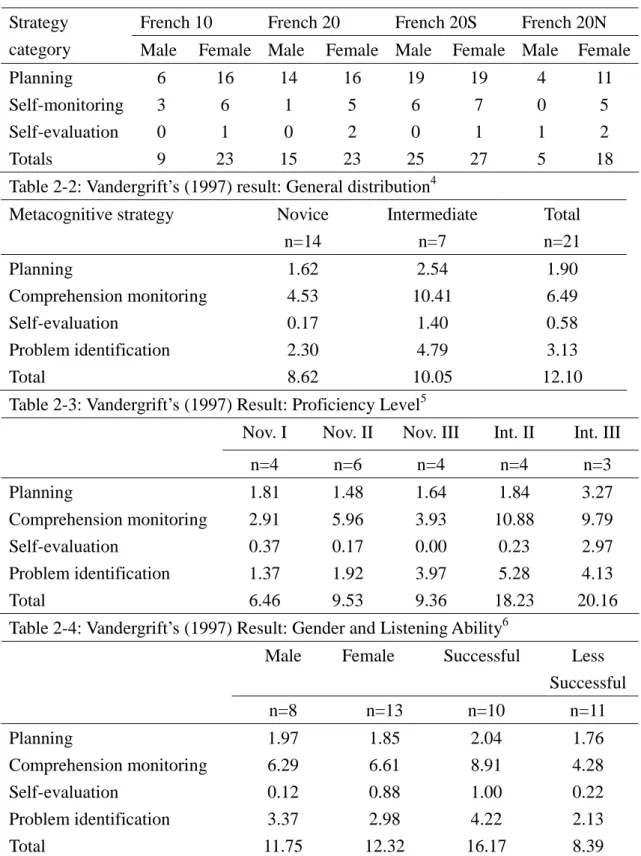
In the first phase of his study, Vandergrift (1996) used a structured interview to identify strategies of high school Core French students at different course levels2 during varied types of listening tasks. The total number of distinct listening comprehension strategies described increase by course level and the largest percentage of strategies used was the cognitive strategies. In spite of fewer metacognitive strategies reported, the number of stated metacognitive strategies increased by course level; females tended to reveal a greater amount of metacognitive strategies than males, as found in Ehrman and Oxford (1989).
In 1997, Vandergrift advanced his study to determine the relationship between the types of listening comprehension strategies, their frequency, and the differences across variables, including levels of language proficiency and listening ability. It was found that the novice listeners tended to employ “surface-processing” (e.g., translation, transfer, and repetition) and cognitive strategies. On the other hand, the intermediate listeners tended to use “deep-processing” and metacognitive strategies.
The use of metacognitive strategies (e.g., Comprehension Monitoring, Problem Identification, and Selective Attention) appeared to be the main factor differentiating
2 Table (i) showed the distribution of participants by course level and gender, taken from Vandergrift (1996:206).
Table (i) Distribution of the participants by their course level and gender
Course level Total Females Males
French 10 (year 1 of a 3-year program) 10 7 3 French 20 (year 2 of a 3-year program) 11 6 5 French 20S (year 5 of a 6-year program) 11 5 6 French 20N (year 8 of a 9-year program) 4 3 1
Totals 36 21 15
the successful from the less successful listeners. A qualitative analysis of protocols also demonstrated apparent differences in the use of prior knowledge, quality of inferencing, prediction skills, and timing and depth of comprehension monitoring.
Goh (1998) examined the listening strategies and tactics of EFL learners in Singapore and found similar results as Vandergrift’s, claiming that the quality of metacognitive tactics distinguished good from poor listeners.
Following the previous researchers’ framework, Young (1997) investigated the existence of a serial ordering of listening comprehension strategies by advanced ESL learners in Hong Kong. Eighteen Chinese university students participated in her study, verbalizing what they were thinking while listening to audio texts from commercial ESL textbooks. After the coding of the think-aloud reports against a twenty-item coding scheme, the strategy data was analyzed both quantitatively and qualitatively.
In the quantitative phase, the implicational scaling analysis was employed, showing a similar pattern of strategy use, regardless of the subjects’ gender and English achievement. In the qualitative phase, the analysis of the representative protocols revealed a sequence of strategy use in the process of aural information. The listeners first used the inferencing strategy to guess the theme of the text by grasping the contextual clues, or the elaboration strategy to activate their background knowledge.
After the activation of prior knowledge, they applied summarizing strategy to strengthen their interpretation of the text. Furthermore, they employed Self-monitoring or Self-evaluation to monitor their comprehension and evaluate their strategy use. They gave comments and feedback to interact with the text. Young concluded that after using the cognitive strategies to activate their world knowledge, the listeners employed the metacognitive strategies to direct and monitor their comprehension.
Using the Strategy Inventory for Language Learning (SILL), Ku (1998)
compared and contrasted listening comprehension strategies of freshmen and juniors in a university. The results showed that the juniors employed strategies more often than the freshmen and that the juniors employed more global strategies than the freshmen. In other words, more experienced listeners used strategies more frequently to complete the listening task.
With an aim to find the divergence and frequency of listening strategies between high- and low-level college students, Chang (2003) adopted a modified questionnaire to explore students’ strategy use in the paper version of a TOEFL test. The results indicated that the high-level students tended to use more listening comprehension strategies use than the low-level ones. Surprisingly, “being interested in the topic” was one of the strategies that positively correlated with the subjects’ listening comprehension.
Chan (2005) used Vandergrift’s (1997) classification scheme to investigate college EFL learners’ metacognitive listening strategy use in Taiwan. The results showed that the proficient learners tended to use more metacognitive listening strategies such as Planning, Monitoring, and Evaluation than the less proficient learners. As for Planning, the proficient learners reported twice the number of Self-management than the less proficient learners but the less proficient learners reported slightly more Directed Attention than their counterparts. With regard to Monitoring, there were no apparent differences between the proficient and less proficient learners in their use of metacognitive listening strategies. As for Evaluation, the proficient learners employed more Strategy Evaluation than their counterparts.
Concerning Problem Identification, the less proficient learners reported slightly more than twice than their counterparts.
Table 2-1: Vandergrift’s (1996) Result of Metacognitive Strategy Use3
French 10 French 20 French 20S French 20N Strategy
category Male Female Male Female Male Female Male Female
Planning 6 16 14 16 19 19 4 11
Self-monitoring 3 6 1 5 6 7 0 5
Self-evaluation 0 1 0 2 0 1 1 2
Totals 9 23 15 23 25 27 5 18
Table 2-2: Vandergrift’s (1997) result: General distribution4 Metacognitive strategy Novice
n=14
Intermediate n=7
Total n=21
Planning 1.62 2.54 1.90
Comprehension monitoring 4.53 10.41 6.49
Self-evaluation 0.17 1.40 0.58
Problem identification 2.30 4.79 3.13
Total 8.62 10.05 12.10
Table 2-3: Vandergrift’s (1997) Result: Proficiency Level5
Nov. I Nov. II Nov. III Int. II Int. III n=4 n=6 n=4 n=4 n=3
Planning 1.81 1.48 1.64 1.84 3.27
Comprehension monitoring 2.91 5.96 3.93 10.88 9.79
Self-evaluation 0.37 0.17 0.00 0.23 2.97
Problem identification 1.37 1.92 3.97 5.28 4.13
Total 6.46 9.53 9.36 18.23 20.16
Table 2-4: Vandergrift’s (1997) Result: Gender and Listening Ability6
Male Female Successful Less Successful n=8 n=13 n=10 n=11
Planning 1.97 1.85 2.04 1.76
Comprehension monitoring 6.29 6.61 8.91 4.28
Self-evaluation 0.12 0.88 1.00 0.22
Problem identification 3.37 2.98 4.22 2.13
Total 11.75 12.32 16.17 8.39
3 Total number of distinct metacognitive strategies by reported by category, taken from Vandergrift (1996:214).
4 Mean number of strategies reported by category for novice and intermediate listeners, taken from Vandergrift (1997:397).
5 Mean number of strategies reported by proficiency level, taken from Vandergrift (1997:398).
6 Mean number of strategies reported by gender and listening ability, taken from Vandergrift (1997:399).
In conclusion, the listeners tended to use more cognitive strategies than metacognitive strategies while completing the listening task. Furthermore, the students with high proficiency used more listening comprehension strategies than those with low proficiency. They used listening comprehension strategies more frequently and purposefully, applied a greater variety of strategies and persistently, recognized their failure in listening comprehension and identified their problems, activated appropriate prior knowledge, monitored their comprehension, and used both top-down and bottom-up processing. The number of metacognitive strategy use was likely to increase by their proficiency level. The more proficient and successful listeners showed more metacognitive strategy use in quantity and better in quality.
Young thus indicated the serial ordering of listening comprehension strategies, from the cognitive strategies to activate their background knowledge to the metacognitive strategies to direct and monitor their comprehension. In Taiwan, there are fewer studies on metacognitive strategies used by EFL learners in listening comprehension.
Therefore, it is important to explore metacognitive strategy use of Taiwan EFL listeners in the present study.
2.4 Metacognitive Strategies in Listening
O’Malley & Chamot (1990) differentiated three categories (i.e. metacognitive, cognitive, and social/affective strategies) of learning strategies, depending on the level of processing involved.
Metacognitoive strategies, according to them, are higher order executive skills that facilitate plan for, monitor, and evaluate the success of a learning task.
Metacognitive strategies which can be employed during receptive or productive
language tasks include (p.44) 7:
(1) Selective attention for special aspects of a learning task, as in planning to listen for key words or phrases;
(2) Planning the organization of either written or spoken discourse;
(3) Monitoring or reviewing attention to a task, monitoring comprehension for information that should be remembered, or monitoring production while it is occurring; and
(4) Evaluating or checking comprehension after completion of a receptive language activity, or evaluating language production after it has taken place.
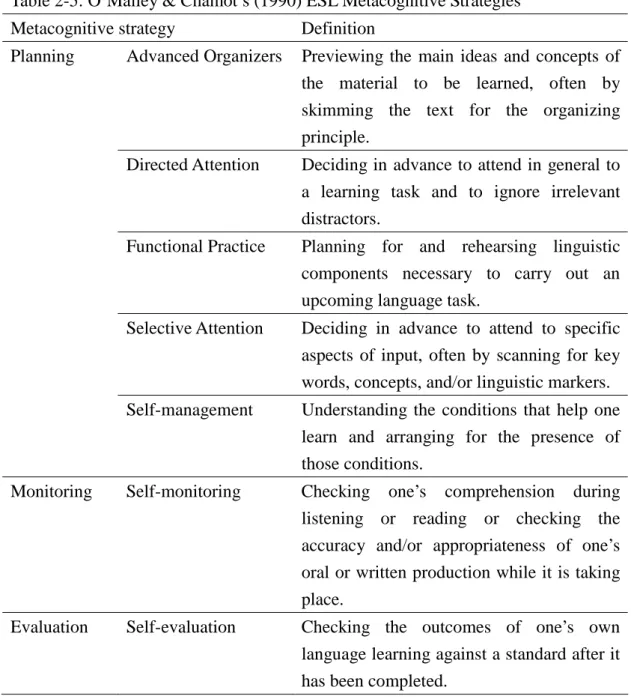
Furthermore, O’Malley and Chamot performed a series of studies and provided detailed information regarding ESL and EFL learners’ metacognitive strategies respectively. Their first study attempted to define and classify strategies used in second language acquisition, using retrospective interviews with high school students learning English as a second language. Table 2-5 shows the classification of metacognitive strategies and the definitions of the individual strategy type. There were seven metacognitive strategies, including Advanced Organizers, Directed Attention, Functional Practice, Selective Attention, Self-management, Self-monitoring,
7 In addition to the classification of O’Malley and Chamot, Oxford (1990) divided metacognitive strategies into three categories: centering your learning, arranging and planning your learning, and evaluating your learning. Table (ii) shows the detail information of Oxford’s categories of metacognitive strategies.
Table (ii): Oxford’s (1990) Categories of Metacognitive Strategies (Oxford, 1990:137) Category Strategy
Overviewing and linking with already known material Paying attention
Centering your learning
Delaying speech production to focus on listening Finding out about language learning
Organizing
Setting goals and objectives
Identifying the purpose of a language task Planning for a language task
Arranging and planning your learning
Seeking practice opportunities Self-monitoring
Evaluating your learning
Self-evaluating
and Self-evaluation.
Table 2-5: O’Malley & Chamot’s (1990) ESL Metacognitive Strategies8 Metacognitive strategy Definition
Advanced Organizers Previewing the main ideas and concepts of the material to be learned, often by skimming the text for the organizing principle.
Directed Attention Deciding in advance to attend in general to a learning task and to ignore irrelevant distractors.
Functional Practice Planning for and rehearsing linguistic components necessary to carry out an upcoming language task.
Selective Attention Deciding in advance to attend to specific aspects of input, often by scanning for key words, concepts, and/or linguistic markers.
Planning
Self-management Understanding the conditions that help one learn and arranging for the presence of those conditions.
Monitoring Self-monitoring Checking one’s comprehension during listening or reading or checking the accuracy and/or appropriateness of one’s oral or written production while it is taking place.
Evaluation Self-evaluation Checking the outcomes of one’s own language learning against a standard after it has been completed.
8 This table is taken from O’Malley & Chamot (1990: 119).
After completing their initial study with ESL students, O’Malley and Chamot extended their research to students of a foreign language in high school and college settings, with an attempt to determine whether the same methodological approaches used successfully in the previous ESL studies could be equally adapted to achieve the same goal in discovering the strategies used by native English-speaking students learning a foreign language. Table 2-6 is their categorization of metacognitive strategy use among EFL students, including Organizational Planning and Delayed Production.
Table 2-6: O’Malley & Chamot’s (1990) EFL Metacognitive Strategies9 Metacognitive strategy Definition
Organizational Planning Planning the parts, sequence, main ideas, or language functions to be expressed orally or in writing.
Planning
Delayed Production Consciously deciding to postpone speaking to learn initially through listening comprehension.
9 This table is taken from O’Malley & Chamot (1990: 126).
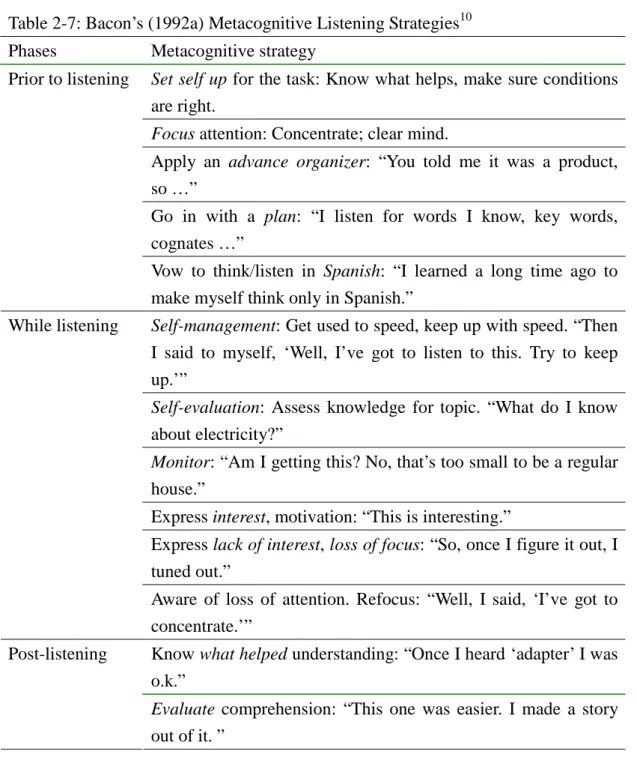
Different from other researchers’ categorization, Bacon (1992a, b) distinguished between metacognitive strategies that were used before, during, and after listening on the basis of her research procedures: pre-listening, listening, and post-listening. As Table 2-7 illustrates, there are five types of metacognitive strategies used before listening, six while listening, and two post-listening.
Table 2-7: Bacon’s (1992a) Metacognitive Listening Strategies10 Phases Metacognitive strategy
Set self up for the task: Know what helps, make sure conditions are right.
Focus attention: Concentrate; clear mind.
Apply an advance organizer: “You told me it was a product, so …”
Go in with a plan: “I listen for words I know, key words, cognates …”
Prior to listening
Vow to think/listen in Spanish: “I learned a long time ago to make myself think only in Spanish.”
Self-management: Get used to speed, keep up with speed. “Then I said to myself, ‘Well, I’ve got to listen to this. Try to keep up.’”
Self-evaluation: Assess knowledge for topic. “What do I know about electricity?”
Monitor: “Am I getting this? No, that’s too small to be a regular house.”
Express interest, motivation: “This is interesting.”
Express lack of interest, loss of focus: “So, once I figure it out, I tuned out.”
While listening
Aware of loss of attention. Refocus: “Well, I said, ‘I’ve got to concentrate.’”
Know what helped understanding: “Once I heard ‘adapter’ I was o.k.”
Post-listening
Evaluate comprehension: “This one was easier. I made a story out of it. ”
10 This table is taken from Bacon (1992a:165).
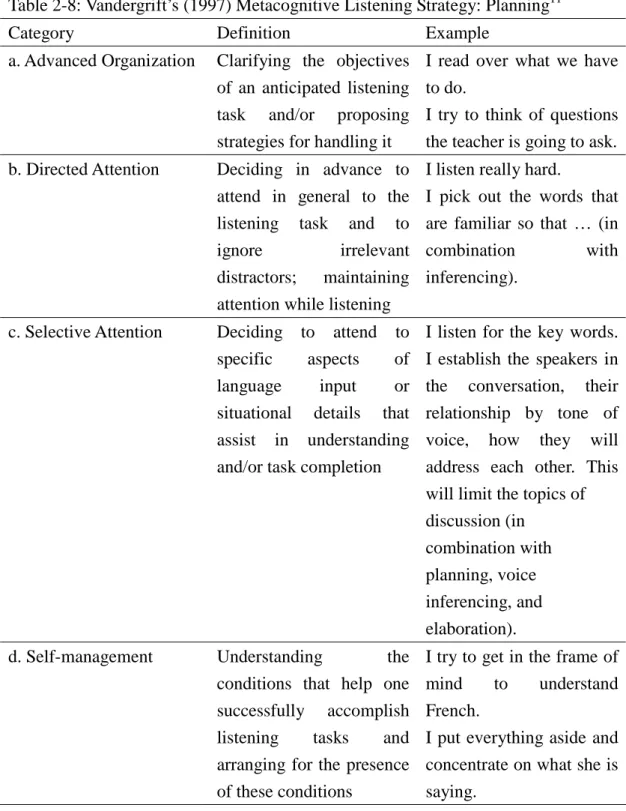
Following O’Malley & Chamot’s and Oxford’s taxonomies, Vandergrift (1997) focused on the identification of listening comprehension strategies, providing four major categories of metacognitive strategies as Planning, Monitoring, Evaluating, and Problem Identification.
As shown in the Table 2-8, the first category is Planning, including Advanced Organization, Direct Attention, Selective Attention, and Self-management. These strategies help learners listen to the key words, pick out familiar vocabulary, establish the relationship between themselves and the speakers in the conversation, adjust their frame of mind to understand English, and concentrate on what they have heard.
According to Vandergrift, Planning is “developing an awareness of what needs to be done to accomplish a listening task, developing an appropriate action plan and/or appropriate contingency plans to overcome difficulties that may interfere with successful completion of the task” (p. 392).
Table 2-8: Vandergrift’s (1997) Metacognitive Listening Strategy: Planning11
Category Definition Example a. Advanced Organization Clarifying the objectives
of an anticipated listening task and/or proposing strategies for handling it
I read over what we have to do.
I try to think of questions the teacher is going to ask.
b. Directed Attention Deciding in advance to attend in general to the listening task and to
ignore irrelevant distractors; maintaining
attention while listening
I listen really hard.
I pick out the words that are familiar so that … (in
combination with inferencing).
c. Selective Attention Deciding to attend to specific aspects of language input or situational details that assist in understanding and/or task completion
I listen for the key words.
I establish the speakers in the conversation, their relationship by tone of voice, how they will address each other. This will limit the topics of discussion (in
combination with planning, voice inferencing, and elaboration).
d. Self-management Understanding the conditions that help one successfully accomplish listening tasks and arranging for the presence of these conditions
I try to get in the frame of mind to understand French.
I put everything aside and concentrate on what she is saying.
11This table is taken from Vandergrift (1997: 392).
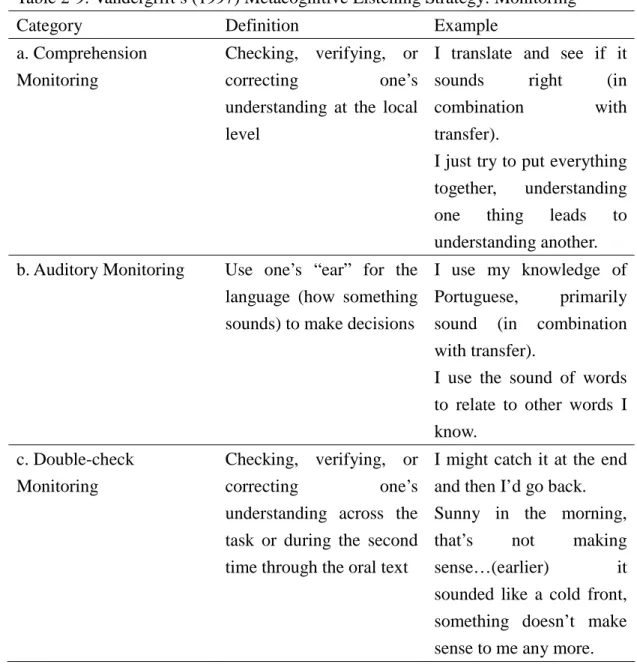
Table 2-9 illustrates the second category, Monitoring, which is composed of Comprehension Monitoring, Auditory Monitoring, and Double-check Monitoring.
They are identified when listeners translate to comprehend, put everything heard to construct meaning, use their knowledge of native language (primarily sounds), and refer back to what they have heard to check understanding. As Vandergrift noted, monitoring helps listeners check, verify, and correct their comprehension or performance in the course of a listening task.
Table 2-9: Vandergrift’s (1997) Metacognitive Listening Strategy: Monitoring12
Category Definition Example a. Comprehension
Monitoring
Checking, verifying, or
correcting one’s understanding at the local
level
I translate and see if it sounds right (in combination with transfer).
I just try to put everything together, understanding one thing leads to understanding another.
b. Auditory Monitoring Use one’s “ear” for the language (how something sounds) to make decisions
I use my knowledge of Portuguese, primarily sound (in combination with transfer).
I use the sound of words to relate to other words I know.
c. Double-check Monitoring
Checking, verifying, or
correcting one’s understanding across the
task or during the second time through the oral text
I might catch it at the end and then I’d go back.
Sunny in the morning, that’s not making sense…(earlier) it sounded like a cold front,
something doesn’t make sense to me any more.
12 This table is taken from Vandergrift (1997: 392).
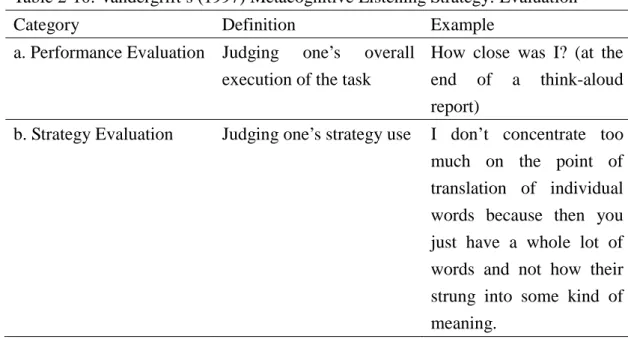
The third category, presented in Table 2-10, is Evaluation, which is divided into Performance Evaluation and Strategy Evaluation. Listeners may evaluate how close their overall comprehension is and how effective their strategy use is. They can check the outcomes of their listening comprehension against an internal measure of completeness and accuracy.
Table 2-10: Vandergrift’s (1997) Metacognitive Listening Strategy: Evaluation13 Category Definition Example a. Performance Evaluation Judging one’s overall
execution of the task
How close was I? (at the end of a think-aloud report)
b. Strategy Evaluation Judging one’s strategy use I don’t concentrate too much on the point of translation of individual words because then you just have a whole lot of words and not how their strung into some kind of meaning.
13 This table is taken from Vandergrift (1997: 392).
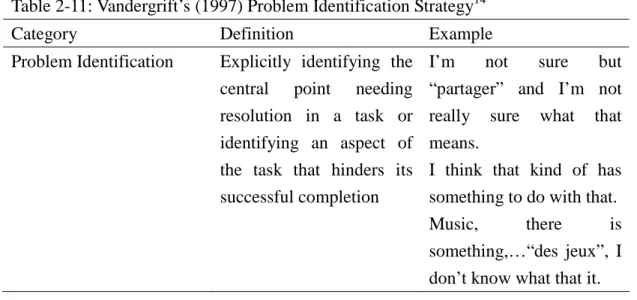
Table 2-11 is the last category, Problem Identification. Listeners are aware of their deficiency in the listening passage or their comprehension problems or difficulties they encounter in completing the listening task.
Table 2-11: Vandergrift’s (1997) Problem Identification Strategy14
Category Definition Example Problem Identification Explicitly identifying the
central point needing resolution in a task or identifying an aspect of the task that hinders its successful completion
I’m not sure but
“partager” and I’m not really sure what that means.
I think that kind of has something to do with that.
Music, there is something,…“des jeux”, I don’t know what that it.
Goh (2002) made a distinction between general strategy (termed strategy) and specific strategy (termed tactic). Tactics refer to individual techniques learners use to operationalize a general strategy. She concentrated her study on metacognitive strategies of listening comprehension and elaborated six main categories:
Pre-listening Preparation, Selective Attention, Directed Attention, Comprehension Monitoring, Real-time Assessment of Input, and Comprehension Evaluation.
There are two types of the Planning strategy: (i) Pre-listening Preparation tactics can prepare listeners both cognitively and affectively; (ii) Selective Attention can help listeners decide in advance which aspects of input they wanted to pay attention to.
Monitoring tactics encompass Directed Attention and Comprehension Monitoring.
The former means attention monitoring; the latter means checking of comprehension during listening. Checking comprehension after listening is Comprehension Monitoring, which facilitates check accuracy, completeness, and acceptability of an
14 This table is taken from Vandergrift (1997: 393).
interpretation against the context of the input after listening. Real-time Assessment of Input, as reported by Goh as the newly-coined classification, refers to listeners’
assessment of the importance of the input they have listened to. Tactics for Real-time Assessment of Input can give listeners the option to use other tactics to facilitate understanding.
Table 2-12: Goh’s (2002) Metacognitive Listening Strategies15
Strategy Tactic Preview contents
Rehearse sounds of potential content words
Pre-listening Preparation (Preparing mentally and emotionally for a listening task)
Encourage oneself to relax Listen to words in groups Listen for gist
Listen for familiar content words
Notice how information is structured (e.g. discourse markers)
Pay attention to repetitions
Notice intonation features (e.g. fall and rise tones)
Listen to specific parts of the input Selective Attention (Noticing specific
aspects of input)
Pay attention to visuals and body language
Concentrate hard Directed Attention (Monitoring attention
and avoiding distractions) Continue to listen in spite of difficulty Confirm that comprehension has taken place
Identify words or ideas not understood Check current interpretation with context of the message
Comprehension Monitoring
(Checking/Confirming understanding while listening )
Check current interpretation with prior knowledge
Assess the importance of problematic parts that are heard
Real-time Assessment of Input
(Determining the value of specific parts
of the input) Determine the potential value of
subsequent parts of input
Check interpretation against some external sources
Check interpretation using prior knowledge
Comprehension Evaluation (Checking interpretation for accuracy, completeness and acceptability after listening)
Match interpretation with the context of the message
15 This table is taken from Goh (2002:193).
To summarize, each classification of the metacognitive strategies has its unique characteristics and value. O’Malley & Chamot built up the foundation of language learning strategies in metacognition, and Vandergrift and Goh further identified the metacognitive strategies in listening comprehension. Bacon offered a comprehensive guideline for listening instruction.
However, these taxonomies come from studies carried out in ESL environments mostly, in which the participants were mainly intermediate-level learners. There is little attention paid to EFL learners who are more proficient (from high-intermediate to advanced levels) or more experienced in English learning. In Taiwan, Chan (2005) merely adapted Vandergrift’s taxonomy, counting frequencies of metacognitive listening strategy use. Little information was mentioned in his study about when and how to use metacognitive strategies in listening. Therefore, it deserves further investigation on how EFL listeners with higher proficiency or with more English learning experience apply metacognitive strategies in listening and on whether they use new metacognitive strategies.
2.5 Factors Affecting Listening Comprehension Strategy Use
2.5.1 Factors Influencing the Choice of Language Learning Strategy
Many researchers have suggested that learners’ choice of language learning strategies (LLS) is influenced by factors such as motivational levels, genders, learning styles, proficiency level/achievement, duration (i.e., years of studying an L2) or length of studying abroad (e.g. Green & Oxford, 1995; Okada, Oxford & Abo, 1999; Oxford, 1993; Oxford & Ehrman, 1993, 1995; Oxford & Nyikos, 1989).
Researchers in language learning began to investigate the relationship between motivation and the LLS in the late 80s. Ely (1989) found that the strength of motivation influenced the learners’ use of the LLS. Oxford & Nyikos (1989) found
that the more motivated students used the LLS more often than the less motivated students. In a study of 78 adult learners in the US Foreign Service, those who learned a foreign language for job-related reasons were found to use functional communicative practice strategies (Ehrman & Oxford, 1989). It was found that instrumental motivation was related to the choice of strategies. Peng (2001) conducted a survey among senior high school students and found that those who were motivated to learn English used strategies more significantly than those who were required to.
Liao (2000) showed that, in her study of junior high school students, their low English learning motivation correlated with their infrequent use of learning strategies.
When it comes to the gender differences in the LLS use, previous research showed that females employed learning strategies (Green, 1991; Green & Oxford, 1995; Noguchi, 1991; Oxford & Nyikos, 1989; Oxford, Nyikos & Ehrman, 1988;
Oxford, Park-Oh, Ita & Sumrall, 1993) more often than males. According to Sy (1994, 1995) and Yang (1992, 1993), female students in Taiwan used language learning strategies more frequently than males. In Wang’s (2002) investigation of 301 Taiwanese senior high school EFL learners’ listening comprehension strategy use, the female listeners reported more frequent use of strategies than the male students as well.
Furthermore, learning styles could determine students’ learning strategies (Ehrman & Oxford, 1989; Ely 1989). Extrovert students reported to use learning strategies more frequently than introvert ones (Hsu & Huang, 2004; Rubin, 1994;
Wakamoto, 2000). Ko (2002) concluded that kinesthetic-/tactile-style students tended to use memory, compensation and social strategies, while visual-/nonverbal- and multiple-style learners tended to use affective strategies. Sy (2003) found that college students should utilize reading and writing strategies and they preferred a visual learning style.
Language performance/achievement played an important role in the choice of the LLS. The English learners with high proficiency in Taiwan seemed to employ learning strategies more frequently than medium and low proficiency levels (Chen, 2001; Lin, 1999; Luo, 1998; Tsao, 2002; Wang, 2002; Yang, 1992, 1996, 1999). More effective and proficient listeners exhibited more and higher strategy use in English listening tasks (Lin, 1999; Wang, 2001). Language achievement was highly correlated with metacognitive strategies (Chang, 1998).
Oxford & Nyikos (1989) studied the relationship between the number of years of study and choice of the LLS and found that those who had studied TL for more than four years appeared to use communicative strategies more than the inexperienced ones. In Su’s (2003) study of elementary school students’ LLS in Taiwan, the number of years of studying an L2 was significantly correlated with the frequency of using learning strategies. In his study of factors affecting Japanese college/university students’ choice of the LLS, Watanabe (1990) concluded that living abroad influenced the learners’ use of communication strategies. Su (2003) also found that the number of years of living in English-speaking countries was significantly correlated with their use of learning strategies.
2.5.2 Learner’s Beliefs and Listening Comprehension Strategy
Language learning beliefs are “a set of attitudes, experiences, expectations, and learning strategies that learners bring to the learning task” (Shih, 2004:21). Similarly, learners’ beliefs are in consonant with their attitudes, representations, opinions, and ideologies (Fraeser & Gaskell, 1990). In other words, language learners’ beliefs are their concepts about language learning to the learning task.
Some researchers have outlined the importance of learner’s belief in language learning (cf. Abraham & Vann, 1987; Horwitz, 1987). In a case study of two learners’
strategies use, Abraham and Vann (1987) claimed that learners’ use of strategies demonstrated their beliefs about language learning. Furthermore, Horwitz (1987) asserted that learners’ beliefs in language determined not only their success in second language learning but also their use of language learning strategies. As she pointed out,
“erroneous beliefs about language learning lead to less effective language learning strategies” (p. 126). In an attempt to examine the variables affecting individual difference of successful learners in speaking and reading, Ehrman and Oxford (1995) pointed out the critical role of beliefs (self-confidence), and stated that “believing that one can learn a language well was significantly correlated with proficiency in both speaking and reading” (p. 79). Riley (1996) suggested that beliefs about language and language learning “may directly influence or even determine … (a learner’s) attitude or motivation or behavior when learning the language in question” (p. 155).
Previous researchers have reported the influence of beliefs on learners’ behaviors.
For example, McDonough (1995) found that beliefs were important stimuli for action:
…what we believe we are doing, what we pay attention to, what we think is important, how we choose to behave, how we prefer to solve problems, form the basis for our personal decisions as how to proceed. An important fact about this argument is that it is not necessary for these kinds of evidence to be true for them to have important consequences for our further development (p. 9).
Victori and Lockhart (1995) discussed the differences between successful learners’ “insightful” beliefs and poor learners’ “negative or limited” beliefs, and concluded that:
…if students develop or maintain misconceptions about their own learning, if they attribute undue importance to factors that are external to their own action…they are not likely to adopt a responsible and active attitude in their
approach to learning and may never become autonomous (p. 225).
Researchers have identified different language learners’ beliefs (cf. Horwitz, 1987; Wenden, 1987). With the administration of questionnaire to survey 32 intermediate-level ESL learners, Horwitz (1987) identified 5 aspects of learners’
beliefs. First of all, most of the students agreed that everyone could learn to speak a foreign language. Second, they considered that the difficulty of language learning determined their expectation for and commitment to language learning. Next, they regarded language learning as the learning of vocabulary and grammar as well as being familiar with the English culture. Moreover, they recognized the importance of speaking English. Finally, they had strong motivation for learning English.
Wenden (1987) interviewed 25 adult ESL learners and categorized their beliefs into three groups. First, the interviewees reported that they should learn in a natural way, practice and think in the target language, live and study in English-speaking environment, and not worry about making mistakes. Second, they believed it was crucial to learn grammar and vocabulary, to take formal course, to learn from mistakes, and to be mentally active. Third, they considered personal factors, such as emotional aspect, self-concept, and learning aptitude, were all important.
Paris and Cross (1983) found that learners’ beliefs and attitude formed a basis for meaningful goals and intentions. Other researchers (cf. Horwitz, 1988; Rubin, 1987;
Wenden 1986, 1987) have illustrated that learners’ preconceived beliefs about language learning are likely to influence the way they use language learning strategies and learn a second language.
According to Wenden (1986), learners’ explicit beliefs about how best to learn a language tend to provide the logic for the choice of language learning strategies. In her interviews, Wenden (1987) found that learners’ strategy use was consistent with their beliefs. Learners who valued the importance of using the target language would
use the communication strategies more often. On the other hand, those who emphasized the dept learning of target language would use the cognitive strategies.
Similarly, Rubin (1987) found that learners’ knowledge about language and their beliefs about language using itself might have impact on their selection and activation of one strategy over another. Horwitz (1988) further argued that certain preconceived beliefs seemed to restrict the learners’ range of strategy use.
In their case study of two language learners, Abraham and Vann (1987) observed that learners’ strategy use reflected their beliefs about language learning and these beliefs, in turns, led to their selection of language learning strategies. The successful learner recognized that language learning requires attention to both function and form, including vocabulary, morphology, and grammar. Therefore, his strategy use was flexible and varied encompassing different strategies. However, the poor learner considered language as “a set of words” and applied fewer strategies in language learning.
Park (1995) investigated Korean university students’ language learning beliefs and strategy use and found that students’ beliefs about English learning were significantly correlated with their strategy use, including the interactive practice strategy, metacognitive strategy, and communication strategy.
To sum up, learners’ beliefs were found to have impact on their use/choice of learning strategies, goals and motivation in language learning, and attention to or focus on which aspects of input. However, little attention has been paid to learners’
beliefs in separate skills, i.e., listening, speaking, reading, and writing. Further examination on EFL learners’ beliefs about listening and how it may influence their use/choice of metacognitive strategies is desirable.
2.6 Summary of Chapter Two
Listening comprehension is an active and complicated process, in which listeners have to decode incoming sounds, construct meanings based on background knowledge, and organize what they hear into a meaningful unit. It requires both bottom-up skills (the ability to decode sounds, vocabulary, and grammatical structure) and top-down skills (the capability of predicting and focusing on meaning) to achieve comprehension. Good listeners do as much when listening as good speakers do when speaking.
Schema theory provides complete and sound theoretical framework for listening comprehension. Better comprehension can be achieved when listeners listen to familiar topics, and poorer comprehension may result from the demand of higher linguistic proficiency to decode the listening passage. Therefore, listeners’
background knowledge and familiarity with the listening topic can determine their comprehension.
With regard to the use of strategies in listening comprehension, listening comprehension strategies are regarded as devices used by listeners to enhance their comprehension and retention of the input. Metacognitive strategies are considered as skills to cope with learning deficiencies and as a result contribute to learner autonomy.
Most researchers agreed to the essential role of metacognitive knowledge in successful language learning and a number of studies have identified different categories of metacognitive strategies. It has been found that successful listeners tended to employ more strategies, especially more metacognitive strategies during their listening process.
There are many factors affecting learners’ use/choice of language learning strategies, including the motivational levels, genders, learning styles, proficiency level/achievement, duration, length of studying abroad and learners’ beliefs. Learners’
beliefs are assumed to be crucial because they can determine learners’ goals and motivation in language learning which may influence learners’ strategic behaviors and intentions later.
However, most studies concerning metacognitive listening strategies were conducted in ESL and most participants were intermediate level students. There is a need to pay attention to students in EFL environments and students with high-intermediate proficiency and above. Successful listeners’ metacognitive listening strategy use can help teachers equip low achievers with problem-solving skills. Since background knowledge plays an important role in listening comprehension, it will benefit to investigate successful listeners’ use of metacognitive listening strategies for different listening topics. And their beliefs in listening can help shed light on their logic for metacognitive listening strategy use.