行政院國家科學委員會專題研究計畫 成果報告
牙髓斷髓藥物作用於牙髓細胞之反應研究
計畫類別: 個別型計畫
計畫編號: NSC94-2314-B-040-017-
執行期間: 94 年 08 月 01 日至 95 年 07 月 31 日 執行單位: 中山醫學大學牙醫學系
計畫主持人: 黃翠賢 共同主持人: 高嘉澤
報告類型: 精簡報告
報告附件: 出席國際會議研究心得報告及發表論文 處理方式: 本計畫可公開查詢
中 華 民 國 95 年 9 月 5 日
I
中、英文摘要及關鍵詞(keywords)。
中文摘要
臨床上有不同之材料應用於牙髓斷髓術之治療。本研究之目的乃比較不同之配方
下,這些材料對於 L929 細胞株之毒性反應。 研究材料乃採用下面幾組配方:
1.
Zinc oxide powder, eugenol 和 formocresol (FC).
2.Zinc oxide powder, eugenol 和 glutaraldehyde(Glu).
3.Zinc oxide powder, eugenol 和 ferric sulfate (FeS). 4. Calcium hydroxide, distilled water 和 formocresol.
5.Calcium hydroxide (Ca(OH)
2), distilled water 和 glutaraldehyde. 6
.Calcium hydroxide, distilled water 和 ferric sulfate.。所有材料調製完成後浸泡於 細胞培養液中,並將之置備濃度為 10, 20, 40 和 80 μl/ml 之溶液,細胞粒線體 呈色反應(MTT assay)用於偵測材料對於 L929 細胞株之存活率。結果以 one way ANOVA
統計分析比較其存活率,事後分析以
Student-Newman-Keul’s test 比較。結果顯示六種配方之存活率因所配置之濃度高低有不同之大小,濃度高時細胞之存貨 率下降(p<0.05)。較高之細胞存活率出現於第 3,5,和 6 組。結語:臨床上使用 此材料十可以考慮使用下面之組合
Zinc oxide powder, eugenol 和 ferric
sulfate; Calcium hydroxide, distilled water 和 glutaraldehyde; 或 Calcium
hydroxide, distilled water 和 ferric sulfate。近一步研究則可以於日後進行
臨床之研究比較。
II
英文摘要
Abstract
A number of pulpotomy dressing materials have been applied clinically with various rates of success. The purpose of the present study was to evaluate the toxicity of different medicaments on treated L929 cells.
The puplotomy preparations were grouped as follows: 1. Zinc oxide powder, eugenol and formocresol (FC).
2.Zinc oxide powder, eugenol and glutaraldehyde(Glu).
3.Zinc oxide powder, eugenol and ferric sulfate (FeS). 4. Calcium hydroxide, distilled water and formocresol.
5.Calcium hydroxide (Ca(OH)
2), distilled water and glutaraldehyde. 6
.Calcium hydroxide, distilled water and ferric sulfate.
All mixed materials were dissolved in medium and diluted to10, 20, 40 and 80 μl / ml
concentrations. A cell colorimetric assay (MTT) was used to detect the viability of L929 cells. Results were compared using one way analysis of variance (ANOVA). Differences in treatment means were analyzed using Student-Newman-Keul’stestand wereconsidered significant at p <0.05. The survival rate of treated L929 cell showed statistical differences as the concentrations of the pulpotomy materials increased (p<0.05). The highest survival rates were found in groups 3, 5 and 6.Conclusions: It is recommended that low toxicity formulas such as Zinc oxide powder, eugenol and ferric sulfate; Calcium hydroxide, distilled water and glutaraldehyde; or Calcium hydroxide, distilled water and ferric sulfate be used clinically as pulpotomy dressing materials. Further research with randomized clinical trials is needed to verify these clinical success rates.
Key words: pulpotomy, formocresol, glutaraldehyde, ferric sulphate
III
Introduction
In extensive dental caries management, a tooth is sometimes treated with a pulpotomy. The goals of pulpotomy intervention can be classified as devitalization [formocresol (FC), glutaraldehyde (Glu), electrocoagulation], preservation [ferric sulphate (FeS), calcium hydroxide (Ca(OH)2), mineral trioxide aggregate (MTA), lasers)] and remineralization (indirect pulp therapy, bone morphogenic proteins, collagen) of the dental pulp in a primary molar with extensive caries (1). Many pulpotomy materials have been clinically applied. There is little data on their toxicity.
Buckley’sformocresolwasfirstintroduced asapulp medicamentin 1904 (2), and since 1930 (3), it has been the treatment of choice for primary molar vital pulpotomies. A one-fifth dilution of formocresol was as effective as a full strength solution in terms of its initial cytotoxicity on fibroblasts (4,5). Formaldehyde is an ingredientin Buckley’sformocresol solution. In June 2004, the International Agency for Research Cancer (IARC) classified formaldehyde as carcinogenic to humans and the dental profession then needed to look for viable alternatives to formocresol (6).
Glutaraldehyde was proposed as a new pulp tissue fixative by -Gravenmade in 1975 (7) and has been reported to be a better tissue fixative than formocresol (8). But its systemic distribution from pulpotomy sites, cytotoxicity (9) and mutagenicity (10) have been reported to be similar to formocresol. It has been used clinically as a replacement for formocresol.
Ferric sulphate (15·5%) has been investigated widely and has been used in animal and human studies as a haemostatic agent in pulpotomy procedures. On
IV
contact with blood, a ferric ion protein complex is formed, and the membrane of this complex seals the cut vessels mechanically, producing haemostasis. The agglutinated protein complex forms plugs which occlude the capillary orifices, preventing blood clot formation (11).
Calcium hydroxide has been proposed as an alternative to formocresol for pulpotomies in primary teeth (12). Because fibrous layer and vital pulp tissue are found beyond the calcific bridge (13), calcium hydroxide can be used for either preservation and/or intervention. Thus calcium hydroxide is used in pulpotomies as a base material mixed with formocresol, glutaraldehyde or ferric sulphate.
Because of IARC concerns about formaldehyde carcinogenicity, different medicaments have been selected and applied in pulpotomies. However, cell biocompatibility reports on these materials are lacking, and clinicians are still confused on the best choice of pulpotomy medicaments. Published results on pulpotomy medicaments, included basic and clinical studies, are unclear in material selection. The purpose of the present study was to evaluate cell toxicity from different pulpotomy materials. It is hoped that this study can provide the clinician with further selection criteria for pulpotomy procedures.
MATERIAL AND METHODS Material and sample preparation
Six different puplotomy materials were prepared and grouped as follows: 1. Zinc
oxide powder 6 g : Eugenol 1 ml: Formocresol 1ml.
2.Zinc oxide powder 6 g :
Eugenol 1 ml: Glutaldehyde 1 ml.
3.Zinc oxide powder 6 g: Eugenol 1 ml: Ferric
sulfate 1 ml 4. Calcium hydroxide 6 g : distilled water 1 ml: Formocresol 1 ml.
5.V
Calcium hydroxide 6 g : distilled water 1ml : Glutaldehyde 1 ml.
6.Calcium hydroxide 6 g: distilled water 1 ml: Ferric sulfate 1 ml.
Samples were prepared as follows: freshly mixed materials were placed in glass rings (2 mm in height, 6 mm in diameter) and allowed to set for 24 h at 37 °C in a humidified chamber. In the experimental group, five samples of each pulpotomy material were then eluted in 10 ml of cell culture medium at 37 °C, in air and 5% CO
2for 24 hours. After that, the materials were centrifuged at 10000rpm for 10 minutes. The supernatant were used to prepare different concentrations of the test materials. The concentrations of the test materials were diluted by adding culture medium to final concentrations of 1 0, 20, 40 and 80 μl / ml . The pur e cul t ur e medi um wi t hout any experimental material served as the control group.
Cell viability test by MTT((3-[4,5-dimethylthiazol-2-yl]-2,5-diphenyl tetrazolium bromide colorimetric) assay
The assay procedure was the same as described in our previous study (14). The procedure was as follows: a mouse cell fibroblast cell line (L929) was routinely cultivated in DMEM medium (Sigma Chemical, St. Louis, Mo, USA) supplemented with 5% fetal bovine serum (Sigma Chemical, St. Louis, Mo, USA) at 37 °C in air and 5% CO2. Single-cell suspensions of L929 cells were obtained from monolayer cell cultures close to confluency after trypsinization. Cell numbers were determined by hemocytometric counting, and 104cells/well were seeded into 96-well plates. Cells were then incubated for 24 h in a humidified atmosphere of air and 5% CO2 at 37 °C.
Cell cultures were exposed to 10, 20, 40 and 80μl/m concentrations of the experimental materials. Exposure of cell cultures was stopped by discarding the exposure medium after 24 h. Viable cells in both treated and untreated cell cultures
VI
were stained with formazan dye MTT (1 mg/ml) (Sigma Chemical, St. Louis, Mo, USA) dissolved in a 200 μlculturemedium.After3 h at37 °C,theMTT solution was discarded and formazan crystals were solubilized with 200 μl of DMSO. All experiments were performed in triplicate. Optical densities were measured at 570 nm in a multi-well spectrophotometer (Hitachi, Tokyo, Japan). The survival rate was calculated as survival % = absorbance of the treated sample / absorbance of the medium x 100%. Results were compared using one way analysis of variance (ANOVA). Differences in treatment means were analyzed using Student-Newman-Keul’stestand wereconsidered significantatp <0.05.
Results
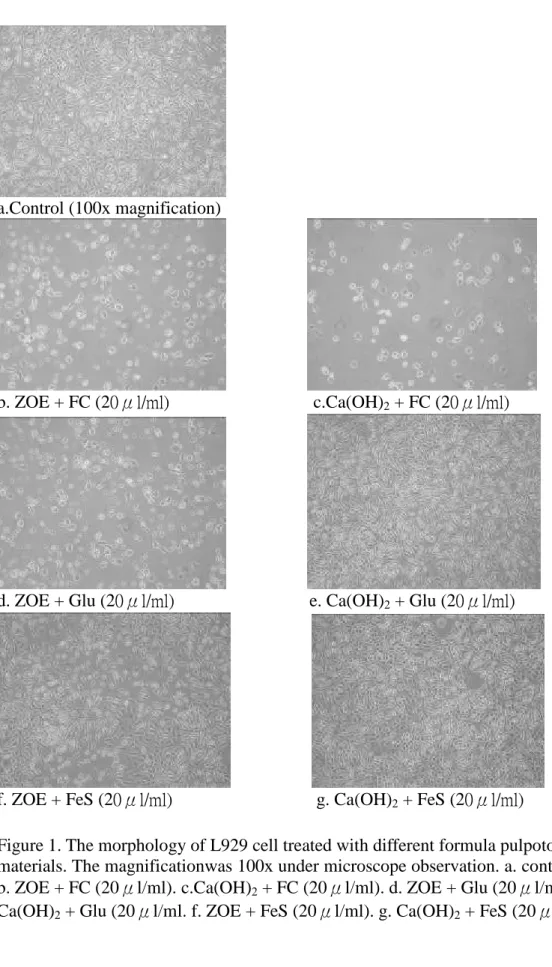
The morphology of L929 cells treated with different materials was observed under a microscope at a magnification of 100X (Figure 1). The control group showed normal L929 growth under routine culture (Fig. 1a). The experimental groups which contained formacresol, such as groups 1 and 4, had decreased L929 cell numbers (Fig.
1 b and 1c). Group 2 also had reduced L929 cell numbers (Fig. 1d). The cell growth in groups 3, 5 and 6 was as good as that in the control group (Fig. 1e, 1f and 1g).
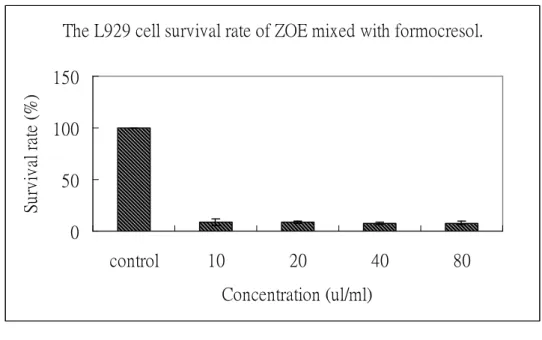
The L929 survival rates after treatment with various pulpotomy materials are shown in the table and in Figures 2-7. The survival rates of all test groups showed statistically significant differences as concentrations changed (p<0.05). In group 1, at concentrations above10μl/ml, the L929 survival rates were below 20% (Fig. 2). In group 2, the L929 survival rates showed dose dependent decreases (p<0.05) (Fig.3).
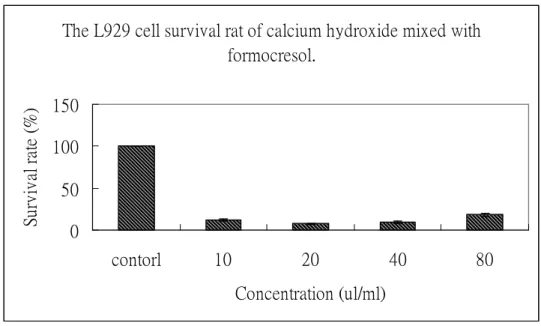
In group 4, the L929 cell survival rates were all below 20% at concentrations above 10μl/ml(Fig.4). In groups 5 and 6, the L929 cell survival rates decreased as the
VII
concentrations increased (p<0.05) (Fig. 5,6). In group 3, the L929 cell survival rate was severely decreased at a concentration of80μl/ml(Fig.7).
Discussion
The present results showed low L929 cell survival rates for materials mixed with formocresol (Fig. 2 and 4). This demonstrates that formocresol is toxic to L929 cells. Previous studies showed different results in experiments with formocresol or formaldehyde (15-18). Small amounts of labeled formaldehyde were detected in the liver, kidney, lung and skeletal muscle of dogs after pulpotomy (15). However, another assessment of the systemic distribution and toxicity of formaldehyde following pulpotomy claimed no toxic effects on the liver and kidneys.(16) Similarily, opposite results were found in two studies of allergic effects (17,18). In a study of embryotoxic and teratogenic effects on chick embryos, formocresol showed mutagnic and carcinogenic effects (19). The results of in vitro and animal studies (in vivo) sometimes do not agree. It is proposed that in vitro tests involve direct contact with the cell, but in animal study chemicals are probably diluted by tissue fluid. In addition, some body organs can detoxify these chemicals, thereby reducing damage. Thus the results of cell culture study and animal study can not be compared. Our in vitro study demonstrated that small amounts of formocresol can cause cell death. Clinicians need to be aware of this when they choose materials for a pulpotomy.
Many base materials have been applied in pulpotomy studies, including calcium hydroxide and zinc oxide power. One clinical report on calcium hydroxide dressings and zinc oxide eugenol dressings with glutaraldehyde showed a 73.6% success rate after 12 months follow-up (20). However, in the present study, the two groups with glutaraldehyde showed different survival results. In Figure 3, the survival rate
VIII
decreased to 50% for the10μl/mlconcentrationsin zincoxideeugenolmixed with glutaraldehyde. But in Figure 5 showing calcium hydroxide mixed with glutaraldehyde, the L929 cell survival rate were shown high survival rate except in the high concentrations80μl/mlwhich showed low survivalrate.Thepresentin vitro survival result was different from the above mentioned clinical success rate.
It is reported that glutaraldehyde is distributed systemically from the pulpotomy site, and its cytotoxicity and mutagenicity have been reported to be similar to formocresol (21-23). Calcium hydroxide has favourable antibacterial effects, is easily resorbed and causes no foreign body reaction. Zinc oxide eugenol paste dressing has been the material of choice for pulpotomies recently, but concerns have been expressed regarding its rate of resorption. Therefore, calcium hydroxide with glutaraldehyde would be better than zinc oxide eugenol with gluaraldehyde.
However one clinical assay showed a high success rate (92.9%) was zinc oxide eugenol mixed with glutaraldehyde (20). Therefore, zinc oxide eugenol mixed with glutaraldehyde can be a good pulpotomy material.
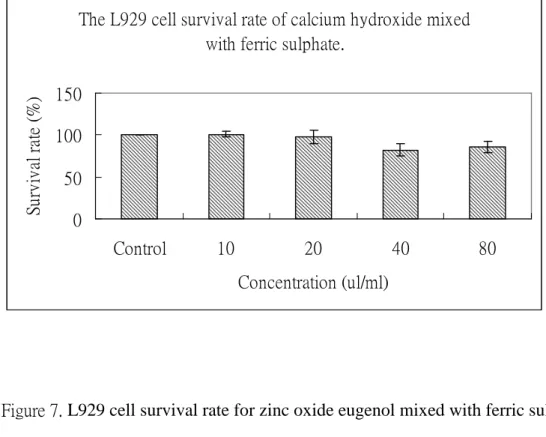
Ferric sulphate (15.5%) has been investigated widely and has been used as a haemostatic agent in pulpotomy procedures in human and animal studies. It is used to improve the efficacy of calcium hydroxide. Failure of calcium hydroxide in one study was attributed to persistent extrapulpal blood clots (24). Ferric sulphate and formocresol have produced equivalent successful clinical and radiographic outcomes (25). Thus, in the present study we selected ferric sulphate mixed with calcium hydroxide and zinc oxide eugenol as test materials. The present study showed high or equivalent survival rates for ferric sulphate mixed with either calcium hydroxide or zinc oxide eugenol for all concentrations (Fig 6 and 7, Table 1). The only
IX
exception was for the 80μl/m concentration of zinc oxide eugenol mixed ferric sulphate, which showed a severely decreased survival rate (10.68%) (Fig 7).
It is reported that ferric sulphate appears to be as effective in vital pulpotomies as formocresol, and there is no evidence to date to suggest any adverse effects of this medicament (25). From the present study, the authors propose using ferric sulphate mixed with either calcium hydroxide or zinc oxide eugenol as the treatment of choice for vital pulpotomties.
Conclusions
The results showed high survival rates for a combination of calcium hydroxide or zinc oxide eugenol mixed with ferric sulphate and for calcium hydroxide mixed with glutaraldehyde. These are suggested to be the best choices in pulpotomy medicament.
Further research with long term randomized clinical trials is required to evaluate the success rate.
Acknowledge:
This study was supported by the grant of National Science Council ( NSC 94-2314-B-040-017-).
X
Reference
1. Ranly DM. Pulpotomy therapy in primary teeth: new modalities for old rationales.
Paedia Dent 1994;18: 403–409.
2. Buckley JP. The chemistry of pulp decomposition with a rational treatment for this condition and its sequelae. Am Dent J 1904;3 : 764–771.
3. Sweet CA, Jr. Procedure for treatment of exposed and pulpless deciduous teeth.
JADA 1930; 17 : 1150–1153..
4. Haworth S, Lawlor T, Mortelmans K, Speck W, Zeiger E. Salmonella mutagenicity test results for 250 chemicals. Environ Muta 1983;1: 3–142.
5. Ruiz-Rubio M, Alejandre-Duran E, Pueyo C. Oxidative mutagens specific for A.T.
base pairs induce forward mutations to L-arabi-nos resistance in Salmonella typhimurium Muta Res 1985; 147 : 153–163
6. International Agency for Research on Cancer. Press release no. 153. 15 June 2004.
[WWW document.] URL http://www.iarc.fr/pageroot/PRELEASES/pr153a.html 7. ’s-Gravenmade EJ. Some biochemical considerations of fixation in endodontics.
J Endod1975;1: 233–237.
8. Ranly DM, Lazzari EP. A biochemical study of two bifunctional reagents as alternatives to formocresol. J Dent Res 1983; 62 : 1054–1057.
9. Jeng H, Feigal RJ, Messer HH. Comparison of the cytotoxicity of formocresol, formaldehyde, cresol, and glutaraldehyde using human pulp fibroblast cultures.
Pedia Dent 1987;9 : 295–300.
10.Haworth S, Lawlor T, Mortelmans K, Speck W, Zeiger E. Salmonella mutagenicity test results for 250 chemicals. Environ Muta1983; 1: 3–142.
XI
11.Lemon RR, Steele PJ, Jeansome BG. Ferric sulfate hemostasis: effect on osseous wound healing. 1. Left in situ for maximum exposure. J Endod 1993; 19 :
170–173.
12.Doyle WA, McDonald RE, Mitchell DF. Formocresol versus calcium hydroxide in pulpotomy. J Dent Child1962; 29: 86–97.
13.Özata F, Piskin B, Erdilek N, Aktener O, Tuncer AV. Comparison of calcium hydroxide and formocresol pulpotomies in primary teeth in lambs: preliminary study. J Endod 1987; 13: 328–335.
14. Huang TH, Tsai CY, Kao CT. An evaluation of the cytotoxic effects of orthodontic bonding adhesives upon a primary human oral gingival fibroblast culture and a permanent, human oral cancer -cell line. J Biomed Mater Res 2002; 63:814-21 15.Pashley EI, Myers DR, Pashley DH, Whitford GM. Systemic distribution of C-14
formaldehyde from formocresol treated pulpotomy sites. J Dent Res 1980; 59:
603-608.
16. Ranly DM, Horn D. Assessment ofthe systemic distribution and toxieity of
formaldehyde following pulpotomy treatment:part two. ASDC J Dent Child 1987;
54:-40-44.
17.Thoden Van Velzen SK, Feltkamp-veroom TM.Immunologicconsequences of formaldehyde fixation of autologous tissue implants. J Endod 1977; 3: 179-183.
18.Rolling I, Thulin H.Allergy tests against formaldehyde, cresol and eugenol in children with formocresol pulpotomised primary teeth. Scand J Dent Res 1976; 84:
345-347.
19.freidberg BH, Gartner LP.Embryotoxicity and teratogenicity of formocresol on developing chick embryos. J Endod 1990; ifr 434-437.
XII
20.Shumayrikh NM, Adenubi JO. Clinical evaluation fo glutaraldehyde with calcium hydroxide and glutaraldehyde with zinc oxide in puplotomy of primary molar.
Endod Dent Trauma 1999; 15:259-264.
21.Ranly DM, Horn D, Hubbard B. Assessment of the systemic distribution and toxicity of glutaraldehyde a s a pulpotomy agent. Pediat Dent 1989;11:8-13.
22.Jeng H. Feigal RJ, Messer HH. Comparison of the cytotoxicity of formaocresol, formaldehyde, cresol, and glutaraldhyde using human plup fibroblast culture.
Pedia Dent 1987;9:295-300.
23.Haworth S. Lawlor T, Mortelmans K, Speck W, Zeiger E. Salmonellla mutageniicty test results for 250 chemicals. Environ Mutag 1983;1:3-142.
24.Schroder U. A 2-year followup of primary molars pulpotomized with a gentle technique and capped with calcium hydroxide. Scandi J Dent Res 1978; 39:
273-278.
25.Loh A, O’Hoy P, Tran X. Evidence based assessment: Evaluation of the formocresol versus ferric sulphate primary molar pulpotomy. Pedia Dent 2004;26:401-409.
XIII
a.Control (100x magnification)
b. ZOE + FC (20μl/ml) c.Ca(OH)2+ FC (20μl/ml)
d. ZOE + Glu (20μl/ml) e. Ca(OH)2+ Glu (20μl/ml)
f. ZOE + FeS (20μl/ml) g. Ca(OH)2+ FeS (20μl/ml)
Figure 1. The morphology of L929 cell treated with different formula pulpotomy materials. The magnificationwas 100x under microscope observation. a. control group.
b. ZOE + FC (20μl/ml). c.Ca(OH)2+ FC (20μl/ml). d. ZOE + Glu (20μl/ml).e.
Ca(OH)2+ Glu (20μl/ml. f. ZOE + FeS (20μl/ml). g. Ca(OH)2+ FeS (20μl/ml).
XIV
Figure 2. L929 cell survival rate for zinc oxide eugenol mixed with formocresol.
The L929 cell survival rate of ZOE mixed with formocresol.
0 50 100 150
control 10 20 40 80
Concentration (ul/ml)
S u rv iv al ra te (% )
Figure 3. L929 cell survival rate for zinc oxide eugenol mixed with glutaraldehyde.
The L929 cell sruvival rate of ZOE mixed with glutaraldehyde.
0 50 100 150
control 10 20 40 80
Concentration (ul/ml)
S u rv iv al ra te (% )
XV
Figure 4. L929 cell survival rate for calcium hydroxide mixed with formocresol
The L929 cell survival rat of calcium hydroxide mixed with
formocresol.
0 50 100 150
contorl 10 20 40 80
Concentration (ul/ml)
S u rv iv al ra te (% )
Figure 5. L929 cell survival rate for calcium hydroxide mixed with glutaraldehyde.
The L929 cell survival rat of calcium hydroxide mixed with glutaraldehyde.
0 50 100 150
control 10 20 40 80
Concentration (u/ml)
S u rv iv al ra te (% )
XVI
Figure 6. L929 cell survival rate for calcium hydroxide mixed with ferric sulphate.
The L929 cell survival rate of calcium hydroxide mixed with ferric sulphate.
0 50 100 150
Control 10 20 40 80
Concentration (ul/ml)
S u rv iv al ra te (% )
Figure 7. L929 cell survival rate for zinc oxide eugenol mixed with ferric sulphate.
The L929 cell survivial rate of ZOE mixed with Ferric sulphate.
0 50 100 150
control 10 20 40 80
Concentration (ul/ml)
S u rv iv al ra te (% )
XVII
Table I. L929 cell survival rates after treatment with different pulpotomy materials.
Aberration: ZOE: zinc oxide eugenol, FC:formocresol, Glu: glutaraldehyde, FeS:
ferric sulfate.
control 10 20 40 80 P<0.05
ZOE+FC Mean 100 8.918a 8.623a 7.63b 7.997b Yes
SD 0 3.294 1.222 1.348 1.298
ZOE+Glu Mean 100 57.38 28.52 25.15 7.65 Yes
SD 0 4.192 1.721 0.7876 0.3397
ZOE+FeS Mean 100a 84.04b 92.68a 72.5b 10.68 Yes
SD 0 35.81 10.27 2.381 0.6246
Ca(OH)2+FC Mean 100 12.54 7.778a 9.082a 18.35 Yes
SD 0 1.339 0.8984 0.9753 1.78
Ca(OH)2+Glu Mean 100a 92.46 98.29a 113.8 69.38 Yes
SD 0 1.989 2.369 4.465 4.189
Ca(OH)2+FeS Mean 100a 101.1a 97.42a 82.24b 85.41b Yes
SD 0 3.819 8.226 7.541 6.762
One-way ANOVA was used to test for significant differences among different concentrations. The Student-Newman-Keul (SNK) multiple comparison of means procedure at P < 0.05 was used to show differences. SNK ranking with the same letters do not significantly differ at P = 0.05.
18
(六)計畫成果自評部份,
請就研究內容與原計畫相符程度:內容與計劃大致上相符合 達成預期目標情況:有達到第一年計畫要求
研究成果之學術或應用價值:對不同配方之材料,提供選擇性參考,
已著手投稿期刊 綜合評估: