行政院國家科學委員會專題研究計畫 成果報告
抑癌基因 p21 在三價砷所誘發癌細胞凋亡所扮演的角色
計畫類別: 個別型計畫 計畫編號: NSC91-2314-B-006-081- 執行期間: 91 年 08 月 01 日至 92 年 07 月 31 日 執行單位: 國立成功大學醫事技術學系 計畫主持人: 黃暉升 計畫參與人員: 黃暉升、許蓓茵、劉姿妙 報告類型: 精簡報告 處理方式: 本計畫可公開查詢中 華 民 國 92 年 10 月 27 日
Role of p21
WAF1/CIP1in the arsenite-induced cancer cell
apoptosis
計畫編號:NSC91-2314-B-006-081
執行期限:91年08月01日至92年07月31日 主持人:黃暉升 國立成功大學醫學院醫技系
Abstract ─ Sodium arsenite exists
ubiquitously in our environment, and various forms of arsenic circulate in soil, water, air, and living organisms. High arsenic levels in drinking water (0.35-1.14 mg/liter) will induce neurotoxicity, liver injury, peripheral vascular disease (known as blackfoot disease), and increase risks of cancer of skin, bladder, kidney, lung and colon. However, arsenite has been used effectively in the treatment of acute promyelocytic leukemia (APL) in some traditional Chinese remedies. Although arsenite has been used as a therapeutic agent and poison for more than 2400 years, the precise mechanism of arsenite action is unclear. p21WAF1/CIP1 is regarded as a universal inhibitor of cyclin-cdk complexes and resulting in an arrest of cell in the G1 phase of the cell cycle. In our preliminary results, we found that sodium arsenite induced p21WAF1/CIP1 activation in protein, total RNA expression and promoter activity in A431 cells. Using MAP kinase inhibitors to address what pathway was involved in arsenite-induced p21 activation showed that only PD98059, an inhibitor of MEK, could inhibit arsenite-induced p21 induction. In immunoblot analysis, pretreatment of
PD153035, an inhibitor of epidermal growth factor receptor tyrosine kinase (EGF-RTK), and N-acetyl-L-cysteine (NAC), a GSH donor, could inhibit both ERK phosphorylation and p21 activation. Therefore, we suggest ROS formation, EGF-R and ERK phosphorylation were involved in the signal transduction of arsenite-induced p21 activation. And the p21 activation seemed to be not involved in the arsenite-induced apoptosis in A431 cells.
Keywords ─ arsenite, p21WAF1/CIP1, MAPK, apoptosis 中文摘要: 三價砷化物在我們生活的環境中無所 不在,以不同的形式存在土壤中、水 中、空氣中、及生物體內。有許多報 告指出,飲用水中存在高濃度的三價 砷會誘發神經性中毒、肝臟受損、週 邊血管疾病〔譬如:烏腳病〕,甚至會 增加罹患皮膚癌、膀胱癌、腎癌、肺 癌及大腸癌的風險。然而,在傳統的 中藥藥方中,三價砷化物對於治療急 性骨髓前白血病具有很好的療效。雖 然三價砷用在治療藥及毒藥已有 2400 年,然而其作用機轉仍未十分清楚。 抑癌基因 p21 乃是在細胞週期中調節 週期休止或繼續進行的蛋白質,在我
們初步的結果顯示,三價砷在人類子 宮 頸 上 皮 癌 細 胞 株 會 誘 導 抑 癌 基 因 p21 的表現,藉由 MAPK 抑制劑的作 用,發現 ERK 參與在 p21 的活化;除 此,EGF 接受器抑制劑及 NAC 抗氧化 劑,也都有作用,由此顯示,EGF-ERK 路徑參與在此機轉,其中也有抗氧化 物參與其中;p21 蛋白質的產生似乎與 三價砷所導致的細胞凋亡無關。 關鍵詞:砷;抑癌基因 p21;MAPK; 細胞凋亡 INTRODUCTION
Sodium arsenite exists ubiquitously in our environment, and various forms of arsenic circulate in soil, water, air, and living organisms. It has been reported that high arsenic levels in drinking water (0.35-1.14 mg/liter) will induce neurotoxicity, liver injury, peripheral vascular disease (known as blackfoot disease), and increase risks of cancer of skin, bladder, kidney, lung and colon (Bagla, et al., 1996). However, in the treatment of acute promyelocytic leukemia (APL), two arsenic compounds, including arsenic trioxide (As2O3) and
arsenic disulfide, used in some traditional Chinese remedies are very effective (Huang, et al., 1995). Studies in culture cells show that it inhibits growth and promotes apoptosis not only in myeloid leukemia, multiple myeloma, lymphoma, and lymphocytic leukemia, but also in solid tumor cell lines including prostate, cervical, bladder, ovarian, colon, and gastric cancer cell lines (Murgo, et al., 2001). Recently, the National Cancer Institute Cooperative Research and Development Agreement
whether the preclinical antitumoer effects of arsenic trioxide can be translated into significant clinical benefit. The mechanism of arsenite on APL might be through induction of apoptosis in the leukemia cell (Chen, et al., 1996). Recent studies indicate that arsenite may generate ROS to induce apoptosis in Chinese hamster ovary cells (Wang, et
al., 1996) and NIH3T3 cells (Chen, et al.,
1998). However, the mechanism is still unclear.
In our preliminary results, treatment of arsenite for 24 h could induce apoptosis in A431 cells. It was also found arsenite could up-regulate CDK inhibitor p21WAF1/CIP1 (p21) expression. We suggested that the reactive oxygen species (ROS) induced by arsenite in cells were involved in the mechanism (Huang, et al., 2002). With the aids of MAPK inhibitor and antinoxidant, we found the ROS formation, and ERK phosphorylation were involved in the signal transduction of arsenite-induced p21 activation. And the activation of p21 was not involved in the arsenite-induced apoptosis.
Results and Discussion
Protein expression of p21 by arsenite in various cells
After exposure in various time by 20 µM of arsenite, p21 protein expression was detected in A431 cells, A549 cells, TCCSUP cells, and TSGH8301 cells. Figure 1 showed that treatment of arsenite produced a time-dependent increase of p21 protein in various cancer cell lines.
p21 expression
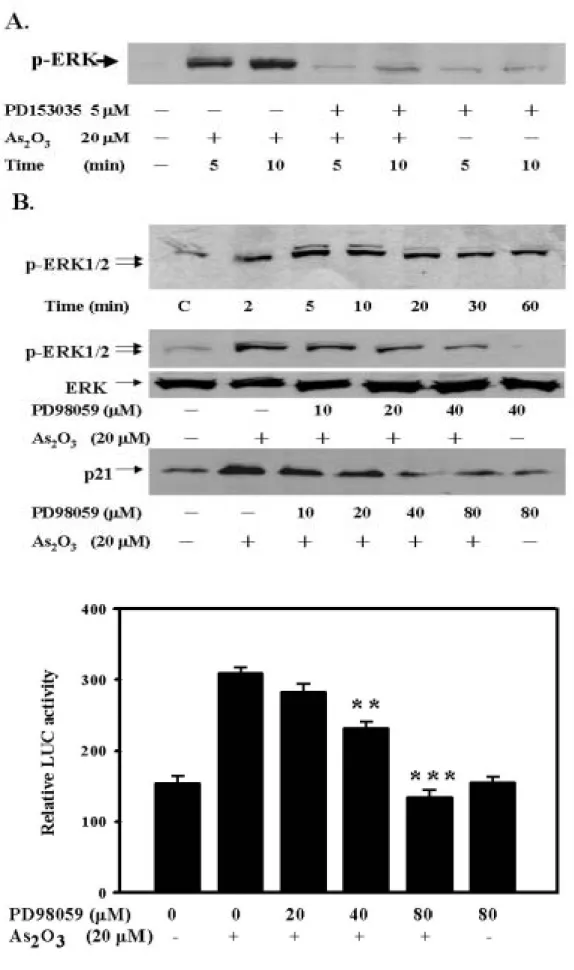
To find the signal transduction pathway of arsenite-induced p21 activation, we used various kinds of MAPK inhibitors to address the question. The results showed that only ERK1/2 inhibitor (PD98058) could inhibit arsenite-induced p21 protein expression (Fig. 2A, B), and promoter expression (Fig. 2C).
EGFR activation involved in the arsenite-induced p21 activation
To further clarify the signal transduction pathway of arsenite-induced p21 activation, we used
the inhibitor of EGFR activation (PD153035) to perform the experiment. As shown in figure 3, arsenite could activate p21 activation through EGFR phosphorylation.
ROS production involved in the arsenite-induced p21 activation
Using various kinds of antioxidants, we found ROS involved in the arsenite-induced p21 activation (Fig. 4). However, which kinds of ROS involved in the pathway should be further elucidated.
p21 activation not involved in the arsenite-indcued apoptosis in A431 cells
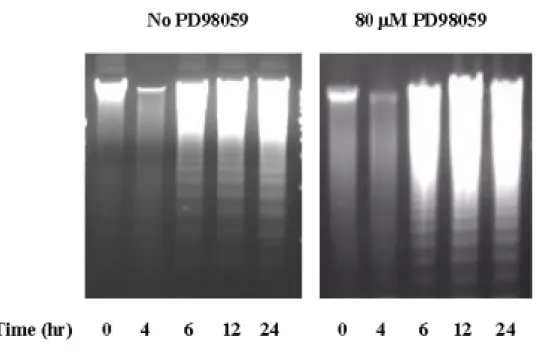
To sum up previous results, we conclude the ERK1/2 activation was involved in the arsenite-induced p21 activation. In our previous result, we found arsenite also could induce apoptosis in A431 cells. Therefore, in order to clarify the relationship between them, we used ERK1/2 inhibitor (PD98059) to address the question. The
results showed that arsenite could induce apoptosis in A431 cells no matter whether we pretreated with PD98059 or not. However, to solid the results, we should further perform other experiments to clarify the relationship in the future.
REFERENCES:
1. Bagla, P.; Kaiser, J. Science 274: 174-175; 1996.
2. Huang, S. L.; Guo, A. X.; Xiang, Y.; Wang, X. B.; Ling, H. J.; Fu, L. Chin.
J. Hematol. 16:26; 1995.
3. Chen, G. Q.; Zhu, J.; Shi, X. G.; Ni, J. H.; Zhong, H. J.; Si, G. Y. Jin, X. L.
Blood 88:1052-1061; 1996.
4. Murgo, A. J. Oncologist 6 Suppl
2:22-28; 2001.
5. Wang, T. S.; Kuo, C. F.; Jan, K. Y.; Huang, H. J. Cell. Physiol.
169:256-268; 1996.
6. Chen, W.; Martindale, J. L.; Holbrook, N. J.; Liu, Y. Mol. Cell.
Biol. 18:5178-5188; 1998.
7. Jacks, T.; Weinberg, R. A. Nature
(Lond.) 381:643-644; 1996.
8. Park, W. H.; Seol, J. G..; Kim, E. S.; Hyun, J. M.; Jung, C. W.; Lee, C. C.; Kim, B. K.; Lee, Y. Y. Cancer Res.
60:3065-3071; 2000.
9. 9. Huang, H.S., Chen, C.J., and Chang, W.C. Involvement of reactive oxygen species in arsenite-induced down-regulation of phospholipid
hydroperoxide glutathione peroxidase in A431 cells. Free Radic.